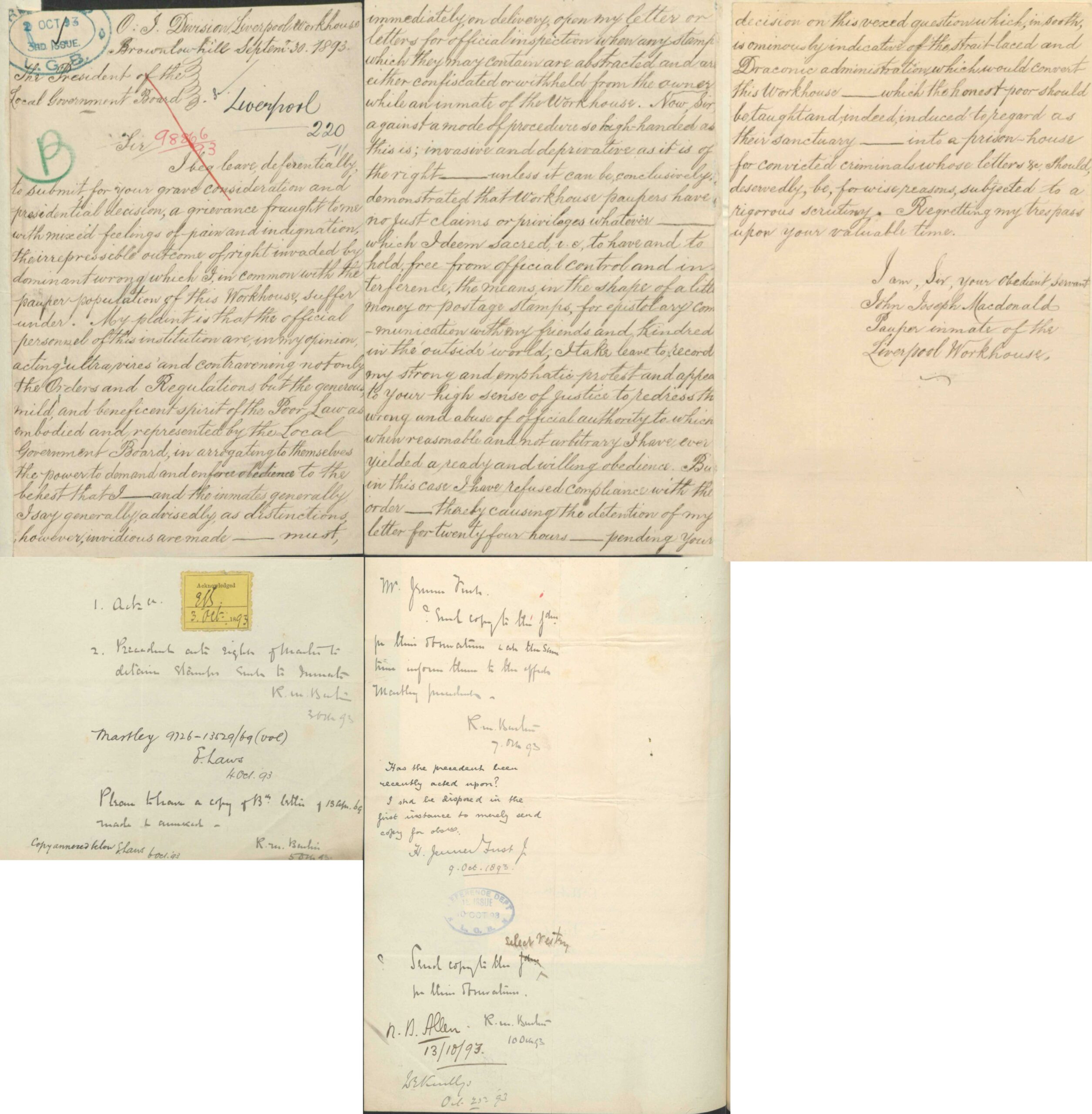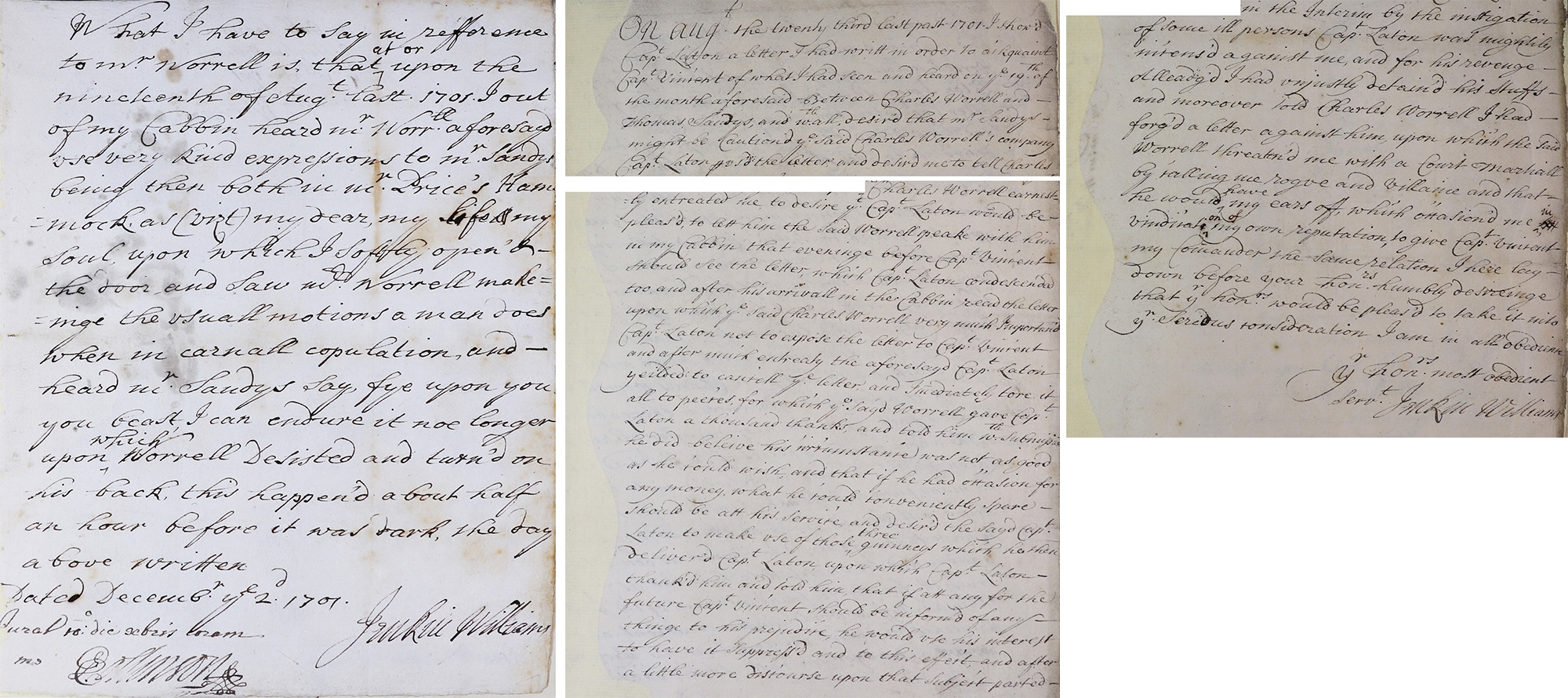
1701: Papers related to trial of Charles Worrell for sodomy. Catalogue ref: ADM 1/5262/169 ff. 164-168
Charles Worrell was a crew member on ship. He was spotted by another crew member, Jenkin Williams, having sexual relations with another man. This document shows how he survived through blackmailing his captain.
Note: A sodomy law is a law that defines certain sexual acts as crimes.

People have always existed who engaged in same sex relationships, defied conventional gender norms, or lived as a different gender to the one they were assigned as at birth. The social climate these individuals lived in, and the language they had available to them, has changed significantly over the last 1,000 years – the span of The National Archives’ collections. The history of lesbian, gay, bisexual, transgender, and queer people in the UK is a complex mixture of moments of pain, resistance, and progress.
‘LGBTQ+’ is used as an umbrella term to describe people historically who were either not cisgender or heterosexual. These individuals would have used a variety of different language to describe themselves in their own lifetimes. We recognise our records contain words that are at times offensive, however some of the original language and legal terms are preserved here to accurately represent our records and help us fully understand the past. Please note that some of these sources contain non-explicit references to sex and sexuality.
Use this lesson to find out more about LGBTQ+ rights and lives from the 1700s to the present day. The documents are listed chronologically.
This lesson has been developed in collaboration with the Bishopsgate Institute.

The National Archives perspective
The National Archives has a unique view of LGBTQ+ history; our records reflect the state perspective, relating to UK government departments and major courts of law. Our archives give a valuable insight into how government interacted with and viewed LGBTQ+ communities in the past, through police, criminal, policy and legislation records. For most of our collections there has been significant criminal or social risk in LGBTQ+ people recording their lives, our collection therefore offers a rare material evidence into lives in this period before decriminalisation. Other archive collections are more likely to reflect personal documents relating to LGBTQ+ lives, such as the photographic and campaigning collections held at the Bishopsgate Archives.
The challenges of being an LGBTQ+ person are and historically have been significant, but even more so when intersected with other factors, such as race, disability and class. These intersectional experiences are underrepresented in the history that is told and in the surviving records. At The National Archives we actively work to find these voices and redress this balance.
Historical overview
Until recent decades, people who challenged sexual or gender norms were seen as a ‘threat’ to the ‘natural order’ of society. It has never been illegal, as such, to be gay, but the associated sex acts between men have been punishable at various times throughout history. Changing the gender you presented as has not been regarded a criminal act, but the law and society could make it very difficult.
In the Early Modern and Medieval period, the church and ecclesiastical courts determined the approach to homosexuality, seeing it as at odds with Christian values of heterosexual marriage and procreation. In 1533 the Buggery Act was introduced under Henry the VIII. For the first time in England sex between men was formally criminalised, with a potential penalty of the death sentence. The last two Englishmen to be hung for sodomy were James Pratt and John Smith at Newgate prison in 1835.
Domestic legislation also had an impact beyond the UK. The British colonial government introduced Section 377 of the Indian Penal Code, which outlawed ‘carnal intercourse against the order of nature’ in 1860. This was loosely modelled on the 1533 Buggery Act. Similar legislation spread to other parts of the British Empire. When countries gained independence, they inherited colonial legislation, and in some Commonwealth countries these laws continue to exist.
In 1885 the Criminal Amendment Act, including the controversial Labouchere Amendment, became law. This amendment actually extended the acts that were criminalised between men. The law was thought to have been influenced by the case of Fanny and Stella in 1870. Theatrical performers, the duo presented as women both on stage and off, and records held at The National Archives reveal that they used he/she pronouns and their masculine/feminine names interchangeably among family and friends. They were accused of the ‘abominable crime of buggery’, but the physical act of sodomy could not be proved. Such cases influenced the broadening of the law, to criminalise a wider range of acts relating to homosexuality.
Homosexuality was increasingly visible in society and the press; there was a moral panic. Cleveland Street scandal had seen a male brothel hit the headlines, as lots of high-profile individuals were rumoured to be involved. Oscar Wilde decided to fight public accusations of his homosexuality in the courts. He was made an example of receiving the harshest sentence of two-years hard labour for gross indecency. The Wilde trials influenced public attitudes for many years.
Despite the role of the law in policing gay and bisexual men’s lives, there was an everyday homelife that was possible for some LGBTQ+ people. From 1841 to 1921 census records reveal the same sex units people were living in. Gender non-conforming artists Gluck and E M Craig were listed as living together at 30 Tite Street, Chelsea in 1921, while author and free love advocates Edward Carpenter and George Merrill can be seen living together across many decades of census forms in their home Milthorpe, near Sheffield. Author Radclyffe Hall and sculptor Una Troubridge are listed as ‘joint head of household’ in their 1921 census record.
Sex between women was never criminalised, but was socially unacceptable. In 1921 a Parliamentary Bill to criminalise ‘gross indecency between females’ failed to become law. It was feared that it would lead to a greater visibility of lesbians. Women who loved women are present in our collections, but the law’s focus on policing same sex acts between men means that their lives can be harder to trace. These come to us through wills, census records, divorce files and censorship cases. Not long after this bill went to parliament was the headline grabbing trial of Radclyffe Hall’s the Well of Loneliness, which was controversial for its depiction of lesbian relationships. Censorship of LGBTQ+ literature and arts was a reoccurring way of attempting to control and restrict the public image of same sex relationships between women.
In spite of the law, LGBTQ+ people have always found ways to gather, meet and create their own spaces. The 1920s and 1930s particularly saw a network of underground clubs develop that cultivated a queer clientele. The National Archives has a rich collection relating to some of these spaces, from the Harlem inspired Shim Sham club to ‘London’s greatest bohemian rendezvous’ the Caravan Club. These spaces were a haven for, particularly working class, men to meet other men, but they were also vulnerable to police raids. Public spaces were also policed.
Men would meet in parks and cottages (public toilets). Police used controversial methods of undercover policing to catch men engaging in homosexual acts.
The twentieth century increasingly saw a shift from a criminal view of homosexuality to a medicalised one, seeing it as an illness. In 1952 Alan Turing, famed codebreaker and computer scientist, was arrested under the Labouchere Amendment and later prosecuted. He was given oestrogen injections, rather than a prison sentence, in attempt to ‘cure’ his sexuality. Turing committed suicide not long afterwards. The prevalence of such cases, and several high-profile incidents in the press, led to a desire for legal reform. The result was the 1957 Wolfenden Report, which recommended the partial decriminalisation of homosexuality.
There have always been individuals living as a different gender from the one they were assigned at birth or expressing a non-normative gender. By the 1950s gender affirming surgery was increasingly available. In 1961 April Ashley’s assigned sex at birth was revealed by the press as she went through a divorce case, known as Corbett v Corbett. An annulment was granted on the grounds that Ashley was considered legally male. Corbett v Corbett set a legal precedent, preventing trans people from changing their gender on legal documents for several decades.
The 1967 Sexual Offences Act finally acted on Wolfenden’s recommendations a decade later and decriminalised sex acts between men. However, it did not grant homosexual men a parity with heterosexual couples. There was a higher age of consent, the Armed Forces and Merchant Navy were exempted, and acts were only decriminalised ‘in private’. Arrests actually increased – the police and public were more aware of the parameters of the law. It only applied in England and Wales. Equivalent law changes did not happen in Scotland until 1980, and Northern Ireland until 1982. But, while only partial, the 1967 Act was a huge step forward and galvanised LGBTQ+ campaigns for greater equality. The 1970s saw a shift in political consciousness towards pride and equal rights; in the UK it was the decade of the first Gay Pride parade, the opening of Gay’s the Word bookshop, and the launch of Switchboard, one of the first LGBTQ+ helplines. Campaign groups such as the Campaign for Homosexual Equality and the Gay Liberation Front were increasingly active.
LGBTQ+ individuals were greatly impacted during the 1980s by the rising number HIV infections and the subsequent AIDS crisis. It was a traumatic time, marked by ignorance and misinformation. The government instigated TV and cinema adverts to reinforce awareness about preventing the spread of AIDS, and took the unprecedented step of sending educational leaflets to every household in the country. In 1988, Section 28 was introduced, under the Local Government Act, prohibiting the ‘promotion of homosexuality’. It was feared this would hamper the gains made around LGBTQ+ rights and stop AIDS education reaching the population. This attempt to supress LGBTQ+ lives fuelled a fight back, including the founding of the campaigning organisation Stonewall.
The 2000s saw the age of consent lowered to the same age for homosexual and heterosexual acts, the UK Government lifted the ban on lesbians, gay and bisexual people serving in the Armed Forces and Section 28 was repealed. This was followed by a raft of progressive legislation, including the Civil Partnership Act 2004 and Marriage (Same-Sex Couples) Act 2013. The Gender Recognition Act also came into force in 2005, enabling trans people to change their legal gender. April Ashley was finally able to have legal documentation that matched her gender identity.
The shift in LGBTQ+ rights over the last few centuries is significant. Where our records about the UK government were once dominated by criminalisation and ostracization, they now reflect equality legislation, Civil Service LGBTQ+ staff networks and presence at Pride parades. However this history also shows that progress is not always linear, and it is important to recognise that these changes were hard fought for. Whether it was through collective campaigns or individual acts of resistance LGBTQ+ people have repeatedly strived for, and continue to fight for, change and acceptance.
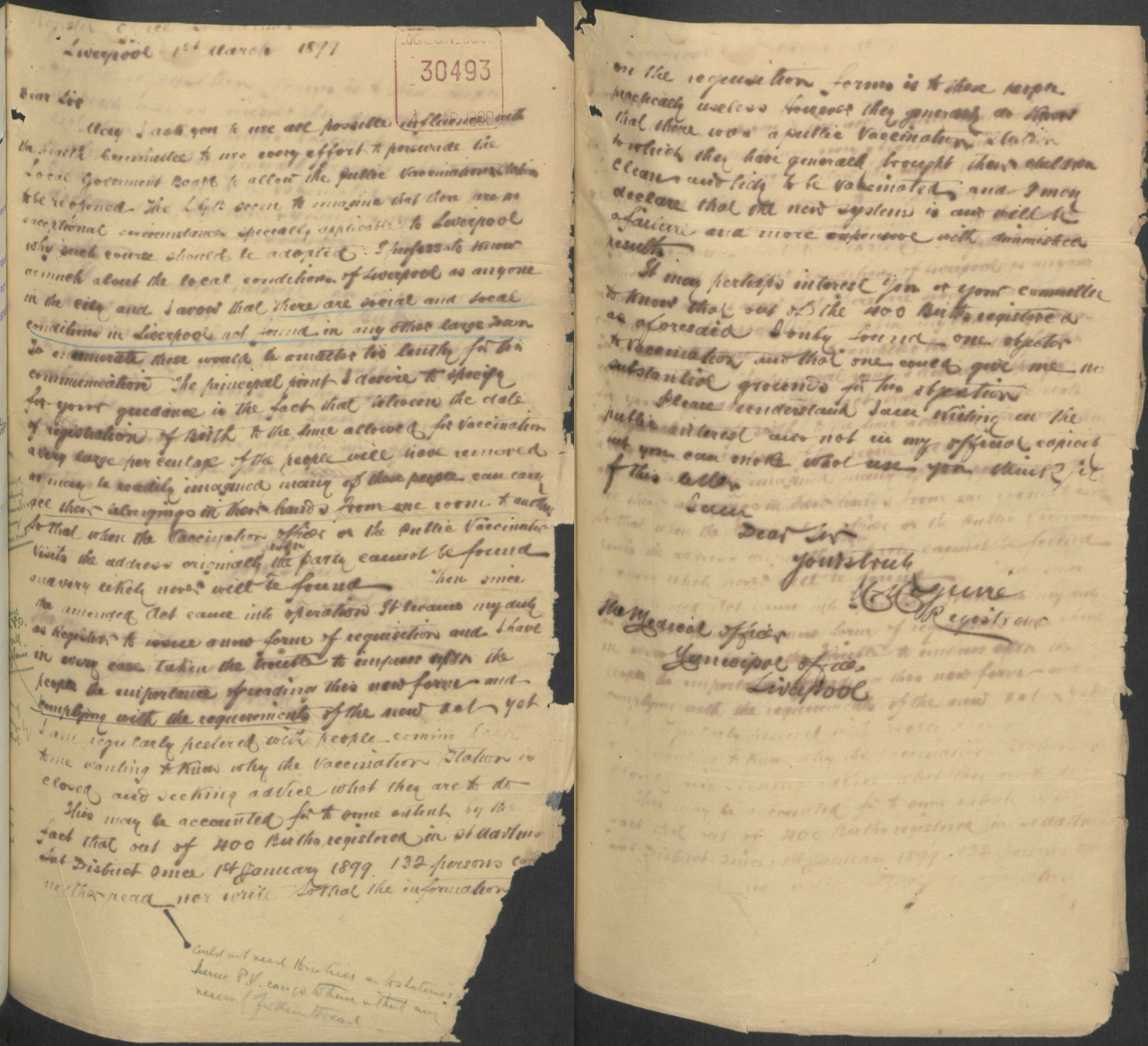
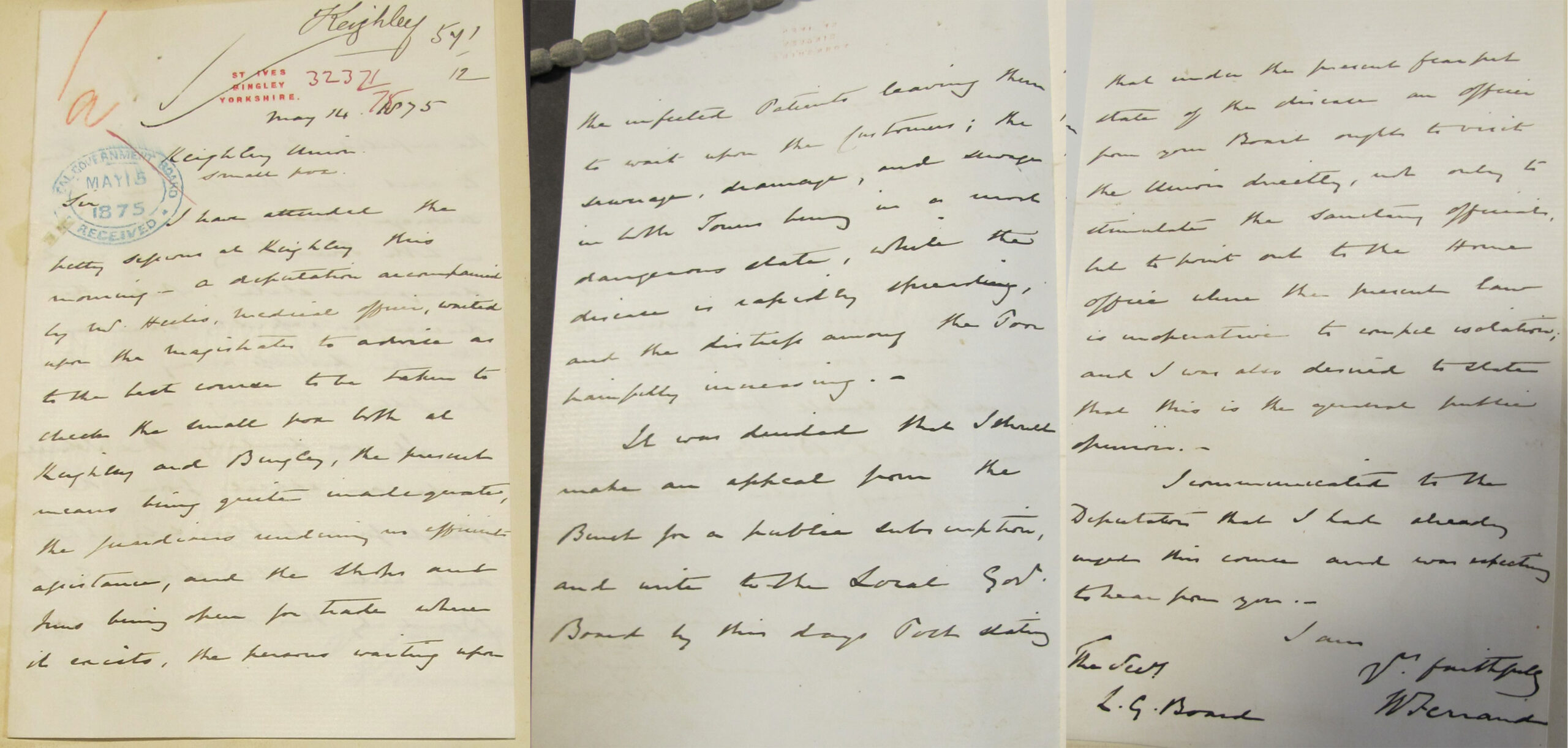
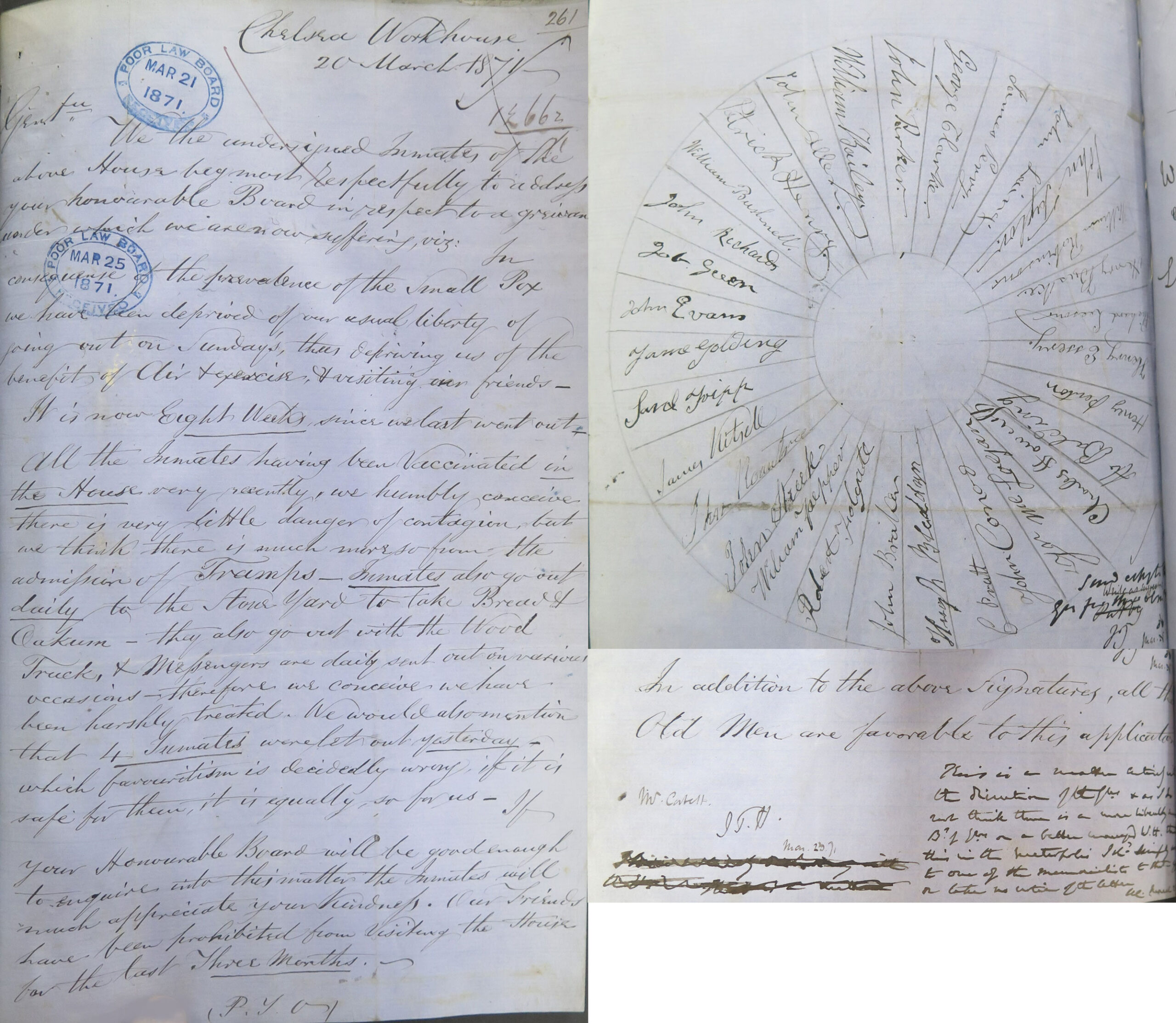
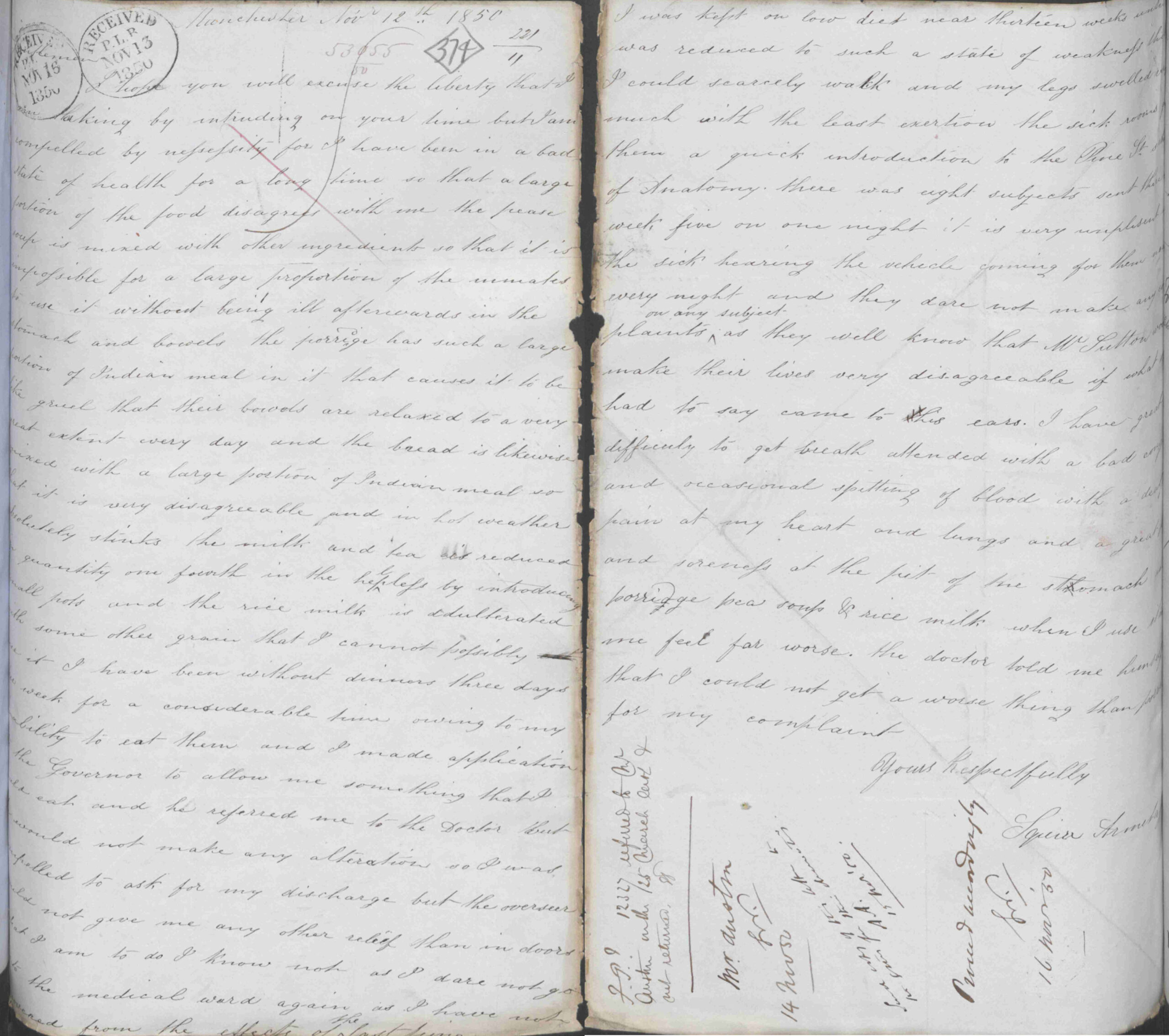

This lesson asks students to examine a set of letters to discover the health concerns of a sample of poor people in the Victorian era. The activity can be done in groups or as a carousel providing the whole class with knowledge of the content of each letter.
The letters have been grouped into five main themes related to health allowing you to select the letters most appropriate to your group’s studies. You may also want to pair this activity with the use of our interactive maps on www.victorianpoor.org where there are over 3500 letters from the victorian poor to explore. There is a curated map on health within the ‘secondary’ student portal, or further health related filters within the ‘research’ portal. Using these maps can allow you to explore health issues in your local area or explore national trends in medical care, sanitary reform or disease outbreaks.
This lesson was created as part of the Teaching the Voices of the Victorian Poor Teacher Scholar Programme.
To what degree did the Poor Law make an important contribution to Public Health?The Victorian era was a point of major overhaul for public health in England and Wales, with The Poor Law and the Public Health Act working to support the basic needs of the people and attempting to understand and prevent illness in a manner never seen before.
A key figure in both of these acts was Edwin Chadwick. After helping to set up the 1834 Poor Law it became clear to Chadwick that health and sanitation was a major issue for the poor, with many seeking relief for issues stemming from illness and disease. The answer for Chadwick, as he suggests in his 1842 publication ‘The Sanitary Condition of the Labouring Population for Great Britain’ was to improve sanitation and access to preventative health care in order to prevent illness and therefore stop the poor from needing to ask for relief.
In the meantime the Poor Law created new administrative systems to oversee the relief provided to those in need. Workhouses were staffed with doctors and nurses and a dietary provided a recommended meal plan – which though meagre could still be more than the poor could provide for themselves if they could not work. Out relief could also be provided by relieving officers, providing access to food, clothing or some medical treatment.
A Central Board of Health was created after the Public Health Act of 1848, following a serious outbreak of cholera that year. Yet the board was unfunded and had little power to make changes, so the Poor Law continued to be an important service for the poor seeking help with the medical needs.