
Hand bill offering a reward for information regarding the theft of bank notes, 24 December 1818 (HO 61/1 f.4)
Transcript
Public Office, Bow Street, Dec 24, 1818
100 GUINEAS Reward
WHEREAS, on the Night of the 31st October, the undermentioned NOTES of the Sturminster and Dorsetshire Bank, under the Firm of “WARRY, COLBOURNE, BEST, and Co.” were Stolen from the Exeter Mail [coach] and being Payable at the House of Messrs. PRESCOTT, GROTE and Co., Bankers, London, Payment thereof has been stopped:- Notice is thereby given, that whoever shall give information of the Parties whole stole the same, shall upon Conviction, receive the above Reward, by applying to Mr. John Stafford, Chief Clerk at the Public Office, Bow Street; or Mr. THOMAS WARRY, Solicitor, No.7, New Inn, London:-
[N.B. Serial numbers for ten, five and one pound notes were listed on the bill, these have not been transcribed]
…
The person first described [below] purchased a new pair of Wellington Boots at Bath, marked in the Inside “Jones, No.16262”, and it was observed by the Bootmaker that he was awkward about the Feet, and that all his Toes seemed to be nearly of the same Length. The Boots which he bought were stuffed at the Point with Wool to be more easy for Walking.
A considerable Number of the above Notes was passed on the 3rd and the 4th Instant, at Cheltenham and Bath, to different Tradesmen, by Two Men, one acting as Servant to the other- The Description of the pretended Master (who called himself Captain Mowbray,) is as follows, viz.—Five feet 9 Inches high, rather of light but sallow Complexion, very dark grey Eyes, small Whiskers, shews a little of the Small Pox, large rough Hands, very large Feet; wears his Boots easy, very genteel in his Manner, rather long Visage, high Cheek Bones rather tapering towards the Chin, which is rather sharp, good Teeth, thick brown Eyebrows, Nose rather long and a little hooked at the Point, but Nostrils rather large and flat, good looking, and very sharp and quick with his Eyes; active and bustling and well made, very much the Appearance and Manners of a Gentleman; brown Hair cut in the common Way; From his having his Boots and Shoes made easy, it is supposed his quick Walking was affected; remarkably ready and quick at Figures, carries himself upright—Was dressed in a black Coat and Waistcoat, with a blue Great Coat over, blue cloth Trowsers, and Wellington Boots, had 3 or 4 embossed Seals, and a blue Amethyst embossed Key was purchased at Bath with a Stone in the Middle, which he put upon his Watch. The Description of the other Man. Is, an Inch or two shorter than the Other, about 5 Feet 7, darker Complexion, open Countenance, small Whiskers of a sandy colour, light brown Hair, hazel Eyes, rather short dumpy Nose, not lusty nor thin, but middling—He acted as Servant to the Other and made himself appear like one—He had on a drab coloured Great Coat with Pockets outside—Took off his Hat like a Servant and smoothed down his Hair which was particularly smooth on the Crown; upright in his Stature; rather low Forehead or perhaps it appeared so from the Smoothness of the Hair, rather a wide Mouth. They had several Great Coats with them, a Black Portmanteau [large suitcase for carrying clothes], and several parcels.—
They both appeared to be about 30 Years of Age.
*** Please to keep this Bill out of Sight.
- Downs, PRINTER, 240, Strand London
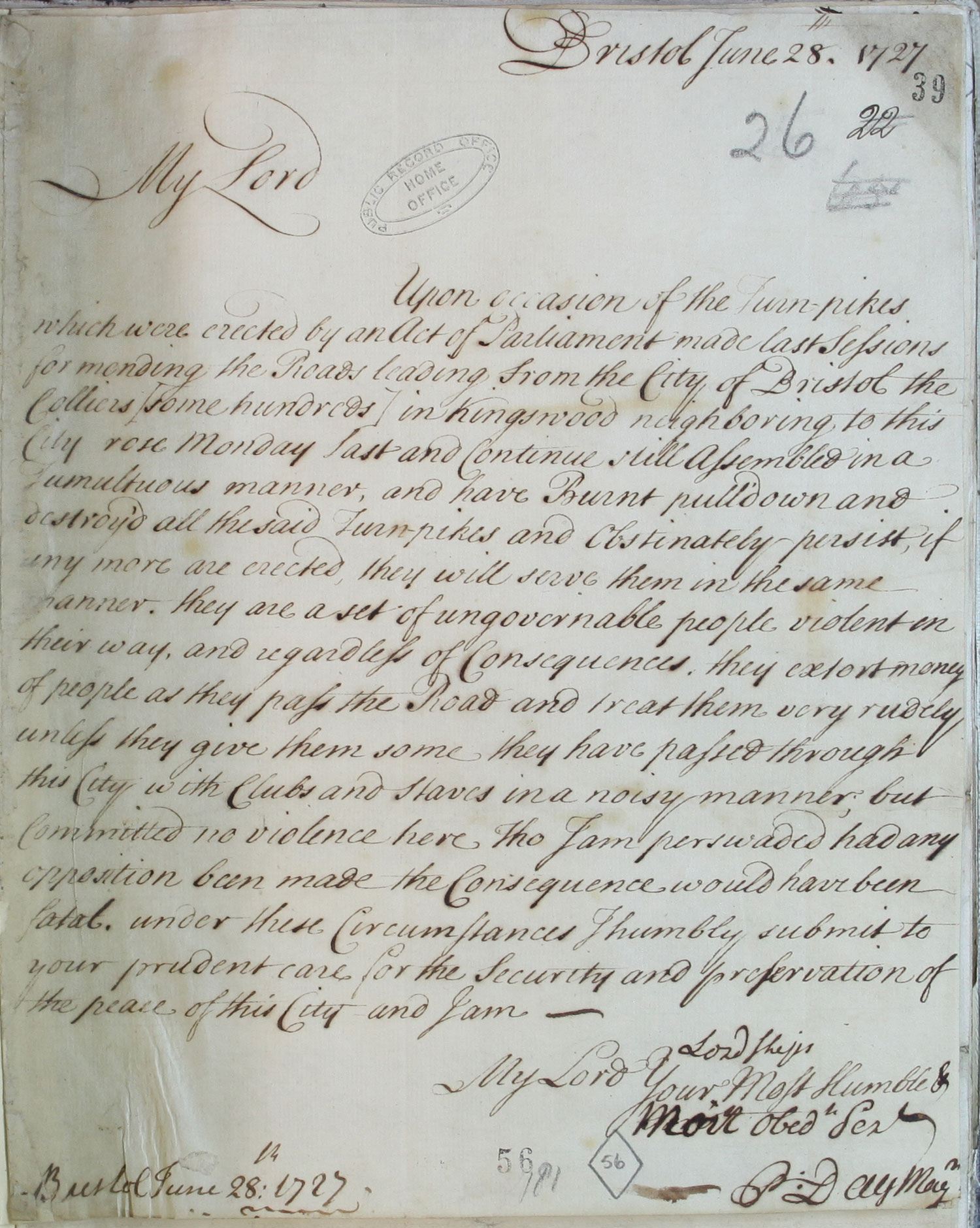
Letter from the Mayor of Bristol about a protest against a new turnpike road in the area, 28 June 1727 (SP 36/1/56)
Transcript
Bristol June 28th 1727
My Lord,
Upon the occasion of the Turnpikes which were erected by an Act of Parliament made last sessions for mending the Roads leading from the City of Bristol, the colliers [coal miners] some hundreds, in Kingswood neighbouring to this city, rose Monday last and continue still assembled in a tumultuous manner and have burnt, pull’d down and destroyed all the said Turnpikes and obstinately persist, if any more are erected, they will serve them in the same manner. They are a set of ungovernable people violent in their way and regardless of consequences, they extort money of people as they pass the Road and treat them very rudely unless they give them some, they have passed through this city with clubs and staves in a noisy manner, but committed no violence here, tho’ I am persuaded had any opposition been made the Consequence would have been fatal under these circumstances. I humbly submit to your prudent care for the security and preservation of the peace of this City and I am,
My Lord, your Lordship’s most Humble and most obedient servant, P. Day, Mayor
Bristol, June 28th 1727
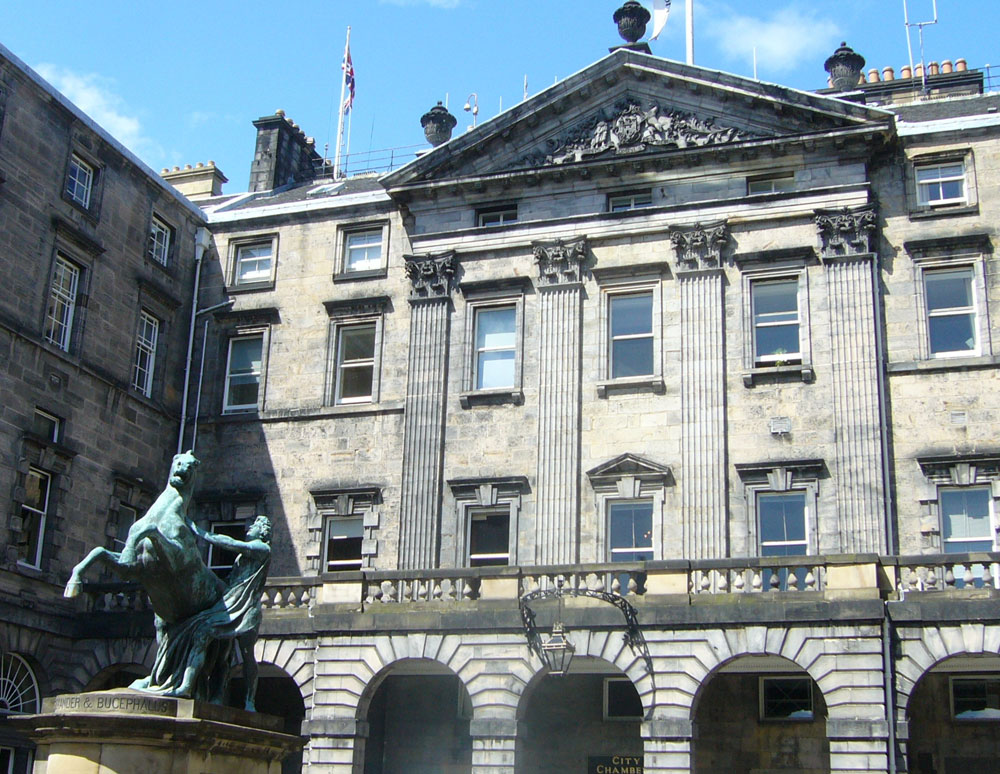
The Royal Exchange, Edinburgh which later became the City Chambers, was built in 1753-4 and designed by the brothers John and Robert Adam (photo: Wikimedia commons)

Drawings of the city hospital at Exeter in 1743, showing it before and after it was rebuilt (WO 78/5781(3))

Comb making machine, 1768- 69 (C 73/13 m35 (3))
Hair combs were made from ox and sheep’s horns.
Transcript
A shew of the Engine for Manufacturing Combs, when it is set for the Cutters For preparing the Horn into a proper shape For pointing the Teeth of Ivory and Box-combs etc.________________________________________________________
A.The Arbor [shaft or beam] on which the Cutters are fixed a set of which there must be for every different sized Comb and are taken in and taken out of the Frame B by slacking the skrew D. The rollers with teeth in them for shaping the Horn, and pointing are put in and taken out in like manner. By pulling down the Handle E it Throws the Cogg wheel out of the Nut on the Balance Wheel Axis which may be seen in the Draught shewing the Movement used in this View mark’d. J.H.

Extracts from an inventory of Morris Lewin Mosley, silversmith in Liverpool, 5 June 1802 (C 107/164)
Transcript
[Please note there is frequent use of the term ‘ditto’ which we have taken to mean as before, in this sense, another similar item in the inventory. Any unusual terms are defined in square brackets.]
An Inventory of the Household
Furniture Fixtures etc taken under a Commission of Bankruptcy at Morris Lewin Mosleys, Silver Smith at Liverpool in the County of Lancaster. 5th June 1802
No 1: Front Garret
A Four Post Bedstead Japand [a hard black varnish, originally from Japan, for coating wood or metal and often decorated with an oriental style motifs or patterns] cornices [horizontal projecting moulding at the top of a wall] Mahogany feet Manchester Cotton furniture Feather bed Bolster and 2 pillows ditto
1 blanket to each and 2 coverlids [bedspreads], 2 pairs window curtains to match and 2 Japand cornices to match.
3 pieces of carpet, a mahogany double chest of drawers and Japand chairs, matted seats [using flat woven fabric] and 2 painted tables.
No 2: Back Garret
A field Bedstead, [folding bed] printed cotton furniture, 2 window curtains to match a feather bed bolster [long pillow], 1 pillow, 1 blanket and quilt, a looking glass in mahogany frame, a mahogany table with drawer, a mahogany chair and 3 Japand chairs, matted seats.
No 3: Lumber Room
A small bedstead, a small mahogany table, 2 wire fenders, one with brass top and knobs, shovel, tongs and poker to match, a rocking horse, a small clothes horse, a pair of low steps, a Japand tin pail [bucket] with cover. 2 pairs Japand window cornices with laths [thin, narrow strips of wood, used to form latticework, a backing for plaster], 2 Queensware wash hand basins [a type of light white earthenware with a brilliant glaze developed from creamware by Josiah Wedgwood and named after Queen Charlotte] and 2 ewers [jugs] 2 bits of carpet.
No 4 – 2 pair front
A four poster bedstead [with] Japand cornice, mahogany feet, foot board [supporting piece at the end of a bed], a wool mattress, a bordered feather bed a bolster and four pillows 2 blankets and white counterpain [counterpane, or quilt or coverlet for a bed], and Manchester cotton [Manchester was the centre of the cotton industry], Furniture, two window curtains to match with 2 Japand cornices a large dressing glass [mirror] 2 foot by 1ft 4 inches, stand with 3 drawers, a painted commode dressing table with 5 drawers [chest of drawers with curved front and legs, often with shaped sides, seen as “French” taste, popularized by Thomas Chippendale] a mahogany wardrobe, a pair bedside steps, a 2 arm easy chair and cushion, and Japand chairs cane seats, 1 [similar] stool, matted seat, a painted corner wash hand stand [table, used to keep a jug and bowl for washing] a blue and white basin and ewer [jug].
A bedside carpet round 7 foot 9 by 4 foot 4 inches and 2 pieces as before, and a hearth rug. A bath stove with polished steel front, a hearth brush.
No 5: Back Room
A four post bedstead, Japand cornice and mahogany feet, painted Manchester cotton furniture, scollopt [scalloped, a curved ornamental edging in fabric copying the edge of a scallop shell] lined and fringed and window curtains to match with Japand cornice, a mattress, a bordered feather bed, a bolster and 4 pillows, 2 blankets and white counterpane, a spring rolling sunshade [for the] window.
A mahogany chamber chest of drawers, a ditto [second one], night stool, a circular Japand dressing table, a dressing glass in oval frame 1 foot 5½ inches by 1 foot 3½ inches, a Japand wash hand stand, blue and white basin and ewer [jug].
Small back room
A field bedstead [folding bed] Manchester cotton furniture- a window curtain to match a feather bed, bolster and 2 pillows, 2 blankets and spotted coverlid [bedcover] a mahogany chamber chest of drawers, Ditto, wash hand stand blue and white basin & ewer.
No. 6 back room
1 pair 4 poster bedstead, Japand cornice, mahogany feet and foot board, white dimity lined, [dimity was light sheer cotton fabric, made with fine cord running through it, sometimes printed with coloured pattern]. Drapered and fringed furniture two- Mattresses, a bordered feather bed, a bolster and two pillows, two blankets and white dimity Mozela quilt and patch coverlid [bedcover], a Japand cornice to window and rolling spring sun shade. A mahogany octagon [eight sided] chamber chest of drawers, a ditto, bedside steps carpeted, a Japand compass dressing table, a bedside round carpet, a piece ditto, and a hearth rug and a bath stove, and polished steel front, a ditto compass fender.
No 7: Drawing Room
A polished steel front register stove with draw out bars, a compass steel fender, a pier glass [a large high mirror often designed to occupy the wall space between windows] in gilt frame with carved and fluted columns, 6 feet by 2 foot 9inches; 2 chimney lustures [Lustres were candlesticks or vases decorated with hanging glass prism-like shapes] with 3 branches to each, 2 gilt ornamental chandeliers, 2 pair Manchester cotton window curtains, olive colour vallens fringed and lined [valance or short piece of material used as a decorative heading to conceal the top of curtains] a gilt cornice and 2 green sun blinds, 3 Japand Pembroke card tables [small 4-legged table originating in the Georgian period and having two drop leaves and a drawer] satin wood ground lined with green baze [green baize was a wool fabric resembling felt] and leather covers. 2 japand sophas [sofas] cane bottoms stuffed backs and elbows and cushions. Covered rose wood colour 10 elbow chairs with cushions- covered to match 2 pole fire screens- 2 silk ribband [ribbon] bell pulls, extra linen covers for sopha [sofa] , chairs etc…
No 9: Best Parlour
A bath stove polished steel front a circular cut fender shovel tongs and poker, a pier glass [mirror] carved gilt frame. Ditto fluted columns 6 foot by 2 foot, and 2 glass chandeliers on mantel piece. A mahogany secretary book case with gothic sash doors and green silk curtains. A mahogany side board with 2 drawers and celleret [cellarette or cellaret is a small furniture cabinet, available in various sizes and shapes, which is used to store bottles of alcoholic drinks], 2 mahogany knife cases & vase spoon case and leather covey? a pair of Manchester cotton window curtains, lined & brass rod, 3 family pictures in Gilt frames a pair mahogany card tables with green cloth covers – 12 mahogany chairs [with] brass casters a small Japand work table, a carpet 15 feet by 12 a piece ditto.
No 10: Back Parlour
A bath stove [with] cut steel front, shovel, tongs and poker, a wire fire fence, mahogany 2 flap table with drawer, 2 mahogany stools, horse hair seats, a painting of Reverend Isaac Polack in gilt frame, a needle work map of the British Isles in gilt frame, an oval glass in gilt frame. 2 foot 2 by 1 foot 6 a figured oil cloth. 12 feet 6 by 9 foot 6 and a bit ditto a carpet 7 foot by 4 foot and 3 bits,
Closet
14 wine glasses, 2 tumblers, 8 rummers [large glass or cup with short stem for drinking toasts], 1 glass water jug, 13 cups and saucers, 4 coffee cups, 1 china plate and 6 others, a bronze tea urn…a plated coffee pot and tea pot, a ditto crewit [cruet] stand, a pair of plated candle sticks, a silver cream mug, 6 table spoons, 12 tea spoons, 4 salts 4 spoons.
A Japand plate warmer 4, ditto waiters [trays] a mahogany knife box 16 table knives, 1 pair carvers [carving knives] 5 small knives, 7 forks, a piece of green baize.
Passage
A glazed [glass] lamp with glass shade liner & pullies 2 painted laths with 16 cloak pins- strip of wood with hooks for hanging clothes] 3 pieces oil cloth 31 feet [in length]
No 11 kitchen
A smoke jack [device for turning a roasting spit], iron crane and pothook a windup range drop bar and 2 swing trivets and draw out racks, a shovel tongs & poker a sliding bar fender, 1 box iron, 2 heaters, 1 flat iron, 1 grid iron, a frying pan, 2 spits and iron meat roaster, a large copper boiler, 2 copper tea kettles, 2 copper stew pans, 3 large copper saucepans and 3 covers, 4 small saucepans and a coffee pot, 1 coal scuttle and 1 iron (another as before), 1 brass pestle and mortar, 4 brass candlesticks, 1 tin tea kettle, 3 tin saucepans, 1 fish plate and cover, tea dish, covers 12 saucepans, ditto steamer, a Dutch oven, a tin cheese toaster, a plate basket dripping pan and ladle, a bread grater [for making bread crumbs] pepper box dredger [box with a perforated top used for sprinkling pepper] 2 tin candlesticks, a lanthorn [lantern] and sundry tin pots, a fire screen lined with tin, a warming pan, a brass footman, a pair of steak tongs, a cleaver [heavy knife for chopping meat], a skewer rack, 12 skewers, a mahogany butlers tray, a mahogany cheese waggon and knife box, 5 Japand tea trays, a pewter tea set, 2 spice boxes, 4 egg cups and sundries in cupboard.
Larder
3 table tureens [large serving dishes] and covers, 2 sauce tureens as before and covers, 2 ladles and stands, 3 butter boats [small butter dishes] 2 salad bowls, 2 vegetable dishes and covers, 10 table dishes, 44 table plates 30 small, 15 soup plates, 2 fish plates, 11 pye dishes 6 basins, 6 patty pans, 5 jugs, 7 black dishes, 2 bread pans, 17 stone bottles, 1 iron pot, 2 sauce pans with covers, a flour kit and meal, a chopping block, chocolate mill and lemon squeezer, 1 iron footman, 3 washing tubs, 2 pails, 2 stools, a beer stand, 2 clothes horses, napkin press, flour tub and cover, 2 Deal tables, 6 wood bottom chairs, a looking glass, a coal shovel and cinder sifter. 1 coffee and pepper mill as fixed, a Deal dresser, painted front with drawers and cupboards 9 feet 10 inches by 2 feet 4½ inches, one ironing board let down flap 8 feet 5 inches by 2 feet 11 inches, a dresser in back kitchen with shelf underneath, a wood cistern lined with lead and brass lock, a bottle rack…

Extract from Western Circuit 1773, Devon, Assizes gaol book (ASSI 23/7)
An interesting list of crimes from ‘unlawfully riotously tumultuously and feloniously assembling and meeting together’ to various cases of burglary. Men and women are mentioned.
Transcript
…Devon Summer Circuit 1773 continued
| James Bristol po: se. not guilty | For unlawfully, riotously tumultuously and feloniously assembling and meeting together with other persons to the number of twelve or more and feloniously riotously and tumultuously remaining and continuing together by the space of one hour after command and proclamation was made for them to disperse and agreeable to the statute. |
| po: se. not guilty John Shasswell. 2nd [conviction] po: se: guilty | For unlawfully, riotously and routously [causing wild confusion] assembling together with other persons to the number of 200 and more to disturb the peace near the Dwelling House of William Cardor Esq. For unlawfully, riotously, routously and tumultuously assembling together with other persons to disturb the Peace |
| To be hanged Burg [burglary] Samuel Smallridge Reprieved | To burglariously breaking and Entering the Dwelling House of Jeremiah Connatt about one in the night and stealing one canvas bag value 6d and other goods of the said Jeremiah Connatt |
| po: se: not guilty Fel. [felony] John Hodge | For stealing two pounds weight of candles value 12d, the goods of James Cole. |
| Po: se: Guilty of stealing the goods not Guilty of the Burglary To be transported for 7 years Robert Pike | For burglariously breaking and entering the Dwelling House of James Hutchings about 8 in the night and stealing one cloth coat value 3d and other goods of Andrew Webber |
| Po.se: Not guilty Manslaughter: Bartholomew Hurley | For feloniously killing and slaying Benjamin Turner as in the Coroner’s Inquisition |
| Po.se: Not guilty Arson: Sarah Archer | For feloniously and maliciously setting fire to a House of William Deeves, Richard [Williamson], John Parrot, John Morrell and William Lizard overseer of the Poor of the Parish Berry Pomeroy [South Devon] |
| Po.se: guilty To be hanged, Burglary, Reprieved William Woolaway | For burglariously breaking and entering the Dwelling House of John Friend between 10 & 11 in the night and stealing one linen shift value 2d and other goods of the said John Friend. |
| Po: se. Guilty vad.10d [Felony] Hester Reed To be publically whipped in the market place at Topsham on Saturday the 21st August inst. Between the hours of 12 & 2 and then discharged. | For stealing one pack of wheaten flour value 12d and other goods of William Redwood |

Engraving by Thomas Rowlandson (1756- 1827) showing a crowd at a chemical lecture (after 1809) © Wikimedia Commons.

List of tolls charged on the turnpike road from Leeds to Selby, 1740 (RAIL 800/241/4)
Transcript
Tolls to be taken
For every Coach, Chariot, Landau [four-wheeled carriage with for two passenger with a roof in two sections that can be lowered or detached], Berlin, [four-wheeled closed carriage with a footman’s platform behind] Chaise [open carriage, usually with a hood, especially a one-horse, two-wheeled carriage for two persons], Calash [light carriage with two or four low wheels and a collapsible top], or Hearse drawn by six horses, or more Two Shillings
For every Coach, Chariot, Landau, Berlin, Chaise, Calash, or Hearse drawn by four horses, One Shilling & six pence
For every Coach, Chariot, Landau, Berlin, Chaise, Calash, or Hearse or chair drawn by two horses, One Shilling
For every Calash, Chaise or chair drawn by one horse; Six pence
For every Waggon, Wain [heavy four-wheeled cart for hauling loads, pulled by horses or oxen for farm use], or Carriage with four Wheels
(not above charged) drawn by four or more Horses One Shilling & six pence
or Oxen
For every such carriage drawn by less than four: One Shilling
For all other Carriages One Shilling
For every Horse, Mule or Ass laden or unladen, and not drawing One penny
For every Drove [herd] of Oxen, Cows or Neat Cattle
[other domestic bovine animals] per score, and so in proportion Ten pence
for any greater or less Number
For every Drove of Calves, Hogs, sheep or lambs per score Five pence
& so proportionably for a greater or less Number
______________________________

Example of note paper used to record the admission of an infant or young child into the hospital (CHAR 2/384)
The lamb holding a sprig of thyme in its mouth is an element from the original coat of arms designed by William Hogarth for the hospital in 1747. It showed a child flanked by Britannia on the right and the figure of Nature on the left. The lamb represented the Hospital.
Transcript
HOSPITAL for the Maintenance and Education of Exposed and Deserted Young Children
The Day of
Received a Child
Secretary
Note.—Let this be carefully kept, that it may be produced whenever an enquiry is made after the Health of the Child, (which may be done on Mondays, between the Hours of Ten and Four), and also in case the Child should be claimed.