
Engraving by Charles Williams entitled ‘The Fashions of the Day, or Time Past and Time Present’ published 2 November 1807 by Walker, No. 7 Cornhill (image: Wikimedia Commons)
The caption reads: ‘The Year (1740) A lady’s full dress of Bombazeen (heavy twill fabric woven in a diagonal pattern, often dyed black for mourning clothes) – ‘The Year (1807) a Lady’s undress of Bum-be-seen’.
The cartoon also shows the popularity of fine muslin, Indian cotton. It was ‘Respectfully dedicated the Fashionable Editors of [Fashion Magazine] La Belle Assemblée: Le Beau Monde’.
Caricaturist Williams’ style resembles that of James Gillray.
Transcript:
The Year (1740) A lady’s full dress of Bombazeen – ‘The Year (1807) a Lady’s undress of Bum-be-seen
THE FASHIONS OF THE DAY or Time Past and Time Present.
Respectfully Dedicated to the Fashionable Editors of La Belle Assemblée – Le Beau Monde No. 30 – Published Nov. 2nd, 1807 by Walker, No. 7 Cornhill.

An engraving of the southern front of Somerset House and gardens, drawn by L. Knyff about 1720 and engraved by Sawyer Junior (WORK 30/269)
Transcript
SOUTHERN FRONT OF SOMERSET HOUSE, WITH ITS EXTENSIVE GARDENS, &c
N.B. The floating house, moored in front was a Coffee House, denominated the Folly, & was frequented by the wits and fashionables of the day, but it latterly became so common and notorious that the Magistrates abolished it.
London. Published as the act directs April 1 1808 by John Thomas Smith.

An inventory for the possessions of James Butcher at the time of his marriage in 1732 and after his death in 1738 (DEL 8/79 f.19)
Transcript
An inventory of such Household goods and is as did belong to Mr James Butcher, at the Time of his Marriage to the Widow Edwards in the Year 1732 and likewise of what things have been Bought by them since that time, taken at his late dwelling house at the Sign of the King and Queen in the Fryery, in the Parish of Saint James Westminster and Appraised the twenty-ninth of March 1738 and the following days.
Things that did belong to Mr. Butcher before Marriage
In the Garrets
A Compass stove, a feather bed, and bolster, one small one ) £ s d
Ditto (another one) and bolster, five old blankets, and one old rug ) 2 09 0
In the Two Pair [garrets] Backwards [at back of the house]
A Pier glass [tall mirror] in a walnut tree frame, and a book in ) 2 0 00
Folio of the Works of the Bishop of Norwich )
In the Club Room
Two pair of yellow window curtains and rods 0 4 00
In the Cellar
A range, cheeks [the masonry on either side of a fireplace opening that )
supports the mantel and the upper part of the chimney] and fender, ) 2 4 00
two old porridge potts and covers, two skimmers [cooking ladles], and )
old coffee pott, a dish kettle, two tin covers, two baskets and a stove )
compleat, and bellows.
At the Lodge, at White Hall
An old bedstead, part of an old stove, some old window shutters ) 0 6 00
And six old chairs.
Plait [Plate], two large spoons and one child’s spoon [pewter] ) 1 10 11
weight 5 oz 16 at 5 shillings: 4d pence per ounce.
[Total] 9 18 11
Brought over 9 18 11
Goods purchased since marriage
In the Garrets
A small bedstead, the cotton side of A quilt, three blankets, ) 0 19 0
A pewter tea pott )
a pewter tea pot
In the Two Pair [garrets] Backwards [at back of the house] 3 6 00
A Bedstead, with red half teaster [part canopy for a four poster bed] furniture. And one pair of window curtains ditto compleat, two blankets, part of A cupboard, a mahogany hand tea board, a black walking stick, a lock and key, twelve yards of Toweling which when new cost 3½d a yard and three pair of (middling good) sheets
In the one Pair [garrets] Forwards [at front of the house] 4 18 0
A stove with brass fender compleat and bellows. A Beaufett fixed [sideboard] a brass lock and key, a marble slab, six matted chairs and a tick [a linen or cotton bag filled with feathers, wool, cotton, or straw] for a bed, bolster and two pillows
In the one Pair [garrets] Backwards [at back of the house] 0 17 0
A brass plate frame, a pair of brass arms, two window curtains, and rod and two matted chairs
In the Club Room 4 3 00
A grate, and iron back fixed, and brass fender, a pair of brass arms, eighteen leather chairs, a sign of the King and Queen, a bedstead. In the closet, a brass lock and key, a cruet stand and a picture over the door, a basket lined with tin.
In the fore [front] Drinking Room 3 16 8
Two cain sashes, a leaden pott cistern, two tin warming potts, three pewter Quart potts, three pints ditto, two pewter covers, a close stool pan [chamber-pot], part of the barr fixed, a long table, a form [bench], a basket, a pewter bed pan, and a cullender a [colander or pan with a perforated bottom for straining or rinsing foods] ditto, and two china sugar potts, about four pounds of candles. 1lb ½ of tobacco,
½ a gross of pipes, a dozen wines.
Plait [plate]: A two handled cup, and a tip (cover) for a pint mug waid [weighed]
17 ounces at 5 shillings 4d per ounce 4 10 8
Carried over 32 9 3
…
In the Kitchen
A brass plate frame, a pewter porringer [shallow cup or bowl with a handle for soup or porridge] and cover, four spoons, a hand whip, thirty knives and thirty forks, a brass pale, a plate rack, eight brass candle sticks, a pair of snuffers [a device with a cone on the end of a handle used to put a burning candle] and stand, six iron candle sticks, a dresser and shelves fixed, and a lock and key on the door.
Wairing apparells and linnens [clothing and linen]
A suit of ash coloured cloth cloathes, trimmed with mettle [metal] buttons, and ash coloured coat, and britches [short trousers or breeches], two olive suits of clothes, two old red coats, an old pair of britches, two hats, three perukes (wigs), eleven pair of gloves, two old swords, six pair of stockens [thick stockings], three pair of shoos [shoes] and one pair of boots, a pair of mourning buccles [buckles as a form of jewellery designed to commemorate the death of person] and a pair of silver shooe, and knee buckles [worn with breeches], sixteen shirts course [coarse] and fine [cloth], thirteen stocks [a strip of cloth that was wound around the neck and fastened at the back, in the front it looked something like a pre-tied bowtie] and sixteen turnovers [collars] and a laced cravett [cravat] four pair of weepers [strips of white cloth which were sown onto cuffs], seven pocket handkerchiefs. Four caps and an old table cloth and a pair of silver buttons.
Cash in the House at the time of Mr. Butcher’s Death
£ s d
In Gold 24 3 00 )
In Silver 0 5 00 ) £24: 13: 00
In Copper 0 5 00 )
By forward ommissions £76: 3: 3
£77: 16: 4
- Thomas Bond…
These things following were given away (viz) a wainscot beauroe [wooden writing desk, slanted top, with drawers], a chimney glass [glass for a lamp] in a walnut tree frame, and two suits of Black cloth cloathes [clothes]
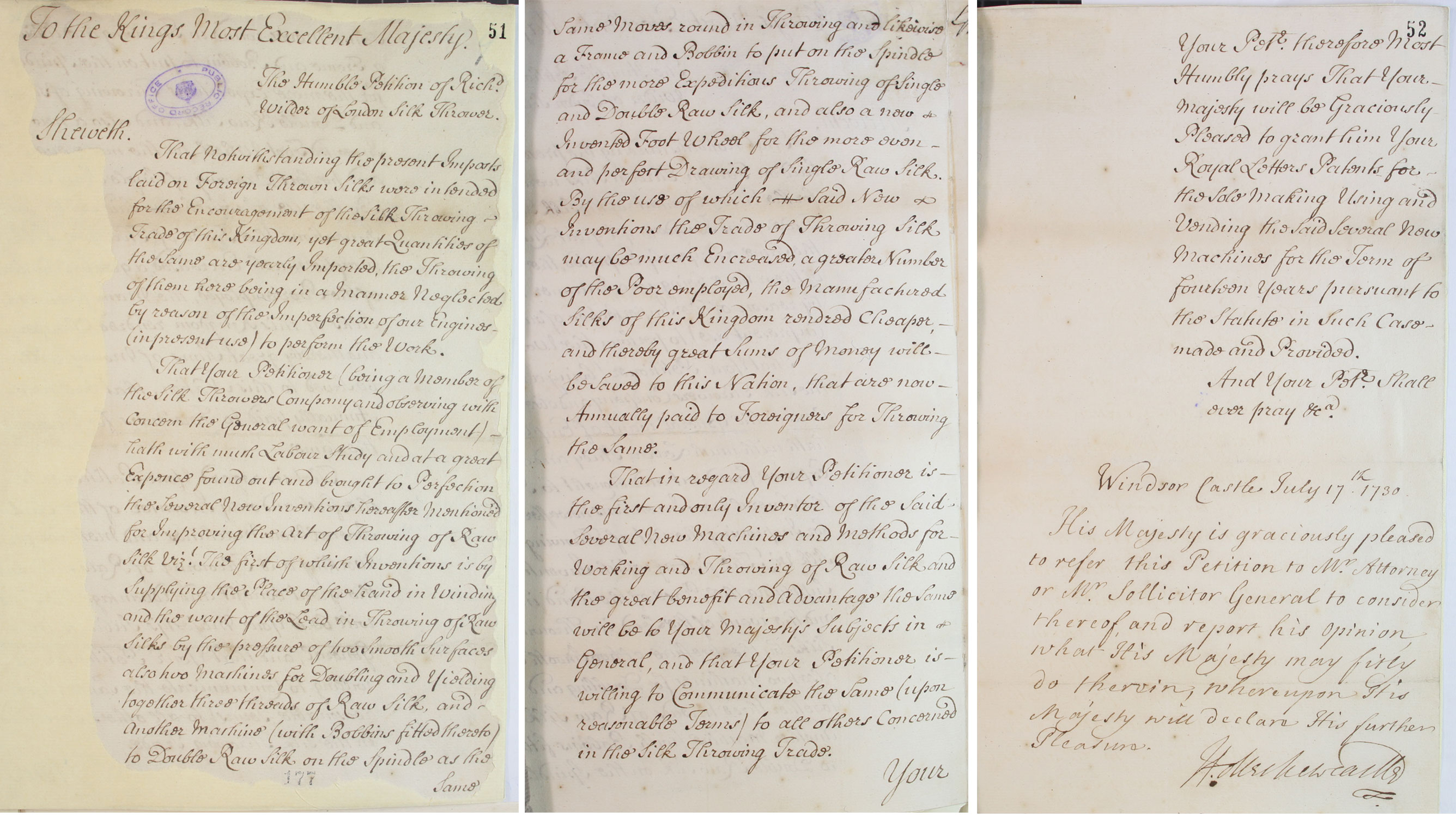
Petition from Richard Wilder, silk manufacturer, about his invention, to Lord Newcastle, 17 July 1730 (SP 36/19/f.177-178)
Wilder wanted a patent for a spinning machine that made silk yarn, which could then be woven into cloth.
Transcript
To the King’s most excellent Majesty
The Humble Petition of Richard Wilder of London, silk thrower [spinner of silk yarn/thread]
Sheweth
That notwithstanding the present Imports laid on Foreign Thrown Silks were intended for the Encouragement of the silk throwing trade of this Kingdom, yet great Quantities of the Same are yearly Imported, the Throwing of them here being in a manner Neglected by reason of the Imperfection of our Engines (in present use) to perform the Work.
That your petitioner (being a Member of the Silk Throwers Company and observing with concern the general want of Employment) hath with much Labour study and at a great Expense found out and brought to Perfection his several new inventions hereafter mentioned for Improving the Art of Throwing of raw silk viz. The first of which Inventions is by supplying the place of the hand in winding and the want of the Load in Throwing of Raw Silks by the pressure of two Smooth surfaces also two machines for Doubling and yielding together three threads of raw silk, and another machine (with bobbins fitted thereto) to double Raw silk on the spindle as the same moves round in Throwing and likewise a Frame and bobbin to put on the spindle for the more Expeditious Throwing of single and double Raw Silk, and also a new and invented Foot Wheel for the more even and perfect Drawing of Single raw Silk. By the use of which— said. New Inventions the Trade of Throwing Silk may be much increased, a greater Number of the Poor employed, the manufactured silks of this kingdom rendered cheaper and thereby great sums of money will be saved to this Nation, that are now Annually paid to Foreigners for throwing the Same.
That in regard your Petitioner is the first and only Inventor of the said several new machines and methods for working and throwing of Raw silk and the great benefit and advantage the same will be to your majesty’s subjects in General, and that Your Petitioner is—willing to communicate the same (upon reasonable Terms) to all others concerned in the silk Throwing Trade.
Your Petitioner therefore most Humbly prays That Your Majesty will be Graciously Pleased to grant him your Royal Letters Patents for the sole making, using and vending [selling] the said several new machines for the Term of fourteen years pursuant to the statute in such case made and Provided.
And your Petitioner shall ever pray &c
[The following note was added by Lord Newcastle]
Windsor Castle July 17th 1730
His Majesty is graciously pleased to refer this Petition to Mr. Attorney or Mr Solicitor General to consider thereof and report his opinion what His Majesty may fitly do therein, where upon His Majesty will declare His further Pleasure.
Holles Newcastle

Letter from the Treasurer of the Marine Society to the Admiralty, 22 August 1791 (ADM 1/5119/16)
The Society was founded in 1756. It aimed to support poor children from the age of 13 by giving them the skills needed to work on board the King’s ships. This letter requested that the boys extended their time on HM ships to keep them out of trouble if discharged immediately after war service.
Transcript
22nd August 1791
[Marine Society]
Sir,
I am requested by the Committee of the Marine Society to represent to you, for the information of the Right Honourable, the Lords Commission of the Admiralty that having at the close of the War in 1763 & 1783, as well as that of the Armament in 1790 experienced the utility of their Lordships orders for the boys sent by the Society being received on board such of his Majesty’s Ships, as they have been pleased to appoint, on their being paid off from their respective ships.
I am therefore to beg you will represent to their Lordships, that the Society requests they will be pleased to give orders, that such boys sent by them, to His Majesty’s ships who may be discharged, be received on board a ship in Ordinary, [as ordinary seamen, apprentices for able seamen] at Portsmouth and Chatham, there to continue for a time not exceeding three months, for any one boy, for victuals [provisions] only, and that such may be discharged at Plymouth, be passed round the Tenders, to the ships at Portsmouth or Chatham.
For the better care of these boys, it is requested their Lordships will also please to order that the wages due to each boy be paid and that the clothing and bedding be also delivered on his discharge.
I am at the same time to mention that the Society’s Agents at Portsmouth and Chatham will be directed to go on board such ships in order to make out Lists, which being transmitted to the Society, they will have directions to send up such boys who do not find Masters, as the Society can get Masters for in Town.
I am further to observe that many of these boys are of unsettled dispositions and if they are permitted to go on shore, the good intentions of the Society will be frustrated, for they have been protected at a great expense they are anxious to preserve them, either for sea or land service, that they may become useful subjects.
I am Sir,
your most humble & obedient servant…

Petition from Joseph Harris to Robert Peel, Secretary of State, 7 July 1828 (HO 17/40 pt.3 f.18)
Transcript
To the Right Honourable Robert Peel M.P. His Majesty’s Secretary of State for the Home Department.
The Humble Petition of Joseph Harris aged 19, a convict now confined in H.M. Gaol Newgate.
Respectfully Sheweth,
That your Petitioner was tried at the Sessions held at the Old Bailey, in July 1829 for having stolen three Ducks, the property of Thomas Bray for which offence your Petitioner received the judgement of the Court in being sentenced to Transportation for the term of seven years.
Your Petitioner begs to submit that he is by profession a Fisherman that the above offence in the first for which he has ever been placed in a criminal point of view, in and that having an aged Mother of whom your Petitioner since the decease of his father, has been the whole support, doth Right Honourable Sir, from his former good character in Life as will be testified by the undernamed respectable individuals, implore that your Petitioner through your human influence may be permitted to go to the Penitentiary [prison] in Lieu of being banished from his native country and relatives, when your Petitioner begs with submission to Say that his whole line of conduct shall be marked by that propriety which shall evince [prove] his gratitude for the Indulgence he herein implores, and as in duty bound your Petitioner will ever pray to it.
Joseph X [cross as signature] Harris
We the undersigned beg to recommend the Petitioner’s prayer
John Jefferies…

Plan of the flower garden at Nuneham Courtney, Oxfordshire belonging to the Honourable Earl of Harcourt, 1785 (WORK 38/349)
Nuneham House is a good example of villa revival in the 1750s. It was built for Earl Harcourt, one of George III’s leading courtiers. Sir Simon Harcourt had become Earl Harcourt in 1749.
In 1777 his son George, the 2nd Earl of Harcourt, inherited the villa with its classical gardens, and hired Capability Brown to improve the landscape and house. William Mason laid out a new flower garden.
Transcript:
Plan of the flower garden at Nuneham, Oxon
Belonging to the Right Honourable Earl Harcourt
1785
References to the Busts
No.
- Flora
- Cowley
- Rousseau
- Cato
- Grotto
- Lock
- Urn
- Faunus
- Temple of Flora
- Pan
- Appollo
- Bower
- Venus
- Prior
- Urn to the Memory of Vicant de Palmerston
- Conservatory
- Hebe

Extracts from ‘the Regulations for Managing the Hospital’, which relate to admission of infants to the Foundling Hospital (CHAR 2/384)
The Foundling Hospital in London was founded by Thomas Coram in 1739, It was a home for the care and education of abandoned children.
Transcript
… The age limited for admitting Children is 12 months.
If the mother is in distress, it is discretionary in in the General Committee to make her some weekly allowance for the maintenance of the Child until the day of its admittance.
The Billets for the admittance of Children are given on the Wednesday preceeding Baptism…
- Of the Numbering and Registering of the CHILDREN
Before the Children are sent into the country, they are to be numbered and registered in the following manner.
The Secretary, immediately upon the reception of each Child, is to affix the number; which is to be done by writing the number of the Child on a slip of parchment, and sewing it to its clothes.
The numbers are to follow each other in succession, and great care to be taken that the number always remains fixed to the dress of the Child during its continuance at nurse.
The Secretary, after the child is received, enters in a register set apart for that purpose, the day, month and year of its admission: the name of the mother, the sex and age of the child, the name by which it is Baptized in the Hospital, the number of the child, the private mark attached to the certificate of its admission given to the mother, and the name of the nurse, and place to which it is sent in the country…

The indictment of Dick Turpin (ASSI 44/54)
Transcript
Yorkshire
Horse stealing
Puts guilty. No goods. Hanged
To wit the jurors for our Lord the King upon their oath present that John Palmer otherwise Pawmer
otherwise Richard Turpin late of the castle of York in the County of York Labourer on the First Day of
March in the twelfth year of the Reign of our sovereign Lord George the Second now King of Great Britain
Etc at the parish of Welton in the county aforesaid one Gelding of a black colour of the price of three pounds
Of the goods and chattels of one Thomas Creasy then and there being found did then and there feloniously steal
Take and lead away against the peace of our said Lord the King his Crown and Dignity
Simon
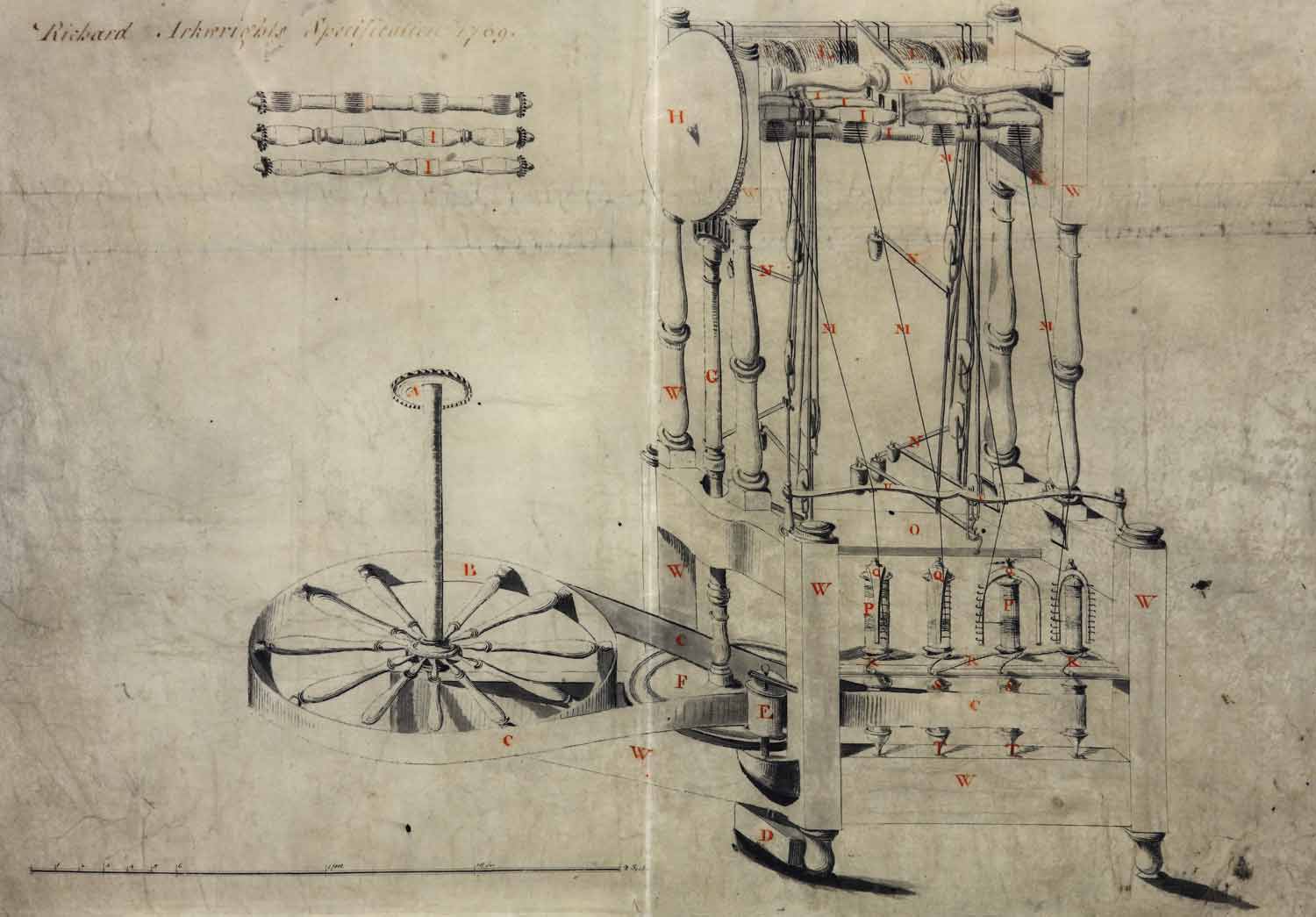
Richard Arkwright’s specification for his spinning frame, 1769 (C73/13 m31)
This became known as the water-frame, which used water power at Arkwright’s mill at Cromford, Derbyshire in 1771. The machine made it possible to mass produce strong yarn and reduced the need to spin cotton by hand.