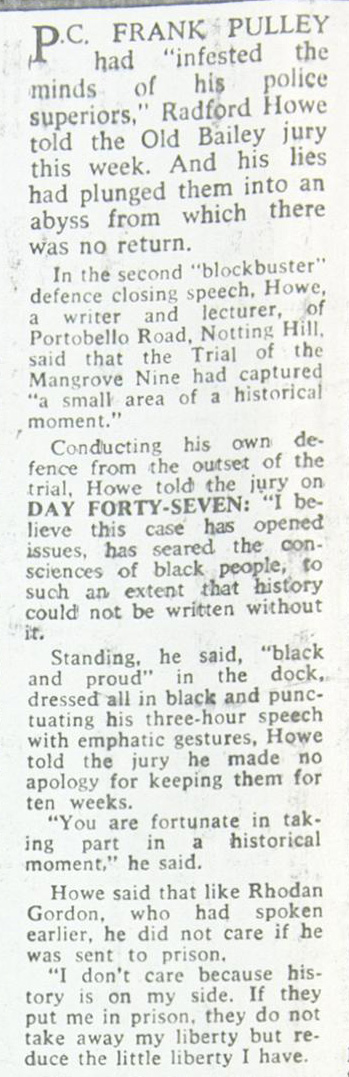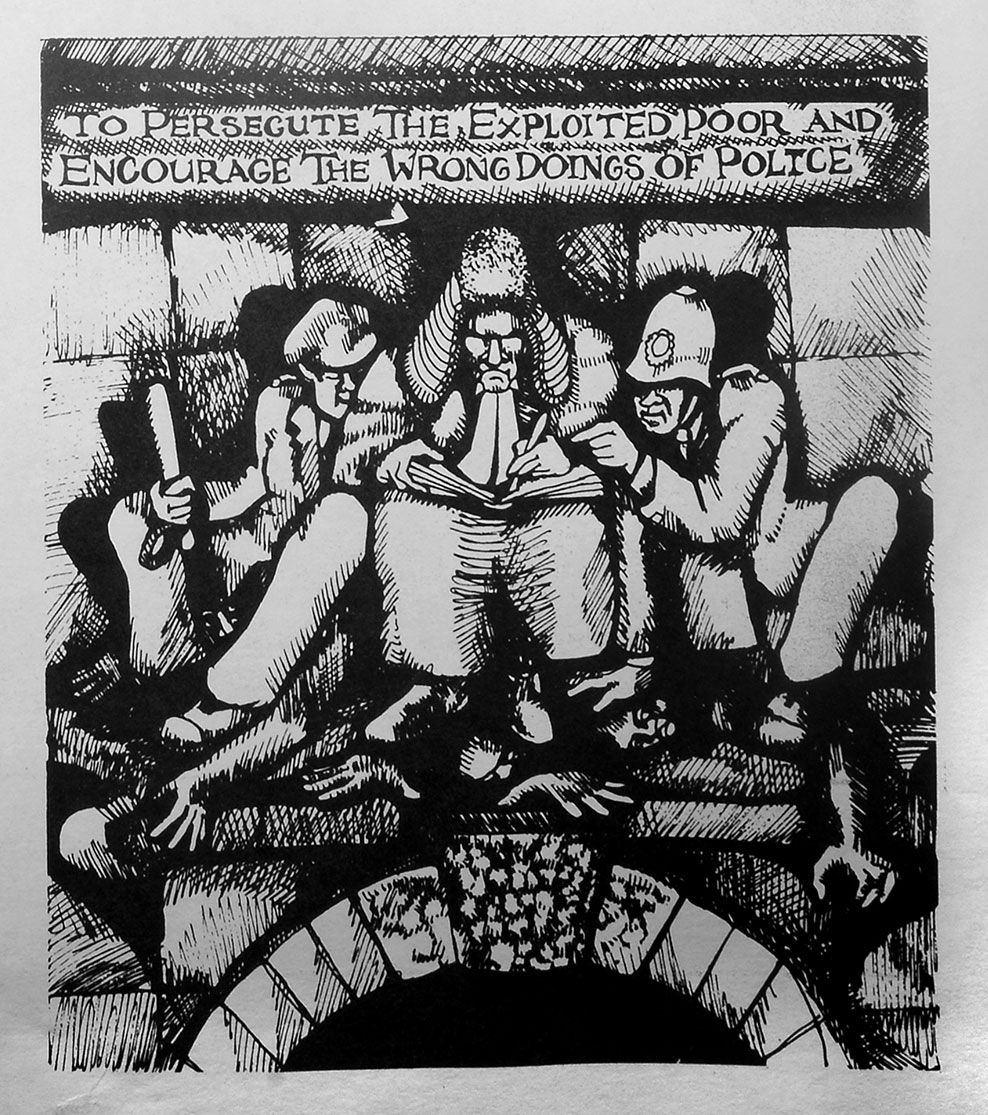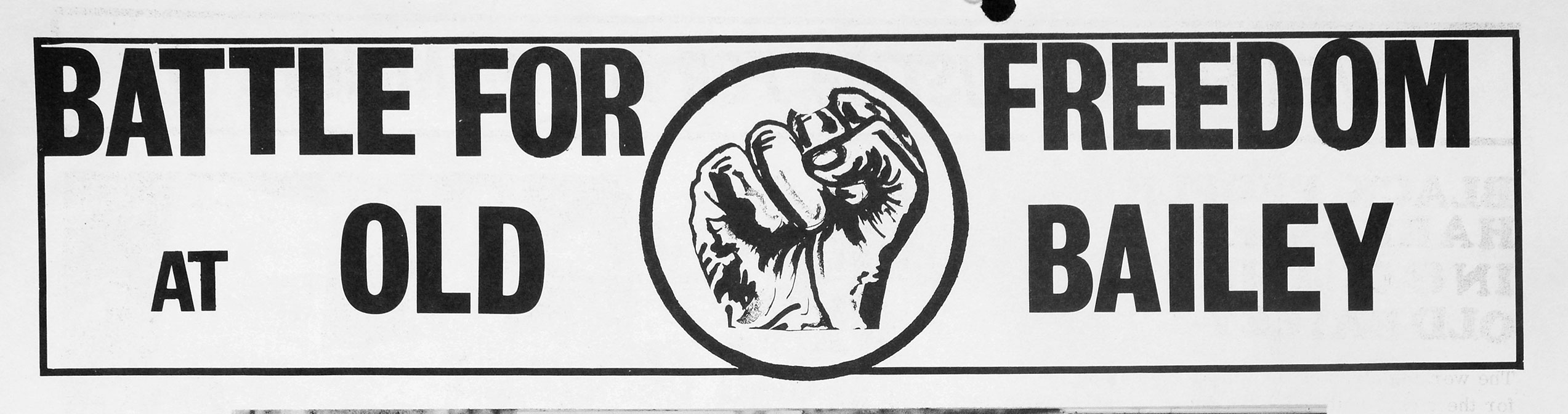
Images from a pamphlet printed in defence of the Mangrove Nine. 1971, Catalogue ref: HO 325/143 
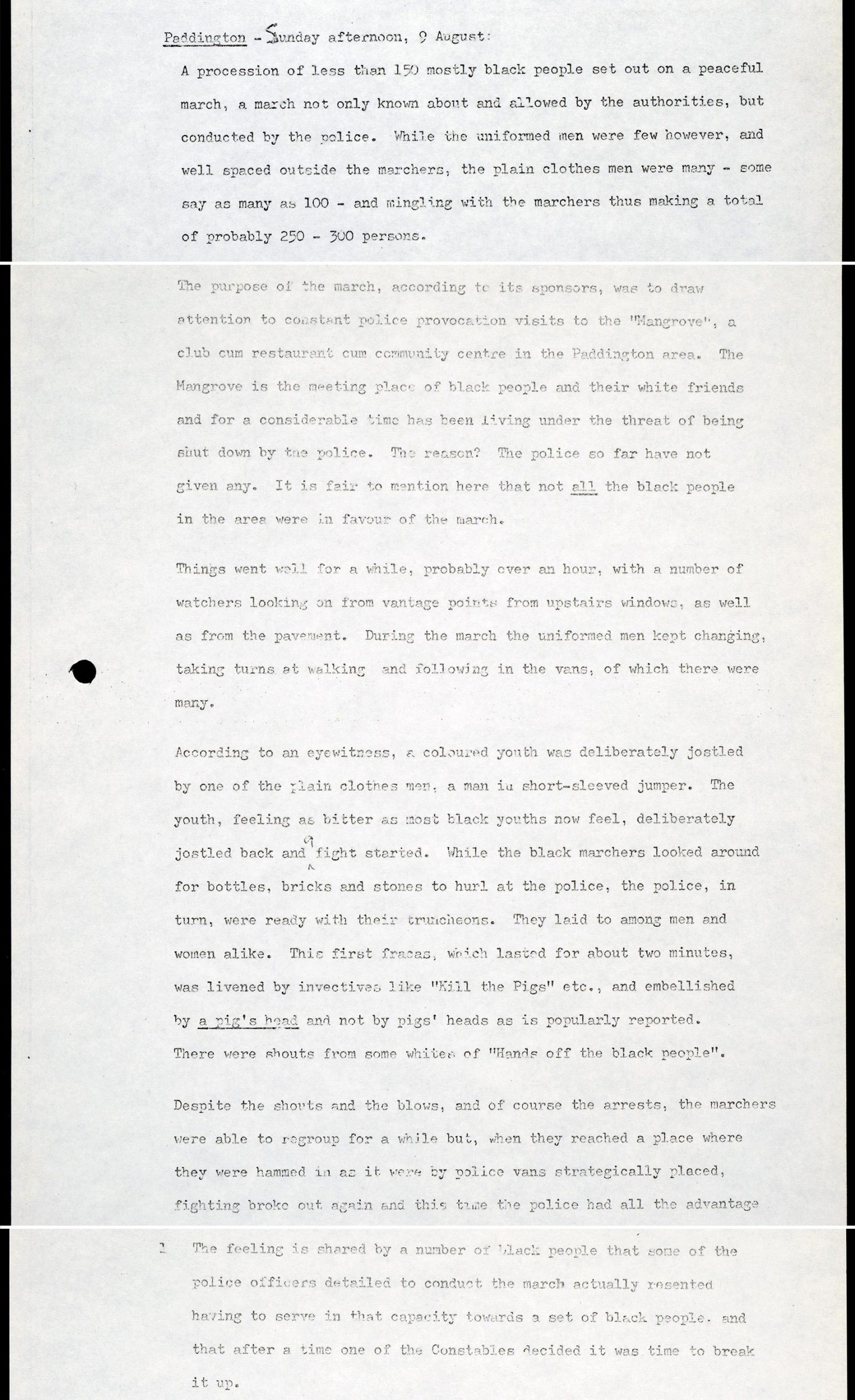
Extract from ‘Report on Police/Immigrant Relations’ by Sam Morris, 17 August 1970. Catalogue ref: HO 325/143, pp. 3-5 


Sam Morris (b.1908-d.1976), deputy-general of the Community Relations Commission was asked to write a report for the Home Secretary a week after the protest. According to Morris, this report was ‘based on eyewitness accounts. Some of those to whom I spoke are known to me personally and are quite reliable.’ 


The Community Relations Commission, established by the 1968 Race Relations Act, sought to promote good ‘community relations’ between black and minority ethnic communities and white people in Britain. Sam Morris was a Grenada-born educationalist, anti-colonialist and civil rights activist. He first came to London in 1939. After serving in the British Army for two and half years during the war, he soon began working to support the welfare of New Commonwealth Immigrants in Britain.  
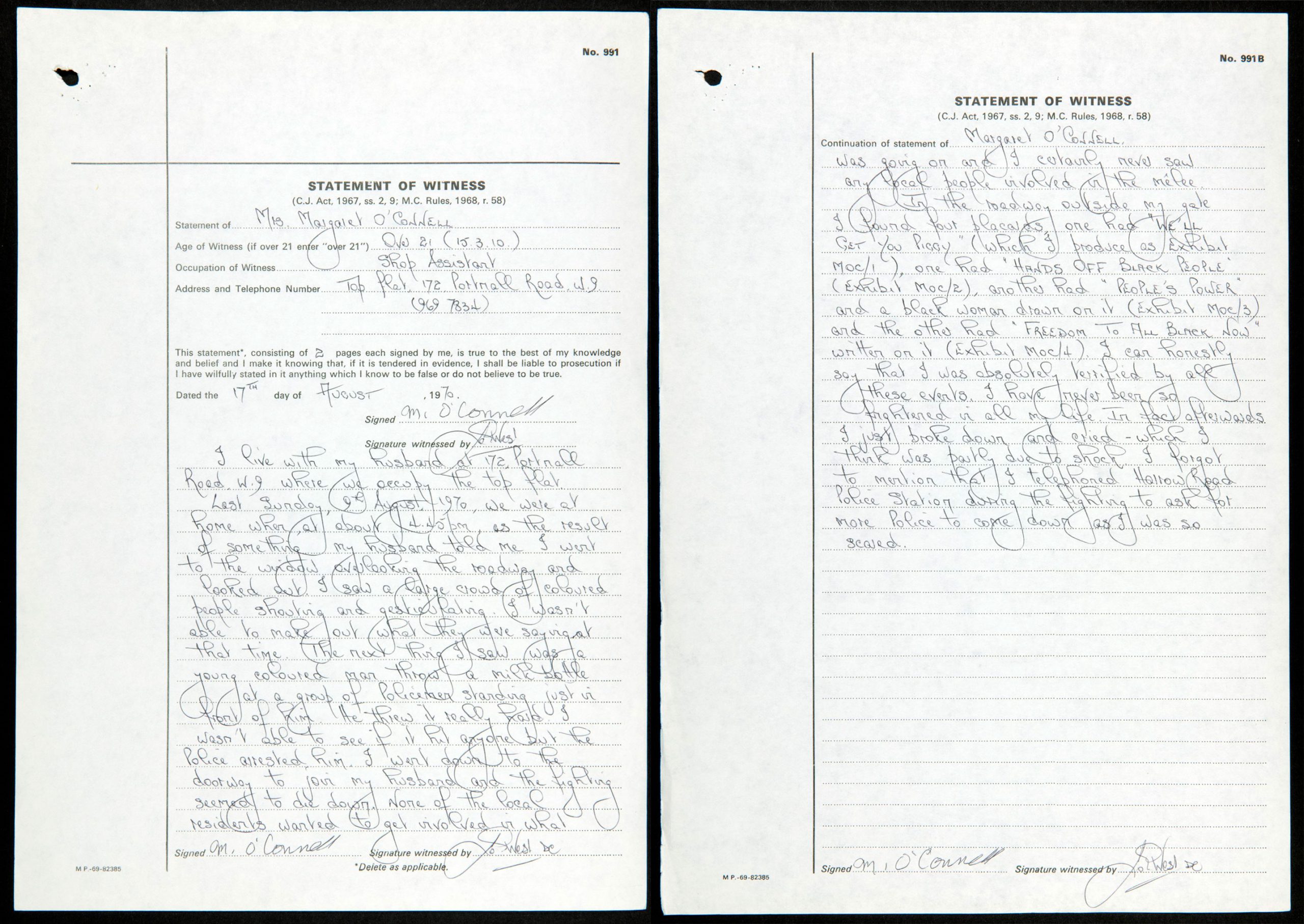
Margaret O’Connell, witness statement, Black Power demonstration and march, Notting Hill, London, 17 August 1970. Catalogue ref: MEPO 31/21 


Margaret O’Connell was a resident of the area and served as a witness for the police.   
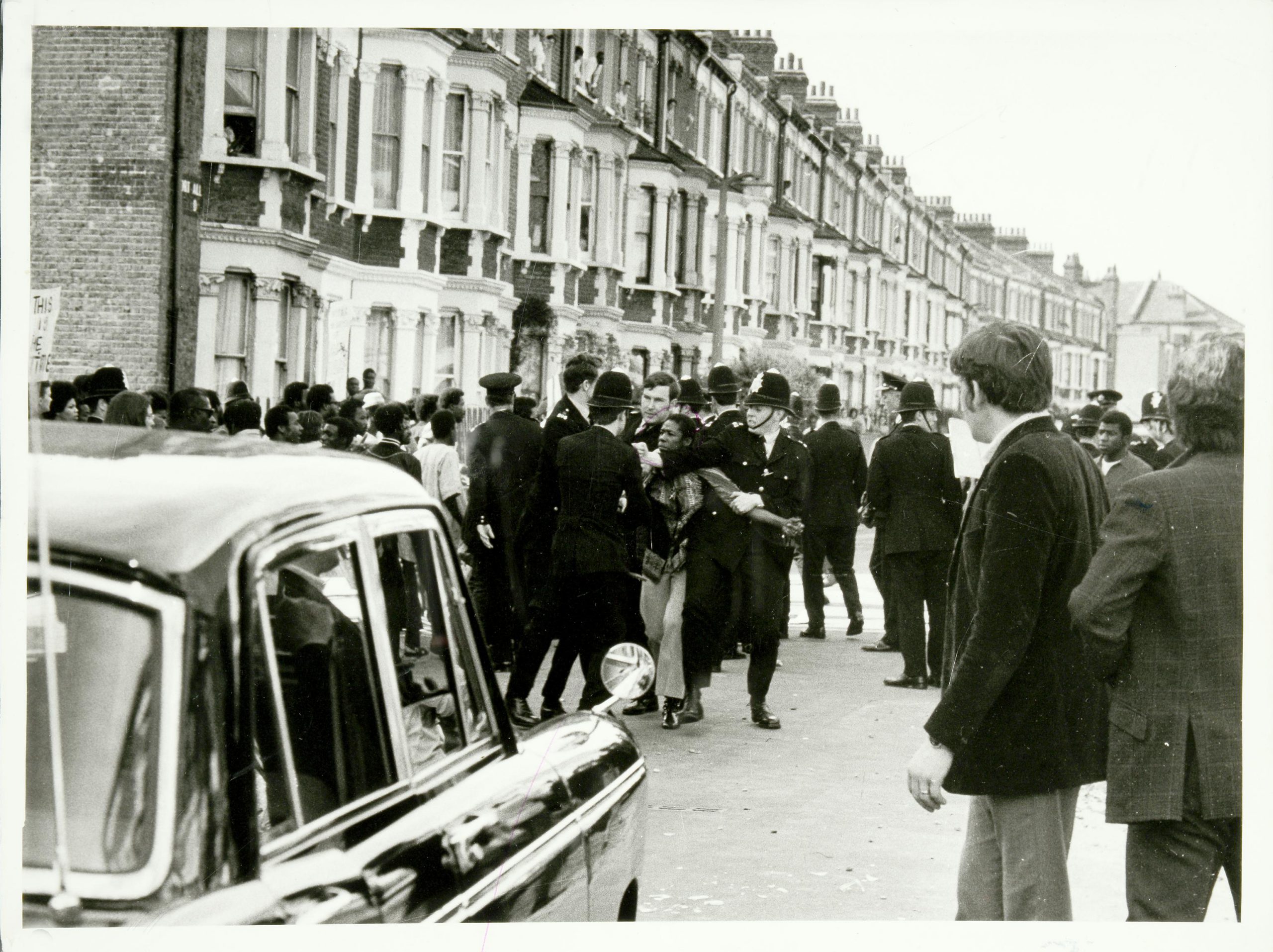
DC Colin Lynch, three photographs taken from a police file of evidence against the Mangrove Nine. Catalogue ref: MEPO 31/21 


Colin Lynch, Detective Constable attached to Special Branch, New Scotland Yard, was directed by his senior officer to ‘attend a demonstration organised by coloured people to protest against alleged police oppression in the Notting Hill area.’ He explained further: ‘I was told that in view of the violent sentiments expressed in some of the literature publicising the demonstration it was feared that public disorder might occur. Accordingly I was instructed to take photographs of the demonstration to provide a sequential record of events should disorder ensue.’  
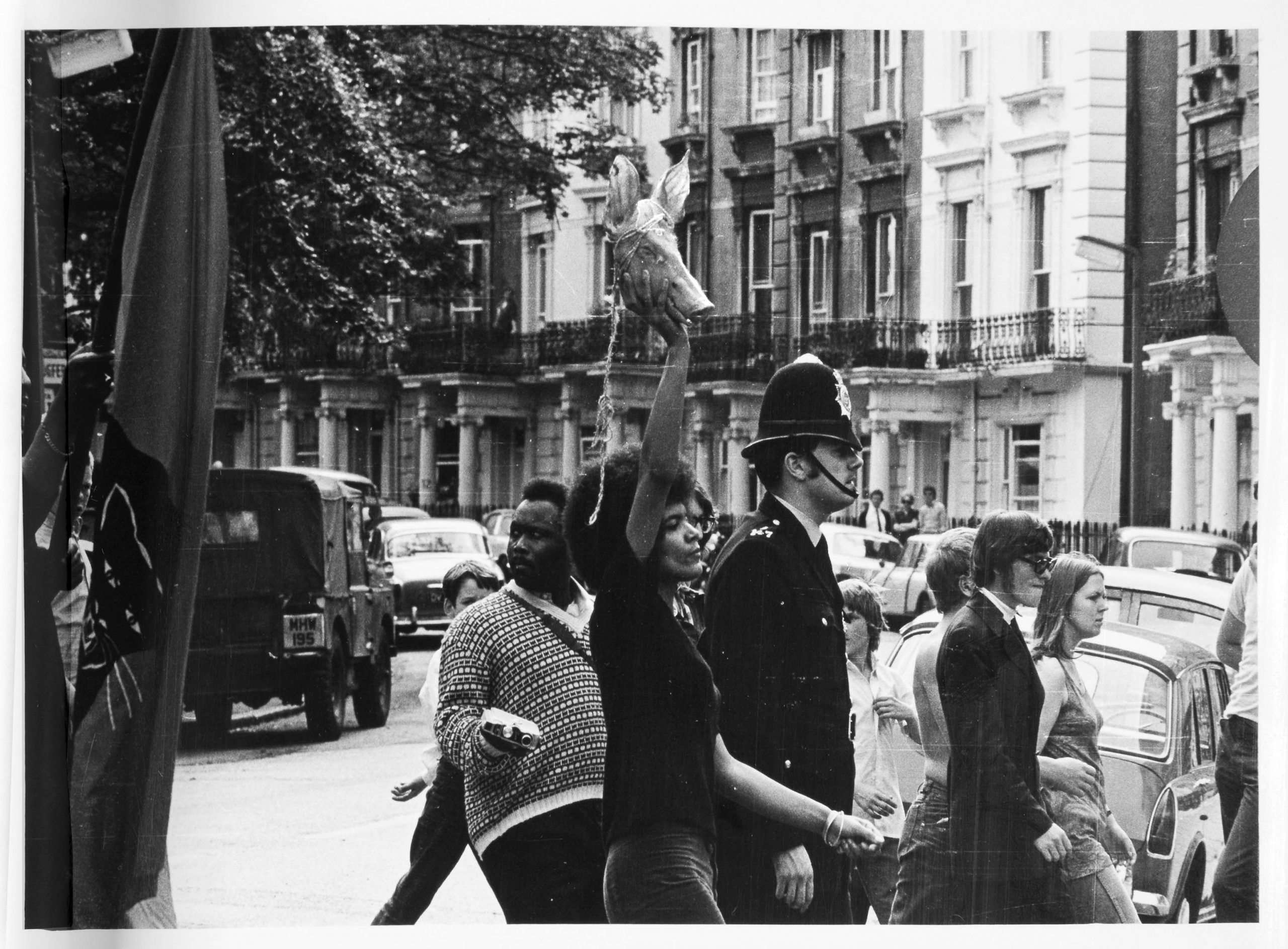
DC Colin Lynch, three photographs taken from a police file of evidence against the Mangrove Nine. Catalogue ref: MEPO 31/21 


Colin Lynch, Detective Constable attached to Special Branch, New Scotland Yard, was directed by his senior officer to ‘attend a demonstration organised by coloured people to protest against alleged police oppression in the Notting Hill area.’ He explained further: ‘I was told that in view of the violent sentiments expressed in some of the literature publicising the demonstration it was feared that public disorder might occur. Accordingly I was instructed to take photographs of the demonstration to provide a sequential record of events should disorder ensue.’  

DC Colin Lynch, three photographs taken from a police file of evidence against the Mangrove Nine. Catalogue ref: MEPO 31/21 


Colin Lynch, Detective Constable attached to Special Branch, New Scotland Yard, was directed by his senior officer to ‘attend a demonstration organised by coloured people to protest against alleged police oppression in the Notting Hill area.’ He explained further: ‘I was told that in view of the violent sentiments expressed in some of the literature publicising the demonstration it was feared that public disorder might occur. Accordingly I was instructed to take photographs of the demonstration to provide a sequential record of events should disorder ensue.’  

Newsletter entitled ‘Black People’s News Service’ published by the British Black Panther Party, the largest Black Power group in Britain, 1970. Catalogue ref: MEPO 31/21. 

Action Group statement for the Defence of the Mangrove, 1970. Catalogue ref: HO 325/143 


The Action Group provided a public statement to explain the reasons for the protest march against police harassment and the persecution of the Mangrove Restaurant. This group was set up by anti-racist activists, like the leader of Britain’s Black Panthers Althea Jones-Lacointe, and local community leaders. 

Frank Crichlow’s complaint to the Race Relations Board, 23 December, 1969. Catalogue ref: CK 2/690. 

 The Mangrove Restaurant was owned by Frank Crichlow. 


[Frank Crichlow’s Letter of Complaint, 1969. Recorded by Daniel Ooko for SPID Theatre Estate Endz Black History Project in partnership with The National Archives, Decolonising the Archive and Black Cultural Archives. Project funded by Camilla Schofield with AHRC, University of East Anglia. Aug – Oct 2020, online workshops.] 


Frank Crichlow accidentally got the month wrong when dating the bottom of the form. As both are 23rd, it seems likely he wrote the complaint when he received the letter.  This seems like a historic human error.


On 9 August 1970, a group of Black Power activists led 150 people on a march against police harassment of the black community in Notting Hill, London. They called for the ‘end of the persecution of the Mangrove Restaurant’. Between January 1969 and July 1970, the police had raided the Mangrove Restaurant twelve times. No evidence of illegal activity was found during these raids.  

Local Police Constable Frank Pulley remained convinced that the restaurant was ‘a den of iniquity’ frequented by ‘pimps, prostitutes and criminals’.¹ At the 1970 march in defence of the Mangrove, violence broke out between the police and protestors.  

The following year nine men and women were put on trial at the Old Bailey for causing a riot at the march. Their names were Darcus Howe, Frank CrichlowRhodan Gordan, Althea Jones-Lacointe, Barbara Beese, Godfrey Miller, Rupert Glasgow Boyce, Anthony Carlisle Innis and Rothwell Kentish. These men and women became known nationally as the ‘Mangrove Nine.’ When all nine defendants were acquitted of the most serious charges after a long 55-day trial, it was widely recognised as a moment of victory for black protest.    

Use this lesson to find out more about the history of Britain’s Black Power movement and the trial of the Mangrove Nine.

¹ Constable Frank Pulley quoted in ‘A Den of Iniquity,’ Kensington Post, October 12, 1971, as cited in Rob Waters, Thinking Black: Britain, 1964-1985 (2019), p. 99 

What does this reveal about police brutality and racism in '70s Britain?

(Source One and Source Two)

By 1970, the defence of the Mangrove Restaurant had become a local focal point for a much wider set of concerns about police brutality and racism within the Metropolitan police. Throughout the 1970s and early 1980s, over-policing of black and minority ethnic communities was conducted under the guise of the Vagrancy Act 1824 – the so-called ‘sus’ law – which empowered the police to stop, search and arrest a person suspected of loitering with intent to commit a criminal offence.² Many black people in Notting Hill had experienced wrongful arrest and intimidation; prior to the Mangrove protest, activists and community organisers appealed to local council members, government ministers and police chiefs about police brutality in Notting Hill, with little impact. It would take another thirty years (with the Equality Act of 2000) before race equality legislation fully applied to the police.       

The British Black Power movement helps us recognise and analyse New Commonwealth immigrants’ experiences of racism in post-war Britain and their struggles for equal treatment.  

In post-war Britain, black British people faced widespread racial discrimination and unfair treatment in their daily lives. Some white people refused to rent properties to non-white tenants. Black people were also sometimes refused service in restaurants and shops. Like many immigrant groups, Trinidadian migrants in the working-class neighbourhood of Notting Hill, London, established restaurants, churches, clubs and shops that reflected their culture and provided a safe space for community-building.  

The Mangrove Restaurant was an important example of this, serving Trinidadian food to first generation migrants and their children. As the Trinidadian migrant Clive Phillip put it, ‘It was like a sanctuary. It was family, a base for support.’³ 

The Mangrove Restaurant was a hub for Notting Hill’s black community, but it was also a meeting space for community organisers, activists and intellectuals in the area.  

Inside, the restaurant reflected the new cosmopolitan culture of 1970s Britain: with a photograph of Beatles star John Lennon hanging on the wall alongside a mural of mangrove trees, African figurines and posters decrying police brutality. Black intellectuals like CLR James and Lionel Morrison and celebrities like Jimi Hendrix, Bob Marley, Diana Ross, Marvin Gaye, Nina Simone, Sammy Davis Jr and Vanessa Redgrave had all been seen there.  

This lesson includes Mangrove owner, Frank Crichlow’s 1969 complaint to the Race Relations Board. The Race Relations Board (1965-1976) was first established by the 1965 Race Relations Act. This Act made some forms of discrimination based on race, ethnicity or national origin illegal in Britain for the first time; remarkably, the police were exempted from this equality law. Even though its powers’ were weak, the Race Relations Board gave residents of Britain the ability to record their experiences of racial discrimination.   

² Ben Bowling, Shruti Iyer and Iyiola Solanke, ‘Race, Law and the Police: Reflections on the Race Relations Act at 50,’ Justice Resistance and Solidarity: Race and Policing in England and Wales (2015), pp. 7-10, p. 7

³ For interviews of those who remember the Mangrove Restaurant, see https://www.bbc.co.uk/news/extra/jGD9WJrVXf/the-mangrove-nine-black-lives-matter

The British Black Power movement (Sources Three through Six)

The British Black Power movement emerged in London in the summer of 1967, after the American political radical Stokely Carmichael gave a public talk in Camden, London, against ‘white power’ in Britain and the United States. Stokely Carmichael followed in a long line of African American radical thinkers and activists – including Martin Luther King Jr., Malcolm X, and Angela Davis – who gave speeches in Britain and inspired British anti-racist activism. But the British Black Power Movement was not simply a bi-product of the African American freedom struggle. The legacy of the British Empire and the decolonisation of the British Caribbean loom large in this history. The fight against white supremacy in Britain was viewed by many as a continuation of the fight against colonialism.  

Throughout the post-war period, activists in Britain connected their struggles for equality in Britain to both anticolonial politics and the US civil rights movement. In fact, for many British activists in the 1970s, ‘black’ as a term did not describe any single ethnicity but instead connoted a shared experience of colonial oppression and struggle. This concept of ‘political blackness’ could encompass British South Asian, Middle Eastern, Irish, Asian, African and Afro-Caribbean communities in Britain, among others.   

Black Power activists would come to argue that revolutionary violence was a legitimate response to white supremacy, and that black people should defend themselves against state brutality in all its forms. By the end of the 1960s, Black Power was a global phenomenon. Local chapters of the Black Panther Party were present in most major US cities. In Trinidad in 1970, thousands of citizens took to the streets in massive demonstrations to support Black Power. Concerned that black revolutionary violence could happen in the UK, Scotland Yard established a ‘Black Power Desk’ in 1967 to track the activities of Black Power leaders in the UK. They worked with the British government’s Joint Intelligence Committee and the M15 and reported directly to the Home Secretary.    

The Nigerian playwright Obi B. Egbuna founded the largest and most influential British Black Power organisation in the summer of 1968, called the Black Panthers. Althea Jones-Lacointe, a PhD student who had recently moved from Trinidad to London to study biochemistry at the University of London, later became its leader.  

The trial of the Mangrove Nine (Source Seven and Source Eight)

The demonstration and the eventual three-month trial of the Mangrove Nine received national attention in the press and among politicians and activist groups. The defendants used the courtroom and the media attention of the trial as a platform to critique the racism of the police, the justice system and the British state. Both Darcus Howe and Althea Jones-Lecointe took the unusual step of defending themselves at the trial. Ian Macdonald, who was a Scottish barrister (and who would go on to spend the next three decades leading in the development of anti-racist lawyering in Britain) defended Barbara Beese. At the onset of the trial, Macdonald applied unsuccessfully to have an all-black jury on the basis that the Magna Carta enshrined the right to trial by one’s peers. Like Source Three, using the language of Black Power, Jones-Lacointe and Howe situated black people’s experiences of systemic racism and repression in a long history of colonialism and white supremacy.  

The Mangrove Nine trial captured the imagination and support of a broad range of radical ‘New Left’ groups and individuals, too, who were concerned with the protection of personal liberties and freedom of expression. These groups viewed the police harassment of black cultural centres, like the Mangrove Restaurant, and state efforts to contain and control Black Power activism as further examples of state repression. The 1971 Immigration Act, the 1971 Industrial Relations Act and the Troubles in Northern Ireland revealed, they argued, the increasing authoritarianism of the British state.    

In his summing up at the end of the trial, the presiding judge, His Honour Judge Edward Clarke QC, famously noted that the trial had ‘regrettably shown evidence of racial hatred on both sides’.  Metropolitan Police attempted, unsuccessfully, to have this statement withdrawn. While it was not until the 2000 Equalities Act that the police would come under anti-discrimination law in Britain, the trial was historic in including the first judicial acknowledgement of racial prejudice in the Metropolitan Police. Thanks in part to the Mangrove Nine trial, the 1976 Race Relations Act attracted board support. This law expanded the scope and power of anti-discrimination law in Britain and was the foundation of today’s Equality and Human Rights Commission.  

Also in Classroom resources