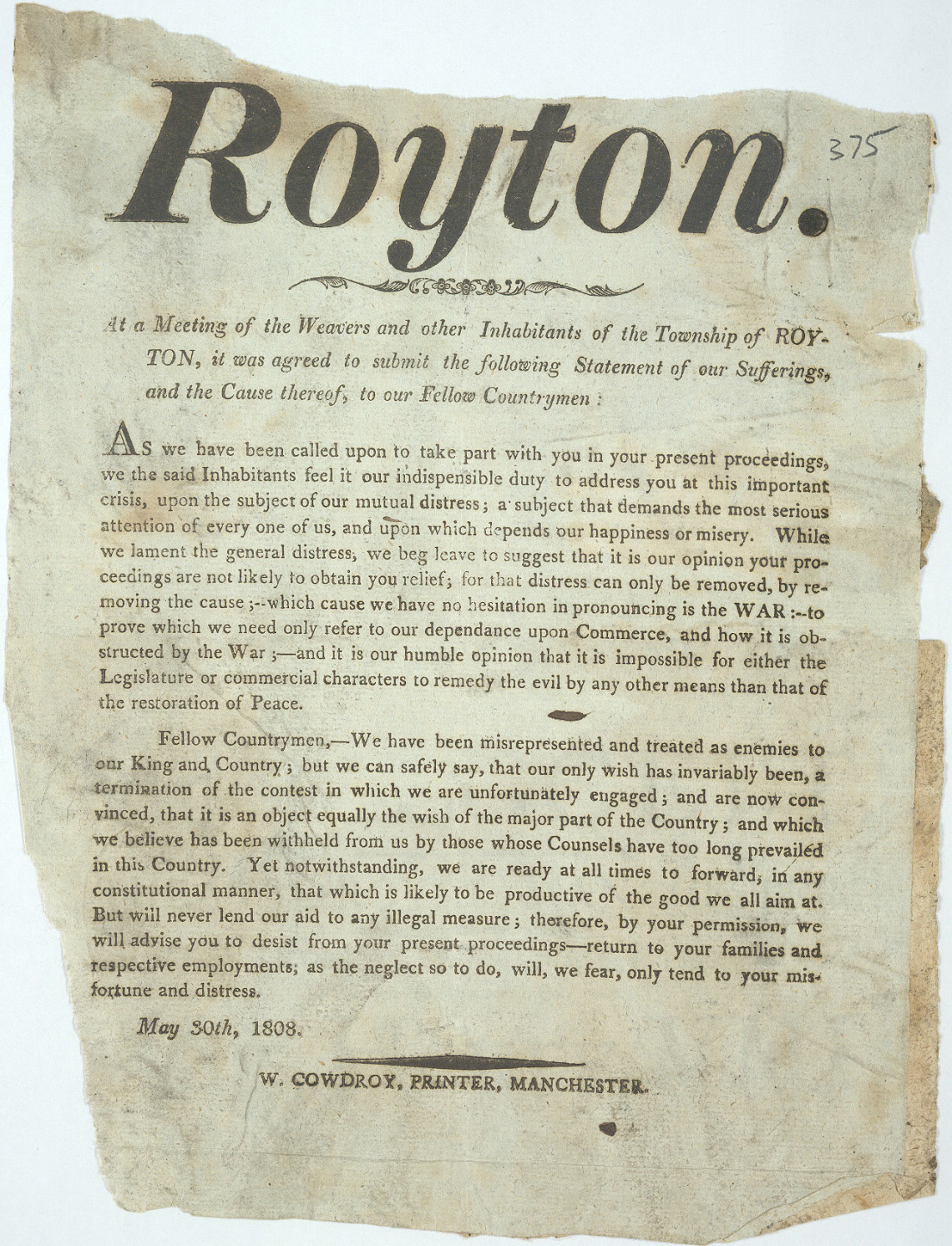
Handbill issued by the weavers and townspeople of Royton, near Manchester, Lancashire in May 1808, after Parliament rejected a bill to guarantee the weavers a minimum wage. Catalogue ref: HO 42/95 f.375
The Napoleonic War lasted from 1802-1812.
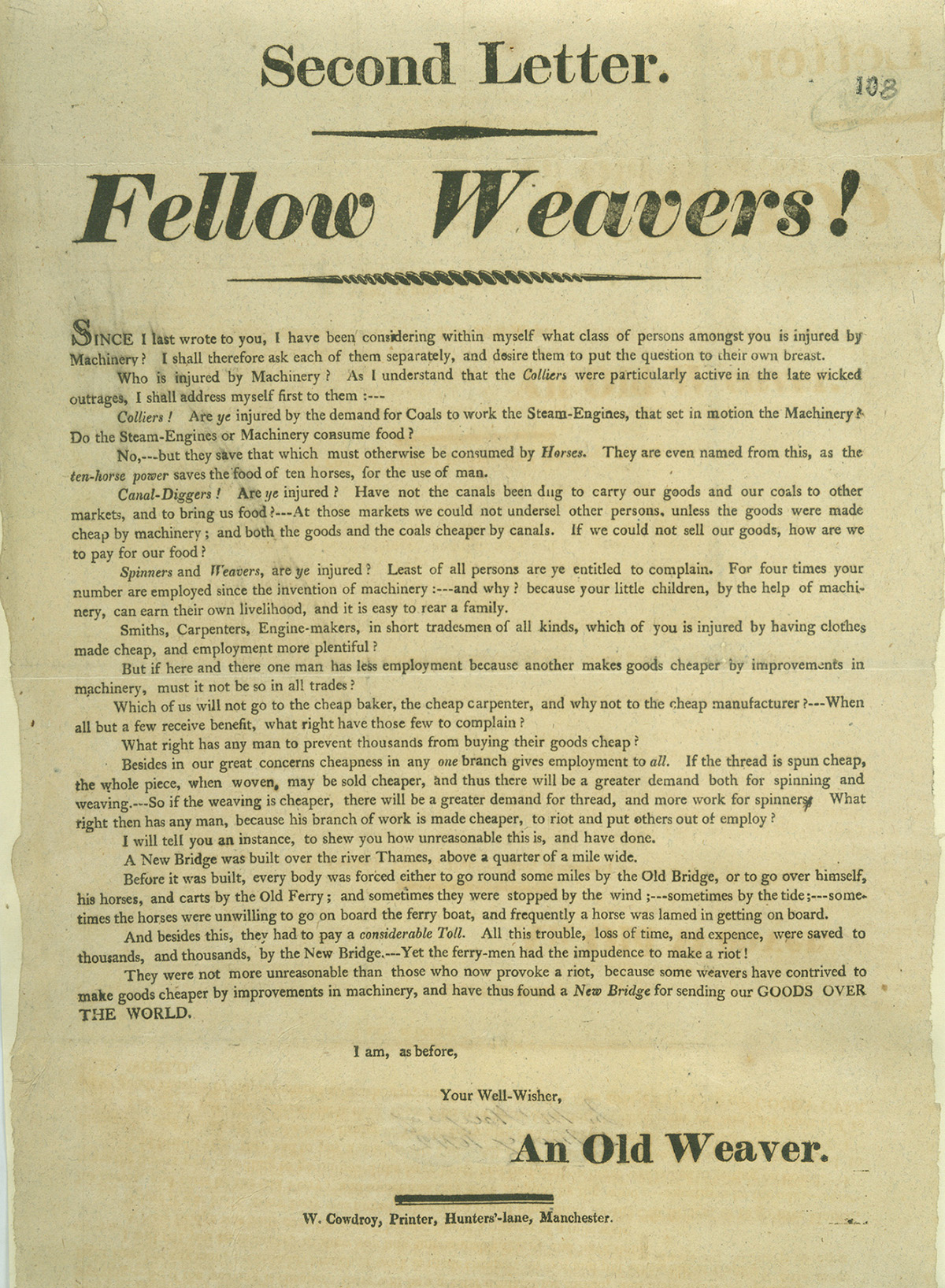
A handbill entitled ‘Fellow Weavers’, printed in March 1812 in Manchester, one of the main centres for the cotton industry. Catalogue ref: HO 40/1/1, f.108
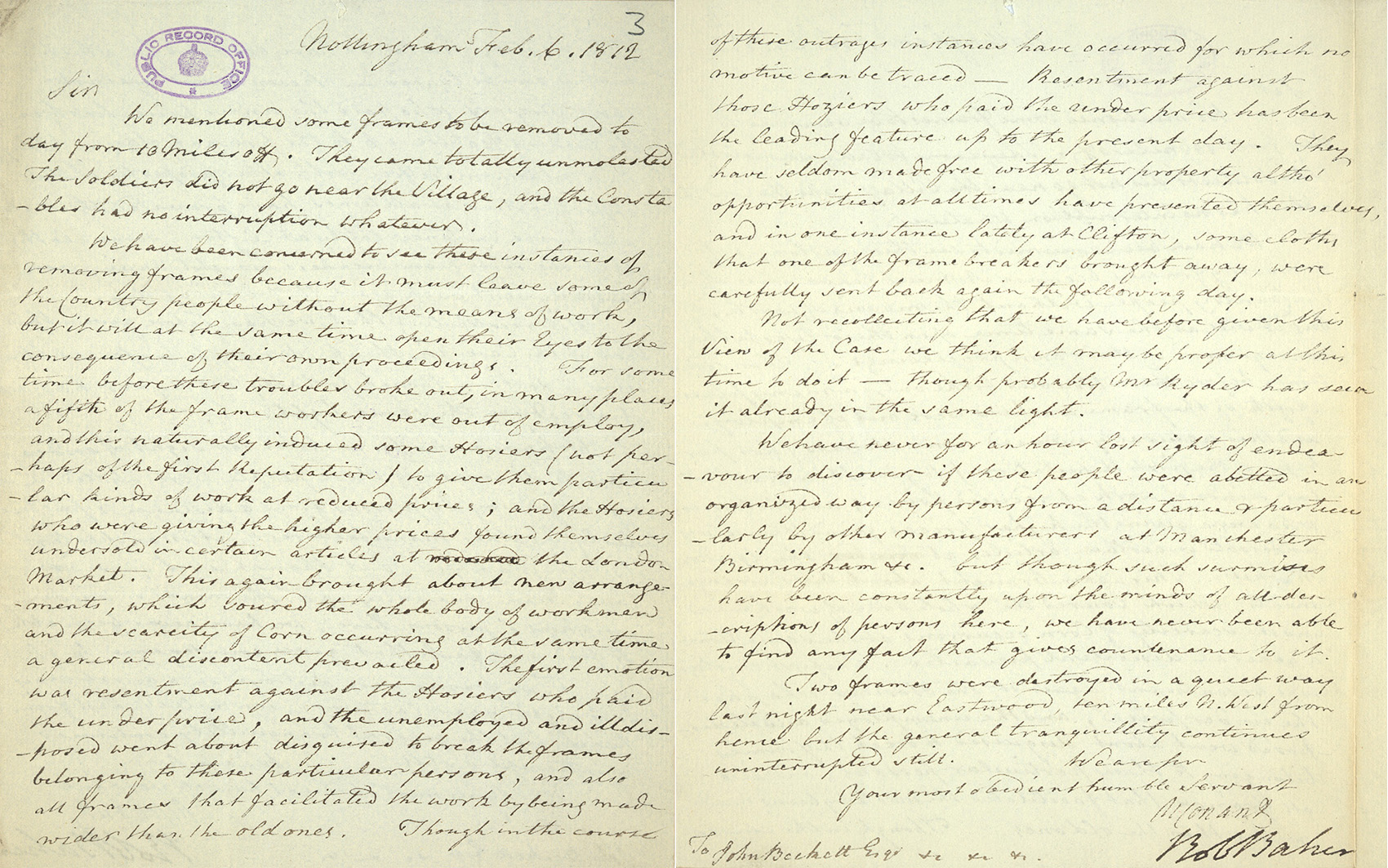
A letter from magistrate Robert Baker describing the situation in Nottingham in February 1812. Catalogue ref: HO 42/120 f.3-4
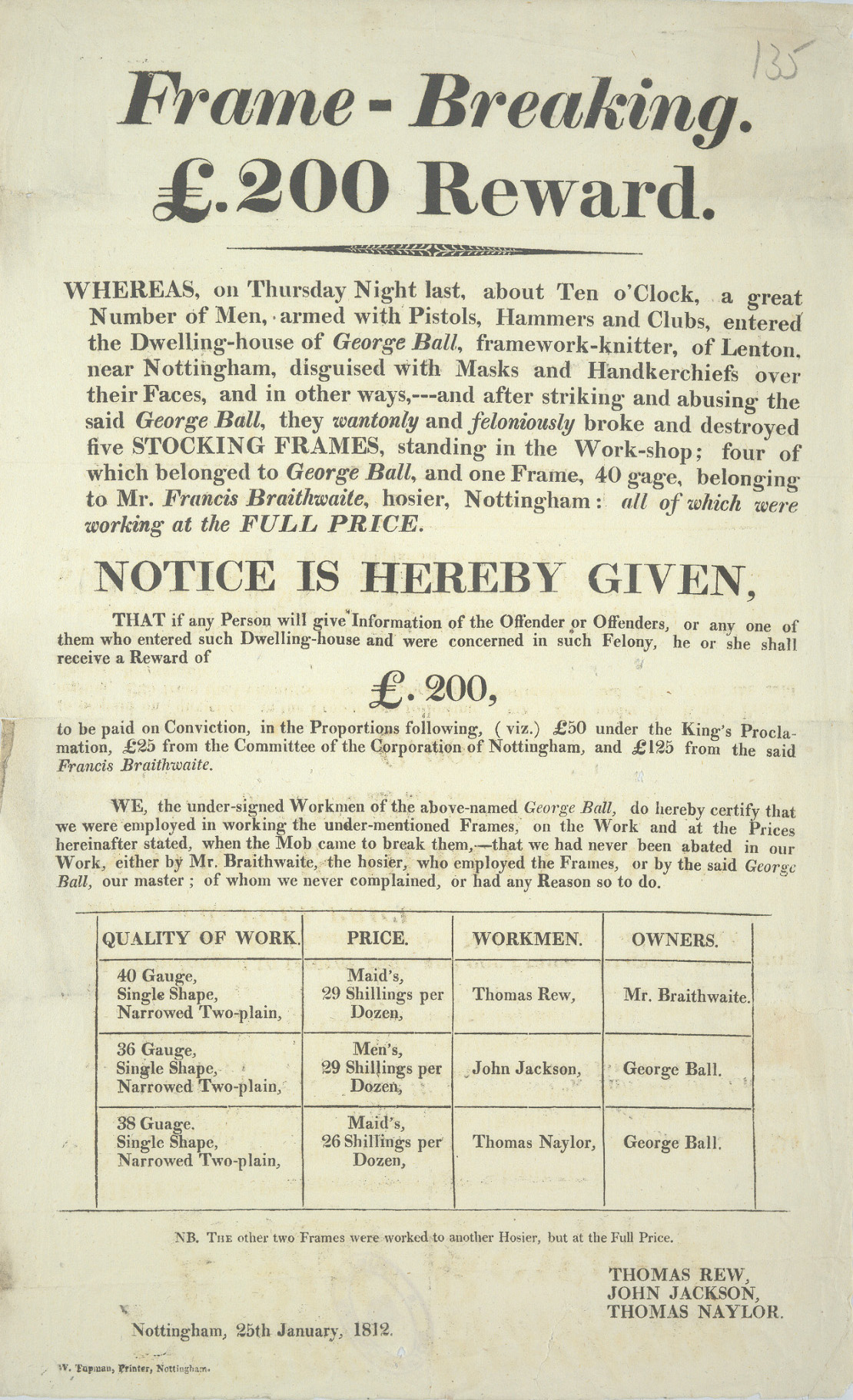
‘Reward’ poster for the arrest and conviction of men who destroyed three knitting machines in January 1812. Catalogue ref: HO 42/119 f.135
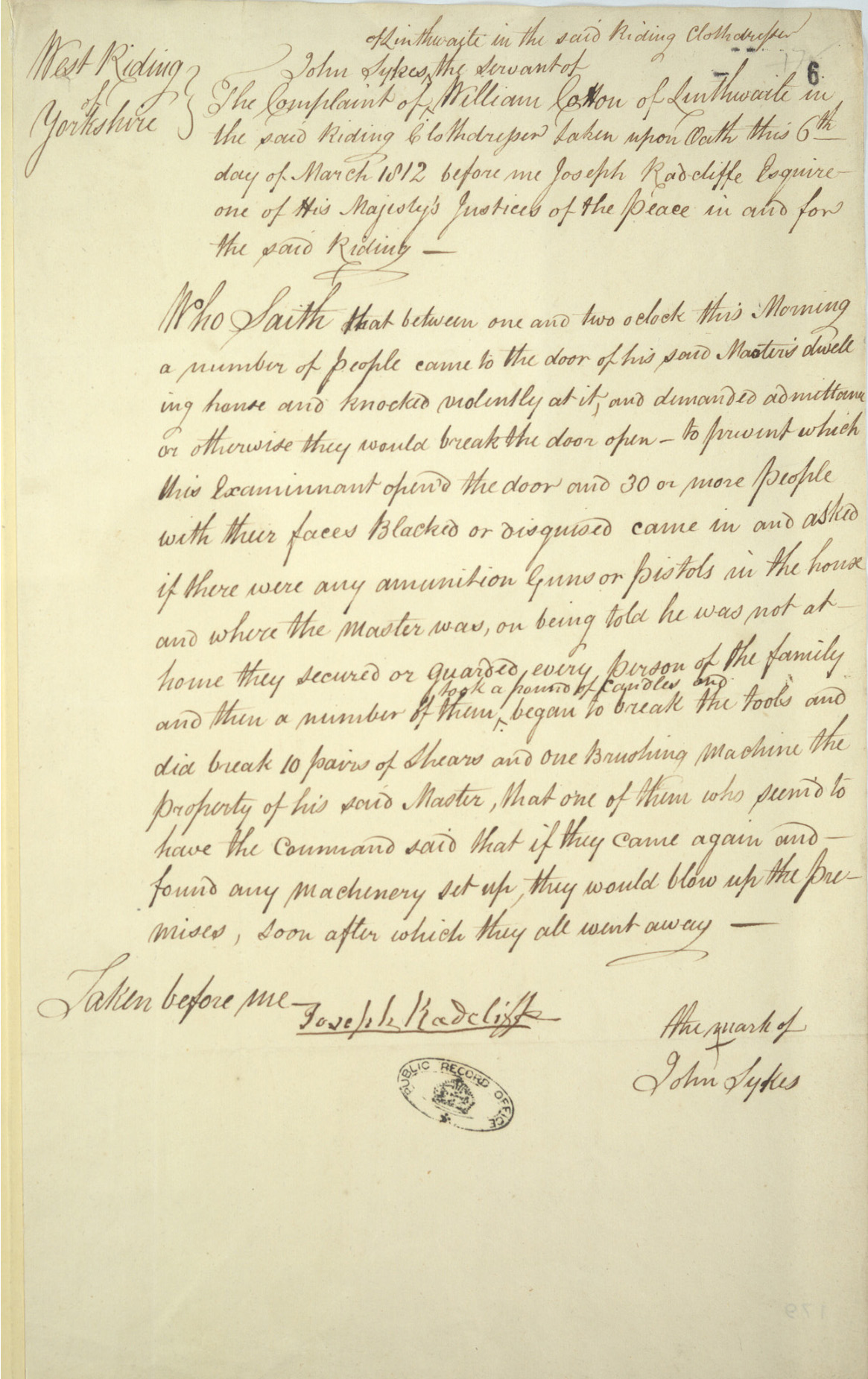
An account of machine-breaking at Linthwaite, Yorkshire, March, 1812. Catalogue ref: HO 40/1/1, part 2, f.6
This is evidence given by a servant called John Sykes to the local Justice of the Peace.
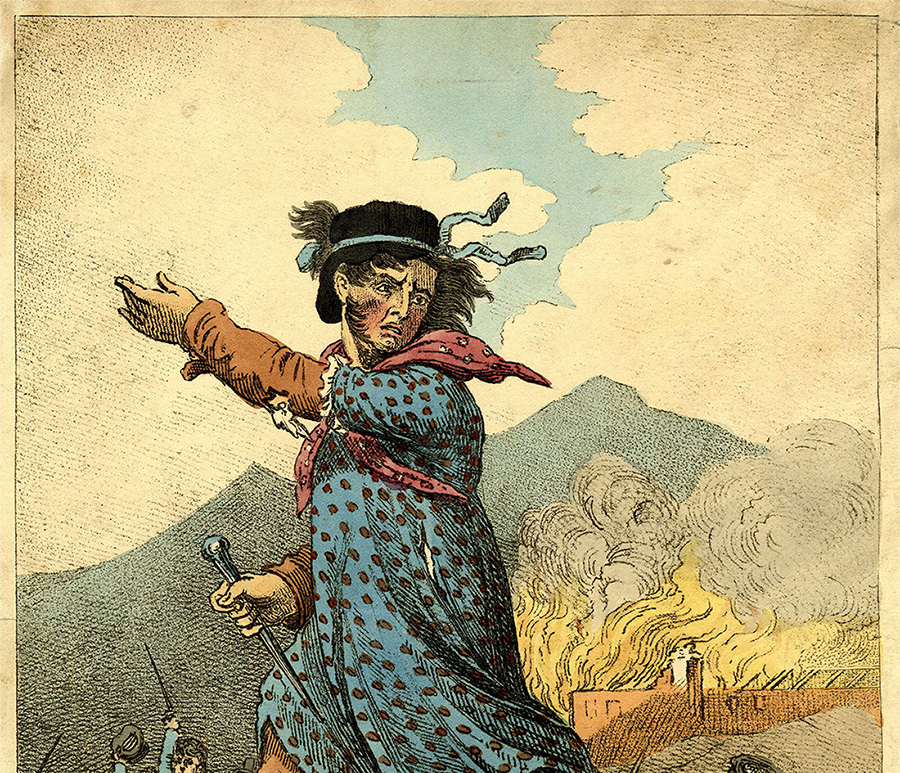
The machine-breaking disturbances that rocked the wool and cotton industries were known as the ‘Luddite riots’. The Luddites were named after ‘General Ned Ludd’ or ‘King Ludd’, a mythical figure who lived in Sherwood Forest and supposedly led the movement.
They began in Nottinghamshire in 1811 and quickly spread throughout the country, especially to the West Riding of Yorkshire and Lancashire in 1812, and also to Leicestershire and Derbyshire. In Yorkshire, they wanted to get rid of the new machinery that was causing unemployment among workers. Hand loom weavers did not want the introduction of power looms. In Nottinghamshire, they protested against wage reductions.
Workers sent threatening letters to employers and broke into factories to destroy the new machines, such as the new wide weaving frames. They also attacked employers, magistrates and food merchants. There were fights between Luddites and government soldiers.
Using the original documents in this lesson, find out how the Luddites protested against changes affecting their working conditions. How did the government respond?
Political reform in 19th century BritainTo catch the machine-breakers, men were engaged to guard the factories and rewards were offered for information. The government sent thousands of troops to the areas where there had been trouble. In 1812, machine-breaking became a crime punishable by death and 17 men were executed the following year. The Luddites were very effective, and some of their biggest actions involved as many as 100 men, but there were relatively few arrests and executions. This may be because they were protected by their local communities.
The disturbances continued for another five years. The crisis was made worse by food shortages as the price of wheat increased, and by the collapse of hosiery and knitwear prices in 1815 and 1816. Various attempts were made to find a compromise, but problems remained until the middle of the nineteenth century, by which time the woollen industry had moved away from hand-production.
The Luddites were not the first group of workers to face problems at the beginning of the nineteenth century. Some of the country’s economic difficulties were put down to the Napoleonic War (1802-1812), which disrupted trade between countries.
The Luddites have been described as people violently opposed to technological change and the riots put down to the introduction of new machinery in the wool industry.
Luddites were protesting against changes they thought would make their lives much worse, changes that were part of a new market system. Before this time, craftspeople would do their work for a set price, the usual price. They did not want this new system that involved working out how much work they did, how much materials cost, and how much profit there would be for the factory owner.

What can archives reveal about people’s lives in the 1920s?
This resource was created as a result of 20sStreets, a project designed to bring local history to life for students. The National Archives collaborated with four local archives: Tower Hamlets, Lancashire, West Yorkshire and Kresen Kernow, to help children explore life in one local street 100 years ago. This education resource includes eight selected case studies from this project. Each case study focuses on a different household in the 1920s, firstly through the 1921 census, then a range of documents from archival collections. The locations explored are Tower Hamlets, Accrington, Wakefield and Falmouth. Students are encouraged to be history detectives, investigating people’s lives using documents as clues. This helps pupils gain a deeper understanding of what life was like 100 years ago, what people’s jobs were, how they had fun and what their houses might have looked like. This resource can also open up a discussion about what information archives contain and how they can help us find out about ordinary people’s lives. It is suggested that students are divided in to groups focusing on different case studies. There are also creative activities included to extend student’s learning.
Watch our film about the project created by Postcode Films.
Find out more about the 20sStreets project
Download the PDF resource pack (22.6MB)
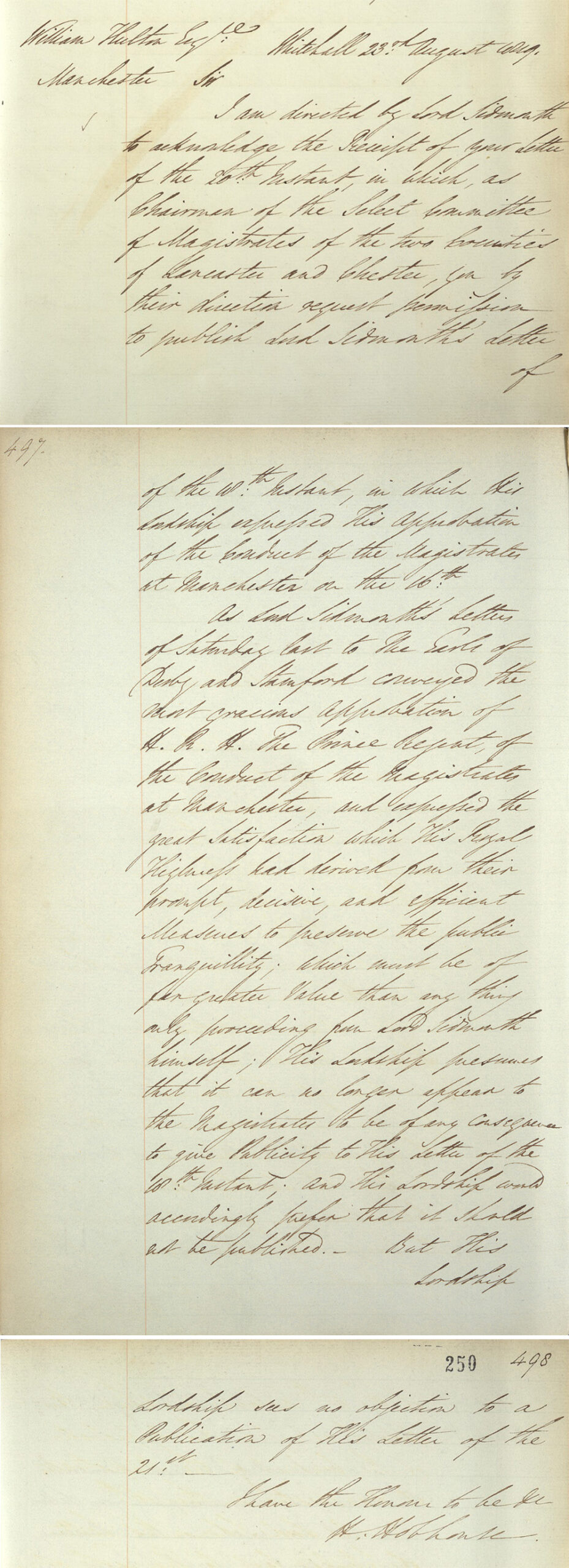
Letter from the Home Office on the conduct of the Manchester magistrates, 23 August 1819, Catalogue ref: HO 41/4 f.496