






youtube.com
Who were the Luddites? | The Battle of Rawfolds Mill 1812
This video from Royal Holloway, University of London, filmed at The National Archives, looks at Luddism and the attack on Rawfolds Mill in 1812.
Teaching resource
The machine-breaking disturbances that rocked the wool and cotton industries in the 19th century were known as the ‘Luddite riots’. Using the original documents in this lesson, find out how the Luddites protested against changes affecting their working conditions. How did the government respond?

The Leader of the Luddites satirical cartoon, May 1812.
The Trustees of the British Museum (CC BY-NC-SA 4.0)
What methods did they use to protest about their working conditions?
Teachers could use this satirical illustration of Ned Ludd from the British Museum as a starter document to introduce the lesson.

The Leader of the Luddites satirical cartoon, May 1812.
The Trustees of the British Museum (CC BY-NC-SA 4.0)
This is evidence given by a servant called John Sykes to the local Justice of the Peace.

West Riding of Yorkshire
The complaint of John Sykes of Linthwaite in the said Riding clothdraper, the servant of William Cotton of Linthwaite in the said Riding clothdresser taken upon oath this 6th day of March 1812 before me Joseph Radcliffe Esquire one of His Majesty’s Justices of the Peace in and for the said Riding –
Who saith [said] that between one and two o clock this Morning a number of people came to the door of his said Master’s dwelling house and knocked violently at it, and demanded admittance or otherwise they would break the door open – to prevent which this Examinnant [witness] opened the door and 30 or more people with their faces blacked or disguised came in and asked
If there were any amunition [ammunition] guns or pistols in the house and where the Master was, on being told he was not at home they secured or guarded every person of the family and then a number of them took a pound of candles and began to break the tools and did break 10 pairs of shears and one brushing machine the property of his said Master, that one of them who seemed to have the command said that if they came again and found any machinery set up, they would blow up the premises, soon after which they all went away –
Taken [sworn on oath] before me – Joseph Radcliffe
The mark of John Sykes
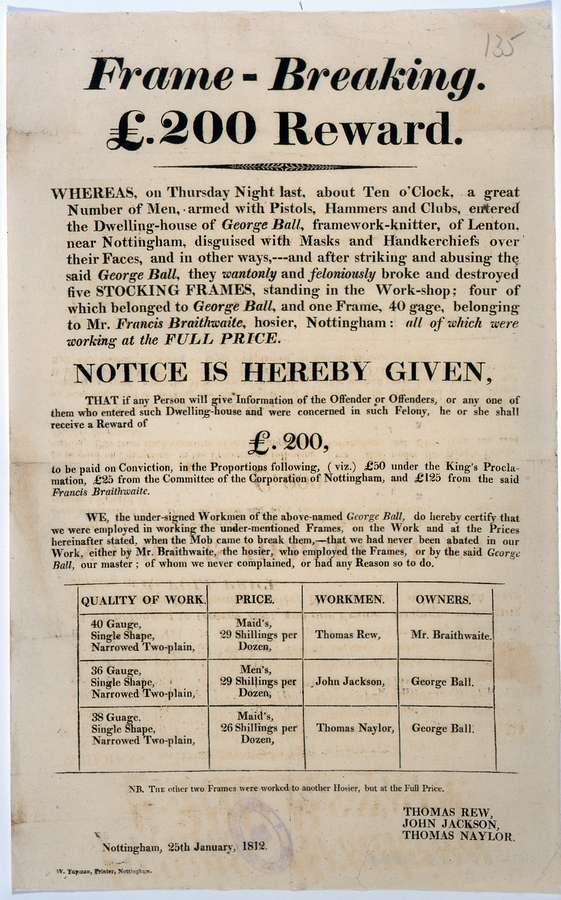
‘Reward’ poster for the arrest and conviction of men who destroyed three knitting machines in January 1812. Catalogue reference: HO 42/119 f.135

Frame – Breaking.
£200 Reward.
WHEREAS, on Thursday Night last, about Ten o’ Clock, a great Number of Men, armed with Pistols, Hammers and Clubs, entered the Dwelling-house of George Ball, framework-knitter, of Lenton, near Nottingham, disguised with Masks and Handkerchiefs over their Faces, and in other ways, – and after striking and abusing the said George Ball, they wantonly and feloniously [against the law] broke and destroyed five STOCKING FRAMES, standing in the Work-shop; four of which belonged to George Ball, and one Frame, 40 gauge, belonging to Mr. Francis Braithwaite, hosier, Nottingham: all of which were working at the FULL PRICE.
NOTICE IS HEREBY GIVEN,
THAT if any Person will give Information of the Offender or Offenders, or any one of them who entered such Dwelling-house and were concerned in such Felony, he or she shall receive a Reward of
£.200,
to be paid on Conviction [found guilty], in the Proportions [amounts] following, (viz.) £50 under the King’s Proclamation, £25 from the Committee of the Corporation of Nottingham, and £125 from the said Francis Braithwaite.
WE, the under-signed Workmen of the above-named George Ball, do hereby certify that we were employed in working the under-mentioned Frames, on the Work and at the Prices hereinafter stated, when the Mob came to break them, – that we had never been abated [called to ease off] in our Work, either by Mr. Braithwaite, the hosier, who employed the Frames, or by the said George Ball, our master; of whom we never complained, or had any Reason so to do.
Reward poster for the arrest and conviction of men who destroyed three knitting machines in January 1812. Catalogue reference: HO 42/119 f.135

Nottingham Feb, 6, 1812
Sir
We mentioned some frames to be removed today from 10 miles off. They came totally unmolested [undamaged]. The soldiers did not go near the village, and the constables had no interruption whatever.
We have been concerned to see these instances of removing frames because it must leave some of the country people without the means of work, but it will at the same time open their eyes to the consequence of their own proceedings. For some time before these troubles broke out, in many places a fifth of the frame workers were out of employ, and this naturally induced some hosiers (not perhaps of the first reputation) to give them particular kinds of work at reduced prices; and the hosiers who were giving the higher prices found themselves undersold in certain articles at the London Market.
This again brought about new arrangements, which soured the whole body of workmen and the scarcity of corn occurring at the same time a general discontent prevailed. The first emotion was resentment against the hosiers who paid the under-prices and the unemployed and ill-disposed went about disguised to break the frames belonging to these particular persons, and also all frames that facilitated the work by being made wider than the old ones. Though in the course of these outrages instances have occurred for which no motive can be traced – resentment against those hosiers who paid the under-price has been the leading feature up to the present day. They have seldom made free with other property although opportunities at all times have presented themselves, and in one instance lately at Clifton, some cloths that one of the frame breakers brought away, were carefully sent back again the following day.
Not recollecting that we have before given this view of the case we think it may be proper at this time to do it—though probably Mr Ryder has seen it already in the same light.
We have never for an hour lost sight of endeavour discover if these people were abetted [encouraged] in an organized way by persons from a distance and particularly by other manufacturers at Manchester, Birmingham etc., but though such surmises have been constantly upon minds of all descriptions of persons here, we have never been able to find any fact that gives countenance [proof] to it.
Two frames were destroyed in a great way last night near Eastwood, ten miles North West from here but the general tranquillity continues uninterrupted still.
We are Sir,
Your most obedient humble servant
A letter from magistrate Robert Baker describing the situation in Nottingham in February 1812. Catalogue reference: HO 42/120 f.3-4

Fellow Weavers!
Since I last wrote to you, I have been considering within myself what class of persons amongst you is injured by Machinery? I shall therefore ask each of them separately, and desire them to put the question to their own breast.
Who is injured by Machinery? As I understand that the Colliers were particularly active in the late wicked outrages, I shall address myself first to them: –
Colliers! [Coal worker/dealers in coal] Are ye injured by the demand for Coals to work the steam-engines that set in motion the Machinery? Do the Steam-Engines or Machinery consume food?
No, – but they save that which must otherwise be consumed by Horses. They are even named from this, as the ten-horse power saves the food of ten horses, for the use of man.
Canal-Diggers! Are ye [you] injured? Have not the canals been dug to carry our goods and our coals to other markets, and to bring us food? – At those markets we could not undersell other persons, unless the goods were made cheap by machinery; and both the goods and the coals cheaper by canals. If we could not sell our goods, how are we to pay for our food?
Spinners and Weavers, are ye injured? Least of all persons are ye entitled to complain. For four times your number are employed since the invention of machinery: – and why? Because your little children, by the help of machinery, can earn their own livelihood, and it is easy to rear a family.
Smiths [Metal workers e.g. blacksmith/silversmith] Carpenters, Engine-makers, in short tradesmen of all kinds, which of you is injured by having clothes made cheap, and employment more plentiful?
But if here and there one man has less employment because another makes goods cheaper by improvements in machinery, must it not be so in all trades?
Which of us will not go to the cheap baker, the cheap carpenter, and why not to the cheap manufacturer? – When all but a few receive benefit, what right have those few to complain?
What right has any man to prevent thousands from buying their goods cheap?
Besides in our great concerns cheapness in any one branch gives employment to all. If the thread is spun cheap, the whole piece, when woven, may be sold cheaper, and thus there will be a greater demand both for spinning and weaving. – So if the weaving is cheaper, there will be a greater demand for thread, and more work for spinners. What right then has any man, because his branch of work is made cheaper, to riot and put others out of employ?
I will tell you an instance, to shew you how unreasonable this is, and have done.
A New Bridge was built over the river Thames, above a quarter of a mile wide.
Before it was built, everybody was forced either to go round some miles by the Old Bridge, or to go over himself, his horses, and carts by the Old Ferry; and sometimes they were stopped by the wind; – sometimes by the tide; – sometimes the horses were unwilling to go on board the ferry boat, and frequently a horse was lamed in getting on board.
And besides this, they had to pay a considerable Toll. All this trouble, loss of time, and expence, were saved to thousands, and thousands, by the New Bridge. – Yet the ferry-men had the impudence to make a riot!
They were not more unreasonable than those who now provoke a riot, because some weavers have contrived to make goods cheaper by improvements in machinery, and have thus found a New Bridge for sending our GOODS OVER THE WORLD.
I am, as before,
Your Well-Wisher,
An Old Weaver
A handbill entitled ‘Fellow Weavers’, printed in March 1812 in Manchester, one of the main centres for the cotton industry. Catalogue reference: HO 40/1/1, f.108

Royton.
At a Meeting of the Weavers and other Inhabitants of the Township of ROYTON, it was agreed to submit the following Statement of our Sufferings, and the Cause thereof, to our Fellow Countrymen:
As we have been called upon to take part with you in your present proceedings, we the said Inhabitants feel it our indispensable duty to address you at this important crisis, upon the subject of our mutual distress; a subject that demands the most serious attention of every one of us, and upon which depends our happiness or misery. While we lament the general distress; we beg leave to suggest that it is our opinion your proceedings are not likely to obtain you relief; for that distress can only be removed, by removing the cause; – which cause we have no hesitation in pronouncing is the WAR: – to prove which we need only refer to our dependence upon Commerce, and how it is obstructed by the War; – and it is our humble opinion that it is impossible for either the Legislature or commercial characters to remedy the evil by any other means than that of the restoration of Peace.
Fellow Countrymen, – We have been misrepresented and treated as enemies to our King and Country; but we can safely say, that our only wish has invariably been, a termination of the contest in which we are unfortunately engaged; and are now convinced, that it is an object equally the wish of the major part of the Country; and which we believe has been withheld from us by those whose Counsels have too long prevailed in this Country. Yet notwithstanding, we are ready at all times to forward, in any constitutional manner, that which is likely to be productive of the good we all aim at. But will never lend our aid to any illegal measure; therefore, by your permission, we will advise you to desist from your present proceedings – return to your families and respective employments; as the neglect so to do, will, we fear, only tend to your misfortune and distress.
May 30th, 1808.
Handbill issued by the weavers and townspeople of Royton, near Manchester, Lancashire in May 1808, after Parliament rejected a bill to guarantee the weavers a minimum wage. Catalogue reference: HO 42/95 f.375
Students use sources from The National Archives to explore how the Luddites protested against changes in their working conditions. Before starting the lesson define the following terms:
The second source in this lesson examines an account of machine-breaking at Linthwaite, Yorkshire in March 1812. Students explore what happened and can consider the nature of the domestic system and the impact of new machinery such as power looms on skilled weavers. The ‘the mark of John Sykes’ suggests that the witness could not write and sign his own name. Students can discuss what other sources might provide evidence to explain the actions of those who broke machinery according to this account.
The third source is a printed ‘reward’ poster for the arrest and conviction of men who destroyed three knitting machines in January 1812. The document infers how employers and local authorities viewed and responded to the attacks on machinery. It also gives us information about wages paid to weavers. Teachers can discuss the meaning of the catalogue code ‘HO’, meaning Home Office. The document is a Home Office record. These records often concern threats to law and order, which explains why this poster exists in the collection.
Students then look at a letter sent to the Home Office from a magistrate describing the situation in Nottingham in February 1812. They consider how manufacturers tried to prevent the attacks on machinery. With this document, students acquire more of the economic context to Luddism and the impact of new machinery- ‘wider frames’ in lowering wages and de-skilling the workforce.
The fifth source is a handbill entitled ‘Fellow Weavers’, printed in March 1812 in Manchester, a main centre for the cotton industry. The poster offers a justification for the factory system for manufacture for cotton in particular as it creates cheaper mass produced cotton. It means, according to the source, that ‘children can earn their own livelihood’. However, it unwittingly infers the resulting lower wages and the exploitation of younger unskilled workers and children.
The final source is a handbill issued by the weavers and townspeople of Royton in May 1808, after Parliament rejected a bill to guarantee the weavers a minimum wage. It is important to place this in the context of the Napoleonic Wars. The wars had disrupted trade and meant lower wages or unemployment for many workers including handloom weavers and knitters.
By way of conclusion, ask the students, which document in this collection is the most useful for understanding the Luddite protest? How did the government respond? What are the limitations of looking at this evidence to evaluate any understanding of the Luddite protests?
You may want to split the lesson for students working individually or use the document sources in paired/group work. All sources are transcribed and difficult language defined in square brackets.
Weaver of cloth
Person employed in finishing cloth for the market, as napping, shearing, brushing, or pressing
Tool for cutting like large scissors
Used to remove loose fibres from textiles for better finish
Mechanical knitting machine used in the textile industry
Number of stitches a garment has per inch, used to calculate width of cloth.
Person who makes or deals in hose or stockings or goods knitted or woven like hose.
AQA GCSE History: Britain: Power and the people: c1170 to the present day.
Edexcel GCSE History: Crime and punishment in eighteenth- and nineteenth century Britain.
OCR GCSE History: Crime and punishment, c.1250 to present: Economic and social change impact on crime, including growth and new crimes
Edexcel GCE History: Industrialisation and social change in Britain, 1759–1928: forging a new society.
AQA GCE History: The impact of industrialisation: Britain, c1783–1832: Government and a changing society, 1812–1832: Pressures for change: Luddism and radical agitation.
Edexcel GCE History: Protest, agitation and parliamentary reform in Britain, c1780 1928.
The Luddites were named after ‘General Ned Ludd’ or ‘King Ludd’, a mythical figure who lived in Sherwood Forest and supposedly led the movement.
Disturbances began in Nottinghamshire in 1811 and quickly spread throughout the country, especially to the West Riding of Yorkshire and Lancashire in 1812, and also to Leicestershire and Derbyshire. In Yorkshire, they wanted to get rid of the new machinery that was causing unemployment among workers. Hand loom weavers did not want the introduction of power looms. In Nottinghamshire, they protested against wage reductions.
Workers sent threatening letters to employers and broke into factories to destroy the new machines, such as the new wide weaving frames. They also attacked employers, magistrates and food merchants. There were fights between Luddites and government soldiers.
To catch the machine-breakers, men were engaged to guard the factories and rewards were offered for information. The government sent thousands of troops to the areas where there had been trouble. In 1812, machine-breaking became a crime punishable by death and 17 men were executed the following year. The Luddites were very effective, and some of their biggest actions involved as many as 100 men, but there were relatively few arrests and executions. This may be because they were protected by their local communities.
The disturbances continued for another five years. The crisis was made worse by food shortages as the price of wheat increased, and by the collapse of hosiery and knitwear prices in 1815 and 1816. Various attempts were made to find a compromise, but problems remained until the middle of the 19th century, by which time the woollen industry had moved away from hand-production.
The Luddites were not the first group of workers to face problems at the beginning of the 19th century. Some of the country’s economic difficulties were put down to the Napoleonic War (1802-1812), which disrupted trade between countries.
The Luddites have been described as people violently opposed to technological change and the riots put down to the introduction of new machinery in the wool industry.
Luddites were protesting against changes they thought would make their lives much worse, changes that were part of a new market system. Before this time, craftspeople would do their work for a set price, the usual price. They did not want this new system that involved working out how much work they did, how much materials cost, and how much profit there would be for the factory owner.
youtube.com
This video from Royal Holloway, University of London, filmed at The National Archives, looks at Luddism and the attack on Rawfolds Mill in 1812.