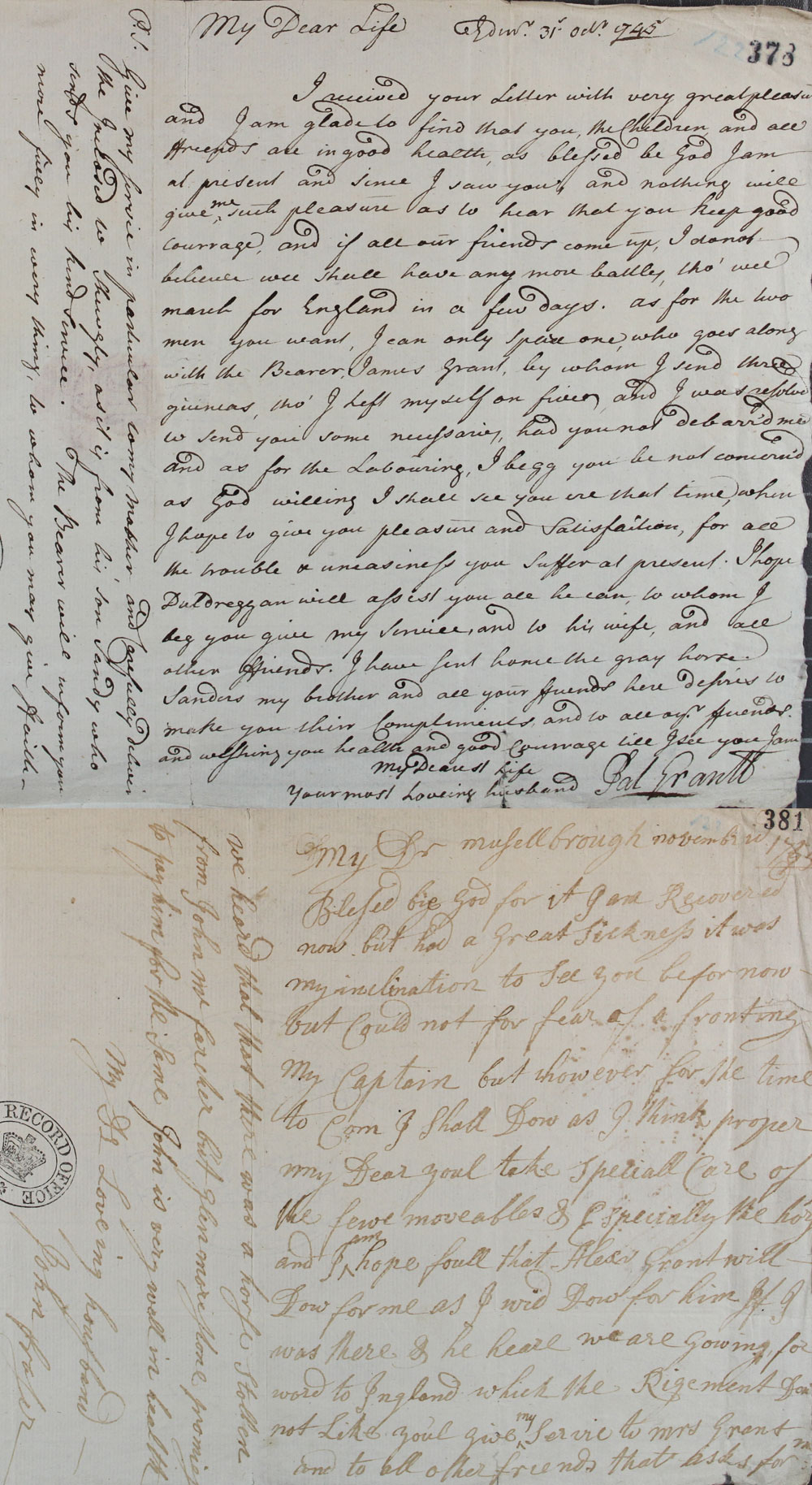
Letter from a Jacobite soldier to his wife, 31st October 1745 (SP 54/26/122, no.18 (f.378)).
Transcript
My Dear Life, Edin. [Edinburgh] 31st October 1745
I received your letter with very great pleasure and I am glad to find that you, the children and all friends are in good health, as blessed be God I am at present and since I saw you and nothing will give me such pleasure as to hear that you keep good courage, and if all our friends come up I do not believe we shall have any more battles, though we march for England in a few days. As for the two men you want, I can only spare one, who goes along with the Bearer, James Grant, by whom I send three guineas, though I left myself on five and I was resolved to send you some necessaries, had you not debarred me, and as for the labouring, I begg you be not concerned as God willing I shall see you ere that time, when I hope to give you pleasure and satisfaction for all the trouble & uneasiness you suffer at present. I hope Duldreggan will assist you all he can to whom I beg you give my service, and to his wife and all other friends. I have sent home the gray horse. Sanders my brother and all your friends here desires to make you their compliments and to all your friends and wishing you health and good courage I’ll see you I am,
My dearest life,
Your most loving husband, Pal Grantt
P.S. Give my service in particular to my mother and carefully deliver the Inclosed to Shurgly as it is from his son Sandy who sends you his service. The Bearer will inform you more fully in everything to whom you may give faith.
Letter from John Fraser, Jacobite soldier to his wife, 10 November 1745 (SP 54/26/122, no.21 (f.381)).
Transcript
Musellbrough, November 10th 1745
My Dear
Blessed bye [be] God for it I am Recovered but had a Great Sickness it was my inclination to see you before now but could not for fear of afronting [offending] My Captain but however for the time to [come] I shall Done [do] as I think proper my Dear soul take special care of the few moveables [possessions] & especially the horse and I am hopeful that Alexander Grant will [do] for me as I will [do] for him If I was there & he heare [here] We are gowing [going] forward to Ingland [England] which the Regiment [don’t] like. You’ll give my service to Mrs Grant and to all other friends that asks for [news]
We heard that [that] there was a horse stollen [stolen] from John McFarcher but Glenmoristone promised to pay him for the same. John is very well in health
Thy [Ever] Loveing housband [husband]
John Fraser
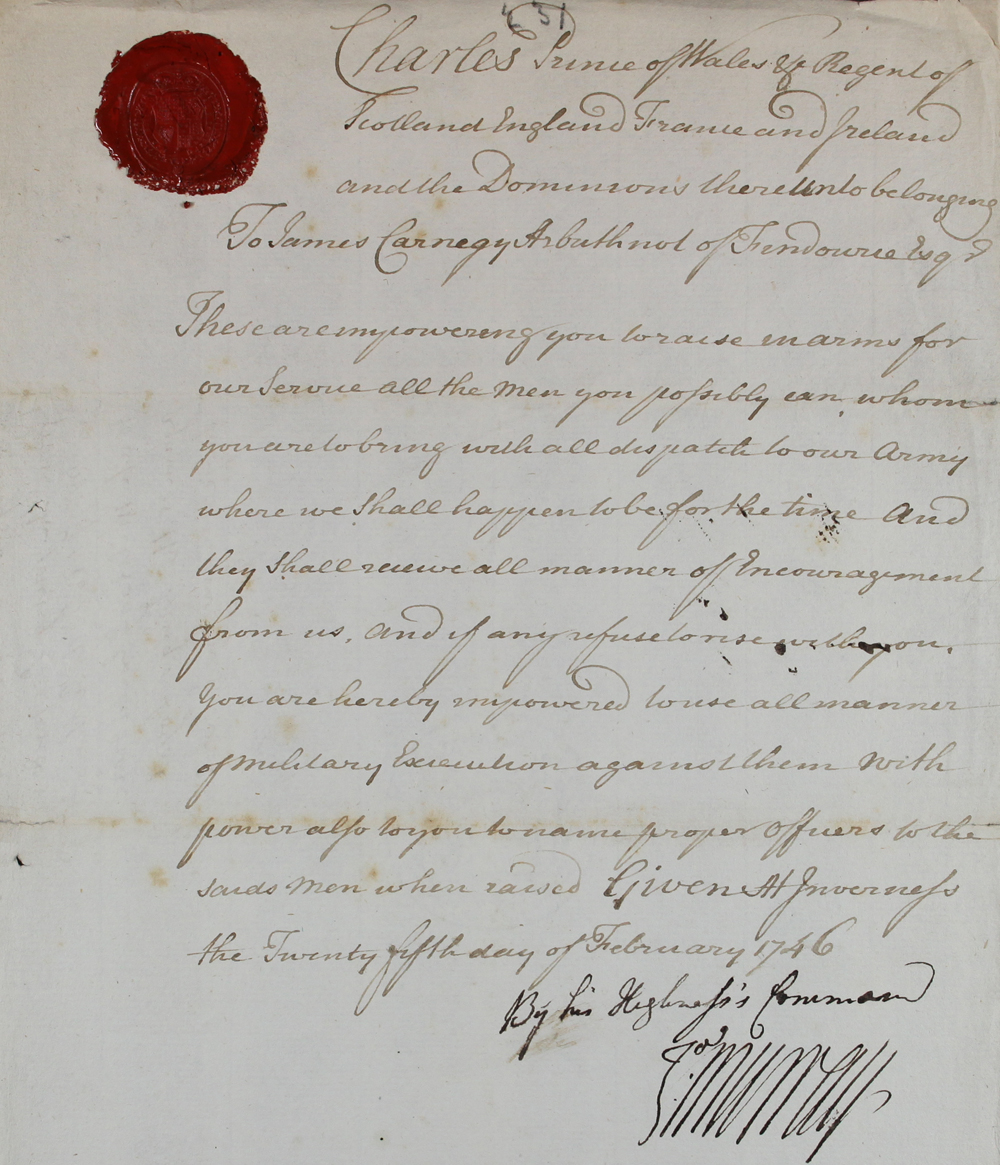
A warrant [royal order] from the Young Pretender [Charles Edward Stuart] given at Inverness to Mr James Carnegy Arbuthnot to raise an army, 25 February 1746 (SP 54/26/123F).
Transcript
Charles Prince of Wales & Regent of Scotland, England France and Ireland and the Dominions there unto belonging
To James Carnegy Arbuthnot of Findowrie Esq
These are impowering you to raise in arms for our Service all the men you possibly can whom you are to bring with all dispatch to our Army where we shall happen to be for the time. And they shall receive all manner of Encouragment from us. And if any refuse to rise with you, you are hereby impowered to use all manner of military Execution against them with power also to you to name proper officers to the [lands?] men when raised. Given At Inverness the twenty fifth day of February 1746,
By his Highness’s Command
J. Murray
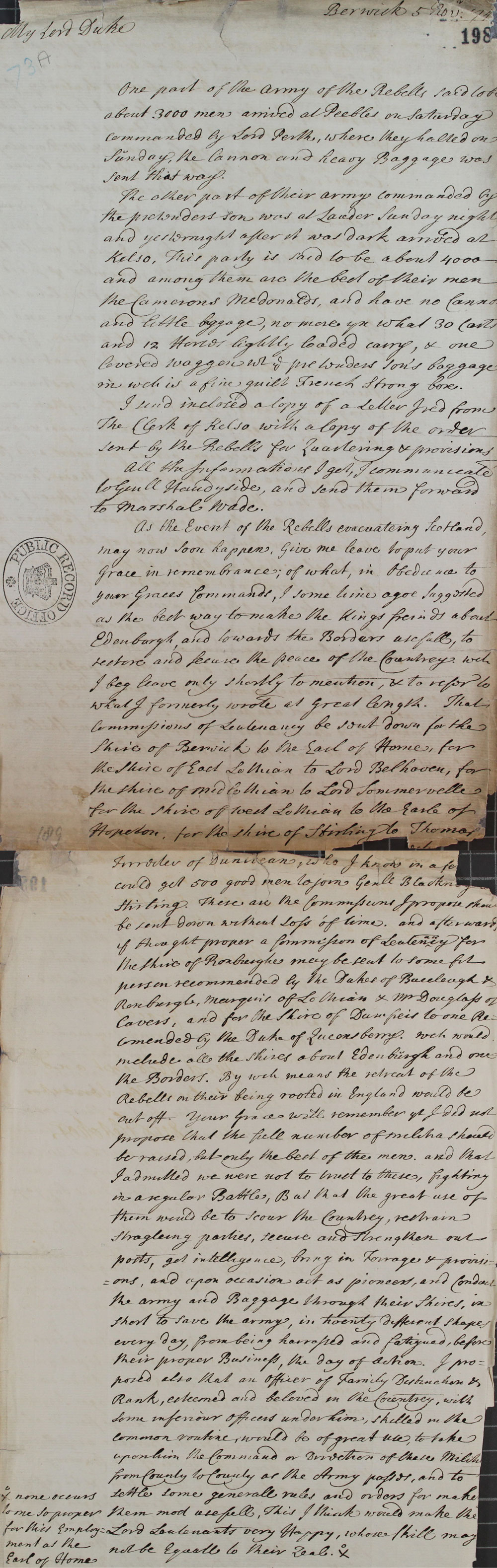
Lord Justice Clerk Fletcher reporting to the Duke of Newcastle, 5 November 1745 (SP 54/26/73A).
Transcript
My Lord Duke Berwick 5th Nov ‘45
One part of the Army of the Rebells said to be about 3000 men arrived at Peebles on Saturday commanded by Lord Perth, where they halted on Sunday, the Cannon and heavy Baggage was sent that way.
The other part of their army commanded by the Pretender’s son was at Lauder. Sunday night and yesterday after it was dark arrived at Kelso, This party is said to be about 4000 and among them are the best of their men, the Camerons McDonalds, and have no Cannon and little baggage, more [in] what 30 carts and 12 Horses lightly loaded carry, & one covered wagon [with the] pretenders son’s baggage in which is a fine guilt French strong box.
I send inclosed a copy of a letter I red from The Clerk of Kelso with a copy of the order sent by the Rebells for Quartering & provisions. All the informations I get, I communicate to General Handyside, and send them forward to Marshal Wade.
As the Event of the Rebells evacuatering Scotland, may now soon happen, give me leave to put your Grace in remembrance, of what, in obedience to your Graces Commands, I sometime agoe suggested as the best way to make the Kings friends about Edenburgh, and towards the Borders usefull, to restore and secure the peace of the country which I beg leave only shortly to mention, & to refer to what I formerly wrote at great length. That commissions of Lieutenancy be sent down for the Shire of Berwick to the Earl of Home, for the Shire of East Lothian to Lord Belhaven, for the Shire of Midlothian to Lord Sommerville for the Shire of West Lothian to the Earl of Hopeton, for the Shire of Stirling to Thomas… [last line of document damaged ]
For order of Dunliean who I know in a few… [document damaged] could get 500 good men to join General Blackney [in] Stirling. These are the commissions I propose should be sent down without loss of time. And afterwards if thought proper a Commission of Lieutenancy for the Shire of Roxbrurgh may be sent to some fit person recommended by the Dukes of Baraclough & Roxbourgh, Marquis of Lothian & Mr. Douglas of Cavers and for the shire of Dumfries to one recommended by the Duke of Queensbury. Which would include all the shires about Edenburgh and on the Borders. By which means the retreat of the rebels on their being rooted in England would be cut off. Your Grace will remember yet I did not propose that the full number of militia should be raised, but only the Best of the men. and that I admitted we were no to trust to these, fighting in a regular Battle, But that the great use of them would be to scour the Country, restrain stragleing parties, secure and strengthen our posts, get intelligence, bring in Forrage and provisions, and upon occasion act as pioneers, and conduct the army and Baggage through their Shires, in short to save the army, in honesty different shapes every day, from being harassed and fatigued, before their proper Business, the day of Action. I proposed also that an Officer of Family Distinction & rank, esteemed and beloved in the Countrey, with some inferior officers under him, skilled in the common routine, would be of great use, to take upon him the Command or Direction of these Militia from County to County as the Army progresses, and to settle some general rules and orders for [making] them most usefull, This I think would make the Lord Lieutenants very happy, whose skill may not be Equall to their zeal *
*None occurs to me so proper for this employment as the Earl of Home.
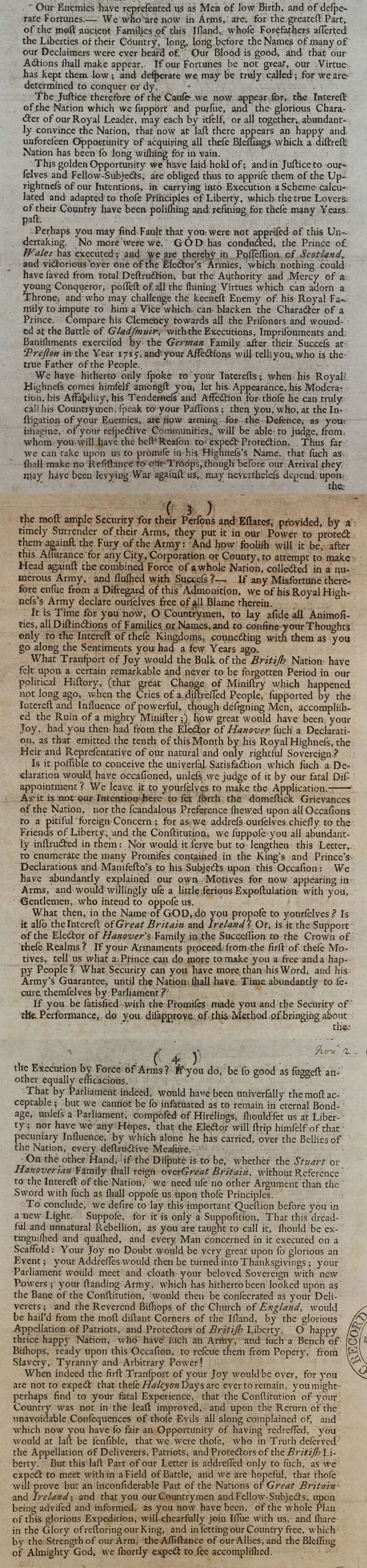
Extracts from a printed letter from Charles Edward Stuart addressed to ‘the nobility, gentry and free-born subjects’, 2 November 1745 (SP 54/26 /72D).
Transcript
Our Enemies have represented us as Men of low Birth, and of desperate Fortunes.- We who are now in Arms, are, for the greatest Part, of the most ancient Families of this Island, whose Forefathers asserted the Liberties of their Country, long, long before the Names of many of our Declaimers were ever heard of. Our Blood is good, and that our Actions shall make appear. If our Fortunes be not great, our Virtue has kept them low; and desperate we may be truly called; for we are determined to conquer or dy [die]
The Justice therefore of the Cause we now appear for, the Interest of the Nation which we support and pursue, and the glorious Character of our Royal Leader, may each by itself, or all together, abundantly convince the Nation, that now at last there appears an happy and unforeseen Opportunity of acquiring all these Blessings which a distrest Nation has been so long wishing for in vain.
This golden Opportunity we have laid hold of; and in Justice to ourselves and Fellow-Subjects, are obliged thus to apprise them of the Uprightness of our Intentions, in carrying into Execution a Scheme calculated and adapted to those Principles of Liberty, which the true Lovers of their Country have been polishing and refining for these many Years past.
Perhaps you may find Fault that you were not apprised of this Undertaking. No more were we. GOD has conducted, the Prince of Wales has executed; and we thereby in Possession of Scotland, and victorious over one of the Elector’s Armies, which nothing could have saved from total Destruction, but the Authority and Mercy of a young Conqueror, possest of all the shining Virtues which can adorn a Throne, and who may challenge the keenest Enemy of his Royal Family to impute to him a Vice which can blacken the Character of a Prince. Compare his Clemency [mercy] towards all the Prisoners and wounded at the Battle of Gladsmuir, with the Executions, Imprisonments and Banishments exercised by the German Family after their Success at Preston in the Year 1715, and your Affections will tell you, who is the true Father of the People.
We have hitherto only spoke to your Interests; when his Royal Highness comes himself amongst you, let his Appearance, his Moderation, his Affability, his Tenderness and Affection for those he can truly call his Countrymen, speak to your Passions; then you, who, at the Instigation of your Enemies, are now arming for the Defence, as you imagine, of your respective Communities, will be able to judge, from whom you will have the best Reason to expect Protection. Thus far we can take upon us to promise in his Highness’s Name, that such as shall make no Resistance to our Troops, though before our Arrival they may have been levying War against us, may nevertheless depend upon
(3) the most ample Security for their Persons and Estates, provided, by a timely Surrender of their Arms, they put it in our Power to protect them against the Fury of the Army: And how foolish will it be, after this Assurance for any City, Corporation or County, to attempt to make Head against the combined Force of a whole Nation, collected in a numerous Army, and flushed with Success?- If any Misfortune therefore ensure from a Disregard of this Admonition, we of his Royal Highness’s Army declare ourselves free of all Blame therein.
It is Time for you now, O Countrymen, to lay aside all Animosities, all Distinctions of Families or Names, and to confine your Thoughts only to the Interest of these Kingdoms, connecting with them as you go along the Sentiments you had a few Years ago.
What Transport of Joy would the Bulk of the British Nation have felt upon a certain remarkable and never to be forgotten Period in our political History, (that great Change of Ministry which happened not long ago, when the Cries of a distressed People, supported by the Interest and Influence of powerful. Though designing Men, accomplished the Ruin of a mighty Minister;) how great would have been your Joy, had you then had from the Elector of Hanover such a Declaration, as that emitted the tenth of this Month by his Royal Highness, the Heir and Representative of our natural and only rightful Sovereign?
Is it possible to conceive the universal Satisfaction which such a Declaration would have occasioned, unless we judge of it by our fatal Disappointment? We leave it to yourselves to make the Application.
As it is not our Intention here to set forth the domestick Grievances of the Nation, nor the scandalous Preference shewed upon all Occasions to a pitiful foreign Concern; for as we address ourselves chiefly to the Friends of Liberty, and the Constitution, we suppose you all abundantly instructed in them: Nor would it serve but to lengthen this Letter, to enumerate the many Promises contained in the King’s and Prince’s Declarations and Manifesto’s to his Subjects upon this Occasion: We have abundantly explained our own Motives for now appearing in Arms, and would willingly use a little ferious Expostulation with you, Gentlemen, who intend to oppose us.
What then, in the Name of GOD, do you propose to yourselves? Is it also the Interest of Great Britain and Ireland? Or, is it the Support of the Elector of Hanover’s Family in the Succession to the Crown of these Realms? If your Armaments proceed form the first of these Motives, tell us what a Prince can do more to make you a free and a happy People? What Security can you have more than his Word, and his Army’s Guarantee, until the Nation shall have Time abundantly to secure themselves by Parliament?
If you be satisfied with the Promises made you and the Security if the Performance, do you disapprove of this Method of bringing about
(4)
the Execution by Force of Arms? If you do, be so good as suggest another equally efficacious.
That by Parliament indeed, would have been universally the most acceptable; but we cannot be so infatuated as to remain in eternal Bondage, unless a Parliament, composed of Hirelings, should set us at Liberty; nor have we any Hopes, that the Elector will strip himself of that pecuniary Influence, by which alone he has carried, over the Bellies of the Nation, every destructive Measure.
On the other Hand, if the Dispute is to be, whether the Stuart or Hanoverian Family shall reign over Great Britain, without Reference to the Interest of the Nation, we need use no other Argument than the Sword with such as shall oppose as upon those Principles.
To conclude, we desire to lay this important Question before you in a new Light. Suppose, for it is only a Supposition, That this dreadful and unnatural Rebellion, as you are taught to call it, should be extinguished and quashed, and every Man concerned in it executed on a Scaffold: Your Joy no Doubt would be very great upon so glorious an Event; your Address would then be turned into Thanksgivings; your Parliament would meet and cloath your beloved Sovereign with new Powers; your standing Army, which has hitherto been looked upon as the Bane of the Constitution, would then be consecrated as your Deliverers; and the Reverend Bishops of the Church of England, would be hail’d from the most distant Corners of the Island, by the glorious Appellation of Patriots, and Protectors of British Liberty. O happy thrice happy Nation, who have such an Army, and such a Bench of Bishops, ready upon this Occasion, to rescue them from Popery, from Slavery, Tyranny and Arbitrary Power!
When indeed the first Transport of your Joy would be over, for you are not to expect that these Halcyon Days are ever to remain, you might perhaps find to your fatal Experience, that the Constitution of your Country was not in the least improved, and upon the Return of the unavoidable Consequences of those Evils all along complained of, and which now you have so fair an Opportunity of having redressed, you would at last be sensible, that we were those, who in Truth deserved the Appellation of Deliverers, Patriots, and Protectors of the British Liberty. But this last Part of our Letter is addressed only to such, as we expect to meet with in a Field of Battle, and we are hopeful, that those will prove but an inconsiderable Part of the Nations of Great Britain and Ireland; and that you our Countrymen and Fellow-Subjects, upon being advised and informed, as you have now been, of the whole Plan of this glorious Expedition, will cheerfully join Issue with us, and share in the Glory of restoring our King, and in setting our Country free, which by the Strength of our Arm, the Assistance of our Allies, and the Blessing of Almighty God, we shortly expect to see accomplished.
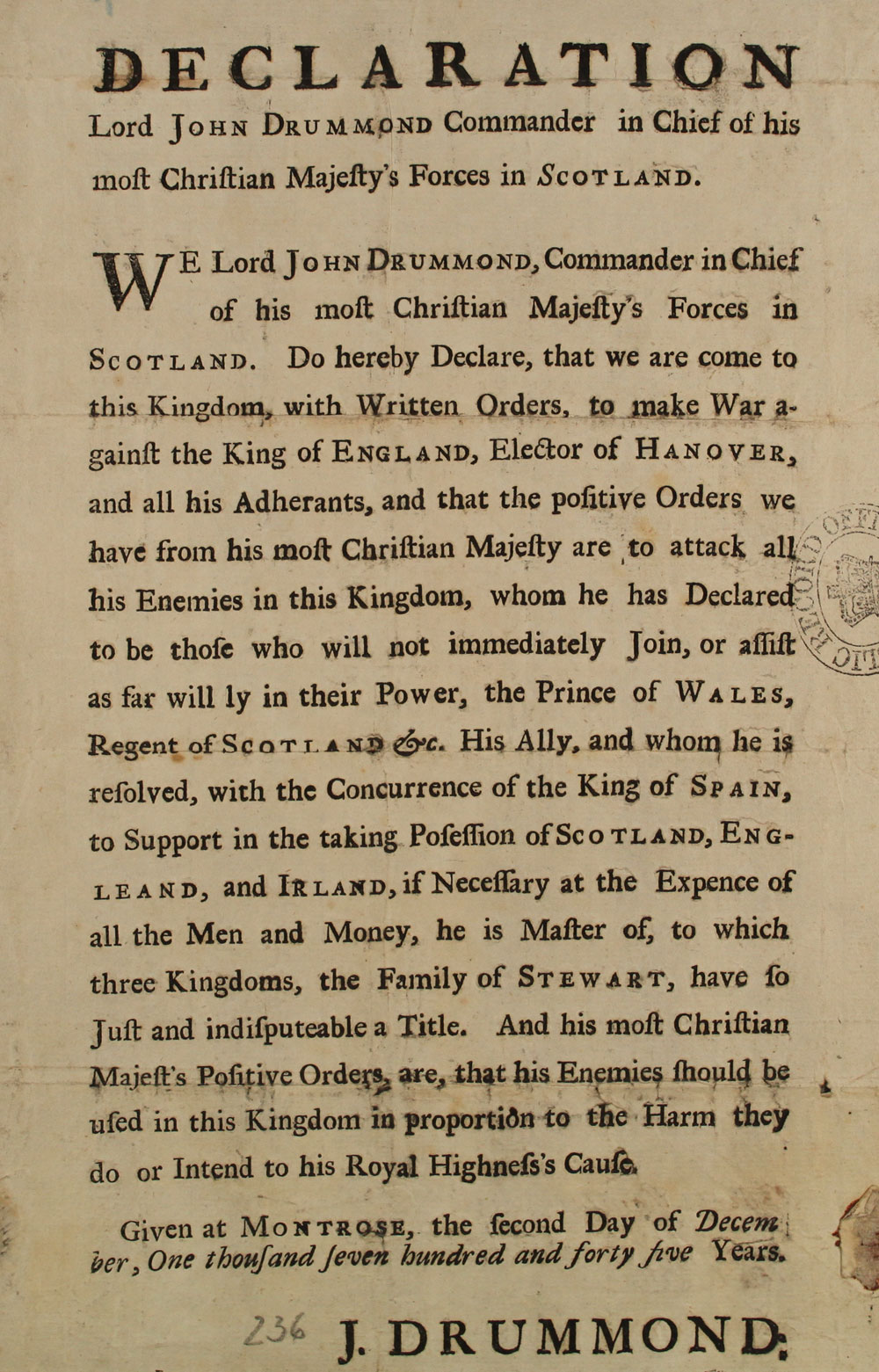
Printed handbill from Lord John Drummond, Scottish Commander, 2 December, 1745 (SP 54/26/90B).
Transcript
DECLARATION
Lord JOHN DRUMMOND Commander in Chief of his most Christian Majesty’s Forces in SCOTLAND.
WE Lord JOHN DRUMMOND, Commander in Chief of his most Christian Majesty’s Forces in SCOTLAND. Do hereby Declare, that we are come to this Kingdom, with Written Orders, to make War against the King of ENGLAND, Elector of HANOVER, and all his Adherants, and that the positive Orders we have from his most Christian Majesty are to attack all his Enemies in this Kingdom, whom he has Declared to be those who will not immediately Join, or assist as far will ly in their Power, the Prince of WALES, Regent of SCOTLAND etc. His Ally, and whom he is resolved, with the Concurrence of the King of SPAIN, to Support in the taking Posession of SCOTLAND, ENGLEAND, and IRLAND, if Necessary at the Expence of all the Men and Money, he is Master of, to which three Kingdoms, the Family of STEWART, have so Just and indisputeable a Title. And his most Christian Majest’s Positive Orders are, that his Enemies should be used in this Kingdom in proportion to the Harm they do or Intend to his Royal Highness’s Cause.
Given to MONTROSE, the second Day of December, One thousand seven hundred and forty five Years.
J. DRUMMOND.
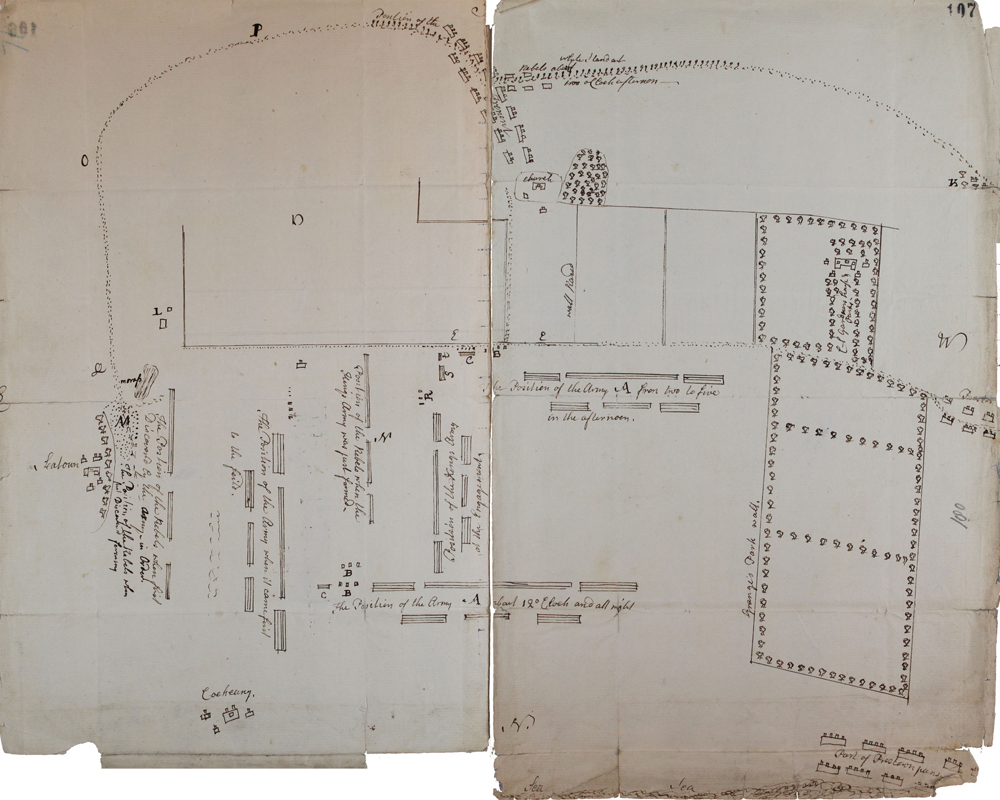
Plan of the Battle of Prestonpans, 21 September 1745 (SP 54/26/71).
Download a high-resolution version of this plan (JPG, 874 KB)
Transcript
1. Position of the Rebels about two o’clock afternoon
2. Position of the Army from two to five in the afternoon.
3. Part of Prestown pans.
4. The Position of the army. About 12 o’ clock and all night
5. Position of the King’s army of the engagement.
6. Position of the rebels when the King’s army was just formed.
7. The Position of the army when it came first in the field.
8. Coeheany
9. The Position of the Rebels when first Discovered by the army in Order.
The Position of the Rebels when first Discovered forming.
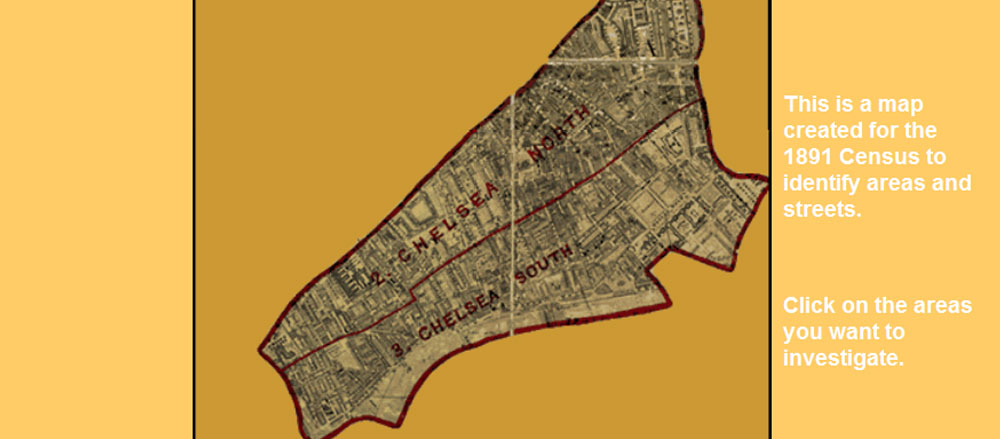
Investigate streets from the 1891 census in this interactive game.
This resource has been archived as the interactive parts no longer work. You can still use the rest of it for information, tasks or research. Please note that it has not been updated since its creation in 2009.
You can find more content on this topic in our other resources:
Lessons

- Victorian family history
How can we find out about the life of a Victorian child? - Census detective
What can you find out?
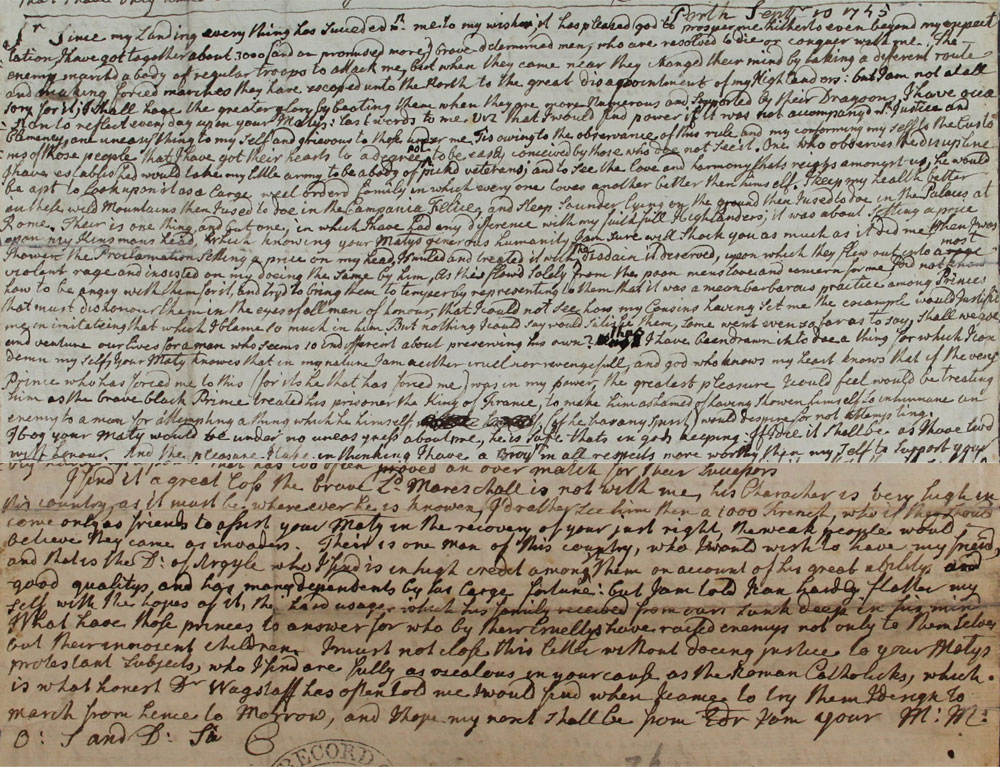
An extract from a letter from Charles Edward Stuart to his father James Stuart dated 20 September 1745 at Perth (SP 54/26/32).
Transcript
Sir, since my landing everything has succeeded to meet my wishes, it has pleased God to prosper me hitherto even beyond my expectation, I have got together about 3000 (and am promised more), brave and determined men who are resolved to die or conquer with me. The enemy marched a body of regular troops to attack me but when they came near they changed their mind by taking a different route and making forced marches they have escaped into the north to the great disappointment of my highlanders: but I am not at all sorry for it, I shall have the greater glory by beating them when they are more numerous and supported by their dragoons. I have occasion to reflect every day upon your majesty’s last words to me, viz [namely] that I would find power if it was not accompanied with justice and clemency, one uneasy thing to myself and grievous to those under me. ‘Tis [It is] owing to the observance of this rule and my conforming myself to the customs of those people that I have got their hearts to a degree not to be easily conceived by those who do not see it. One who observes the discipline I have established would take my little army to be a body of picked veterans; and to see the love and harmony that reigns amongst us, he would be apt to look upon it as a large well-ordered family in which everyone loves another better than himself. I keep my health better in these wild mountains than I used to do, in the campanie felice [happy company], and sleep sounder lying on the ground than I used to do in the palaces at Rome. There is one thing and but one, in which I have had any difference with my faithful highlanders, it was about setting a price upon my kinsman’s head, which knowing your majesty’s generous humanity I am sure will shock you are much as it did me, when I was shown the proclamation setting a price on my head. I smiled and treated it with the distain it deserved, upon which they flew out into a most violent rage and insisted on my doing the same by him as this flowed solely from the poor men’s love and concern for me I did not know how to be angry with them for it, but tried to bring them to temper by representing to them that it was a mean and barbarous practice among princes that must dishonour them in the eyes of all men of honour, that I could not see how my cousin having set me the example would justify me in imitating that which I blame so much in him. But nothing I could say would satisfy them, some went even so far as to say, shall we go and venture our lives for a man who seems so indifferent about preserving his own? Thus I have been drawn in to do a thing for which I can damn myself. Your majesty knows that in my nature I am neither cruel or revengeful and God who knows my heart knows that if the very prince who has forced me to this (for it is he that has forced me) was in my power, the greatest pleasure I could feel would be treating him as the brave, black Prince treated his prisoner, the king of France, to make him ashamed of having shown himself so inhumane an enemy to a man for attempting a thing which he himself if he has any [sincerity] would despise for not attempting. I beg your majesty would be under no uneasiness about me, he is safe that’s in God’s keeping: if I die it shall be as I have lived, with honour.
…
I find it a great loss the brave Lord Marischal is not with me, his character is very high in this country, as it must be wherever he is known, I’d rather see him than 1000 French, who if they should come only as friends to assist your majesty in the recovery of your just right, the weak people would believe they came as invaders. There is one man of this country, who I would wish to have my friend, and that is the duke of Argyll who I find is in high credit among them on account of his great ability and good qualities and had many dependants by his large fortune: but I am told I can hardly flatter myself with the hopes of it, the hard usage which his family received from ours sunk deep in his mind. What have those princes to answer for who by their cruelty have raised enemies not only to themselves but their innocent children, I must not close this letter without doing justice to your majesty’s Protestant subjects, who I find are fully as zealous in your cause as the Roman Catholics, which is what honest Dr Wagstaff has often told me I would find when I can to try them. I design to march from hence tomorrow and I hope my next shall be from Edinburgh. [Charles Edward Stuart].
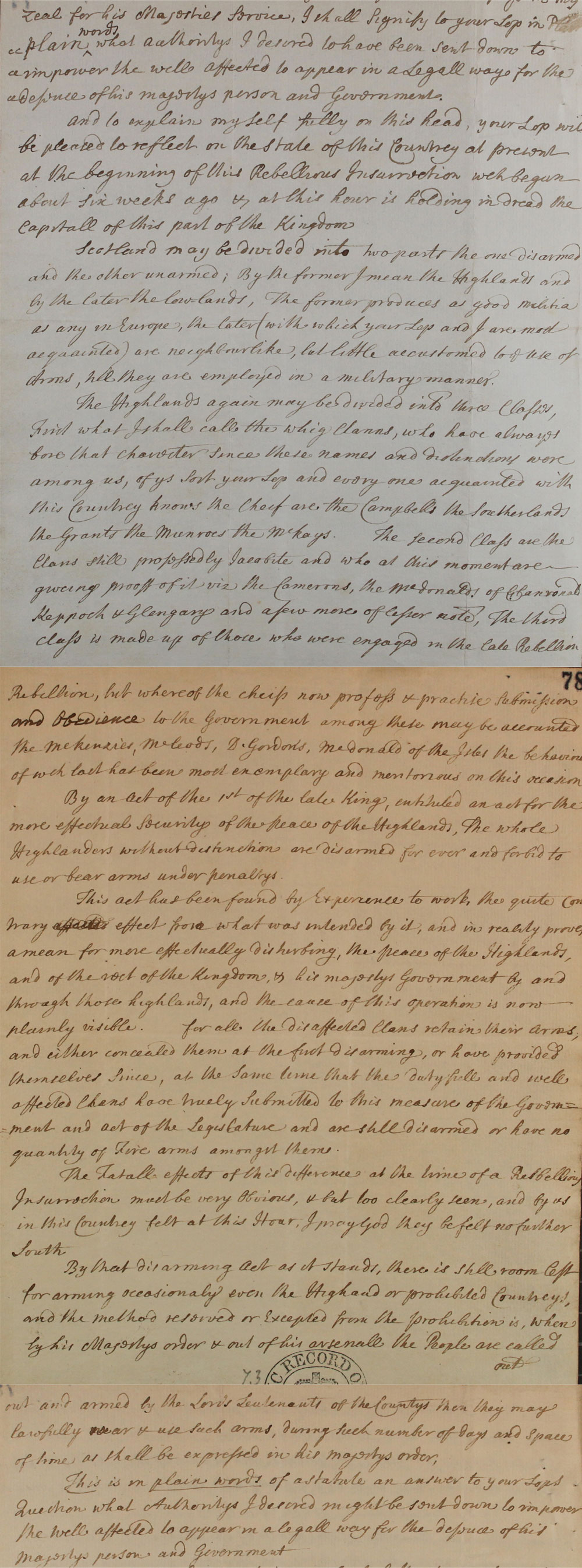
Extract of a letter from Lord Justice Clerk Thomas Fletcher to John, Marquis of Tweeddale, Secretary of State for Scotland (1742-1746) commenting on the political allegiances of the clans, 16 September 1745 (SP 54/26/25).
Transcript
…I shall signify to your Lordship in plain words what authoritys [laws] I desired to have been sent down to impower [empower] the well affected [loyal] to appear in a Legall way for the defence of his Majestys person and Government.
And to explain myself fully on this head, your [Lordship] will be pleased to reflect on the state of this Country at present at the beginning of this Rebellious Insurrection which began about six weeks ago & at this hour is holding in dread the capitall of this part of the Kingdom.
Scotland may be divided into two parts the one disarmed and the other unarmed, By the former I mean the Highlands and by the later the Lowlands, The former produces as good militia as any in Europe, the later (with which your Lordship and I are most acquainted) are neighbourlike, but little accustomed to [&] the use of arms, [while] they are employed in a military manner.
The Highlands again may be divided into three classes. First what I shall call the Whig clanns, who have always bore that character since these names and distinctions were among us, of your sort your Lordship and every one acquainted with this Country knows the Chief are the Campbells, the Southerlands, the Grants, the Munroes, the McKays. The second class are the clans still professedly Jacobite and who at this moment are giveing prooff of it viz the Camerons, the Mcdonalds of Clannronald, Keppoch & Glengary and a few more of lesser note, the third class is made up of those who were engaged in the late Rebellion But whereof the cheifs now profess and practice submission and obedience to the Government among these may be accounted the McKenzies, McLeods, D.Gordon’s, Mcdonald of the Isles the behaviour of which last has been most exemplary and meritorious on this occasion.
By an Act of the 1st of the late King, entitled an act for the more effectual security of the peace of the Highlands, the whole Highlanders without distinction are disarmed forever and forbid to use or bear arms under penaltys.
This act has been found by Experience to work the quite contrary effect from what was intended by it, and in reality proves a mean for more effectually disturbing, the peace of the Highlands, and of the rest of the Kingdom, & his Majestys Government by and through those highlands, and the cause of this operation is now plainly visible. For all the disaffected clans retain their arms, and either concealed them at the fact of disarming, or have provided themselves since, at the same time that the dutyfull and well affected clans have truely submitted to this measure of the Government and Act of the Legislature and are still disarmed or have no quantity of Fire arms amongst them.
The Fatall effects of this difference at the time of a Rebellious Insurrection must be very obvious, & but too clearly seen, and by us in this Country felt at this Hour, I pray God they be felt no further South.
By that disarming Act as it stands, there is still room left for arming occasionally even the Highland or prohibited Countrys [counties] and the method reserved or expected from the prohibition is, when by his Majesty’s order & out of his arsenall the People are called out and armed by the Lords Lieutenant of the Countys then they may lawfully bear & use such arms, during such number of days and space of time as shall be expressed in his Majesty’s order.
This is in plain words of a statute an answer to your Lordship’s question what Authoritys [laws] I desired might be sent down to impower the well affected to appear in a legall way for the defence of his Majestys person and Government.
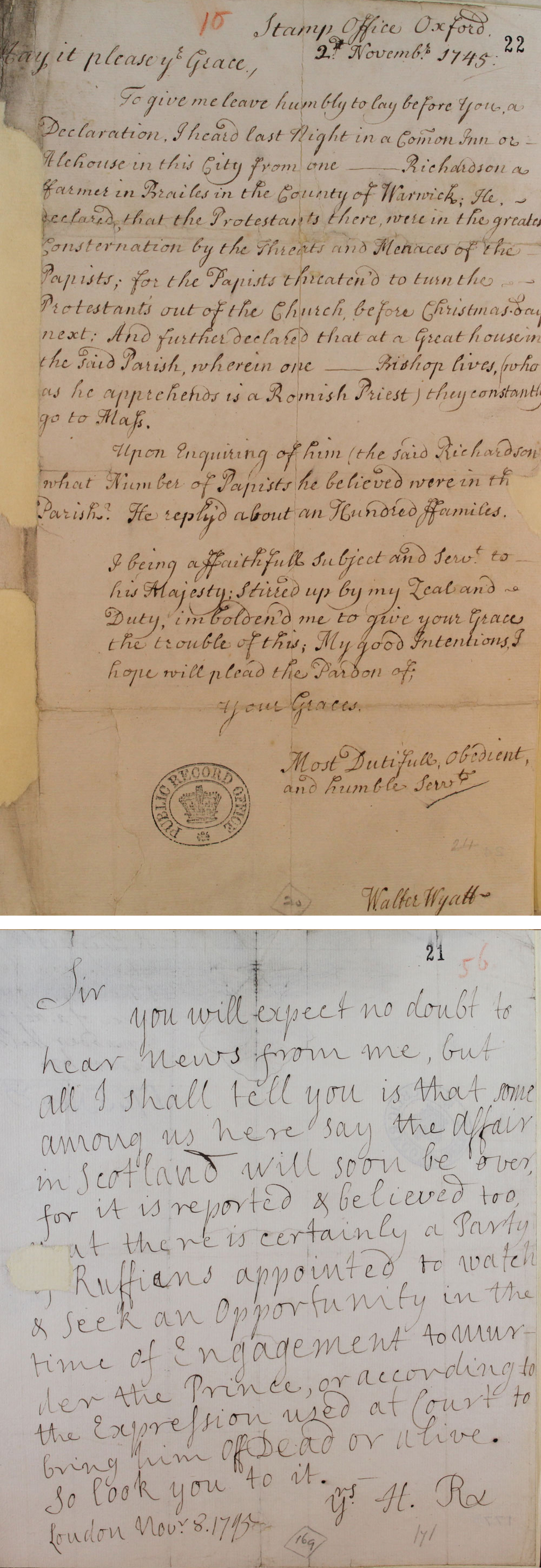
Letter providing information about a supposed Catholic threat in Warwickshire, 2 November 1745 (SP 36/73/f22).
Transcript
Stamp Office, Oxford
2nd November, 1745
May it please your Grace,
To give me leave humbly to lay before you a Declaration, I heard last night in a Common Inn or Alehouse in the City from one———–Richardson a farmer in Brailes in the County of Warwick. He declared that the Protestants there were in the greatest consternation [worry] by the Threats and Menaces of the Papists; for the Papists threaten’d to turn the Protestants out of the Church before Christmas day next: and further declared that a Great House in the said Parish, wherein one————-Bishop lives, (who as he apprehends is a Romish Priest) they constantly go to Mass.
Upon Enquiring of him (the said Richardson) what Number of Papists he believed were in the Parish He replyd about an Hundred Families.
I being a faithfull subject and servant to his Majesty, stirred up by my Zeal and Duty, imbolden’d me to give your Grace the trouble of this, My good Intentions, I hope will plead the Pardon of
Your Grace.
Most Dutifull, Obedient, and humble Servant,
Walter Wyatt
Letter about a plan to murder the Young Pretender, Charles Edward Stuart, 8 November 1745 (SP 36/73 f21).
Transcript
Sir,
You will expect no doubt to hear news from me, but all I shall tell you is that some among us here say the affair in Scotland will soon be over for it is reported & believed too [that] there is certainly a party [of] Ruffians appointed to watch & seek an Opportunity in the time of Engagement to murder the Prince, or according to the Expression used at Court to bring him off Dead or alive. So look you to it.
London November. 8. 1745 Yrs H. Rx