Important information
This story discusses the apartheid system of racial discrimination in South Africa. It refers to violence against protestors, and racist language and ideas, presented here to accurately represent our records and to help us understand the past.
A view from the High Commissioner
As the archive of the UK government, The National Archives contains records not just from civil servants working within Britain and its territories, but also from those working overseas. As such, its files can shed light on significant international events – or at the very least, British diplomats' assessments of them.
Since they were both members of the Commonwealth at the time, South Africa and Britain exchanged High Commissioners (instead of Ambassadors) throughout the 1950s. Reports that Britain's High Commissioner in South Africa wrote back to the British government are contained in the files of the Commonwealth Relations Office.
These files contain a detailed report on the 'Treason Trial', as it became known – the South African government's years-long attempt to prosecute a large number of civil rights campaigners on charges of conspiring to overthrow the state. By sharing his view of what happened, High Commissioner John Maud's report provides a valuable perspective on apartheid in South Africa.
The Freedom Charter
In response to an increasingly repressive South African government, bent on stamping out any criticism in a deeply racially segregated society, The Congress of the People brought together a range of political groups to call for change.
On 26 June 1955, the following organisations met in Kliptown, Soweto, and formed the Congress Alliance:
- The African National Congress (ANC)
- The South African Indian Congress
- The Communist Party of South Africa
- The South African Congress of Trade Unionists
- The Coloured People’s Congress
- The South African Congress of Democrats
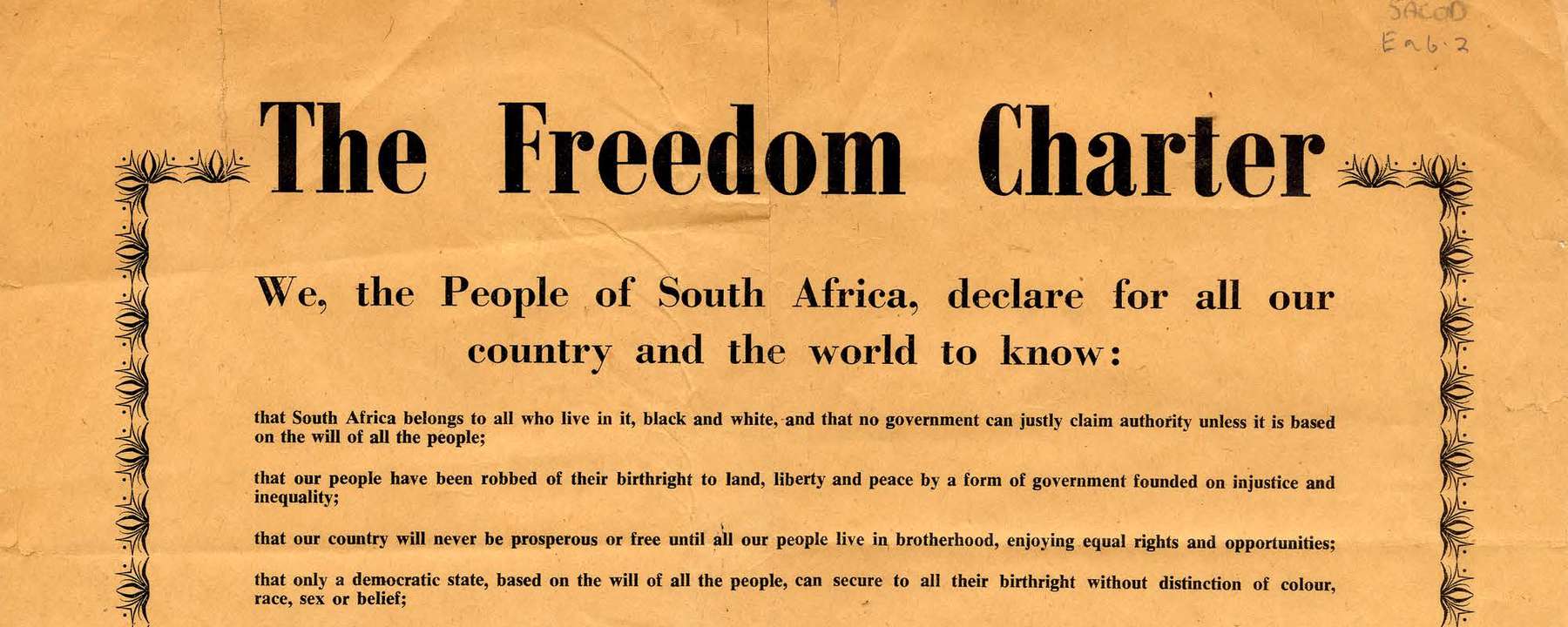
Together they wrote the Freedom Charter – a radical call for a fundamental restructuring of all aspects of South African Society. The Charter demanded democracy and human rights, land reform, labour rights and the nationalisation of major industries.

We the people of South Africa, declare for all our country and the world to know:
That South Africa belongs to all who live in it, black and white, and no government can justly claim authority unless it is based on the will of all the people;
[...]
THE PEOPLE SHALL GOVERN!
Every man and woman shall have the right to vote for and to stand as a candidate for all bodies which make laws;
All people shall be entitled to take part in the administration of the country;
The rights of the people shall be the same, regardless of race, colour or sex;
All bodies of minority rule, advisory boards, councils and authorities shall be replaced by democratic organs of self-government.
The Freedom Charter, 26 June 1955.
Historical Papers Research Archive, University of the Witwatersrand Library, South Africa
South Africa's government believed in apartheid – racial segregation and white minority rule – and viewed the Freedom Charter as a treasonous challenge to its authority. The ruling National Party declared the Charter illegal and banned its distribution. The South African government also sought to discredit the charter's supporters, portraying them as communists and terrorists intent on overthrowing the state.
Charges of conspiracy
The authorities chose to prosecute the leadership of the Congress Alliance under the Suppression of Communism Act 1950. Chief Prosecutor Oswald Pirow argued that because of the radical social change that the Charter demanded, the Congress Alliance would have to violently overthrow the South African state. This was alleged to be part of a 'countrywide conspiracy' inspired by communism.
The British High Commissioner's report recorded the background to the trial:

In September 1955 not long after the Congress of People and the creation of the Congress Alliance, the police carried out widespread raids on the offices and homes of members of the Alliance in search of evidence of high treason and sedition. In April 1956 Mr. Swart, then Minister of Justice and until recently Governor-General, told Parliament that the raids were necessary in view of "the constant agitation among the Natives" and that "it is expected that about 200 people will be charged with breaking laws, with treason and with other offences under the Suppression of Communism Act". The next development was the arrest of 140 (soon increased to 156) people of all races at dawn on 5th December, 1956, as a result, according to Mr. Swart, of evidence acquired during the police raids 15 months earlier. The police informed the Australian High Commissioner confidently that they had been working on the dossiers of the accused for nearly two years and that the Attorney-General’s Department had studied them for a year. Legal advisers had not been satisfied with less than two witnesses for each “overt act of treason” and had deleted a number of names from the original list submitted by the police. For this reason some important Communist leaders who had been lying low during past years had not been arrested.
Extract from the High Commissioner’s report on the Treason Trial, 18 May 1961. Catalogue reference: DO 180/7
As the report explains, on 5 December 1956, an initial 140 people of all races were arrested on charges of high treason and sedition, including future President of South Africa Nelson Mandela (who at the time was President of the ANC in Transvaal, a major South African province, and a member of the ANC National Executive Committee).
Significantly, Chief Albert Luthuli, President of the ANC and a moderate Christian leader who attempted to work within the system, was accused. Another was Z K Matthews, of the University College of Fort Hare, and Reverend Douglas Thompson, a Methodist minister.
Other prominent people arrested included Dr Gagathuram Naicker, President of the Indian Congress in Natal, who had played a prominent part in the passive resistance movement against apartheid. A follower of Indian nationalist and civil rights campaigner Mahatma Gandhi, Naicker had fought against legislation restricting Indians' land tenure rights. He had been served with banning orders prohibiting him from attending meetings prior to the Treason Trial.

Photograph of Dr Naicker addressing a crowd before the Treason Trial. Catalogue reference: DO 35/3837
Others not mentioned in the High Commissioner’s report were also arrested, like Helen Joseph. A leading member of the Federation of South African women, Joseph protested against the extension of the pass system – legal restrictions that the South African government put on freedom of movement within the country – to Black women. Lesser-known figures among the ANC were also charged.
The legal process
From 19 to 21 December 1956, a preliminary hearing began to examine the evidence. Throughout 1957, magistrates would examine 6,200 pages of testimony and 10,000 exhibits before deciding whether to pass sentence on the accused themselves or to let the Attorney General choose whether to go to a trial or not.
The Attorney General took the case forward and in 1958, he obliged the prosecution to drop charges against 65 of the accused, including Chief Luthuli. Instead, two new indictments were put forward against 30 and 61 defendants separately. This was not a jury trial, with three judges presiding over the case in Pretoria, the administrative capital of South Africa.

Nelson Mandela and others come to Pretoria on a bus from Johannesburg for the Treason Trial, 1958.
Drum Magazine photographer / Drum Social Histories / Bailey's African History Archive / african.pictures. Image Number: APN32116
After various legal appeals took place, including one to the Appellate Division of the Supreme Court, eventually the court sat again in April 1959.
The court quashed the indictment against the group of 61 defendants, finding that it failed to specify how the accused were alleged to have joined a conspiracy. With the court refusing permission to appeal its decision, the group of 61, including Professor Z K Matthews and Dr Naicker, were free.
The trial of the group of 30 defendants – including ANC Secretary-General Duma Nokwe and Nelson Mandela – proceeded.
The prosecution attempted to prove that the Congress Alliance were inspired by communism and its commitment to the use of violent revolution. The defence argued that the movement was not motivated by treason, but non-violent methods such as economic boycotts, political strikes, demonstrations, processions and political education. The Congress, argued the defence, was not the gathering of an insurgent army.
The Treason Trial continued into 1960, when in March the horrific shootings of anti-apartheid demonstrators took place at Sharpeville and Langa. Chief Luthuli, recalled as a witness, reiterated the ANC policy of non-violence, and appealed to the South African government to meet the legitimate aspirations of non-white people. A state of emergency was declared, and the ANC was banned.
The court's findings
The High Commissioner’s report from 18 May 1961 explains the findings of the court.

3. The findings of the Court were:
a) The African National Congress and its allies had collaborated to introduce “a radically and fundamentally different form of State” based on the Freedom Charter. At meetings and in publicity material they had condemned the system of government in South Africa –and in the Western democracies- and extolled the advantages of a State variously described as a people’s democracy and a true democracy. The Defence had conceded that some of this material had contained traces of Communist influence. The Crown had not, however, proved that the form of State pictured in the Freedom Charter was a Communist State, though the Court was satisfied that the Executive of the Transvaal branch of the A.N.C. had advocated a “dictatorship of the proletariat” on Communist lines.
b) Although it was the policy of the A.N.C. to admit both Communists and anti-Communists to membership, and some of its responsible executive leaders were former members of the Communist Party banned in 1950, and although “a strong Left-wing tendency” was manifest in the A.N.C., it had not been proved that the A.N.C. had become a Communist organisation.
c) The issue of Communism was relevant to the issue of violence, but the Prosecution had failed to prove that the accused had personal knowledge of or propagated the Communist doctrine of violent revolution.
Extract from the High Commissioner’s report on the Treason Trial, 18 May 1961. Catalogue reference: DO 180/7
By the end of the trial in March 1961, all the defendants had either had the charges against them withdrawn, or in the case of the last 28 accused, had been acquitted. The prosecution had failed to prove that the form of state described as the goal of the Freedom Charter was a communist state.
The High Commissioner concluded in his report that the trial had given the South African government one advantage: it had taken many of the leaders of the ANC and Indian Congress out of action for a lengthy period.
However, the South African government’s strategy had failed to eradicate the Freedom Charter. As the High Commissioner discerned, both the ANC and PAC (Pan African Congress) had been banned under the Unlawful Organisations Act 1960, forcing African politics even further underground. When Nelson Mandela led a campaign in May 1961 demanding the formation of a national convention of representatives of all the peoples of the country, it was put down with military force.
The Treason Trial had other consequences. It inspired the formation of the Anti-Apartheid Movement in the UK, encouraging people to boycott South African goods. Another result was that Oliver Tambo, an ANC activist released through lack of evidence, left South Africa and began to co-ordinate ANC activity from exile, including turning international opinion against the system of apartheid. It would take another 30 years before apartheid in South Africa was brought to an end.


