Record revealed
The parliamentary career of Norah Runge
This scrapbook from Parliament’s Archive Collection contains newspaper clippings that chart Norah Runge’s parliamentary career. From her election to Parliament as the Conservative MP for Rotherhithe in 1931, to her work in Westminster, it provides an insight into her experience as a politician.

Images
Image 1 of 4

A photograph of Conservative women MPs on the terrace of the House of Commons, 1931. Norah Runge is sitting on the first seat on the left in the front row. Catalogue reference: YHL/PO/RO/1/188 (from the Parliament’s Archive Collections).
Image 2 of 4

An article titled, ‘Rotherhithe Political Situation’ from the Southwark Recorder, 2 October 1931. Catalogue reference: YRUN/1 (from the Parliament’s Archive Collections).
Transcript
ROTHERHITHE POLITICAL SITUATION
LADY TO OPPOSE MR. BEN SMITH.
Mrs. N. C. Runge was unanimously chosen on Monday night as prospective Parliamentary candidate for Rotherhithe by the Rotherhithe Conservative Association.
The chair was occupied by Mr. R. Wedden, who said that there was some surprise felt when at a meeting of the Association last week Capt. E. W. Husey, who for twelve months was their candidate, tendered his resignation owing to urgent business reasons. It was with regret that the association accepted the resignation, and the association decided that, owing to the election outlook, it was necessary to find another candidate early. The association was informed by Central Office that it was impossible to find a candidate, as there were already five constituencies in London vacant.
Mrs. Runge was approached by the association, and she offered to stand if no man candidate could be found. Mrs. Runge had been a great worker in Rotherhithe since she came there in 1925, and during the seven years she had been chairman of the women's branch, she had done a great deal to further the cause.
J. Smith proposed that Mrs. Runge be adopted as prospective candidate. Mrs. Bland seconded, and the proposal was carried by acclamation.
In acknowledging the compliment, Mrs. Runge said that Mr. Ben Smith might be a formidable rival, but she was going to prove that she also could be found able. She might be only a woman, but she was a determined woman, and such a one needed a lot of beating.
Image 3 of 4

An article titled, ‘Women Candidates’ from the Aberdeen Press and Journal, 29 September 1931. Catalogue reference: YRUN/1 (from the Parliament’s Archive Collections).
Transcript
Women Candidates.
The prospect of an early appeal to the country is resulting in the adoption of candidates “all along the line.” In London five women Unionists are already in the field, and will contest seats in Islington, Hackney, Hammersmith, Willesden, and Rotherhithe. Women will also do battle at Stoke-on-Trent, Cannock, and Wallsend. In Scotland they will fight at Dundee and Glasgow. The three Unionist women M.P.s, the Duchess of Atholl, Lady Iveagh, and Lady Astor, will stand again for their respective constituencies. The fortunes at the poll of these women politicians will be watched with considerable interest.
Image 4 of 4

An article titled, ‘Crowd that could not believe it’ from the South London Press, 30 October 1931. Catalogue reference: YRUN/1 (from the Parliament’s Archive Collections).
Transcript
CROWD THAT COULD NOT BELIEVE IT
Re-counts in Bermondsey And Rotherhithe
STUNNED SILENCE
Crowd “Goes Mad” When Dr. Salter Appears Dr. Salter Appears
The fight between the Labour and National Conservative candidates in Rotherhithe and West Bermondsey was so close that a re-count was demanded in each case.
So amazed were the supporters of Mr. Ben Smith, Labour candidate and M.P. for Rotherhithe for the past eight years, to hear that Mrs. Nora Runge had defeated him, that they at once demanded a re-count.
The result was that Mrs. Runge increased her majority from 127 to 130.
The majority in favour of Dr. Alfred Salter, Labour candidate and M.P. for West Bermondsey, was given as 91 and a re-count was demanded by the Conservatives, but the figures did not change.
UPROARIOUS SCENE
Two thousand people created an uproarious scene outside the Town Hall when the results were announced.
The crowd stood in dead silence for one minute before they realised that “Big Ben” was out. Then a large section began to boo, but their jeers were drowned by deafening Conservative cheers.
When the two candidates came to the Town Hall steps they were cheered for nearly five minutes.
MRS RUNGE OVERCOME
Mr. Smith began to speak, but a section of the crowd told him to give Mrs. Runge a chance to address them and he at once apologised to his victor, explaining that he was under the impression that she had already spoken.
Mrs. Runge was so overcome that she could only shout, “My friends, I thank you from the bottom of my heart,” before she turned away.
Mr. Smith said: “You’ve had your choice and as a sportsman I know how to take a knock.
“I shall return and I hope we shall have another fight and may the better man win.”
The Conservatives sang “God Save the King” while everybody stood; hats bared, and as soon as they had finished the Labourites sang the “Red Flag.”
Mrs. Runge and her supporters marched away singing patriotic songs and waving Union Jacks.
The total poll in Rotherhithe was 23,240, a percentage of 64.33, and in West Bermondsey the total was 20,360, a percentage of 63.40.
Why this record matters
- Date
- 1931–1939
- Catalogue reference
- YRUN/1
In 1927, Norah Runge OBE (1884 –1978) became Chair of the women's branch of the Rotherhithe Conservative Association in East London. Later, she would become one of just 15 women MPs elected in the 1931 General Election. This record is one of two scrapbooks compiled by Runge’s daughter that documents her political career. The scrapbooks were acquired in 2017, demonstrating the interesting personal papers in Parliament’s Archive Collection.
The scrapbook begins with newspaper clippings about Runge's 1931 election campaign in Rotherhithe. When the original Conservative candidate, Captain Ernest Wynniatt Husey (1897–1958), resigned at short notice, Runge decided to stand.
Despite her determination, she was not expected to win. Rotherhithe was a predominantly working-class industrial constituency and Labour stronghold. In the 1929 election, her Labour opponent, Ben Smith (1879–1964), had won with a majority of over 10,000 votes, having represented the constituency since 1923.
Undeterred, Runge energetically campaigned holding numerous public meetings and appealing to voters. For example, a clipping from the Evening Standard in the scrapbook shows Runge speaking to local dock workers, listening to their concerns around high unemployment.
The election took place during a political and economic crisis. The Wall Street Crash of 1929 and the beginning of the Great Depression caused high levels of poverty and unemployment. As a result, the Labour government (1929–1931) collapsed in August 1931. This led the Prime Minister, Ramsay MacDonald, to form an all-party National Government to deal with the crisis.
Although MacDonald led the National Government, only a small number of Labour colleagues followed him and the Liberals remained divided. The National Government was therefore largely formed of Conservative MPs.
Only a few months later in October 1931, MacDonald called a general election. As a Conservative, Runge supported the National Government’s plans, declaring in the Southwark Recorder that she, 'might be only a woman, but she was a determined woman, and such a one needed a lot of beating.’
In 1931, 62 women stood for Parliament across the political spectrum. Although their numbers had gradually increased since 1918, when women were first given the right to contest parliamentary elections, female candidates were still considered a novelty. One clipping in the scrapbook from the Aberdeen Press and Journal read, ‘The fortunes at the poll of these women politicians will be watched with considerable interest.’
On the day of the election, Runge was pictured ‘polling the first vote at seven in the morning’ and carrying ‘a horseshoe for luck’. (Unnamed newspaper clipping. Catalogue reference: YRUN/1). Crowds gathered outside the town hall to hear the election result. To the surprise of many, Runge won the election by just 130 votes and declared to the crowds, ‘I thank you from the bottom of my heart’.
Of the 15 women elected to Parliament, there were 13 Conservatives MPs, one Liberal MP and one Independent MP. All nine Labour women MPs elected in 1929 lost their seats, although some would return to Parliament in later years. The National Government’s landslide victory helped to increase the number of Conservative women MPs, which attracted press attention. One unnamed newspaper clipping featured the headshots of seven Conservative women MPs, including Runge smiling at the camera (‘Women MPs’, unnamed newspaper. Catalogue reference: YRUN/1). This scrapbook also contains images of the Conservative women MPs pictured on the terrace of the House of Commons (‘Unionist Lady Members’, unnamed newspaper. Catalogue reference: YRUN/1)
During her four years in Parliament, Runge worked on a range of issues, including unemployment, slum clearance, and cinema opening times. While she stood for re-election in 1935, Runge lost to Ben Smith by 4,665 votes, demonstrating the precarious nature of the seat. Afterwards, Runge turned her attention to local politics.
This scrapbook gives us an insight into Runge’s election campaign and parliamentary career. More broadly, it highlights the experiences of women politicians navigating the male-dominated world of electoral and parliamentary politics.
Featured articles
The story of
Margaret Bondfield
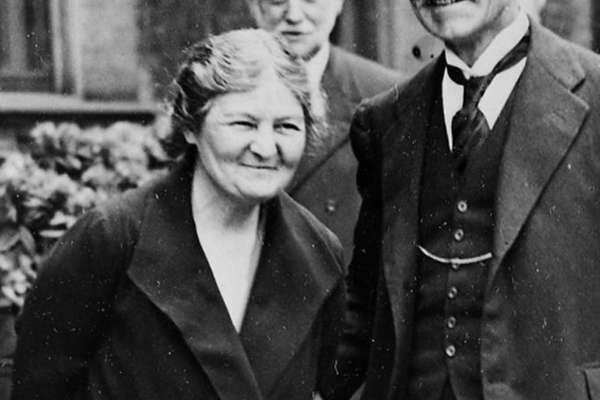
Margaret Bondfield (1873–1953) was a trade unionist and Labour politician. In 1929 she became Britain’s first female cabinet minister.