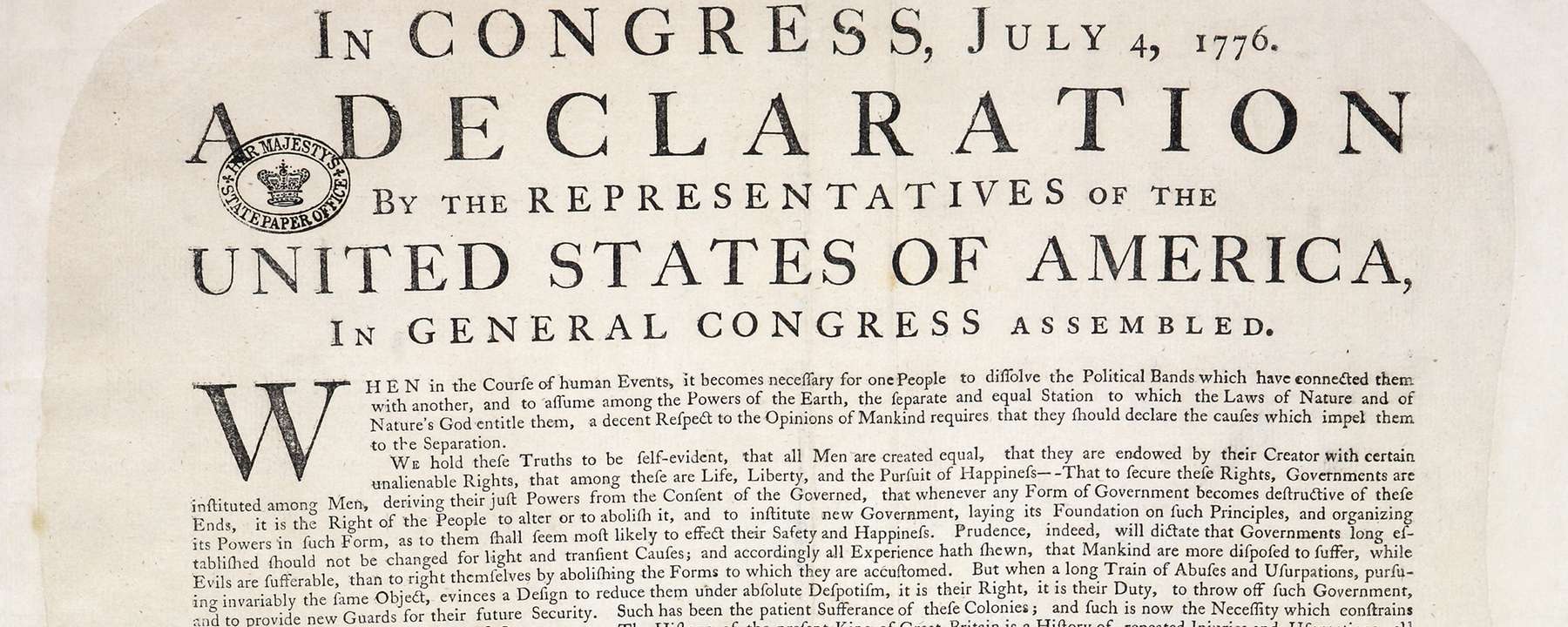

Declaration
On 4 July 1776, Britain’s rebellious North American colonies declared themselves ‘Free and Independent States’ – a new nation, the United States of America.
We hold these truths to be self-evident, that all men are created equal, that they are endowed by their Creator with certain unalienable Rights, that among these are Life, Liberty and the pursuit of Happiness
The US Declaration of Independence
The first imprints of the United States Declaration of Independence were produced with great speed and secrecy by Philadelphia-based printer John Dunlap. The text used was written by a committee of the Second Continental Congress (a convention of delegates from the 13 North American colonies) led by Thomas Jefferson. Printed on wide, broadside paper, these Declarations were designed to publicly proclaim the United States’ separation from Britain. Only 26 known copies remain of these valuable Dunlap broadsides, out of a print run of approximately 200.
Although there is no evidence that Congress deliberately sent any copies to Britain or the British government, several copies nevertheless made their way across the Atlantic. In fact, The National Archives holds the single largest collection of original Dunlap broadsides in the world, with three in total. These copies were sent back by British colonial officials or military officers, enclosed in letters to their superiors in London as evidence of the worsening political crisis in North America.

Three copies of the John Dunlap broadside prints of the US Declaration of Independence, held at The National Archives. Catalogue references: EXT 9/1, EXT 76, EXT 93
We also hold another version of the Declaration that is completely unique: the only known copy attributed to John Dunlap’s shop in Baltimore.

John Dunlap Philadelphia printing of the Declaration of Independence, 1776
IN CONGRESS, JULY 4, 1776.
A DECLARATION
BY THE REPRESENTATIVES OF THE
UNITED STATES OF AMERICA,
IN GENERAL CONGRESS ASSEMBLED.
WHEN in the Course of human Events, it becomes necessary for one People to dissolve the Political Bands which have connected them
with another, and to assume among the Powers of the Earth, the separate and equal station to which the Laws of Nature and of
Nature's God entitle them, a decent Respect to the Opinions of Mankind requires that they should declare the causes which impel them
to the separation.
We hold these Truths to be self-evident, that all Men are created equal, that they are endowed by their Creator with certain
unalienable Rights, that among these are Life, Liberty and the Pursuit of Happiness -
That to secure these rights, Governments are
instituted among Men, deriving their just powers from the Consent of the Governed, that whenever any Form of Government becomes destructive of these
ends, it is the Right of the People to alter or to abolish it, and to institute new Government, laying its Foundation on such principles and organizing
its Powers in such Form, as to them shall seem most likely to effect their Safety and Happiness.
...
Signed by ORDER and in BEHALF of the CONGRESS,
JOHN HANCOCK, PRESIDENT.
Attest.
CHARLES THOMPSON, SECRETARY
BALTIMORE: PRINTED BY JOHN DUNLAP.
The only known copy of the US Declaration of Independence attributed to John Dunlap’s shop in Baltimore. Catalogue reference: CO 5/1353/1
The Baltimore Dunlap
Evidence suggests that this Baltimore Dunlap was actually printed alongside the originals in Philadelphia on 4 July. With the exception of the attribution line at the bottom, Dunlap’s Philadelphia and Baltimore broadsides appear to use the exact same typesetting (the arrangement of the 'type', the physical letter blocks used in the printing press).
Although primarily based in Philadelphia, the beating heart of the American rebellion, John Dunlap also ran a printing shop on Market Street in Baltimore, some 100 miles away. This shop was overseen by another printer named James Hayes Junior. Dunlap’s Baltimore newspaper, Dunlap’s Maryland Gazette, would shortly reproduce the full text of the Declaration in an issue dated 9 July.

Close up of the Baltimore copy of the US Declaration of Independence, which reads 'Baltimore: printed by John Dunlap'. Catalogue reference: CO 5/1353/1
While working on our 2026 exhibition Revolution 250, researchers at The National Archives considered the possibility they were printed together when comparing small faults in the two prints – a theory that had been raised by researchers in the 1970s.
In 1976, the US Library of Congress undertook a detailed study of the Philadelphia Dunlap broadsides. They noticed several clearly damaged letters visible in every copy, as well as four further letters that became increasingly damaged as the type was used to produce more copies. Intriguingly, all 11 of these damaged letters are visible in the Baltimore Dunlap – implying that it used the exact same set of type as the Philadelphia Dunlap broadsides. This is except for the final lines, attributing it to ‘BALTIMORE: PRINTED BY JOHN DUNLAP’, which had been changed from the other copies.
This suggested that the Baltimore Dunlap was printed on Dunlap’s press in Philadelphia, before being sent to his Baltimore shop to be distributed.

Close up of the Baltimore copy of the US Declaration of Independence. It shows a damaged letter 'h', where it says 'to the separation.' This is one of the 11 damaged letters also found on the Philadelphia Dunlap broadsides. Catalogue reference: CO 5/1353/1
Digging deeper
Members of our heritage science team took this research a step further. They used powerful tools, known as feature-matching algorithms, that automatically identify similar points between images and highlight differences.
They compared high-resolution captures of three different Dunlaps: two from Philadelphia (EXT 9/1 and EXT 9/76), and the Baltimore copy. The algorithm shows that, with the exception of the attribution at the bottom, the copies are in clear alignment throughout.

This image shows all three of the Dunlaps overlayed during the process of feature matching. Although there is some misalignment, indicated by the green and blue colours, there is almost perfect alignment, apart from the bottom where it says 'Baltimore' as expected.
In fact, the copy that showed furthest out of alignment was one of the Philadelphia broadsides: likely the result of the gradual build‑up of small deformations caused by repeated folding, handling, and its 250‑year history.
This offers yet more proof that the Baltimore copy was printed at John Dunlap’s shop in Philadelphia, on the same set of type. Only the bottom section, attributing it to Baltimore, was changed. Due to the quick turnaround of printing shops like Dunlap’s, it was probably printed immediately after the Philadelphia broadsides.
Journey to Britain
It seems that the Baltimore copy did not actually arrive in Baltimore until after 9 July. On that date, Dunlap's Baltimore shop had reproduced the Declaration's text for his Maryland Gazette – but with a header showing that the news had been copied from an earlier newspaper, probably the Pennsylvania Evening Post. This implies that Dunlap's broadside had not yet arrived in the city.
By the end of July month, the Baltimore Dunlap had travelled some 200 miles from Philadelphia to Virginia. It was then enclosed in a letter from John Murray (Lord Dunmore), British governor of Virginia, to George Germain (the Secretary of State for the Colonies, in London) dated 31 July.
Murray included the Declaration 'Least your Lordship should not have seen the Resolution of the Congress relative to Independency'. This may have been the first copy of the Declaration seen by Germain – and only the second copy of the Declaration sent to Britain. It was likely beaten across the ocean only by a Philadelphia Dunlap copy included by vice-admiral Richard Howe in a letter to Admiralty Secretary Richard Stephens, dated 28 July, three days earlier.

It is our Duty to acquaint your Lordship that, on the 4th of July last, the General Congress came to a Resolution to declare, that the associated Colonies are, and of Right out to be, free and independent States, that they are absolved from all Allegiance to the British Crown, and that all political Connection between them and the State of Great Britain is, and ought to be, totally dissolved. A printed Copy of their Declaration of Independency came accidentally to our Hands a few Days after the Dispatch of the Mercury Packet, and we have the Honor to inclose it,
Letter from John Murray (Lord Dunmore), British governor of Virginia, to George Germain. Catalogue reference: CO 5/1353/396v
Circulation and timings
By 31 July, Murray had retreated to a fleet of British ships anchored in the Potomac River for his own protection, and was essentially a governor in exile. His 31 July letter to Germain also enclosed a copy of the Virginia Supplement, dated 5 July 1776. The Supplement declared the outcome of the Virginia Convention, which constituted a new, autonomous rebel government in the colony.
For Murray, the Baltimore Dunlap acted as supporting evidence to send to his superiors in London, who might note that many of the Virginia Convention’s listed grievances (in the Supplement) quoted the wider US Declaration almost word for word. Clearly a version of the Declaration was already known to the Convention in Jefferson’s home colony of Virginia by 5 July.

In a general convention begun and holden at the CAPITOL, in the city of Williamsburg, on Monday the fifth day of May, one thousand, seven hundred and seventy six, and continued, by adjournment, to the day of July following.
The CONSTITUTION, or FORM of GOVERNMENT, agreed to and resolved upon by the Delegates and Representatives of the several counties and corporations of Virginia.
WHEREAS George the third, king of Great Britain and Ireland, and elector of Hanover, heretofore intrusted with the exercise of kingly office in this government, hath endeavoured to pervert the fame into a detestable and insupportable tyranny, by putting his negative on laws the most wholesome and necessary for the public good:
By denying his governours permission to pass laws of immediate and pressing importance, unless suspended in their operation for his assent, and, when so suspended, neglecting to attend to them for many years:
…
By which several acts of misrule, the government of this country, as formerly exercised under the crown of Great Britain, is TOTALLY DISSOLVED
Report on the declared the outcome of the Virginia Convention in The Virginia Supplement. Catalogue reference: CO 5/1353/396v
It is worth noting, however, that the final draft could not yet have reached the Virginia Convention from Philadelphia. Instead, the text was likely derived from Jefferson’s ‘rough draft’, presented to Congress on 28 June. Like the original Philadelphia copies, the Baltimore Dunlap that arrived in Virginia in the ensuing weeks was based on the final ‘fair copy’ approved by Congress, and so the text differed in several minor ways from the Convention’s statement.
This Baltimore Dunlap, held at The National Archives, is a rare and unique early example of the US Declaration of Independence. New information about its typesetting marks it as the 27th known surviving copy printed by Dunlap in Philadelphia. Its Baltimore attribution, and its onwards journey, offers an engaging insight into the spread of information around colonial North America at this historic moment in the American Revolution.
Dunlap broadsides in our collection
-
- From our collection
- CO 5/1353/1
- Title
- Baltimore copy of the United States Declaration of Independence
- Date
- 4 July 1776
-
- From our collection
- EXT 9/1
- Title
- Copy of the United States Declaration of Independence
- Date
- 4 July 1776
-
- From our collection
- EXT 9/76
- Title
- Copy of the United States Declaration of Independence
- Date
- 4 July 1776
-
- From our collection
- EXT 9/93
- Title
- Copy of the United States Declaration of Independence
- Date
- 4 July 1776
Further reading
- Emily Sneff (2025), Philadelphia or Baltimore, declarationstories.org
- Frederick R. Goff (1976), The John Dunlap broadside: the first printing of the Declaration of Independence, Library of Congress
- Declaration Resources Project, database of every known edition of the Declaration of Independence, Harvard University
All links accessed 12 August 2026.
Focus on
The American privateer and the secret copy of the Declaration of Independence

Uncover the story of the Dalton, and her rare copy of the Declaration of Independence.


