Important information
The records shown in this article date from before Elke Mackenzie’s gender transition and may refer to Mackenzie by her previous name and gender. The text of this article consistently reflects Elke Mackenzie’s name and gender identity.
Antarctica in the Second World War
The Second World War was a truly global conflict. The British government had to balance delicate military and diplomatic objectives around the world. We typically picture this on battlefields or hidden meeting rooms, but this work stretched to the icy shores of Antarctica too.

A map of the Antarctic produced by the Foreign Office in 1944. Catalogue reference: FO 371/37729/AS1680
The strategic value of the Antarctic continent was widely recognised. The Falkland Islands Dependencies, a region which included part of the Antarctic continent itself, were considered a vital British possession. In November 1942, an Admiralty official (the UK government department in charge of the Royal Navy) reported that, ‘in view of their isolation and their proximity to the route round Cape Horn, their denial to the enemy as a refuelling base for raiders or blockade runners was a matter of considerable importance’. This meant the Dependencies had strong military value to Britain and had to be kept out of enemy hands.

THE STRATEGIC VALUE OF THE ANTARCTIC
[...]
When in 1926 the value of the South Orkney Islands was
being considered, the Admiralty were of the opinion that the
islands, “although admittedly of very slight naval value”,
were of considerable national importance, for if the title
of His Majesty’s Government were not maintained, “a serious
blow would be struck at the whole system of Antarctic
Dependencies.”
In November 1942 the Foreign Office was informed that
the Admiralty saw no reason to modify this view. Experience
gained during the present war had confirmed that the islands
comprising the Falkland Dependencies have little positive
strategic value, so long as the Falkland Islands remain in
British hands, but that, in view of their isolation
and their proximity to the route round Cape Horn, their
denial to the enemy as a refuelling base for raiders or blockade
runners was a matter of considerable importance. The
Admiralty had previously reported that “while it cannot be
stated in what circumstances these islands may in the future
be required in connection with naval use, Their Lordships are
firmly of the opinion that we should continue to retain our
title to them… in accordance with our general approved
policy in the Antarctic, to prevent the establishment of
foreign interests in these southerly waters as far as
possible”.
A report highlighting the importance of the Falkland Islands Dependencies to Britain. Catalogue reference: ADM 1/16103
Additionally, British territorial claims in the Falkland Islands Dependencies were under threat from Argentina. Argentina was a neutral power, and friendly ‘Pan-American’ relations were a cornerstone of United States’ diplomacy during the Second World War. Due to this, as minutes from the below Cabinet meeting show, the competition between Britain and Argentina in the region had to be handled carefully.

The Falkland Islands. Argentine Encroachments against Antarctic Dependencies.
4. The War Cabinet had before them a Memorandum by the Secretary of State for Foreign Affairs (W.P. (43) 41) about the South Orkneys and the South Shetland Islands. These were among the Antarctic Dependencies of the Falkland Islands, and we held a title by discovery although we had never been in effective occupation of them. The Argentine Government included these islands in their general Antarctic claims and had recently taken various steps calculated to support this claim. Further, an Argentine naval transport was expected to leave shortly for the islands and relieve the Argentine ratings at the wireless station maintained on Laurie Island. Chilean naval officers were taking part in the trip.
Minutes from a Cabinet meeting in January 1943, highlighting the Argentinian threat to the British Falkland Islands Dependencies. Catalogue reference: CAB 65/33/19
Operation Tabarin
Protecting the Dependencies would risk diplomatic trouble with Argentina, and by extension the United States. However, the Colonial Office wanted to establish permanent occupation of the islands to solidify British claims to the territory. Meanwhile, the Admiralty wanted to monitor whether other nations were using them as a base of operations in the Southern Ocean.
To fulfil both these objectives without facing diplomatic issues, the War Cabinet decided to send a scientific expedition to the islands. This secret mission, codenamed ‘Operation Tabarin’, would consist of meteorologists, biologists, and geologists sailing aboard the naval ship HMS William Scoresby. The scientists would establish year-round occupation of the Dependencies and carry out survey work. Meanwhile the William Scoresby would bring regular supplies from the nearby Falkland Islands and monitor other nations’ presence in the area.

TOP SECRET OPERATION TABARIN
H.M.S. WILLIAM SCOREBY LETTER OF PROCEEDINGS FEBRUARY 1944
H.M.S. “WILLIAM SCORESBY” slipped from the Public Jetty at 0800 29th
January, 1944 and proceeded out of harbour. Off Cape Pembroke she contacted
H.M.S. FITZROY and proceeded in company with her to Darwin arriving at 1630.
At 1830 sailed in company with FITZROY, clearing Choiseul Channel at 2153
and course was set 180 degrees for the Northern end of King George Island
in the South Shetland Islands. At 1500 30th January altered course to 174
degrees. At 1700 1st February encountered fog and at 2248 reversed course to
clear the land for the night. 2nd February at 0430 altered course to 168
degrees to make the land but at 0600 fog was encountered, at 0645 breakers
were sighted ahead and course was again altered to the Northward. At 1600
altered course to 168 degrees as the fog cleared. 1900 sighted land bearing
195 degrees distant to 20 miles (approx.) 2210 Cape Melville was transit
Simpson Rocks bearing 227 degrees, and course was then shaped for Deception
Island. 3rd February at 1230 approaching Deception Island. At 1400 cleared
Neptune’s Bellows, 1500 secured alongside S.S. FITZROY. At 1600 commenced
landing stores and equipment for Base B. Whilst at Deception an Argentine flag
was found painted on a tank, a metal flag on the ground, and a scroll at the
foot of the flagstaff. No British marks were found.
This document reveals key details of Operation Tabarin. Catalogue reference: ADM 1/19509
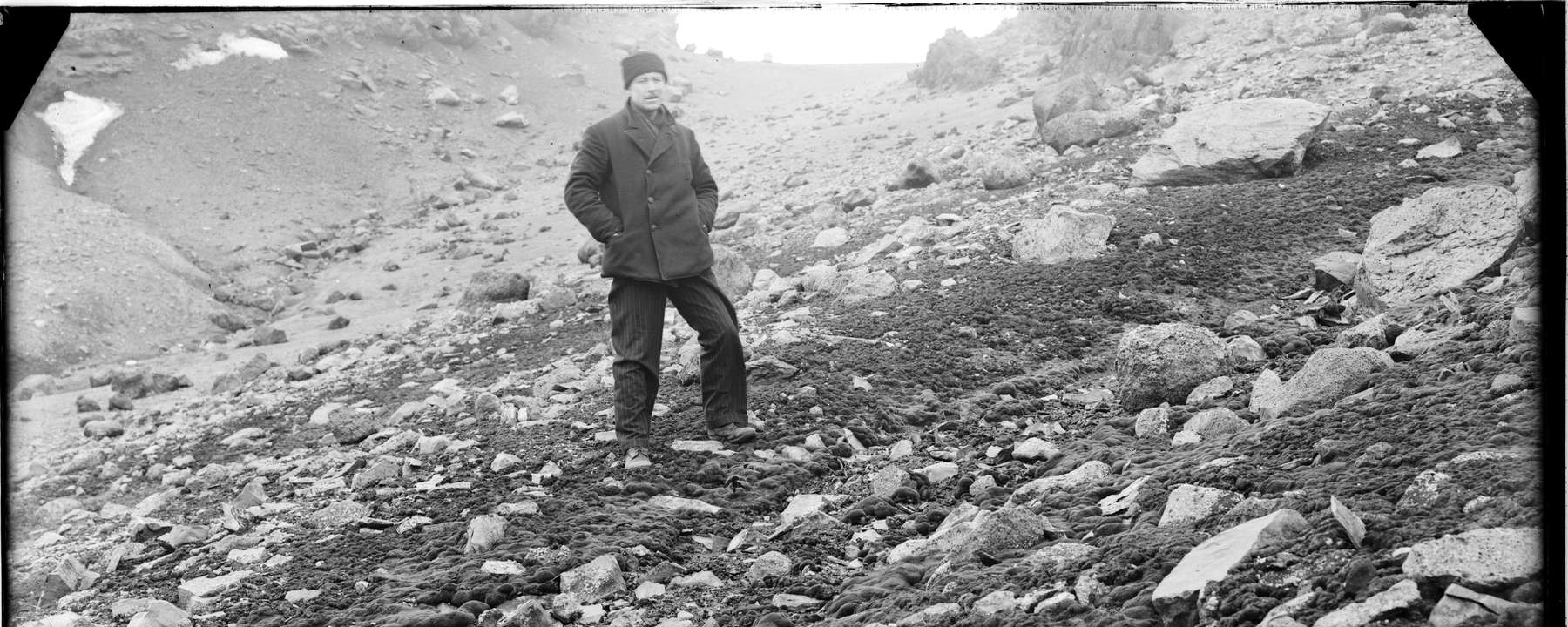
Among the expedition team was Elke Mackenzie (1911–1990). Mackenzie was a botanist specialising in lichen. This is a single organism made from a group of fungus and algae or cyanobacteria living together.
Mackenzie also became a leading expert in Antarctic botany, partly due to her work in this operation. Awarded the Polar Medal in 1953, Mackenzie undertook two further Antarctic expeditions in 1961 and 1964. In 1971, while experiencing a condition now recognised as gender dysphoria, Mackenzie underwent gender-affirming surgery. She is now recognised not only for her scientific achievements, but also as a pioneering trans woman.
Mackenzie in the Antarctic
The expedition first reached Deception Island (in the South Shetland Islands) on 3 February 1944 and established their first base. They would spend the next two years surveying the Dependencies, establishing further bases at Port Lockroy (in the Palmer Archipelago) and Hope Bay (on the Antarctic Peninsula).

BASE D
Hydrographic and Biological Equipment
Nansen-Pettersen water bottle 1
N-P thermometers (reading to -2.0°C) 2
Ekman reversing water bottle (or reversing frame for temperature
readings only) 1
Reversing thermometers (reading to -2.0°C) 2
Messengers, suitable for N.P. water bottle 2
“” “” Reversing water bottle 2
Thermometers for reading surface temperatures
(reading to -2.0°C) 4
Meter wheels if possible (for depths up to
about 200m) 2
4mm wire (or equivalent) Approx. 400m
Current meter (Caruthers pattern, with necessary accessores) 1
Instructions for use of current meter 1
Sounding gear (small portable Lucas (?) gear for boat work and sounding through holes in ice, up to 250 fms.) 1
Small hand winch 1
Awaiting estimate from London Graving Co.
A record of requested equipment from the expedition team to the Government. Catalogue reference: ADM 1/18114
The above Admiralty records detail the supplies requested for the expedition, including scientific equipment for Mackenzie and other personnel. Mackenzie collected over 1,000 lichen specimens during the expedition, many of which had never previously been scientifically classified.
Records kept by the expedition’s medical officer, Eric H. Back, offer an insight into day-to-day life for Mackenzie and the others on Operation Tabarin. For example, Mackenzie, whose role securing botanical specimens required a lot of movement, faced several skiing injuries. She also received second-degree burns from a knocked over camping stove during a long-distance sledging trip.

...
10/6/44 Skied into soft snowdrift at an angle and twisted R leg outwards. c/o pain in knee and ankle. Able with difficulty to walk back to house. Some swelling of ankle, generalised. Tender all round, especially medially. Knee satis. No evidence of fracture; probably torn medial ligament. Lead and Opium lotion and bandage applied. Dover's gr. 10 nocte.
11/6/44 Ankle much swollen. Maximum pain just below medial malleolus only slight pain laterally. Torn ligament confirmed. Ankle strapped with Elastoplast. Dovers gr 10 nocte. Aspirin gr 10 prn.
12/6/44 Still painful at night but appears satis. Tabs Codein Co 2 nocte.
13/6/44 Ankle less painful Aspirin only nocte.
15/6/44 Much improved.
18/6/44 Satis. Able to put boot on and walk about.
1/7/44 Still twinges of pain in knee and ankle. Does not feel that leg is right yet. (Never any swelling of knee). Leave strapping another week.
8/7/44 Elastoplast removed. Movement of ankle full, no pain on palpation. Slight tenderness over medial side of head of tibia. Nil else.
19/7/44 Full power now in ankle, able to ski. Some reaction to elastoplast, slight dermatitis with small shallow ulcer near medial malleolus. Ung Zinc-cum-phenol applied.
...
Mackenzie’s medical records from Operation Tabarin. Catalogue reference: CO 78/218/4
Back also described the expedition’s living conditions. This included living in pre-built wooden huts with ‘layers of aluminium foil and sisalkraft paper’ for insulation. They also had coal stoves that kept them ‘always warm’. To quickly make these huts for the expedition, Norwich-based company Boulton & Paul Ltd. was repurposed from producing Spitfire aeroplane parts to building these huts for two weeks in October 1943.

MINISTRY OF AIRCRAFT PRODUCTION
Millbank, S.W.1.
14th September, 1944.
Dear Birnie,
With reference to your letter of the 9th September concerning your urgent requirement for two huts from Boulton & Paul Ltd., Norwich, we have investigated the position at the firm and find that your work would affect the output of Spitfire aircraft cases for us. Our requirements of Spitfire cases are very urgent indeed and I am afraid that we could not possibly sacrifice any output from Boulton & Paul until the first week in October.
It is understood that the firm can produce your two huts during the week commencing 2nd October provided we give up one week’s production on the Spitfire cases. This we are prepared to do provided Boulton & Paul reinstate the full production of Spitfire cases as from the 9th October.
Yours sincerely,
[Signature]
A letter from the Ministry of Aircraft Production regarding Boulton & Paul Ltd’s production of huts. Catalogue reference: ADM 1/18114
The postage stamp effect
The British Government was aware that Operation Tabarin, and its implications for sovereignty in the Antarctic, would be politically controversial. However, different government departments had competing views on how to handle the operation.
The Colonial Office wanted to use the operation to clearly establish British occupation of the Falkland Islands Dependencies. Due to this, they equipped the expedition team with special postage stamps. Through these stamps, even the scientists’ letters home would signal Britain's territorial claim to the region.

J.V. Perowne Esq.,
South American Department,
Foreign Office,
London, S.W.1.
England.
Post sent from the expedition, including a stamp showing King George VI and the Falkland Islands Dependencies. This is designed to represent Britain's control of the region. Catalogue reference: FO 371/37729/AS2667
The Foreign Office, however, soon realised that this meant the expedition’s post might cause an international incident. By March 1944, the Foreign Office was desperately trying to stop the expedition’s first set of letters which had already been sent. Political relations with Argentina were still unsettled, and the Foreign Office argued that it would be ‘inopportune’ to reveal Britain’s Antarctic activities at that moment.

[...]
The expedition has now carried out extensive work in the Antarctic Dependencies during the past two years and we shall be able to show in the issue of stamps the results of this work. From Port Lockroy a number of letters have recently arrived bearing the new stamps and the postmark of the British Grahamland Expedition, 1944. This postmark is already in use and will, I understand, be retained. There is no objection to this, but it is clearly desirable that at the various bases the new stamps and postmarks should be used in addition to the mark of the expedition. The expedition postmark would be appropriate only for expedition work, while for general postal items the new mark should be used. It is also desirable that the new cancellation mark should be kept distinct from any expedition mark.
The Argentine political situation is in a state of flux. Their interest in Grahamland is not likely to diminish, but it is important that His Majesty’s Government should maintain their position in the Antarctic Dependencies. This is shown through the appearance at the Montevideo post office of what c/m.
A document from the Foreign Office regarding their concerns around the expedition's stamps. Catalogue reference: FO 371/37729/AS1483
Nevertheless, the cat was out of the (mail)bag. Reluctantly, the Foreign Office decided to formally notify both Argentina and the United States that Britain was establishing a permanent presence in Antarctica. This was just as well; by the time the expedition’s post reached South America in April 1944, two letters had gone missing, and a one-shilling postage stamp had been removed. The Foreign Office suspected that these had been intercepted by the Argentine government.
Legacy
Antarctica was a comparatively minor location in the Second World War, but the War Cabinet were right to recognise its strategic importance. Over the next few decades, various nations would make territorial claims to Antarctica, and its resources. Competition was fierce, and some claims remain contested. Since 1961 use of the continent has been monitored by the Antarctic Treaty System, which designated Antarctica as a de-militarised zone, accessible for scientific research.
After Operation Tabarin, Elke Mackenzie was recognised as an authority on Antarctic botany. In 1947, she accepted a research position at the University of Tucumán in Argentina. In 1953, as well as being awarded the Polar Medal for her service during Operation Tabarin, Mackenzie was appointed Director of the Farlow Herbarium at Harvard University. However, she retired from this position, possibly under pressure, shortly after sharing her gender transition.
Mackenzie’s scientific publications, and her appearance in records at The National Archives and elsewhere, appear almost exclusively under her birth name. Mackenzie herself was cautious in revealing her real identity to the botanical world. In a 1972 paper on the lichen ‘Stereocaulon arenarium’, published under her original name, she offered ‘Grateful acknowledgement […] to Miss Elke Mackenzie’. In 1976, the ‘News and Notes’ in the International Lichenological Newsletter noted that she ‘should now be addressed as Dr. Elke Mackenzie’. Today, Elke Mackenzie remains an often-unsung hero of botanical science, of polar exploration, and of LGBT+ history.