
A warship goes north
In January 1875, British warship HMS Charybdis sailed on the Gulf of Siam (today known as the Gulf of Thailand). The ship’s surgeon, Thomas Leaman Bickford, noted something unusual: the boarding of Sir Andrew Clarke, Governor of the Straits Settlements, to his ship. The Straits Settlements were a group of British crown colonies in Southeast Asia, which included present-day Singapore.
The journal does not dwell on this moment. It simply records it as a brief entry, surrounded by medical notes and other routine ship events. Bickford could not have realised that his small note marked the turning point for diplomatic interventions in Siam.
Image 1 of 2

Cover of record ADM 101/191, containing the Medical journal of HMS Charybdis, by Thomas Leaman Bickford. Catalogue refernce: ADM 101/191
Image 2 of 2

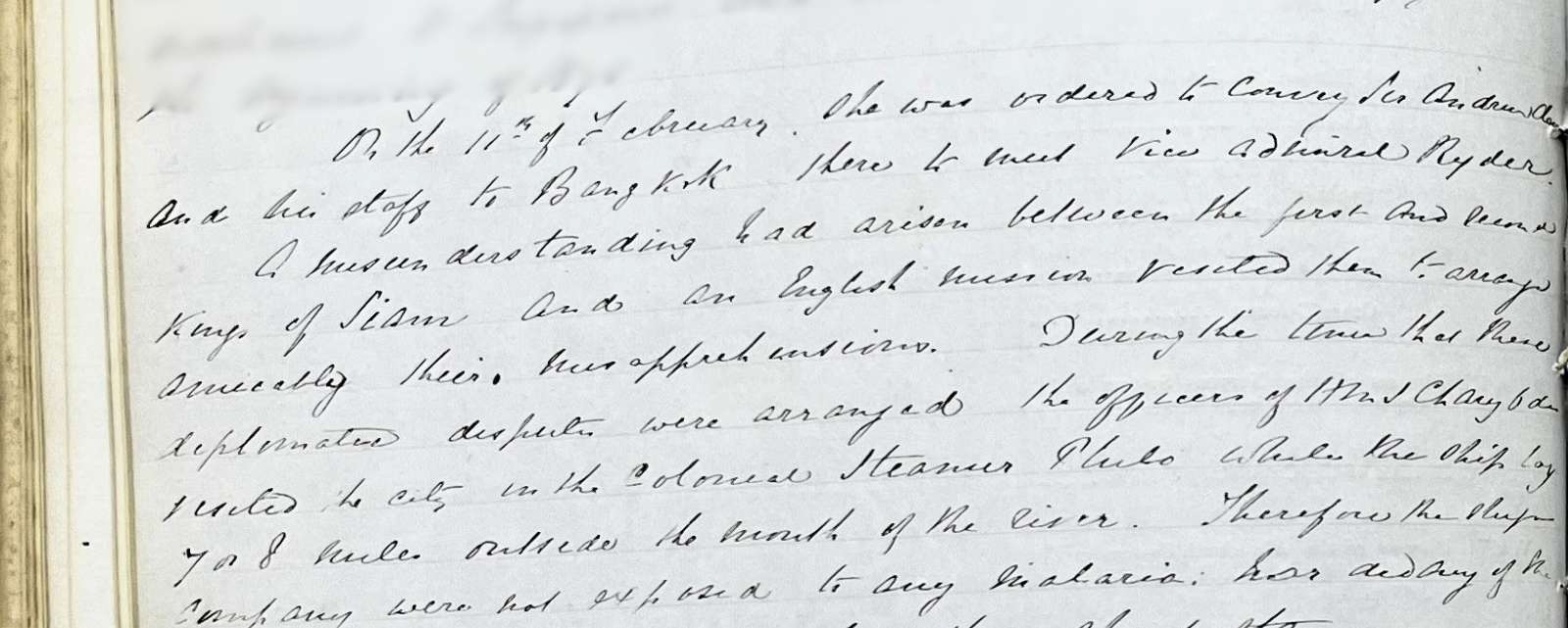
Thomas Leaman Bickford account of Sir Andrew Clark being aboard the Charybdis, 11 February 1875. Catalogue reference: ADM 101/191/1B
On the 11th of February she [HMS Charybdis] was ordered to convey Sir Andrew Clarke and his staff to Bangkok. There to meet Vice Admiral Ryder.
A misunderstanding has arisen between the first and second Kings of Siam and an English mission visited there to arrange amicably their misapprehension. During the time that these diplomatic disputes were arranged the officers of HMS Charybdis visited the city in the Colonial Steamer Pluto while the ship lay 7 or 8 miles outside the mouth of the river. Therefore, the ship company were not exposed to any malaria.
Thomas Leaman Bickford. Catalogue reference: ADM 101/191/1B
-
- From our collection
- ADM 101/191
- Title
- Ship surgeon Thomas Leaman Bickford's journal from theHMS Charybdis.
- Date
- Janaury 1874 – December 1876
Siam in crisis
In the mid-19th century, a few decades before the Charybdis journey to Siam (present-day Thailand), the country was led by a dual monarchy under King Mongkut (1804–1868). This meant that while Mongkut ruled as king, his brother, King Pinklao (1808–1865), acted as Front Palace (also known as Second King). In this role, Pinklao had significant power with his own palace, army and revenue. This arrangement worked well during their lifetimes, but it created a structural problem: two centres of power, each with its own supporters and ambitions.
Image 1 of 2

King Mongkut (King Rama IV) of Siam (Thailand). Photograph by John Thomson, 1865.
Image 2 of 2

Bangkok, Siam (Thailand): the funeral meru for the cremation of King Pinklao (Second King), January 1866. Photograph by John Thomson, 1866. Wellcome Collection.
When Mongkut died in 1868, his son King Chulalongkorn ( 1853–1910) inherited the throne at just 15 years old. At the same time, Pinklao’s son, King Vichaichan, also written as King Wichaichan, (1838–1885), inherited the Front Palace.
By the early 1870s, tensions between the two courts had become impossible to ignore. Chulalongkorn sought to modernise and centralise the state. He aimed to reduce the power of noble families, reform the bureaucracy, and strengthen the monarchy’s authority. Vichaichan, backed by conservative noble factions, resisted these changes.
The fragile balance of power between the two kings collapsed dramatically in late 1874 when a fire broke out in the Grand Palace, the king's residence . The cause was never established, but the political consequences were immediate. Each side suspected the other of carrying out this attack. Soon, troops were mobilised by both rulers and rumours of assassination spread.
In fear for his life, Vichaichan fled to the British Consulate. This single act transformed an internal Siamese dispute into a diplomatic emergency. Britain suddenly found itself sheltering one of the kingdom’s most powerful figures. The British government could also be seen as standing between him and the king, potentially creating diplomatic tensions.
Britain steps in
During this time, the British Consul in Bangkok, Thomas George Knox, requested urgent assistance from Britain. He feared that a destabilised Siam could weaken British trade routes, regional diplomacy, and the delicate balance of power across Southeast Asia. Britain did not aim to colonise Siam, but as Knox’s request shows, its officials wanted the country stabilised to suit their wider ambitions. To achieve this, Britain was willing to intervene.
Sir Andrew Clarke responded immediately to Knox’s request. As Governor of the Straits Settlements, he understood the strategic importance of Siam as a buffer between British Burma and French Indochina (Vietnam, Laos, and Cambodia). Clarke recognised that the crisis presented a risk of regional instability but the opportunity for Britain to position itself as a trusted mediator.
He boarded the Charybdis in Singapore and sailed north to Bangkok. Bickford’s surgeon’s journal captures this moment. It does not describe the political stakes or the tension awaiting Clarke in Siam. It does, however, anchor the story in time and space: a British governor, on a British warship, heading into a Southeast Asian political crisis.
The mediation
When Clarke reached Bangkok, he stepped into a kingdom in political destress. King Chulalongkorn and the Front Palace stood in open opposition, each refusing to back down. Vichaichan would not leave the safety of British protection, and Chulalongkorn refused to enter any negotiation while his rival remained in foreign shelter.
Clarke’s careful mediation unfolded over several weeks, during which he worked to reassure Vichaichan that he would not face a punishment for his actions, while affirming Chulalongkorn’s authority as the rightful sovereign. He applied steady pressure on both sides urging them toward a settlement. He also maintained the appearance of British neutrality while subtly encouraging Chulalongkorn’s modernising agenda as it aligned with British strategic interests. Clarke believed that a stable, centralised Siam would be far less vulnerable to French colonisation and, therefore, far more likely to remain a cooperative partner.
Image 1 of 2

A photograph of King Chulalongkorn taken at Graitney, Camberley. He is seated second to the right. Catalogue reference: COPY/1/431/725
Image 2 of 2

King Vichaichan as a Prince before becoming the Front Palace.
Archive PL / Alamy
-
- From our collection
- COPY 1/431/725
- Title
- A group photograph, including The King of Siam, taken at Graitney, Camberley.
- Date
- 17 August 1897
The deadlock finally broke on 24 February 1875. Vichaichan agreed to terms that would strongly limit the traditional powers of the Front Palace. In effect, this ended the centuries old dual monarchy system in Siam. With the crisis resolved, Chulalongkorn gained the political power he needed to bring in administrative, legal, military, and economic reforms. These would lay the foundations of the modern Thai state we know today.
The importance of Bickford’s journal
The surgeon's journal from HMS Charybdis is, on the surface, an unlikely witness to a political crisis. Despite this, it conveys a striking sense of urgency around Clarke’s mission and highlights the subtle role of naval power in supporting British diplomacy. The journal also demonstrates how imperial networks, maritime mobility, and local sovereignty intersected in deliberate and structured ways during this period.
Its significance extends beyond the event it documents. The journal highlights that history can hide in places we do not think to look. Here, a single line in a ship’s log can trace the movement of people, power, and ideas across oceans. It also challenges our assumptions about what different kinds of records are ‘supposed’ to contain. This record ultimately reminds us that archives are not merely repositories of documents. They are repositories of stories that stretch across continents, cultures, and centuries, waiting to be rediscovered.
A wider lens: Britain, Siam, and the politics of non-colonisation
The Front Palace Crisis is often remembered as a domestic Siamese conflict, but it also reveals something important about Britain’s role in Southeast Asia. Unlike Burma or Malaya, Siam was never colonised. Instead, it navigated the pressures of European imperialism through diplomacy, reform, and strategic adaptation.
Clarke’s intervention is a clear example of this dynamic. Britain did not impose direct rule, but it influenced the country through mediation, advice, and strategic presence. The voyage of HMS Charybdis symbolises this approach: a warship used not for conquest, but for negotiation.
This does not mean Britain was benevolent. Its interests were clear. Regardless, a strengthened Siamese monarchy, a modernising state, and a preserved independence, reflects a rare moment when imperial and local interests aligned.