
Important information
This article contains historical records that include themes of homophobia, policing, and surveillance. Some records use homophobic language and highlight the legal discrimination faced by the LGBT+ community.
A monthly social medium for lonely people
The Link was a ‘lonely hearts’-style publication from the early 20th century, that aimed to to connect people. It was founded by author Alfred Walter Barrett in 1915, in response to a perceived crisis of loneliness after the First World War.
The Link described itself as ‘not matrimonial’, differentiating it from competitors. By explicitly defining itself as looking beyond marital love, it pushed the boundaries and social norms of the era, suggesting what might be acceptable in its pages. These adverts did not just fill a few pages at the back of the magazine, they provided its entire content. While the personal advert was not a new concept, this approach was.

THE GREAT SOCIAL MEDIUM—NOT MATRIMONIAL
The Link
A Monthly Social Medium for Lonely People
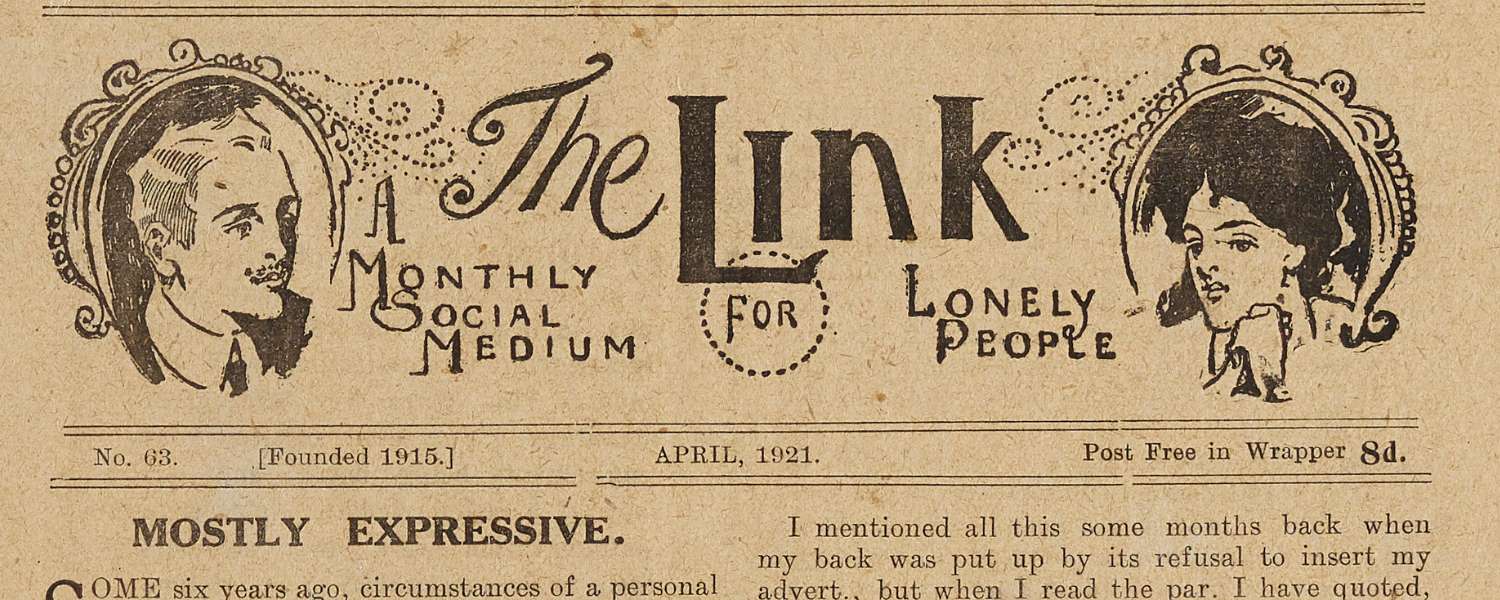
No. 68 [Founded 1915.] APRIL, 1921. Post Free via Wrapper 8d.
MOSTLY EXPRESSIVE.
Some six years ago, circumstances of a personal and somewhat tragic nature set me to seriously consider the problem of loneliness, and as the outcome the “Link” came into existence. Something of the idea of it is due to T. P. O’Connor, and something to the late “Mrs Bull”; but so much of it is mine that I am ready to accept whatever there may be of credit or blame attaching to the fundamental idea and the carrying out.
I can’t honestly say that the enterprise was blessed save by those for whom it was intended. There are lots of fools still with us, and we have to suffer them gladly or otherwise because the law is strictly impartial and would look at you with chilly disapproval if you tried to thin them out with an axe or something.
The greatest sinners are those in charge of our great and gloriously free and independent Press. They recognise the evil. Oh, yes! They even deplore it. “The Chronicle,” “ The Mail,” “The Mirror,” and a host of others have from time to time written about the theme, and only a few weeks ago, I culled the following from the chaste pages of the “Daily Express”:
...
The Link, A Monthly Social Medium for Lonely People, No. 63. April 1921. Catalogue reference: MEPO 3/283
The adverts were divided into three sections of personals: Ladies, Civilians, and Soldiers and Sailors. This included adverts by war widows, disabled soldiers and people searching for less formal relationships, reflecting the changing society it was created in and contributed to.
Much like modern dating profiles, people had a set number of words (up to 25) to describe themselves and what they were seeking. These adverts can be read as emotional artefacts, as valid and meaningful as any other declaration of affection in our collections.

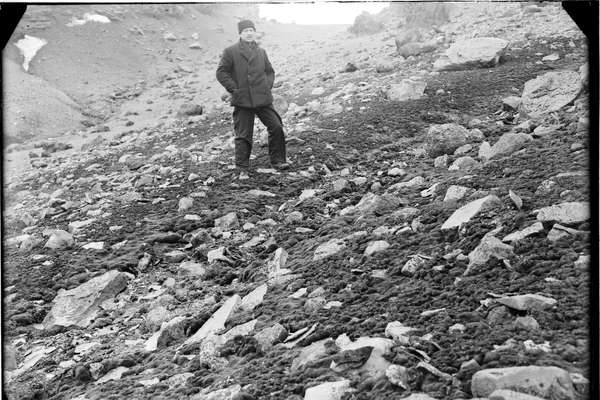
A photograph of Alfred Walter Barrett, the owner of The Link. Catalogue reference: MEPO 3/283
Love in code
The 1920s was an era of contradictions; same sex acts between men remained criminalised while the underground queer community continued to grow, especially around London.
The Link offered exciting possibilities to people we might now read as gay, lesbian, bisexual and/or transgender. It empowered people to create a carefully curated version of themselves that had the potential to evade the law and public scrutiny. It also offered the possibility of making connections with like-minded people, nationally and even internationally. This was a more accessible form of contact that avoided the potential barriers of club entrance fees or costly travel.
Through these pages, men, and some women, used the coded and suggestive language possible through classified adverts to meet members of the same sex. These adverts also show that LGBT+ desire was not just linked to London and other large cities, with entries from places as varied as Southsea, Portugal, Canada, Cornwall, Lowestoft and Somerset. It is not clear if Barrett wanted to engage this audience or turned a blind eye to the expanding appeal of the publication.

ADVERTISEMENT and COPY OF PAPER 2/6
Owing to the demands on my space, and the consequent holding over of so many advertisements, PRIORITY WILL BE GIVEN to Advertisements sent in on above Coupon, with a prepaid Booking Fee of 6d. extra. Adverts must not exceed 25 words. All booked Advertisements received up to and including the first day of each month will be certain to appear in the issue following the number then current. THE LINK is published about the 14th of each month, and is current during the month it is dated for.
Classified advert template from The Link, No. 63. April 1921. Catalogue reference: MEPO 3/283
‘Broadminded’, ‘unconventional’ and ‘musical’
In their classified adverts, men would often use the word ‘bachelor’ or the phrase ‘seeking friend’. Some were bold enough to specify that they wanted to meet with someone of their ‘own sex’. They would describe themselves as ‘bohemian’, ‘unconventional’, ‘musical’ or ‘artistic’, marking themselves against the norm and masculine ideals of the time.
Another approach was to list people who represented queerness in culture, notably Oscar Wilde, socialist Edward Carpenter (who openly published about sexuality) and the American poet Walt Whitman. Some people used non-English languages, attempting to evade the law. Many also mentioned loneliness and a desire for companionship.
Joe (London, S.W.), 24, working-class, musical, affectionate, lonely, needs chum for moral support. Appreciate week-ends with somebody. Photos desired. All answered.
D. (London), 28, wants musical, broad-minded, well-bred boy pal. Fond of sports, art literature, etc. Refs. exchanged.
Jeune Anglais (London, W.), qui n’aime pas les femmes, désire connaitre un francais pour échange de conversation. [Translation: Young Englishman (London, W.), who does not like women, wishes to meet a Frenchman for conversation exchange.]
Otherwise Normal (Western Suburbanite), 21, seeks young friends who do not chase girls.
Selected classified adverts from The Link
Archived page
Further reading
Explore our archived blog, '‘Bohemian, broad-minded, unconventional.’ What was it like to be queer in the 1920s?'

Discharged Soldier (London, S.E.), 20, quiet, honest, good family, good situation, wishes correspond with nice, quiet young lady, 18-20, fair complexion. London district. (979.)
Young Man (Lancs.), 27, would like to hear from refined, working girl, 24, broad-minded, fond music, cycling. Near Preston, Lancs. (980.)
H. O. H. (London, N.W.), 40, tall, fair, honourable, sincere, business man, wants to meet educated girl for genuine friendship, refined, 28-33. Photo (returnable) appreciated. (983.)
Medical Student (I.O.M.), 25, tall, dark, invites correspondence from well-educated young lady, 18-25. Must be sincere, genuine. Photo appreciated and returned. (984.)
Young Man (London, S.W.), 31, tall, dark, would like to meet sincere young woman or widow, 25-35, working-class. (985.)
Idealist (London, S.W.), 31, well-educated man, artistic, genuine, broad-minded, tall, decent-looking, firm believer in Carpenter’s books, wishes meet men similar disposition. Photos welcomed. (988.)
Young Man (Canada), 25, is anxious to correspond with friend. Must be same sex, affectionate, and amiable temperament. Will send photo. (990.)
Boy (London, W.), 24, orphan, friendless, comfortable position, would be ever grateful if any elderly lady would be mother to him. Son’s affection offered. Genuine. Please do. (992.)
Bachelor (Cornwall), 30, wishes to meet bachelor, 20-30, for holiday on Cornish Coast. Apartments and board paid in return for companionship. Enclose photo please, returnable. (993.)
A sample list of classified adverts from issue No. 56 of The Link, September 1920, as underlined by a member of the public. Catalogue reference: MEPO 3/283
Listen
More queer classified adverts from The Link, read by actors.
Audio transcript for "More queer classified adverts from The Link, read by actors."
Bachelor, London SW1, smart, Italian, 35, tall, dark, small income, would appreciate good English male friend, 30, sincere, reliable, with same means, 30 upwards, settle Italian Riviera, photo return, reference exchanged.
Lonely Lad, Sussex, London shortly, 27, anxious, meet real pals, same age or younger, temporarily artistic, affectionate, sincere, all letters answered, genuine, own sex only.
Young foreigner, London, West, 32. Would like to meet young male friends. Letters with photos only, please.
R. Surrey, 28. Educated, travelled, good appearance, sportsman, fond of the country. Wishes to eat educated chum, own sex, for weekends away, summer evenings and town.
Bohemian, North London, 26, ex-captain, jolly, sporty, educated, wants to meet congenial spirits, both sexes with original ideas.
Musician, London, North West. 25, cultured, artistic, intellectual, desires true man chum, likewise, not older. Enthusiast in friendship. Keen appreciator of personal charm, not pursuers of damsels.
Gentleman, London, 34. Would like nice young manly fellow as chum. Fond of music, theatres, broad-minded. Photograph, please.
Bachelor, London, S.E., 33. Lonely in digs requires sincere, sociable friends. Own sex, 20 to 30. No girl hunters. Photos returned. Weekends, etc.
‘Jolly’ and ‘sporty’
Most same sex classified adverts were from men seeking other men. While facing stigma from society, the lack of laws policing women’s relationships meant there was slightly less need for these underground methods of communication. However, there are some written by women, with similar coded language in these adverts, including ‘unconventional’, ‘lonely’, ‘jolly’ and ‘bachelor girl’.
Unconventional (Wales), 30, well-educated, literary tastes, fond of travel, dancing, good times, and studying human nature, would like correspondence.
classified advert from The Link
Unfortunately, the police and public were also able to interpret some of these classified adverts. This early coded language was less subtle than later, more complex, developments like Polari (which was a secret, coded language used by gay men to communicate with each other).
As a result, these adverts were often filled with clichéd ideas of male femininity or female masculinity. These coded adverts demonstrate a tension between the author sending a clear message about their sexuality while attempting to hide from the law.
This balancing act was difficult to maintain. Due to this, members of the public would sometimes raise complaints with the Metropolitan Police, highlighting sections of text they found problematic.
Ernie and Geof
People’s determination and creativity in finding ways to meet despite the law is clear, but is there evidence that people successfully connected?
In October 1920 Ernie, a clerk in Belfast, placed a personal advertisement in The Link, containing just the following words:
Youth (Ireland), 18 fond of music etc, literature well educated, refined, desires sincere friend, own sex. Any age to 35, all letters answered.
Ernie
In his allocated space Ernie used certain words and phrases: ‘music’, ‘literature’, ‘sincere friend’ and, most significantly, ‘own sex’. These words signalled his desire to meet other men, and his adverts in the Link proved very successful.

A selection of love letters found by the police on Ernie in Belfast. Catalogue reference: MEPO 3/283
Geof, an ex-serviceman from Enfield, was one of the men who responded to Ernie. The Link gave them a chance to connect, despite the distance between Enfield and Belfast, with Geof writing to Ernie, ‘I feel sure we would be able to become excellent friends’.
Through their vivid and open correspondence, we can see that Ernie and Geof pursued a relationship, although whether they were ever able to meet in person is unclear. Geof wrote; ‘I am longing to revel in the joys of your naked body.’ They talked about their fondness for each other, but there is also a thread of jealousy running through the correspondence as both also met with other men.
In a particularly telling line Geof talks openly about his frustrations with the law:
I cannot understand why it should be considered a criminal offence for two people of the same sex, who are fond of each other & mutually agreed, to commit sodomy.
Geof, in a letter to Ernie
It would take over 40 years for the State to partially decriminalise homosexual acts. Meanwhile, Ernie and Geof would live in the shadows of discriminatory legislation for many decades.

COPY OF LETTER
"Colebrooke",
108 Chase Side,
Enfield,
Middlesex.
12-9-20.
Dear Ernest,
Thanks very much indeed for your letter & especially for the excellent photograph. I am having some photos taken & will send you one along.
I feel sure we would be able to become excellent friends.
I am also very fond of all good music, and abhor ragtime & jazz. Incidentally I am also fond of literature, & like a great number of authors ancient & modern. I must say I have often wanted to obtain some of Oscar Wilde’s books but have not come across any.
I fully understand your letter, old chap, & can assure you that what you desire in the way of a chum is also my own desire. I cannot understand why it should be considered a criminal offence for two people of the same sex, who are fond of each other & mutually agreed, to commit sodomy. If I become really fond of another young fellow I always desire to bestow my affection upon him in its most ardent form. From your letter I gather that we should be as one mind on this topic.
Please write quite frankly to me, old chap.
Your sincere chum,
Geof. B. Smith.
Love letter to ‘Dear Ernest’ from his ‘sincere chum’ Geof, typed up as evidence in a police file. Catalogue reference: MEPO 3/283
Archived page
Ernie and Geof: Love between men
Explore our archived blog on Ernie and Geof's relationship.
In court
In 1922 Ernie was arrested. In his possession were hundreds of letters between himself and many other men. This evidence led to Geof’s arrest too. Their intimate letters were then shared by the Belfast Constabulary with the Metropolitan Police to be used as evidence, along with copies of the Link. This led to their survival in our collections, now offering a challenging, first-hand lens into a private relationship. The letters also provide powerful evidence of how queer people fought against the constraints of their time.
Walter Birks, a self-styled bohemian who had also met men through The Link, was additionally arrested. The men were charged with conspiring to commit ‘gross indecency’ or ‘sodomy’.
As the owner of the publication, Barrett faced an additional charge: publishing advertisements with intent to corrupt public morals. The police paid little attention to advertisements between women, as these did not go against the law. However, adverts suggesting an exchange of money, potentially linked to sex work, were cited in the charges.
All four men were tried at the Old Bailey in London. In court, Barrett claimed The Link was intended for ‘decent people’, stating: ‘The other sort is not desired.’ He admitted he had been careless, failing to realise people’s ‘true character’.
Each man was convicted and sentenced to two years’ imprisonment with hard labour at Wormwood Scrubs. The 1921 census records three of their names next to each other, all of them still in prison.

Location:
H.M. Prison Wormwood Scrubs Ducane Road W12
Name and surname:
- Alfred Walter Barrett
- William Ernest Hunter Smyth
- Geoffrey B. I Smith
Relationship to Head of Institution or position in Institution
- Inmate
- do [ditto]
- do [ditto]
Age
- 52 years 6 months
- 22 years 11 months
- 27 years 6 months
Sex
- M
- M
- M
Marriage or orphanhood
- Married
- Single
- Single
Birthplace and nationality
- London ?
- Ireland Belfast
- London Kensington
Personal occupation
- Author
- Library Assistant
- Clerk
Employment
- No fixed place
- No fixed place
- No fixed place
Extract of the 1921 census of England and Wales. Catalogue reference: RG 15
Despite Barrett’s previous success as an author and publisher, this case marked his downfall. The Link ceased publication. There is no evidence that Ernie and Geof ever corresponded again, but we can hope they continued using creative means to find love.
Defiance and creativity
The Link powerfully shows that despite the criminalisation and social stigma of queer love, people continued to seek ways to connect and defy the law. As Geof wrote, ‘I think the ‘Link’ and the U.C.C [the Universal Correspondence Club] are about the only ways I know about to become acquainted with people like ourselves.’ A century later, the instinct to meet others endures, whether through dating apps or classified ads.