




fireoflondon.org.uk
The Great Fire of London game
The Great Fire of London game from the Museum of London.
Teaching resource
Use this lesson to work with original documents that tell the story of the Great Fire of London in 1666.

Hollar’s Survey of the City of London, 1667. Catalogue reference: ZMAP 4/18
What happened during the Great Fire of London and how did London change?
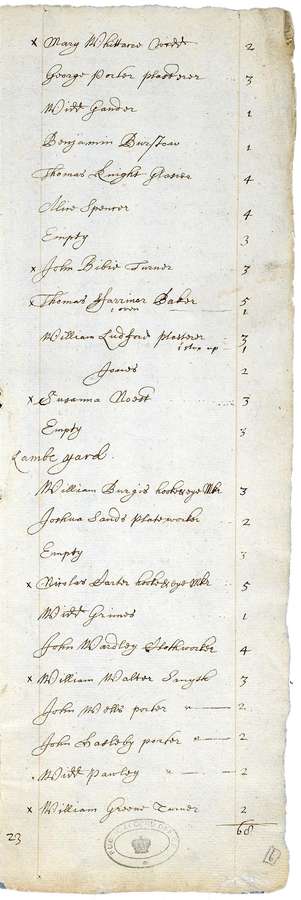
This is a tax record for August 1666. These people lived in Pudding Lane in London. The numbers show the amount of hearths (fireplaces) in each person’s house.
People who owned a house had to pay a hearth tax to the king. They paid 1 shilling (5p) for each hearth.
This tax was collected twice a year. Some people might stop up their fireplaces for part of the year so they didn’t have to pay the tax twice.

Pudding Lane Hearth Tax, August 1666. Catalogue reference: E 179/252/32 pt4 p6
This source was written about two weeks before the fire. It lists some of the people who lived in Pudding Lane. This is where the fire began.
After the fire, King Charles II wanted a new map of London.

We have appointed Wencelaus Hollar and Francis Sandford to take an exact plan and survey of our city of London with the suburbs adjoining as the same now stands after the sad calamity of the late fire with a particular depiction of the ruins thereof.
The king has chosen Wencelaus Hollar and Francis Sandford to make a map of the city of London and the nearest suburbs to show the damage caused by the terrible fire.
Order from Charles II, 10 September 1666. Catalogue reference: SP 44/23
Wenceslaus Hollar drew this map.
On the corner of his map, Hollar put some information. It is a list of places that are numbered on the map. This is called a key.

An exact surveigh of the streets lane and churches contained within the ruines of the city of London first described in six plat[e]s by John Leake, John Jennings, William Marr, Will Leyburn, Thomas Streete & Richard Shortgrave in December anno 1666. By the order of the Lord Mayor Aldermen, and Common Councell of the said city.
Reduced here into one intire plat[e], by John Leake, the City Wall being added also. The places where the Halls stood are exprest by Coats of Armes, & all the Wards divided by pricks & Alphabet.
The Prospect of this Citty, as it appeared from the opposite Southwarke side, in the fire time.
HOLLAR’S “EXACT SURVEIGH” OF THE CITY OF LONDON, 1667
[from the 1669 copy in the British Museum]
Hollar’s Survey of the City of London, 1667. Catalogue reference: ZMAP 4/18

Key to Hollar’s Survey of the City of London, 1667. Catalogue reference: ZMAP 4/18
King Charles praised the courage of the people in the fire. He hoped to see a more beautiful city rebuilt. He also made plans to prevent another fire. Here are some of his plans.

In the first place the woful experience in this late heavy visitation hath sufficiently convinced all men of the pernicious consequences which have attended the building with Timber, and even with Stone itself, and the notable benefit of Brick, which in so many places hath resisted and even extinguished the Fire; And we do therefore declare Our express Wil and Pleasure, That no man whatsoever shal presume to erect any House or Building, great or small, but of Brick or Stone, and if any man shal do the contrary, the next Magistrate shall forthwith cause it to be pulled down, .
.all other eminent and notorious Streets, shal be of such a breadth, as may with Gods blessing prevent the mischief that one side may suffer if the other be on fire,
.nor wil we suffer any Lanes or Allyes to be erected, but where upon mature deliberation the same shal be found absolutely necessary,
…no house shall be erected within so many foot of the River,
.any houses to be inhabited by Brewers, or Diers, or Sugar-Bakers, which Trades by their continual Smoaks contribute very much to the unhealthiness of the adjacent places, but We require the Lord Mayor and Aldermen of London upon a ful consideration, and weighing all conveniences and inconveniences that can be foreseen, to propose such a place as may be fit for all those Trades which are carried on by smoak to inhabit together, .
Firstly, the sad experience of the fire has shown us all the bad results of building with wood, and even with stone, and the good benefits of brick, which in so many places did not catch fire. And it is the King’s wish that no man shall build any house or building, large or small, unless it is made of brick or stone. And if any man does not do this, his house will be pulled down.
All of the main streets shall be wide enough to (God willing) stop a fire spreading from one side to the other.
No lanes or alleys will be built unless we think they are really needed.
No houses shall be built near the river.
Brewers (making beer), dyers (colouring cloth) or bakers are trades whose constant smoke makes nearby places unhealthy. The Lord Mayor and the men who run London must think of a place where all those trades which use fire can be housed together.
Charles II’s declaration to London in 1666. Catalogue reference: SP 9/171
This lesson can be used with pupils at Key Stage 1 for the history National Curriculum in Year 2. It looks at the story of the Fire of London through evidence relating to some of the key characters: Thomas Farriner and Charles II. Background notes also provide contemporary views on the causes of the fire, based on original documents at The National Archives.
The questions progress in difficulty, so those based on Source 4 are a little harder than those questions based on Source 1. It is suggested that teachers/helpers read through the documents together with the class. Have a go at reading the original document first to spot familiar words, but all documents are transcribed and have simplified transcripts
An event beyond living memory that is significant nationally.
A programme of study concerning an aspect of social history from the Anglo-Saxons to the present.
The Restoration, ‘Glorious Revolution’ and power of Parliament, covering the reign of Charles II.
Here are some suggestions for further activities:
London was a very crowded city in 1666. The streets were narrow and the houses were made of wood and very close together. Inside their homes, people used candles for light and cooked on open fires. A fire could easily get out of control. In those days there were no fire engines or firefighters to stop a fire from spreading.
The fire began on early Sunday morning on 2 September 1666. It started in Pudding Lane in the shop of the king’s baker, Thomas Farriner. When Thomas went to bed, he did not put out the fire that heated his oven. Sparks from the oven fell onto some dry flour sacks and they caught fire. The flames spread through the house, down Pudding Lane and into the nearby streets. Soon London was filled with smoke. The sky was red with huge flames from the fire. By Monday, 300 houses had burned down.
Everybody was in a panic. People loaded their things onto carts and tried to leave town. Others tried to get away on boats on the river. Some people buried their things in the garden, hoping to save them from the fire.
The fire still spread, helped by a strong wind from the east. London Bridge and St Paul’s Cathedral were both burnt. On Tuesday, King Charles II ordered that houses and shops be pulled down to stop the fire from spreading. By Wednesday, they had the fire under control. But by then, 100,000 people were homeless.
Thomas Farriner and his wife got out of their bakery in time, but their maid was too frightened to jump from the roof. She was the first to die. Surprisingly, only nine people died because of the fire.
Two people have left us eyewitness accounts of the fire. The first is Samuel Pepys, who worked for the Navy. He kept a diary from 1660–1669. The second is John Evelyn, who also kept a diary. Both men describe how dramatic and scary the fire was.
Not everyone at the time thought that the fire was an accident. Some said foreigners caused it. Others felt that the fire was started by those not free to follow their own religion. Some even saw the fire as a punishment from God. A ten-year-old boy, called Edward Taylor, and his family were questioned for throwing fireballs at an open window in Pudding Lane and in the streets. Fireballs were made from animal fat (called tallow), set alight and used to start fires. However, the fire was most likely caused by chance rather than by a deliberate act.
Charles II ordered that 10 October 1666 be a day of fasting on account of the fire. He told the Lord Mayor of London to support collections for victims of the fire. Later, close to Pudding Lane, a monument was built so that people would not forget the fire. It was the work of Sir Christopher Wren, who designed many new buildings, including St Paul's Cathedral, when the city was rebuilt after the fire.
fireoflondon.org.uk
The Great Fire of London game from the Museum of London.
londonmuseum.org.uk
Objects from Museum of London collections tell the story of the Great Fire.