







Collection blog
Researching LGBTQ+ histories in the archives of government
In this blog post Vicky Iglikowski-Broad explains how you can get started in researching LGBTQ+ histories through government records.
Teaching resource
James Barry was a leading 19th-century army doctor with a glittering medical career. He chose to exclusively live and identify as a man, having been assigned female at birth. This resource traces Barry's military and medical career through government records.

James Barry's appointment to Inspector General of Hospitals in 1857. Catalogue reference: WO 138/1
Sources within this resource deal with historical transphobia. Source 8 contains an outdated term for an intersex person. Original language is reproduced here to accurately represent our records and to help us fully understand the past.
What do these documents reveal about transgender histories?

Return of the Services
And [Added comment: ‘See Statements of Services 1, 614’]
Professional Education
James Barry M.D. Assistant Staff Surgeon [Added comment: ‘a woman’]
From 5th July 1813 to 7th April 1824
I commenced the Study of my Profession at the University of Edinburgh as Literary & Medical Student in the year 1810
The following are the classes I attended before and since my entry into the Service
Practice of Physic
Theory of Medicine: Two courses & clinical lectures 3- 6 months 1811 &1812
Chemistry 18 courses 1810, 1811, 1812
Pharmacy 3 courses of Clinical lectures
Botany
Anatomy 3 courses & Morbid Anatomy 2 courses
Military Surgery
Midwifery
Dissections 3 courses 1810, 11, 12
Clinical surgical lectures
Surgery course
Barclay & Murray’s Private lectures, Dr Duncan Just. Medical Jurisprudence
Literary classes in Greek, Natural & Moral Philosophy
Private pupil to Mr Fyfe
Likewise attended the undermentioned Hospitals a regular Pupil, during the Period…
Guys & St Thomas in London for 6 months in the year
Royal Infirmary, Dispensary of Lying in Hospital in Edinburgh for 12 months in the year 1811 as perpetual pupil
I received a Diploma in 1812 as Doctor of Medicine from the University of Edinburgh
and the following is a correct detail of my services, both upon Full and upon Half Pay, with the several Stations.
Extract from Dr James Barry’s personal army service record. Catalogue reference: WO 25/3910
This is an extract from a document entitled ‘Memorandum of the Services of Dr James Barry Inspector General of Hospitals’. This was written by Dr Barry at the end of his career after serving in Canada when he returned to London in 1859, although the date stamp on the document is not clear.
In this extract Dr James Barry refers to an important rebellion of enslaved people on the island of Jamaica 1831–32.

Memorandum of the Services of Dr James Barry Inspector General of Hospitals.
I entered the Army as a medical officer under the age of fourteen years and served first at the Cape of Good Hope about thirteen years attached to the personal Staff of the late General Lord Charles Somerset on whose resignation, I was promoted to the rank of Staff Surgeon and sent to the Mauritius. I served there about eighteen months and was recalled in consequence of the serious illness of Lord Charles Somerset upon whose death I proceeded to Jamaica and served under Sir Willoughby Cotton during the Rebellion and the burning of the Plantations by the Negroes. I was in medical charge of the Troops employed on that service the Inspector General remaining at Head Quarters….
Memorandum of the Services of Dr James Barry Inspector General of Hospitals. Catalogue reference: WO 138/1
This is a second extract from the ‘Memorandum of the Services of Dr James Barry Inspector General of Hospitals’.
In this extract Dr Barry makes refers to the Crimean War (1854–56) fought by an alliance of Britain, France, Turkey and Sardinia against Russia. While serving during the Crimean War, Dr James Barry was supposed to have argued with Florence Nightingale.

I was shortly after promoted to the rank of Deputy Inspector General in the Ionian Islands. During the period of my service there, war was declared against Russia and at my suggestion to Lord Raglan and Inspector General Sir J. Hall, 500 of the sick and wounded from the Crimea were sent and placed under my charge at Corfu, upward of 400 of them returned fit for active service having been restored to health in an unusually short period and I myself proceeded on leave to the Crimea where I remained about three months with the 4th Division before Sebastopol and made myself useful as opportunities offered which can be testified by Sir John Hall and the Colonel and officers…
Memorandum of the Services of Dr James Barry Inspector General of Hospitals. Catalogue reference: WO 138/1
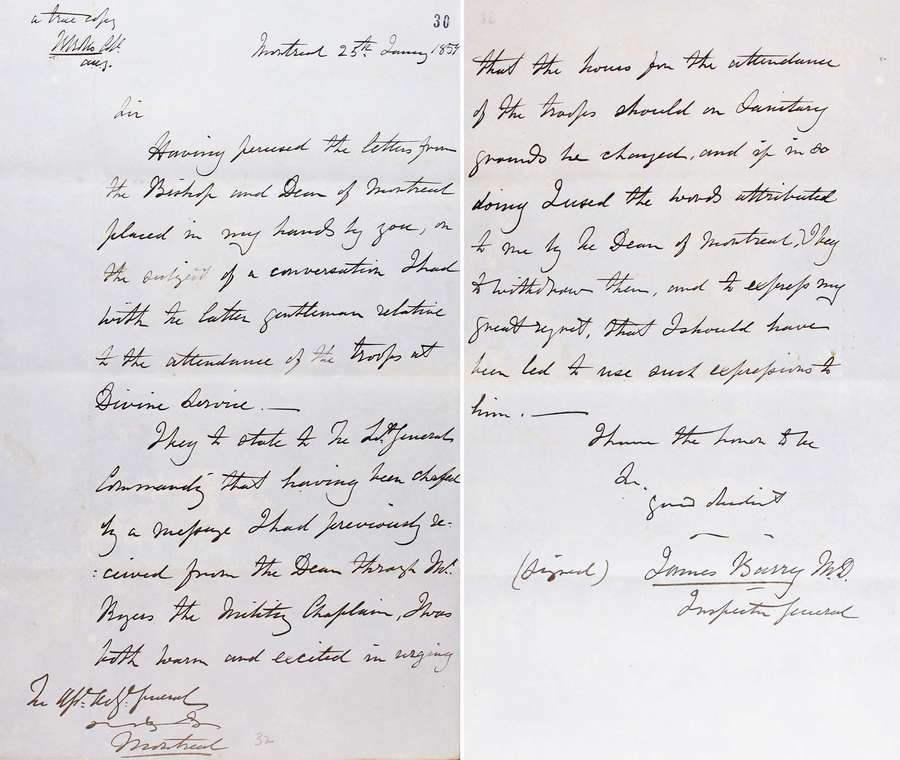
This letter from Dr James Barry to the army General Commanding Officer, 25th January 1859, refers to a disagreement between Dr Barry and two church officials for the Church of St John’s in Montreal, Canada.
Barry was promoted to the highest rank in the army as Inspector General of Hospitals in the British colony of Canada in 1857.
The disagreement concerned the timing of the church Service held for the army. The churchmen complained to the Bishop of Montreal that Dr Barry had ‘with such violence of manner and language, accused the Archdeacon and me [the Dean] of refusing to allow the military service to be changed from 2pm to 9am, stating that we were callous to the spiritual welfare of her Majesty’s soldiers, with much more to the same effect, and finishing with a threat to publish us in the London Times newspaper’.

Montreal 25th January 1857
Sir,
Having perused the letters from the Bishop and Dean of Montreal placed in my hands by you on the subject of a conversation I had with the later gentlemen relative to the attendance of the troops at Divine Service.
They [to] state [to] the Lieutenant General Commanding that having been changed by a message I had previously received from the Dean, Mr Byers the Military Chaplain, I was both warm and excited in urging that the hours for the attendance of the troops should on sanitary grounds be changed and if in so doing I used the words attributed to me by the Dean of Montreal, I beg to withdraw them, and to express my great regret that I should have been led to use such expressions to him.
I have the honour to be, your obedient
(Signed) James Barry M.D.
Inspector General
Letter from Dr James Barry to the army General Commanding Officer, 25th January 1859. Catalogue reference: PRO 30/46/18
This is a third extract from the ‘Memorandum of the Services of Dr James Barry Inspector General of Hospitals’.

On each change of station, I was put to an immense personal outlay, the climates of each being of such different temperatures. Each move entailed a sacrifice of property then in my possession and an outlay to procure that required for the service in prospect. I am now prepared to serve Her Majesty in any quarter of the Globe to which I may be sent and am now loath to close a career which impartially may be deemed to have been useful and faithful one without some special mark of Her Majesty’s favour.
James Barry M.D.
Inspector General
Memorandum of the Services of Dr James Barry Inspector General of Hospitals. Catalogue reference: WO 138/1

25 Duke Street,
Westminster
July 25th 1865
Sir,
I have the honour, Inspector General to report that the officer, named in the margin address died at 4’o clock am this morning.
Dr James Barry
14 Margaret Street,
Cavendish Square’
Disease: Diarrhoea
I have the honour to be Sir, your most obedient humble Servant,
D.R. McKinnon M.B.
Staff Surgeon, Major.
Sir J.B. Gibson K.C.B
Director General
Letter to J.B. Gibson, Director General for Army Medical Department from Senior Surgeon D.R. McKinnon, Major. 25 July 1865. Catalogue reference: WO 138/1

General Register Office
Somerset House
23rd August 1865
Sir,
It has been stated to me that Inspector General Dr James Barry, who died at 14 Margaret Street on 25th July 1865, was after his death found to be female.
As you furnished the Certificate as to the cause of his death, I take the liberty of asking you whether what I have heard is true, and whether you yourself ascertained that he was a woman and had apparently, been a mother?
Perhaps you may decline answering these questions, but I ask them not for publication but for my own information.
I have the honour to be Sir, Your Faithful Servant,
George Graham
Register General
To: Staff Surgeon Major
D.R. McKinnon
Letter from George Graham, Registrar General at General Register Office for the registration of births, marriages and deaths in England and Wales, to Staff Surgeon D.R. McKinnon. 23 August 1865. Catalogue reference: WO 138/1
This letter was sent in response to George Graham's letter in Source 7.

I had been intimately acquainted with that gentleman for a good many years, both in the West Indies, & in England and have never had any suspicion that Dr Barry was a female. I attended him during his last illness, and for some months previously for bronchitis and the affection [infection] causing his death was diarrhoea produced apparently by errors in diet.
On one occasion after Dr Barry’s death, I was sent for to the office of Sir Charles McGregor, and there the woman, who performed the last offices for Dr Barry [laid out the body before burial] was waiting to speak to me.
She wished to obtain some perquisites [tip/gift in addition to her wages] of her employment which the lady who kept the lodging house in which Dr Barry died had refused to give her.
Amongst other things she said Dr Barry was a female and that I was a pretty doctor not to know this [not a very good doctor] and that she would not like to be attended by me. I informed her that it was none of my business whether Dr Barry was a male or a female- and that I thought it as likely he might be neither, viz. an imperfectly developed man.
She then said that she had examined the body and that it was a perfect female and farther that there were marks of her having had a child when young. I then enquired: How have you reached this conclusion? The woman pointing to the lower part of her stomach, said from marks here, I am a married woman, and mother of nine children, I ought to know.
The woman seemed to me to think that she had become acquainted with a great secret and wished to be paid for keeping it. I informed her that all Dr Barry’s relatives were dead and it was no secret of mine and that my own impression was that Dr Barry was a hermaphrodite [intersex].
But whether Dr Barry was male or female or hermaphrodite I do not know, nor had I any purpose in making the discovery as I could positively swear to the identity of the body as being that of a person whom I had been acquainted with as Inspector General of Hospitals for a period of eight or nine years.
Sir
Yours faithfully
Signed
D.R. McKinnon
« Return to Dr James Barry
Extract from a letter from Dr McKinnon in reply to George Graham, 24 August 1865, Catalogue reference: WO 138/1.
Shortly after Dr Barry’s death, his history was reported without respect for his personal life in this publication.

He was gifted with much acuteness and had a good memory. So long as he was treated with deference he was good humoured and would enjoy mirth at his own expense; but if anything touched his importance, his anger knew no bounds; there was no authority or station which he (secure in his own importance) would not set at defiance. After this period, he was stationed at Malta and Corfu, and during the Crimean war he appeared with his huge sword and spurs at Balaclava.
He subsequently obtained the rank of Inspector-General and went to Canada, where he served for several years. He finally retired from service in 1859 and died in London in July last.
Through life his irritable and impatient temper brought him in constant collision with authority, he was, however, very capable of generous feeling, and of gratitude to those who were kind to him.
The stories which have circulated about him since his death are too absurd to be gravely disputed. There can be no doubt among those who knew him that his real physical condition was that of a male in whom sexual development had been arrested about the sixth month of foetal life. It is greatly to be regretted that the opportunity of his death was allowed to pass without exact observation of his real condition by a skilled person.
The real marvel of his history is, that of being of a frame so feeble, without domestic resources, with a temper so irritable and even mischievous, in spite of frequent severe sickness in tropical climates, and constantly at variance with authority, should have attained the highest rank in the Medical Department, and lived to the age of 65 years.
August. Edward Bradford.
Extract from a letter written by Edward Bradford, Deputy-Inspector-General of Hospitals published under the heading, ‘The Reputed Female Army Surgeon’ in the Medical Times & Gazette, 9 September 1865. Catalogue reference: WO 138/1.

Dr James Barry
Army surgeon and Inspector- General of Hospitals. In a sketch of “his” career Lieutenant-Colonel Rogers advances evidence that he really was a woman.
In spite of the common opinion that a woman cannot for long pass as a man without arousing suspicion two striking instances have recently come to light where for a number of years the imposition has never been suspected.
Marie le Roy passed for twenty-five years as Larry Lloyd at Enfield and her sex was only discovered on her death a few weeks ago, and Mrs Elena Smith has engaged for the last five years in business in New York as “Mr A.L. Martinez” and her sex was not even suspected till she confessed it with some scathing criticism of the American as he appears to his fellow men.
One of the most interesting of these impersonations is that of Dr James Barry, M.D. Inspector-General of Hospitals, concerning whom Lieutenant-Colonel E Rogers, sends us the following account taken from the introduction of his book: “A Modern Sphinx.
Extract from the Daily Mail entitled ‘Women who pose as men: An army Surgeon’s Career’, 27 August 1910, from Dr James Barry’s personal file. Catalogue reference: WO 25/3910.
This lesson is based on the life of Dr James Barry and his importance as a transgender man and as a significant doctor in the history of medicine.
Our understanding of gender and sexuality has changed a lot since the times of Dr James Barry. ‘Transgender’, for example, would not have been a term used in the 1800s. These records reflect the period that produced them, and some may find their content upsetting in terms of their tone and attitude. The text in the lesson uses the pronouns he/him in accordance with how Dr James Barry identified himself throughout his life and how his contemporaries referred to him.
To begin with, students examine an extract from Dr Barry’s personal army service record revealing his course of study at Edinburgh University in medicine. This allows them to compare his medical training to that required in the 18th century and today.
The second source is an extract from a document entitled ‘Memorandum of the Services of Dr James Barry Inspector General of Hospitals’. Here Dr Barry refers to an important rebellion of the enslaved in the island of Jamaica 1831–32.
The third source, again in Dr Barry’s words, describes his service in the Crimean War (1854–56). It is interesting for students to explore these extracts as they help pinpoint Dr Barry’s career in its historical context. They help reveal his significance as a reformer and medic as discussed in the Background notes with reference to his ‘Memorandum of Services’.
The fourth source is a letter concerning Dr Barry’s posting to the colony of Canada. This possibly provides a glimpse into his personality. In the fifth source, students read about Dr Barry’s reflections on his period of service in 1859. Subsequent sources concern correspondence between George Graham, Registrar General at General Register Office for the registration of births, marriages and deaths in England and Wales, and Staff Surgeon Dr McKinnon who registered the death of Dr James Barry.
The final two sources show how Dr Barry’s biological sex became a matter of discussion amongst some of his contemporaries after his death in 1865. They show how it was publicly reported in the Medical Times & Gazette and later in 1910 in the Daily Mail newspaper as part of a prurient exposé of ‘Women who pose as men’. These sources could also provide the opportunity to extend discussions concerning the role of the press and the Human Rights Act Article 8: protecting a right to respect a person’s private and family life.
Ideas, political power, industry and empire: Britain, 1745-1901
The history of Dr James Barry could be explored as part of a study on empire through selected sources and transcripts found here.
After leaving Ireland, James Barry wrote in 1809 that he was ‘sailing to Edinburgh with his aunt’ who ‘wished to have a Gentleman to take care of her on Board Ship and to have one in a strange country’.
Dr James Barry’s professional service record for the army (WO 25/3910) gives us an outline of his career after qualifying as a doctor at Edinburgh University in 1812. He qualified as a surgeon in 1813 ‘before the College of Surgeons’ in London. He entered the army in the same year and was commissioned as an army hospital assistant and stationed at military hospitals in Chelsea and Plymouth, and later made Assistant Staff Surgeon in December 1815.
Barry was sent to the Cape of Good Hope (South Africa) in 1817 as a medical officer, and went with the Governor, Lord Charles Somerset, to inspect the frontier settlements. He was then appointed physician to the Governor’s household in 1818. He became Assistant Staff Surgeon in 1822 and Surgeon of the Forces in 1827.
During his time at the Cape, Barry did much to improve the sanitary conditions in army hospitals with better hygiene and diet for the patients and helped to reduce the spread of disease. He also attempted to improve the regulation of medicines sold. At this time, Dr Barry also performed an early successful caesarean section on a society woman, Wilhelmina Munnik, saving the life of both mother and baby. He was also accused of having a relationship with Lord Charles Somerset, which caused a scandal at the time. He went on to serve in Mauritius from 1828 and was recalled owing to the illness of Sir Charles Somerset, who later died.
Dr Barry was then posted to Jamaica in 1831–2 and returned on leave to England in 1835. As Principal Medical Officer, he was later ordered to St Helena (1836), and then to the Windward and Leeward Islands for 12 months. Later in Antigua, Barbados (1838) and Trinidad, he was in medical charge of the troops while the Inspector General was absent. He returned to England having contracted yellow fever in Trinidad. He resumed service in Malta as Principal Medical Officer, where, according to ‘A memorandum of the Services of Dr James Barry, Inspector General of Hospitals’, (WO 138/1): ‘I also had the thanks of the Duke of Wellington for my services during [which] that island (Malta) was visited by the cholera’.
After this, Dr James Barry was promoted to the rank of Deputy Inspector General in the Ionian Islands when he cared for sick soldiers sent to Corfu, wounded during the Crimean War. Barry went on to serve in Crimea for three months where he allegedly had a public spat with Florence Nightingale. After his exceptional work in Greece, which included supporting soldiers of his regiment in Piraeus with ‘medicines, comforts and supplies’, he was also praised by Admiral Lyons for ‘commanding the “Modeste” for my zeal and service having discovered the cause of the malignant fever on board that vessel and for my successful treatment of the sick and the purification of the ship’ (Catalogue reference: WO 138/1).
He was promoted to the highest rank in the army as Inspector General of Hospitals in the British colony of Canada in 1857. He continued to reform living conditions for soldiers and prisoners and those suffering from leprosy. He returned to London after contracting a severe case of bronchitis in 1859, arriving in March 1860 after a difficult sea voyage. He lived in London in retirement and died in 1865. He was buried in Kensal Green Cemetery following a military funeral.
In a letter from Dr McKinnon replying to George Graham on 24 August 1865 (Catalogue reference: WO 138/1), it is mentioned that a woman claimed that Dr James Barry ‘was a female’ and wanted money to keep the ‘great secret’. Dr Barry left instructions that his body was not to be examined after his death. In documents he consistently identified himself as male and uses male pronouns. He signs himself as ‘Dr James Barry’ and refers to himself as ‘gentleman’. In character, he appears to have had a reputation for being highly outspoken. The document (Catalogue reference: PRO 30/46/18) concerning a clash he had with church authorities in Canada gives us a little window into his personality but also highlights his constant concern for the soldiers of his regiment.
The documents reveal Dr James Barry not as woman living as a man choosing a medical career, but as a man living a man’s life within the society he found himself in.
Barry could not have used the term ‘transgender’ to describe himself in the nineteenth century. Our understanding of gender and sexuality has changed a lot since the times of James Barry. ‘Transgender’, meaning someone whose gender identity differs from the sex that they were assigned at birth, was not a term used in the 1800s.
However, from today’s perspective, research has shown him to be a significant figure in the context of trans history, and an important character in the history of medicine as both a pioneer and reformer. According to Jack Doyle, in his article ‘“The Trans Take”: Towards a Transgender Public History’ (2019), ‘lives like James Barry’s are fascinating precisely because they reveal the ways in which trans and gender-nonconforming people have navigated, embodied, and survived gender across historical and cultural contexts.’
Archives can reveal historical sources for LGBTQ+ lives that can help us to understand their stories and how they were treated in society. Sometimes, these histories appear to be ‘hiding in plain sight’, and other times are more difficult to find.
In some cases, we find out about stories like that of Dr James Barry because their privacy has been invaded, in this case after death. The history of some transgender people may remain untold without the legacy of personal records. Hopefully, the archival material held in The National Archives relating to Dr James Barry can serve to reveal the power of this history and its importance for identity.
Collection blog
In this blog post Vicky Iglikowski-Broad explains how you can get started in researching LGBTQ+ histories through government records.
The story of

April Ashley (1935–2021) was a pioneering model, campaigner and key figure in trans history.
The story of
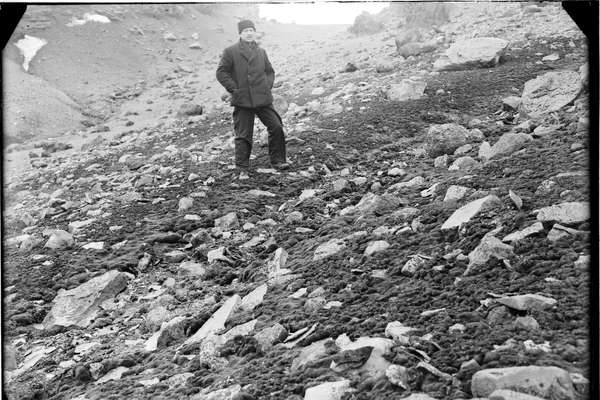
Explore how Elke Mackenzie, a pioneering transgender botanist, helped reshaped our understanding of polar exploration and LGBT+ history.
Focus on
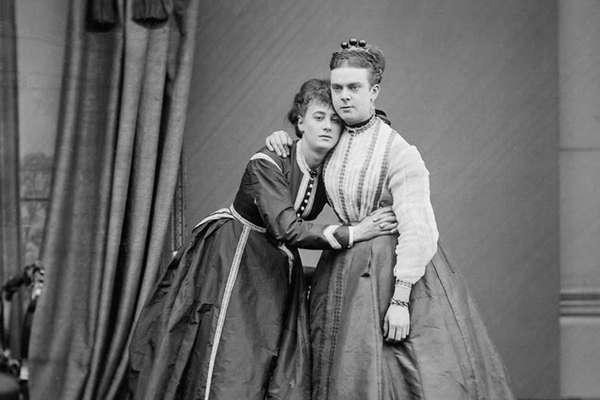
Did you know that the word ‘camp’ was used by members of the LGBTQ+ community as early as 1868?