







Archived page
On the Record: The Boston Tea Party
Episode on The Boston Tea Party from The National Archives’ podcast, On the Record.
Teaching resource
This resource uses original documents to explore the causes, events and consequences of the Boston Tea Party of 1773. What do the documents reveal about Britain’s relationship with the American colonists? How do they help us to understand the American Revolution?

Engraving of the Boston Tea Party from The History of North America, by W. D. Cooper, 1789.
How was the Boston Tea Party of 1773 significant for the American Revolution?
This is an engraving from ‘The History of North America’ by Reverend W. D. Cooper, published in London in 1789. The book contained ‘a review of the customs and manners of the original inhabitants: the First Settlement of the British Colonies, and their Rise and progress, from the Earliest Period to the time of their becoming United, Free and Independent States’.

Engraving of the Boston Tea Party from The History of North America, by W. D. Cooper, 1789.
The Tea Act was passed by the British parliament in May 1773. It supported the East India Company, which faced financial difficulties due to unsold tea, by giving it a monopoly on the tea trade with the American colonies, as well as other privileges.

The Tea Act. Catalogue reference: C65/942 (Geo III, c 44)

An act to allow a drawback of the duties of customs on the exportation of tea to any of his Majesty’s colonies or plantations in America; to increase the deposit on bohea tea to be sold at the India Company’s sales; and to impower the commissioners of the treasury to grant licences to the East India Company to export tea duty-free.
An extract from the Tea Act. A 'drawback of the duties' is a refund on taxes or fees paid. 'Bohea tea' was the most imported tea in colonial times, obtained through trade with China. Catalogue reference: C65/942 (Geo III, c 44)
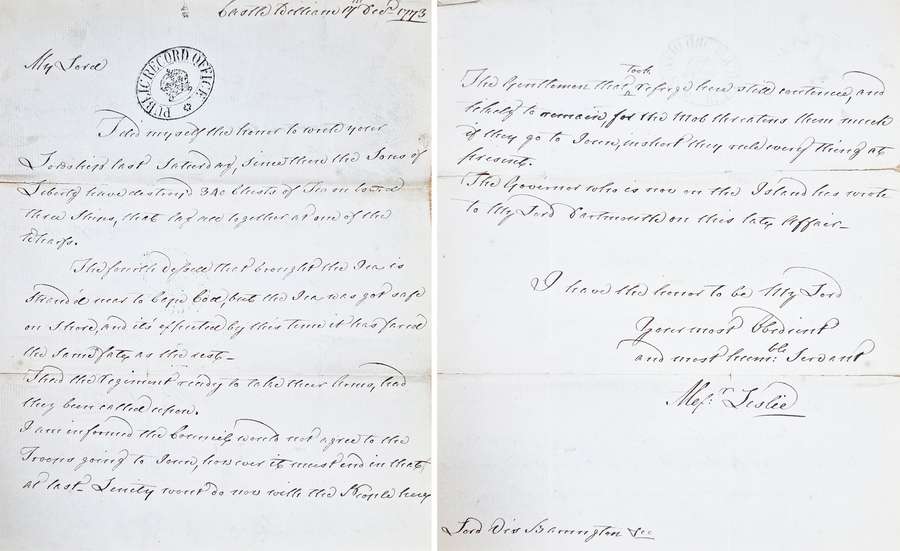
This letter was written by Lieutenant Colonel Alexander Leslie of the 64th Regiment of Foot to Lord Viscount Barrington, the Secretary at War. Leslie was writing from his barracks at Castle William, on an island in Boston Harbour, on 17 December 1773 – the day after the Boston Tea Party.

Castle William 17th December 1773
My Lord
I did myself the honor to write your Lordship last Saturday, since then the Sons of Liberty* have destroy’d [destroyed] 340 Chests of Tea on board three ships, that lay all together at one of the Wharfs.
The fourth vessel that brought the Tea is strand’d [stranded] near to Cape Cod, but the Tea was got safe on Shore, and it’s expected by this time it has fared the same fate as the rest.
I had the regiment ready to take their Arms, had they been called upon.
I am informed the Council would not agree to the Troops going to town, however it must end in that at last. Lenity [gentleness] won’t do now with the People here. The Gentlemen* that took refuge here still continue and likely to remain, for the mob threatens them much if they go to town, in short, they rule everything at present.
The Governor who is now on the Island, has wrote to My Lord Dartmouth on this late Affair.
I have the honor to be My Lord
Your most Obedient
and most humble Servant
Alexr. [Alexander] Leslie
Front and back pages of Leslie's letter. ‘The Gentlemen’ were probably customs officials and tea agents who sheltered at Castle William to avoid the people of Boston. Catalogue reference: WO 40/1

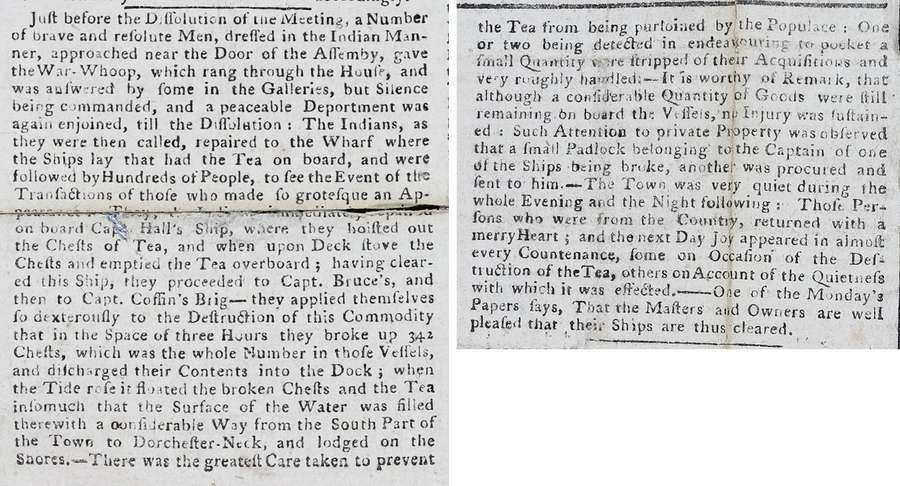
[Left column] Just before the Dissolution of the Meeting, a number of brave and resolute Men, dressed in the Indian Manner, approached near the Door of the Assembly, gave the War-Whoop, which rang through the House, and was answered by some in the Galleries, but Silence being commanded, and a peaceable Deportment was again enjoined, till the Dissolution: The Indians as, they were then called, repaired to the Wharf where the ships lay that had the Tea on board, and were followed by Hundreds of People, to see the Event of the Transactions of those who made grotesque an Appearance…….[newspaper damaged]……on Board Capt. Hall’s ship, where they hoisted out the cheats of Tea, and when upon Deck stove [broke] the Chests and emptied the Tea overboard; having cleared this ship, they proceeded to Capt. Bruce’s, and then to Capt. Coffin’s Brig [two masted square-rigged ship]- they applied themselves so dexterously [skilfully] to the Destruction of this Commodity that in the Space of three Hours they broke up 342 Chests, which was the whole number in those Vessells and discharged their Contents into the Dock; when the Tide rose it floated the broken Chests and the Tea insomuch that the Surface of the Water was filled therewith a considerable Way from the South Part of the Town to Dorchester-Neck, and lodged on the Shores. There was the greatest care taken to prevent
[Right column] the Tea from being purloined by the Populace: One or two being detected in endeavouring to pocket a small quantity were stripped of their Acquisitions, and very roughly handled- It is a worthy Remark, that although a considerable Quantity of Goods were still remaining on board the Vessels, no injury was sustained: Such Attention to private Property was observed that a small Padlock belonging to the Captain of one of the Ships being broke, another was procured and sent to him.- The town was very quiet during the whole Evening and the Night following: Those Persons who were from the Country, returned with a merry Heart, and the next Day, Joy appeared in almost every Countenance, some on Occasion of the Destruction of the Tea, others on Account of the Quietness with which it was effected.- One of the Monday’s Papers says, that the Masters and Owners are well pleased that their Ships are thus cleared.
Extract from 'Massachusetts and Boston Weekly' newspaper, 23 December 1773. Catalogue reference: CO 5/91
Sources 5a to 5c are extracts from a letter requesting legal advice on whether the Boston Tea Party constituted 'high treason'. The letter was sent to the Attorney and Solicitor General from William Legge, Earl of Dartmouth, the Secretary of State for the Colonies, in February 1774. It includes a narrative of events and questions concerning the punishment of those involved.
Source 5d is the Attorney and Solicitor General's reply.

Whitehall 5th February 1774
Attorney and Solicitor General
Gentlemen
I am commanded by the King to transmit to you the enclosed narrative of facts relating to some of the late transactions of Boston in North America, accompanied with the two Questions thereupon.
This is the King’s Pleasure that you do take this Case into your immediate and mature consideration and Report to me for His Majesty’s Information your answer to the Questions proposed.
The state of His Majesty’s Colonies in America, under the Insults that have been offered to the Authority of this Kingdom, requires the most serious deliberation and speedy decision. It is therefore His Majesty’s Pleasure that you should transmit your answer to me with all possible dispatch, to the end that the measures His Majesty may think proper to pursue may not fail of their Effect through any Delay that can be avoided.
…
Dartmouth
Extract from a letter from William Legge to the Attorney and Solicitor General, February 1774. Catalogue reference: CO 5/160

…
Twenty Second
That this committee repeatedly sent for the owner of the Ship Dartmouth requesting him to comply with the request of the Town and send his ship with the Tea back to England. In excuse for his refusal, he said that he could not obtain a clearance from the Custom house, whereupon notification were again posted up upon the 14th December for another meeting of the Inhabitants, which was accordingly held in the afternoon. That at this Meeting, it was determined that the owner should demand at the Custom house a clearance of the Teas for England, which was accordingly done in the presence of twelve Persons appointed to see it done.
That, upon the refusal of the Custom house to grant such clearance, the meeting was adjourned to the next day, in order to consider what was to be done, when the said owner was required to demand a Permit from the naval officer to pass the Castle, which was also refused, he was ordered to apply to the Governor in person for such a Permit, which being also refused, he returned and made his report to the meeting, whereupon numbers of People cried out a ‘Mob’ a ‘Mob’ and immediately a body of men disguised like Indians, and encouraged by Mr. John Hancock, Samuel Adams and others repaired to the wharf where three vessels having tea on board, lay aground, took possession of the said vessels, and in two hours, the whole of the tea was destroyed…
Extract from a letter from William Legge to the Attorney and Solicitor General, February 1774. Catalogue reference: CO 5/160

Queries
Extract from a letter from William Legge to the Attorney and Solicitor General, February 1774. Catalogue reference: CO 5/160

To the Right Honorable
The Earl of Dartmouth, one of his
Majesty’s Principal Secretaries of State, and First Lord of Trade and Plantations
My Lord,
Having received Your Lordship’s commands to take into consideration a case transmitted to us etc… and two questions put thereinupon, we have considered the same; and humbly submit to your Lordship the following Answer to the said Questions.
These proceedings are an attempt, concerted with much deliberation, and made with open force in pursuance of such concert, to obstruct the execution of an Act of the Parliament of Great Britian, imposing a duty upon Tea imported into America; and to put a general restraint upon the exercise of lawful trade, as if it were a publick grievance.
…
We take each of these courses to be legal, and that to be the most proper, which the circumstances of the case absolutely require. In the consideration of which we humbly submit, that a Preference is due to the most ordinary course, if it is to be thought , in other respects, equally sufficient and effective.
The Attorney and Solicitor General's reply to William Legge. Catalogue reference: CO 5/160

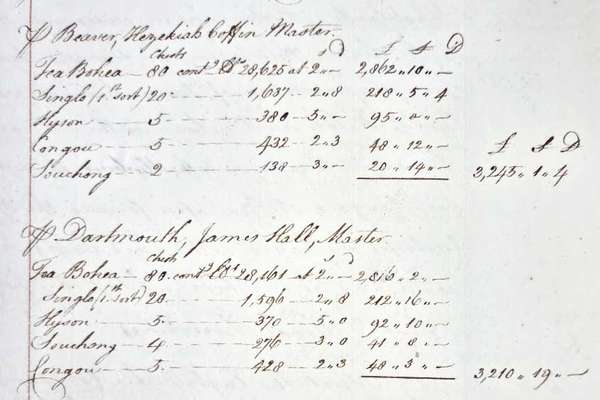
Invoice from the East India Company for the destroyed tea from the Boston Tea Party, dated February 1774. Catalogue reference: CO 5/247
With the Boston Port Act of 1774, the British Parliament closed the port of Boston until the colonists compensated the East India Company for the tea destroyed at the Boston Tea Party. It was one of the 'Coercive Acts', which became known as the Intolerable Acts to the colonists.

An Act to discontinue, in such manner, and for such time as are therein mentioned, the landing and discharging, lading [loading] or shipping, of goods, wares, and merchandise, at the town, and within the harbour, of Boston, in the province of Massachusett’s Bay, in North America.
Whereas dangerous commotions [disturbances] and insurrections have been fomented [cause trouble to develop] and raised in the town of Boston, in the province of Massachusett’s Bay, in New England, by divers ill-affected persons, to the subversion of his Majesty’s government, and to the utter destruction of the publick [public] peace, and good order of the said town; in which commotions and insurrections certain valuable cargoes of teas, being the property of the East India Company, and on board certain vessels lying within the bay or harbour of Boston, were seized and destroyed: And whereas, in the present condition of the said town and harbour, the commerce of his Majesty’s subjects cannot be safely carried on there, nor the customs payable to his Majesty duly collected; and it is therefore expedient [necessary] that the officers of his Majesty’s customs should be forthwith removed from the said town: May it please your Majesty that it may be enacted; and be it enacted by the King’s most excellent majesty, by and with the advice and consent of the lords spiritual and temporal, and commons, in this present parliament assembled, and by the authority of the same, That from and after the first day of June, one thousand seven hundred and seventy-four, it shall not be lawful for any person or persons whatsoever to lade [load cargo] put, or cause or procure to be laden or put, off or from any quay, wharf, or other place, within the said town of Boston, or in or upon any part of the shore of the bay, commonly called The Harbour of Boston, between a certain headland or point called Nahant Point, on the eastern side of the entrance into the said bay, and a certain other headland or point called Alderton Point, on the western side of the entrance into the said bay…
On 19 April 1775, General Thomas Gage sent out regiments of British soldiers from Boston to Lexington to arrest colonial leaders Sam Adams and John Hancock and then move to Concord to suppress any resistance. The plan failed as the colonists became aware of the plan and Paul Revere and other ‘Minutemen’ warned the local population that the British were coming. This letter provides the King's orders on how to handle the situation that followed.

Whitehall, 5th July 1775
Governor of New Jersey
Sir,
Your ideas of the situation of the King’s Affairs in North America and the fatal effects of General Gage’s attempt at Concord are perfectly just and I really believe that if that unfortunate event had not happened just at the time that my letter of the 3rd of March was received by the Governors of the several colonies separately, or upon some plan of communication less dangerous than a general Congress would have been committed such a consideration of the Resolution of the House of Commons of the 20th of February as would have led to some plan of accommodation.
That happy moment of advantage is lost and instead of Reconciliation all North Americans, except Quebec, Nova Scotia, Georgia & the Floridas, is in Arms against Great Britian & committed in Rebellion that menaces to overthrow the Constitution.
In this situation it is the King’s firm resolution that the most vigorous efforts should be made both by Sea and Land to reduce these Rebellious subjects to Obedience & the proper measures are now pursuing not only for augmenting the Army under General Gage but also for making such addition to our Naval strength in North America as may enable Admiral Graves to make such a Disposition of his Fleet as that beside the Squadron necessary for the New England Station, there may be separate Squadrons at New York within the Bay of Delaware in Chesapeake Bay & upon the Coast of Carolina.
…
I have only to add that it is His Majesty’s express Command that you do exert every Endeavour & employ every means in your power to aid & support him [Gage] & Admiral Graves in all such operations as they may think proper to undertake for carrying the King’s Orders into full Execution and restoring the Authority of His Majesty’s Government.
(Dartmouth)
Letter from Lord Dartmouth, British Secretary of State, to New Jersey Governor William Franklin, 5 July, 1775. Catalogue reference: CO 5/992, folios 127-129d
In this document, King George III referred to the American colonists as traitors. The proclamation was printed and distributed by William Franklin, the Colonial Governor of New Jersey (1763–1776), a Loyalist during American Revolutionary War. Benjamin Franklin, his father, however, became one of the most important Patriot leaders of the American Revolution and a Founding Father of the United States.

BY HIS EXCELLENCY
WILLIAM FRANKLIN, Esq.
Captain-General, Governor and Commander in Chief and over the Province of New-Jersey, and Territories thereon depending in AMERICA, Chancellor and Vice-Admiral in the same, etc.
A PROCLAMATION .
WHEREAS I have received His Majesty’s Royal proclamation, bearing Date at St. James, the twenty-third Day of August last, together with His Majesty’s Commands to cause the same to be made public in such Manner as has been usual on the like Occasions, which Proclamation is in the Words following:
BY THE KING
A PROCLAMATION
For suppressing Rebellion and Sedition
George R [Rex]
Whereas many of our Subjects in diverse Parts of or Colonies and Plantations in North-America, misled by dangerous and ill designing Men, and forgetting the Allegiance which they owe to the Power that has protected and sustained them, after various disorderly Acts committed in Disturbance for the public Peace to the Obstruction of lawful Commerce, and to the Oppression of our loyal Subjects carrying on the same, have at length proceeded to an open and avowed Rebellion, by arraying themselves in hostile Manner to with Execution of the Law, and traitorously preparing, ordering, and levying War against Us; AND WHEREAS there is Reason to apprehend that such Rebellion hath been much promoted and encouraged by the traitorous Correspondence, Counsels and Comfort of divers wicked and desperate Persons within this Realm. TO THE END THEREFORE that none of our Subjects may neglect or violate their Duty through Ignorance thereof, or through any Doubt of the Protection which the Law will afford to their Loyalty and Zeal; We have thought fit, by and with the Advice of our Privy Council, to issue this our Royal Proclamation, hereby declaring that not only all our Officers civil and military are obliged to exert their utmost Endeavours to supress such Rebellion, and to bring the Traitors to Justice; but that all our Subjects of this realm and the Dominions thereunto belong are bound by Law to be aiding and assisting in the Suppression of such Rebellion, and to disclose and make know all traitorous Conspiracies and Attempts against Us, Our Crown and Dignity; And we do accordingly strictly charge and command all our Officers as well civil as military, and all other our obedient and loyal Subjects to use their utmost Endeavours to withstand an suppress such Rebellion, and to disclose and make known all Treasons and traitorous Conspiracies which they shall know to be against Us, our Crown and Dignity; and for that Purpose, that they transmit to one of our Principal Secretaries of State , or other proper Officer, due and full Information of all Persons who shall be found carrying on Correspondence with, or in any Manner or Degree aiding or abetting the Persons now in open Arms and rebellion against our Government within any of our Colonies and Plantations in North-America, in order to bring to condign [deserved] Punishment the Authors, Perpetrators and Abettors [accomplices] of such traitorous Designs.
GIVEN at our Court at St James’, the twenty-third Day of August, One Thousand Seven Hundred and Seventy-Five, in the fifteenth year of or Reign.
I DO THEREFORE, in Obedience to His Majesty’s Commands, and with the Advice of His Majesty’s Council for this Province, hereby publish the same, to the end that all His Majesty’s liege Subjects in this Province may be fully acquainted therewith and govern themselves accordingly.
Given under my Hand and Seal at Arms**, in the City of Burlington***, the twenty-fourth Day of November, in the Year of our Lord One Thousand Seven Hundred and Seventy-five; and in the sixteenth Year of the reign of our sovereign Lord George the Third of Great-Britain, France and Ireland, King, Defender of the Faith, etc.
By His EXCELLENCY’S Command
CCHA. PETTIT, D. Secretary.
GOD SAVE THE KING
Proclamation for Suppressing Rebellion, 1775. Catalogue reference: CO 5/993 f.7. 'Whereas’ is often used in legal documents and proclamations it means ‘that being the case’ or ‘in view of the fact’. ‘Given under my Hand and Seal at Arms’ means according to powers delegated to William Franklin by the Crown.
This document is titled 'A Declaration by the Representatives of the United States of America in General Congress Assembled'. This particular copy was printed on the night of 4 July 1776, one of the so-called 'Dunlap Broadsides'. In this document George III is referred to as a traitor and the American colonies declare their independence from Britain.

In Congress, July 4, 1776
A DECLARATION
BY THE REPRESENTATIVES OF THE UNITED STATES OF AMERICA
IN THE GENERAL CONGRESS ASSEMBLED
When in the Course of human events, it becomes necessary for one people to dissolve the political bands which have connected them with another, and to assume among the powers of the earth, the separate and equal station to which the Laws of Nature and of Nature’s God entitle them, a decent respect to the opinions of mankind requires that they should declare the causes which impel them to the separation.
We hold these truths to be self-evident, that all men are created equal, that they are endowed by their Creator with certain unalienable Rights, that among these are Life, Liberty and the pursuit of Happiness –That to secure these rights, Governments are instituted among Men, deriving their just powers from the consent of the governed, –That whenever any Form of Government becomes destructive of these ends, it is the Right of the People to alter or to abolish it, and to institute new Government, laying its foundation on such principles and organizing its powers in such form, as to them shall seem most likely to effect their Safety and Happiness. Prudence, indeed, will dictate that Governments long established should not be changed for light and transient causes; and accordingly all experience hath shewn, that mankind are more disposed to suffer, while evils are sufferable, than to right themselves by abolishing the forms to which they are accustomed. But when a long train of abuses and usurpations, pursuing invariably the same Object evinces a design to reduce them under absolute Despotism, it is their right, it is their duty, to throw off such Government, and to provide new Guards for their future security.–Such has been the patient sufferance of these Colonies; and such is now the necessity which constrains them to alter their former Systems of Government. The history of the present King of Great Britain is a history of repeated injuries and usurpations, all having in direct object the establishment of an absolute Tyranny over these States. To prove this, let Facts be submitted to a candid world.
He has refused his Assent to Laws, the most wholesome and necessary for the public good.
He has forbidden his Governors to pass Laws of immediate and pressing importance, unless suspended in their operation till his Assent should be obtained; and when so suspended, he has utterly neglected to attend to them.
...
He has abdicated Government here, by declaring us out of his Protection and waging War against us.
...
We, therefore, the Representatives of the United States of America, in General Congress, Assembled, appealing to the Supreme Judge of the world for the rectitude of our intentions, do, in the Name, and by Authority of the good People of these Colonies, solemnly publish and declare, That these United Colonies are, and of Right ought to be Free and Independent States; that they are Absolved from all Allegiance to the British Crown, and that all political connection between them and the State of Great Britain, is and ought to be totally dissolved; and that as Free and Independent States, they have full Power to levy War, conclude Peace, contract Alliances, establish Commerce, and to do all other Acts and Things which Independent States may of right do. And for the support of this Declaration, with a firm reliance on the protection of divine Providence, we mutually pledge to each other our Lives, our Fortunes and our sacred Honor.
Sjgned by ORDER and in BEHALF of the CONGRESS
JOHN HANCOCK, PRESIDENT
ATTEST
CHARLES THOMSON, SECRETARY
PHILADELPHIA: PRINTED BY JOHN DUNLAP
The United States' Declaration of Independence, 1776. Catalogue reference: EXT 9/1
This lesson examines documents held at The National Archives that relate to the Boston Tea Party, including records from Chancery, the Colonial Office, and the War Office. The aim is to assess their importance for the American Revolution. What do they reveal about Britain’s relationship with the American colonists?
Source 2 provides an image of the Tea Act and a short extract from it. Students can see that the act is a long parchment roll stitched together. We see that it has been carefully weighted down to make sure it is not damaged when examined and is stored in a document box. The prompt questions help students consider why it was the catalyst for the Boston Tea Party and assess its impact.
Source 3 is probably the earliest British account of the Boston Tea Party, from 17 December 1773. It interesting that a soldier like Leslie wrote directly to address the Secretary of State. This provides the opportunity to discuss the intimate and personal qualities of the letter form. It may lead onto a discussion of the value of letters as historical sources that provide insights into the daily lived experience of individuals.
Source 4 provides an extract from the ‘Massachusetts and Boston Weekly’ newspaper, 23 December 1773. Students can compare this to the earlier British account. It is also an opportunity to discuss why this appears in in The National Archives’ Colonial Office collections.
Source 5 is divided into two parts. The first part consists of extracts from a document requesting legal advice sent to the Attorney General from the Earl of Dartmouth, the Secretary of State for the Colonies in February 1774. The second part consists of extracts from the Attorney General’s responses that say that those involved in the Boston Tea Party had committed treason.
Source 6 is the invoice from the East India Company for the destroyed tea from the Boston Tea Party. Students can see the different types of tea that were exported.
In Source 7, students look at the Boston Port Act, the first of the Coercive Acts. It authorised the Royal Navy blockade of Boston Harbour and closed Boston’s port to commercial traffic. Exports to foreign ports or provinces were also forbidden. Students consider, amongst other questions, the tone and attitude implied in this extract from the Act and what its impact was on the colonies.
Source 8 provides long extracts from a letter from Lord Dartmouth, British Secretary of State, to New Jersey Governor William Franklin in July 1775. It mentions Thomas Gage, commander-in-chief of all British forces in North America since 1763. The implication of the letter is that had it not been for General Gage’s failed attempt at Concord, colonies separately or together possibly might have come to some plan of accommodation. Instead, almost all North America rose against British control.
Source 9 is a proclamation from George III for suppressing rebellion in 1775. In this document, King George III referred to the American colonists as traitors. The proclamation was printed and distributed by William Franklin, the Colonial Governor of New Jersey (1763–1776), a Loyalist during the American Revolutionary War. His father Benjamin Franklin, however, became one of the most important leaders of the American Revolution and a Founding Father of the United States. Again, the document is important because it allows students to explore the relationship between Britain and her colonies in the context of revolution.
Source 10 is the iconic Declaration of Independence, which allows students a huge opportunity for discussion and debate.
All documents are provided with transcripts with difficult terms defined in square brackets. Students can work through the questions individually or in pairs and report back to the class. Alternatively, teachers may want to use this lesson in two parts owing to the large number of sources. We would encourage teachers to ask students to explore other original records available online from the links in this lesson.
These sources, by nature of the collection, largely present the British perspective on the American colonies, which is important for students to keep in mind.
Finally, although this lesson is aimed at Key Stages 4 and 5, teachers could use these documents and provide their own questions and/or create simplified transcripts to use with younger students.
The largest tea import in colonial times. This blend of tea originated from China in the trade with the British and Dutch East India Companies. It was a smoky tasting tea, rather like lapsang souchong, and very popular.
The office at a port or frontier where customs duty is collected.
A refund in payments that were initially collected upon importation of goods. These payments could have been for customs duties, sales taxes, or other fees.
An organization formed in the American Colonies in 1765 to oppose the Stamp Act. They supported colonial resistance against the British Crown with petitions and assemblies before the American Revolution.
British America: Empire & Revolution 1713-83.
On the night of 16 December 1773, 340 chests of tea were destroyed in Boston Harbour, an event that has gone down in history as the Boston Tea Party. This political and mercantile protest was one of the key events in the lead up to the American Revolutionary War and, ultimately, American independence.
Those involved in the protest were against the British tax on tea in the Americas and the monopoly of the East India Company on tea there, both expressed by the 1773 Tea Act.
Tensions regarding taxation in America had been rising since 1763, when Great Britain signed the Treaty of Paris, ending the Seven Years’ War and making Britain the dominant imperial power in North America. After this date, the British Parliament sought to tax their subjects in America to recover from a costly war with France and to better defend these colonies from future invasion.
However, doing so uncovered deeply opposing views regarding the way in which the North American colonies should be taxed. Parliament believed that they had the right to levy taxes upon all subjects within King George III’s dominions. British subjects living in America thought differently. They were not represented in the British Parliament, making decisions thousands of miles away about their livelihoods. They were not against paying taxes to the British Crown and believed that they should set those taxes.
Protests in America over the 1765 Stamp Act, which imposed a direct tax on almost every form of paper used in the colonies, showed that Americans would not back down over this issue. Parliament was forced to repeal the intolerable Stamp Act in March 1766. However, to ensure that they would be able to enforce laws and taxes on the colonies in future they enacted the 1766 Declaratory Act, which asserted the government’s right to pass laws in the colonies ‘in all cases whatsoever’.
In 1767 and 1768, Parliament enacted the Townshend Duties – named after the Chancellor of the Exchequer Charles Townshend – which proposed new taxes on all lead, glass, paint, and tea imported into the colonies. Again, Americans protested; in Boston, hundreds refused to purchase any of the taxed British imports. Following protests in Boston, George III authorised the dispatch of troops to the area to deal with this rising lawlessness.
This ultimately resulted in bloodshed, when on 5 March 1770 nine British soldiers fired at a crowd of hundreds of Sons Bostonians, resulting in the deaths of five American colonists. To ease tensions in America, all the Townshend Duties were repealed, except the one on tea. This meant that tea suddenly became a focus of protest in America. The Sons of Liberty and similar groups, initially established to protest the Stamp Act, encouraged Americans to avoid legally importing tea.
This resistance led to a drop in demand for East India Company Tea. The fortunes of this British joint-stock company were closely tied to those of the British State, as they had taken out a significant loan from the Bank of England.
To save the Company, and to encourage the payment of tea duties in America, Parliament passed the 1773 Tea Act. This act allowed the East India Company to export tea directly to North America, without first going through London. As with the Stamp Act, many in America opposed this for validating Parliament’s right to directly tax American subjects.
Most American colonies simply protested this act by returning the tea to Britain. However, in Boston, Governor Thomas Hutchinson refused to let the ships leave the harbour, and those that opposed the Tea Act in the town refused to let the ships unload.
On 28 November 1773, a ship carrying East India Tea, the Dartmouth, arrived at Griffin’s Wharf in Boston. According to the Townshend Duty, if the tax was not paid within twenty days of the ship’s arrival, then the ship and its cargo was to be seized by the authorities. That meant that the people of Boston had until December 17 to decide what to do. Over the next few weeks, thousands of concerned citizens attended meetings organised by the Boston Committee of Correspondence and the Sons of Liberty, where they decided that the tea should be sent back. Meanwhile, two more ships of tea, the Eleanor, and the Beaver, arrived in Boston. However, Governor Hutchinson still refused to release the ships. On the night of December 16th, following another meeting where Governor Hutchinson had refused to budge, a group of people, some disguised as Mohawks, flocked to Griffin’s Wharf, boarded the three ships, and destroyed the entire shipment of tea.
News of the Boston Tea Party reached London in January 1774. In response, the British Government firstly tried to identify and prosecute the individuals involved. Once that failed, they instead passed a set of repressive acts, colloquially referred to in America as the Intolerable Acts, designed to punish the people of Boston and compel them to compensate the East India Company for the loss of their tea, and to send a message to other North American colonies of the consequences for protests such as the Boston Tea Party. These acts halted trade to Boston, brought Massachusetts under British governmental control, granted immunity to British soldiers and officials to criminal prosecution in the state, and required colonists to house British soldiers.
The Intolerable Acts only served to bring the American colonies together against Great Britain. In September 1774, representatives from twelve of the thirteen colonies assembled in Philadelphia for the First Continental Congress aimed to settle the concerns and frustrations of the Americans with the British King and Government before relations broke down even further.
The Suffolk Resolves, accepted by the congress on September 17th, encouraged the continued protest of the Intolerable Acts by stockpiling military supplies and boycotting British goods. The Declaration of Rights also developed at this congress, outlining the need for a rebellion if the Intolerable Acts were not repealed.
These attempts at a peaceful reconciliation failed, however, and in April 1775, less than eighteen months after the Boston Tea Party, American Patriot forces went to war with Great Britain.
On 4 July 1776, when the Thirteen United States of America declared independence from Great Britain, they referenced the Intolerable Acts – passed in response to the Boston Tea Party – when justifying their actions. They no longer wished to be subject to a king who obstructed the Administration of Justice, cut off their trade, and who imposed taxes on them without their consent.
Archived page
Episode on The Boston Tea Party from The National Archives’ podcast, On the Record.
Record revealed
On 16 December 1773, 340 chests of tea were thrown into Boston harbour by protesting colonists. This letter from the East India Company requests reimbursement.
In pictures
What were the key moments that led to the American Revolution? From the Boston Tea Party to the Declaration of Independence.
Teaching resource

This resource uses journal entries from 1607 that describe what happened between early English settlers and Native Americans in Virginia.