1. Why use this guide
This guide supplements our guide on American and West Indian colonies before 1782 and helps you to find records of the British administration in colonial North America and the West Indies.
The Calendar of State Papers Colonial, America and West Indies is a key resource for finding these records.
The calendar is available online and in printed form at academic institutions and specialist libraries as well as at The National Archives in Kew. This guide is written to help you if you are using a printed, rather than online, copy of the calendar.
The calendar contains summaries of the original colonial-era documents, arranged by date. The indexes to the calendar make it easy to find out which original documents mention a specific person, place or event.
You might find that the information in the calendar is all you need, but if you would like to see the original documents, this guide explains how to find the relevant references for them.
The Calendar of State Papers Colonial, America and the West Indies is available online at Colonial State Papers and British History Online. If you have access to one of these subscription sites it is by far the simplest way to proceed.
2. What is the Calendar of State Papers Colonial, America and West Indies?
The Calendar of State Papers Colonial, America and West Indies is a very detailed index of a wide range of documents relating to the American and West Indian colonies between 1574 and 1739. Most of the documents it covers are from Colonial Office record series CO 1 and CO 5, but the calendar also contains references to papers from other departments such as the State Paper Office and the War Office.
The calendar entries are transcripts and summaries of the documents they refer to. Sometimes these summaries give you all the information you need, making it unnecessary to consult the original documents.
The documents were originally filed and stored in two categories:
- America and West Indies – correspondence between the governors and the secretary of state
- Board of Trade – correspondence with that department
When the calendar was compiled, the documents were rearranged into one chronological sequence, divided primarily by colony and type of document.
There is a separate series of calendars that covers the period of the American Revolution – Documents of the American Revolution, 1770-1783.
3. Arrangement of the Calendar
The calendar is printed in a number of volumes. The first covers the period 1574-1660 and subsequent volumes cover between one and seven years.
Each volume has a comprehensive index which lists people, places and events relevant to the years the calendar covers.
For example, Volume 5 lists ‘Maryland’ in the index and then shows various subheadings to do with people, events and subjects related to Maryland. Each subheading is followed by page numbers where you can find transcripts or abstracts of documents that relate to that subject. Some examples of the subheadings under ‘Maryland’ are shown below:
- planters and traders to, 597
- petitions of, 406, 1321
- papists in, 404
- about improvement of flax, hemp, silk in, 301, 332, 862, 863, 865
- to be custom free (for five years), 863, 865, 1585
- about planting tobacco in, 301, 307, 308, 311, 312, 332, 358, 368, 406, 454, 781, 855, 856, 862
- frauds in HM customs in, 644
- directions for ships sailing from, 1084, 1321
- prisoners sent to, 1114
- a mint to be set up in, 72
In the first volume of the calendar (1574-1660), the numbers in the index refer to the pages in the calendar that you should turn to, but in all other volumes the numbers refer to the ‘item’ number that you should turn to. Item numbers are shown to the left of each section on a page.
Each page in the calendar also shows a year in the top left corner. This is so that you can tell which year the documents are from on any given page.
4. Finding the references to documents in the calendar
Calendar volumes to 1699: old style references given
At the end of each calendar entry you will find a reference in square brackets. These old style references were created when the records were arranged in their original categories (see section 3) and follow the format below:
- [Board of Trade, Plantations General, 5, No 29 pp 97-104]
- [Board of Trade, New England, 49, pp 549-562]
- [America and West Indies, Bermuda, 447, No 57, and 39 p 11]
- [Colonial Entry Bk Vol LXI]
- [Col Papers, Vol XXI, No 13]
- [Dom Entry Bk, Chas II, Vol CXCI, No 3, Cal p 498]
Where calendar entries are broken down into smaller sections, the reference is shown at the very end.
These references need to be converted into modern National Archives’ references in the format of CO 5 or CO 1 followed by another number. Go to section 6 for advice on how to do this.
Calendar volume for 1700: old style references but with its own key
The calendar for 1700 has a key (after the preface) that shows CO 5 references listed by colony. So for example, if your calendar entry had a reference of ‘New England 10’, the key shows the modern reference is CO 5/861.
With this reference you can now view the document, either by visiting The National Archives at Kew or paying for copies to be sent to you – you do not need to go to the second step below.
Calendar volumes from 1701: modern references given
In calendars for 1701 onwards there is no old style reference to convert, so you don’t need to use a key. The modern document reference is already given – so they begin with CO 1 or CO 5 and then a second number – such as CO 1/22 or CO 5/184.
With this reference you can now view the document, either by visiting The National Archives at Kew or paying for copies to be sent to you – you do not need to go to the second step below.
5. Converting old references to current ones
Keys for converting references
There are two ways to convert the old reference to a current reference:
- using a three volume manuscript key
- using the List and Index Society key volume 342
These are keys to all colonial records, not just those for America and the West Indies. Both keys are available in the reading rooms at The National Archives in Kew.
The three-volume manuscript key is also published in appendix B of Charles M Andrews, Guide to the Materials for American History, to 1783, in The National Archives of Great Britain, Volume 1 The State Papers (1912).
Potential pitfalls to avoid
Original references might start with ‘Colonial Papers’, ‘Colonial Entry Book’ or ‘Board of Trade’ for example, but when you look references up in the keys, the initial descriptions are sometimes more broad.
This is particularly the case with documents where the reference starts with ‘Board of Trade’. You need to read the old reference carefully to determine whether they fall under the heading:
- Board of Trade: Colonial Entry Books series
- Board of Trade Acts group of series
- Board of Trade group of series
- Board of Trade: Commercial series 1 and 2
Similarly, be careful to distinguish between references that mention:
- Colonial Papers
- Colonial Entry Books
- Colonial Correspondence
6. Using the three volume manuscript key
Let’s say you want to convert a reference that says ‘Board of Trade, Plantations General, 5’.
First, take out the three manuscript volumes and consult the contents list at the front of each one to find which one covers ‘Board of Trade, Plantations General’.
If you start with volume one of the key you will see that the first part of the index page reads as follows
| This volume contains keys to the following superseded references: | |
|---|---|
| Colonial Correspondence (Colonial Papers) |
p 41 |
| Colonial Entry Books | p 45 |
| America and West Indies | p 53 |
| Board of Trade Acts | p 115 |
| Board of Trade (Antigua-Virginia) | p 213 |
| Board of Trade (Plantations General) | p 309 |
Your reference from the calendar was ‘Board of Trade, Plantations General 5’ so you need to turn to the page listed against ‘Board of Trade (Plantations General)’ – which is page 309.
Turn to page 309, but note that you should be looking at the page numbers at the top right (not the bottom centre).
When you turn to page 309 you will see the following information:
| Key to Board of Trade 309 | |
|---|---|
| Old reference | New reference |
| BT Pennsylvania | CO 5 |
| 3 | 1238 |
| 4 | 1256 |
| BT Plantations General | CO 323 |
| 2 | 1 |
| 4 | 2 |
| 5 | 3 |
| 6 | 4 |
The reference shown against ‘BT Plantations General’ is CO 323.
Looking down the subdivisions of BT Plantations General to number 5, you can read across to see the last part of the reference – which is 3. The whole reference is CO 323/3.
7. Using the List and Index Society key, volume 342
Turn to page ix near the front of the key and look for the heading ‘Summary descriptions of old series’. You will see sub headings such as the following:
- Colonial Papers series
- Board of Trade: Colonial Entry Books series
- America and West Indies series
- Board of Trade Acts group of series
- Board of Trade group of series
- Board of Trade: Commercial series 1 and 2
- Colonial Transmissions series
Choose the description that your reference should fall under and turn to the pages shown in the key. Then work your way down the list to find the volume number for your reference.
Sometimes the reference might not have an obvious volume number – such as in ‘Board of Trade, New England, 49′. In this case, ’49’ is the number you are looking for.
Where Roman numerals were used in the reference – such as ‘Vol XXI’ – you will find modern Arabic numerals are used in the key instead.
When you find the volume number in the key, read across to find the modern CO reference.
Note that the page numbers given in the calendar reference – such as in ‘Board of Trade, New England, 49 pp 549-562’ – refer to pages in the original Colonial Office document.
Some examples of using the key are given below:
Example one: Reference ‘Board of Trade, New York 7’
Turn to page ix of the key and look through the ‘Summary descriptions of old series’ to find the right one for ‘Board of Trade, New York 7’.
There are a number of descriptions that begin with ‘Board or Trade’ – such as the following:
- Board of Trade: Colonial Entry Books series (pages 49-50)
- Board of Trade Acts group of series (pages 59-67)
- Board of Trade group of series (pages 67-82)
- Board of Trade: Commercial series 1 and 2 (pages 82-83)
The reference in this example does not specify ‘Colonial Entry Books’, ‘Acts’ or ‘Commercial’, and so the relevant description is ‘Board of Trade group of series’ (pages 67-82). Note that it is not the ‘America and the West Indies series’.
Turn to page 67 and find the heading BOARD OF TRADE followed by an alphabetical list of colonies. New York is on page 77.
Look down the column under the New York sub-heading to number 7 and read across to the corresponding reference which is CO 5/1040.
Example two: Reference ‘Colonial Entry Bk Vol III’
Find the ‘Summary descriptions of old series’ on page ix at the front of the key.
This reference falls into the category ‘Board of Trade: Colonial Entry Books series’ which is on pages 49-50.
Turn to page 49 and find the heading COLONIAL ENTRY BOOKS. You then need to turn to page 50 to find the sub category for AMERICA AND WEST INDIES: Original Correspondence.
Read down the columns to find number 3 (which represents Vol III) and read across to see that the corresponding reference is CO 5/900.
Example three: Reference ‘Board of Trade, Proprieties 3’
Find the ‘Summary descriptions of old series’ on page ix at the front of the key.
This reference falls into the category ‘Board of Trade group of series’ which is on pages 67-82.
Turn to page 67 and find the heading BOARD OF TRADE. Then follow the alphabetical sub headings until you find ‘Proprieties’ on page 79.
Read down the column to find number 3 and read across to see that the corresponding reference is CO 5/1258.
This is a guide to searching for records at the National Archives of legal disputes, settled in court, between two parties over matters such as land, property rights, debt, inheritance and trusts. Such cases are known as civil cases, as opposed to criminal cases, and the legal process is known as civil litigation.
Over the centuries many civil courts were created to deal with different branches of the law. Some were relatively short lived and no longer exist, some were absorbed into other courts, while others still continue. Each court created its own set of records and they vary considerably in how complete and how informative, or easy to understand, they are. This guide covers the courts whose records are held at the National Archives. Records of some courts, such as County Courts or Magistrate’s courts, do not come to the National Archives but may be in city or county archives.
For guidance on records relating to the following subjects, click on the links below:
- Divorce
- Changes of name
- Bankruptcy and insolvency.
- Probate of wills and administrations in the Prerogative Court of Canterbury
- Manorial courts
Most of the court records we hold are not online and to see them you will need to consult them at our building in Kew or pay for copies to be made and sent to you.
How the records are arranged
Records are arranged by the court that created them, then by the type of record, such as pleadings or affidavits, and by date. There are no ‘case files’ containing all the information about a single case. For any case, or action, there may be a number of different types of document, each of which will have to be searched for separately. The documents themselves may be in different formats, from handwritten register books, listing a number of cases, to printed forms or large sheets of parchment, each representing one aspect of a particular case.
How to search for records
In general, you cannot start a search for records of civil court cases by the names of plaintiffs or anyone else involved in the case, though there are some exceptions to this. Some Chancery court records, for example, appear in our catalogue with the surnames of plaintiffs, though very little additional detail. This, for example, is the catalogue listing for a Court of Chancery case from 1844: C 14/295/S48, Slack v Saunders, 1844. Usually you will need to know when and where a trial took place to have any hope of finding records.
To search for records, follow these steps:
Step 1: Establish which court heard the case and when.
If you know when the trial took place but don’t know which court they were heard in, you may find the missing details in local newspaper reports. Newspapers tend to report more on criminal cases but some civil cases do get covered and the reports are often more informative than the court records themselves. Consult the British Library Newspaper Library or the appropriate local county record office.
Step 2: Establish where the records for the court are held
Once you know the court, use the following sections of this guide to locate advice on where to find records for that type of court. We have listed the different courts by period, each with brief details of where to find the respective records or with links to one of our guides if the records are held here.
Step 3: Consult the respective research guide
Use our guides for search advice on each of the courts whose records we hold. Searches at The National Archives usually begin in our online catalogue. Catalogue descriptions usually indicate the type of document and the date but not the names of litigants or details of the case. A successful catalogue search will unearth short descriptions of the court records and a document reference for each – you will need the document reference to see the record itself or to request copies.
For more guidance on searching or browsing our catalogue, visit our Discovery help pages.
Civil courts and their records since 1972
County Courts or specialist tribunals, depending on the nature of the dispute, are where most civil cases are held today. County Courts (hearing civil cases) and Crown Courts (hearing criminal cases) replaced assize courts (which heard criminal and civil cases) in 1972.
Records of County Courts are not held at the National Archives. Search for County Court records:
- at the courts themselves (use the Courts and Tribunal Service website to find the location of a court)
- in county archives and other local archives
See our guide to Courts of law records held in other archives for further information and advice.
Family Courts handle cases related to adoption, divorce, parental disputes over the upbringing of children and other family disputes (see the Judiciary.uk website for more information).
Records of Family Courts are not held at The National Archives. Though very little is kept, search for Family Court records:
- at the courts themselves
- at county record offices
The High Court is divided into Chancery, Family and King’s/Queen’s Bench divisions. Each of the divisions has some specific responsibilities but there is also some overlap.
Chancery Division’s specific responsibilities include the administration of:
- the estates of the deceased
- partnerships
- mortgages
- other charges on land, trusts, real estate
- the wardship of infants
King’s/Queen’s Bench Division hears both criminal and civil cases. Examples of the sorts of civil cases heard include:
- Breach of contract
- Debt
- Personal injury
- Medical negligence
- Libel
- Slander
- Wrongful arrest
The Court of Appeal hears civil cases referred from:
- the High Court (Chancery or King’s/Queen’s bench divisions)
- appeals from county courts (since 1934)
- appeals from certain administrative bodies, such as the Lands Tribunal, the Patents Appeal Tribunal and the Income Tax Commissioners
The High Court of Admiralty was a specialist court established around 1450 to deal with piracy but which later considered civil cases to do with captured ships, known as ‘prize jurisdiction’, commercial matters and disputes over wages on ships at sea, known as ‘instance jurisdiction’. In 1875 the civil law business of the court joined the other civil law courts in the creation of the Probate, Divorce and Admiralty Division of the High Court of Justice.
The Find Case Law service provides public access to recent judgments from the England and Wales High Court, the Court of Appeal, the Supreme Court and tribunal decisions from the Upper Tribunals. The service will be expanded to include more courts and tribunals and a greater range of judgments will be added. For more information see the website.
For earlier cases try the BAILII website.
Civil courts and their records from 1875-1971
In 1875 the central courts in London were amalgamated into the Supreme Court of Judicature, consisting of a High Court and a Court of Appeal. The lower courts hierarchy, which had been in place since the medieval period continued up until 1971. From bottom to top, the civil court hierarchy was as follows:
Petty sessions were at the base of the pyramid, where minor civil disputes were dealt with. The records are held in local archives. Use our Find an archive tool to search for the location and contact details of local archive offices or search our catalogue using the phrase “petty sessions” plus the name of a county, city or town, ensuring you select the ‘Other archives’ catalogue results filter.
Assize courts also heard civil cases. They sat between two and four times a year and were presided over by professional judges. See our guide to the civil assizes for advice on finding records.
The High Court was established in 1875, bringing the central courts under the same banner but separated into divisions. The Chancery Division replaced the Court of Chancery. See our guide to records of the Chancery Division.
The Court of Appeal was also established in 1875. Most records relating to appeal cases give very few details about the original case and only briefly note the decision on appeal, without giving reasons. See our guide to Civil appeal cases after 1875.
Civil courts and their records from 1485 to 1875
Until the late 19th century there was no clear division of jurisdiction between the various courts and similar types of case could have been heard in any of a number of courts. Our guides give more information on finding records of the various courts but if you do not know which court heard a case, it may be a lengthy search.
Court of Common Pleas was concerned with civil litigation at common law between subjects, principally about real property and debt. Records are in 73 series within the department code CP.
This hierarchical view of CP shows the division into types of proceedings. Records relating to pleas are further divided into 27 series, according to type of record and in date order.
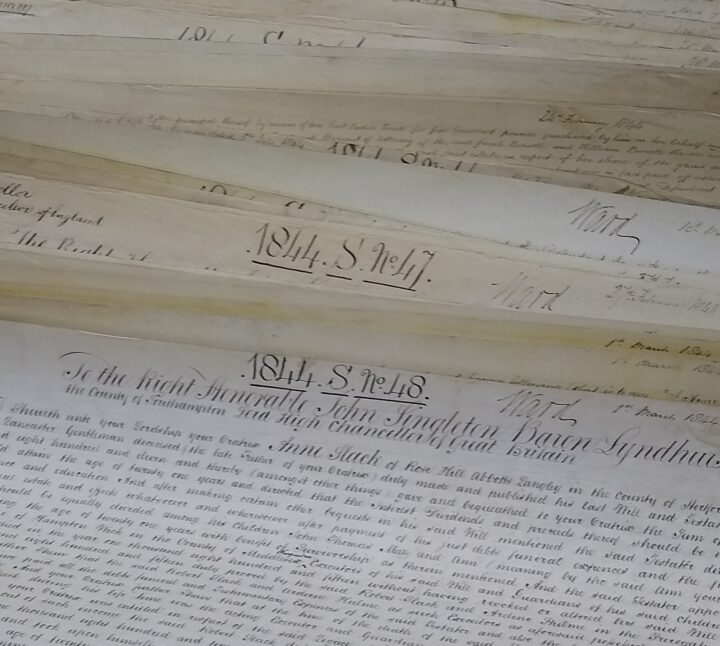
Legal documents may be in a variety of formats. Although these pleadings are from a Chancery case in 1844 (reference: C 14/295/s48) they are recorded on large sheets of parchment and kept in rolls, as they had been for many hundreds of years.
The Court of Chancery heard disputes over land and other property, family heritance and wills, debts marriage settlements, trade and bankruptcy and many more. We have research guide for cases before 1558 and after 1558.
Court of Exchequer dealt mainly with disputes over titles of land, manorial rights, tithes, mineral rights, debts and wills and many more.
Court of King’s Bench to 1702 and from 1702 for cases of breach of contract, debt, personal injury, medical negligence, libel, slander and wrongful arrest among others.
Court of Wards and Liveries 1540-1645 dealt with land inheritance disputes.
Palatinate Courts in the counties of Chester, Durham and Lancaster had ancient rights granting them some autonomy in legal matters and had their own courts. Click on the links to Discovery to browse records of courts of the Palatinate of Chester, 1200-1851, Palatinate of Durham, 1311-1971, and the Palatinate of Lancaster, 1357-1977.
Court of Requests, 1485-1642, was initially known as the Court of Poor Men’s Causes. It dealt primarily with small scale civil cases and was established to provide access to justice for poor men and women.
Civil courts and their records in the medieval period, 1194-1484
Court of Common Pleas records are in 73 series within the department code CP. This hierarchical view of CP shows division into types of proceedings. Records relating to pleas are in 27 series according to type of record and in date order.
General Eyres, 1194-1348, – groups of judges from the central courts at Westminster travelled to all the counties of England, apart from Chester and Durham, at roughly seven year intervals. The term eyre may refer to the court or to the circuit. Both civil and criminal cases were heard.
Records in other organisations and other sources
See our guide to Courts of law records held in other archives for information on court records held at local or county archives.Newspaper libraries such as the British Library collection may help in finding which court heard a case and in reporting the proceedings and result. Records relating to cases heard by the House of Lords on appeal are held by the Parliamentary Archives.
The Guildhall Library holds various collections of published law reports.
The British Library and the Law Society Library hold indexes to Court of Appeal transcripts.
The research guidance listed below can help you explore a particular historical subject.
Each guide indicates how to find access and understand records to support your research. Records at The National Archives are arranged by government department or court, not by subject. These guides will help you identify which departments and courts kept the relevant records.