This short guide provides advice on where to go to locate police records. Only the records of the Metropolitan Police, the Royal Irish Constabulary, Palestine Police and transport police are held at The National Archives.
There is some advice below on the transport police records held here and links to some of the places you can try to find the records of other police forces. See our separate guides for advice on records of the London Metropolitan Police and the Royal Irish Constabulary.
Transport police
The evolution of the transport police
A specific police force for transport began with the railways. The first railway police force in Britain was formed in 1830. From as early as 1826 men were employed as Policemen on the railways but their role was to ‘police’ or direct the trains, like a Signalman, ensuring they were on the right lines. You will therefore find their records amongst the railway staff records for each separate company. Following the Railways Act 1921 , and prior to nationalisation, the four largest railway companies had their own police force controlled by a Chief of Police. They were:
- Great Western Railway Company (GWR)
- London Midland and Scottish Railway Company (LMS)
- London and North Eastern Railway Company (LNER)
- Southern Railway Company (SR)
During the Second World War the railways were run by the Railway Executive Committee, under which was the Police Committee made up of the four Chiefs of Police. After the war the railways were nationalised and a national railway police force was established. In 1949 the British Transport Commission Police was created, incorporating the old four railway police forces as well as several minor canal and dock forces. In 1958 the London Transport Police was absorbed into the British Transport Police.
The records and how to search for them
The National Archives has administrative records relating to the Railway and Transport Police, but not records relating to its investigation of crime. To access the records held here you will either need to visit us, pay for research (£) or, where you can identify a specific record reference, order a copy (£).
Among the records that we hold are the following (click on the references to search the respective series with keywords):
- Corresponence and other records relating to railways staff conferences, covering topics which include pay and conditions, in RAIL 1172
- Personnel department records of the British Transport Commission and British Railways Board, 1928-1994, in AN 174 – including records of pay, conditions and training
- Administration records of the Railway Executive Committee which governed the railways during the Second World War in AN 2 and AN 3
Use the advanced search option in our catalogue to limit your search to records with department references RAIL and/or AN. Generally, records from before 1921 have the departmental reference RAIL and those from after 1921 have the reference AN. Search with key words which might include:
- ‘railway police’
- ‘transport police’
- the name of one of the railway companies listed above and the word ‘police’
The British Transport Police hold records on its officers and staff. You can request information from the British Transport Police historical group. The organisation holds several thousand staff record cards dating back to the 1860s.
Other police forces
The first modern police force in England was the Metropolitan Police Force, created in 1829. Provincial police forces in England and Wales did not begin in incorporated boroughs until after the Municipal Corporations Act of 1835, and elsewhere until after the County Police Act of 1839. Before that policing was carried out by locally employed watchmen, constables and magistrates.
For all other police records, other than the London Metropolitan Police and the Royal Irish Constabulary you will need to go to other archives and organisations.
Parliamentary records
Parliamentary records may contain information about police forces across the UK, for example Acts of Parliament, private bill plans, private bill evidence and select committee papers. Search Discovery for the name of the police force.
Committee reports and other published papers may be found in Parliamentary papers. You can access these online via Proquest UK Parliamentary Papers. This is a subscription website you can access on TNA computers by visiting us at Kew. You may also be able to access it via a large reference library such as a university library.
Local police forces
Surviving records of local police forces are not public records and are held either by local archives or the respective police force itself. Not all police staff records have survived. Contact the local police force itself for their records or try the respective county or city archive. Search for contact details using our Find an archive tool.
The City of London Police registers (1832 onwards)
Consult registers of The City of London Police. These list every member of the force since warrant numbers were introduced in 1832, together with personal files on 95% of officers who have served since that date. They are held at The London Archives.
Colonial police forces
Records of the forces may well have been deposited in the archives of the country to which they relate.
Palestine Police personnel files
Service records of just over 900 officers recruited to serve in the Palestine Police between 1920 and 1948 are held at The National Archives in records of the British administration of the League of Nations Mandate for Palestine and Transjordan.
Search series CO 733 by surname.
Correspondence relating to medal claims for service in the Palestine Police can be found in CO 820/70/1-4.
The Middle East Centre Archive at St Antony’s College, Oxford, has a collection of service record cards of Palestine Police.
Overseas railway police
The Control Office for Germany and Austria and the Control Commission for Germany (British Element) were responsible for transport in the occupied territories after the war. They were part of the Foreign Office and their records have the department code FO.
You can search our catalogue within the department code FO with keyword phrases such as:
- “control commission AND railway”
- “control office AND railway”
Other records on railway policing overseas were created by the Colonial Office, Dominions Office and Foreign Office. Their records have the departmental codes CO, DO and FO respectively.
You can search our catalogue within CO, DO or FO using keywords such as “railway police”.
Other resources
Websites
Browse the National Police Officers Roll of Honour for details of 4,000 UK police officers who have lost their lives in the line of duty.
Consult the Police archives guide, one of the useful resources on the International Centre for the History of Crime, Policing and Justice pages of the Open University. This guide was published in 1991 and some information will be out of date.
The Police History Society can give general advice to researchers.
The British Transport Police hold several thousand ‘staff record cards’ going back as far as the 1860s, although they are by no means complete. See the British Transport Police website for further details and an email address for enquiries on this material.
Look at British Transport Police website which contains information on historical resource.
Books
Consult details of the recipients of the King’s Police Medal for Gallantry in the volume Police Gallantry: The King’s Police Medal, the King’s Police and Fire Service Medal and the Queen’s Police Medal for Gallantry 1909-1978 by Peter J Farmery (1995).
1. Why use this guide?
Use this guide for an overview of The National Archives’ collection of architectural drawings and related records and for advice on how to find them among our vast holdings.
The guide does not cover building contracts, accounts or correspondence.
We do not hold any architectural models.
Copies of all of the architectural drawings illustrated in this guide are available to buy through our Image Library.
2. What kinds of architectural drawings do we hold?
The National Archives holds many thousands of architectural drawings and related records, covering a very wide range of buildings and other structures, most of which date from the 18th, 19th and 20th centuries. These include plans, elevations, sections, perspective drawings and various other depictions and details of architectural works, including some iconic British landmarks and major engineering projects. We also hold site plans, which range from elaborate depictions of houses and grounds to simple outline block plans.
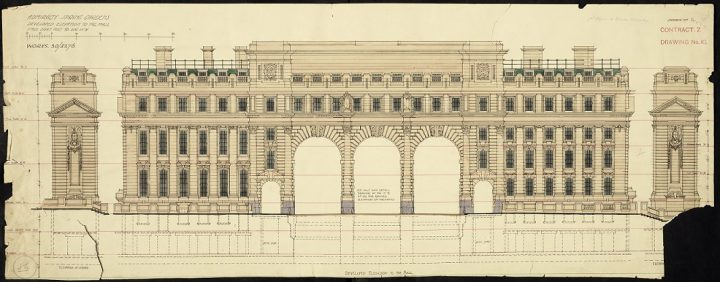
Elevation of Admiralty Arch in London, 1907 (catalogue reference WORK 30/3276). This drawing is held at The National Archives among the records of the Office of Works and its successors.
Before the 20th century the British government’s interest in architecture was largely confined to public and Crown buildings and schemes, and works by local authorities under various acts of Parliament. The records we hold very rarely represent the full range of drawings produced for any building project; we usually hold only a handful for a particular structure or scheme, although in a few cases a large number have survived (notably for the Houses of Parliament and the Royal Courts of Justice). Many older plans and drawings have not survived, and large numbers are held by other institutions (see section 7).
Because of the Crown’s landholdings, and litigation relating to privately-owned land, we hold some records of buildings and structures on landed estates; but except in the case of the Crown Estate we are seldom the best place to start a search for such material.
2.1 Crown Estate buildings
The majority of our architectural drawings relate to buildings which form part of the Crown Estate or have been the responsibility of the Office of Works and its successor departments and agencies. Among these are:
- royal palaces
- the Houses of Parliament
- government buildings
- buildings constructed for or used by the armed services
- ancient monuments
- works for ceremonial events such as coronations and state funerals
Many drawings are held among the records of the Crown Estate Commissioners, and the Office of Land Revenue Records and Enrolments and its predecessors and associated departments.
Architectural drawings of the Houses of Parliament may also be found among the records of the Parliament’s Archive Collections.
2.2 Municipal buildings and public works
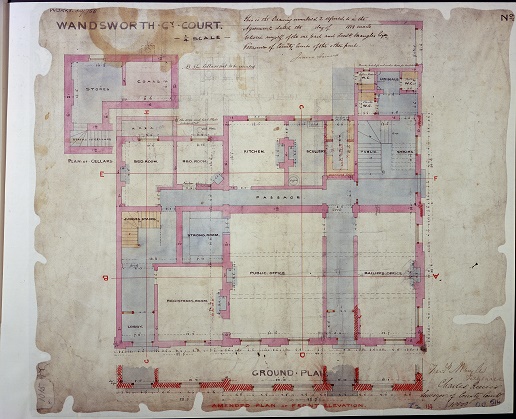
A ground floor plan of Wandsworth County Court in 1858, held among the records of the Office of Works and its successors (catalogue reference WORK 30/758).
We hold a range of drawings and plans relating to local municipal buildings, including schools, hospitals, poor law buildings, Metropolitan Police stations and other civic structures. The majority among the records of the Ministry of Housing and Local Government and successor and related bodies.
We also hold various plans relating to substantial complexes, such as housing estates, naval dockyards, or the Festival of Britain site, as well as a range of other sites and buildings.
Architectural plans and drawings for the built environment which were the subject of a private Act of Parliament may be found in the deposited plans in the Parliament’s Archive Collections. Search the catalogue for the name of the bill.
2.3 Public transport constructions
Many plans and drawings of railway stations and hotels are among the records of pre-nationalisation railway, canal and related companies in the British Transport Historical Collection and those created or inherited by the British Transport Commission, British Railways Board and successors.
2.4 Buildings and constructions overseas
We also hold drawings of buildings and structures outside the British Isles, which were created or collected in the course of British government business abroad and in the work of the armed services, both in foreign countries and, during the years of the British Empire, colonies. Drawings of fortifications are particularly well-represented.
Plans and drawings from overseas are held among, though are not exclusive to, the records of the following departments:
- Colonial Office
- Dominions Office
- Foreign Office
- Foreign and Commonwealth Office
- Admiralty
- Air Ministry and related bodies
- War Office
3. How to search
The place to start a search is our online catalogue (see 3.1). However, many drawings are not listed in our catalogue, often because they belong to larger documents (‘parent’ files) whose catalogue descriptions are limited to broad details. Drawings are often filed or bound up with correspondence and other records generated in the course of the government business of which they formed a part. Some government departments created discrete series of maps and plans but even with these departments there are likely to be at least as many drawings among their respective text-based records.
The most detailed listings of drawings are those that appear in the published and unpublished catalogues, available in The National Archives library and reading rooms in Kew. If your online catalogue searches are unsuccessful you should turn to these paper catalogues (see 3.2 and 3.3), though you will need to visit us to do so.
As a last resort you can return to the online catalogue and try speculative searches of the records by searching for ‘parent’ files. For example, to find architectural drawings of a hospital you could try a search within Ministry of Health files for the area where the hospital is located, or for ‘hospital building programmes’ or any other description that may match your research topic.
3.1 Using our online catalogue
You can find some architectural drawings (usually described as ‘plans’) by using keywords to search for the short descriptions of them in our online catalogue. Some drawings and plans are individually described, others are only described as forming part of a file or a whole series in a wider description.
Start a search with the name of the building or structure; you can narrow searches by combining the name with terms such as:
- Plan/s
- Survey plans
- Diagram
- Drawings
- Cross-section
- Layout
- Elevation
- an architectural feature such as ‘foundations’, ‘towers’ and so on
Bear in mind that searching with ‘plan’ will find references to ‘plans’ and ‘planning’ which have nothing to do with architecture.
To target the records of a specific department, use the advanced search of our catalogue or the key series described in section 5 of this guide.
3.2. Using published catalogues available at our library and libraries elsewhere
Four volumes of Maps and Plans in the Public Record Office describe architectural plans and drawings, as well as maps, held at The National Archives (formerly the Public Record Office). Contents are arranged topographically under country names in use at the date of publication, and then chronologically within each region, country or place. They contain indexes of draughtsmen, surveyors, architects and cartographers, but not of subjects. The four volumes are:
- Part 1: British Isles c.1410-1860 (HMSO, 1967)
- Part 2: America and West Indies (HMSO, 1974)
- Part 3: Africa (HMSO, 1983)
- Part 4: Europe and Turkey (TSO, 1998)
3.3. Using unpublished catalogues available only at our building in Kew
The following resources, created by the Public Record Office, the forerunner of The National Archives, are held in the Map and Large Document Room at our building in Kew.
Searching by place or subject: maps and plans summary catalogues
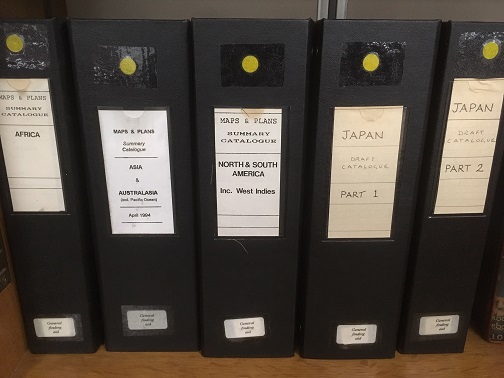
Part of the Summary Catalogue and the draft catalogue for maps and plans from Japan in our reading rooms at Kew.
For a few years in the late 1980s and early 1990s, maps, plans and drawings found with documents in series not consisting wholly of graphic material were recorded in a summary catalogue.
The catalogues are arranged topographically across a dozen or so files and there are three separate files providing subject indexes. The topographical and subject indexes both provide full document references.
Draft catalogue for maps and plans from Japan
A draft, manuscript catalogue of ‘Maps and plans’ for locations and constructions in Japan. It is arranged topographically.
4. How to search for the plans and drawings of specific architects
Not all the plans and drawings in our collection can be attributed to a specific architect but in some cases they are signed or otherwise identified as the work of a particular individual.
You can search by architects’ names in the following ways, though none of these methods offers a comprehensive search of the records:
- Search our catalogue using an architect’s name as your search term
- Consult the indexes of architects, draughtsmen and surveyors in the published and unpublished catalogues (see sections 3.2 and 3.3)
- Use the subject heading for architects and surveyors which forms part of the ‘Maps and plans summary catalogue’ (see section 3.3)
- Use the typescript index of signed drawings among the records of the Office of Works and successors (this index is not wholly reliable)
5. Key records series
The three tables in this section highlight those record series containing significant quantities of maps, plans and drawings relating to architecture and the built environment. These series were inherited from various government departments, notably the former Office of Works, which accumulated series of records consisting wholly or largely of plans and drawings of buildings, or maps illustrating aspects of the built environment, usually in relation to planning and development. Many architectural plans and drawings were filed in series which consisted principally of maps.
Click on the series references below to search within the respective series but keep in mind the following limitations:
- Catalogue descriptions seldom indicate the drawing material or medium.
- Catalogue descriptions seldom record the stage in the building project at which a particular drawing or set of drawings was produced (for example, presentation drawings, contract drawings, working drawings, record/as built drawings). In some cases, this can be determined from the drawings themselves, but it is not always easy to establish.
The tables overlap in places, and you can expect to find some types of drawings and plans in series appearing in more than one of these tables.
5.1. Drawings and plans of specific buildings, sites and schemes
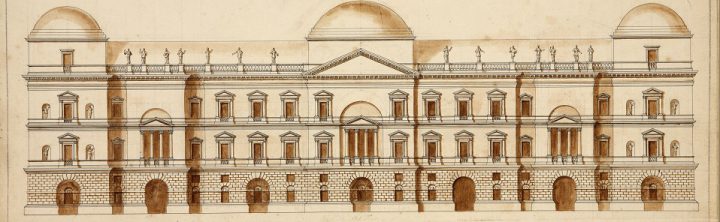
A drawing from 1739 showing William Kent’s design for the Houses of Parliament (catalogue reference WORK 29/3358). The plan did not make it past the drawing board.
| Series | Description |
|---|---|
| AT 13 | Department of the Environment: Ancient Monuments Branch: Maps and Plans, 1971-1980 |
| BD 101 | Ministry of Public Buildings and Works and Welsh Office: Plans and Drawings relating to the Investiture of the Prince of Wales, 1969, 1968-1970 |
| FCO 18/873-1169 | Foreign Office and Foreign and Commonwealth Office: Library and Records Department and predecessors: Plans and Drawings’, 1875-2003 |
| HLG 5 | Local Government Board and successors: Housing and Town Planning Department and successors: Planning Schemes, Maps and Plans, 1905-1951 |
| HLG 6 | Ministry of Health and predecessors: Buildings and Works, Miscellaneous Maps and Plans, 1800-1919 |
| HLG 23 | Ministry of Health: Legal Branch: Sealed Plans, 1923-1937 |
| HLG 24 | Local Government Board and Ministry of Health: Legal Branch and predecessors: Rehousing Schemes of Statutory Undertakers, Sealed Plans and Schemes, 1890-1939 |
| HLG 111 | Ministry of Local Government and Planning and Ministry of Housing and Local Government: Legal and Parliamentary Branch: Miscellaneous Sealed Plans, 1951-1955 |
| LRRO 1 | Office of Land Revenue Records and Enrolments and predecessors: Associated Departments and successors: Maps and Plans, 1560-1981 |
| MEPO 9 | Metropolitan Police: Architectural Plans and Drawings, 1847-1965 |
| MH 14 | Poor Law Board and Local Government Board: Architect’s Department and Metropolitan Department: Poor Law Union Plans, 1861-1918 |
| PRO 50 | Public Record Office: Maps, Plans and Photographs of the Chancery Lane Building, 1896-1965 |
| PRO 55 | Public Record Office: Maps, Plans and Photographs of the Hayes Site, 1953-1973 |
| PRO 62 | Public Record Office: Maps, Plans and Photographs of the Kew Site, 1928-1978 |
| PRO 65 | Public Record Office: Former Repositories and Offices, Maps, Plans and Photographs, 1957-1977 |
| T 179 | Treasury: John F Kennedy Memorial Plan and Deed, 1964 |
| WO 385 | Board of Ordnance Office and successors: Royal Gunpowder Factory and successors, Waltham Abbey: Maps and Plans, 1783-1983 |
| WORK 29 | Office of Works and successors: Houses of Parliament: Plans and Drawings, 1698-1947 |
| WORK 30 | Office of Works and successors: Public Buildings in England: Plans and Drawings, 1656-1962 |
| WORK 31 | Office of Works and successors: Ancient Monuments and Historic Buildings: Plans and Drawings, 1666-1977 |
| WORK 32 | Office of Works and successors: Royal Parks and Pleasure Gardens: Plans and Drawings, 1653-1964 |
| WORK 33 | Office of Works and successors: Art and Science Buildings: Plans and Drawings, 1815-1952 |
| WORK 34 | Office of Works and successors: Royal Palaces: Plans and Drawings, 1662-1994 |
| WORK 35 | Office of Works and successors: Statues and Memorials: Plans and Drawings, 1821-1958 |
| WORK 36 | Office of Works and successors: Ceremonial: Plans and Drawings, 1685-1936 |
| WORK 37 | Office of Woods, Forests, Land Revenues, Works and Buildings and successors: Osborne House: Plans and Drawings, 1843-1952 |
| WORK 38 | Office of Works and successors: Miscellaneous Plans and Drawings, 1662-1951 |
| WORK 40 | Office of Works and successors: Public Buildings, Overseas: Plans and Drawings, 1852-1952 |
5.2. Drawings and plans of major civil engineering projects
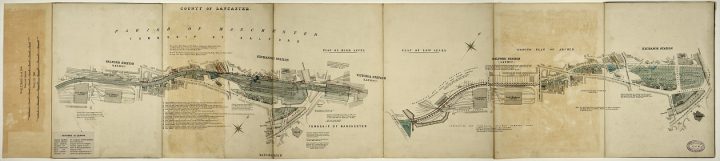
Manchester and Salford Exchange Stations layout plan from 1896, held among the records of the London and North Western Railway Company in series RAIL 410 (catalogue reference RAIL 410/796).
| Series | Description |
|---|---|
| AB 5 | Department of Scientific and Industrial Research and successor: Directorate of Tube Alloys and successor: Chalk River Project, Engineering Drawings, 1943-1976 |
| AN 23 | British Railway: Eastern Region: Signalling Plans and Track Diagrams, 1883-1968 |
| AN 31 | British Railways: London Midland Region: Station Plans and Drawings, 1948-1966 |
| AN 42 | British Railways: Southern Region: Signalling Plans and Track Diagrams, 1948-1962 |
| AN 48 | British Railways: Western Region: Station plans and Drawings, 1850-1960 |
| AN 93 | British Railways: London Midland Region: Signalling Plans and Track Diagrams, 1939-1979 |
| BK 7 | National Dock Labour Board: Premises Plans, 1949-1984 |
| BK 25 | National Dock Labour Board: Maps and Plans of Docks and Harbours, 1904-1983 |
| MT 8 | Railway Commissioners Returns and Plans of Iron Bridges, 1847 |
| MT 21 | Ramsgate Harbour: Deeds, Evidences and Plans, 1613-1939 |
| MT 54 | Light Railway Plans, 1896-1946 |
| MT 57 | Highways Maps and Plans, 1920-1964 |
| MT 91 | Board of Trade Railway Department: Drawings and Plans, 1840 – c1886 |
| RAIL 796 | Great Northern Railway Company: Working Plans and Sections, 1846-1914 |
| RAIL 1029 | British Transport Historical Records: Maps, Plans & Surveys of Canals and Inland Waterways, 1761-1974 |
| RAIL 1030 | British Transport Historical Records: Maps, Plans and Surveys of Individual Railway companies, 1824-1963 |
| RAIL 1031 | British Transport Historical Records: Maps, Plans and Surveys of British Railways, Canals and Inland Waterways, 1808-1964 |
| RAIL 1032 | Maps, Plans & Surveys: Railway Clearing House, 1870-1960 |
| RAIL 1033 | Maps, Plans & Surveys: Towns, Ports and Local Areas, 1834-1960 |
| RAIL 1034 | Maps, Plans & Surveys: London, & London Transport, 1870-1960 |
| RAIL 1035 | Maps, Plans & Surveys: General & Atlases, 1843-1961 |
| RAIL 1036 | Maps, Plans and Surveys: British Empire and Foreign, 1863-1956 |
| RAIL 1037 | Maps, Plans and Surveys: York Collection 1737-1958 |
| RAIL 1071 | Parliamentary: Deposited Plans |
5.3. Drawings and plans of military establishments
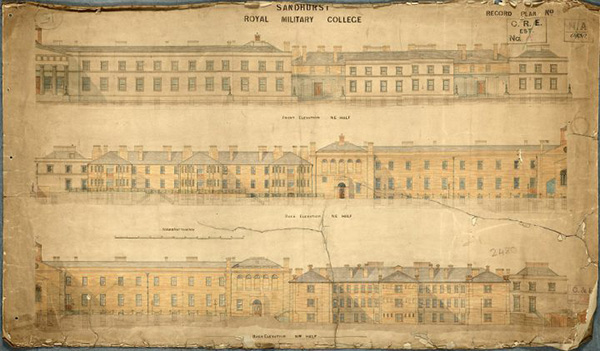
Elevations from 1880 of the front and back of Sandhurst Royal Military College (catalogue reference WORK 43/986).
| Series | Description |
|---|---|
| ADM 140 | Navy Board and Admiralty: Civil Engineer in Chief’s Department and predecessor: Maps and Plans, 1786-1956 |
| AVIA 62 | Air Ministry and successors: Estates Branch: Civil and Military Airfields: Maps, Plans and Papers, 1935-1968 |
| BD 54 | Welsh Office and predecessors: Plans of Airfields in Wales, 1937-1946 |
| WO 78 | War Office and predecessors: Maps and Plans, 1627-1953 |
| WORK 41 | Admiralty, Navy Works Department and predecessors: Naval Establishments: Plans and Drawings, c1760-1970 |
| WORK 43 | War Office, Directorate of Works and predecessors: Army Establishments: Plans and Drawings, 1713-1963 |
| WORK 44 | Air Ministry, Directorate of Works: Air Force Establishments: Plans and Drawings, 1914-1956 |
6. Architectural furnishings and fittings
Drawings of architectural details, fittings and furnishings may appear in many of the series listed in section 5, often relating to the contents of specific buildings. Other useful sources include:
- BT 183: Board of Trade: Utility Furniture Scheme: Files, 1943-1949, which contains large numbers of drawings
- WORK 25: Festival of Britain Office records, which includes many drawings relating to furnishings, fixtures and fittings in buildings on the Festival site
- DSIR 4: Department of Scientific and Industrial Research: Building Research Station: Correspondence and Papers
7. Architectural drawings held elsewhere
Numerous institutions around the world hold collections of architectural drawings and related records. This section details those with significant collections of material with a connection to our records in their history or content.
- Large numbers of plans and drawings created by local government and other bodies are held in local authority record offices. For their addresses and contact details, use the find an archive tool or consult British Archives: A Guide to Archive Resources in the UK by Janet Foster and Julia Sheppard (4th edition, Palgrave Macmillan, 2002).
- Historic England Archive – substantial collections of drawings created or collected by government departments are held by the Historic England Archive. Records shed light on the history of specific buildings built for or occupied by government departments, among other things.
- National Records of Scotland – holdings include government records relating to public works, and some records of former or present public utilities.
- National Library of Wales – holdings include government records relating to public works, and some records of former or present public utilities.
- Public Record Office of Northern Ireland – holds some records relating to British government in Ireland before 1922 as well as specifically Northern Irish records.
- The National Archives of Ireland – holds some records relating to British government in Ireland before 1922.
- National Monuments Record of Wales – this is the archive of the Royal Commission on the Ancient and Historic Monuments of Wales.
- Historic Environment Scotland – the archives include collections on ‘Scotland’s Urban Past’ and the work pf Sir Basil Spence, one of the most celebrated architects of post-war Britain.
- Research and Special Collections Available Locally – a hub for research resources relating to Ireland, including EHS: Built Heritage, which It aims to identify, record and protect the built, buried and underwater remains of human activity from prehistoric times to the present day.
- V&A – architectural drawings and photographs of the Victoria and Albert Museum, from the Renaissance to the present day, includes material on buildings or architects, in the public or private sector.
- Royal Institute of British Architects – home to one of the largest and most diverse architectural collections in the world.
8. Further reading and resources
All of the publications listed here are available for consultation at The National Archives library in Kew.
The following two publications contain advice on records in our collection, with some information about plans and drawings:
Nick Barratt, Tracing the History of your House (2nd edition, 2006)
Cliff Edwards, Railway Records: A Guide to Sources (2001)
The following guides may help you with your keyword choices when searching our catalogue and more generally:
Robin Thornes and Vicki Porter, A Guide to the Description of Architectural Drawings (G K Hall & Co., 1994)
Toni Petersen and Patricia J Barnett, Guide to Indexing and Cataloguing with the Art & Architecture Thesaurus (Oxford University Press, 1994)
The following may also prove useful:
Angela Mace, The Royal Institute of British Architects: A Guide to its Archive and History (Mansell Publishing, 1986)
James Bettley and Richard Raper, Catalogue of the Drawings Collection of the Royal Institute of British Architects: A Cumulative Index (Gregg Publishing, 1989)
Eleonore Kissel and Erin Vigneau, Architectural Photo-reproductions: A Manual for Identification and Care (Oak Knoll Press, 2009)
A Guide to the Archival Care of Architectural Records, 19th-20th centuries (International Council on Archives, 2000)
This guide provides an overview of political records held at The National Archives, dating from the early modern period, covering the 16th, 17th and 18th centuries.The advice here will help you to get your research into English and British early modern political government started, with links to our more specialist guides will help you to take your next steps and locate specific records.
Latin was regularly used in formal and legal documents until 1733 (except during the Interregnum). The handwriting can be difficult to decipher. See reading old documents for help.
Government in the Early Modern era
During the early modern period, the monarch was the central source of justice and authority, and records at The National Archives reflect this. Most documents served to implement the king or queen’s decisions or preferences, often referred to in the records as the royal will.At the centre of the government in England was the Privy Council, where the monarch and senior ministers of state were presented with the daily round of business. They handled a vast range of matters, from trade and war to religion and colonial affairs. Each issue generated paperwork, including private petitions, correspondence, and official orders.
The council’s decisions were processed through three key secretarial offices, each with its own seal: the great seal, the privy seal, and the signet. This order reflects the chain of command, but each seal worked independently of each other to ensure the smooth running of government. In doing so, each created paperwork which gives modern researchers access to the early modern decision-making process.
The great seal, held by the Lord Chancellor, was the most senior and authenticated final decisions. Many decisions of government carried authority only if done under that seal. The privy seal issued internal government orders (known as warrants), while the signet, although the lowest ranked seal, was controlled by the secretary of state who oversaw all correspondence on the monarch’s behalf. The signet gave the secretary authority to implement government business in his own right.
The secretary of state’s office evolved significantly over the early modern period, especially from Henry VIII’s reign. Initially a chief minister, the secretary became central to government operations.
It was further expanded, especially during Elizabeth I’s reign, and the authority of the secretary of state increased. There was quickly a need for two secretaries to handle the volume of government business and this division lasted until 1782, when the office of secretary of state was formally divided into the modern Home and Foreign Offices.
The State Papers collection were originally understood to be a private collection of the monarch’s correspondence and were stored at the Rolls Office and at Westminster. The papers from the secretaries of states’ offices were kept separate at the State Papers Office, until they were sorted and assembled in the nineteenth and early twentieth centuries into the State Papers, as we now understand them.
What kinds of records to use
Early modern records held at The National Archives, like all records here, were created in the everyday business of the departments and law courts running English and subsequently British governmental affairs.
Political issues were usually dealt with by more than one government department, and records related to a single issue or person can often be found across multiple series. For example, a case taken against a person may result in correspondence within the State Papers; with entries of the matter being discussed at the Privy Council; before the matter was heard at the Star Chamber; and a resulting fine paid into the Exchequer. This will result in the need to examine at least four series, all of which were created independently of the other but exist together.
We recommend that you focus research on political issues in this era on the records of the following government departments and central law courts:
- State Papers
- Privy Council
- The Exchequer
- Court of Chancery enrolments
- Court of Star Chamber
- Court of King’s Bench
The records themselves come in a wide variety of formats and types. Typically, you will find:
- Correspondence. Letters received at the secretary of state’s office from within government, from petitioners within England and Wales, from ambassadorial missions abroad, from royal government in Ireland and Scotland. The list is extensive. Incoming correspondence that became part of the State Papers was sub-divided into Domestic and Foreign, sorted by reign, and bound into volumes.
- Memoranda. Records of issues, decisions, instructions and proceedings as recorded by government clerks and other officials.
- Enrolments. Clerical copies of documents, such as those which were issued under the Great Seal such as patent rolls. The text of the issued document was written onto parchment, which was sewn at the top and bottom, and rolled, ensuring the information on the roll was protected.
How to get a search for records started
In general, locating individual early modern records in our collections is trickier than finding modern records. While searches for modern records usually begin in our online catalogue, the listings for early modern records in the catalogue are less comprehensive and more often a catalogue search will come up short.
To find individual items within early modern records you are likely to need to use calendars and other finding aids, some available online and others held exclusively in our reading rooms in Kew. Calendars give brief descriptions of correspondence and papers in chronological order. Chief among these are the Calendars of State Papers, a vital means of access to the records of the State Paper Office. They are available in our reading rooms and in research libraries but also online, though an institutional subscription.
This research is therefore likely to require a visit to our building, or to another archival or educational institution or a library with an institutional subscription to one or more of the following online sources:
Records of the State Paper Office
Records of the State Paper Office are more commonly referred to as State Papers. The modern arrangement of State Papers is into series according to the royal dynasty or overseas interests.
State Papers Domestic
State Papers Domestic are the accumulated papers of the secretaries of state relating to domestic affairs from about 1547 to 1782, at which date the business of the two secretaries was divided between the Home Office and Foreign Office. State Papers Domestic are divided by reign.
For advice on how to find State Papers from specific eras, use the table below to select guides to for the relevant royal dynasties:
Monarchs/Dynasties |
Dates |
| Henry VIII | 1509-1547 |
| Tudor/Stuart | 1547-1649 |
| Civil war/interregnum | 1642-1660 |
| Stuart/Restoration | 1660-1714 |
| Hanoverian | 1714-1782 |
State Papers Foreign and Colonial
State Papers Foreign and Colonial are the papers of the secretaries of state in the conduct of British diplomacy abroad. They are divided by country.
Browse the State Papers Foreign list of series, in our catalogue, arranged by country and find research guides on State Papers Foreign and Colonial below:
| Foreign affairs | 1509-1782 |
| Irish affairs | 1509-1782 |
| America and West Indies | 1573-1739 |
Online access to State Papers
State Papers Online (institutional subscription required) offers online access to State Papers Domestic, Foreign, Scotland and Ireland.
Colonial State Papers (institutional subscription required) provides access to the Calendar of State Papers, Colonial: North America and the West Indies 1574-1739.
Access to both is available at The National Archives and some major academic and research libraries.
Records of the Privy Council
The Privy Council, also known as the King’s Council, was a group of advisers chosen to help the monarch govern. Its members included the chief ministers of state, senior church leaders, important nobles and senior royal household officials. As well as its advisory role, the council also handled legal and administrative matters. It dealt with crimes against the king and reviewed appeals from the public. Until the mid-17th century, it carried out its authority through special courts, like the Star Chamber.Browse our catalogue, in record series PC 2 for registers of the Privy Council, comprising the records of its proceedings, its orders, certain proclamations and the reports of committees. See our research guide for more information.
Records of decisions of the Privy Council judicial committee are available online at the Privy Council Papers website.
Records of the Exchequer
The Exchequer was responsible for the accounting and audit of Crown (and therefore government) revenue. The records include those of the departments set up to deal with additional Crown revenues following the Reformation.Browse our catalogue, in record series E for records of the Exchequer, the main financial department of the medieval and early modern English state. They include records of the Court of Augmentation, founded in 1536 to deal with the transfer of land to the Crown when the monasteries were dissolved. Our guide to the dissolution of the monasteries gives more information.
State Papers online also contains some Exchequer records.
Records of the Court of Star Chamber
The Court of Star Chamber was effectively the Privy Council sitting as a tribunal to enforce law and order in both civil and criminal matters. James I and Charles I used the court to suppress opposition to royal policies, and it became increasingly unpopular in Parliament. Star Chamber was abolished in 1641.
Browse our catalogue in record series STAC for records of the Court of Star Chamber, which was concerned with the enforcement of law and order.
Our research guide gives more information.
The Court of King’s Bench – Baga de secretis
The Court of the King’s Bench was the most senior criminal court and had supervisory jurisdiction over inferior criminal courts. It also dealt with some of the most important ‘State trials’ for treason held between 1477 and 1813. Records of these cases were collected together in bags, referred to as ‘baga de secretis’, and this arrangement remains today.
Browse our catalogue for treason trials and other special court cases in the records series KB 8.
You can search the same series by name but you should note that not all the catalogue descriptions of records in KB 8 include a person’s name.
Other resources
Websites
Search the 18th Century Parliamentary Papers Collection (institutional subscription required) for digitised copies of official papers published by the House of Commons and House of Lords.
Search the London Gazette on The Gazette website by date or keyword for official news from home and abroad from 1665 onwards.
Explore a range of sources in British History Online.
Consult the Oxford Dictionary of National Biography (institutional subscription required) for biographies of prominent people.
This guide provides an overview of records held at The National Archives covering major political issues in the United Kingdom in the modern era, from 1782 onwards, and the government policies towards them. The advice here will help you to get your research started; links to our more specialist guides will help you to take your next steps and locate specific records.
In general, records created in the last 20 years remain in the hands of the government departments themselves, but more contemporary information can be found on the websites captured in the UK Government Web Archive.
Central government in the modern era
Most of the major modern government departments we know today were established between 1782 and 1919. Many of these departments grew significantly in size and took on more duties and responsibilities as the role of the state increased during the 19th and 20th centuries.
One of the most significant changes in government structure marking the transition from early modern to modern central government was the creation of the Home Office and Foreign Office in 1782, replacing the Southern Department and the Northern Department of the State Paper Office.
What kinds of records to use
In some ways, all records held at The National Archives are political records. The documents held here are those created in the everyday business of central government departments and subsequently selected for permanent preservation. However, we recommend that you start research here into modern political history by looking at the records of the most prominent government departments, where the issues dealt with are at their most wide-ranging and more likely to be closely aligned with the key areas of each government’s policy:
- The Prime Minister’s Office
- The Cabinet Office
- The Home Office
- The Treasury
- The Foreign Office and its successor the Foreign and Commonwealth Office (FCO)
- The Colonial Office (later part of the FCO)
The records themselves come in a wide variety of formats and types but typically you will find:
- Correspondence. Much of what has been preserved is original correspondence, chiefly letters and telegrams from other central and local government officials, from magistrates, county authorities, municipal and private corporations, members of the public and a long list of other sources. There may also be draft out-going correspondence sent from the departments themselves and internal comments, notes or memoranda.
- Registers. Created to record and organise the large amounts of correspondence and other documents received by government departments; these registers remain, to this day, valuable source material in their own right, as well as vital tools for locating individual items of correspondence.
- Minutes of meetings. Accounts of what was said at the time when decisions were being made.
- Reports. The records of these departments include thousands of official reports made by civil servants, diplomats, intelligence officers, scientists, experts in countless fields and so on, many of which helped to inform or determine government policy.
How to get a search for records started
A search for records at The National Archives usually begins in our online catalogue. The catalogue contains short descriptions of each and every record, arranged by the government departments that created them and identified by The National Archives’ own department references (letter codes, such as HO for Home Office).
Each National Archives department is split into a number of series, sometimes hundreds of series. A series contains records grouped together by theme or linked in some other way and you can focus a catalogue search on any one series if you choose to. Each series is distinguished by its own two-part reference: the department letter code and the series number. For example, Home Office papers of the Committee on the Prison Disciplinary System of the early 1980s are held together in their own series with the reference HO 318 – click on this reference to search specifically within those records.
A catalogue search is a search of record descriptions, not of the content of the records themselves, most of which are only available on paper. Some descriptions are just a word or two, essentially the titles of the original files, others contain several sentences of descriptive Simple searches, using just one or two keywords, are often the most effective. For advice on how to narrow your search to the records of specific government departments and major policy areas you should see if there is a guide to these records – the rest of this guide is designed to help you to do that.
How to view records
Once you have document references you can request the records themselves via the catalogue. Most of these records have no online version and to see them you will need to consult them at our building in Kew or pay for copies to be made and emailed to you, in both instances using your document references to place your request.
The guides linked to below indicate where online versions of records do exist. The online copies are accessed either directly from our website or from the websites of our licensed partners, primarily AM Digital and Gale, both of which require institutional subscriptions. There is free access to them at our building in Kew and at some reference and university libraries.
Records of the major government departments
We have published guides to the records of five of the most important government departments, with each guide focussed on the records most likely to provide answers to typical research questions.
Records of the Cabinet Office
By the mid-19th Century the Cabinet was firmly established as the senior decision making body in government.
With the foundation of the Cabinet Office in 1916, the system was reformed. The records of the Cabinet Office cover every major issue dealt with by successive governments since its creation.
Our guide to records of the Cabinet and its committees will help you to find accounts of the thinking behind major government policy decisions.
Records of the Home Office
The Home Office was created in 1782 to supervise the internal affairs of Great Britain, with particular emphasis on law, order and regulation. Its records cover a huge range of subjects including the criminal justice and penal systems, immigration, education, public improvement works, electoral administration, trade union relations and registered charities.
You will find material on all of these issues and many more in Home Office correspondence, the primary focus of our guide to Home Office records.
Records of the Treasury
As the government’s economic and finance ministry, responsible for maintaining control over public spending, virtually every area of government action involves the Treasury at some stage and its records, therefore, cover a very wide range of subjects. Our guide to Treasury records focusses on the records of the Treasury Board, the main decision-making body in the Treasury.
Records of the Foreign Office and Foreign and Commonwealth Office
he Foreign Office, the department responsible for the conduct of British relations with nearly all foreign states, was formed in 1782 and superseded by the Foreign and Commonwealth Office in 1968. Our guide to Foreign Office and Foreign and Commonwealth Office records helps you to make use of the tens of thousands of records of general correspondence that form the bulk of the material available. Correspondence from British ambassadors and other high-ranking diplomats around the world offers insights into the advice and information that influenced government policy towards specific countries. Other records known as ‘confidential print’ provide useful summaries of the important issues under discussion and debate at the Foreign Office at any given time.
Records of the Prime Minister’s Office
The Prime Minister’s Office provides administrative and secretarial support to the serving Prime Minister. Its records range widely in their subject-matter and represent a virtual ‘A-Z’ of governmental activity. Our guide to records of the Prime Minister’s Office includes advice on how to consult the official correspondence of successive Prime Ministers.
How to explore the records of other departments
Though there is advice on the records of many other departments in our guidance, they are primarily presented by record type (for example, Maps and plans) or subject area (for example, Propaganda). However, by using the advanced search of our catalogue, you can target the records of any department.
To do so, first select The National Archives in the ‘Held by’ field:

If you don’t know the National Archives code for a department, enter the name of the department here:

Records of major policy areas
As well as guides to the records of single departments, we also publish guides to policy areas spanning the work of multiple departments. The links below lead to our research guidance on some of the main areas of policy.
Poverty, welfare and the Poor Laws
Much of government policy towards poverty in the 19th and early 20th centuries is captured in the Poor Laws, especially from 1834 when the system of ‘poor relief’ was centralised. Our guide to poor law records will aid your research in this area and includes advice on finding records of the government bodies responsible for administration of the Poor Law unions, the Poor Law Commission, the Poor Law Board and the Poor Law Department of the Local Government Board.
Public health
Government policy towards public health and sanitation during the 19th century underwent several transformations, evidence of which you can find with the help of our guide to public health and social policy in the 19th century. The most transformational policy change of all came in 1948 with the setting up of the National Health Service. The thinking behind this and policy decisions before and since can be traced using the advice in our guide to records of public health and social policy in the 20th century.
Government attitudes to mental health can also be traced through our records. Although our guide to asylums, psychiatric hospitals and mental health focusses more on records of patients and individual institutions, it will help you get research into policy started.
Education
The 1870 Elementary Education Act was the effective start of state-financed education in England and Wales and our education records increase significantly in volume from this point onwards. The volume and breadth of material rises again following the creation of the Board of Education in 1899.
Our guides to records of education focus primarily on government education policy towards specific types of schools and educational institutions. To pursue research beyond those focal points, you should go straight to our catalogue and use the ED department reference in the advanced search of the catalogue (see above for more advice on exploring the records of a department). The records of the Board of Education and the departments which replaced it, including the Ministry of Education (1944-1964) and the Department of Education and Science (1954-1992) are searchable within the ED department and its various divisions.
Economic policy
The obvious records to consult for studies of the economic policy of central government are those of the Treasury, the economic and finance ministry, responsible for maintaining control over public spending (see above). Our guide to Economic policy and government spending in the 20th century contains advice on how to search in Treasury records (and in those of the Cabinet and the Prime Minister’s Office,) specifically for records of policy – the advice can be applied to 19th century records too.
Civil rights and the politics of discrimination
During the 20th century, increased government recognition of discrimination in various forms led to changes in policy. For advice on records at The National Archives that relate to civil rights and race relations consult our guide to Black British social and political history in the 20th century. For guidance on records which demonstrate the development of government attitudes and policies towards the LGBTQ+ communities, read our guide to Sexuality and gender identity history.
Surveys and statistics
In the 19th and 20th centuries the government collected all kinds of nationwide statistical information, with a notable emphasis on the population and agriculture. For advice on some of the most significant of these surveys see our guides to:
Private correspondence
The National Archives does not, in general, hold private correspondence but there are some collections of correspondence written by Prime Ministers and other prominent politicians and public figures that have come to The National Archives. We do not publish guides to these records but searching for and within them is relatively straight forward.
Collections catalogued as original records acquired as gifts or deposits can be browsed under our catalogue reference PRO 30.
Some of the collections relating to Prime Ministers are listed below:
- Papers of former Prime Minister David Lloyd George are in YLG
- Papers of former Prime Minister Andrew Bonar Law are in YBL
- private papers of Sir Desmond Morton, personal assistant to the Prime Minister from 1939 to 1951, in PREM 7
- ‘Chatham Papers’, comprising the papers of William Pitt (the ‘Elder’), First Earl of Chatham and his son William Pitt (the ‘Younger’) in PRO 30/8
- Russell Papers relating to John, First Earl Russell and his family (1800-1913) in PRO 30/22
- Papers of James Ramsay MacDonald and his family in PRO 30/69 and CAB 127/282-295
The papers each have their own unique arrangement and may be better browsed than searched.
Records of correspondence of diplomats and senior officials of the Foreign Office are in various series of Foreign Office private office and private papers and can be browsed or searched from the links in this division of the catalogue.
Private Office papers of Secretaries of State and senior officials of the Foreign and Commonwealth Office since 1968 can be found in series FCO 73.
See also our guide to Sir Anthony Eden’s private office papers
Records in other archives and organisations
You can find other papers in private and specialist archives, for example:
- Winston Churchill’s papers, known as the ‘Chartwell Papers’, at Churchill College, Cambridge
- William Gladstone’s papers at the British Library
- Henry Herbert Asquith’s papers at the Bodleian Library
- Neville Chamberlain’s papers at Birmingham University Library
Other resources
The Gazette (1665-present)
Search the London Gazette, on The Gazette website, by date or keyword for official government notices and intelligence from home and abroad.
The Gazette is not a conventional newspaper. The official notices concern the effects of statutory instruments (secondary legislation stopping up highways or adopting legislation to a particular place), military promotions, notices of bankruptcy. Prior to the late-19th century you will also find official government proclamations and accounts of foreign battles or events.
Search using the ‘notices’ section of the website. For content before the late 20th century only the ‘text search’, date of publication, and Gazette edition fields should be used.
Parliamentary Papers (1715-present)
Search Parliamentary Papers (institutional subscription required) for digitised copies of official papers published by the House of Commons and House of Lords.
Hansard
Search Hansard for official report of debates in Parliament.
Our research guide to Hansard details different ways of accessing the reports and records of Parliamentary debates.
Websites
Explore a range of 19th century sources in British History Online.
Consult the Oxford Dictionary of National Biography (institutional subscription required) for biographies of prominent people.
Search The Times Digital Archive (gale.com) and Guardian and Observer Digital Archive to view articles (charges apply) about 19th and 20th century politics.
Search the UK Government Web Archive for UK central government information published on the web. The Web Archive includes videos, tweets, images and websites dating from 1996 to the present day.
Pamphlets and newspapers
Search the catalogues on the British Library website to find archived political pamphlets and newspapers.
1. Why use this guide?
Use this guide if you are researching British maritime history and are interested in collections which are held by archives other than The National Archives. For research guides specifically on The National Archives maritime records please see the other guides in our Military and maritime research guidance category.
The collections described in this guide cover a broad range of maritime records including records of:
- merchant shipping
- privately owned shipping companies
- shipbuilding
- ship owners
This research guide briefly describes:
- how to start searching for these records
- the principal relevant repositories with significant collections relating to maritime history in the UK
- useful addresses, links and general works of reference.
2. How to search for records
Search Discovery, our catalogue, to find records from over 2,500 archives across the UK, as well as from The National Archives itself. Your search results will include details of which archives currently hold the records.
Click on the title of a result for the contact details of the archive which holds the record – you will need to contact this archive for further information about the collection or the record itself.
Where the keywords you searched for appear in the description of a record, the search results are displayed under the ‘Records’ tab.
Where the keywords you searched for appear in the name of the institution or person that originally created the record (often not the same as the institution or person that currently holds the record), the search results are displayed under the ‘Record creators’ tab. For further tips on searching see our catalogue help pages.
3. Records recently collected by other archives
Many archives regularly take in new records to add to their collections – this process is known as accessioning. Every year, The National Archives collects information about new accessions from 250 archives across Britain and Ireland. This is known as the annual Accessions to Repositories’ survey.
This information is added to Discovery, our catalogue. It is also edited and used to produce thematic digests, including one relating to maritime history. The digests are made available through this website and distributed for publication in a number of learned journals and newsletters. Further information is available at Accessions to Repositories.
4. Major collections
Below are details of repositories and institutions that hold major collections of records relating to maritime history.
British Library, Asia, Pacific and Africa Collections The extensive records of the India Office Marine Department include material relating to the East India Company’s maritime service, the Bombay Marine, the Indian Navy and the Bengal Pilot Service. There are stray records relating to individual East Indiamen in other collections, as well as a small collection relating to the Irrawaddy Flotilla Co Ltd.
Edinburgh University Library, Special Collections Holds the whaling records of Christian Salvesen of Leith as well as voyage books of Ben Line Steamers Ltd.
Glasgow City Archives Along with Glasgow University (see below) holds most of the records relating to Clyde shipbuilding. In addition, there are numerous shipowners’ collections including Burns & Laird and Donaldson lines, H Hogarth & Sons Ltd and Lyle Shipping Co Ltd. Other holdings include records of Clyde Marine Society, Glasgow and Clyde Ship-Owners’ Association and Glasgow Sailors Home.
Glasgow University Archive Services The University is particularly rich in modern business collections and holds, for example, records of Clyde Shipping Co Ltd, Ellerman Lines Ltd and Walter Runciman & Co Ltd. There are also collections relating to some forty Scottish shipbuilding, repairing and marine engineering concerns, and survey reports of the British Corporation for the Survey and Registry of Shipping, which later merged with Lloyd’s Register of Shipping.
The London Archives The London Archives holds the records of the former Guildhall Library including numerous overseas merchants and shipping agents, the extensive shipping records of Inchcape plc, the archives of the Watermen and Lightermen’s and Shipwrights’ companies, Lloyd’s Marine Collection, and the records of the Corporation of Trinity House, the general lighthouse authority for England, Wales and the Channel Islands.
Liverpool Record Office Holds the records of numerous shipping companies including the Booth Line, CT Bowring & Co Ltd, Thos & Jno Brocklebank, China Navigation Co Ltd, Lancashire Shipping Co Ltd, and the White Star Line. There are also the logbooks of a number of slave ships, the records of numerous marine insurers and the minutes of the Mersey Ship Repairers’ Association.
Liverpool University: Special Collections and Archives The university holds the extensive archives of the Cunard Steam-Ship Co Ltd.
Memorial University of Newfoundland, Maritime History Archive Given the enormous physical bulk of the records of the Registrar General of Shipping and Seaman, and the reluctance of any single UK repository to house them, roughly 70% of crew lists, agreements and official logbooks are now deposited in Newfoundland. The remaining 30% are spread between The National Archives, the National Maritime Museum and various local repositories in the UK.
National Records of Scotland Shipping collections include those of the British Railways Board, Caledonian MacBrayne Ltd and the London & Edinburgh Shipping Co Ltd. The office also holds considerable shipbuilding collections including Burntisland Shipbuilding Co Ltd, Henry Robb Ltd and Ramage & Ferguson Ltd.
National Maritime Museum: The Caird Library, Manuscripts Section Among the collections here are the business records of P&O and William Denny & Brothers Ltd; the museum’s 10% share of British crew agreements 1861-1965; certificates of competency or service for masters, mates, engineers and skippers 1845-c1927; and Lloyd’s Register of Shipping survey reports c1834-1960. For additional guidance to the collections see RJB Knight’s Guide to the manuscripts of the National Maritime Museum, Vol. 1: The personal collections (1977), Vol. 2: Public Records, Business Records and Artificial Collections (1980).
National Museums Liverpool, Maritime Archives and Library Holds records of local dock companies, ship owners, overseas merchants, shipbuilders and repairers, shipbrokers and sail makers. There are also records for related employers’ associations and the Mersey Docks and Harbour Board. For more guidance on the collection see Gordon Read and Michael Stammers’ Guide to the Records of Merseyside Maritime Museum (1995).
The National Archives The National Archives holds all the records relating to government regulation of merchant shipping, notably the records of the Registrar General of Shipping and Seamen. It also holds business records from several sectors of the economy which were nationalised in the mid twentieth century. Canal, dock, harbour, navigation and steamship company records are described in British Transport Commission Historical Records (List & Index Society, volume 142, 1977).
Public Record Office of Northern Ireland Holds the records of numerous harbour companies and authorities, including those of Belfast Harbour Commissioners. Shipping collections include records of the Antrim Iron Ore Co Ltd, the Head Line, Newry & Kilkeel Steamship Co Ltd and the Ulster Steamship Co Ltd. The office also holds the important shipbuilding collection of Harland & Wolff Ltd.
Tyne and Wear Archives This a particularly rich regional archive containing records as diverse as the North East Coast Institution of Engineers and Shipbuilders, the North of England Shipowners Association, South Shields Marine College and Sunderland Pilotage Authority. The region’s connection with shipbuilding and ship owning are also well represented in collections of the records of R & W Hawthorn, Leslie & Co Ltd, Swan, Hunter Shipbuilders Ltd, Hall Brothers and Stag Line Ltd.
Warwick University: Modern Records Centre Specialises in the records of trade unions and employers’ associations. These include the records of the National Union of Seamen and the British Marine Industries Federation. See Richard Storey and Alistair Tough, Consolidated Guide to the Modern Records Centre (1986) and Richard Storey, Alistair Tough and Christine Woodland, Supplement to the Consolidated Guide (1992).
5. Useful links
Archives Hub – The Archives Hub provides descriptions of collections held at archives in UK universities and colleges. At present the descriptions are primarily of the broad themes and subject matters of the collections, although where possible they are linked to more detailed descriptions of the records that make up each collection.
Archives in London and the M25 area (AIM25) – AIM25 provides online descriptions of collections held at the archives of over fifty higher education institutions and other academic and cultural organizations within the greater London area.
Scottish Archive Network (SCAN) – The Scottish Archive Network allows online searching of over 20,000 collections in 52 Scottish repositories.
6. Further reading
Rita V Bryon and Terence N Bryon, Maritime Information: A guide to libraries and sources of information in the United Kingdom (3rd ed, 1993)
Edward Carson, ‘Customs Bills of Entry’, in Maritime History vol 1, number 2 (1971)
Edward Carson, ‘Customs records as a source for historical research’, in Archives vol XII, no 57 (1977)
HAL Cockerell and Edwin Green, The British Insurance Business. A Guide to its History and Archives (1994)
Nicholas Cox, ‘The Records of the Registrar-General of Shipping and Seamen’, in Maritime History vol 2, number 2 (1972)
Rupert C Jarvis, ‘Ship Registry – to 1707’, in Maritime History vol 1, number 1 (1971), ‘Ship Registry – 1707-86’, in Maritime History vol 2, number 2 (1972) and ‘Ship Registry – 1786’, in Maritime History vol 4, number 1 (1974)
DJ Jeremy (ed), Dictionary of business biography (5 vols, 1984-86)
Lloyd’s Maritime Directory (2003)
Peter Mathias and AWH Pearsall, Shipping: a survey of historical records (1971)
K Matthews, ‘Crew lists, agreements and official logs of the British Empire 1863-1913 now in the possession of the Maritime History Group, Memorial University, St John’s, Newfoundland’ in Business History VXI (1974)
LA Ritchie, The shipbuilding industry: a guide to historical records (1992)
Anthony Slaven & Sydney Checkland (eds.), Dictionary of Scottish business biography 1860-1960 (2 vols, 1986-90)
CT and MJ Watts, My ancestor was a merchant seaman: how can I find out more about him? (1986)
Donald Woodward, ‘The Port Books of England and Wales’, in Maritime History vol 3, number 2 (1973)
1. Why use this guide?
This guide will help you to find enclosure Acts, awards, and other related records including enclosure maps, at The National Archives. Large numbers of enclosure awards and maps are also held by local county record offices and archives. Enclosure is sometimes spelled inclosure and you may need to search for both spellings.
Enclosure awards are legal documents created to record redistribution or reorganisation of land, providing legal proof of historical ownership and the boundaries of landholdings. They may include details of roads, rights of way, waterways, drainage and so on, as well as details of the landowners, whether people or institutions. Enclosure awards are usually accompanied by maps depicting the reorganised land and the features which distinguish it, including buildings, roads and of course the lines of the new boundaries.
The enclosure awards we hold are only comprehensive for dates after 1845. Most of the enclosure maps we hold date from after 1800 and few survive from before 1770.
2. About enclosure
Enclosure describes various ways in which land was redistributed into designated units, usually consolidating small landholdings into larger farms. This included the conversion of commons, wasteland and open fields to formally enclosed units of land, the conversion of arable land to pasture and the partition of large areas of communally farmed land into small fields farmed by individuals.
Enclosure began in the medieval period but the practice became particularly widespread in the 18th and 19th centuries, when it was established through local Acts of Parliament known as Enclosure Acts.
The process was long and complex, with various forms of private and public enclosure occurring simultaneously. As a result there may be a number of enclosure awards for the same place, which may be held in different archives.
3. What do enclosure awards and maps tell us?
Enclosure awards typically contain:
- The name of the landowner of each plot of land
- The extent of each landowner’s holdings
- The nature of tenure (freehold, copyhold and so on)
- Details of roads, rights of way, waterways, drainage and so on
There may also be information about who was to be responsible for maintaining fences, hedges or other boundaries.
Enclosure maps show:
- The boundaries of the enclosed land
- Roads, waterways and other features of the landscape
- Buildings
Pre-19th century enclosure awards are much less likely to be accompanied by a map.
4. How to find enclosure awards and maps
Enclosure awards are widely scattered among our collections and beyond. Many enclosure records, including maps, are held in local record offices.
As enclosure awards are legal documents they are commonly found among the records of courts of various kinds. Within our own records you can find enclosure awards and maps among the records of the Court of Common Pleas, the Court of Chancery, the Palatinates of Chester and of Durham, the Duchy of Lancaster, the Land Revenue Record Office and the Ministry of Agriculture.
To begin a search, go to our catalogue and search for a place name and the term ‘enclosure’. Search results are likely to include details of records held here and in county record offices (our catalogue contains descriptions of records held by more than 2,500 archives across the country). If a catalogue search fails, try any of the ‘Other resources’ listed below.
Example: a search for an award covering Anstey in Hertfordshire
- Step 1: Go to our catalogue.
- Step 2: Search with the words ‘Anstey’, ‘Hertfordshire’ and ‘enclosure’. Search results for records held here and at other archives will display on the search results page.
- Step 3: In the left-hand panel, under ‘Held by’, click on ‘The National Archives’ to narrow your search results to records held here. This should leave you with two results.
- Step 4: Of the two record descriptions, click on ‘1 item extracted from CP 43/998 rot 2…’ to get to the catalogue description page. This is the description for document reference MR 1/123. The document is a map which has been removed from its original parent document for reasons of safe storage. The reference of the original parent document is CP 43/998 and you can order and view this separately.
- Step 5: Sticking with the map, you will see your options for viewing or ordering copies of the map on the right hand side of the page – to view the original you will usually need to visit us at our reading rooms in Kew
- Step 6: Turning to the award document itself, click on the hyperlinked reference CP 43/998 on the catalogue description page of MR 1/123. This leads to the catalogue description page of CP 43/998 itself.
- Step 7: Again, you will see your options for viewing or ordering copies of the award on the right hand side of the page
- Step 8: When you finally get sight of the award, you will see a detailed schedule listing the ownership of each plot of land numbered or described on the enclosure map, its extent in acres, roods and perches (even in 1800, these measurements varied between counties; see Zupko’s Dictionary of English Weights and Measures) and the rent charge payable on it. For example:
| Numbers of ancient enclosures | Lands and tenements | Quantity | Yearly rents or sums charged | Quantities of wheat in bushels | |
| Prior Thomas | |||||
| Copyhold | 21 | Ravens | 6.1.11 | 1 17 10 | 5.1302 |
| of Anstey | 22 | Cottage and garden | 0.1.10 | . 1 10 | .2486 |
Other resources
There are a number of published sources that could prove invaluable in the search for an enclosure award and/or map. Consult the following at The National Archives library in Kew and at other libraries:
- Domesday of English Enclosure Acts and Awards (1978) by W E Tate, which gives the location and date of awards and maps in England
- Guide to Parliamentary Enclosures in Wales (1992) by J Chapman is the equivalent guide for Wales
- The Enclosure Maps of England and Wales, 1595-1918 (2004) by Roger J P Kain, John Chapman and Richard Oliver (2004) is a more recent guide to enclosure maps
- Maps and Plans in the Public Record Office – British Isles c.1410-1860 (1967) is a broader guide but describes some of the enclosure maps held at The National Archives (previously known as the Public Record Office)
There is also an online database of The Enclosure Maps of England and Wales accessible from the History Data Service housed within the UK Data Archive of the University of Essex – it lists many enclosure maps and their locations.
At our reading rooms in Kew the printed version of our catalogue (sometimes referred to as the ‘paper lists’) contains a place index of those awards and maps that have been identified in our collection. It is filed with series CP 43. The Your Archives wiki previously maintained by The National Archives contains awards and maps from this index. Though Your Archives has not been maintained since 2012, it is still available as an archived website on the UK Government Web Archive.
As tithes were normally commuted as part of the enclosure process, areas covered by enclosure maps often lack tithe maps and vice versa. See our guide to tithes for more information.
A podcast accompanying The Enclosure Map Project explains how data on land enclosure maps has been integrated into our catalogue, shedding light on how you might access them.
5. Private enclosures of the medieval and Tudor periods
Many early enclosures of common lands, pastures and manorial wastes, whether by popular agreement or compulsion, have left no formal record. There may be references in private estate or manorial records but few of these are held in our collection.
There may be records of legal proceedings for controversial enclosures, particularly those which were resisted by force. Search among the records of the Court of Requests or the Court of Star Chamber, for example, to see if you can find cases relating to enclosures.
Enclosures that involved the commutation of tithe could be brought before the Court of Exchequer in cases of tithe disputes.
Special commissions of enquiry relating to enclosures and rural depopulation are in:
Search for printed versions in I.S Leadam’s Domesday of Enclosures 1517-1518 (1897).
Aggrieved parties might also petition the Privy Council for redress; see our guide on Privy Council since 1386.
Some licenses to enclose, and pardons for having illegally done so, are enrolled on the Patent Rolls in C 66.
6. Enclosures by enrolled decree or agreement
From the mid 16th century enclosures were commonly enrolled by decree of one of the equity courts, especially the Court of Chancery and the Court of Exchequer. Some took the form of fictitious quarrels to bring the case before the court, but most took place by agreement. You can read more in M W Beresford’s Habitation versus Improvement: The Debate on Enclosure by Agreement in Essays in the Economic and Social History of Tudor and Stuart England (1961).
For Chancery Decrees search in:
- C 78 – search by place name (for example, manor, parish or county) or person’s name (not all of the records in C 78 have been described in our catalogue in detail so these searches should not be considered conclusive, especially for records after the early 17th century)
M W Beresford’s ‘The Decree Rolls of Chancery as a Source for Economic History, 1547-c.1700’, in The Economic History Review, 2nd series, XXXII (1979) gives further information about them as a source for enclosures.
For Exchequer Decrees, which were not separately enrolled, try a search in:
- the Remembrancers’ Rolls in E 159 or E 368
- the Entry Books in E 123-E 131 where some decrees are recorded
Enrolled decrees concerning Duchy of Lancaster properties (throughout England) are in DL 5.
7. Enclosure by private Act of Parliament
The few private enclosure acts made in the 16th century were largely concerned with the drainage and enclosure of marshes, although acts confirming enclosures by decree are sometimes found from the 17th century. Private Enclosure Acts for waste, common land and open fields were more frequent after 1750, and became so numerous that from 1801 public general acts were passed to reduce the need for them.
Private enclosure acts were often not printed and may only exist as the original manuscript parchment. These can be found on the catalogue categorised as both private and public Acts, under the reference YHL/PO/PB/1 or YHL/PO/PU/1. Search for the name of the local area to find them using advanced search. Be aware that ‘enclosure’ is often spelled ‘inclosure’, and the long titles of the Act are often in the form ‘An Act to inclose…’ or ‘An Act for dividing and inclosing…’.
Printed private enclosure acts can be found in printed sets of Local or Private Acts. Search legislation.gov.uk, especially for Local Acts after 1797, but be aware that not all printed Acts are online. For more information see our research guide on Original Acts of Parliament.
The acts did not divide up the lands to be enclosed, but named commissioners who were to do so within a specified time period and over a specified area. They may also detail certain reserved rights, for example those of the lord of the manor. The acts also indicate where awards made under the act were to be deposited or enrolled; often with the clerks of the peace for the appropriate county (and therefore now in the local county record office), or with one of the courts of record (see above). The records of commissioners, which may include minutes, accounts and correspondence draft bills, claims submitted, surveys and valuations are described in W E Tate’s ‘Some Unexplored Records of the Enclosure Movement’, English Historical Review, Vol LVII (1942). Not all enclosure acts that were passed were necessarily implemented.
8. Enclosure by public Act of Parliament, 1801 onwards
From 1801 public general enclosure acts were passed. These normally specified where awards were to be deposited or enrolled, either by one of the courts of record or with the local clerk of the peace. The General Enclosure Act of 1845 (8 & 9 Vict. c.118) appointed permanent enclosure commissioners who were authorised to issue Enclosure Awards without submitting them to Parliament for approval. Manorial wastes and lands subject to indefinite rights of common were excluded, but covered by later general acts that were passed annually.
After 1899, the Board of Agriculture, which later became the Ministry of Agriculture and Fisheries, inherited the powers of the Enclosure Commissioners and their records of enclosure awards after 1845 are now in MAF 1. Related maps and awards are usually bound together, though some have been separated for conservation reasons; in these cases they need to be ordered separately. Copies of these awards were also deposited with local clerks of the peace and churchwardens of the parish, and are normally available at county record offices.
Related series include:
MAF 2: Various awards and orders
MAF 4: Metropolitan common schemes of regulation
MAF 11: Orders of Exchange of Lands under the Enclosure Acts
MAF 17: Orders of Apportionment of Rentcharge
MAF 18: Orders of Division of Lands under the Enclosure Acts
MAF 21: Orders of Partition of Lands under the Enclosure Acts
MAF 24: Commons, Statements of Claims and Valuer’s Awards
MAF 25: Commons, Correspondence and Papers
MAF 39: Establishment and Finance: Correspondence and Papers
MAF 48: Land Correspondence and Papers
MAF 49: Land Drainage and Water Supply: Correspondence and Papers
MAF 66: Land Improvement Loans
and, for Wales:
BD 1: Commons: Declarations and Limitations
BD 3: Schemes of Regulation Under The Commons Act 1899
‘The Return of all Acts passed for Enclosure of Commons or Waste Lands in England and Wales’ is available to read in our library under class mark 333.2 INC. It is a Parliamentary Return of Enclosure published as a House of Commons Sessional Paper.
Public Acts will be printed. Search legislation.gov.uk, but be aware that not all printed Acts are online. For more information see our research guide on Original Acts of Parliament.
9. Other record series containing enclosure records
Extracts from some awards that were not enrolled are in the Constat Books of the Crown Estate Commissioners, held in series CRES 6.
The unfiled correspondence and papers of the Office of Woods, Forests and Land Revenues also contain material relating to enclosure commissions. They are held in CRES 2.
You can also search in reports on the enclosure of land under the Dean and New Forests Act of 1808 in series J 124.
10. Further reading
The following publications provide background to enclosure:
‘The English Village Community and the Enclosure Movements’ (1976) by W E Tate
‘Enclosure Awards and Acts’ (one of the Historical Association’s ‘Short Guides to Readers’ series) by W E Tate
Essential guides to the location and date of English enclosure awards and maps:
A Domesday of English Enclosure Acts and Awards (1978) by W E Tate
Guide to Parliamentary Enclosures in Wales (1992) by J Chapman
1. Why use this guide?
Use this guide to research potential chancel repair liability from records held by The National Archives.
Such research is not straightforward as there is no central register for records held at The National Archives or elsewhere.
You are strongly advised to check the property deeds, contact the Land Registry and current land owners, to see if they hold relevant information. Those embarking on this type of research are also advised to consult the publication Chancel Repair Liability. Details supplied in section 8.
Use our paid search service if you want us to do the research on your behalf to help establish whether chancel repair liability falls on a particular piece of land or property.
There are some chancel repair liabilities records held by The National Archives available to view online. See section 3 for details.
2. What is a chancel repair liability?
Chancel repair liability is an ancient interest benefiting some 5,200 pre-Reformation churches in England and Wales. It allows the Parochial Church Council to require owners of former rectorial (church) land to meet the cost of repairing the church chancel. Such rectorial land is not necessarily situated in close proximity to a church building.
The owner of such property in England may be liable to pay the local parish church for chancel repairs, where such liability has not ceased.
For Wales and Monmouth liability for chancel repairs is owed to the Church of Wales rather than to individual parochial churches.
NOTE: The information in this guide is not a statement of law. For advice on questions of liability in individual cases, you should consult a legal adviser.
3. How to research chancel repair liability at The National Archives
Before you start a search you need to know the name of the Church of England or Church of Wales parish in which the property was situated in 1836.
If you are unsure about the ecclesiastical parish name in which the property is located, contact the church authorities or local council.
Alternatively, consult:
- Phillmore’s Atlas of Parish Registers by Cecil R Humphreys-Smith (Phillmore, 2003)
- the county diagrams (1 inch Ordnance Survey maps) available at The National Archives or a reference library
- the Tithe index maps in IR 105, or district record maps in IR 90 which show the boundaries of tithe districts
Step 1: Finding the Records of Ascertainment in IR 104 and looking at the indexes to the Records of Ascertainment
The Records of Ascertainment will show the likelihood of liability of a given property or land.
The Records of Ascertainment for some parishes have been digitised. For these you can search by parish name within IR 104.
If you have no results, search by county name within IR 104 instead.
For instructions on what to look for, read the section What to look for in the Record of Ascertainment.
What to do if the records aren’t online
Records of Ascertainments for a number of counties have not been digitised. If you do not find the Record of Ascertainments by the method explained above then see below.
Look at the indexes in IR 104/107-108 which are available on open access at The National Archives to find out whether there is a Record of Ascertainment for the parish in which the property you are researching lies.
If the name of the parish is annotated in the index with the following abbreviations (or if it is not listed) it means that there is no such record and no need to proceed further with a search:
If your parish has any of the above abbreviations you may wish to take a copy of the index (IR 104/107-108) for your records.
If the name of the parish is annotated with the following abbreviations it means that there is a Record of Ascertainment:
- R/A
- R/A (L)
- R/A (SA)
To find the document reference for a Record of Ascertainment volume that is not online, browse IR 104 instead. You can view the original volume at The National Archives.
What to look for in the Record of Ascertainment
Once you have obtained the Record of Ascertainment for the parish you are researching, look for a list of plot numbers in the second column of the schedule which relate to the property or land you are investigating. These numbers correspond with the apportionment number on the tithe maps.
Look at What do the Records of Ascertainment Show (section 5) for more information about what the records might tell you.
Proceed to step 2.
Step 2: Locating a tithe map in IR 30
Tithe maps show the location of numbered plots which were liable to tithe, an ecclesiastical tax; these plot numbers are generally those listed in the Records of Ascertainments.
To see if there is a tithe map for the parish you are researching, search by parish name within IR 30.
If you have a problem finding a tithe map, check for a parish name change, and check tithe maps for neighbouring parishes, as boundaries may have changed over time. If these searches are unsuccessful, consult the tithe district record maps in IR 90.
When viewing a tithe map, some research, perhaps using current maps of the area, may be needed to relate the position of properties as they now are to the way they are shown on the tithe map.
Note the plot number(s) from the tithe map for the property you are investigating. If the plot number(s) on the tithe map appears on the list of plot numbers in the record of ascertainment, there may be liability on this plot.
Step 3: Calculation of proportion of liability
In the example below 306 (£1, 5 shillings, 6 pence) is an amount expressed in old pennies [£1 = 240 old pennies, 1 shilling = 12 old pennies].
The amount is shown as £1, 5 shillings, 6 pence in the Record of Ascertainment. The liability is expressed as a fraction in Section 3 of the Record of Ascertainment. This is the proportion for each old penny rent charge attached to the relevant plot. In the example below for Watford St Mary the fraction is 1/205499.
Assumed repair bill: £12,000
306 divided by 205499 = 0.001489 or approximately 0.15% of the total repair bill
0.001489 multiplied by £12,000 = £17.87
Please note if the plot is grouped with others in the Record of Ascertainment, then the figure for the whole group is the same amount as it is for each plot.
4. Other records of potential interest
4.1 Beyond these records
The Records of Ascertainments in IR 104 deal solely with the liability, if any, attached to the ownership of the tithe rentcharge. These records do not deal with parishes where tithe rentcharge was never created, nor do they necessarily cover the whole liability in a parish.
Examples of situations where liability may exist but is not documented in the record of ascertainments are:
- where enclosure of the land led to conversion of some or all of the tithes in the parish into corn rents, or allotment of lands in lieu of tithes
- where rectorial glebe land has passed into lay hands
- where the tithes were merged with the land
4.2 Other sources for researchers
Further records for a few parishes which indicate chancel repair liability from 1847 until 1920 are in IR 97, which contains special apportionments and deeds of special charge.
Other records which researchers may wish to consult are:
- IR 94 for orders for apportionment indentifying remaining tithe rentcharges after 1936
- IR 107 for altered apportionments of corn rents
- IR 110 for records of tithe rentcharges which had not been redeemed by 1936
- IR 102 and MAF 22 for certificates of redemption of tithe rentcharge by annuity
- TITH 3 for documents of mergers of tithe rentcharges (where the landowners were the tithe owners)
If you do not find a record, this does not mean that there is no chancel repair liability for the property concerned. It may mean that no records showing potential liability were created for that parish which survive at The National Archives. Read Chancel Repair Liability (see section 8) for more information and other sources to research.
5. What does a record of ascertainment show?
A typical first page of a record of ascertainment gives the following information (the example below is taken from IR 104/28).
| County: | HERTFORD | |||
| Chancel: | ST MARY, WATFORD | |||
| 1. | The apportionable amount of rentcharge liability (ie the residue of the rentcharges to which the liability originally attached) is | £856 | s. 4 |
d 11 |
| 2. | That residue consists of: | |||
| (a) Rentcharges in respect of which stock was to be issued under the Tithe Act 1936 and which were not vested in any of the corporations or bodies mentioned in (b) below | 671 | 15 | 10 | |
| (b) Rentcharges in respect of which stock was to be issued issued under the Tithe Act 1936 but which were vested in certain corporations or bodies (specified in the proviso to section 31(2) of the Tithe Act 1936) | NIL | |||
| (c) Rentcharges specified in the First Schedule to the Record of Ascertainments (these were rentcharges owned by the landowner, as described in section 21 of the Tithe Act 1936) | NIL | |||
| (d) Rentcharges specified in the Second Schedule to the Record of Ascertainments (these were rentcharges merged or extinguished under the Tithe Acts 1836-1925 in the land to which section 1 of the Tithe Act 1839 applied) | 184 | 9 | 1 | |
| £856 | 4 | 11 |
If there is an amount payable against the following paragraphs:
- 2(c) or 2(d) or both 2(c) and 2(d) then there is liability for the repair of the chancel
- 2(a) only then there is no liability to pay for chancel repairs
- 2(b) only and one body is named then the body is responsibility for the whole liability
- 2(b) plus 2(c) or 2(d) or both 2(c) and 2(d) then a calculation needs to be made in order to determine the partial amount payment for chancel repair
6. Background information
6.1 Tithe Acts
Following the Tithe Act 1936, which extinguished all tithe rentcharge, it was necessary to establish liability for chancel repairs that had previously attached to the ownership of rectorial tithe rentcharge and to any vicarial tithe rentcharge that exceptionally fell into the same category.
There still existed in 1936 a substantial amount of rectorial tithe rentcharge in the ownership of ecclesiastical corporations, universities and colleges and other corporate bodies as well as private persons (commonly known as lay rectors).
The liability continues in the case of ecclesiastical corporations, certain universities and colleges, the owners of merged land and the owners of land in which tithe rentcharge was constructively merged by the operation of the Tithe Act 1936, section 2l.
In all other cases where there was liability in respect of the ownership of tithe rentcharge, the liability was extinguished and compensation was paid by the tithe-owner to the appropriate ecclesiastical authorities. This compensation took the form of an issue of stock, which was deducted from the amount which otherwise would have been issued to the tithe-owner.
6.2 Land Registration Act 2002
The Land Registration Act 2002 states that from 13 October 2013, new owners of land will only be bound by chancel repair liability if it is entered in the land register.
7. Appendix
List of abbreviations found in indexes in IR 104/107-108:
| Abbreviations | What it means |
|---|---|
| D/N | Refers to Declarations of no rentcharge liability in IR 104/102-106 arranged alphabetically within counties in county number order (county numbers form part of both the IR 29 and IR 30 tithe record references in our catalogue, for example the county number for Kent is 17) |
| R/N | Refers to the individual Record of Ascertainments showing no rentcharge for the parish |
| R/AN (Cty) | Refers to records included in a collective record for each county, showing that no individual Record of Ascertainment exists. These records can be found at the end of the final (or only) IR 104 volume for each county |
8. Further reading
Chancel Repair Liability: How To Research It by James Derriman (Barry Rose Law Publishers Ltd. 2005) suggests other sources of chancel repair liability, shows how to calculate it and provides background information. Copies of the book are available through our library and our bookshop.
1. Why use this guide?
Use this guide if you are researching the British Army, the Royal Navy and/or the Royal Air Force and are interested in collections which are held by archives other than The National Archives. For research guides specifically on The National Archives records please see the other guides in our Military and Maritime category.
This research guide briefly describes:
- how to start searching for records
- the principal relevant repositories with strong collections relating to the history of the armed forces
- useful addresses and links and general works of reference
2. How to search for records
Search Discovery, our catalogue, to find records from over 2,500 archives across the UK, as well as from The National Archives itself. Your search results will include details of which archives currently hold the records.
Click on the title of a result for the contact details of the archive which holds the record – you will need to contact this archive for further information about the collection or the record itself.
Where the keywords you searched for appear in the description of a record, the search results are displayed under the ‘Records’ tab.
Where the keywords you searched for appear in the name of the institution or person that originally created the record (often not the same as the institution or person that currently holds the record), the search results are displayed under the ‘Record creators’ tab. For further tips on searching, see our Discovery help pages.
3. Records recently collected by other archives
Many archives regularly take in new records to add to their collections – this process is known as accessioning. Every year, The National Archives collects information about new accessions from 250 archives across Britain and Ireland. This is known as the annual Accessions to Repositories’ survey.
This information is added to Discovery, our catalogue. It is also edited and used to produce thematic digests, including one relating to military history. The digests are made available through this website and distributed for publication in a number of learned journals and newsletters. Further information is available at Accessions to Repositories.
4. Major collections
The following provides details of repositories and institutions that hold major collections relating to military history.
4.1 General repositories
Cambridge University, Churchill Archives Centre
Holds papers of Sir Winston Churchill, including those relating to his military career; airforce, military and naval papers, predominantly 20th century, including the papers of Marshal of the RAF Sir William Dickson, Air Marshal Sir Thomas Elmhirst, General Sir Charles Bonham Carter, General Sir Thomas Erle, Field Marshal William Joseph Slim, Admiral Andrew Browne Cunningham, and Admiral John Arbuthnot Fisher. See Select Classified Guide To The Holdings Of The Churchill Archives Centre (1992).
Imperial War Museum Department of Documents
Personal diaries, letters and unpublished memoirs of over 5000 servicemen and women and civilians in war time. Records of senior commanders from all three services, from both world wars, including Marshal of the RAF William Sholto Douglas, Field Marshal John Denton Pinkstone French, Field Marshal Bernard Law Montgomery, and Field Marshal Sir Henry Wilson.
King’s College London, Liddell Hart Centre for Military Archives
Papers of Sir Basil Liddell Hart. Private papers of higher commanders of the armed services and defence personnel in the 20th century including Field Marshal Edmund Henry Hynman Allenby, Field Marshal Alan Francis Brooke, Major-General John Frederick Charles Fuller, Major-General Sir Percy Hobart and Admiral Francis William Kennedy. Upwards of 400 individual accessions. See the Consolidated List of Accessions (1986), further Supplement 1985-1990.
Leeds University Library, Liddle Collection
Peter Liddle’s 1914-18 Personal Experience Archive, the private letters, diaries, logs and non-manuscript material of some 5000 individuals who served in the armed forces, merchant navy and wartime civilian occupations during the First World War.
National War Museum of Scotland
Papers relating to the history of Scottish servicemen. Private diaries and papers, regimental order books and papers including the Royal Scots Greys and the records of local militia and fencibles 17th-20th century. Papers of General Sir David Baird.
Southampton University Library
The main collection of the 1st Duke of Wellington’s papers including military correspondence. Papers of Earl Mountbatten of Burma, covering his period in command of Combined Operations in the Second World War, as Supreme Allied Commander in SE Asia and his post war roles as First Sea Lord and Chief of the UK Defence staff. Material on HMS Kelly. Papers relating to the Dieppe Raid. Papers of Wing Commander Marchess de Casa Maury and copies of papers (some with original material) of Vice-Admiral J Hughes-Hallett. The Library also holds papers relating to the Nuremberg Military Tribunal 1945-49. See CM Woolgar and K Robson, A Guide to the Archive and Manuscript Collections of the Hartley Library (1992).
4.2 Specialist repositories – Army
Most of the papers held by this organisation have been deposited in the National Army Museum. See next entry.
National Army Museum Templer Study Centre
Papers relating to the British Army and earlier formations from the 15th-20th centuries, with a strong emphasis on the 18th and 19th centuries. Private papers of army officers including General Sir William John Codrington, Field Marshal Sir George Nugent, Lord Fitzroy Somerset, Lt-General Sir James Outram and General Henry Seymour Rawlinson. A large collection of personal papers and memoirs of service by individual soldiers. Regimental records including the 9th/12th Royal Lancers, Westminster Dragoons, the Surrey Yeomanry and Middlesex Regiment. Records of the Women’s Royal Army Corps and the Royal Army Educational Corps. Records of organizations, including the United Service Club.
A small MS collection, including the papers of Dame Maud McCarthy, Army Matron in Chief.
Firepower – The Royal Artillery Museum
Artillery topics 1716-20th century. Papers of serving officers, including papers of General Sir Robert Biddulph, General Sir Robert William Gardiner, Lt-General John Henry Lefroy, the collections of Lt-General Samuel Cleveland and Major-General Sir Alexander Dickson. Regimental archives, including Royal Artillery unit war diaries for the First and Second World Wars.
Private papers of serving and former RE serving officers, including General Sir John Burgoyne, General Sir John Hawkins and General Sir Edward Stanton. Letters from Major-General Gordon 1874-1879, miscellaneous letters, papers and notebooks of Gordon. Papers of Major General Sir Elliot Wood. Diaries, journals and papers of officers and other ranks 18th-20th centuries. A large collection of plans, maps and surveys relating to the work of the Royal Engineer Corps and predecessor bodies.
RE Garrison letter books 18th-19th centuries, unit war diaries, mainly the First World War, personnel registers, records of related bodies and organisations including sports clubs. Private papers, including typescript memoirs of Major FJ Mulgheen relating to tunnelling 1914-18. ER James’ narrative account of Crimean War experiences (3 volumes). Sir John Glubb’s diaries 1914-18. Typescript history of General Sir Charles W Pasley (founder of Royal School of Military Engineering) by Colonel JC Tyler. An extensive collection of MS and typescript technical reports, a photograph collection and a collection of maps and plans.
Royal Military Academy Library
Records of the Academy and predecessor bodies, the Royal Military Academy (Woolwich) and the Royal Military College, Sandhurst. Papers of General JG Le Marchant.
Papers relating to the history of military communications from the Crimean War to the present day. Records of the Royal Corps of Signals and predecessor bodies, the Telegraph Battalions Royal Engineers and subsequently the Royal Engineers Signal Service. Diaries and papers of officers and soldiers who served in the various units 19th-20th century.
Manuscripts and other material relating to the history of mechanical armoured warfare on land. War diaries and histories of British armoured regiments and papers of serving individuals.
MS collection of the Royal Army Medical Corps, comprising private journals and papers of army surgeons including Sir John Hall and Sir Thomas Longmore. MS collections relating to army medical services including the Mytchet Collection. Administrative records of the Corps, its component units and predecessor bodies are kept in The National Archives (series WO), including war diaries of individual units, WO 95 (First World War) and WO 177 (Second World War).
4.3 Specialist repositories – Royal Navy
National Maritime Museum: The Caird Library. Manuscripts Section
Official records including papers of Board of Admiralty, Navy Board, Royal Dockyards and related bodies 17th-19th centuries. Personal papers of serving officers including Admirals Beatty, Hawke, Hood and Nelson. Several large collections of naval MSS comprising letters, papers, journals, logs and order books. Some papers of the Royal Naval Air Service and business records of shipbuilding firms including Vickers-Armstrongs Ltd. See RJB Knight Guide to the Manuscripts in the National Maritime Museum, vol i; The Personal Collections (1977), vol ii: Public Records, Business Records and Artificial Collections (1980).
Archives of the Corps, including material transferred from the Ministry of Defence, comprising divisional order books from 1664. Personal correspondence, papers, diaries and log books of serving officers.
Papers and photographs relating to the general and in particular the social history of the Royal Navy from the 17th century to the present day. 200 hundred logs and journals, several hundred personal records of service and the official WRNS collection. Correspondence and papers of Admiral Sir Arthur Auckland Cochrane, Admiral Sir Robert Stopford and Admiral Sir Reginald Godfrey Otaw Tupper. Some official clerk’s office papers of Portsmouth Dockyard. The museum now holds the manuscript collections formerly at the Admiralty Library.
4.4 Specialist repositories – Royal Air Force
Archives relating to British Aerospace and its predecessor companies engaged in aircraft manufacture at Brooklands, Vickers-Armstrongs Ltd and the British Aircraft Corporation, including De Havilland Engine Co Ltd, D Napier & Son Ltd and Rolls-Royce. A large collection of technical drawings and manuals. Records of aircraft designers including Barnes Wallis (with information relating to the Dams raid).
Royal Air Force Museum, Department of Research and Information Services
Records relating primarily to British military aviation (although they also hold some civil aviation material). Private papers of former serving officers including senior commanders, most notably, Air Chief Marshals Hugh Caswell Tremenhere Dowding, Sir Douglas Evill, Sir Roderic Hill, Sir Leslie Hollinghurst and Marshals of the RAF Sir Arthur Tedder and Sir Hugh Trenchard. A collection of air crew log books and diaries and papers of airmen and women and also papers of pioneer aviators, such as Lord Brabazon of Tara and Sir Charles Richard Fairey. Business records of aircraft manufacturers (mainly drawings) including Handley Page Ltd, HG Hawker Engineering Co and Sopwith Aviation Co Ltd.
5. Useful addresses
In addition to the specialist repositories noted above there are several military museums which hold some manuscript material. These include Airborne Assault – The Museum of the Parachute Regiment and Airborne Forces, Imperial War Museum Duxford, Cambridgeshire, CB22 4QR and the Intelligence Corps Museum, Chicksands, Bedforshire, SG17 5PR.
Those interested in military aviation may also care to contact the Fleet Air Arm Museum, RNAS Yeovilton, Ilchester, Somerset BA22 8HT; the Royal Air Force Association, Central HQ, 117½ Loughborough Road, Leicester, LE4 5ND and the Royal Aeronautical Society, 4 Hamilton Place, London W1V 0BQ.
The Royal Armouries Library, The Library, Royal Armouries, Armouries Drive, Leeds LS10 1LT, holds papers relating to the study of armoury 19th-20th centuries.
6. Other useful resources
The Archives Hub – provides descriptions of collections held at archives in UK universities and colleges. At present the descriptions are primarily of the broad themes and subject matters of the collections, although where possible they are linked to more detailed descriptions of the records that make up each collection.
AIM25 – provides online descriptions of collections held at the archives of over fifty higher education institutions and other academic and cultural organizations within the greater London area.
The Defence of Britain archive – the purpose of the Project was to record the 20th century militarised landscape of the United Kingdom, and to inform the responsible heritage agencies at both local and national level with a view to the future preservation of surviving structures. It recorded nearly 20,000 twentieth century military sites in the United Kingdom. has
The Scottish Archive Network – the project aims to revolutionise access to Scotland’s archives by providing a single electronic catalogue to the holdings of more than 50 Scottish archives.
Survey of the Papers of Senior UK Defence Personnel 1793-1975 – Southampton University Library, in conjunction with the Liddell Hart Centre for Military Archives, King’s College, London, undertook a survey of the papers of senior commanders and defence staff, covering between 4000-5000 individuals for the period 1793-1975.
7. Further reading
All of the following recommended publications are available in The National Archives’ library. Some may also be available to buy from The National Archives’ shop.
A Guide to the Sources of British Military History, (ed) R Higham (1972)
CT Atkinson, ‘Material for military history in the reports and calendars of the Historical Manuscripts Commission’, Journal of the Society for Army Historical Research, XXI (1942), 17-34
GM Bayliss, Bibliographic Guide to the Two World Wars: An Annotated Survey of English-language Reference Materials (1977)
C Cook, Sources for British Political History 1900-51 (1975), II, VI
H Hall, British Archives and the Sources for the History of the World War (1925)
N Holding, The Location of British Army Records 1914 to 1918 (fourth edition, 1987)
SL Mayer and WJ Koenig, The Two World Wars: A Guide to Manuscript Collections in the United Kingdom (1976)
A Swinson, A Register of the Regiments and Corps of the British Army: The Ancestry of the Regiments and Corps of the Regular Establishment (1972)
G Usher, Dictionary of British Military History (2003)
MJ and CT Watts, My Ancestor Was in the British Army: How Can I Find Out More About Him? (1995)
AS White, A Bibliography of Regimental Histories of the British Army (1992)
T Wise, A Guide to Military Museums and Other Places of Military Interest (ninth edition, 1992)
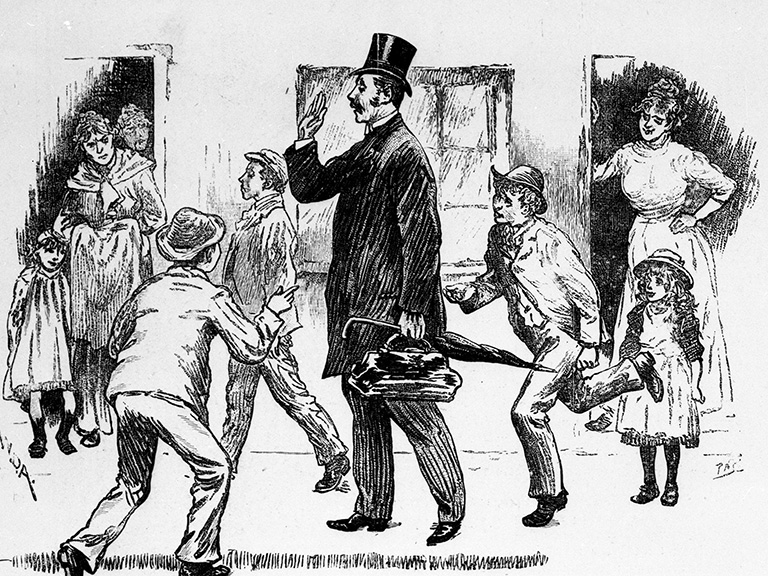
1. Why use this guide?
This guide explains how to access the historical censuses from 1841 to 1921 and provides information on using the census returns of:
- England
- Wales
- the Channel Islands
- the Isle of Man
- vessels in English and Welsh ports and inland waterways from 1861 onwards
- the British Army overseas (1911 and 1921 only)
- RAF bases overseas (1921 only)
All later censuses remain in the custody of the Office for National Statistics. They will remain closed to the public for 100 years after the date they were conducted.
Read section 12 for information on the census returns for Scotland and Ireland.
The 1939 Register is similar to but not the same as the census. For more information on the 1939 Register, please read the guide on the 1939 Register.
2. What is the census and why was it compiled?
The census is a head count of everyone in the country on a given day. A census has been taken in England and Wales, and separately for Scotland, every ten years since 1801, with the exception of 1941.
The object of the census was not to obtain detailed information about individuals, but to provide information about the population as a whole; listing everyone by name, wherever they happened to be on a single night, was the most efficient way to count everybody once, and nobody twice.
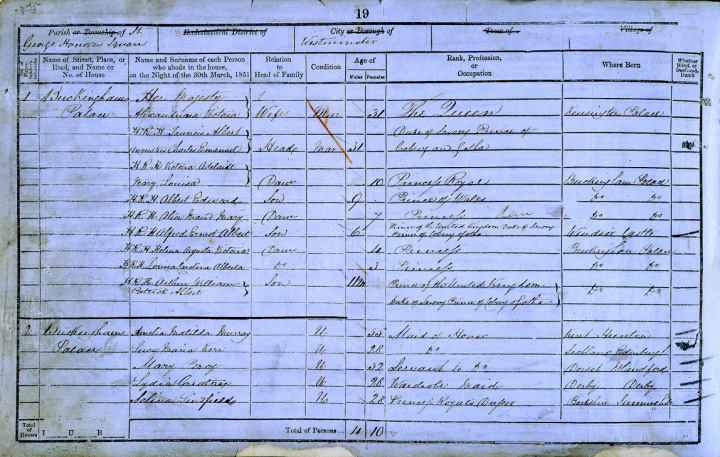
A page from the 1851 census. This page, from the enumeration books, shows part of the head count at Buckingham Palace (catalogue reference HO 107/1478).
3. How the census was taken and on what dates
In every census year an enumerator delivered a form to each household in the country for them to complete. The heads of household were instructed to give details of everyone who slept in that dwelling on census night, which was always a Sunday. The forms completed by each household, known as schedules, were collected a few days later by the enumerator. From 1841 to 1901 the information from the schedules was then copied into enumeration books. Once the enumeration books had been completed, most household schedules were destroyed, although there are some rare survivals. It is the enumeration books that we consult today online or on microfilm.
The 1841 census was the first to list the names of every individual, which makes it the earliest useful census for family historians. However, less information was collected in 1841 than in later census years. Read section 5 for details of the information recorded in each census year.
The General Register Office was responsible for taking the census, so it used the administrative framework already in place for the registration of births, marriages and deaths. The Superintendent Registrar was responsible for collecting the returns from each Registrar of Births and Deaths in their registration district, and sending them to the Census Office in London. Each Registrar of Births and Deaths was responsible for a sub-district, which they divided into enumeration districts (EDs), and recruited enumerators for each ED.
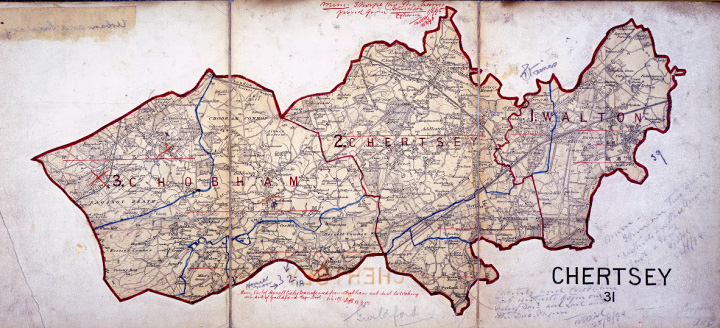
This map illustrates three of the registration sub-districts at the time of the 1891 census. The map was annotated for use by the registrars responsible for collecting the census returns for this district (catalogue reference RG 18/229).
The dates of the censuses were as follows:
- 1841 – 6 June
- 1851 – 30 March
- 1861 – 7 April
- 1871 – 2 April
- 1881 – 3 April
- 1891 – 5 April
- 1901 – 31 March
- 1911 – 2 April
- 1921 – 19 June
The intended date for the 1921 census was 24 April, but was postponed due to industrial unrest, which the GRO decided would have made it impossible to collect accurate information in some areas.
In the censuses of 1801, 1811, 1821 and 1831 lists of names were not collected centrally, although some are held in local record offices. Other lists were sometimes compiled, for a variety of reasons, which are often referred to as census ‘substitutes’. Read Local Census Listings or Pre-1841 Censuses and Population Listings in the British Isles for more information. Some transcripts and images for these early censuses and census substitutes are searchable online on Findmypast.co.uk, Ancestry.co.uk and the Brigham Young University Early British Census Project.
4. Where to access and how to search the censuses
4.1 Where to access the censuses
The censuses from 1841 to 1921 are available online. Links to our official partner websites for each census (£) are listed in the table below. Images and indexes for all censuses from 1841 to 1921 are available on both Ancestry and Findmypast, and on a number of other commercial websites (£).
It is free to search on these sites, but there is a charge to view full search results and digitised images. However, you can view censuses from 1841 to 1921 free of charge on site at The National Archives in Kew, and from 1841 to 1911 at many libraries and record offices and at FamilySearch Centres worldwide. The 1921 Census is also free to view via Findmypast at the Manchester Central Library, on St Peter’s Square, Manchester, supported by the Manchester and Lancashire Family History Society helpdesk and the Archives+ Team, and at the National Library of Wales, in Aberystwyth.
Many local and county record offices also hold microfilm or microfiche copies of the census returns for their own area, excluding 1911 and 1921. Use Find an archive to find contact details for local and county record offices.
Read section 12 for information on the census returns for Scotland and Ireland.
| Census year | Online version of censuses for… | Partnered with |
|---|---|---|
| 1921 | England, Wales, Channel Islands and Isle of Man | Findmypast.co.uk |
| 1911 | England, Wales, Channel Islands and Isle of Man | Findmypast.co.uk |
| 1901 | England, Wales, Channel Islands and Isle of Man | Findmypast.co.uk |
| 1891 | England, Wales, Channel Islands, Isle of Man | Ancestry.co.uk |
| 1881 | England, Wales, Channel Islands, Isle of Man | Ancestry.co.uk |
| 1871 | England, Wales, Channel Islands, Isle of Man | Ancestry.co.uk |
| 1861 | England, Wales, Channel Islands, Isle of Man | Ancestry.co.uk |
| 1851 | England, Wales, Channel Islands, Isle of Man | Ancestry.co.uk |
| 1841 | England, Wales, Channel Islands, Isle of Man | Ancestry.co.uk |
There are free indexes to all of the census returns up to 1911 at FamilySearch.org, with links to the images on Findmypast (£). You can also search census returns for England and Wales on Findmypast (£).
Some transcripts of census records covering England, Wales and Scotland are available free of charge on FreeCEN.org.uk. Statistics on coverage are listed, by county, on their website.
4.2 How to search the censuses
You can search by name, browse by place, or locate an exact page if you have the full census reference. Read section 11 for information on using census references. Depending on the census year, and the site, other search options may be available.
Street indexes were created for districts containing towns with a population of around 40,000 or more, from 1841 to 1901. Online versions for the street indexes for 1841, 1851, 1861, 1871 and 1891 are preserved in the UK Government Web Archive. Please note that the limitations of the software that captures website content means that some links within archived web pages do not work. Printed copies of the 1841, 1881 and 1901 street indexes are available in the reading rooms at The National Archives. For 1871 census registration district maps see Cassinimaps.co.uk (£).
4.3 Post-1911 censuses
Unlike earlier censuses, the 1921 census (and later censuses) are subject to the Census Act 1920, as amended by the Census (Confidentiality) Act 1991 c.6 which makes it an offence to disclose personal information held in them until 100 years after the date they were conducted. Until then, they are held by the Office for National Statistics. Statistical information from these censuses is openly available.
Unfortunately, the 1931 census for England and Wales was destroyed by fire in 1942, and no census was taken in 1941 because of the Second World War.
5. People in the census
The following information on individuals enumerated within households is included in each census year as follows (slightly different questions were asked on schedules for institutions and vessels, depending on the location and census year):
1841
- first name and surname
- age (rounded down to the nearest five years for those aged 15 or over)
- sex
- occupation
- whether they were born in the county where they were enumerated (Y or N)
- whether they were born in Scotland (S), Ireland (I) or Foreign Parts (P)
1851 and 1861
- first name, middle names (often just initials) and surname
- relationship to the head of the household
- marital status
- age (at last birthday)
- sex
- rank, profession or occupation
- where born – county and parish if born in England or Wales, country only if born outside England and Wales)
- whether blind, or deaf and dumb
1871 and 1881
As 1851 and 1861, except for the following difference:
- the last column now reads: 1. Blind 2. Deaf and Dumb 3. Imbecile or Idiot 4. Lunatic
1891
As 1871 and 1881 with the following extra details on employment:
- whether Employer, Employed, or Neither Employer nor Employed
- language spoken (Wales only)
1901
As 1891, with occupation details changed to:
- ‘Employer, Worker or Own account’
- a new column ‘If working at home’
- language spoken (Isle of Man only)
1911
As 1901, with extra questions:
- For married women only, the number of years of their present marriage, the number of children born of that marriage, the number still living, and the number that had died.
- As well as their occupation, the industry in which the person was employed. If employed by a government, municipal or other public body, the name of that body.
- Parish and county of birth for anyone born in the UK (which included all of Ireland). If born elsewhere in the British Empire, the colony or dependency, and the state or province.
- For anyone born outside England and Wales, whether they were resident or visitor in the country.
- Nationality of anyone born overseas whether British by parentage, British by naturalisation (including year of naturalisation) or, if a foreign national, of which country.
- In the Infirmity column, the age at which the person had become afflicted.
In 1911 all the household schedules were kept, for the first time (see RG 14), and were not copied into enumeration books. There are instead enumerators’ summary books which list every address, including unoccupied buildings, and the only names they contain are those of the head of each household (see RG 78). These summary books are the only place you will find a description of each building such as ‘House and shop’, ‘Hotel’, ‘Private house’. Unoccupied houses and non-residential properties such as churches and factories are also listed.
1921
This was the first census where old questions were dropped, as well as new ones being added. The questions about the length of present marriage, and the number of children born within it, were no longer included. For the first time since 1841, there was no longer a question on infirmity or disability.
There were also changes to some existing questions:
- Age was asked for in years and months, not just in years
- ‘Divorced’ was added as an option for marital status
- Name and business of each person’s employer (in 1911 this was only required from those in public service), and the address of their place of work. ‘No fixed place’ was added as an option, in addition to ‘Home’
- For persons born outside the United Kingdom, country and state or province of birth; state or province was previously asked only of those born in the British Empire. Naturalised British subjects were no longer asked for their year of naturalisation
New questions were added:
- For children under 15, whether both parents were alive, father dead, mother dead, or both dead
- Whether in full-time or part-time education
- Married men, widows and widowers were asked for the number and ages of their living children and step-children under 16
In 1921 there are household schedules, as in 1911, but there are no enumerators’ summary books as there are for 1911. Instead, there are ‘Plans of Division’ which describe the boundaries and contents of each enumeration district.
6. Places in the census
The first page of each enumeration book contains a description of the area covered. In the earlier years the amount of detail varies; they could contain a list of streets, and describe the route taken by the enumerator, but in rural areas the description might simply read ‘The whole of the parish of …’. From 1891 onwards there are separate sections for a description of the boundaries of the ED, and for a list of the streets or dwellings included.
In 1911 these details are in the Enumerators’ Summary Books, and in 1921 they are in the Plans of Division.
7. Addresses, houses and other buildings in the census
Exact addresses were not required in 1841, only ‘place’. From 1851 an exact address was required, including the house name or number, if any. However, in rural areas the only information given still might be the name of the village or parish. Numbers in the left-hand column are schedule numbers, and should not be mistaken for house numbers.
A note was made of buildings that were uninhabited, or under construction, in every census year. In 1891 and 1901 the number of rooms in a dwelling was listed, if fewer than five. In 1911 and 1921 the number of rooms is shown on all household schedules, and other information is in the Enumerators’ Summary Books, described in section 5, above, for 1911 only.
From 1851 to 1901 a census entry for a new household is indicated by a new schedule number. In all census years except 1851, 1911 and 1921 the last entry in a building is indicated by a double oblique line //, and where there is more than one household within a building, they are separated by a single oblique line /. In 1851 a line is ruled across the page at the end of a building, or half-way across the page between households within a building.
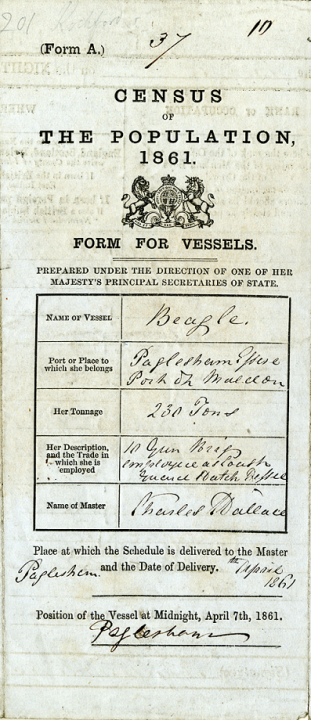
Example of a census form for vessels. This one was used for the 1861 census to record the crew of the HMS Beagle (catalogue reference RG 9/1085).
8. Ships and institutions in the census
Special enumeration books were completed for institutions such as workhouses, barracks and hospitals in every census year from 1851, including 1911. Special schedules for vessels were introduced in 1851, although none are known to survive from that year, so in practice 1861 was the first year to include returns from the Royal Navy and merchant shipping, at sea and in ports at home and abroad. Due to the difficulties of collecting enumeration books from ships in distant ports, shipping returns are likely to be incomplete.
In 1861 all returns from the Royal Navy and from merchant vessels are at the end of the series, but after that vessels in home ports are listed at the end of the districts where they were moored, and only those in foreign waters are grouped together at the end of the series.
There are no surviving records for Royal Navy ships in foreign waters in 1891. It is not known what happened to these records.
In 1901 Royal Navy ships in foreign waters are listed alphabetically, and there are no returns for ships between HMS Amphion and HMS High Flyer. However, a duplicate copy of the enumeration of HMS Cygnet in 1901 was sent to the General Register Office by the Admiralty and is included in RG 19/20.
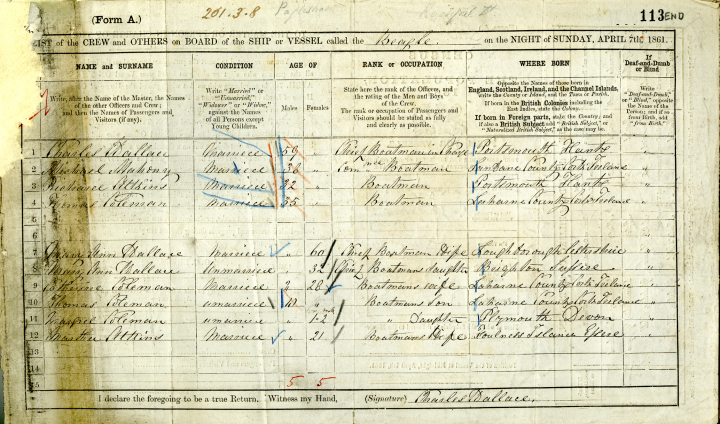
The completed census form recording the crew of the HMS Beagle (catalogue reference RG 9/1085).
1911 was the first census where the British Army overseas was enumerated; previously there was only a headcount. This also applies in 1921, with the addition of Royal Air Force bases overseas.
9. Common census terms and abbreviations
In addition to the terms and abbreviations described below, section 5 and section 7 of this guide describe other conventions used in the censuses.
Relationships (from 1851)
In practice, the head of the household was often the oldest male, but not necessarily. Everyone else, whether wife, son, servant or anyone else, should have been described in relation to this person, but this was not always followed accurately. In three-generation families young children may be shown as ‘son’ or ‘daur’ (daughter) when they are really the grandchildren of the head. ‘Son (or daughter)-in-law’ can mean a stepchild, as well as the husband or wife of the head’s own children. A boarder is someone who resides within the household but is not a relative or servant, while a lodger only rents a room or rooms, but these terms are often used interchangeably.
Relationships are not recorded in most schedules for vessels or institutions. Instead, there may be a question on each person’s rank or position within the vessel or institutions. However, the exact details vary depending on the type of schedule, the year, and the location.
Condition (as to marriage)
Mar or M – married
Unm, Un or U – unmarried (replaced by S for single from 1891)
Wid or W – widowed
D – divorced (1921 only)
‘Divorced’ was not an official category until 1921, and does not feature in the statistical tables, but does appear occasionally in this column in some earlier census years.
Rank, profession or occupation
There were specific instructions on recording extra details for several occupations; notably the professions, the armed forces, public servants and anyone involved in agriculture or manufacturing. Sometimes the clerks in the Census Office altered or expanded these definitions to assign them to one of the categories in the Registrar General’s classification of occupations for that census year.
These are some of the most common terms and abbreviations found in the ‘Rank profession or occupation’ column:
Ag lab – agricultural labourer
Annuitant – living on income from investments
Ap or App – apprentice
FS, MS – used in the 1841 census for ‘female servant’ and ‘male servant’
FWK – also in 1841, for ‘framework knitter’ a common occupation in the East Midlands
Gentleman – Usually denotes someone living on an income from investments, or retired from business, but has no official definition
Ind or Independent – ‘Of independent means’
J – journeyman; someone who had completed an apprenticeship but was not a master with a business and apprentices of their own
Pensioner – usually means an army pensioner; other types of pensioner are generally identified as such, including Greenwich Pensioner (naval pensioner), police pensioner and so on. Old age pensions were introduced in 1908, so the term ‘old age pensioner’ appears for the first time in 1911
10. Why can’t I find my ancestor in the census?
There are many reasons that explain why you might not find somebody in the census. Read our blog post ‘Missing from the census?’ or watch our webinar, also called ‘Missing from the census?’, to discover how information can be missed or altered, as well as to learn tips for more successful searching.
There are some pages missing from all censuses, but 1861 has suffered most.
Missing from 1861 census
You can use The National Archives catalogue to find out which parishes or districts are known to be missing from the 1861 census. Use the keyword ‘missing’ to search within series RG 9 in our catalogue.
Missing from 1841 census: Wrexham
The 1841 census returns for the whole registration district of Wrexham, Denbighshire, were believed to be missing. However, the original enumeration books for the town of Wrexham were discovered in a bookshop, and are now deposited in the Denbighshire Archives. An indexed transcript has been published by the Clwyd Family History Society, and a copy is available at The National Archives.
Missing from other censuses
As with the 1861 census, you can use our catalogue to search the record series for any other census year to find out about whole parishes or districts that are known to be missing, but compared to 1861 there is less detail about odd missing pages. Use section 11 to determine which National Archives record series to search within and search using the word ‘missing’.
For more guidance on how to search our catalogue, read Discovery search help.
11. The National Archives references for censuses
Although most people now access the census online, and not on microfilm, census references are still very useful. Search engines on websites vary, and they can also change over time, but the original National Archives references never change. If you have a full reference, you should be able to use it to find a page on Ancestry.co.uk or on Findmypast.co.uk, even if you have obtained it from a different site, or from some other source. This is particularly useful when a person can be found using a name search on one site, but not on another, due to differences in transcription.
You may find census references quoted in books and articles, and you will also need to know how to use them if you are consulting our online and hard-copy street indexes (see section 4.2).
A census reference has three main elements; a department (letter) code, a series number, and a piece number. The department and series codes for each census year are:
- 1841 and 1851: HO 107
- 1861: RG 9
- 1871: RG 10
- 1881: RG 11
- 1891: RG 12
- 1901: RG 13
- 1911: RG 14
- 1921: RG 15
A piece may contain hundreds of pages, so extra information is required to find the right place within a piece. The census returns for most years follow a single format, but there are slightly different arrangements for 1841, 1911 and 1921.
Census returns from 1851 to 1901
The extra reference is a folio number and (optionally) a page number.
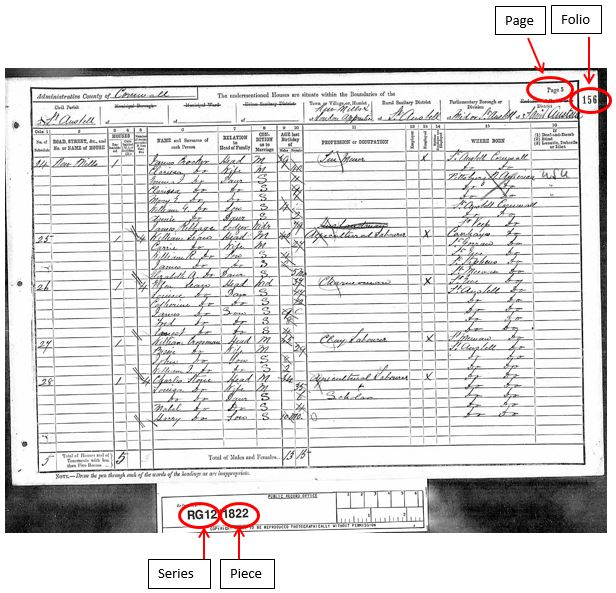
The National Archives reference for this page, from the 1891 census, is RG 12/1822, Folio 156, Page 5.
Each piece contains several enumeration books with numbered pages. Later, folio numbers were stamped on the top right corner of every right-hand page, starting at the beginning of the piece and continuing through all the enumeration books. Since folio numbers appear only on alternate pages, each folio represents the page where it appears and the following page. Therefore a series, piece and folio reference enables you to locate the correct pair of pages but a page number can be added to the reference to identify a single page, if required, as in this example from the 1891 census:
Both Ancestry.co.uk and Findmypast.co.uk offer an exact reference search facility for each census year 1841 – 1901. For 1911, there is an exact reference search on Findmypast only.
The 1841 census
Each piece in 1841 is further divided into books, so a full reference needs to include a book number after the piece number, for example HO 107/1298/8 as it appears on the census image. Each book then contains its own series of folio numbers, which should be included in a full reference, for example, HO 107/1298, book 8, folio 10.
The 1911 and 1921 census
For these census years the household schedules were kept, instead of being copied into enumeration books. Each piece represents an enumeration district (ED). In 1921 some pieces cover two small enumeration districts, so the ED number should be included in a full reference. Instead of folio numbers, each household has a unique schedule number in the top right-hand corner, so that a reference will be in the format RG 14/26288 Sch 227, for 1911, or RG 15/12199, ED 7, Sch 43, for 1921.
Institutions and vessels do not have schedule numbers, instead the information was recorded directly into special enumeration books with numbered pages, as in previous census years.
12. Censuses for Scotland and Ireland
Scotland, 1841-1921
Search and view the census returns for Scotland from 1841 to 1921 at Scotlandspeople (£).
Census returns for Scotland are almost identical in format to those for England and Wales, except for 1911 and 1921, when similarly detailed information was gathered but was then copied into enumeration books as in previous years, so there are no household schedules or enumerators’ summary books.
Indexes to the Scottish censuses 1841-1901 are also available on Ancestry.co.uk (£) and Findmypast.co.uk (£) and other commercial sites. None of these indexes has links to digitised images.
Ireland
Search and view digitised and indexed images of the surviving censuses of Ireland (and Northern Ireland up to 1911) for free on the National Archives of Ireland website.
Unfortunately, few 19th-century Irish census returns have survived; most were lost when the Public Record Office was destroyed in the fire at the Four Courts in Dublin 1922. Only the 1901 and 1911 censuses survived, along with a very small number of earlier returns. No census was taken in Ireland in 1921 owing to the War of Independence. Instead, a census was taken in 1926.
13. British colonies and protectorates
Censuses were also taken in many British colonies on the same dates as in the United Kingdom. Surviving records of these will normally be found in the country of origin, and not in The National Archives. The only exceptions to this are:
- Census of settlers and convicts in New South Wales and Tasmania 1828 in HO 10/21-27. These documents can be downloaded free of charge as Digital microfilm. A name-indexed version is also online at Ancestry.co.uk (£) and at Findmypast.co.uk (£).
- Census of Surinam 1811 in CO 278/15-25. Some of the records are in English, but the majority are in Dutch
- Census (of the white population only) of Barbados 1715 in CO 28/16
- Census of Sierra Leone: ‘population and liberated Africans’ 1831 in CO 267/111
- Census of Heligoland 1881 in CO 122/37
14. Other useful online resources
Access census street indexes in our Web Archive. As with all content in the UK Government Web Archive, these are archived pages that are no longer edited or updated.
Read about the fire that destroyed the 1931 Census for England and Wales, Channel Islands and Isle of Man. the Your Archives pages now held in the UK Government Web Archive.
Browse Vision of Britain for reports based on information from censuses up to 1971, or search for census data relating to a town or district
Consult The Online Historical Population Reports for online access to the complete population reports for Britain and Ireland from 1801 to 1937 and extensive background information, including examples of documents.
15. Further reading
Use our library catalogue to find a recommended book list. The books are all available in The National Archives’ reference library. You may also be able to find them in a local library.
Visit The National Archives’ bookshop for a range of publications relating to census records.
Search our blogs for posts relating to the census.
Watch the video Census records: an introduction by Audrey Collins.
This is a brief guide to help you with your research into coroners’ inquests. The majority of post mid-18th century records of inquests are held at local archives and not The National Archives. Records of deaths less than 75 years old may be retained by the coroner’s office.
What do I need to know before I start?
For modern inquests you should try to find out:
- the date the coroners’ inquest took place
- the county in which the inquest took place
Begin your search for records at the local or county archives for the place where the inquest would have been held.
From 1752 to 1860, coroners were required to file their inquests at the Quarter Sessions, and so they may be preserved among the records of Quarter Sessions, at local or county record offices.
Newspapers may have reported on inquests and local newspaper collections in libraries or online may be a good source of information.
If the inquest resulted in a trial for manslaughter or murder, or was before the mid-18th century, see the instructions below on searching for records at The National Archives.
Records available at The National Archives in Kew
Most coroners’ inquests at the National Archives will be found among the records of the Court of King’s Bench or in assizes records.
It was common practice from 1487 to 1752 for coroners to hand over records of all their inquests to assize judges. Those which resulted in verdicts of murder or manslaughter (including many that would now be regarded as misadventure) are normally found in the indictments or depositions files of the relevant assizes circuit.
The assizes judges then returned the remainder to the Court of King’s Bench. These records were subsequently transferred to The National Archives among King’s bench records.
Records of coroners’ inquests may be found at The National Archives if
· prior to 1752 they were routinely filed with the Court of King’s Bench
· they survive as part of a trial at the assizes for manslaughter or murder
· they are among the records of other courts, such as palatinate courts
Records are not available online and you will need to visit The National Archives at Kew to see them.
It is likely to be easier to find information reported in newspapers than original inquests among court records.
King’s Bench records, before 1752
Coroners’ inquisitions for all counties except London and Middlesex are filed with the “out-county indictments” in KB 11.
As London and Middlesex were anomalous jurisdictions without assize courts, their inquisitions were not treated in the same way. Look in KB 10 for any inquests which may be found among the London and Middlesex indictments.
Coroners’ inquisitions are also in KB 13 and KB 140. They include a significant number of items from the mid to late 18th century, although the practice of forwarding all inquisitions to the King’s Bench appears to have fallen into disuse in the early 18th century.
Inquisitions on prisoners who died in the King’s Bench prison are in KB 14.
Browse other indictment files which may contain inquests in KB 9, KB 12 and KB 13.
Trial records: Assize court files, 1554–1971
Refer to the research guide Criminal trials in the assize courts 1559–1971 to find out what records may survive and how to search for them.
It is possible to find inquests related to murder and manslaughter cases and returns from coroners for accidental deaths among the indictment records, miscellanea or depositions.
From 1972 Crown Courts replaced the assize courts. Modern coroners’ records, if they survive, are more likely to be found in the coroner’s office.
Coroners’ records from other courts, 1339–1896
Browse coroners’ records collected by other courts, such as the Palatinates of Lancaster, Chester and Durham, or the High Court of Admiralty.
| Palatinate of Chester | CHES 18, CHES17/13 |
| Duchy of Lancaster | DL 46 |
| Palatinate of Lancaster | PL 26/285–295 |
| Assizes: North and South Wales Circuit, Chester and North Wales Division | ASSI 66 |
| Assizes: Northern and North-Eastern Circuit | ASSI 47/24–73 |
| Millbank Prison, Middlesex: register of deaths and inquests | PCOM 2/165 |
| Chancery Files, Tower and Rolls Chapel Series, Recorda | C 260 |
| High Court of Admiralty | HCA 1 |
Rolls and files, 1128–1426
Browse Discovery, our catalogue, for entries of inquests from coroners who presented their rolls to the court of the King’s Bench in JUST 1, JUST 2 and JUST 3.
Records in other archives and organisations
Records held elsewhere
Survival of records and their contents vary greatly, many are little more than expenses of inquests. Quarter sessions records are held at local or county archives.
Local coroners’ offices
Collections of records from local coroners and their locations can be found by searching our catalogue, Discovery, using the Search for record creators tab in advanced search. Enter coroner as a search term and the county, as in this search for coroner and Essex.
Other resources
Newspapers
Locate newspapers held at local libraries or the British Library Newspaper Collections which may provide details of an unexpected, sudden or suspicious death. From the 19th century onwards, a newspaper report may be the only surviving account.
Books
Search The National Archives’ shop to see whether any of the publications below may be available to buy. Alternatively, look in The National Archives’ library catalogue to see what is available to consult at Kew.
J Gibson and C Rogers, ‘Coroners’ records in England and Wales’ (The Family History Partnership, 2009)
R F Hunnisett, ‘The medieval coroner’ (Cambridge, 1961)