These records are not available to view online so to see them you will have to either visit us in Kew or, if you can locate document references, order copies.
1. Why use this guide?
This is a guide to records of government involvement in the mining industry and how to search within them at The National Archives. These records cover a wide variety of topics, from nationalisation, labour relations, welfare and accidents to general policy and administration.
The National Archives does not hold personnel records for miners. Records containing information about individual miners and other mining industry staff, if they survive, are more likely to be found in local record offices.
2. The origins of the records
The direct involvement of the State with mines and quarries began in 1842 with the Mines Act, under which inspectors were appointed to regulate employment conditions in mines. The records of the mining industry held at The National Archives are primarily the records of the government departments that have had responsibility for the industry since the 1842 Mines Act. These are:
- Home Office: Mines Inspectorate 1843-1920
- Board of Trade: Mines Department, 1920-1942
- Ministry of Fuel and Power 1942-1957
- Ministry of Power 1957-1969
- Ministry of Technology 1969-1970
- Department of Trade and Industry, 1970-1974
- Department of Energy 1974-1992
- Department of Trade and Industry 1992 to date
Other departments have exercised a variety of specific powers and have also produced records:
- Board of Inland Revenue – collected mineral rights duties
- Board of Trade and the Ministry of Works – retained responsibility for the quarrying of certain materials
- Ministry of Labour – handled questions relating to industrial relations and to health, safety and welfare
- Ministry of National Insurance – assessed and allocated compensation for industrial diseases
Bodies within the industry have been responsible for day-to-day executive functions and some of their records are held here too:
- Coal Mines Reorganisation Commission 1930-1936
- Coal Commission 1938-1947
- National Coal Board (NCB) 1946-1986
- British Coal Corporation (commonly called simply ‘British Coal’) 1987-1997
- Coal Authority 1994 to date
The inspectors’ responsibilities were extended by a succession of statutes:
- Ironstone mines (Mines Act 1860)
- Metalliferous mines (Metalliferous Mines Regulation Act 1872)
- Stratified ironstone mines (Stratified Ironstone Mines (Gunpowder) Act 1881)
- Slate mines (Slate Mines (Gunpowder) Act 1882)
- Quarries (Quarries Act 1894)
Following the Quarries Act 1894, mines inspectors were given responsibility for all quarries, whereas previously factory inspectors had been responsible for quarries using steam power.
3. How to use this guide and search for records
A search for documents at The National Archives usually begins in our online catalogue. The following sections of this guide provide links to key record series that you can search within our catalogue, helping you to target your searches more precisely. By clicking on the series links (for example, POWE 4) you will arrive on the respective ‘series description’ pages from where you can search the series, using keywords (such as ‘mine’ or ‘mining’ combined with ‘research’, ‘compensation’, ‘accident’ or ‘plans’, depending on your research interests) and/or dates/years. Series description pages also provide information on the arrangement of the records and sometimes some of the historical context in which they were created, as well as suggesting related series you could explore.
Use the advanced catalogue search to restrict your search results to the records of a specific government department, including its predecessors (for example, the Ministry of Power). Use the department reference, which is always a letter code, to do this (the code for the Ministry of Power is POWE).
Catalogue search results provide short descriptions of our records and a document reference for each one – you will need the document reference to see the record itself. The records covered in this guide are not available to view online so to see them you will have to either visit us in Kew or order copies. Bear in mind that a search in our catalogue will also search for records in other archives around the country – keep your eye on the ‘Held by’ field to establish whether the records are here or elsewhere.
4. Records of individual collieries, mines, quarries and coal mining companies
Local archives are the best source of information about individual mines and quarries. The National Archives does hold some information but it is not the best place to start.
Try searching our catalogue using keywords such as the name of the colliery or mining company, or using the keyword ‘mine’ and a geographical area. To narrow your results try searching within specific department codes such as those listed below.
4.1 Mines and quarries in the 19th century and up until 1920
The record series below include some references to individual mines and quarries.
- HO 42 general registers, registered papers, warrant and entry books and correspondence 1782-1820
- HO 44 domestic correspondence 1820-1861
- HO 45 registered papers 1841 onwards (including reports on explosions and accidents)
- POWE 4 Home Office out-letters relating to mines and quarries 1873-1920
- POWE 6 registered files on mines and quarries 1887-1920
- J 75 and POWE 22 papers relating to decisions by Railway and Canal Commissioners to grant permission to search for and to mine minerals
4.2 Records of mining companies dissolved by or before nationalisation in 1946
The Coal Industry Nationalisation Act 1946 meant the winding up of many private mining companies. The following record series contain details:
- BT 31 and BT 41 records from colliery companies dissolved before nationalisation. Use our catalogue to search by company name for relevant files. The files normally contain items such as articles of incorporation and lists of shareholders rather than records of the companies themselves.
- J 13 High Court files relating to the winding up of companies. Search by company name in our catalogue
- POWE 35 and POWE 36 papers relating to 32 sample companies showing how company assets were settled and compensation awarded at the time of nationalisation
- COAL 34 papers relating to the registration of assets, estimates of value and statements of interest
- POWE 42 records of the Central Valuation Board, which settled and apportioned compensation
4.3 Other sources
- AN 210 records from the British Transport Commission and the British Railways Board relating to Meldon quarry
- MT 6 Board of Trade papers about branch lines to collieries
- HLG 89 a very few Ministry of Town and Country Planning files on NCB applications to mine in specific locations
- RAIL 1057 British Transport Historical Records (BTHR) include references to mines, mineral workings, statistics, mining accident reports and the provision of transport for mines. A card index is available at The National Archives, giving references under the headings ‘Mines’ and ‘Minerals’
- The Mines Department published lists of all quarries and mines in the United Kingdom, their owners, and the metals or other substances they produced. Copies of these lists for 1937-1938 are available in The National Archives’ library
- ADM 75, ADM 79 and ADM 169 Greenwich Hospital records which include references to mines in Cumberland, Northumberland and County Durham – land forfeited by Lord Derwentwater and added to the endowments of the Hospital in 1716
5. Maps and plans of mines and quarries
The 1954 Mines and Quarries Act required working mines to deposit maps and plans with the Mining Record Office. Plans deposited under this and earlier statutes were distributed to local record offices in the 1990s. Enquiries concerning them should now be directed to the appropriate local record office. The National Archives holds many maps and some plans from before this time. Early examples include 16th century maps showing open-cast mines.
The Metalliferous Mines Regulation Act 1872 required owners to deposit plans of abandoned mines with the Home Secretary. This requirement applied to mines of all description except coal (for which legal obligation already existed under the Coal Mines Inspection Act 1850), stratified ironstone, shale, salt and firestone. Catalogues of the plans deposited under the 1872 Act were published in the 1920s by HMSO. The Home Office files in HO 45 include a few plans of abandoned mines.
5.1 National Coal Board maps
Search the following record series from the National Coal Board using ‘map’ with a geographical area as your keywords:
- COAL 40 maps relating to the registration of assets. Registers are in COAL 39
- COAL 10 coal seam surveys (1957-1967)
- COAL 38 plans of some collieries
- COAL 4 Coal Mines Act 1930: Central Coal Mines Scheme and District Coal Mines Scheme
- COAL 12 Coal Mines Reorganisation Commission
- COAL 17 Coal Commission administrative files
- COAL 29 National Coal Board and British Coal Corporation: Production Department
5.2 Other map sources
- Tithe maps (IR) – some tithe maps in IR 30 show pits and shafts, but it is usually only the surface entrance which is shown, not the underground workings. Roger J P Kain, The Tithe Maps of England and Wales: A Cartographic Analysis and County-by-County Catalogue (Cambridge, 1995) lists tithe maps where this is the case
- Crown Estates (CRES) – search our catalogue using keywords such as mine or map within the CRES record series
- Land Revenue Office (LRRO) – particularly LRRO 1. Many of the maps have been removed from their original files so they can be stored appropriately. Where this is the case there is a link to the new reference
- Mines Inspectorate – maps of several counties dated 1895 are in POWE 6/85
6. Labour relations and disputes
The National Archives holds a considerable amount of material on industrial relations in the coal industry.
Search our catalogue using keywords and dates. You can narrow your results by searching specifically within records from the departments listed below.
6.1 Ministry of Labour (LAB)
- LAB 2 general correspondence files
- LAB 3/35 trade disputes record books
- LAB 8 Employment Department files
- LAB 10 industrial relations files
- LAB 27 coal-mining industry dispute and general strike
- LAB 34 record books of trade disputes
6.2 Cabinet Office (CAB)
6.3 Ministry of Fuel and Power (POWE)
- POWE 8 labour and trade unions (search within POWE 8 using keyword ‘9’)
- POWE 16 labour relations (search within POWE 16 using keyword ‘9’)
- POWE 20 Coal Division correspondence and papers
- POWE 22 production and labour relations (search within POWE 22 using keyword ‘5’)
- POWE 26 records of the Coal Division, ‘A’ series files,
- POWE 37 records of the Coal Division, ‘B’ series files
6.4 National Coal Board (COAL)
- COAL 26 records of the National Coal Board Industrial Relations Department
- COAL 11 records of the Mining Association of Great Britain
- COAL 31 and COAL 95 numerous files about the coal-miners’ strike of 1984
7. Health and safety, industrial diseases and accidents
7.1 Health and Safety
Search our catalogue using keywords such as ‘mine’ or ‘mining’ with ‘accident’ or ‘industrial disease’. Narrow your search by entering a date range or specific government department codes such as those listed below.
- Home Office (HO) – particularly HO 34 letters to government departments, HO 45 explosions and accidents, HO 81 and HO 95 inspections
- Ministry of Power (POWE) – particularly POWE 4 and POWE 6 mines and quarries, POWE 25 Safety in Mines Research Board (search POWE 25 using keyword ‘4’), POWE 75 Safety and Health Division
- Mines inspectorate – particularly HO 87 out-letters from inspectors, HO 87/53 and POWE 7 inspectors reports, POWE 8 (search POWE 8 using keyword ’11’), POWE 10 (search POWE 10 using keyword ‘7’ and ’12’), Parliamentary Papers include many reports of inspections (free access at The National Archives)
- Health and Safety Commission and Executive – particularly EF 2 and EF 4 Explosives Inspectorate
- Ministry of Labour (LAB) – particularly LAB 104 Occupational Safety and Health, LAB 96 Committee on Safety and Health at Work (Robens Committee), LAB 15/22-25 mines inspectors and the Mines Department
7.2 Compensation
Compensation for industrial diseases was administered by the Home Office until 1947 and then by the Ministry of National Insurance (PIN) and its successors. Relevant files series are shown below.
- Ministry of National Insurance (PIN) – particularly PIN 12, PIN 20 and PIN 900 compensation schemes and industrial diseases, PIN 21 industrial injuries, PIN 11 workmen’s compensation, PIN 39 Medical Department
- Ministry of Power (POWE) – particularly POWE 26 workmen’s compensation schemes and industrial diseases
- Home Office (HO) – particularly HO 157 workmen’s compensation entry books
- Ministry of Labour (LAB) – particularly LAB 56 registers of industrial diseases
- Coal Board (COAL) – particularly COAL 26
- Lord Chancellor’s Office (LCO) – particularly LCO 2/1934-1952 Workmen’s Compensation Regulations
7.3 Accidents
The National Archives has a number of files relating to the Aberfan disaster of 1966. Search our catalogue using the keyword ‘Aberfan’ and to narrow your results search within files from the Welsh Office (BD), the National Coal Board (NCB), the Treasury Solicitor (TS) or the Ministry of Power (POWE). The records below may be of particular use.
- The report of the Tribunal of Inquiry into the Aberfan disaster in BD 52/154
- PIN 21 contains a file concerning injury benefit claims made by rescue workers at the Aberfan disaster, 1966
- COAL 73 correspondence to the Chairman of the National Coal Board on the subject of the Aberfan disaster and subsequent events
Reports on many major mining disasters can be found in Proquest UK Parliamentary Papers. This is a subscription website you can access for free at The National Archives at Kew. You may also be able to access it from a large reference library such as a university library. Other useful record series are shown below.
- POWE 8 – accidents and accident prevention and papers on the Royal Commission on Safety in Coal-mines (search using keyword ‘8’)
- POWE 6 includes files on accidents from 1889 to 1919
- COAL 27 subseries ‘Litigation and Arbitration’ of the Legal Department files
- EF 2 and EF 4 Health and Safety Commission Explosives Inspectorate
- EF 7 Health and Safety Commission’s policy on various matters
- HO 45 records on explosions and accidents in the 19th century
- COAL 43 National Coal Board Headquarters’ Medical Department
7.4 Miners’ Welfare
The Miners’ Welfare Fund was extablished in 1920 and was administered successively by the Miners’ Welfare Commission, the Miners’ Welfare Committee and the Coal Industry Social Welfare Organisation.
Search our catalogue, particularly within files from the Ministry of Power (POWE) and the Coal Industry Social Welfare Organisation (BX), using keywords such as ‘miners’ and ‘welfare’ together. The record series listed below may particularly useful.
- POWE 1 Miners’ Welfare Committee and Commission
- POWE 8/278 Miners’ Welfare Commission Rheumatism Committee
- POWE 10 Minstry of Power correspondence and papers. Search using keyword ‘6’ to find Miners’ Welfare Commission
- T224 material on redundancies in the coal and steel industry in the 1970s
8. Policy, administration and finance
There are many policy, administration and finance files relating to mining at The National Archives. Search our catalogue using keywords and dates to find relevant files (some very recent records are already available). Narrow down your results by searching within records from specific departments such as those listed below.
- Ministry of Power (POWE) – browse the POWE record series to find relevant files
- Prime Minister’s Office (PREM) – browse the PREM record series to find relevant files
- Department of Industry (PV) – particularly PV 14 Regional Support and Inward Investment Division and PV 15 Iron and Steel Division and Minerals and Metals Division
- Department of Energy (EG) – particularly EG 16 Energy Technology Division, EG 2 Sizewell B Inquiry and EG 4 Hinkley Point C Inquiry
- Home Office (HO) – particularly HO 42, HO 44 and HO 45 domestic correspondence including general registers, registered papers, warrant and entry books and HO 87 factory and mines entry books
- Cabinet Office (CAB) – particularly CAB 27 policy files, CAB 27/597-598 Committee on the Reorganisation of the Coal Industry 1935-1938, CAB 134/62 and CAB 134/523-524 files relating to the post-nationalised coal industry
- Coal Board (COAL) – browse the COAL record series to find relevant files
- Coal Authority (KD) – browse the KD record series to find relevant files
- Treasury (T) – particularly T 228 Trade and Industry Division, T 230 Economic Advisory Section, T 233 Home Finance Division, T 319 Public Enterprises Division, T 370 Public Enterprises Group
- Lands Tribunal (LT) – particularly LT 8, specimen case files including Wombwell Foundry and Engineering and National Coal Board
- Treasury Solicitor (TS) – particularly TS 49, Treasury Solicitor’s outstation at the Department of Energy
9. The First World War
During the First World War the government increased its control over mines and mineral resources.
Search our catalogue using keywords such as ‘mine’ and/or ‘mining’. To focus your search enter relevant dates and/or search specifically within the departments shown below.
- Ministry of Munitions (MUN)
- Ministry of Power (POWE) – particularly POWE 10, POWE 22 and POWE 26. Papers from the Coal Division in POWE 16 are arranged into numbered subdivisions with records from the First World War numbered 13. To search within POWE 16 for these files use the key word ’13’.
- Board of Trade (BT) – particularly BT 189 Coal Controller’s Advisory Council, BT 62 Controller of Trading Accounts and BT 55/46 Non-Ferrous Metals Committee
- Ministry of Reconstruction (RECO) – particularly records of the Central Materials Supply Committee in RECO 1/357 to RECO 1/409 and records from the Mining Sub-Committee of the Acquisition and Valuation of Land Committee in LCO 3/34-39.
10. Between the wars
10.1 The Mines Department
The Mines Department was created in 1920. Search our catalogue within department code POWE. In particular try searching for records from the Production Division and Labour Division in POWE 16, POWE 20, POWE 22 and POWE 26.
10.2 Mineral commodities
After the First World War, authority over the exploitation and supply of certain mineral commodities was divided among a number of government departments. Search our catalogue using the names of specific commodities as keywords to identify relevant documents. In particular, search within BT 11 using keyword ‘3f’ to find files on commodities.
10.3 Records from other departments
Search our catalogue using keywords and specifying a date range to find relevant records. In particular try searching the record series below:
- BT 64 Board of Trade Industries and Manufactures Division
- SUPP 14 Ministry of Supply
- T 161 Treasury supply files
- T 228 Treasury Trade and Industry Division files
- CAB 27/453 Mines Department Organisation Committee (1931)
- POWE 26 and POWE 22 Metalliferous Mining Industry Advisory Committee, 1921-32. Search our catalogue using keywords ‘7’ or ‘metalliferous mining’
10.4 Regulation and legislation
In 1925, the Royal Commission on the Coal Industry (or the Samuel Commission) recommended the amalgamation of small mines. The Coal Mines Act of 1930 created the Coal Mines Reorganisation Commission to try and achieve this, but colliery owners blocked the scheme and the Commission was dissolved in 1936.
The Coal Act of 1938 nationalised coal deposits and created the Coal Commission to take over the role of the Coal Mines Reorganisation Commission, but the outbreak of war in 1939 prevented any progress being made.
Search our catalogue using keywords such as ‘royal commission’ or ‘coal mines reorganisation’ within the department code COAL. The record series listed below are particularly relevant:
- COAL 4 Central Coal Mines Scheme and District Coal Mines Sceme 1930-1949
- COAL 12 Coal Mines Reorganisation Commission1926-1939
- COAL 17 Coal Commission: Administrative files 1931-1949
- COAL 29 Production Department, later the Mining Dept, 1935-1995
11. The Second World War
11.1 Key sources
The following sources are particularly useful for research covering the Second World War:
- Board of Trade Official History (available in The National Archives library)
- Eric Lyde Hargreaves and Margaret Mary Gowing, Civil industry and trade (London, 1952)
- J Hurstfield, The Control of Raw Materials (London, 1953)
- Copies of documents extracted from registered files by the official historians in the course of their work in BT 131
11.2 Ministry of Fuel and Power (POWE)
Prior to the Second World War, responsibilities for sources of power and energy had been split between several government departments. In June 1942 these were brought together under the new Ministry of Fuel and Power to manage the demand for energy supplies. Search our catalogue within department codes COAL and/or POWE using keywords and dates to identify relevant records. The following record series may be particularly useful:
- COAL 4 minute books of the War Emergency Committee on Coal Mines 1939 -1946
- POWE 6 solid fuel control and rationing 1939-1959
- POWE 7 and POWE 10 records of the Mines Inspectorate
- POWE 8, POWE 10 and POWE 25 health and safety in mines
- POWE 16 wartime emergency measures and production policy files. Search our catalogue within POWE 16 using the keyword ’13’ to find records from the war years and keyword ‘2’ for files on Coal Bunkering
- POWE 17 emergency services 1941-1946
- POWE 20 regulated labour relations
- POWE 21 control of supplies of coal and coal products
11.3 Cabinet Office (CAB)
Try searching our catalogue within department code ‘CAB’ using keywords and dates to identify relevant records. The following record series may be particularly useful:
- CAB 87/92 and CAB 87/93 War Cabinet Committees on Reconstruction
- CAB 117/243 War Cabinet Reconstruction Secretariat
- CAB 123/33 Office of the Lord President of the Council
- CAB 124/704-45 Offices of the Minister of Reconstruction, Lord President of the Council and Minister for Science
11.4 Other departments
Other departments worth searching in our catalogue include:
- Treasury Solicitor (TS) – particularly TS 49 with files relating to the regulation of coal and other fuels during and after the Second World War
- Ministry of Transport (MT) – particularly MT 39 with information on stone, slag and lime quarries.
- Board of Trade (BT) – particularly BT 96 Industrial Supplies Department and BT 161 Ministry of Materials
12. After the Second World War
Search the catalogue using keywords and specifying a post-war date range. To narrow your results search within specific departments or topics such as those mentioned below.
- Mineral Development Committee – set up in 1946 to investigate mineral resources in the United Kingdom and to recommend how they might be exploited
- Town and Country Planning Act 1947 – introduced new controls over the extraction of minerals. Existing workings were subject to review and planning and permission was made compulsory for new workings
- Housing and Local Government (HLG) – in particular HLG 71 correspondence and papers, HLG 79 files documenting dealings with local authorities, HLG 89 Minerals Divisions, HLG 98 Central Land Board, HLG 104 planning and redevelopment, HLG 107 regional office files, HLG 132 records relating to applications for payments from the Ironstone Restoration Fund
- Cabinet Office (CAB) – in particular CAB 129/36, CAB 128/16 and CAB 134/498
- Ministry of Power (POWE) – records of the Coal Division in POWE 16 may be particularly useful
- Board of Trade – in particular record series BT 177 which contains records on mineral workings in development areas
13. Records before 1850
From the middle ages the Crown was entitled not only to gold and silver mines, but also to any other mines where gold and silver were found – such as those producing copper, tin, iron or lead. Many mines and quarries were on land owned by the Crown, the Duchy of Lancaster or the Duchy of Cornwall. The Royal Mines Act 1688 revoked royal rights to these other mines, but duties on the ores produced there continued to be levied.
The Exchequer, and subsequently the Auditors of Land Revenues and the Commissioners of Woods, Forests and Land Revenues, administered the revenues from royal mines and quarries.
The National Archives holds records of these mines as well as some privately owned mines and quarries. It is often not obvious from the record description in the catalogue that these records contain material on mines
13.1 Exchequer records
The following record series may have useful material within them.
- E 101 accounts various (particularly on the stannaries of Devon and Cornwall). Search within E101 using keywords such as ‘mine’
- E 317 parliamentary surveys
- E 372 pipe rolls
- E 364 foreign accounts
- E 363/4 – Devon stannaries
- E 36/53 – crown tenants and tinners in stannaries of Foweymoor
- List and Index XI has a section on documents relating to mines in E 372, E 352 (Chancellor’s Roll) and E364
- C 197/18 Draft letters patent of the Steward of the duchy of Cornwall, warden and vice warden of the stannaries
13.2 Land Revenue Record Office (LRRO)
In 1554, the Auditors of the Land Revenues took over from the Court of Augmentations the responsibility for managing the Crown lands. From 1625 they worked in conjunction with the Surveyor General of Land Revenues, whose task it was to survey and value royal estates.
Between 1810 and 1924 these functions were carried out by the Commissioners of Woods, Forests and Land Revenues, and subsequently by the Commissioners of Crown Lands (1925-1956) and the Crown Estate Commissioners.
The record series listed below may be useful.
- LR 6 and LR 12 receivers’ accounts (indexes in IND 1/7655 and IND 1/7656)
- LR 1 enrolment books of grants and leases (indexes in IND 1/7629- 7649)
- LR 5 accounts, vouchers
- MPE 1 maps and plans originally in LRRO 1
- LRRO 3 accounts various
- LRRO 5 deeds and evidences
- LRRO 12 rentals
- LRRO 37 miscellanea
It is worth noting that rentals relating to mines (including iron, tin and fireclay mines, and stone quarries) are accounted separately. LRRO 3/84, for example, is a set of accounts relating to Yorkshire lead mines 1697-1831.
13.3 Crown Estate Commissioners (CRES)
Browse the record series from the Crown Estate (CRES) in our catalogue. Specifically, records in CRES 55 (royal gold and silver mines) may be relevant.
13.4 State Papers (SP), Home Office (HO) and Treasury (T)
Browse our catalogue for relevant files within State Papers Domestic (SP), early Home Office (HO) and Treasury Board (T 1).
For all these series of records you can identify relevant papers by using the indexes to the printed Calendars in The National Archives in Kew. The calendars of documents for State Papers can be searched using State Papers Online and British History Online, available on the public computers at The National Archives.
You may find the research guide Treasury Board letters and papers useful, as well as the guides on State Papers domestic for the periods 1547-1649, 1642-1660, 1660-1714 and 1714-1782.
13.5 Forestry Commission (F)
F 17 contains material on ironstone mining and stone quarrying in the Forest of Dean.
Other relevant files previously held in F 3, F 16 and F 26 were transferred to Gloucestershire record office in 2002.
13.6 Palatinates of Durham (DURH)
References to mining may be found in:
- DURH 3 Cursitor’s Records
- PL 2 Close rolls
- PL 3 Chancery warrants
- PL 4 Inquisitions post mortem
- PL 5 Commissions and inquisitions of lunacy
13.7 Duchy of Lancaster (DL)
References to mining may be found in:
- DL 14 Drafts and particulars for leases
- DL 25 Deeds
- DL 37 Enrolments
- DL 39 Justice of the Forest South of the Trent: Forest Records
- DL 41 Miscellanea
- DL 34 Letters and diplomatic documents
- DL 44 Special commissions and returns
14. Overseas
Search our catalogue using keywords to identify records relating to overseas mining. Alternatively, browse the specific record series shown below.
- POWE 41 import and export of coal and coal products in the post war period
- PJ 5 Export Projects and Export Policy Divisions 1979-1987
- BT 241 files from the Commercial Relations and Export Division 1934-1987
- COAL 95 correspondence, minutes and reports relating to all aspects of the International Department’s work 1949-1995
- FO, CO and FCO records are rich in material relating to the exploitation of minerals overseas such as bauxite in South America, gold in West Africa and diamonds in South Africa. For more guidance on using the records of the Foreign Office and the Colonial Office, see Foreign and Commonwealth correspondence and records research guide
- PRO 30/76, ED 26 and ED 121 records of the Imperial Institute relating to mineral resources in British possessions overseas
15. Records held elsewhere
The pre-nationalisation records of colliery companies operating in 1946 are deemed to be public records but are usually held in local authority record offices along with any surviving deeds and evidences of the companies. Some records of the National Coal Board and British Coal are also held in local authority record offices. Search our catalogue and click on the record creators tab within your search results for details.
The Coal Authority Mining Records Office holds records including all the coal-mine abandonment plans. These show areas of coal extraction, the extent of coaling operations and locations of mine entrances.
Reports from the National Coal Board can be found in Proquest UK Parliamentary Papers. This is a subscription website you can access for free at The National Archives at Kew. You may also be able to access it from a large reference library such as a university library.
16. Further reading and useful websites
- The History of the British Coal Industry Volumes 1 to 5 (available in the The National Archives’ library)
- Useful websites Durham Mining Museum, National Coal Mining Museum, Scottish Mining Museum
The National Archives holds most surviving records of English Customs officers, as well as many from Ireland. As there is no single index of people or places that can be used to find service records your search for information may require some patience.
What do I need to know before I start?
Try to find out:
- in which county the person was posted
- the dates of his service
Online records
Consult Proquest UK Parliamentary Papers for published reports of Customs activities. This is a subscription website you can access on The National Archives’ computers by visiting us at Kew. You may also be able to access it via a large reference library such as a university library.
Records available only at The National Archives in Kew
To access these records you will either need to visit us, pay for research (£) or, where you can identify a specific record reference, order a copy (£).
Customs Board minute books (1734–1885)
Browse CUST 28 in Discovery, our catalogue, for minute books of Customs officers. These do not record appointments but include details such as leave, transfers, suspensions, sackings, resignations and pensions for existing officers.
Unfortunately, because of a fire at Custom House in London in 1814, very few minute books from before 1814 have survived.
From 1839 the volumes are quarterly. They are internally indexed, but before 1849 some of them have been split into two parts, with the index in the first part.
Pension records and staff lists (1642–1970)
Browse CUST 39 in our catalogue for pension records and staff lists of Customs officers. These records have not been indexed, so you will need to search records for the relevant years.
Quarterly bills of salaries (1675–1829)
Browse CUST 18 and CUST 19 in our catalogue for quarterly bills of salaries and pay lists.
Warrants for the appointment of Customs officers (1714–1797)
Search the indexes to warrants for the appointment of Customs officers in C 202/267–269 for a reference to the warrants themselves in C 208.
General records
Search, browse and consult the following departments for various records of Customs officers:
Records in other archives and organisations
Scottish records
Contact the National Records of Scotland for records of Customs officers in Scotland.
Irish records
Contact the National Archives of Ireland and the Public Record Office of Northern Ireland for some surviving Irish records of Customs officers.
Cornish records
Contact the Courtney Library at the Royal Institution of Cornwall and the Cornwall Record Office, for records about Customs officers in Cornwall.
Other resources
Books
Consult ‘Ham’s Customs Year Book’ and ‘Ham’s Inland Revenue Year Book’, available in major research libraries. These are indexed directories of Customs officers, Excise men and Inland Revenue officials covering 1875 to 1930.
1. Why use this guide?
This guide will help you find records of the staff of Royal Navy dockyards, victualling yards and other naval establishments from around the 1920s or before. The records covered are for yards in the UK and abroad.
For records of workers from the last 100 years you should start your search at one of the dockyard historical trusts or societies or at a local county or metropolitan archive. Some post-1920s service records for dockyards personnel are held by the Ministry of Defence. Visit Veterans UK to find out how to request a summary of a service record.
2. How the dockyards were organised
2.1 Before 1832
Before 1832 dockyards were run entirely by naval officers who were civilian employees of the Navy Board, not Admiralty sea officers. However, it was not unusual for officers to move between the the Navy Board and the Board of Admiralty over the course of their career.
The senior official of a Royal Navy dockyard was the commissioner, who was supported by other senior officers including:
- clerk of cheque and storekeeper – responsible for finance and administration
- master shipwright – responsible for building and repairs
- master attendants and boatswain – supervised yard craft and boats in ordinary (on reserve)
- master ropemaker – responsible for the ropeyard
Clerks and foremen, known as inferior officers, supported the senior officers.
The senior officers of a victualling yard were:
- the agent victualler (in larger establishments only)
- the storekeeper or naval officer
- the clerk of the cheque
The victualling yards reported to a Victualling Board, which in turn reported to the Navy Board.
2.2 After 1832
In 1832 the Navy Board was abolished and all yards and establishments, except gun wharves, were amalgamated under a single authority. The victualling yards, however, continued to be practically independent.
The senior officer was now a serving sea officer – the superintendent, admiral or captain-superintendent – who was often also the port admiral, or flag officer. New positions were created such as inspector of steam machinery, as steam factories were attached to major yards.
The yards have continued to be run by a mixture of civilians and sea officers.
3. The principal records and how to search for them
The surviving records for dockyard workers tend to be various kinds of records of pay, including muster books (but not after the mid-19th century) and pension records. However, as some men worked in both the dockyards and aboard ships across the course of their naval career, it is sometimes also worth looking for records of individuals, especially skilled workers (artificers or tradesmen), in Royal Navy records (as administered by the Admiralty Board). See our research guides on Royal Navy ratings and Royal Navy commissioned and warrant officers for more information.
Dockyard personnel documents are usually arranged by yard, so for most searches it is vital to know the name of the yard where the person worked. For England this will usually mean one of the following six Royal Navy dockyards (the years in brackets are opening and closing dates):
- Chatham (1567-1983)
- Deptford (1513-1869)
- Plymouth – from 1824 known as Devonport Dockyard (1690-present)
- Portsmouth (1495-present)
- Sheerness (1665-1957)
- Woolwich (1512-1869)
For details of more Royal Navy dockyards, both in the UK and overseas, see the Appendix.
The records do not cover every yard in every year.
4. Records of pay
Use our catalogue to search within the records series listed below. In almost all cases you can only search by yard or ship’s name, not by a person’s names. Some dockyards have changed their name so you may need to search using the alternative names or the dockyard locations provided in above and in the appendix (you can also browse series ADM 42 to get an idea of what dockyards are covered by the records).
The following terms appear in the records of pay:
- Ordinary: refers to the permanent workforce, those who were paid salaries – includes senior officers, clerks and foremen (inferior officers), established artificers and labourers of the yard.
- Extraordinary: refers to the payment of unestablished/casual employees who were employed only when needed, for example at times of war.
4.1 For dockyard workers
Click on the links below to search for a yard name, for example ‘Woolwich’, within the following series:
- ADM 42 (Yard pay books 1660-1857)
- ADM 36 (Ships’ muster books 1688-1808)
- ADM 37 (Ships’ muster books 1757-1842)
- ADM 38 (Ships’ muster books 1793-1878)
- ADM 33 (Ships’ pay books 1669-1778)
Try searching by name or, otherwise, keyword in the various Navy Board records held in ADM 106 (1650-1837). The chances of finding someone by name within this series are steadily improving as details are added to the online catalogue as part of the Navy Board cataloguing project. The project also includes ADM 354 and ADM 359; these records are at the National Maritime Museum.
4.2 For victualling yard workers
As some victualling yards also changed their names, you may need to search for alternative names:
- Deptford became Royal Victoria
- Plymouth became Royal William
- Portsmouth became Royal Clarence
Click on the links below to search for a yard name within series:
- ADM 113 (pay lists, musters, pension lists and registers for victualling workers 1703-1857)
- ADM 224 (registers of staffing and pay at victualling establishments in Portsmouth and Gosport 1712-1903)
4.3 For gun wharf workers
Gun wharves, where ships’ guns were stored, were the responsibility of the Ordnance Board. The National Archives has some records of Ordnance employees, mainly within WO 54.
5. Additional records 1832-1928
As no muster books survive after the mid-19th century you will need to consult salary and pension records for dockyard workers after that period. The following series cover workers who retired or worked after 1832:
- ADM 23 (1830-1926)
- PMG 24 (1836-1918)
- ADM 7/917 (1857-1914)
- ADM 7/920 (1866-1875)
- PMG 25 (1836-1928)
Try, also, searching the Admiralty Miscellanea in ADM 7 (1563-1956).
6. Additional records before 1832
Click on the series references in the table below to browse the record descriptions by year ranges:
| Type of records | Series references |
|---|---|
| Coopers and Labourers, 1797-1816, yard unknown | ADM 30/58-61 |
| Shipwrights, 1800 | ADM 30/62 |
| Artificers dismissed, 1784-1811 | ADM 106/3006-3007 |
| Caulkers, Coopers and Ropemakers, 1798-1831 | ADM 6/197 |
| Officers superannuated, 1801-9 | ADM 6/403 |
| Registers of protections from being pressed, 1794-1815 | ADM 7/377-80 |
| Civil Establishment of Admiralty and Navy Board (including yard officers), 1694-1832 | ADM 7/809-823 |
| Salaries, home yards, 1808 | ADM 7/859 |
| Salaries, home yards, 1822-1832 | ADM 7/861 |
Try, also, searching the Admiralty Miscellanea in ADM 7 (1563-1956).
7. Further reading
Websites
Visit the National Maritime museum Caird Library website for other sources.
Devonport Naval History Centre has very good guidance on workers at Devonport (Plymouth) Dockyard.
Books
Some or all of the recommended publications below may be available to buy from The National Archives’ Bookshop. Alternatively, search The National Archives’ Library to see what is available to consult at Kew.
R Cock and N A M Rodger, A guide to the naval records in The National Archives of the UK (London 2006)
Appendix: Dockyard names and locations
Documents are usually arranged by yard, so for most searches it is vital to know the name of the yard where the person worked. For England this will usually mean one of the following six Royal Navy dockyards (the years in brackets are opening and closing dates):
- Chatham (1567-1983)
- Deptford (1513-1869)
- Plymouth – from 1824 known as Devonport Dockyard (1690-present)
- Portsmouth (1495-present)
- Sheerness (1665-1957)
- Woolwich (1512-1869)
The Royal Navy also had dockyards in Wales, Scotland and Ireland:
- Haulbowline Dockyard at Cork (1869-1923)
- Rosyth Dockyard at Fife (1909-1997)
- Pembroke Dockyard at Pembroke (1815-1947)
There were other Royal Navy dockyards and naval establishments overseas including:
- Jamaica Dockyard – also known as Port Royal (c.1675-1905)
- Kingston Dockyard on Lake Ontario, Canada (1788-1853)
- Penang Island – part of modern day Malaysia – also known as Prince of Wales Island (1800s)
- Port Mahon Dockyard on Minorca (1708-1802)
See the National Maritime Museum Caird Library website for another abridged list of dockyards.

1. What are these records?
These are service records of ratings and officers in the Royal Naval Division (RND) during the First World War. They consist of all the surviving service records, held in series ADM 339, for anyone who joined the RND between 1914 and 1919.
The Royal Naval Division, formed in September 1914, fought on land alongside the Army in the First World War. It consisted of personnel brought together from the Royal Naval Reserve, Royal Fleet Reserve, Royal Naval Volunteer Reserve, a brigade of Royal Marines, Royal Navy and Army personnel.
2. How do I search the records?
You can search and download the records in Discovery (£) by using the search box below.
This is a keyword search so your results will show all instances of the term(s) you searched for within our catalogue descriptions for these records.
- Use AND to find more than one term in a description
- Use “double quotation marks” to find exact phrases
Be careful with the use of quotation marks as this can hide some potential matches. For instance if you search for “John Thompson” it will not find “John Arthur Thompson” or “Thompson, John”.
3. What information do the records contain?
The files hold enormous detail and can reveal:
- home address
- occupation
- religion
- name and address of next-of-kin
- career in the RND, including where they served and significant events during this time
- awards and details of action
- wounds sustained and which hospital treated them
Ratings’ service records may also include details of:
- date of birth
- height
- chest measurement and sometimes weight
- complexion
- colour of hair and eyes
- any distinguishing features, including descriptions of tattoos
Some of the records indicate place of birth and swimming ability.
4. What do the records look like?
The majority of these records were typed and are therefore very easy to read. Some abbreviations are obvious (‘V.G.’ for ‘very good’, ‘NOK’ for ‘next of kin’). Other abbreviations are less clear, but often they refer to administrative forms or offices.
There are slight variations in the layout. You can see examples below from the service records of a rating and of an officer.
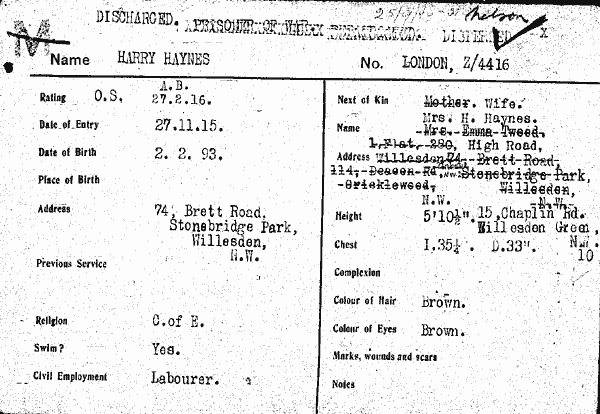
RND record of Harry Haynes ADM 339/1
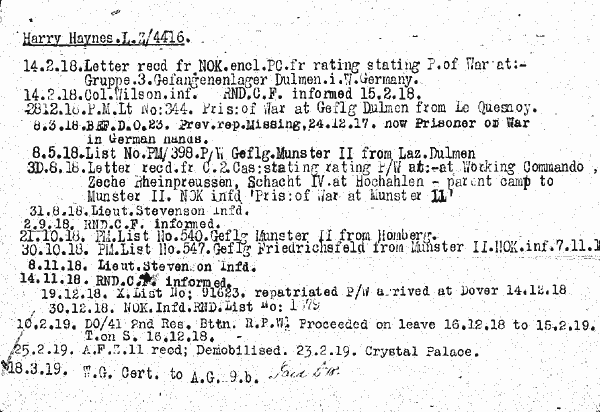
RND record of Harry Haynes ADM 339/
The first two images have been extracted from the service record of Able Seaman Harry Haynes. The first page of the record gives us an idea of his physical appearance and reveals the names and addresses of his mother and of his wife. Although there are no details, this service record indicates that he married after 27 November 1915 and before 23 February 1919. His record also shows that he was a prisoner of war and the third page gives more detail about this time.
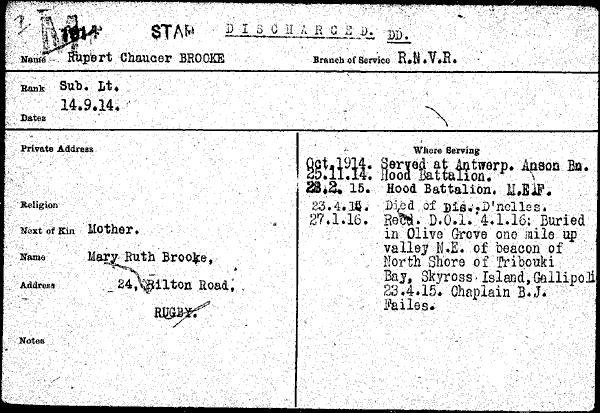
RND record of Rupert Brookes ADM 339/3
The second example is taken from the service record of the poet, Rupert Brooke, who served as a lieutenant.
The first page includes the battalions Brooke served in, Anson and Hood, and his mother’s name and address, while another page features the report of his death which appeared in The Times and the official cause of death. Elsewhere in the record you can find details of his burial place.
Ratings who died in service were officially recorded as ‘discharged dead’. You can find these two pages in the service record of Leading Seaman Charles Edgar Stirling.
In addition to a physical description and family information, the first page shows that he had been a student when he entered at the age of 18. The second extract from this service record shows that he was reported as having been killed in action in France on 13 November 1916. He was 19 years old. Elsewhere in the record there are details of where he was buried initially, when the body was exhumed and where he was finally laid to rest.
5. Why can’t I find what I’m looking for?
Some records of RND officers are kept with the service records of officers in the Royal Navy or the British Army. If you are looking for the record of an RND officer and you can’t find it here, try looking in series ADM 337, ADM 196, WO 339 or WO 374.
1. Why use this guide?
Use this guide to discover how to find records of people serving in the Territorial Army and its predecessors, from the late 18th century until the mid-20th century.
Records from the Second World War and later are held by the Ministry of Defence.
For information about the Militia or the Special Reserve, see our Militia research guide.
2. What is the Territorial Army?
The Territorial Army, renamed the Army Reserve in 2013, is an army of volunteers which supports the British Army. Volunteer units have existed for centuries, but in 1908 they were merged to form the Territorial Force.
Members of the Territorial Force were mobilised in the First World War and served alongside the regular army.
In 1920 the Territorial Force units were formed into the Territorial Army. The Territorial Army was mobilised again in the Second World War.
Find out more on the British Army website and the Long, Long Trail website.
3. Finding records – general tips
Comprehensive collections of records relating to the Territorial Army and its predecessors have not survived. Therefore it might be difficult to trace a particular person.
Many records are in local archives. Search the Find an archive directory for local archives or regimental museums.
There are various types of Territorial and volunteer records at The National Archives, including personnel service records. However, many of these records are not searchable by personal name. Search Discovery (£), our catalogue using keywords such as:
- territorial
- volunteers
- yeomanry
- other unit names
Refine your search by department – most relevant records are in the War Office collection (WO).
4. How to find Territorial Army service records for the First and Second World Wars
You can find members of the Territorial Force amongst the British Army service records for the First World War.
Search military records (£) of non-commissioned officers and other ranks on Ancestry.co.uk.
Search and download (£) British Army medal index cards in Discovery, our catalogue to find records of men awarded the Territorial Force Efficiency Medal.
Find a Territorial officer’s service record by searching for his name within WO 374.
Second World War service records are still held by the Ministry of Defence. Visit the GOV.UK website for information about requesting access to a summary of a person’s record.
5. How to find other records of the Territorial Army
Most records of the Territorials are in local archives and regimental museums. Search for local archives and regimental museums using Find an archive.
The National Archives has very few records of the Territorials. For example:
- administrative records in WO 70, including muster books of some London and Middlesex volunteer and Territorial units
- records of the organisation of the Territorials in WO 32
6. Which volunteer units existed before the Territorial Army was created?
There were various types of volunteer units before 1908 including:
- the Volunteers (1794-1813, revived as the Rifle Volunteers in 1859)
- the Yeomanry (1804 onwards)
- the Imperial Yeomanry (1899-1902)
In 1908 all of the above units were consolidated as the Territorial Force.
The Militia (created by the Militia Act of 1757) was also a volunteer force, but it remained separate from the Territorials. In 1908 it became the Special Reserve. See our Militia research guide for more information.
7. How to find records of the Volunteers
Use the printed Army Lists (available in some research libraries) to trace the career of a Volunteer officer. Look up officers’ commissions in the London Gazette using The Gazette website.
The National Archives has some records of the Volunteers up to 1859, though coverage is patchy. Consult:
- muster books and pay lists in WO 13/4160-4621
- muster rolls of some London and Middlesex regiments in WO 70
- lists of officers’ commissions in HO 51
- pension records in PMG 13 and WO 23
After 1859 records of the Rifle Volunteers are very rare and are mostly held in local archives or private collections. Search for archives using Find an archive.
However, you can find some records at The National Archives:
- pay lists in WO 13/4622-4675
- regimental books of the Paddington Rifles in WO 70/1-21
- registers of decorations and medals in WO 330/3-4 and WO 102/21
- medal rolls for the City of London Imperial Volunteers for the South African (Second Boer) War can be found in WO 100/231
8. How to find records of the Yeomanry
The Yeomanry were mounted on horseback and served at home only. Most surviving records are in private hands or regimental museums. Search Find an archive to find local record offices and regimental museums that may contain relevant records.
The National Archives has a few records of the Yeomanry including: muster rolls in
- WO 13/3968-4159
- administrative records in WO 32 and WO 43
- pension records in PMG 13 and WO 23
9. How to find records of the Imperial Yeomanry
The Imperial Yeomanry was raised in 1899 for the South African (Second Boer) War.
Officers
Officers’ records have not survived, but you can use the printed Army Lists (available in some research libraries) to get an outline of service.
Look up details of officers’ commissions in the London Gazette using The Gazette website.
Other ranks
You can find records of some other ranks who left the Imperial Yeomanry to join the regular army in the Royal Hospital Chelsea pension records (WO 97) on findmypast.co.uk (£).
Search by name in the campaign medal rolls (WO 100) on ancestry.co.uk (£).
Search the British Medals database to find the names, ranks, numbers and units of around 40,000 men who served with the Imperial Yeomanry. You can also look up an individual by name in the published source The Roll of the Imperial Yeomanry, 2 volumes by Kevin Asplin (the author, 2000).
For records of the Imperial Yeomanry serving in South Africa search for:
- registers and casualty books by regimental number in WO 129
- attestation and discharge documents from WO 128 on findmypast.co.uk (£)
Other
The National Archives also has Imperial Yeomanry administrative records in WO 108 and casualty books in WO 129.
10. Further reading
Read ‘Records of the Militia and Volunteer Forces 1757-1945’ by William Spencer (Public Record Office, 1997).
What are these records?
These are records of the issuing of the British War Medal, the Mercantile Marine Medal and the Silver War Badge to merchant seamen and officers in the First World War.
They consist of over 155,000 index cards (catalogue references BT 351/1) and, for the Silver War Badge, a list of recipients (catalogue reference MT 9/1404).
How do I search the records?
You can download the entire list of 155 recipients of the Silver War Badge (MT 9/1404) for a single fee. You will need to scroll through the downloaded PDF file to locate the merchant seaman that you are interested in. The recipients appear in badge number order.
You can search (£) for the British War Medal and the Mercantile Marine Medal records (BT 351/1) by name in Discovery, our catalogue, by filling in the form below.
You do not have to fill out every field to search these records.
What information do the records contain?
British War Medal and Mercantile Marine Medal index cards
The index cards, in BT 351/1/1 and BT 351/1/2, provide the following information:
- name
- place of birth
- year of birth
- medals, ribbons and clasps issued (a date next to any of these indicates that the award was issued)
- the mercantile marine office (‘M.M.O.’) to which the medals were sent (in some instances a home address may be noted in this section)
- discharge/RS2 number(s)
Ribbons were issued in lieu of medals until the medals were minted. Clasps were awarded for taking part in a particular battle or action.
The reverse of the card contains the date the award(s) were confirmed and the address to which the medals and ribbons were sent.
Occasionally a card will confirm that the seaman did not receive any medals. In these cases it is most likely that the merchant seaman did not fulfil the necessary criteria needed in order to be issued with a medal.
Silver War Badge list
For each merchant seaman the Silver War Badge list records:
- name
- badge number
- ship served on
- incapacity/reason for being awarded the medal
Why were medals awarded?
There were different qualifications for each type of medal:
- Mercantile Marine Medal – awarded to those who served at sea for at least six months, and on at least one voyage through a danger zone
- British War Medal -automatically awarded to all recipients of the Mercantile Marine Medal
- Silver War Badge -awarded to those who were no longer fit for sea service
What do the records look like?
To get an idea of what the records look like, have a look at the medal card of Hassan Abbas, who was awarded the Mercantile Marine Medal and the British War Medal, and the following example of a Silver War Badge record.
Medal card of Hassan Abbas (0.72MB)
Silver war badge record example (2.47MB)

Medal card of Hassan Abbas (TNA ref: BT 351/1)

An example of a Silver War Badge record (TNA ref: BT 351)
This guide provides advice on searching for records of British Army officers who served up to 1913. It covers both commissioned officers and officers who were promoted through the ranks.
Although Britain has had a regular standing army since around 1660, there are few personnel records before the early 18th century. Even then, the British Army did not keep records of individual officers spanning their entire careers. You will have to look at a number of sources to piece together an officer’s service.
Officer ranks
Officer ranks include:
- Lieutenant
- Captain
- Major
- Colonel
- Brigadier
- General
The Ministry of Defence website gives more detail.
Online records
Officers’ service records (1764–1913)
Search officers‘ service records by name in WO 25 and WO 76. Please note, these record descriptions have been created from a card index which was not comprehensive and may contain some errors.
Narrow your search by using (double) quotation marks to find a person’s full name, such as “John Williams”.
Please note, this is a search across the entire catalogue description of each record, not just the name. A search for someone called Barnes, for example, may give some results for people born in Barnes.
Alternatively browse WO 76 and WO 25 by regiment in the catalogue, and select individual pieces (such as WO 76/1 or WO 25/2) to view on digital microfilm.
Registers in series WO 25 are also available online through the FamilySearch website but can only be accessed at Family History Centres or through organisations with affiliate library status. Search Great Britain, War Office registers: Collection record, 1772-1935.
Printed annual army lists (1754–1879)
Browse the printed army lists (WO 65) available as digital microfilm via Discovery, our catalogue. They are arranged by regiment, of the regular army only, and give the names of officers with dates of their commissions. They are indexed from 1766, but engineer and artillery officers are only included in the index from 1803.
Georgian Army lists, 1790-1820
Army lists between 1790 and 1820 can be searched on the Georgian Army Officers website.
Campaign medals (1793–1949)
Search by name online in the campaign medal and award rolls (WO 100) using Ancestry (£), if you know a person was awarded a specific medal. The medal rolls do not usually contain biographical information. You can also search these records on microfilm at The National Archives at Kew, but you will need to know the campaign and the relevant regiment to use these records.
Birth, marriage and death certificates (1755–1908)
Search certificates of marriage, death, burial and the birth of officers’ children in WO 42 (1755–1908) on Ancestry.
The records can also be browsed, but not name searched, in our catalogue and downloaded. There are printed index books to these records in the reading rooms at The National Archives at Kew and separate indexes for the French, Swiss, Italian and Greek corps; Loyal American and Canadian corps; and the King’s German Legion.
Records available only at The National Archives in Kew
To access these records you will either need to visit us, pay for research (£) or, where you can identify a specific record reference, order a copy (£).
Manuscript army lists (1702–1752)
Browse the manuscript army lists in WO 64 to trace an officer’s promotions before the published army lists appeared in 1740.
Baptismal certificates (1777–1868)
Look through the baptismal certificates for British Army officers in WO 32/8903-8920 (1777-1868).
Officers’ commissions (1679–1914)
Though the records contain scant information on each individual, the commissions or warrants of appointments of an officer are likely to be recorded in several places. Browse by reference or search using keywords such as ‘commissions’, ‘appointments’, ‘warrants’, ‘promotions’, ‘commission books’ or ‘succession books’ in the following series:
- Military entry books (1758–1855) in HO 51
- Submissions for royal approval of commissions, promotions and appointments (1809 and 1871–1914) in WO 103
In addition, use the index found in a private notebook (IND 1/8914) to locate records of commissions in SP 44/164 (1679–1782).
Army Purchase Commission records (1758–1908)
Browse through the various types of records created by the Army Purchase Commission in WO 74. Our catalogue does not yet contain separate descriptions for each piece but the series description provides some detail on the records included. Applications from officers of the British and Indian establishment (c.1871–1891) are in WO 74/1. The papers include certificates of service and related correspondence.
Commander in Chief’s memoranda of appointments, promotions and resignations (1793–1870)
Browse by reference the Commander-in-Chief’s memoranda in WO 31 for personal applications to purchase and sell commissions. The records are arranged by the date the appointment or promotion was announced in the London Gazette.
Secretary-at-War correspondence on the purchase and sale of commissions (1704–1858)
Select records by year range from WO 4/513 to WO 4/520 (1704–1858) to view War Office correspondence on the purchase and sale of commissions. Later volumes may include details of where the officer’s regiment was stationed or his own private address.
Half pay, disability and widows’ pensions (1755–1921)
Officers were not automatically entitled to a pension until 1871. Before then, when officers retired they sold their commissions or went on half pay.
Though there is little genealogical information in these documents, you can search for pension records using this advanced search option in our catalogue. Refine your search by date and try the following keywords and keyword combinations:
- ‘pension’ AND ‘widow’
- ‘pension’ AND the rank of officer
- ‘pension’ AND type of pay such as ‘half pay’
The following series all contain some records relating to officers’ pension. Click on the series codes for more information and to browse by reference/year or to search by the keywords suggested above:
Within the above listed series, the following may prove most useful and easiest to use:
- Registers of the annual bounty paid to officers’ widows in WO 25/3995 (1755–1816) and WO 25/3069-3072 (1815–1856). The registers come with indexes.
- Ledgers of payments of half pay in PMG 4 (1737–1921). After 1841 arranged alphabetically, not by regiment, making it easier to find an officer by name, even if you do not know the regiment.
- Records of officers on half pay in WO 24/660-747 (1713–1809). The records provide an officer’s name, rank and regiment.
Records in other archives and organisations
Sandhurst registers (1783–1964)
Visit the Sandhurst Collection website to search by name the registers of cadets who attended the Royal Military Academy Sandhurst 1783–1964 (£). These contain the cadets’ dates of attendance and may also include other personal information such as date of birth, school attended, religion and their father’s profession.
Records held elsewhere
The National Archives’ catalogue contains collections and contact details of local archives around the UK and beyond. To locate these records, search our catalogue with keywords and refine your results to ‘Other archives’ using the filters.
Other resources
Published British Army Lists
Consult the official published Army Lists to trace an officer’s career in the British Army. There are annual lists (1740–1879), quarterly lists (1879–1922) and monthly lists (1798–1940) for the regular army in this period. The monthly lists include officers of colonial, militia and territorial units. All lists contain dates of commission and promotion.
Officers on half pay can be traced in the Army Lists, which give date of commencement.
Annual lists:
- arranged by regiment
- name indexed from 1766 (except engineer and artillery officers)
- name indexed for engineer and artillery officers from 1803
Quarterly lists:
- list officers in order of seniority
- include details of officers’ war service from April 1881
Monthly lists:
- name indexed from 1867
- provide some details of a regiment’s location
Other books
Some or all of the recommended publications below may be available to buy from The National Archives’ Bookshop. Alternatively, search The National Archives’ Library to see what is available to consult at Kew.
William Spencer, ‘Army Records’ (The National Archives, 2008)
Consult ‘Hart’s Army List’ by Henry George Hart (Smith, Elder & Co., 1839–1915), an unofficial alternative to the official Army List with details of officers’ war service from 1839.
Websites and blogs
Search the London Gazette on The Gazette website for information about British Army officers’ commissions and gallantry awards.
Read the blog Isaac Chetham: From ‘Scum of the Earth’ to Commissioned Officer in Wellington’s Army which explains the process of researching an Officer in this period.
This is a brief guide to researching records of villages and the countryside. This guide will help you to identify some key sources of information which will help you with your research.
What do I need to know before I start?
Try to find out:
- the name of the local parish
- if the village you are researching has been known by any other name
- if there have been any changes to county names and boundaries in the area you are researching
A village is usually described as a centre of population with an area less than 2.5 square kilometres (1 square mile). A village will always have a church, whereas a hamlet is usually defined as a small, isolated group of houses without a church.
The National Farm Survey was instigated by the government in 1941 to provide data for post-war planning. It was perceived as a ‘Second Domesday Book’.
The National Parks Commission for England and Wales was appointed in 1949 under the National Parks and Access to the Countryside Act of the same year.
The origins of the Ministry of Agriculture, Fisheries and Food may be traced to a chartered society, the Board of Agriculture. This body was formed in 1793, dissolved in 1822, and then revived as the English Agricultural Society in 1838 (renamed the Royal Agricultural Society of England in 1840), and inspired the Tithe Commutation Act 1836, the Copyhold Act 1841, and the Inclosure Act 1845.
The 1919 Forestry Act gave the Forestry Commission the general duty of promoting the interests of forestry, the development of afforestation, and the production and supply of timber in the United Kingdom.
Online records
Historical Directories (1750–1919)
Search the University of Leicester’s Historical Directories website for local and trade directories describing rural communities and their principal inhabitants.
Records available only at The National Archives in Kew
To access these records you will either need to visit us, pay for research (£) or, where you can identify a specific record reference, order a copy (£).
Tithe maps and apportionments from 1836
Search Discovery, our catalogue for tithe maps (IR30) and apportionments (IR 29) by place name.
National Farm Survey (1941–1943)
Search our catalogue by parish name for records of individual farms (MAF 32). Associated maps are in MAF 73.
Records of the Ministry of Agriculture, Fisheries and Food from 1386
Browse our catalogue for records created or inherited by the Ministry of Agriculture Fisheries and Food in MAF.
Records of the Rural Development, National Parks, Countryside and Forestry Commissions from 1910
Browse our catalogue for records of the Rural Development Commission in D, the National Parks and Countryside Commissions in COU and the Forestry Commission in F.
Records in other archives and organisations
Local authority records
Consult records of local authorities and parishes in local archives and libraries. Use Find an archive to find their contact details.
The National Archives’ catalogue contains collections and contact details of local archives around the UK and beyond. To locate these records, search our catalogue with keywords and refine your results to ‘Other archives’ using the filters.
Other resources
Websites
Visit A Vision of Britain Through Time for maps, statistical trends and historical descriptions of places in Britain between 1801 and 2001.
1. Why use this guide?
If you want to know something about the value, use, extent or ownership of a property or piece of land in England or Wales around the beginning of the 20th century, this guide should be of use.
This is a guide to finding records of the Valuation Office Survey which was carried out between 1910 and 1915. The survey provided a unique snapshot of land and property in the Edwardian era, assessing its worth, how it was used and by whom and in so doing inadvertently painting a picture of society itself.
Contact The National Records of Scotland for records of the Valuation Office in Scotland and The National Archives of Ireland for records of the Valuation Office in Ireland.
Some records of the Valuation Office Survey are available to see online, see the Online records section for more details.
2. The Valuation Office and the survey
The survey took place as a result of the 1909-1910 Finance Act which provided for the levy and collection of a duty on land in the United Kingdom based on any increased value of the land as a result of public money spent on communal infrastructure – a so-called ‘increment value duty’.
The Valuation Office was set up by the Inland Revenue in 1910 for England and Wales (and in 1911 for Scotland) to make valuations of property for Estate Duty purposes, and was then set to carry out the work of the Survey. 118 valuation districts were established in England and Wales, each in the charge of a district valuer and each comprised a number of income tax parishes. It was through these valuation districts and income tax parishes that the work of the survey was organised and carried out.
3. The records and their content
The two main types of Valuation Office Survey records at The National Archives are Ordnance Survey maps (often referred to as ‘plans’) with manuscript annotations, and accompanying ‘field books’. The field books contain information collected about properties during the Survey. Generally, you need to consult the plans for a place first before you can find the respective field book.
Records for some areas do not survive, largely as a result of the bombing of Valuation Offices during the Second World War. Areas known to be affected include:
- Basildon
- Chelmsford
- Liverpool
- Birkenhead and most of the Wirral
- Coventry
- Portsmouth
- Southampton
- Winchester
Where plans do not survive, you might contact the relevant local record office for surviving working plans or valuation books which may help you to find field books.
3.1 Plans (maps)
The plans are printed Ordnance Survey map sheets, annotated by the Valuation Office surveyors, and act as a visual index to the field books. The surveyors marked the plans with plot numbers, referred to as assessment numbers, which act as a means of reference to the field books.
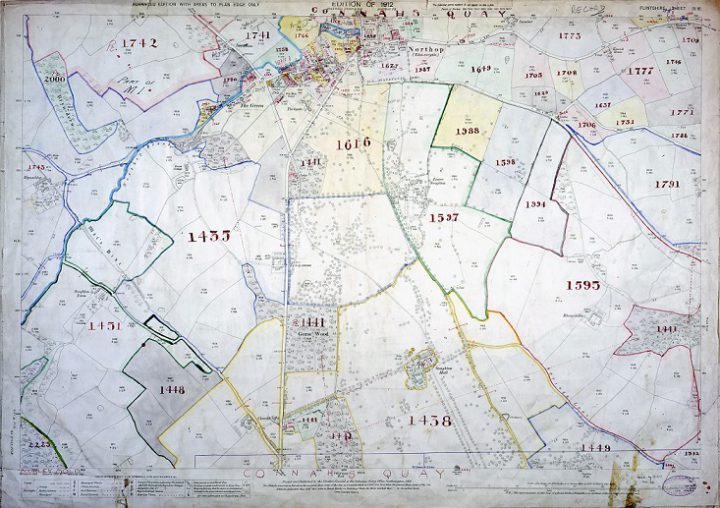
A plan for the town of Connah’s Quay and the surrounding land, in the valuation district of Wrexham, in the county of Flintshire (catalogue reference IR 131/10/85).
Two sets of plans were created. Those used as working documents in the course of the original valuation, where they survive, are held at local archives. Surviving record plans created after the valuation was completed are held at The National Archives. See section 4 for advice on how to find plans.
3.2 Field books
Information from landowners and surveyors was written up into small printed bound volumes called field books. Each field book contains space to record 100 plots. The amount of information entered in the field books varies considerably. Unfortunately, where a field book entry says ‘see file’ or ‘see notes’, this paperwork is not believed to have survived.
Field books usually include:
- the names of owner and occupier
- the owner’s interest (freehold, copyhold, etc.)
- details of tenancy (term and rent)
- the area covered by the property
- figures entered for the purpose of valuation (i.e. market value)
They sometimes include:
- the date of erection of buildings
- number of rooms
- state of repair
- liability for rates, insurance and repairs
- date(s) of previous sale(s)
- a sketch-plan of the property
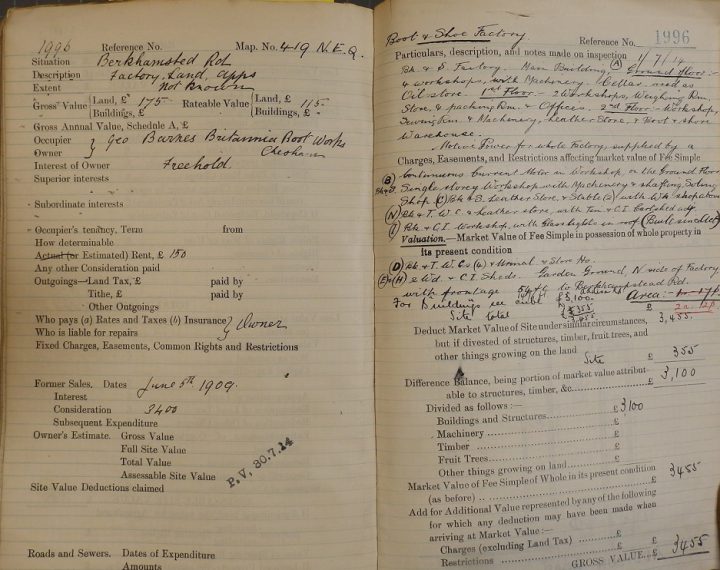
The first two pages of a field book entry for land occupied by a boot and shoe factory in Chesham, Buckinghamshire (catalogue reference IR 58/39367).
See section 5 for advice on how to find field books.
3.3 Valuation books
Valuation books (also known as ‘Domesday books’) were the first major record created by the Valuation Office at the start of the survey. They are distinct from the field books, which were the final record compiled after the survey was completed, and which usually contain more information. See section 6 for advice on how to find valuation books.
3.4 Survey forms
In the course of the survey a number of forms were used to collect information. Some of them were sent to land and property owners for completion. See section 7 for advice on how to find examples of surviving forms.
4. Online records
The Genealogist website has digitised images of plans and valuation books that can be searched by name. More information can be found on their website but coverage of the country is incomplete.
Records can also be accessed using their Map explorer. Select “1910 Lloyd George Domesday” as the top layer. The map will show England and Wales with a coloured area showing where digitised records can be found. As you zoom in to the area you are interested in this will resolve to coloured patches, if information is available, and eventually into a large scale map with pins for properties or parcels of land. Click on the pin to see an image of the valuation book for that property.
5. How to find plans (maps)
To find and see a plan you will need to identify its document reference using our online catalogue. The plans are not online and you will need to consult them at The National Archives.
You can refer to the National Library of Scotland’s Ordnance Survey map page to identify an Ordnance Survey sheet number and then search Discovery for the corresponding plan or plans (see 5.1). For maps of London, see 5.2.
If you are at The National Archives, you can use the county index maps held there in the Map and Large Document Reading Room (see 5.3).
5.1 Using the National Library of Scotland’s Ordnance Survey map page
Go to the National Library of Scotland’s Ordnance Survey map page.
In the pane on the left ‘Choose a map series’, select ‘County series 25 inch’.
To find a place, you can either search by place name or grid reference, or you can zoom the map and select the appropriate rectangle on the map.
You can choose a background map to display to help you find the exact place you are looking for. Options include modern maps, satellite images or old Ordnance Survey maps.
When you have found the appropriate place, click on the area and look at the results box on the right of the screen. This box shows maps available at the National Library of Scotland but displays the Ordnance Survey sheet name, Roman numerals and number you need to search for the plan at The National Archives e.g. Warwickshire XXXIII 15.
Go to 5.4 to look up the sheet number in our online catalogue.
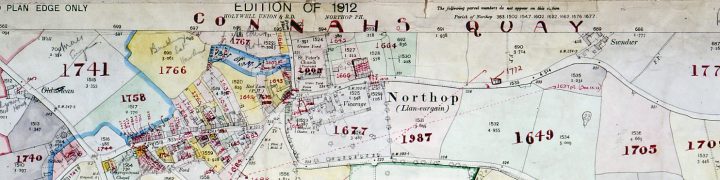
A cross section of the plan shown in section 3.1. The assessment numbers are marked in red handwritten script.
5.2 London maps
Use the Genealogist website to either zoom in on the part of London you are interested in on the map explorer, or try a name search. See Online records for more detailed instructions.
Maps used for the London region (see the appendix at 11.2 below) are at the 1:1056 scale. To find these using the National Library of Scotland’s map page you should search at the 1:1056 scale in the ‘Choose a map series’ box.
Go to 5.4 to look up the sheet number in our online catalogue.
5.3 Using original county index maps
You can use unique annotated county index maps to identify individual sheet numbers at the 1:10,560 and 1:2,500 scales. These index maps are available at The National Archives building in Kew.
Go to 5.4 to look up the sheet number in our online catalogue.
5.4 Finding plans in Discovery, The National Archives online catalogue
Perform an advanced search in Discovery with Department code IR in the reference box, using the Ordnance Survey sheet county or place name and Roman numerals (numerals in upper case) plus Arabic numerals, and the date 1910 in the date field.
For example this search.
The plans you need will say Valuation Office in the catalogue description (the search may also find Tithe Redemption Office maps).
You may need to look at more than one plan to find the one used for the property you are interested in, which should be annotated with handwritten numbers.
There may be maps for the area you are interested in at more than one scale. Most areas will be covered by the 25 inch scale county map (1:2,500) but for towns there may be maps at larger scales such as 1:1,250, while London maps are at 1:1056 scale. The Discovery search will find maps at all scales.
Guidance on understanding the map scales used for the survey can be found in the appendix at the foot of this guide.
Another explanation for the situation where the property you seek lacks a handwritten plot number is that a county or Valuation District boundary ran through the area. Two different local offices each annotated a copy of the map that fell within their area. If a map shows parts of two or more different income tax parishes, the boundaries between them are often shown as yellow lines. Look for the same sheet number in a different county or Valuation District.
It is also possible to browse the catalogue using the links in the appendix at the foot of this guide. The plans, however, are arranged by Valuation Office regions and districts, which do not always equate to counties, and districts may have more than 100 maps, so this search method can be time-consuming. Since 1910, regions, districts and other divisions of the Valuation Office have been reorganised on a number of occasions. Plans have been transferred from closed district valuation offices to new ones. You may, therefore, need to examine plans in more than one district before identifying the appropriate plot(s).
Once you have the plan in front of you, look for the assessment number (or ‘hereditament number’) of the individual property or parcel of land, handwritten, usually in red or black ink. Look at the margin of the plan to see if the income tax parish may be written there, and if so, make a note of this, too.
6. How to find field books
The key to finding a field book is to first find the respective plan for a place to ascertain the assessment number and income tax parish where possible (see section 4).
The field books are arranged alphabetically by valuation district and, within districts, by income tax parish.
Many income tax parishes were made up of a number of civil parishes, but were usually named after the place with the name nearest the beginning of the alphabet. If you cannot find the place you want in our catalogue, look for other local places, especially those beginning with a letter near the beginning of the alphabet.
There is no place or street index to the field books.
6.1 Using our catalogue to find a field book
Once you know the assessment number and income tax parish, follow these steps:
- Step 1: Use our catalogue to search IR 58 by the name of the income tax parish – this will usually produce multiple results for IR 58 documents
- Step 2: Use the drop-down menu on the search results page to sort the results by ‘Reference’ (the default display for search results is by ‘Relevance’)
- Step 3: Once sorted by reference, scan down through the results to find the assessment number range which covers the assessment number you are looking for
- Step 4: Click on the title of the field book to view the full catalogue description and the ordering and viewing options
- Step 5: Order the original field book (if you are on site, in our building) or a copy (if you are off site)
7. How to find valuation books
A number of valuation books for the City of London and City of Westminster are held at The National Archives. For other areas you will need to search in local archives for surviving valuation books.
Search for City of London and City of Westminster valuation books by browsing through record series IR 91.
8. How to find survey forms
Survey forms were not systematically retained by the Valuation Office but we hold some examples among the records of other government departments who themselves provided information for the survey about land they occupied. Copies of forms have, in some instances, also been retained by landowners for their own use and are sometimes found among estate records, solicitors’ papers and at local archives.
The forms include:
| Type of form | What was form used for? | Where to find examples of forms |
|---|---|---|
| Form 4-Land | This form was originally filled in by the landowners and the information later transferred to the field books. Some field books may contain nothing more than a note to ‘see Form 4’. | Example of forms filled out by the Admiralty are in ADM 116/1279, Forestry Commission are in F 6/16, Rhymney Railway Company are in RAIL 1057/1714. |
| Form 37-Land | Form 37-Land contains the statement of provisional valuation made on the completion of the survey which was retained by the district valuation office. | None held at The National Archives. Surviving sets of Form 37-Land are held at local record offices or remain in district valuation offices. |
| Form 36-Land | A copy of Form 37-Land was sent to the landowner. | A few examples of Form 36-Land are in RAIL 1057/1714. |
A set of blank forms is preserved as ‘Various Specimen Forms’ in IR 9/62-64.
9. Records on the work of the Valuation Office
Some records on the work of the Valuation Office include:
- a number of files about the Valuation Office itself, including some instructions to valuers in IR 40
- a set of papers about the land tax proposals and discussions prior to the 1909 budget in IR 73/6
- draft notes about the organisation of the Land Valuation Department drawn up in June 1910 in IR 74/146
- reports on the progress of the original valuation in IR 74/148
- a copy of the report of a Committee appointed to inquire into the organisation of the Valuation Office in 1920 in IR 75/114
- an account of the Office’s history and functions was compiled in 1920; a copy is in IR 74/218
- lists of addresses of district valuation offices showing the changing distribution of offices between 1913 and 1919 in IR 40/2878
- a number of Treasury files in T 1, T 170, T 171 and T 172 contain papers on the work of the Valuation Office. Papers explaining the mathematics of increment value duty calculations, and copies of the rules made by the Inland Revenue Commissioners are in T 1/11209 and T 170/4
- Inland Revenue memoranda in T 171/28 and T 39
- reports of the Inland Revenue Solicitor in IR 99/29B-42
Records which relate to specific cases:
- press cuttings about individual legal cases, c.1914, are in IR 83/54
- other memoranda about court cases are in T 171/39
- a few petitions, including special cases and awards, are in E 186
- papers relating to one celebrated test case, Lady Emily Frances Smyth v Commissioners of Inland Revenue, are in IR 40/2502
- papers on the case, Commissioners of Inland Revenue v Lumsden, are in T 172/100
- records of the Land Value Reference Committee set up under the Act to regulate procedure in appeals against assessment are in LT 5. They include registers of appeals and a few sample case files
10. The Finance (1909-1910) Act and its legacy
The Valuation Office Survey was initiated by the Finance (1909-1910) Act (10 Edw. VII, c.8 section 26(1)) which provided for the levy and collection of a duty on the increment value of all land in the United Kingdom.
The main object of the Act was to tax that part of the capital appreciation of real property which was attributable to the site itself, i.e. excluding that arising from crops, buildings and improvements paid for by the owners. In this way, private owners were required to surrender to the State part of the increase in the site value of their land which resulted from the expenditure of public money on communal developments such as roads or public services.
Increment value duty, as this levy was called, was based on the difference between the amount of two valuations. The site value as at 30 April 1909 constituted the ‘datum line’ for the purposes of increment value duty. A second site value was to be taken on the occasion of any subsequent sale or grant of a lease, or transfer or interest in a piece of land, or the subsequent death of a land owner, to determine any potential payment of increment value duty. The assessment of the site value on subsequent occasions was a recurring operation which formed part of the role of the Valuation Office until increment value duty was repealed by the 1920 Finance Act (10 and 11 Geo. V, c.18).
Although the 1910 land value tax was abolished following the 1920 Finance Act, the Valuation Office remained. Its modern-day successor is the Valuation Office Agency.
11. Further reading
Most of the following recommended publications are available in The National Archives Library.
A range of books can also be purchased from the National Archives’ shop.
Geraldine Beech and Rose Mitchell, Maps for Family and Local History (2004)
Brian Short, Land and Society in Edwardian Britain (2005)
Brian Short and Mick Reed, An Edwardian Land Survey: the Finance (1909-10) Act 1910 Records (Journal of the Society of Archivists, 8(1), pp. 82-3, and 8(2), 1986, pp. 95-103)
Brian Short and Mick Reed, Landownership and Society in Edwardian England and Wales: The Finance (1909-10) Act 1910 Records (University of Sussex, 1987)
Brian Short and Mick Reed and Bill Cauldwell, The County of Sussex in 1910: Sources for a New Analysis, (Sussex Archaeological Collections, vol. 125, 1987, pp. 199-224)
12. Appendices
12.1 Understanding map scales
At a scale of 1:2500 each grid rectangle represents an area of land which is 1 x 1.5 miles (1.6 x 2.4 km) on the ground. The vast majority (c.82%) of available VO maps are drawn at a scale of 1:2500. One of these maps covers the entire rectangular area. They were sufficient in detail for the majority of rural areas: countryside and villages.
In some small towns there was need for greater detail. Here you may find there are four further maps drawn at a scale of 1:1250 which cover the same rectangular grid area. Each of these four maps therefore represents an area of land which is 0.5 x 0.75 miles (0.8 x 1.2 km) on the ground.
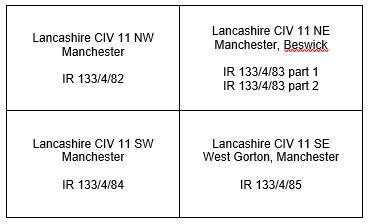
The density of the larger towns and cities meant even greater detail was required by VO. Here there may be 25 further maps drawn at a scale of 1:500 which, put together, cover the same original rectangular grid area. Each of these 25 maps therefore represents an area of land which is just 0.04 x 0.06 miles (64 x 96 metres) on the ground.
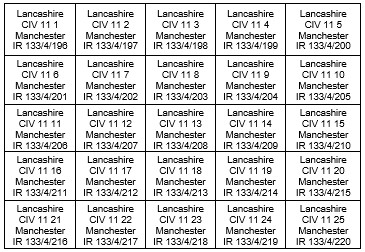
12.2 Catalogue arrangement of plans
The catalogue references for Valuation Office Survey plans, arranged by region and district are shown in the table below.
| Region | Area | Reference |
|---|---|---|
| London Region | Merton District | IR 121/1 |
| Barking District | IR 121/2 | |
| Barnet District | IR 121/3 | |
| Bexley and Greenwich District | IR 121/4 | |
| Bromley District | IR 121/5 | |
| Camden District | IR 121/6 | |
| City of London District | IR 121/7 | |
| Croydon District | IR 121/8 | |
| Ealing District | IR 121/9 | |
| Enfield District | IR 121/10 | |
| Hammersmith and Fulham District | IR 121/11 | |
| Harrow District | IR 121/12 | |
| Hillingdon District | IR 121/13 | |
| Islington District | IR 121/14 | |
| Kensington and Chelsea District | IR 121/15 | |
| Lambeth District | IR 121/16 | |
| Redbridge District | IR 121/17 | |
| Richmond upon Thames District | IR 121/18 | |
| Southwark District | IR 121/19 | |
| Tower Hamlets District | IR 121/20 | |
| Westminster 1 District | IR 121/21 | |
| Westminster 2 District | IR 121/22 | |
| South East Region | Brighton District | IR 124/1 |
| Canterbury District | IR 124/2 | |
| Canterbury (Maidstone) District | IR 124/3 | |
| Eastbourne District | IR 124/4 | |
| East Kent District | IR 124/5 | |
| Medway District | IR 124/6 | |
| Reigate District | IR 124/7 | |
| Tunbridge Wells District | IR 124/8 | |
| Worthing District | IR 124/9 | |
| Wessex Region | Bournemouth District | IR 125/1 |
| Dorset County West District | IR 125/2 | |
| Guildford District | IR 125/3 | |
| NE Hampshire District | IR 125/4 | |
| North Surrey District | IR 125/5 | |
| Portsmouth (records destroyed) | IR 125/6 | |
| Salisbury District | IR 125/7 | |
| Solent District | IR 125/8 | |
| Solent (IOW) District | IR 125/9 | |
| Southampton (records destroyed) | IR 125/10 | |
| Wiltshire North District | IR 125/11 | |
| Central Region | Aylesbury District | IR 126/1 |
| Bedfordshire District | IR 126/2 | |
| East Berkshire District | IR 126/3 | |
| Hertfordshire North District | IR 126/4 | |
| Northampton District | IR 126/5 | |
| Oxford District | IR 126/6 | |
| Reading District | IR 126/7 | |
| St Albans District | IR 126/8 | |
| South Buckinghamshire District | IR 126/9 | |
| Watford District | IR 126/10 | |
| East Anglia Region | Basildon District | IR 127/1 |
| Cambridge District | IR 127/2 | |
| Chelmsford District | IR 127/3 | |
| Colchester District | IR 127/4 | |
| Ipswich District | IR 127/5 | |
| Norwich District | IR 127/6 | |
| Peterborough District | IR 127/7 | |
| Peterborough (King’s Lynn) District | IR 127/8 | |
| St Edmundsbury District | IR 127/9 | |
| Western Region | Barnstaple District | IR 128/1 |
| Bath District | IR 128/2 | |
| Bristol District | IR 128/3 | |
| Cheltenham District | IR 128/4 | |
| Cornwall District | IR 128/5 | |
| Exeter District | IR 128/6 | |
| Gloucester District | IR 128/7 | |
| Plymouth District | IR 128/8 | |
| Somerset District | IR 128/9 | |
| Torbay District | IR 128/10 | |
| West Midland Region | Birmingham District | IR 129/1 |
| Coventry District | IR 129/2 | |
| Hereford and Worcester District | IR 129/3 | |
| Kidderminster District | IR 129/4 | |
| Lichfield District | IR 129/5 | |
| Sandwell District | IR 129/6 | |
| Walsall District | IR 129/7 | |
| Warwick District | IR 129/8 | |
| Wolverhampton District | IR 129/9 | |
| East Midland Region | Boston District | IR 130/1 |
| Derby District | IR 130/2 | |
| Grimsby District | IR 130/3 | |
| Leicester District | IR 130/4 | |
| Lincoln District | IR 130/5 | |
| Loughborough District | IR 130/6 | |
| Mansfield District | IR 130/7 | |
| Matlock District | IR 130/8 | |
| Nottingham District | IR 130/9 | |
| Welsh Region | Abergavenny District | IR 131/1 |
| Bangor District | IR 131/2 | |
| Bangor (Colwyn Bay) District | IR 131/3 | |
| Cardiff District | IR 131/4 | |
| Dyfed District | IR 131/5 | |
| Merthyr Tydfil District | IR 131/6 | |
| Newport District | IR 131/7 | |
| Pontypridd District | IR 131/8 | |
| Swansea District | IR 131/9 | |
| Wrexham District | IR 131/10 | |
| Wrexham (Welshpool) District | IR 131/11 | |
| Liverpool Region | Chester District | IR 132/1 |
| East Cheshire District | IR 132/2 | |
| Liverpool District | IR 132/3 | |
| Shropshire District | IR 132/4 | |
| Stafford District | IR 132/5 | |
| Stoke-on-Trent District | IR 132/6 | |
| Warrington District | IR 132/7 | |
| Wigan District | IR 132/8 | |
| Manchester Region | Bolton District | IR 133/1 |
| East Lancashire District | IR 133/2 | |
| Lancaster District | IR 133/3 | |
| Manchester District | IR 133/4 | |
| Preston District | IR 133/5 | |
| Rochdale District | IR 133/6 | |
| Salford District | IR 133/7 | |
| Stockport District | IR 133/8 | |
| Yorkshire Region | Bradford District | IR 134/1 |
| Calderdale District | IR 134/2 | |
| Doncaster District | IR 134/3 | |
| Harrogate District | IR 134/4 | |
| Hull District | IR 134/5 | |
| Kirklees District | IR 134/6 | |
| Leeds District | IR 134/7 | |
| Sheffield District | IR 134/8 | |
| Wakefield District | IR 134/9 | |
| York District | IR 134/10 | |
| Northern Region | Carlisle District | IR 135/1 |
| Cleveland District | IR 135/2 | |
| Darlington District | IR 135/3 | |
| Durham District | IR 135/4 | |
| Newcastle District | IR 135/5 | |
| Newcastle (Tyneside) District | IR 135/6 | |
| Northumberland District | IR 135/7 | |
| South Lakeland District | IR 135/8 | |
| Sunderland District | IR 135/9 |
This is a guide to searching for records of British Army officers who served in the First World War. Some First World War veterans continued to serve with the army after the war and for the records of these officers you may need to read the advice in our guide to British Army officers in service after 1918. However, many of the records in the First World War collections cover service up to 1920.
Officer ranks covered by this guide include Lieutenant, Captain, Major, Colonel, Brigadier and General.
How to get started
To uncover details of an officer’s service in the First World War you should begin by searching for the following three types of records:
- Service record: If it survives it is likely to be the most detailed record for an officer that you will find but they are not available online. To see them you will need either to visit us or order a copy (£) to be sent to you.
- Medal records: Low on detail but, unlike service records, available online. All soldiers of all ranks who served in a theatre of war were issued with at least one campaign medal; some were also awarded medals for gallantry and meritorious service though there are few surviving records of this type.
- Unit war diaries: Among the records available online, unit war diaries hold the most promise for a picture of an officer’s time at war. You will need to know which unit, often a battalion, an officer served with to effectively search these records. If you do not know the exact unit in which he served you may be able to find out by consulting the medal records.
Whether other records survive or ever existed for an officer depend upon a number of variable factors. If, for example, an officer was wounded or taken prisoner, records may survive recording these events.
Online records
First World War British Army Lists
Search the British Army Lists 1882–1962 by name on the Fold3 website (£) – you can search the lists at Ancestry.co.uk (£) but for images of the lists you will need to go to Fold3.com. These online versions include all the First World War lists, originally published at monthly or quarterly intervals.
Monthly Army Lists contain lists of officers by regiment and include details of:
- promotions and appointments
- deaths of officers, with date and cause
- regiment’s location
Quarterly Army Lists feature lists of regular army officers by rank in seniority order and include details of:
- promotions, with dates
- gallantry medals
- war service since April 1881 (in January issue only, 1909–1922)
British military medical records, 1912-1921
A representative selection of several types of medical records relating to the diagnosis and medical treatment of service personnel during the First World War can be found in series MH 106.
The first 2078 boxes of the series are admission and discharge registers from military hospitals and casualty clearing stations, field ambulances, an ambulance train and a hospital ship. Search MH 106 admission and discharge registers by name or regimental number on Findmypast (charges apply) in the collection British Armed Forces, First World War Soldiers’ Medical Records. Details of service personnel may include year of birth, service number, rank and hospital admission date.
The series also contains 306 boxes of medical case sheets and medical cards for individual service personnel. The case sheets were selected to illustrate the diversity of diseases contracted, the type of injuries received and the kinds of treatments prescribed to the war wounded, and the medical cards relate to individuals from selected regiments.
To search the case sheets and cards go to MH 106 and search by name, regimental number, unit, and condition, injury and disease. These records are only available as original records and cannot be downloaded.
Unit war diaries from the Western Front, Mesopotamia and Gallipoli, 1914–1922
Search by unit name and number for the war diaries of British Army units that served on the Western Front and in Mesopotamia on our website (£) and for units that served in the Gallipoli Campaign at the Dardanelles on Ancestry.co.uk (£).
See below for advice on searching for the war diaries of units that served elsewhere in the world during the war.
Campaign medal index cards, 1914–1920
For details of First World War campaign medals awarded to both officers and other ranks, search and download (£) British Army medal index cards (WO 372) from our catalogue. These cards provided an index to the medal rolls (see below).
Not all officers applied for their campaign medals. If an officer did not apply, there will be no medal index card.
Campaign medal rolls, 1914–1920
Search by name, regimental number and regiment the campaign medal rolls (WO 329) on Ancestry (£). You may find abbreviations on a roll entry – some of these abbreviations are explained in our guide to British Army medal index cards.
The campaign medal roll usually contains the same information as the medal index card, but it may also provide the battalion or equivalent unit number.
Silver War Badge rolls, 1914–1920
Search the Silver War Badge rolls (WO 329) on Ancestry (£) by recipients’ name or by badge number.
The badge was awarded to all of those military personnel who were discharged as a result of sickness or wounds contracted or received during the war, either at home or overseas.
Official announcements of commissions and gallantry awards in the London Gazette
Search the London Gazette, the official journal of the British government, on The Gazette website for announcements of British Army officers’ commissions and gallantry awards.
Prisoner of war records, 1914–1918
See our guide to records of British prisoners of the First World War for details of the prisoner of war records available online.
Birth, marriage and death certificates (1755–1908)
Search certificates of marriage, death, burial and the birth of officers’ children in WO 42 (1755–1908) on Ancestry. Some records from the late nineteenth century could relate to First World War officers.
The records can also be browsed, but not name searched, in our catalogue and downloaded. There are printed index books to these records in the reading rooms at The National Archives at Kew.
Records available only at The National Archives in Kew
To access these records you will either need to visit us, pay for research (£) or, where you can identify a specific record reference, order a copy (£).
Officers’ service records, 1914–1922
There are over 217,000 British Army officers‘ service records for the First World War held by The National Archives. An officer’s file originally had three parts but two of these were destroyed by enemy action in September 1940. What remains was heavily weeded prior to 1940 and in many cases this means that nothing remains for many officers.
Search our catalogue for references to officers’ service records by name in record series WO 339 and WO 374:
The content of the files varies – some have simply a note of the date of death whilst others contain attestation papers for those commissioned from the ranks, a record of service, personal correspondence and other items.
Alternatively, click on the links below to search more specifically for references to:
- records of officers who finished serving before 1922, by first and last name in WO 339. WO 339 includes officers who were given a temporary commission in the regular army, those who were commissioned into the Special Reserve of officers and those who were regular army officers before the war.
- records of officers given a Territorial Army commission or a temporary commission, by first and last name, regiment and rank, in WO 374.
- officer’s long numbers in the online indexes in WO 338 – this is only worthwhile if you have not found anything in WO 339 or WO 374 (please be aware that the online indexes are very large files and only suitable for download on a fast and unlimited broadband connection). Long numbers for officers in the WO 374 series start with the first letter of the surname and the first vowel of the surname. The number for Anderson, for example will start with AE (references starting with a P refer to records which are still held by the Ministry of Defence). To search WO 374 with an officers name and number, remove the initials from the number. For example if the long number is AE/279, simply search for Anderson 279.
Famous army officers
Search by name among the service records of a few notable individuals (WO 138), such as Wilfred Owen and Field Marshal Douglas Haig, in our catalogue.
Unit war diaries from Russia, British colonies and other theatres of operations, 1914–1922
Search by unit name and number for document references to unit war diaries of British Army units that served in Russia, British colonies and other theatres of operations. This series of records, WO 95, also contains diaries for units located on the Western Front, in Mesopotamia and Gallipoli, but for advice on locating those diaries see the Online records section of this guide.
For more detailed advice see our guide to British Army operations in the First World War.
Records in other archives and organisations
Sandhurst registers, 1783–1964
Visit the Sandhurst Collection website to search by name and download (£) the registers of cadets who attended the Royal Military Academy Sandhurst 1783–1964. These contain the cadets’ dates of attendance and may also include other personal information such as date of birth, school attended, religion and their father’s profession.
First World War pension record cards for servicemen killed or injured
Search among the First World War pension record cards on Fold3.com (£) – you can also search on Ancestry.co.uk (£) but for images of the records you will need to go to Fold3.com.
The cards record details of the pension entitlements of soldiers and other servicemen killed or injured in the war, both of officers and other ranks, and of the widows and dependants of deceased soldiers.
The much larger collection of originals are in the care of The Western Front Association (WFA) but had previously been held locally, around the country, and then by the Ministry of Defence. Read the WFA’s article on the records for more information.
Absent Voters Lists, 1918–1921
Search for a soldier by name in the Absent Voters Lists, taken from electoral registers held at the British Library, on Findmypast.co.uk (£) and Ancestry.co.uk (£).
The Absent Voter Lists enabled servicemen and women away from home to vote by proxy or by postal application. They record the address, service number and regimental details of each person.
Indian Army records
Records of officers in the Indian Army are held at the British Library.
Other resources
Printed British Army Lists
Consult the official published Army Lists to trace an officer’s career in the British Army. These are the original printed versions of the online lists described above. There are monthly lists (1798–1940), quarterly lists (1879–1922 and 1940–1950) and half-yearly lists (1923–1950), as well as the ongoing modern Army List (1951–), for the regular army in this period. All the monthly lists and the quarterly lists for 1940–1950 include officers of colonial, militia and territorial units. All lists contain dates of commission and promotion.
Books
Choose from a wide selection of First World War books at The National Archives bookshop. The following publications are available at The National Archives’ Library at Kew:
The Cross of Sacrifice: An Alphabetically Compiled record of British Officers who Died in Service of Their Country, Identifying Where They Died and are Commemorated by S D and D B Jarvis (Roberts Medals, 1993)
Officers Died in the Great War (Samson Books, 1979)
Commissioned Officers in the Medical Services of the British Army 1660–1960 by A Peterkin (The Wellcome Historical medical Library, 1968)
The Roll of Honour: A Biographical Record of Members of His Majesty’s Naval and Military Forces who Fell in the Great War by the Marquis de Ruvigny (London Stamp Exchange, 1987)
First World War Army Service Records by William Spencer (The National Archives, 2008)