This guide contains advice on how and where to search for records of Royal Flying Corps (RFC) officers.
What do I need to know before I start?
The Royal Flying Corps (RFC), founded in 1912, was the first air service. In July 1914 the RFC’s naval wing was detached to form the Royal Naval Air Service (RNAS). On 1 April 1918 the two services were merged again to form the Royal Air Force (RAF).
Before 1 April 1918, the RFC was a corps of the British army. If you are looking for an RFC officer, consult both RAF and British army service records.
The service records of RFC/RAF officers who relinquished their commissions after 1920 are still kept by the Ministry of Defence.
Online records
RAF service records (1918-1920)
Search the Royal Air Force officers’ service records (£) online for RFC officer who served between 1914 and March 1918 (AIR 76).
First World War medal index cards (1914-1922)
Search and download the First World War medal index cards (£) (WO 372) online to find details of campaign medals awarded to some members of the RFC and RAF (Royal Air Force). RFC officers who served overseas in 1916 or later had their medals issued by the Air Ministry, not the War Office.
Campaign medal rolls (1914-1920)
Search by name the campaign medal rolls on Ancestry (£). You may find abbreviations on a roll entry – some of these abbreviations are explained on our army medal index card guide (see section above).
Records available only at The National Archives in Kew
To access these records you will either need to visit us, pay for research (£) or, where you can identify a specific record reference, order a copy (£).
British army officers service records (1914-1922)
Look in the British army service records in WO 339 and WO 374 to find some records of RFC officers. Search Discovery, our catalogue by the name of the officer if he had an unusual name. Common names are likely to produce too many results.
Records in other archives and organisations
RAF service records after 1920
Use the GOV.UK website find out how to obtain information about accessing RAF service records after 1920, which are kept by the Ministry of Defence.
Other resources
Websites
Search the Commonwealth War Graves Commission website for details of men and women who died in the First and Second World Wars.
Look up an announcement of a 20th-century gallantry award on The Gazette website.
Books
Visit The National Archives’ bookshop for a range of publications on the Royal Flying Corps and the associated records.
Consult the Army Lists for an RFC officer’s service up to the end of March 1918. Search the Air Force Lists for his service after April 1918.
Read Air Force Records: A Guide for Family Historians, 2nd edition, by William Spencer (The National Archives, 2008).
1. Why use this guide?
This guide will help you find and use the records of the National Farm Survey of England and Wales, carried out between 1941 and 1943.
These records can provide information on:
- farm land
- farmers and farm owners
- life on a farm
- the wider community within the parish where a farm was located
As a source for local and family historians the records of the National Farm Survey are of great value, and for the historical geographer these records present an enormous database of land ownership and land usage in mid-20th century Britain.
Register to take part in a user research session
We’re looking to learn about how people are using the information within The National Farm Survey, receive a voucher for your time.
2. Why was there a National Farm Survey?
When the Second World War began in September 1939, Britain was faced with an urgent need to increase food production, as imports of food and fertilisers were drastically cut. The area of land under cultivation had to be increased significantly and quickly. The Ministry of Agriculture and Fisheries set up War Agricultural Executive Committees in each county (sometimes referred to as ‘WAECs’ or ‘County War Ags’) to carry out a farm survey between 1940 and 1941 (see section 9.1), and to use the information collected to bring uncultivated land under the plough and to improve poor farms.
Once the short-term objective of increasing food production had been met, the government decided to carry out a more general National Farm Survey between 1941 and 1943, with a longer-term purpose of providing data that would form the basis of post-war planning. Such a survey was seen at the time as a ‘Second Domesday Book’, a ‘permanent and comprehensive record of the conditions on the farms of England and Wales’.
For more detail on the background and administration of the surveys, see the books listed in section 11.
3. What are the components of the survey?
Every farm and holding of five acres and more was surveyed, including those of market gardeners, horticulturists, and poultry-keepers. The resulting National Farm Survey consists of two distinct components:
- A set of forms for every farm, completed by farmers and farm inspectors, referred to in this guide as ‘individual farm records’ or sometimes simply ‘the forms’. They make up record series MAF 32.
- A set of maps for each county, based on Ordnance Survey maps, showing the land belonging to each farm. These make up record series MAF 73.
Each part of the survey for a given farm bears that farm’s unique code. This comprises an abbreviation of the county name, the parish number, and the individual farm number: for example NK 531/7 for the Norfolk parish of Stiffkey (531) and the individual farm number 7 for Old Hall Farm. This may be useful as there may be many farm records within a parish.
Generally the forms and the maps are consulted together; the map provides the extent and layout of the farm, while the forms provide the details (as described in section 6). However, the maps and forms are not filed together and therefore need to be consulted separately, using different document references.
You may wish to consult the map first, for the following reasons:
- if you do not know the name or parish of your farm but just the approximate area where it lay (especially if it is a place since urbanised)
- for a large parish, to obtain the survey’s individual farm code which could save you time looking through large numbers of forms
More detailed information on the maps can be found in section 5 of this guide and farm records in section 6.
4. How to search for National Farm Survey records
As part of a multi-year cataloguing project funded by the Lund Trust, all MAF 73 and MAF 32 records will be available online by March 2027.
MAF 32 farm records and MAF 73 maps will be published to Discovery gradually, by county. We expect counties in the South East, London, East, East Midlands, and Yorkshire to be available in Discovery by October 2026.
Records for farms in the North East, North West, West Midlands, Wales, and South West will be available in Discovery by March 2027.
Begin by following the instructions below on searching for records that are online.
For records that are not yet online you can still use Discovery to search for document references. To view these records before they are made available online, you will need either to visit The National Archives at Kew or order copies (for an entire parish). Alternatively, you can pay for research.
4.1 Searching for maps and farms online
To find a map online
First search Discovery to find if the parish map is online.
Search in MAF 73 using County and Civil Parish.
If the search is successful, click on correct search result and download map.
If the search is unsuccessful you may wish to try browsing Discovery for the county to see if any parishes are listed and select possible maps.
If no parishes are listed then the map is not yet available online and you will need to visit The National Archives and use index maps in our map and large document reading room, or, wait until records become available online.
To find farm records online
First search Discovery to find if the farm records are online.
Search in MAF 32 using any of the following:
- The full 3-part farm number
- name of the farm
- name of the farmer
- name of the landowner
- address of the farmer
- address of the landowner
If the search is successful, click on the search result to download farm records.
If you do not find the farm you are looking for:
If you know the civil parish in which the farm lay, search for the name of the parish in our catalogue. For instance, to find the farm records for Wennington in Lancashire, enter ‘Wennington’ as your keyword into the search box in MAF 32 (with this example, you should find MAF 32/577/186).
If you do not know the parish of your farm, or it is a very large parish, to obtain the individual farm number that it was given by the survey you will need to consult one of the survey maps for the parish and farm code.
Where it has not been possible to identify the farm number, the affected form(s) have been assigned a U (Unidentified) number. These records are still searchable via the other data transcribed from the form.
4.2 Searching for maps and plans onsite
To find a map onsite
You can still visit The National Archives at Kew to view a particular National Farm Survey map.
To order a map you will need to know its document reference, the first part of which will always be MAF 73. If you are onsite then you can go to our Map and Large Document Reading Room and follow the steps below.
Step 1: Consult the large folder of county index maps for MAF 73 in MAF 73/64. These index maps are arranged in alphabetical order by county for England, then Wales. Find the index map for the county you seek. In the image of the index map, note the large stamped number in the lower right-hand corner, which is the second part of the document reference. For example, for Herefordshire this is 17.
Step 2: Find the area of the map where your farm lies and note the number in the centre of the large rectangular grid in which it lies. This is the third and final part of the document reference. For example, Lea in Herefordshire lies in rectangle number 52 so the full reference for that map is MAF 73/17/52. Make a note of this reference.
Step 3: Looking closely at the index map you will see that each numbered rectangle is divided into 16 smaller rectangles. To know which sheet to look at when you come to view your map it will help to note:
- the number of the small rectangle (from 1 to 16) – this will be useful if 25-inch scale sheets were used for that area
- the quadrant your farm falls in (NW, NE, SW, or SE) – this will be useful if 6-inch scale sheets were used for that area
In the example used above, Lea in Herefordshire falls in the SW quadrant in rectangle number 10. As the map is on the 25-inch scale the full reference would be MAF 73/17/52/10.
Step 4: Request the map in our document ordering system using the reference. If the map cannot be ordered because it is available online, use the document reference in our catalogue to access the download.
To find farm records onsite
If the farm you are looking for is not yet available online, you can visit The National Archives at Kew to view particular forms or pay for research.
If you know the parish in which the farm lay, search for the name of the parish in our online catalogue. For instance, to find the farm records for Wennington in Lancashire, enter ‘Wennington’ as your keyword into the search box in MAF 32 (with this example, you should find MAF 32/577/186).
If you do not know the parish of your farm, or it is a very large parish, to obtain the individual farm number that it was given by the survey you will need to:
- Consult one of the survey maps for the parish and farm code
- Once you have the parish code, use the search box in MAF 32 to search by county and code. For instance a search using the keywords ‘Somerset’ and ‘255’ shows that the relevant parish is Muchelney
- Your full reference will be, for example, MAF 32/144/255 for Muchelney. Order the forms for the parish
Individual farm records are stored in folders. Each folder contains four loose stacks of forms for a number of farms within a parish, one stack for each of the four types of form. Within these groups, the forms are arranged in numerical sequence by the individual farm codes. When looking at the documents please do not alter the order in which you find them – if any appear to be out of order, then please inform a member of staff.
5. About the maps, MAF 73
The maps are a graphic index to the individual farm records in MAF 32 (see section 6). The National Farm Survey used Ordnance Survey maps as a base; you can use the printed topographical detail to help you identify the area you require. Handwritten detail was added to these base maps showing where each farm lay and its extent. The quality of the annotations varies depending on the county. On the most complete maps, each farm is identified by:
- coloured boundaries or colour wash over the whole area
- individual farm codes in black ink – useful for finding the corresponding individual farm records (see section 6)
- cross references, for farms spread across more than one map, to the map sheets where the additional land holdings appear
5.1 If you are viewing the map before viewing the individual farm records
Find the farm you seek on the map and – if present – note the individual farm number handwritten on it. Also note from the map the (civil) parish in which the farm lay, as you will need this to order the individual farm record forms. In some counties the farm name or farmer’s name may be given in lieu of a parish or farm number. Additionally, some counties used a different internal reference for the maps compared to the farm records (MAF 32); these additional references are not searchable in the catalogue.
5.2 If you are viewing the map after viewing the individual farm records:
- You can find the farm using the farm code, to view the layout and detail of its fields, buildings and roads
If your farm had any other lands which are shown on additional map sheets, this may be indicated by the appropriate Ordnance Survey map reference; on the other map(s), look for the same individual farm code.
5.3 If you are viewing an original map onsite
You will receive your maps in folders. The inside flap of the folders is stamped with a small grid representing the numbered rectangle you requested and showing which maps on the grid are included.
Where the 25-inch scale maps were used, you will receive a folder of 16 map sheets arranged in numerical order 1-16.
Where the 6-inch scale maps were used, you will receive a folder usually of four map sheets. Each one represents a quarter of the large numbered rectangle: the NW, NE, SW and SE quadrants.
The numbering on these maps, in the top right corner, is partly in Roman numerals. Supposing you had requested the maps for rectangle 15 on the index map, the maps themselves, if there are 16 of them, will be numbered XV.1, XV.2, XV.3 and so on; and if there are four of them, they will be numbered XV NW, XV NE, XV SW and XV SE.
Please keep the maps in order, and return them in the order you find them.
6. About the individual farm records, MAF 32
Each individual farm record comprises up to four forms. Each form gives:
- the name of the farmer and farm
- the address
- the parish
- the individual farm code (see section 3)
Three of these forms were effectively an enlarged 1941 farm census return, posted to the farmer to complete on 4 June 1941. The three forms are:
- C 47/SSY: showing details of the agricultural land such as livestock and crops. The Welsh-English bilingual variant of this form is C 49/SSY.
- C51/SSY: showing details of small fruit, vegetables, and stocks of hay and straw
- SF: The ‘Supplementary Form’, showing details of labour, mechanisation, rent, and length of occupancy. Some farm records may feature a similar form (SF C 69/SSY) which was sent to farmers who had failed to successfully complete an SF
The fourth form, the Primary Farm Survey or B496/EI, was completed by an inspector who visited the farm and interviewed the farmer. The Primary Farm Survey has four sections:
- section A: ‘tenure’, stating whether the farmer was a tenant or owner, full or part time
- section B: ‘conditions of farm’, assessing farm layout, soil type, condition of buildings and roads, and the degree of infestation with weeds or pests
- section C: water and electricity provision
- section D: ‘management’, in which the inspector had to classify the farm reflecting how a farmer managed their resources:
- well (A)
- fairly well (B)
- badly (C)
If B or C were due not to old age or lack of capital but to ‘personal failings’, the inspector had to say what these were. This was to assess where farm management could be improved, but was naturally a controversial part of the survey.
Each farm record in Discovery includes images of all forms in that record and – if given – the map sheet the farm may be located on. Be aware that the map sheets recorded on the forms do not always accurately reflect the location of the farm on the maps in MAF 73.
In Discovery, individual farm records are arranged by county, alphabetically by parish within each county, and then by the farm number assigned by the Ministry of Agriculture and Fisheries.
7. How to find records of the planning, implementation and analysis of the survey
Records of the planning and implementation of the two surveys of 1940 and of 1941-1943 are in the record series MAF 38 in the following piece ranges:
Statistical analyses of the National Farm Survey arranged by county are in MAF 38/852-863.
A proof copy of National Farm Survey, England & Wales (1941-1943): a Summary Report (HMSO, 1946) which contains a statistical analysis of the survey data is in MAF 38/216, together with copies of press releases. Contemporary press releases issued by the Ministry of Agriculture and Fisheries include historical notes on the original Domesday Survey and on other land surveys that had been carried out over the centuries.
8. Minutes of the County War Agricultural Executive Committees
Minutes of the County War Agricultural Executive Committees (see section 2) and of their sub-committees are in MAF 80. Some volumes have detailed indexes that include farm names. These records are subject to a closure period of 50 years, but all pieces may be seen by readers on completion of an undertaking form (for a copy of this form speak to the Document Services staff at Kew).
9. Other farm surveys
9.1 The 1940-1941 survey
Between June 1940 and the early months of 1941, some 85% of the agricultural area in England and Wales was surveyed – all but the smallest farms. This survey classified farms into one of three categories: A, B, or C, according to their productive state, rather than the managerial efficiency of the farmer, as was the case with the 1941-1943 survey.
No individual farm records of this survey appear to have survived. However, summarised reports by county of the 1940-1941 survey are in MAF 38/213. You can view them by visiting The National Archives at Kew or paying for copies to be sent to you.
9.2 Parish Summaries of Agricultural Returns
From 1866 there were annual surveys of agricultural land and livestock and there are statistics drawn from these in record series MAF 68. The system of individual farm codes is the same as that used for the National Farm Survey, of which the 4 June 1941 returns provide a unique survival of completed forms. Use the advanced search in our catalogue, placing the county name in the Keyword box and MAF 68 in the ‘Search within’ field.
10. The farm survey in Scotland
An abridged report on the equivalent but more limited farm survey carried out in Scotland, 1941-1943 is in MAF 38/217.
The National Records of Scotland holds records of the Scottish Agricultural Executive Committees and maps showing farm boundaries.
11. Further reading
Search The National Archives’ Library catalogue to see what is available to consult at Kew.
Brian Short, Charles Watkins, William Foot and Phil Kinsman, The National Farm Survey 1941-1943: State surveillance and the countryside in England and Wales in the Second World War (1999)
G Beech and R Mitchell, chapter 4, Maps for family and local history (The National Archives, 2004)
This guide provides advice on how and where to search for records of Royal Marines officers. As soldiers trained for service at sea, marines have served as part of the Royal Navy for over 260 years and the records of the marines are, therefore, Admiralty records.
No service records of officers appointed before 1793 have survived but you may be able to piece together information about an officer’s career before 1793 using other documents.
The evolution of the Royal Marines
The Royal Marines trace their beginnings to the formation in 1664, under Charles II, of the ‘Duke of York and Albany’s Maritime Regiment of Foot’.
In 1755 a permanent Marine Corps of 5,000 marines was established and grouped into 50 companies under three divisions: Chatham, Plymouth and Portsmouth. It became the ‘Royal Marines’ in 1802, by an order of King George III.
In 1855 the Royal Marine Light Infantry (RMLI) was formed, followed by the Royal Marine Artillery (RMA) in 1859. The RMLI and RMA merged in 1923 to form a single Royal Marine Corps.
Online records
Officers’ service records, 1793–1925
Search online by name and download Royal Marines officers’ service records, 1793–1925, from within the wider set of Royal Navy officers’ service records, 1756–1931 (ADM 196).
The Seniority List of Officers of the Royal Marines, 1760 to 1886
Seniority lists provide lists of officers by rank with commission dates. Find officers in the seniority lists by browsing and downloading from Discovery in ADM 192/1–44 (1760 to 1886).
Royal Marine medal rolls, 1914–1920
Search the First World War campaign medal rolls (£) for the Royal Marines on findmypast.co.uk (£). This database provides a complete listing of all Royal Marines who served in the First World War and also has service details for a large number of men.
Recommendations for honours and awards, 1935–1990
Search by name and download (£) Recommendations for Honours and Awards (WO 373) from Discovery, our catalogue. These are mainly British Army awards but do include some for the Royal Marines.
Establishment Book of the Royal Marine Infirmary at Woolwich, 1817–1820
Find references to Royal Marine surgeons within ADM 104/3 which can be downloaded free of charge from our catalogue.
Registers of births, marriages and of the deaths of children, 1830–1920
Search marriage registers by name for marines who served in the Chatham Division (ADM 183/114–120) and Portsmouth Division (ADM 184/43–54) on findmypast.co.uk (£). Included among these records are details of the births and deaths of the children of marines.
Registers of deaths, 1893–1948
Download and browse through digital microfilm copies of the registers of those killed or wounded on board ship between 1893 and 1948 (ADM 104/109 to ADM 104/142). The registers are arranged by ships and later in alphabetical lists by surname. Details recorded changed from era to era but can include:
- rank
- age
- date, place and cause of death
- place and date of birth
- next-of-kin
- some information on their posting from the division to a ship, or station, under the heading ‘Disposal’
Second World War lists of prisoners of war in Germany
Search by name for entries from the nominal lists of Royal Marines who were held as prisoners of war in Germany, 1939-1945 (ADM 201/111) among the prisoners of war records digitised by findmypast.co.uk (£).
Wills, 1786–1909
Search by name for Royal Marines’ wills, 1786–1882 (ADM 48), part of The National Archives online collections.
You can also browse digital microfilm copies of the registers of seamen’s wills (ADM 142), which include some Royal Marines among the Royal Navy personnel, for a date of death and in some cases the name, address and relationship of the executor or administrator of the will. These are very large files and only suitable for download on a fast and unlimited broadband connection.
How to find a Royal Marine’s division
Most of the original Royal Marines records were arranged by division so if you can find out what division a marine belonged to it may help to locate and use the records presented in the next section. You can find a marine’s division by locating his service record in ADM 196 (see above) or locating him in the campaign and medal rolls in ADM 171 (see above) but you can also try the following:
- Consult the Navy List (see below, in the ‘other resources’ section).
- If you know which ship/s he served on, search ships’ musters 1688–1878 (ADM 36 to ADM 39) by ship’s name and date in to establish the home port. Before 1947, marines served on ships drawn from the same division as the home port of the ship.
- If the marine was a war casualty, consult the war graves roll (ADM 242/7–10), for the First World War, or the book A Register of Royal Marine Deaths, 1939–1945 for the Second World War.
- If you know or can find out his home address it should indicate his division as most marines were drawn from the ‘catchment area’ of the nearest division. Check the birth or marriage certificate of a marine or the census to find his address.
- Consult the book The Records of the Royal Marines by Garth Thomas which provides guidance on how to find a division if you know a marine’s company number.
Records available only at The National Archives in Kew
To access these records you will either need to visit us or, where you can identify a specific record reference, order a copy (£).
The Seniority List of Officers of the Royal Marines, 1757 to 1886
Seniority lists provide lists of officers by rank with commission dates. Find officers in the seniority lists held in both ADM 118/230-336 (1757 to 1850, indexed from 1770), and as downloadable digital microfilm in ADM 192/1–44 (1760 to 1886).
Officers pension records, 1712–1961
Search by year for:
- registers of pensions paid to officers, 1871–1961, and to officers’ widows and children, 1882–1933 in ADM 165
- records of pensions paid to widows of officers, 1836–1870, in PMG 16
- records of pensions paid to widows and relatives of officers, 1870–1919, in PMG 20, and 1921–1926, in PMG 72
Select either of the following alphabetically-arranged registers of officers’ pensions for:
- officers with surnames beginning with A-M, 1862–1908, in ADM 201/22
- officers with surnames beginning with N-Z, 1862–1908, in ADM 201/23
Select any of the following files of pensions paid to widows of officers for the following year ranges:
- 1712–1831 in ADM 96/523
- 1880–1885 in ADM 23/124
- 1899–1932 in ADM 23/161
Browse through catalogue descriptions to select records from:
- records of payments made to the children of officers, 1837–1921, in PMG 18
- records of officers’ retired pay, 1871–1932, in ADM 22/475–487
Survey results, leave books and records of appointments, 1673–1960
Search within ADM 6 to find:
- results of an 1822 survey of Royal Marine officers in ADM 6/73–83 and ADM 6/409. For each officer it contains biographical information and pay details
- results of an 1831 Royal Marine officer survey in ADM 6/84–85
- leave books for Royal Marine officers in ADM 6/200–206, and ADM 6/414. Officers on half pay are listed in ADM 6/410–414
- brief statements about officer’s appointments in ADM 6/405 (1703–1713) and ADM 6/406 (1755–1814)
- references to Royal Marine surgeons in ADM 6/406 (1755–1814). Other information may be found in records held by the Royal College to which they belonged and in the alumni lists drawn up by their university
Commissions and appointments registers, c.1679–c.1855
Browse SP 44/164–196, a complete run of royal warrants for commissions for 1664–1782.
From 1782, use the index in HO 51/105 to locate records in HO 51.
Birth, baptism and marriage registers, 1810–1921
In addition to the online birth and marriage registers (see above), you can also look through the following registers:
- Portsmouth Division marriage register, 1869–1881 (ADM 185/69)
- Woolwich Division marriage rolls and registers, 1822–1869 (ADM 81/23-25)
- Royal Marine Artillery register of marriages and baptisms, 1810–1853 (ADM 193/9)
- Royal Marine Artillery register of baptisms, 1866–1921 (ADM 6/437)
First World War war graves roll
Locate some First World War marine casualties in ADM 242/7–10, which are arranged by first letter of surname. Details in these records include:
- name
- rank
- service number
- ship’s name
- date and place of birth
- cause of death
- where buried (including plot number)
- next-of-kin
First World War medical records
A representative sample of medical records from the various theatres of war can be found in series MH 106 . You can search admission and discharge registers by name or regimental number on Findmypast (charges apply) in the collection British Armed Forces, First World War Soldiers’ Medical Records, which includes registers from 1918 of No.2 General Hospital, based in Le Havre (MH 106/986–997) and Royal Marines treated at 18th General Hospital (MH 106/1163).
The series also contains 306 boxes of medical case sheets and medical cards for individual service personnel. Use the search option in our catalogue at MH 106 to search by name, regimental number, unit, and condition, injury and disease. These records are only available as original records and cannot be downloaded.
Wills and administrations, 1740–1764 and 1836–1915
Search for marines’ wills or administrations, 1740-1764 (ADM 96/524), within the records of the Royal Marines Pay Office.
You can also search for letters of administration from the Army and Navy, 1836–1915 (PMG 50), in the probate registers of the Paymaster General’s Office.
Records of good conduct medals and gratuities, 1849–1884
Search in the records of good conduct medals and gratuities, 1849–1884 (ADM 201/21), within the correspondence and other papers of the Royal Marine Office.
Courts martial registers and case files, 1803–1978
Search the courts martial case files, 1890–1965 (ADM 156), by the name of a marine or Royal Navy ship.
Search courts martial registers, 1812–1978 (ADM 194), by year and division to find the appropriate register.
Look through the indexed registers of courts martial, 1803–1856 (ADM 13/103–104).
Correspondence, registers, muster lists, pay lists and other records of the Royal Marines Pay Office, 1688–1862
Search by date in the records of the Royal Marines Pay Office, 1688–1862 (ADM 96), or browse through the series by reference, to find correspondence, muster lists, pay lists and other records of the Royal Marines Pay Office. These records do not contain detailed information of individuals but can be used to connect marines to ships or to dates.
Records in other archives and organisations
Obituaries
Search for obituary notices published in The Times and in the Royal Marines’ magazine, The Globe and Laurel. These can contain very comprehensive information. The Royal Marines Museum has a full run of the Globe and Laurel.
Service records, 1925 to present
Look on the GOV.UK website to find out how to obtain service records from the Royal Navy for Royal Marine officers commissioned after 1925.
Other resources
Navy Lists (1782–2014) and Army Lists (from 1740)
From the 18th century, all the officers of the armed services were listed in the annual Army List and Navy List (and then, later, the Air Force List), collections of which are held in The National Archives reading rooms. Royal Marine officers appear in early Army Lists and then more consistently in the Navy List from the late 18th century, listed by rank and date of commission. From 1848 their division is included too. Using the lists, published annually, you can trace the arc of an officers’ career by the dates of his commissions as they appear in successive editions of the lists.
Online copies of some Navy Lists are available through commercial websites like The Genealogist (£) and Ancestry.co.uk (£).
Books
Read A Register of Royal Marine Deaths, 1939–1945, for details of Second World War casualties by ship and unit; burial details are included.
Visit The National Archives’ bookshop for a range of publications on the Royal Marines.
Use our library catalogue to find a recommended book list or look for the same books at a local library.
Richard Brooks and Matthew Little, Tracing your Royal Marine Ancestors (Pen & Sword, 2008)
Ken Divall, My Ancestor was a Royal Marine (Society of Genealogists, 2008)
Websites
Browse the collection of research documents which are available to download from the Royal Marines Museum website.
Find an officer in the lists of commissions, promotions and resignation in the London Gazette on The Gazette website.
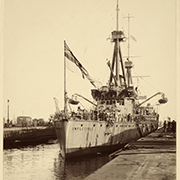
What are these records?
These are the service records of officers who served in the Royal Naval Air Service during the First World War. They can also contain details of service before the First World War.
This collection, in series ADM 273, consists of the records of approximately 7,500 men.
Many officers transferred from the Royal Navy. You can trace their previous service in the Royal Navy officers’ service records.
What information do the records contain?
The officers’ records can contain:
- date of birth
- marital status
- name and address of next of kin
- previous occupation
- service history in the HM forces (air and naval)
- RAC (Royal Aero Club) certificate number and details
- appointments
- notations by the Air department (accidents, meritorious work, for example)
- confidential reports (ability, remarks on character, promotion assessments, for example)
How do I search the records?
You can search by name and download the records in Discovery (£) by using the search box below.
This is a keyword search so your results will show all instances of the term(s) you searched for within our catalogue descriptions for these records.
- Use AND to find more than one term in a description
- Use “quotation marks” to find exact phrases
What do the records look like?
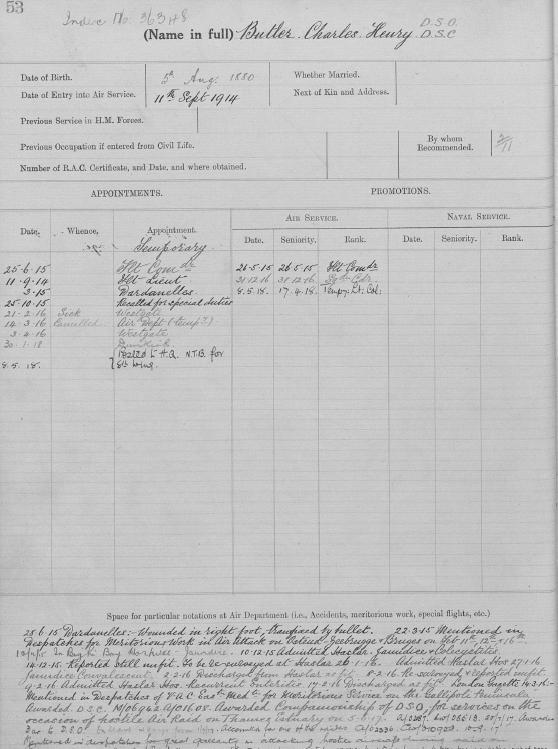
Sample Royal Navy Air Service service record (catalogue reference: ADM 273/3/53)
The records take the form of an entry in a book. Here is a sample image – Charles Henry Butler’s service record.
Why can’t I find what I am looking for?
If the officer you are looking for went on to serve in the RAF try searching the RAF officers service records 1918-1919.
The officer may not have served in the RNAS. You can trace an officer’s career in the published Navy Lists.
1. Why use this guide?
Use this guide to find out how and where to locate records of medal entitlements and honours for merchant seamen. The guide covers records of campaign medals (awarded for service in a specific campaign or war) and of gallantry medals (awarded for acts of gallantry and bravery).
Access to full details of seamen born less than 100 years ago may be restricted.
2. Second World War campaign medals
2.1 All campaign medals except Arctic Star
The medals were claimed and issued from 1946 to 2002. Medals were not automatically issued but had to be claimed by the merchant seaman. If a seaman is not listed, it may be because they did not claim their medal entitlement.
Search by first and last name for records in BT 395 of the award of Second World War campaign medals. These record the issue of campaign medals including the 1939-1945 Star and the War Medal but excluding the Arctic Star, which was not awarded until 2012 and for which there is a separate process (see below). For more information about eligibility for medals and interpretation of details on the records, refer to our guide to Merchant Navy campaign medal records 1939-1945.
Seamen were automatically entitled to some medals if they died in service. You can search by name for records of merchant seamen who died in service or went ‘missing presumed dead’ in the Second World War Rolls of Honour (£) at Ancestry.co.uk. The original records are held in series BT 339.
For merchant marine officers who served in the Royal Naval Reserve, download and scroll through the mishmash of records, which include items of correspondence, relating to awards to Royal Naval Reserve officers (1939-1946) in BT 164/23.
Published sources may also provide information of medal or award entitlement.
2.2 Arctic Star
In December 2012 the Prime Minister announced that veterans of the Second World War Arctic Convoys were to be awarded an Arctic Star medal.
Look on the GOV.UK website at the Ministry of Defence’s Veterans UK pages to find out:
- who qualifies for the award
- what evidence you need to provide
- how to make an application
To issue an Arctic Star the Ministry of Defence require proof that an individual was on a particular ship and also that the ship took part in an operation or convoy north of the Arctic Circle. You may already have documents that prove this and/or you may also be able to find this proof within records held at The National Archives. The Ministry of Defence require either of the following records as evidence of the ships a seaman served on:
- Continuous Discharge Book – issued to the seamen themselves with details of the ships they served on (you may already have this)
- Central Register of Seamen – held at The National Archives; see our guide for advice on finding an individual seaman within these records but to examine them you will need to visit us or pay for research
Once you have found out which ships a seaman served on you can search for and download (£) ships’ movement cards from our website to establish whether any of the ships took part in an operation or convoy north of the Arctic Circle at the time that the seaman was part of the crew. The cards, from record series BT 389, show the movements of British and Allied merchant ships during the Second World War.
Read our research guide on Royal Navy operations in the Second World War for advice on other records we have that might be helpful.
2.3 Applying for Second World War campaign medals
To request the issuing of a Second World War campaign medal, for which you will need to provide evidence, contact the Maritime and Coastguard Agency.
You may be able to find evidence of a seaman’s sea service in one of the registers of seamen or by locating ships’ movement cards (BT 389). This may prove the vessel was in the theatre of war on that date.
3. Second World War gallantry medals
The gallantry medal most commonly awarded to merchant seamen was the Albert Medal.
3.1 Home Office records of the award of the Albert Medal
Search for records of the award of the Albert Medal among the registered Home Office papers in series HO 45. Search with the words ‘awards’ or ‘Albert Medal’ plus the name of the recipient – it may help to include a date range. The date range of the records is primarily from the 1870s to the 1940s.
3.2 Recommendations for and registers of Gallantry at Sea awards, 1856-1973
Browse and download, free of charge, recommendations, registers and other related records of Gallantry at Sea awards in series BT 261.
3.3 Second World War Merchant Navy awards files
Use the search box below to search our catalogue listings of Second World War Merchant Navy award files, by name of person or ship. The records, held in series T 335, list the type of award, the recipient’s rank at the time and the ship they were serving on.
Narrow your search by using double quotation marks to find a ship’s or person’s full name, such as “Sydney Star” or “John Williams”.
3.4 Records of awards among Admiralty correspondence and papers
To make use of these records you will need to visit us. Though accessing admiralty correspondence and papers in series ADM 1 and ADM 199 can be tricky and requires the use of the indexes and digests held in ADM 12, the records themselves can be quite detailed. When consulting the digests you will need to look for the digest headings for ‘Honours and Awards’, covered by Code 85 (or more precisely, codes 85.1 to 85.10). For more on this and for more information on how to use these records in general read Naval correspondence using the ADM 12 indexes and digests.
4. First World War campaign medals
Most of the records of the award of First World War campaign medals to merchant seamen are available online.
4.1 Merchant seamen’s campaign medal records 1914-1918
See our guide and customized search of records of the issuing of the British War Medal, the Mercantile Marine Medal and the Silver War Badge to merchant seamen and officers in the First World War.
4.2 Roll of Naval War Medals, 1914-1920
Download, free of charge, the Roll of Naval War Medals (ADM 171/130-132), which lists the award of the British War Medal, Victory Medal and 1914-1915 Star to men of the Mercantile Marine Reserve and officers and men of the Royal Naval Reserve.
4.3 First World War Rolls of Honour
Search and download records from the First World War Rolls of Honour at Ancestry.co.uk (£) for details of merchant marine fleet crew who died in service. The original records are held in series BT 339.
5. First World War gallantry medals
5.1 Recommendations for and registers of Gallantry at Sea awards, 1856-1973
Browse and download, free of charge, recommendations, registers and other related records of Gallantry at Sea awards in series BT 261.
5.2 Records of awards among Admiralty correspondence and papers
To make use of these records you will need to visit us. Though accessing admiralty correspondence and papers in series ADM 116 can be tricky and requires the use of the indexes and digests held in ADM 12, the records themselves can be quite detailed. When consulting the digests you will need to look for the digest headings for ‘Honours and Awards’, covered by Code 85 (or more precisely, codes 85.1 to 85.10). ADM 137 holds further material. For more on this and for more information on how to use these records in general read Naval correspondence using the ADM 12 indexes and digests.
6. Pre-First World War campaign medals
Download, free of charge, from our website, digital microfilm copies of rolls and lists of officers and ratings awarded or claiming campaign medals. The original Admiralty records, in series ADM 171, are primarily of Royal Navy and Royal Marines personnel but include the awards of medals to merchant seamen too, as follows:
- Lists of claims for and awards of the Sea Transport Medal for officers of the Mercantile Marine who served on vessels transporting troops to the South African War and to the Boxer Rebellion in China (1899-1902)
- Medal roll of naval and marine personnel who qualified for the Egyptian Medal (1882)
7. Pre-First World War gallantry medals
7.1 Albert Medal register, 1866-1913
Search the Albert Medal register, in BT 97/1, for details of all Albert Medals awarded for gallantry at sea from 1866 until 1891; from that date onwards there are details only of awards of the medal made to civilians.
Search for records of the award of the Albert Medal among the registered Home Office papers in series HO 45. Search with the words ‘awards’ or ‘Albert Medal’ plus the name of the recipient – it may help to include a date range. The date range of the records is primarily from the 1870s to the 1940s.
7.2 Recommendations for and registers of Gallantry at Sea awards, 1856-1973
Browse and download, free of charge, recommendations, registers and other related records of Gallantry at Sea awards in series BT 261.
8. Published sources
Consult Lloyd’s Medals, 1836-1989 for a published list of officers and men of the Merchant Navy and Fishing Fleet of exceptional gallantry at sea in the time of war.
Consult Seedie’s list of awards to the Merchant Navy for World War II.
Read Medals: the Researcher’s guide by William Spencer (Kew, 2006) for further guidance on how to find medals.
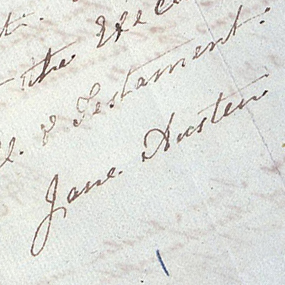
What are these records?
These records are the wills of 102 famous people which form the series PROB 1.
The wills date from the 16th to the 19th centuries. They include the wills of:
- William Shakespeare
- Admiral Lord Nelson
- Jane Austen
What information do the records contain?
The information found in wills includes the following:
- where the person lived
- name of the person responsible for carrying out the wishes (executor)
- date of the will
- witnesses to the will
- chief beneficiaries
Some of the wills, including Jane Austen’s, are accompanied by affidavits sworn by witnesses attesting their authenticity.
Nelson’s will is accompanied by a private diary, which he wrote in September and October 1805.
How do I search the records?
You can search (£) the records in Discovery, our catalogue, by filling in the form below.
You don’t need to complete every field to find a record.
Please note, your results will show all instances of the term(s) you searched for within the record descriptions, as this is currently a keyword search.
You may prefer to browse through PROB 1.
What do the records look like?
Shakespeare’s will and signature
You can view the original will of William Shakespeare, the famous playwright, who died on 23 April 1616.
The will is dated 25 March 1616, less than a month before he died. It includes bequests to his fellow actors, his neighbours in Stratford and the famous gift of his second-best bed to his wife.
His will shows the typical style of writing at the time. It also contains three of the only surviving six examples of his signature.
You can download Shakespeare’s will free of charge:
William Shakespeare’s will (PDF, 0.64MB)
Other wills
You can download the wills below free of charge to see the typical styles of writing used over the years.
The wills of Susanna Smith and Jane Austen have been annotated to show the different parts of a will:
14th century: Thomas Kennardesle 2 December 1391 (PDF, 0.22MB)
15th century: William Mavehy 27 January 1479 (PDF, 0.20MB)
16th century: John Yardley 2 July 1522 (PDF, 0.17MB)
17th century: Henry Purcell 7 December 1695 (PDF, 0.21MB)
18th century: Susanna Smith 19 July 1709 (PDF, 0.91MB)
19th century: Jane Austen 10 September 1817 (PDF, 0.72MB)
1. Why use this guide?
This research guide provides an introduction to important historical sources on film, television and performing arts in archival collections held by various archives.
The collections of records outlined in this research guide are held in various locations; they are not held by The National Archives.
2. Searching for records
Search Discovery, our catalogue, to find records from over 2,500 archives across the UK, as well as from The National Archives itself. Your search results will include details of which archives currently hold the records.
Click on the title of a result for the contact details of the archive which holds the record – you will need to contact this archive for further information about the collection or the record itself.
Where the keywords you searched for appear in the description of a record, the search results are displayed under the ‘Records’ tab.
Where the keywords you searched for appear in the name of the institution or person that originally created the record (often not the same as the institution or person that currently holds the record), the search results are displayed under the ‘Record creators’ tab. For further tips on searching, see our Discovery help pages.
3. Major collections
These repositories and institutions hold major collections relating to film, television and performing arts.
Film and television
BBC Written Archives Centre has two main collections: policy, programme and contributors’ files; and other related holdings. The former includes material on BBC Television’s programme output and correspondence regarding contracts of production staff and performers. The latter includes TV and radio news bulletin and drama scripts, programme-as-broadcast logs, and a collection of BBC publications such as Radio Times and the BBC Year Book. The Centre also holds manuscript and other material relating to individuals connected with the BBC, notably its founder Lord Reith.
Bill Douglas Centre for the History of Cinema and Popular Culture houses the Bill Douglas and Peter Jewell collection on the history of cinema and popular culture, and has a public museum and an academic research centre.
British Film Institute Archive holds the most important collection in the UK relating to the history of film and television. This includes the records of the British Film Institute (BFI) itself, a number of television companies, other organisations connected with the industry and the papers of many prominent individuals from film and television. The BFI Reuben Library holds important printed sources for the history of film and television. The collections are international in scope, focusing mainly on British Film and television.
The East Anglian Film Archive (EAFA) was the first regional film archive in the UK, established in 1976. The archive holds collections of film and television relating to the six counties of the East of England, including the Anglia Television collection, BBC East and the Institute of Amateur Cinematographers.
The Imperial War Museum Film and Video Archive holds material covering all aspects of 20th and 21st century conflict involving Britain, the Commonwealth and other former empire countries. The collections are available to search online.
The Independent Television Commission (ITC), formerly the Independent Broadcasting Authority, is responsible for licensing and regulating independent television. As well as its own records the ITC retains the records of its predecessor bodies and also those of the Cable Authority. There are collections of press cuttings on broadcasting and reports on audience research. The ITC can advise on locating the records of independent television companies.
The Lincolnshire Film Archive was set up in 1986 to locate and preserve motion film showing life and work in all parts of the County (including what was formerly South Humberside). A list of holdings is available online.
The Media Archive for Central England (MACE) collects, preserves and makes available the moving image heritage of the English Midlands. The collections can be searched online.
The National Media Museum collection includes more than three million items covering film, television, photography, radio and the web. These include the world’s first negative, the earliest television footage and what is regarded as the world’s first example of moving pictures – Louis Le Prince’s 1888 film of Leeds Bridge. Information on the collections and searching is available online.
The North East Film Archive (NEFA) finds, preserves and provides public access to moving image made in or about the North East region from Middlesbrough in the south to the Scottish Borders to the north.
The North West Film Archive preserves moving images made in or about Greater Manchester, Lancashire, Cheshire, Merseyside and Cumbria and offers a variety of access services to users in the public, academic and commercial sectors.
The Royal Television Society retains its own records dating from its foundation in 1927 and collects material relevant to the history and development of television.
The Scottish Screen Archive is a film and video collection of over 100 years of Scotland’s social, cultural and industrial history, reflecting the lives of ordinary Scots and achievements of Scottish film-makers. The collections include documentaries, newsreels, educational, television, public information, industrial, advertising and promotional film and video. A catalogue is available online.
The Screen Archive South East is the public sector moving image archive for the South East of England. The collections cover the four counties of Surrey, Kent, East Sussex and West Sussex and the unitary authorities of Brighton & Hove and Medway. Their Screen Search catalogue is available online.
The South West Film and Television Archive is the official film archive for the South West of England. It holds nearly 130,000 films and tapes, dating from the start of film making in the 1880s to the present day and covering every aspect of life in the South West of England.
The Yorkshire Film Archive (YFA) finds, preserves and provides public access to moving image made in or about the Yorkshire region.
Drama and poetry
University of Bristol Theatre Collection holds a vast collection of original documents, photographs, film footage and artefacts from theatres, actors, performers, designers and theatre historians relating to the history of theatre in Britain. Major collections include: the Mander and Mitchenson Collection; the Robinson Collection of 18th and 19th century playbills; the Southern Collection of prints, photographs and models of theatres; the papers of Sir Herbert Beerbohm Tree; correspondence of William Macready; and the Ernest Thesiger Collection.
British Library, Manuscript Collections include the papers of a number of prominent dramatists and actors (including Lord Olivier) and records relating to the censorship of plays by the Lord Chamberlain prior to 1968. The British Library catalogue for manuscript collections is available online.
The Garrick Club Library holds material relating to British drama and the theatre, with special emphasis on the 18th and 19th centuries. Major collections include the Garrick Collection, consisting of material relating to David Garrick himself; the Northcote Collection which includes the archives of Drury Lane Theatre; a major art collection of theatre history; playbills and theatre programmes from the 18th century onwards. The Library catalogue is available online.
Glasgow University Library, Special Collections Department The University holds the Scottish Theatre Archive, which includes the records of many theatrical companies as well as individuals’ papers, programmes and scripts. Collections include: the scripts of BBC Scotland Radio; the Citizens’ Theatre Archive; the Jimmy Logan collection of theatre memorabilia; and the Scottish Ballet Archive. The catalogue is available online.
The Poetry Library is based in the Southbank Centre in the Saison Poetry Library. Major collections include the Arts Council Poetry Collection. In addition to books and periodicals, the Poetry Library holds collections of press cuttings and recordings of poets performing readings of their work.
Royal Academy of Dramatic Art (RADA) retains its own archives which are an important source for the history and development of British theatre.
National Theatre Archive Established in 1993, 30 years after the first performance took place at the Old Vic, National Theatre Archive holdings include the administrative and technical records of the theatre, prompt scripts, production and press photographs and press cuttings. The catalogue is available online.
V&A Department of Theatre and Performance (formerly) the Theatre Museum Archive. The Gabrielle Enthoven Theatre Collection forms the basis of the collections, which are a major resource for the history of theatre, ballet, pantomime and circus in Britain from the early 18th century. The British Theatre Museum Association Collection has extensive coverage of London theatre dating from the 18th century. Non-manuscript material includes designs for Gilbert and Sullivan operas, circus photographs and the Arts Council Collection of modern theatre designs. The collections are catalogued at a broad level on the National Art Library Catalogue.
Music
British Library Music Collections include extensive holdings of published sheet music and collections of papers of important composers and musicians. Catalogues are available online.
Britten-Pears Library Established in 1973, the library holds the papers of Benjamin Britten and Peter Pears along with the records of the English Opera Group, manuscripts of other composers and proofs of published material. A catalogue is available online.
Birmingham: Archives and Heritage Service The library houses the British Organ Archive, which includes the records of many organ-building firms collected by the British Institute of Organ Studies. A catalogue is available online.
The Elgar Birthplace Museum has a unique and nationally important collection of manuscripts, letters, press cuttings, concert programmes, diaries, recordings, books, personal possessions and memorabilia associated with the life, work and influences of Sir Edward Elgar. It is the largest and most wide-ranging collection of material associated with the composer.
Glyndebourne Festival Opera Archive holds the records of Glyndebourne Festival Opera (founded 1934) and its touring company. It also collects material relating to the singers who have worked there and has an oral history project to record interviews with singers, conductors and members of administrative staff.
The Institute of Popular Music is based at the University of Liverpool. It holds major collections including: the Recorded Sound Collection; the Robert Shelton Archive; the Robert Pring-Mill Collection; the Mikis Theodorakis Collection; the Music Journalism Collection; and International Association for the Study of Popular Music (IASPM) archive. Information about the collections is available online.
The British Library Sound Archive (also known as the National Sound Archive or NSA) holds a vast collection of published and unpublished recordings, ranging from wildlife noises to parliamentary debates, music and recordings of poetry and drama. The archive also hold records of BBC, ITV and C4 television programmes and BBC radio broadcasts. The only public access to the BBC sound library is via the NSA. The NSA also maintains a reference library.
Plymouth Theatre History highlights the extensive archive of playbills, photographs and programmes from the 18th century to the present day held in their collections. Access to archived versions of the previous Applause South West theatre history website is also available.
Royal Opera House Collections The collections of playbills, programmes, photographs, correspondence, designs and administrative files concentrate on performances given at the House, the individuals who took part in them and performances by the company elsewhere. The majority of the collections date from 1850 onwards. A catalogue, arranged by performance is available online.
The Royal Academy of Music Library houses the records of the Academy, dating from its foundation in 1822, together with collections of early printed music, early recorded sound and manuscripts of past pupils and teachers of the Academy, including Sir Henry Wood.
The Royal Northern College of Music holds records of its predecessor bodies; the Royal Manchester College of Music and the Northern School of Music, together with collections of private papers, early printed works and historic musical instruments.
The Royal College of Music The extensive holdings of this institution include records of the college and manuscripts of those connected with it, a museum of historical instruments, the most comprehensive collection of portraits of British composers and musicians, a reference library and large collections of opera designs and concert programmes.
The Scottish Music Centre Founded as the Scottish Music Archive in 1969, the Centre is a member of the International Association of Music Information Centres. Its holdings include manuscripts and scores of many Scottish composers, together with recordings of performances of classical, jazz, folk and popular music. Resources include: a comprehensive database with information and contact details on artists, composers, promoters, venues, festivals, services, recording, agents and so on; an online events diary; historical information on Scottish music; a sound archive representing over 30 years of recordings; and a reference library with over 10,000 scores, song and tune collections. A catalogue is available online.
The Vaughan Williams Memorial Library is the library of the English Folk Dance and Song Society, holding the archives of the Society and its predecessor bodies the English Folk Dance Society and the Folk Song Society, together with field recordings and research papers of many British collectors of folk songs. There is a published catalogue of the collections. Information on access to the collections is available online. Online resources and the catalogue are also available.
The National Museum, Cardiff holds extensive collections of Welsh social and cultural history including the records of the Welsh Folk Song Society and a film and sound archive. Information on the collections is available online.
Dance
English National Ballet Archives were set up in 1975 to maintain the records of the English National Ballet. Collections include material relating to the history of ballets in the company’s repertoire and dancers who have performed with the company.
Rambert Dance Company Archives was created in 1982 to document the work of Britain’s oldest dance company. Collections include include: dance notation, designs, photographs, music, costumes and programmes; sound recordings, videos, press cuttings; administrative records and board papers. There are also files for people and productions connected with the Company and a number of small collections, including papers of Andrée Howard and Walter Gore.
Trinity Laban: Laban Library and Archive holds extensive research collections of library and archive of material relating to dance. Information on the collections is available online.
University of Glasgow Library, Special Collections Department catalogues are available online.
The National Resource Centre for Dance holds the records of many dance associations and societies, as well as collections of dance companies and individual collectors’ papers.
4. Useful websites
The Archives Hub provides descriptions of collections held at archives in UK universities and colleges. At present the descriptions are primarily of the broad themes and subject matters of the collections, although where possible they are linked to more detailed descriptions of the records that make up each collection.
Archives in London and the M25 area (AIM25) is a major project to provide electronic access to collection level descriptions of the archives of over 50 higher education institutions and learned societies within the greater London area.
Association of Performing Arts Collections (APAC) provides a specialist network for those working with performing arts collections in the UK. The current members include the institutions responsible for much of the UK’s performing arts heritage.
British Library Newspaper Collections holds the most important and extensive collections of national and provincial newspapers, journals and trade papers relating to Britain and selected overseas countries. These are an invaluable source for copies of reviews, commentaries and articles on film, television, music and the performing arts.
Cecilia: mapping the UK music resource. This project, which is a joint initiative involving Ensemble, the Music Libraries Trust and the United Kingdom branch of the International Association of Music Libraries, Archives, and Documentation Centres (IAML(UK)) will create a web-based collection level map of music resources in UK libraries, archives and specialist music institutions.
The Scottish Archive Network (SCAN) – the project aims to revolutionise access to Scotland’s archives by providing a single electronic catalogue to the holdings of more than 50 Scottish archives.
5. Further reading
Peter Beal, Barbara Rosenbaum et al, Index of English literary manuscripts, 4 volumes (1980-1993)
Francesca Franchi, Directory of performing arts resources (1998)
Location register of 20th century English literary manuscripts and letters, 2 volumes (1988)
Location register of English literary manuscripts and letters: Eighteenth and nineteenth centuries, 2 volumes (1995)
Elizabeth Oliver, Researcher’s guide to British film and television collections (third edition, 1989)
1. Why use this guide?
Use this guide to help find records in The National Archives and other archives in the UK relating to:
- the UK government’s involvement in sport provision and related issues
- sport history in general
- the London 2012 Olympic Games
- the history of the Olympic and Paralympic movements
2. The records held by The National Archives
The National Archives does hold some general sports records but these are scattered across various series, created or inherited as they were by different central government departments. You are more likely to find more coherent collections of records about sport in general in specialist archives, some of which are listed in the latter sections of this guide.
The National Archives has records from the London Organising Committee of the Olympic and Paralympic Games (LOCOG) as well as a dedicated website The Olympic and Paralympic Record. The website has two sections: the first is a timeline highlighting records from Olympic and Paralympic Summer games from 1896 to 2012, and the second is a record of sporting and cultural activities that took place across the UK before, during and after the 2012 Games. The website has been preserved in the UK Government Web Archive.
3. How to search for records
3.1 Using Discovery, our catalogue
Search Discovery to find records from The National Archives and over 2,500 other archives across the UK, as well as some abroad. For detailed advice on searching Discovery and understanding your results see our Discovery help pages.
If you want to search for records at The National Archives only, choose the relevant option under the search box.
Try searching for a particular sport, event or organisation. Searching for famous sports personalities by name is a bit hit and miss – if you don’t find anything you could try searching for events or organisations they were involved with instead.
Unless you have restricted your search to The National Archives only, your search results are likely to list records held at more than one archive. If you want to find out how to see a specific record, you will need to contact the relevant archive directly.
If you get too many results, you can use the filters on the left to narrow them down by the dates the records cover or the archive they are held by.
Alternatively, you can use the Advanced search option and include more about what you want to find before you search.
Searching Discovery won’t find everything. Records of sports organisations and individuals can be held in local record offices, university collections and special repositories. Not all of these places have their collections listed in Discovery, and some have only part of their holdings listed.
3.2 Finding other sources
Whilst Discovery could be the best way to start your research, you should also think about looking for archives based on their locality or the theme of their collection.
The Sporting Heritage website provides a directory of archives with collections of records relating to sports.
You will also find libraries are a great resource as there are plenty of published works on sport and related topics. Search The National Archives’ library catalogue for publications you can see onsite at Kew.
4. London 2012 records at The National Archives
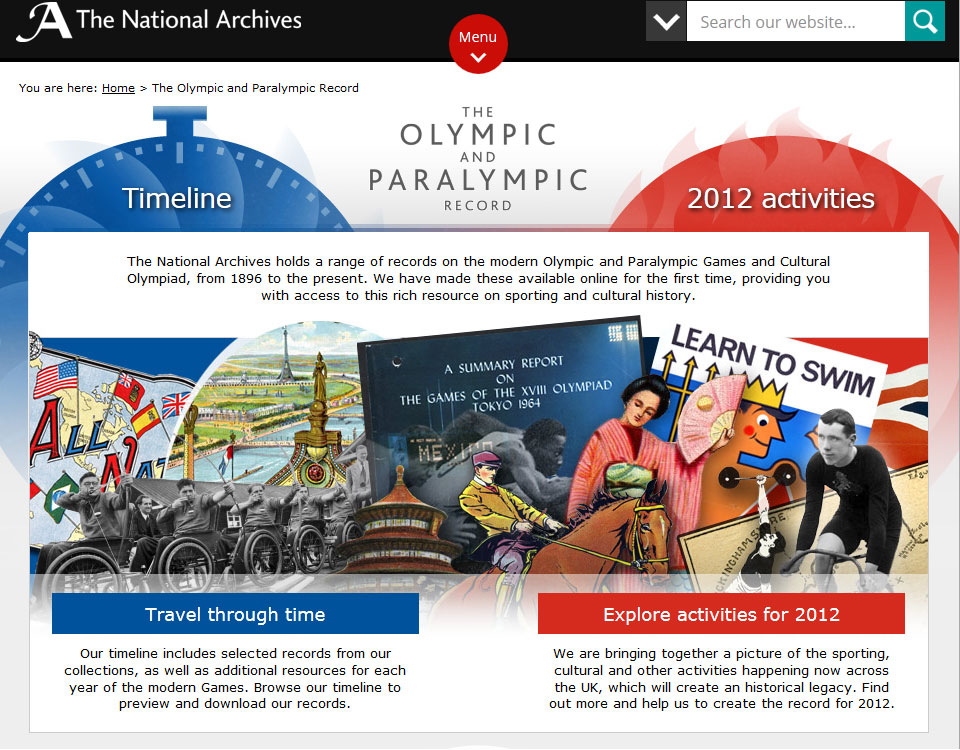
The Olympic and Paralympic Record
4.1 The Olympic and Paralympic Record
Numerous organisations recorded their activities and events before, during and after the 2012 Olympic and Paralympic Games, creating an unprecedented distributed archive collection. We gathered together information about the records on a dedicated website, The Olympic and Paralympic Record, which is now preserved in the UK Government Web Archive.
The Olympic and Paralympic Record gave two distinct ways to research the Olympics:
- 2012 activities – this section used live and archived websites to illustrate the wealth of sporting and cultural activities which took place across the country before, during and after London 2012. It recorded everything from celebrations at national and regional venues by major sporting bodies to the output of local school and community grassroots projects
- Timeline – the timeline highlights selected records from The National Archives relating to Summer Olympic Games from 1896 to 2012. The records include photographs, posters and official documents and reflect the political issues of the time such as the terrorist attacks in Munich in 1972 and the boycotts of the Russian Olympics in 1980.
4.2 LOCOG records
The London Organising Committee of the Olympic and Paralympic Games (LOCOG) was established in July 2005 shortly after the Olympic bid was won by the UK Government London Olympic Bid Team.
LOCOG was responsible for organising, publicising and staging the London 2012 Games. Its records include material ranging from the bid process and the planning and delivery of the Games, through to the organisation’s own dissolution.
The National Archives reached a landmark agreement with LOCOG, the British Olympic Association (BOA), and the International Olympic Committee (IOC) to ensure access to the records of London 2012.
Discovery, our catalogue, lists 13 series of LOCOG records with the department reference LOC. Their descriptions show whether the records are:
- not yet transferred
- closed
- open
The majority of records from LOCOG are in digital form and are gradually being transferred into our digital archive. As this process continues, Discovery will be updated to include references to these records.
4.3 The digital games: social media archive
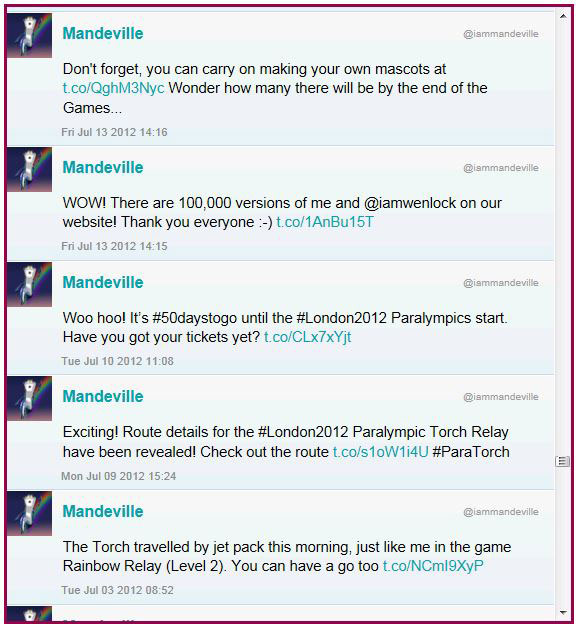
@iammandeville Twitter feed in UK Government Web Archive
London 2012 is considered the first digital Olympics. With dedicated websites, blogs and Twitter feeds there was public engagement and involvement as never before.
The London 2012 Olympic and Paralympic Games and government organisations created tweets on Twitter and videos on You Tube. These have been preserved on the UK government web archive as part of the public record.
Tracey Emin – London 2012 Olympics Poster
YouTube channel: Prime Minister’s Office (number10gov)
5. Records on sport in general at The National Archives
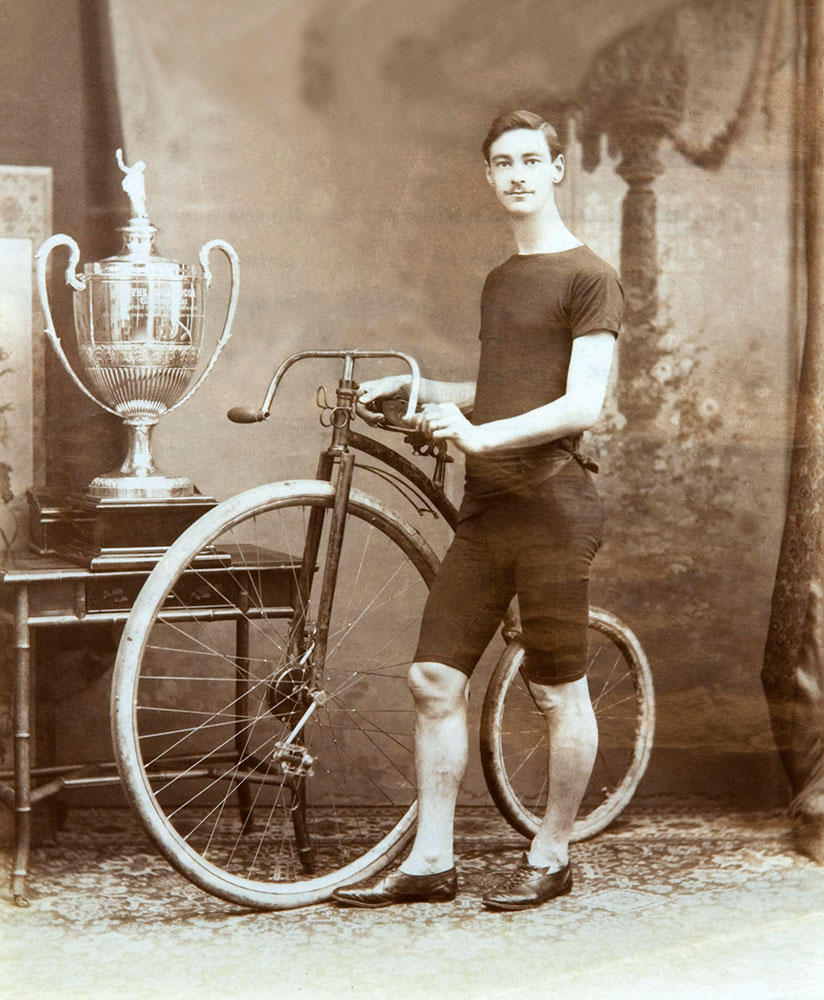
Frank Shortland, Cuca Cocoa Cycling Challenge Cup Champion, 1892 (catalogue reference: COPY 1/410/34)
Use Discovery, our catalogue, to search for records. If you only want to find records held at The National Archives, select that option underneath the search box.
You can use Advanced search if you want to include criteria such as dates or record references where you know them.
There are very few record series devoted entirely to sport at The National Archives. Some examples of record series at The National Archives that might be of interest are:
- AT 60 Department of the Environment and predecessors: Sports Policy, Registered Files
- ED 169 Ministry of Education: Adult Welfare files has a sub-series of files of the Sports Council, 1966-1967
- COPY 1 Copyright registrations containing many photographs related to sport
- CB Records of the National Playing Fields Association
Discussions in Parliament on sport can be found in Hansard, which is available online on the Parliament website. Please note there are some volumes missing from the online data.
Our research guide to Hansard details different ways of accessing the reports and records of Parliamentary debates.
Other Parliamentary records on sport, such as the reports of the Culture, Media and Sport select committee, may be found in published Parliamentary papers. From 1997 these will be on the UK Parliament website. Earlier reports can be accessed online through Proquest UK Parliamentary Papers. This is a subscription website you can access for free at The National Archives, Kew. You may also be able to access it from a large reference library such as a university library.
6. Records recently collected by archives
Many archives regularly take in new records to add to their collections – this process is known as accessioning. Every year, The National Archives collects information about new accessions from over 250 archives across Britain and Ireland. This survey is known as ‘Accessions to Repositories’.
Find out where records relating to sport have been added to archive collections in any year from 1995 by clicking on the relevant year and then picking ‘sport’ from the list of topics.
Accessions relating to the Olympics can be found from 2010 onwards by looking in the topic ‘sport’ and/or ‘London’ and from 2012 the topic ‘2012 Olympics and Paralympics’ is included.
7. General and specialist collections
The following list includes some of the organisations that hold important archival collections relating to the history of sport and the Olympic and Paralympic movements:
7.1 International and national sport archives
Some organisations hold records relating to national or even international sport disciplines.
International Olympic Committee: Olympics Study Centre
Based at the headquarters of the International Olympic Committee in Switzerland. Holds archives relating to the history of both the Summer and Winter Games since 1894, including microfilm and text documents.
National Football Museum
Holds unique collections of football artefacts and archives, including the FIFA collection and the Harry Langton archive.
MCC Archive
Holds records of the Marylebone Cricket Club, from 1714 onwards, as well as archives of individual cricketers, including Pelham Francis Warner.
University of Warwick: Modern Records Centre
Holds the National Cycling Archive, which includes records deposited or donated by cycling bodies and individuals.
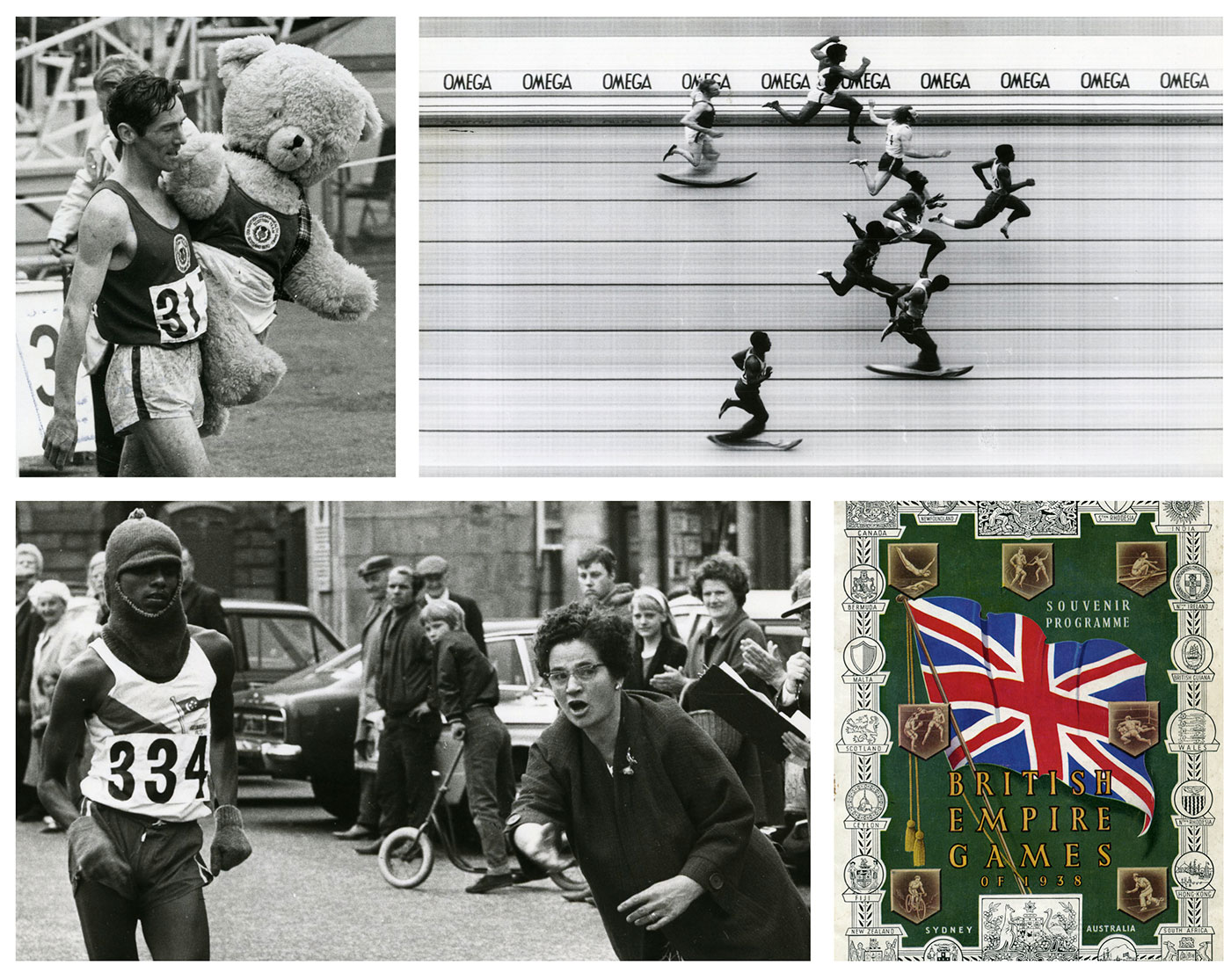
Commonwealth Games Scotland Archive, courtesy of University of Stirling
University of Stirling Archives
Holds the records of Commonwealth Games Scotland. The archive includes papers relating to the organisation of the 1970 and 1986 Edinburgh Commonwealth Games. You can find more records relating to the Commonwealth Games in Discovery.
British Film Institute
The BFI Player allows you to browse a range of films relating to sport disciplines which can be viewed online.
To discover more film footage relating to sport, search Find an archive using the keyword ‘film’.
7.2 Other guides to sports records
Some local archives with specialist collections have put together their own guidance to help locate records relating to sport.
Sheffield Archives
Guides to the records of Sheffield Wednesday and Sheffield United Football Clubs at Sheffield Archives & Local Studies.
Gwent Sports
Guide to records relating to local sports clubs and associations at Gwent Archives.
Our Warwickshire
Information guide relating to sports collections shared by Warwickshire archives, museums and local history groups and communities.
Scottish Sport/Recreational Archives
Guide detailing mostly sport club archives for east-central Scotland, but also sporting activities from the 15th to 20th centuries within private papers, at the National Library of Scotland.
Sport in Wiltshire
Resource guide for sport-related collections held at Wiltshire and Swindon History Centre.
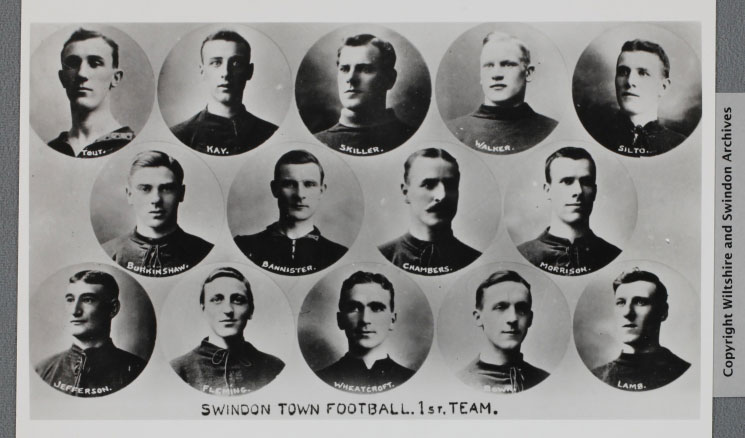
Swindon Town Football 1st team c1909 (catalogue reference: 2367/9), courtesy of Wiltshire and Swindon History Centre
7.3 Other resources
Some organisations have created directories of collections, websites and other information about sport archives.
Sporting Heritage
Directory of sport-related archive and museum collections.
Olympic & Paralympic Games 2012
Collection of archived websites of official bodies, local councils, forums and business websites which documents London 2012. Hosted by the UK Web Archive, British Library.
Parliamentarians at the Olympic and Paralympic Games Full list of MPs and Peers known to have competed, on the UK Parliament website.
Oral History: Sport
Online collection of sound recordings, maintained by the British Library Sound Archive, which documents the activities of sportsmen and women of Britain in the twentieth century, including interviews with sports players, coaches and enthusiasts.
7.4 Podcasts
Take a look at our array of podcasts relating to sport.
1. Why use this guide?
This guide will help you find records at The National Archives relating to military operations planned and carried out by the British Army since the end of the Second World War up until around twenty years ago. These are records that broadly fall into one of two categories:
- records created by units of the army itself
- records created by politicians, top-ranking officers and other high-level personnel
This is not the place to find advice on records of individual soldiers and officers. For the service records of individuals from this period see our guide to British army soldiers in service after 1945.
2. How to use this guide and get a search for records started
There are countless published regimental histories and these are often a good place to start research into British Army operations. Our library holds a copy of Arthur S White’s A Bibliography of Regimental Histories of the British Army, a useful resource for getting started.
A search for documents at The National Archives usually begins in our online catalogue. The following sections of this guide provide links to key record series that you can search within our catalogue, helping you to target your searches more precisely. By clicking on the series links (for example, WO 269) you will arrive on the respective ‘series description’ pages from where you can search the series, using dates/years and keywords, such as:
- name of operation or campaign (for example, ‘Operation Corporate’)
- name of a conflict (for example, ‘Suez crisis’ or ‘Korean War’) – keyword searches like this work best if you put them in inverted commas
- name of army unit. If you are looking for war diaries or other records related to specific British Army regiments and other units – these are often recorded in our catalogue using abbreviations so try a variety of terms when searching (for example, ‘Regt’ as well as ‘Regiment’, ‘Bn’ as well as ‘Battalion, ‘Bty’ as well as ‘Battery’)
Series description pages also provide information on the arrangement of the records and sometimes some of the historical context in which they were created, as well as suggesting related series you could explore.
Use the advanced catalogue search to restrict your search results to the records of a specific government department, including its predecessors (for example, the War Office or the Ministry of Defence). Use the department reference, which is always a letter code, to do this (the code for the Ministry of Defence, for example, is DEFE).
Catalogue search results provide short descriptions of our records and a document reference for each one – you will need the document reference to see the record itself. Many of the records covered in this guide are not available to view online so to see them you will have to either visit us in Kew or order copies. Bear in mind that a search in our catalogue will also search for records in other archives around the country – keep your eye on the ‘Held by’ field to establish whether the records are here or elsewhere.
3. Politics, policy and planning: records of high command
To find records revealing the decision making behind British Army operations, government policy on a specific conflict and all kinds of other high level thinking around the operations, conflicts and wars involving the British Army, search within Cabinet (CAB) and Ministry of Defence (DEFE) departments.
Browse or search the following specific series to get started:
| Date range | Type of information | Record series | How to search |
|---|---|---|---|
| 1945-1978 | Cabinet minutes | CAB 128 | Browse or search by date |
| 1945-1978 | Cabinet memoranda | CAB 129 | Browse or search by date |
| 1946-1963 | Cabinet Defence Committee minutes and [papers | CAB 131 | Browse or search by date |
| 1937-1962 | Combined Operations Headquarters records | DEFE 2 | Search by name of army unit or operation |
| 1946-1973 | Chiefs of Staff Committee registered files | DEFE 11 | Search by country or region |
| 1964-1982 | Defence and Overseas Policy Committees and Sub-committees minutes and papers | CAB 148 | Search by keyword |
Reports of relevant Parliamentary select committees which scrutinised the work of Government, such as the Defence Committee, may be found in published Parliamentary papers. You can access these online via Proquest UK Parliamentary Papers. This is a subscription website you can access on The National Archives’ computers by visiting us at Kew. You may also be able to access it via a large reference library such as a university library.
Unpublished records of Parliamentary select committees are in the Parliament’s Archive Collections, and can be found by searching the catalogue for the name of the committee.
4. Unit records in the aftermath of the Second World War
In the First and Second World Wars, unit records were generally in the form of war diaries but by 1950 unit diaries had been largely superseded by alternative forms of record keeping.
From 1946-1950, quarterly historical records and reports replaced the unit war diaries, which were mostly discontinued after the end of hostilities in 1945.
Click on the following series references to search for records within each respective series using keywords and dates.
| Unit | Record series | Year range |
|---|---|---|
| Africa: East and West Africa | WO 269 | 1940-1950 |
| Austria: British troops Austria | WO 263 | 1946-1950 |
| Caribbean | WO 270 | 1946-1950 |
| Far East land forces | WO 268 | 1946-1950, 1965-1966 |
| Gibraltar | WO 266 | 1946-1950 |
| Home forces | WO 271 | 1945-1950 |
| Malta: British troops Malta | WO 265 | 1946-1950 |
| Mediterranean: central Mediterranean forces | WO 262 | 1946-1949 |
| Middle East land forces | WO 261 | 1946-1950 |
| Rhine: British Army of the Rhine | WO 267 | 1946-1967 |
| Trieste: British element Trieste force | WO 264 | 1946-1950 |
From 1950 onwards, unit historical records and reports are in WO 305.
Army Air Corps’ operations record books and war diaries, 1957-1969, are in WO 295.
5. Specific operations and campaigns
Below are just some of the wars and conflicts since 1945 that are covered in our records. The record series listed do not necessarily contain material exclusively on these conflicts but they are amongst the most comprehensive sources.
| Country | Date range | Record series | Description |
|---|---|---|---|
| Palestine | 1945-1948 | WO 191 | War diaries and headquarters records |
| WO 275 | 6 Airborne division papers | ||
| Korea | 1950-1953 | WO 281 | War diaries |
| WO 308 | Historical records and reports | ||
| DEFE 12 | UN command operation reports | ||
| Suez | 1956 | WO 288 | Headquarters papers and war diaries |
| WO 322 | Maps | ||
| Oman | 1957-1961 | WO 337 | Headquarters British forces Gulf area |
| Falklands War (Operation Corporate) | 1982 | WO 305 | Unit historical records including war diaries and records of operational activity |
6. Other records from overseas stations
Browse or search the following series by keyword in our catalogue, including by name of operation, country or region:
| Overseas station | Date range | Record series |
|---|---|---|
| Africa: Headquarters East Africa command | 1902-1964 | WO 276 |
| Africa: Headquarters West Africa command | 1949-1956 | WO 294 |
| Caribbean: Headquarters British forces Caribbean | 1948-1962 | WO 336 |
| Cyprus: Sovereign base area administration, Cyprus | 1956-1964 | WO 383 |
7. Further reading
Some or all of the publications below may be available to buy from The National Archives’ shop. Alternatively, search The National Archives’ library catalogue to see what is available to consult at Kew.
- Anthony Farrar-Hockley, The British Part in the Korean War: Official History (HMSO, 1990-1995)
- Lawrence Freedman, The Official History of the Falklands Campaign (Routledge, 2005)
- Arthur S White, A Bibliography of Regimental Histories of the British Army (The Naval and Military Press, 1992)
This is a brief guide to help you with your research into a birth, marriage or death in the British Army, Royal Air Force, Royal Marines or Royal Navy. There is no single place or collection where you can easily search for a birth, marriage or death in the armed forces, although many resources are available.
What do I need to know before I start?
Most records of births in the armed forces are held by the General Register Office.
British Army regimental registers of births and baptisms start in 1761 in England and Wales and around 1790 in other countries, and continue to 1924. They include births in the United Kingdom and abroad.
There is no casualty roll for the Royal Air Force outside of the First and Second World Wars, making some RAF deaths particularly difficult to trace. Some of these airmen were registered as deaths in the army or as civilian deaths, rather than as deaths in the Royal Air Force. Similarly, army returns of births, marriages and deaths (1881–1955) include some Royal Air Force births from 1920 onwards.
Online records
Royal Navy registers of reports of deaths on ships (1893–1950)
Download, for free, digital microfilm copies of indexes to registers of reports of deaths on Royal Navy ships in ADM 104/102–108 and the respective registers themselves in ADM 104/109–118 and ADM 104/122–139. The registers include name, age and rank of each seaman, the ship on which they were serving at the time of their death, with the date, place and cause of their death.
Royal Navy registers of killed and wounded (1854–1911 and 1914–1929)
Download, for free, digital microfilm copies of the Royal Navy registers of killed and wounded 1854–1911 and 1914–1929 in ADM 104/144–149. Indexes to these records for 1915–1929 are in ADM 104/140–143. The registers include name, age and rank of seamen, the ship on which they were serving and the date, place and circumstances of their injury or death.
British Army and Royal Navy birth, marriage and death records (1730–1960)
Search for a range of different types of British Army and Royal Navy birth, marriage and death records (£), including baptism and burial records and registers of marriages and deaths, at Ancestry.co.uk. The records span a variety of year ranges between 1730 and 1960 and are from multiple ADM and WO record series.
Indexes to births, marriages and deaths in the armed forces (1761–1995)
Search indexes to the regimental registers, British Army chaplains’ registers, army returns and service departments registers in the military section on findmypast (£). The related certificates can be obtained from the General Register Office.
The indexes to the regimental registers give a name, place, year and regiment.
Army chaplains’ registers (1796–1880) relate to births, marriages and deaths overseas. The index gives a name, place and date range of two to three years.
Service departments registers of births and marriages (1956–1965) relate to army, navy and air force births and marriages abroad.
Royal Navy seamen wills (1786–1882)
Search and download wills of Royal Navy and Royal Marines personnel (£) from ADM 48.
Records available only at The National Archives in Kew
To access these records you will either need to visit us, pay for research (£) or, where you can identify a specific record reference, order a copy (£).
Army registers of baptisms, marriages and burials in UK and overseas garrisons (1808–2007)
Browse Discovery, our catalogue, in record series WO 156 to see which garrison records are held by The National Archives. The registers are relatively few in number and mainly date from the 20th century.
RAF Chaplaincy Board registers of baptisms, confirmations, marriages and burials (1919–2009)
Browse our catalogue, in record series AIR 82 for registers of baptisms, confirmations, burials, and marriage (including banns) which were kept at various RAF stations in the British Isles and overseas. The records are searchable by name of RAF station/country and not by name of individual.
Royal Navy Chaplaincy records of baptisms, marriages and burials (1845–1998)
Browse in ADM 338 for registers of baptisms, marriages and burials by the Chaplain of the Fleet. These will mostly cover Royal Navy personnel but can also include civilians of any national.
Records in other archives and organisations
British Library birth, marriage and death records for the Indian subcontinent
Consult the Asia, Pacific and Africa Collection at the British Library for births or baptisms, marriages, and deaths or burials across the Indian subcontinent, including Burma and Aden.
Other resources
Websites
Search the Commonwealth War Graves Commission website for information about deaths in the First or Second World War.
Search for the will of a soldier who died while serving in the British armed forces between 1850 and 1986 on probatesearch.service.gov.uk.
Books
Search The National Archives’ shop to see whether any of the publications below may be available to buy. Alternatively, look in The National Archives’ library catalogue to see what is available to consult at Kew.
Audrey Collins and David Annal, ‘Birth, marriage and death records’ (Pen and Sword, 2012)
Amanda Bevan, ‘Tracing your ancestors in The National Archives’ (The National Archives, 2006)
C M Hobson, ‘Airmen died in the Great War’ (J B Hayward & Son, 1995)
Bruno Pappalardo, ‘Tracing your naval ancestors’ (The National Archives, 2003)