1. What are these records?
These records are the registration cards for over 600 immigrants to Britain, known as ‘aliens’ in the legal terminology of the time, who arrived between 1918 and 1957. They cover the London area only and include British-born wives of aliens, who lost their British status upon marriage.
These cards are drawn from The National Archives series MEPO 35 which covers aliens resident in London from 1914.
The cards available for download here represent just a sample of the tens of thousands of cards that were issued. Although the cards are a small sample, they do include some notable cases, including Joe Coral the bookmaker (MEPO 35/16/2). You can only download a card if the person in question was born more than 100 years ago.
Aliens were legally required to register with the police from 1914 onwards and to pay a registration fee. In return they received a certificate. The documents we have digitised are the registration cards created by the police.
2. What information do the records contain?
The information provided on the cards includes:
- full name
- date of birth
- date of arrival in the UK
- marital status
- details of any children
- address
- employment history (including employer’s name and address)
- date of naturalisation (with the Home Office reference if applicable)
The cards usually include at least one photograph and for most cases there are continuation cards.
The cards also record any subsequent changes to the following details:
- name
- address
- marital status
- nationality
- employment or occupation
3. How do I search the records?
You can search the records in Discovery, our catalogue, by filling in the form below.
When searching by last name, you can use last name at birth if different, or alias.
You don’t need to complete every field to find a record.
4. What do the records look like?
The cards are in different colours – blue cards were for males, yellow for females and white for continuation cards (for both males and females).
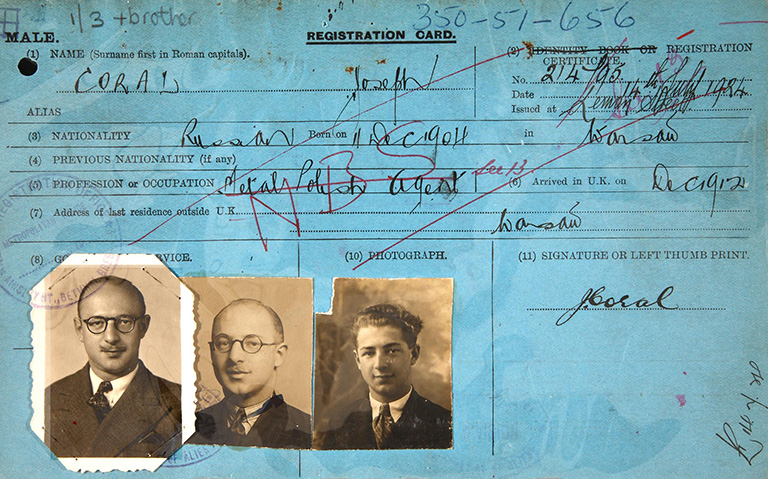
The first example shows us the alien registration card of Joe Coral, founder of the famous British bookmakers. It features the typical head-and-shoulders photograph found in these registration cards. It also reveals that he was born in Warsaw in December 1904.
Joe Coral (catalogue reference: MEPO 35/16/2)
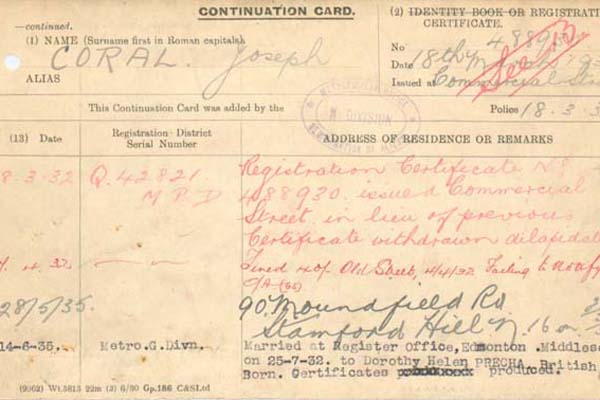
Continuation card of Joe Coral (MEPO 35/16/2)
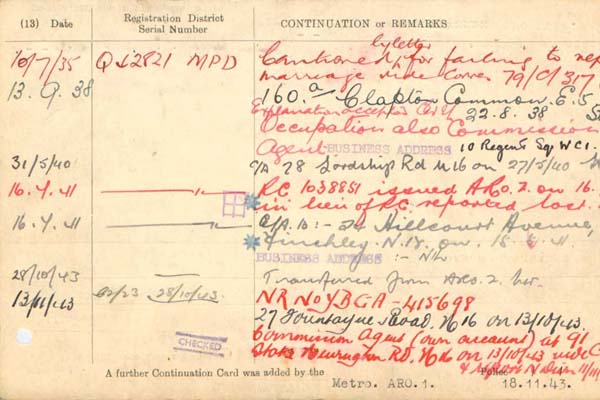
Continuation card of Joe Coral (MEPO 35/16/2)
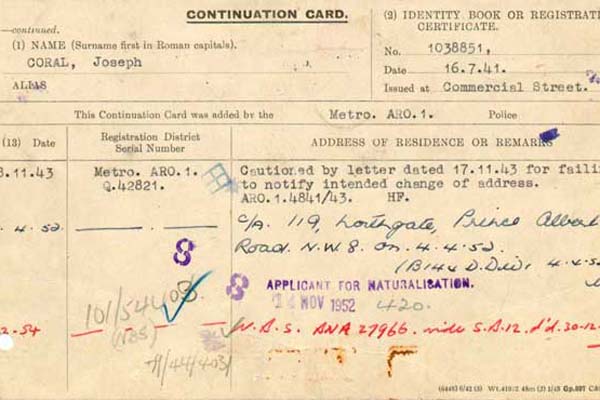
Continuation card of Joe Coral (MEPO 35/16/2)
5. Why can’t I find what I’m looking for?
If you cannot find the person you are looking for here, it may be for one of the following reasons:
- his or her name was recorded under a different spelling – you might need to try searching for spelling variants
- the person’s card is not part of the online sample – we hold around a thousand registration cards for aliens resident in London since 1914 but not all of them are available to download (search by person’s name for the document reference of any card which is not part of the online sample by using the MEPO 35 search in our catalogue – with a document reference you can order copies of the document to be sent to you or you can visit us to view the original document in person)
- the registration card has not survived
- the card has not been made available to the public – some of the more recent cards are not publicly accessible because they feature people who could still be alive
It’s also possible that the case was closed. This usually happened if the person:
- died
- returned to his or her country of origin
- moved to an area outside the metropolitan area
- became a naturalised British subject
1. Why use this guide?
Use this guide for advice on how to find records of the Court of Exchequer held at The National Archives. These are records of civil disputes. It mostly covers cases dealt with on the equity side of the court but does also contain some brief advice on how to search for common law cases.
The records of the Court of Exchequer contain much that is of value to family, local, economic, and social historians. You can find cases relating to land, taxation and financial disputes as well as libel, debt and contractual disputes.
These records are not available to view online so to see them you will have to either visit us in Kew or, if you can locate document references, order copies. However, you may find that to locate document references you will also need to visit us – there are indexes held in our building that may prove essential in your search.
2. What was the Court of Exchequer?
The Court of Exchequer emerged during the medieval period as one of the three main central courts in London. It was originally a common law court but by the mid-16th century it was developing an equity jurisdiction.
Its business on the equity side included disputes over titles of land, manorial rights, tithes, mineral rights, ex-monastic land, debts, wills and so on. The types of cases heard under its common law jurisdiction included breach of contract, debt, personal injury, medical negligence and libel. These type of cases could be tried before a jury.
There was also a Court of Exchequer Chamber, which was a common law appeal court for cases from the Court of Exchequer, Court of King’s Bench and from 1830, directly from the Court of Common Pleas.
In 1841, the Exchequer lost its equity side, and its outstanding business was transferred to the Court of Chancery. The court retained its common law jurisdiction until its abolition in 1880.
3. How to get a search started
A search for documents at The National Archives usually begins in Discovery, our online catalogue. The catalogue contains short descriptions of the records and a document reference for each – you will need the document reference to see the record itself.
3.1 Cases on the equity side of the court
A good way to begin searching for an equity case in the records of the Court of Exchequer is to search in E 134, with the following caveats:
- It only includes depositions taken in the rest of the country, not in London
- There are detailed catalogue descriptions, giving plaintiffs, defendants and subjects in a dispute, for cases only before 1773 and these do not include the names of the deponents
If depositions were taken in London only, or if the case did not involve depositions, you will have to try tracing the case from other series of records. These have not been described in the catalogue at anything like the same level of detail, and need to be accessed by contemporary ‘indexes’ available only at The National Archives. There is no union index of names. Few of the contemporary indexes are in strict alphabetical order.
3.2 Cases on the common law side of the court
Common law cases dealt with by the court are described as Exchequer of Pleas in our catalogue. To search for records of these cases, consult the Exchequer of Pleas division of the Exchequer department. Click on the series links and then use the series search to search by date.
You can search for pleadings by the names of the parties, from 1875 to 1880, in J 55.
Search for records of the appeal or appellant court (the Court of Exchequer Chamber):
- in KB 139
- in E 165/90-91 for Rule Books, 1855-1876
- in KB 140/15 for proceedings from 1842
Additionally, search for court transcripts for a few prominent cases by the names of the parties in Treasury Solicitor series TS 36.
4. Working through an equity case
Documents relating to cases heard in the Exchequer fall into many different categories, each filed separately. Almost all are in English. Each series has a detailed series description, or Series Description, given in brief in our catalogue, and available in fuller form in the paper catalogue at The National Archives.
If you know that an equity dispute was heard in the Exchequer, try a keyword search (using variant spellings) in E 134. If nothing turns up this way (or if something does and you want to find out more!), then look at the pleadings (see E 112 below) and proceed logically through the case as indicated in 1 (b), below. The most important documents are the pleadings, the depositions, and the decree, if any.
For named people – a speculative search is difficult. The Bill Books, which are the original filing registers for the pleadings in E 112, are subdivided by county and are not arranged alphabetically, although the full names of the plaintiffs and defendants are given. Many defendants are recorded in the appearance books (E 107): these are arranged chronologically, but are not indexed. However, the Bernau index (at the Society of Genealogists) indexes deponents and defendants in Exchequer Depositions (E 134) but may not be complete. A list of deponents 1559-1695 is available at The National Archives and at the Society of Genealogists, but is not indexed.
For places/subjects – try a keyword search restricted to E 134. You may also wish to look through the paper versions at The National Archives, which are arranged in two sequences, by county and by date. Read through the Bill Books for the county at The National Archives, to find pleadings which did not produce depositions in E 134.
Some commissions in the series of Special Commissions (E 178), which are arranged by county in a chronological sequence, also relate to equity disputes. The list is descriptive, and searchable online. To find the title of the suit (if any) you will have to read the commission itself (in Latin until 1733) or look for an endorsement or other annotation on the return. The exhibits (E 140) and exhibits in Clerks’ Papers (E 219), although less well listed than the several Chancery series, may also be worth checking.
5. The equity side records
The records of cases fall into three categories: pleadings, evidence, and court decisions and opinions.
Pleadings were statements made by the parties to a suit; these bills, answers, replications and rejoinders are collectively known, for short, as bills and answers.
Evidence took the form of: affidavits (statements on oath); depositions (examinations of witnesses on lists of questions filed in advance by the parties); surveys (enquiries conducted by commissioners acting on instructions from the Exchequer); and exhibits.
Court decisions are recorded in several overlapping series of decree and order books, and in reports by the officers of the court.
5.1 Pleadings and bill books
A bill of complaint submitted by the plaintiff initiated a suit, by setting out the case against the defendant (E 111, E 112 below). Conventionally it included a statement that the parties were ‘Debtors and accountants to His/Her Majesty’. This was to imply that if the wrong was not righted the revenues of the crown would be affected, either directly, or indirectly, because the plaintiff would then be less able to pay his own debts or dues to the crown. There is a possibility that fairly lowly tenants of crown manors were likely to use this court, but in many cases the status as a crown debtor was fictional.
The bills and answers usually give much circumstantial detail. In addition to the plaintiffs’ and defendants’ names, the pleadings give their occupation, rank, and address. When brought by the Attorney General the bill was known as an ‘Information’.
The defendant replied to the bill with his answer; the plaintiff might respond with a replication, and the defendant with a rejoinder, and so on. A purely legal objection given by way of reply was called a demurrer. Because both bills and answers are ex parte, each party setting out his case at length, and in the most favourable light, they may include a wealth of background detail. However they may not necessarily be true or accurate representations of the facts.
Bills, answers and so on in each suit were strung together in a single file, and given a reference number, which is entered on the top left hand corner of the bill. The bills and answers are in two record series:
| Catalogue reference | Description | |
|---|---|---|
| (a) | E 111 | Exchequer, Bills and Answers, Early (Henry VII-Elizabeth I) Most of these are not Exchequer documents but strays from the records of other courts, such as the Court of Requests. The list is descriptive and easily searchable online. |
| (b) | E 112 | Exchequer, K R, Bills and Answers (Elizabeth I-Victoria) These are arranged by reign, subdivided by county. They are not searchable online. To find individual pleadings, you must, at The National Archives: order up the Bill Books described below get a suit number and county key this up in the E 112 list to find the modern number of the portfolio use the suit number to find the right papers in the portfolio |
Bill books (Elizabeth I–Victoria)
These are the original, and still the best, means of access to the bills. They still serve as the main ‘index’. The bills were entered by the Exchequer clerks under different sections for each county. They are indexed by plaintiff, and give the full names of the parties. Before 1700, and sometimes after, they give the subject. Entries up to 1733 are usually in Latin. Some of the very early ones are faded, and need to be seen under ultra violet light. Bedford, Buckingham, Cambridge, Cheshire, Cornwall, Cumberland, Devon, Essex, Hampshire, Hereford, Hertford, Huntingdon, Kent, Lancashire, Lincoln, Middlesex and all Welsh counties
| Monarch | Date range | Catalogue reference |
|---|---|---|
| Elizabeth I | 1558-1603 | IND 1/16820 |
| James I | 1603-1625 | IND 1/16822 |
| Charles I | 1625-1649 | IND 1/16824 |
| Commonwealth | 1649-1660 | IND 1/16826 |
| Charles II | 1660-1674 | IND 1/16828 |
| 1669-1685 | IND 1/16830 | |
| James II | 1685-1688 | IND 1/16832 |
| William and Mary | 1688-1694 | IND 1/16834 |
| William III | 1694-1702 | IND 1/16836 |
| Anne | 1702-1714 | IND 1/16836 |
| George I | 1714-1727 | IND 1/16838 |
| George II | 1727-1760 | IND 1/16840 |
| George III | 1760-1801 | IND 1/16842 |
| 1776-1820 | IND 1/16844 | |
| 1779-1820 | IND 1/16846 | |
| George IV | 1820-1830 | IND 1/16848 |
| William IV | 1830-1837 | IND 1/16850 |
| Victoria | 1837-1841 | IND 1/16852 |
Berkshire, Derby, Dorset, Durham, Leicester, Monmouth, Norfolk, Northampton, Northumberland, Nottingham, Oxford, Rutland, Shropshire, Somerset, Stafford, Suffolk, Surrey, Sussex, Warwick, Westmorland, Wiltshire, Worcester, York
| Monarch | Date range | Catalogue reference |
|---|---|---|
| Elizabeth I | 1558-1603 | IND 1/16821 |
| James I | 1603-1625 | IND 1/16823 |
| Charles I | 1625-1649 | IND 1/16825 |
| Commonwealth | 1649-1660 | IND 1/16827 |
| Charles II | 1660-1674 | IND 1/16829 |
| 1669-1685 | IND 1/16831 | |
| James II | 1685-1688 | IND 1/16833 |
| William and Mary | 1688-1694 | IND 1/16835 |
| William III | 1694-1702 | IND 1/16837 |
| Anne | 1702-1714 | IND 1/16837 |
| George I | 1714-1727 | IND 1/16839 |
| George II | 1727-1760 | IND 1/16841 |
| George III | 1760-1801 | IND 1/16843 |
| 1776-1820 | IND 1/16845 | |
| 1779-1820 | IND 1/16847 | |
| George IV | 1820-1830 | IND 1/16849 |
| William IV | 1830-1837 | IND 1/16851 |
| Victoria | 1837-1841 | IND 1/16853 |
Other means of reference
| Catalogue reference | Description | |
|---|---|---|
| Elizabeth I, cos. Bedford – Kent: MS Calendar | ||
| Elizabeth I–Victoria: Miscellaneous Bundles. MS Index of both plaintiffs and defendants | ||
| (c) | E 193 | Replications and Rejoinders (Elizabeth I–Victoria). Prior to about 1700 the replications and rejoinders in this series appear to be strays from the series of Bills and Answers (E 112). Those dated before 1660 are mostly substantive, adding details on the alleged facts of the case. After that date, they are formulaic, although a few exceptions and demurrers have also been preserved here. By the 18th century (and frequently before then) the filing of replications and rejoinders was a mere formality, and they now form a separate series (E 193). Such documents merely state that the preceding bill/answer was true in all respects, and the opposing claims untrue. They use a standard form of words, and add nothing material to our knowledge of the case. They are listed by date; there is a partial index in OBS 1/752, which has to be searched with the modern series list. It relates only to suits post 1700, and omits many cases. |
| (d) | The appearance in court of the defendant, whether in person or, as was usual, by his attorney, was noted in the appearance books (E 107). Prior to 1815 the books record the names of defendants both in cases on the Memoranda Rolls (E 159) ‘Per Rec’; and in equity disputes ‘Per Bill Anglican’ or, where the Attorney-General was the plaintiff, ‘Per Informac’. The early books sometimes enter subsequent proceedings under the first entry. Since the defendant’s name is given first, the order of the parties should be reversed to obtain the title of the suit, if this is not already known. The principal means of securing the appearance of the defendant in court was the writ known as the sub poena; only one sub poena book has survived, giving the names of the parties (E 222/1). Sub poenas which failed to secure the desired effect may be found with an accompanying affidavit among the affidavits (E 207, E 103, E 218: see 3.2(b) below). | |
| E 107 | Appearance Books (Elizabeth I–Victoria). Not indexed | |
| E 222 | Sub Poena Book (c.1667-1670). Not indexed | |
5.2 Evidence
(a) Depositions When the pleadings were finished, and no more counter-replies remained to be filed, the court commissioned certain persons to examine witnesses. Both sides drew up a list of simple questions, called interrogatories, to be put to the witnesses. Each question was given a number, and was subject to vetting by the court (see E 194-195, below 3.3(b)). The answers to these questions, called depositions, provide information about the case, and often about the parties involved in the dispute, which may not be included in the pleadings. The answers can be understood fully only by reference to the numbered questions of the interrogatories; and separate sets of depositions were taken to answer each party’s interrogatories. The deponent’s name, address, age and occupation are set out at the head of his deposition. The depositions fall into two groups: depositions taken before the barons of the Exchequer at Westminster, and depositions taken in the country by commissioners appointed by the court. In a few cases, especially those in which the crown had an interest, the court appointed commissioners to conduct an inquiry into the facts of the case such as, for example, the boundaries of a manor. The parties might themselves request such a survey after filing an affidavit (E 103, for which see 3.2(b) below). The records are arranged in the following series:
| Catalogue reference | Description |
|---|---|
| E 133 | Depositions before the Barons (Elizabeth I–Victoria). E 133/1-10, depositions for Elizabeth I, are arranged chronologically. The remainder of the series (E 133/11-164) is arranged into three groups. The first is listed alphabetically by plaintiff, excluding crown cases; the second is crown cases listed alphabetically by defendant; and the third is a list of cases in which the plaintiff is not known, plus miscellanea, such as a bundle of evidence concerning defective titles (Charles I). Easily searchable online for plaintiff or defendant surname and by date. |
| Other means of reference: Elizabeth I (E 133): MS calendar, giving date, parties, and subject matter. | |
| E 134 | Depositions taken by Commission. These are listed in some detail in calendars which give the names of the parties, the date, and a brief description of the nature of the dispute. Easily searchable online to Easter Term 1773 (13 George III). |
| (i) | Elizabeth I–George II. Listed both in a chronological series (Report of the Deputy Keeper of Public Records, volumes xxxviii-xlii) and a topographical sequence by county, in which cases are then entered in chronological order. Note that a number of depositions listed in the chronological series were subsequently transferred to E 178 but such transfers are recorded only in the topographical listing. |
| (ii) | George III–Victoria. Chronological listing. The counties are noted in the left hand margin of the calendars. No descriptions in our catalogue. |
| (iii) | Undated and miscellaneous (Elizabeth I–Victoria). Calendared in numerical order. An index of both persons and places refers to this calendar. Some 269 out of 2632 miscellaneous depositions have descriptions in our catalogue. |
| (iv) | Supplementary, all pieces in this subseries have our catalogue descriptions (Elizabeth I–Victoria). Typescript list. No index. |
Other means of reference: the Bernau Index at the Society of Genealogists includes many deponents and defendants, although the coverage may not be complete. Deponents are listed in a county arrangement 1559-1695 in a typescript list, of which copies are in The National Archives and at the Society of Genealogists. The National Archives’ copy is not indexed, but the Bernau Index includes references to this list.
In cases of misunderstanding or malpractice, deponents might swear an affidavit in the Exchequer, sometimes giving additional details about themselves as well as about the case (E 103). Such affidavits were made only in a minority of cases.
| Catalogue reference | Description |
|---|---|
| E 178 | Special Commissions (Elizabeth I–Victoria). Commissions of enquiry in both equity and revenue causes. A few include maps, which are, in general, noted in Maps and plans in the Public Record Office, 1. British Isles (HMSO, 1962) and have been given map references. Descriptive list in Public Record Office lists and indexes, xxxvii, where commissions are listed by county, in date order. Searchable online. |
| E 221 | Commission Books (Elizabeth I–Victoria). These refer to both E 134 and E 178, and record the return of executed commissions into the Exchequer. |
| E 165/43-45 | Exchequer K R, Miscellaneous Books (1578-1584; 1624-1630; 1725-1745). These are Commission Books recording the issue of commissions, writs and so on, in both revenue and equity proceedings. Therefore they therefore include commissions to take the answers of defendants, or the depositions of witnesses, although the majority of entries relate to proceedings on the Memoranda Rolls (E 159) rather than equity disputes between party and party. E 165/45 includes the names of the commissioners, identifying those appointed at the suggestion of the plaintiff and defendant respectively. |
| E 204 | Entry Books of Writs (1725-1842). These continue from E 165/43-45. The detail entered decreases significantly in the later volumes. Not indexed. |
(b) Affidavits These are sworn statements made before the court or, in the country, before commissioners of oaths. Most are procedural, and many relate to the service of process, especially of the sub poena intended to secure the appearance in court of the defendant. They are usually in common form, but some add considerable circumstantial detail; others enlarge on the status of individual deponents, on the evidence, or the circumstances of the case. Affidavits in equity causes and in revenue cases enrolled on the Memoranda Rolls (E 159) are filed in the same bundles. There are three series:
| Catalogue reference | Description |
|---|---|
| E 207 | Bille (to 1774). The files contain much other procedural matter. Date list, no index. |
| E 103 | Affidavits (1774-1841). Date list only: the later indexes relate solely to revenue proceedings. |
| E 218 | Exchequer Office, Affidavits (1695-1822). Date list only, no index. |
(c) Exhibits Documents produced in court as supporting evidence, but not subsequently reclaimed by the parties. With the transfer of outstanding business to the Chancery in 1841 one of the Exchequer clerks became a Chancery Master. Exhibits in Exchequer cases are found in the following series:
| Catalogue reference | Description |
|---|---|
| E 140 | Exhibits. Listed alphabetically by parties where known, but without indication of date or subject matter. Some exhibits are described in more detail in OBS 1/752: this list has to be searched with the modern series list. |
| E 219 | Exchequer Office, Clerks’ Papers (17th-19th century). Includes exhibits. Descriptive list; card index of plaintiffs where known. |
| C 106 | Chancery, Masters’ Exhibits, Master Richards. Most are exhibits in Chancery actions, but the series includes Exchequer cases also (although the list does not identify them as such). Descriptive List. |
| C 121 | Chancery, Masters’ Documents, Master Richards. Most relate to Chancery actions, but the series includes Exchequer cases also. See C 106, above. |
(d) Clerks’ papers Much of the procedural work in Exchequer equity cases was done by the clerks of the King’s Remembrancer’s Office. This part of their duties was similar to that of the Chancery Masters. The clerks’ papers include correspondence, office copies, exhibits, briefs, drafts produced for each stage of the suit, and bills of costs, as well as papers relating to the working of the Exchequer Office itself.
| Catalogue reference | Description |
|---|---|
| E 219 | Exchequer Office, Clerks’ Papers. (17th-19th century). Descriptive list. Card index of plaintiffs, where known. The list has a good introduction, which should be consulted before using the list. |
5.3 Court decisions and other formal records
(a) Decrees and Orders At each stage of an equity dispute an order of the court was required to effect the next stage of the proceedings. Orders appointed days for hearing, authorised the issue of commissions and the like, and, on occasion, made interim settlements. Most orders ran ‘of course’ and were little more than formalities; a few add substantially to our knowledge of the case. The first notice of an order was a brief entry in the Minute Books (E 161); orders were then written out in full (Original Orders, E 128, E 131) and registered (E 123-125, E 127). The final judgement was called a decree. Many cases were either withdrawn or settled out of court before they reached this stage, so that no conclusion would be reached by the court. The first notice of a decree was an entry in the Exchequer Chamber Minute Books (E 162). These, with the clerks’ papers, (E 219) are the only records which give any indication as to what actually happened in court, as distinct from the decisions of the court. Like the orders, decrees were first written out in full (E 128, E 130) and then registered (E 123-124, E 126). Some drafts and copies of both decrees and orders are in the clerks’ papers (E 219). A full description of the interrelationship of the several series is given in the introduction to the E 123 series list. The series overlap, and entries relating to any one case may be found in more than one record series.
| Catalogue reference | Description |
|---|---|
| E 111/56 | Entry Book of Decrees and Orders (Philip and Mary). Not indexed. |
| E 123 | Entry Books of Decrees and Orders, Series I (Elizabeth I–3 James I). Decrees and Orders. |
| Indexes: | Descriptive list, MS, in order of entry, Elizabeth I-James I. List of parties, MS, in order of entry, James I. IND 1/16897 indexes E 123/1A-E 123/1B. |
Other means of reference
Adam Martin, Index to Repertories, Books of Orders, and Decrees, and other records in the Court of Exchequer (London, 1819). Place name index. The references have to be keyed to modern series lists: Wood’s index (IND 1/17050). A descriptive list arranged in county order.
| Catalogue reference | Description |
|---|---|
| E 124 | Entry Books of Decrees and Orders, Series II (1 James I–1 Charles I). Decrees and Orders to Michaelmas 1604, then Orders only. |
| Indexes: | List of parties, MS Descriptive list, MS, to 1610 only. |
| Catalogue reference | Description |
|---|---|
| E 125 | Entry Books of Decrees and Orders, Series III (1 Charles I–13 Charles II). Orders only. |
| Indexes: | List of parties, MS, to 1649 only. Indexes (incomplete) in IND 1/16854-16850: see Catalogue of indexes (List and Index Society Volume 232). |
| Catalogue reference | Description |
|---|---|
| E 126 | Entry Books of Decrees and Orders, Series IV (2 James I–Victoria). Decrees only. See also E 159, below. |
| Indexes: | Calendars, MS, giving parties and subject (James I–5 William and Mary). Indexes of parties 1677-1841, IND 1/16862-16866: see Catalogue of Indexes. |
| Catalogue reference | Description |
|---|---|
| E 127 | Entry Books of Decrees and Orders, Series V (13 Charles II–1841). Orders only |
| Indexes: | Parties only, IND 1/16866-16891. The series is incomplete. Some index the original orders (E 131) rather than the registers, but can be used with minor adjustments as indexes to the registers. |
| E 128 | Decrees and Orders, Original (Elizabeth I-1663) |
| E 130 | Decrees, Original (1663-1841) |
| E 131 | Orders, Original (1663-1842) |
Some decrees, particularly those in which the crown had an interest, might be enrolled elsewhere, in addition to the entry book copy.
| Catalogue reference | Description |
|---|---|
| E 159 | King’s Remembrancer, Memoranda Rolls Occasional enrolment throughout. Important for 1673-1674: see introduction to list of E 123. |
| Indexes: | Agenda Books, IND 1/17051-17979(2); IND 1/6724-6727 |
Decrees relating to crown lands might also be recorded for the Auditors of Land Revenue.
| Catalogue reference | Description |
|---|---|
| LR 1 | Enrolment Books of Grants, Leases, Warrants, and so on |
| Indexes | See series list and Catalogue of Indexes |
| LR 2 | Miscellaneous Books Not indexed. |
The first notification of an order or a decree was an entry in the Minute Books.
| Catalogue reference | Description |
|---|---|
| E 161 | Common Minute Books (1616-1841) Brief notes of orders. Not indexed. |
| E 162 | Exchequer Chamber Minute Books (1584-1841) Minutes of decrees. The volumes (1695-1841) also give some indication of procedures. From 1595, minutes of decrees are sometimes noted on the bills of causes, E 162/48-87 |
| E 219 | Exchequer Office, Clerks’ papers (17th-19th century) These include many drafts, originals and copies of decrees and orders. |
(b) Reports and Certificates At any stage in the dispute the written pleadings, interrogatories and so on, might be referred for comment to the officers of the court; revenue matters might also be referred to the Auditors of Land Revenue. Many surviving reports represent a fairly late stage in the proceedings, dealing with funds in court or the taxation of costs. A few contain very detailed accounts of the disposition of estates.
| Catalogue reference | Description |
|---|---|
| E 194 | Reports and Certificates (1648-1841) |
| Indexes: | Alphabetical by plaintiff, IND 1/16892-16896 |
| E 195 | Miscellaneous Reports (Charles II-1841). Mostly exceptions to reports; and bank certificates. Not indexed. |
| LR 9/111 | Auditors of Land Revenue, Miscellanea. (Elizabeth I–George IV) |
| E 116-117 | Detailed list |
(c) Funds in Court The Court could order that disputed monies should be paid into court, to be held in trust pending settlement of the dispute in question. Where the quarrel was over the estate of a deceased person, the court sometimes ordered the sale or realisation of the profits of that estate. Monies paid into court were invested frequently in consolidated stock: that is, in the Bank of England. Initially administered by the King’s Remembrancer or his deputy those funds were, from 1820, administered by the Accountant General of the Court.
| Catalogue reference | Description |
|---|---|
| E 217 | Account Books of Funds in Court (1675-1841). E 217/1-6, which are indexed, are detailed accounts under the titles of the suits. Other volumes in the series are arranged chronologically, and the entries brief. They contain many entries unrelated to equity proceedings: see the introduction to the series list. |
| E 185 | Equity Petitions (1627-1841). Many of these post-date the filing of the decree, and relate either to the taxation of costs or the payment of funds into or out of court. Petitions earlier than 1800 are mostly for admission to sue in forma paupers. |
| Indexes: | MS list of parties, 1800-1841 |
| E 194 | Reports and Certificates (1648-1841). Many relate to funds in Court. See above. |
5.4 The cost of litigation
Most procedures in the court of Exchequer (or any other court) involved the payment of fees, although the total cost could sometimes be reduced by admission to sue in forma pauperis (see E 185 above). Entries in the registers, writs, and copies were charged at standard rates. The introduction of duties on such fees meant that formal records had to be kept.
| Catalogue reference | Description |
|---|---|
| E 225 | Register’s Accounts for Decrees and Orders (1691-1794). Entry books, arranged chronologically under the names of each clerk. |
| E 194 | Reports and Certificates (1648-1841). Many are concerned with the taxation of costs, by which the court reduced the successful party’s claims for costs to a level which the court considered reasonable. See above. |
| E 219 | Exchequer Office, Clerks’ Papers (17th-19th century). Includes draft bills and accounts. See above. |
| E 165 | Exchequer, K R, Miscellaneous Books, The Commission Books, E 165/43-45, which record the issue of commissions to take depositions, answers, and so on, among other matters, record the payments of fees to the acting clerk in court, although the amounts are not given. |
6. Further reading
W H Bryson, The Equity Side of the Exchequer (Cambridge, 1975).
D B Fowler, The Practice of the Court of the Exchequer (2 vols, London, 1795). A manual produced by a working officer of the court, and much the best guide, at least to eighteenth century procedure.
A Martin, Index to various repertories, books of orders, and decrees and other records preserved in the Court of Exchequer (London, 1819). Selective index to places mentioned in decrees and orders, memoranda rolls, and so on.
See also the introductory notes to The National Archives’ onsite Record Series Lists. Many of the lists have been revised, and introductions added, since their publication in the List and Index Society volumes.

What are these records?
These records are the case files of over 8,000 men who were appealing against their conscription into the army during the First World War.
Men applied to local military tribunals for exemption, and could appeal against a local tribunal’s decision to the county appeal tribunal. These records in MH 47 cover the Middlesex Appeal Tribunal only.
There were seven different grounds on which men could apply for exemption including health reasons and financial obligations (see below).
How do I search the records?
You can search the records in Discovery, our catalogue by filling in the form below.
You do not need to complete all the search fields.
Please note, the place names and occupations follow descriptions given in the records, and so may be different from modern descriptions.
You can download documents for free until 2024. The project to make these records available online was funded by the Friends of the National Archives and the Federation of Family History Societies.
What information do the records contain?
These papers contain a wealth of personal information relating to the applicants, their jobs and their families.
Case papers for each individual generally include:
- personal details
- grounds for the application
- the decision of the local tribunal
- the reason for the appeal and sometimes, supporting correspondence and evidence
As many appellants were refused exemption you can potentially find information on men who later fought in the war. The records also provide an insight into the health, work and home lives of a cross section of men resident in Middlesex, making them a valuable resource for social, local, military and family historians.
Grounds for appeal
When it came to making an appeal, applicants could apply for an absolute, conditional or temporary exemption, under one or more of the seven ‘grounds for appeal’. The legislation (Military Service Act 1916 ch. 104) stated them as follows:
- On the ground that it is expedient in the national interests that the man should, instead of being employed in military service, be engaged in other work in which he is habitually engaged
- On the ground that it is expedient in the national interests that the man should, instead of being employed in military service, be engaged in other work which he wishes to be engaged
- If he is being educated or trained for any work, on the ground that it is expedient in the national interests that, instead of being employed in military service, he should continue to be so educated or trained
- On the ground that serious hardship would ensure if the man were called up for Army service, owing to his exceptional financial or business obligations or domestic position
- On the ground of ill-health or infirmity
- On the ground of a conscientious objection to the undertaking of combatant service
- On the ground that the principal and usual occupation of the man is one of those included in the list of occupations certified by Government Departments for exemption
What do the records look like?
Most records contain multiple handwritten or typed pages. Click on the images on the right to see pages from the record of Stanley Morley Tandy (catalogue reference: MH 47/15/5).
Case papers for each individual generally include the following:
An application for exemption:
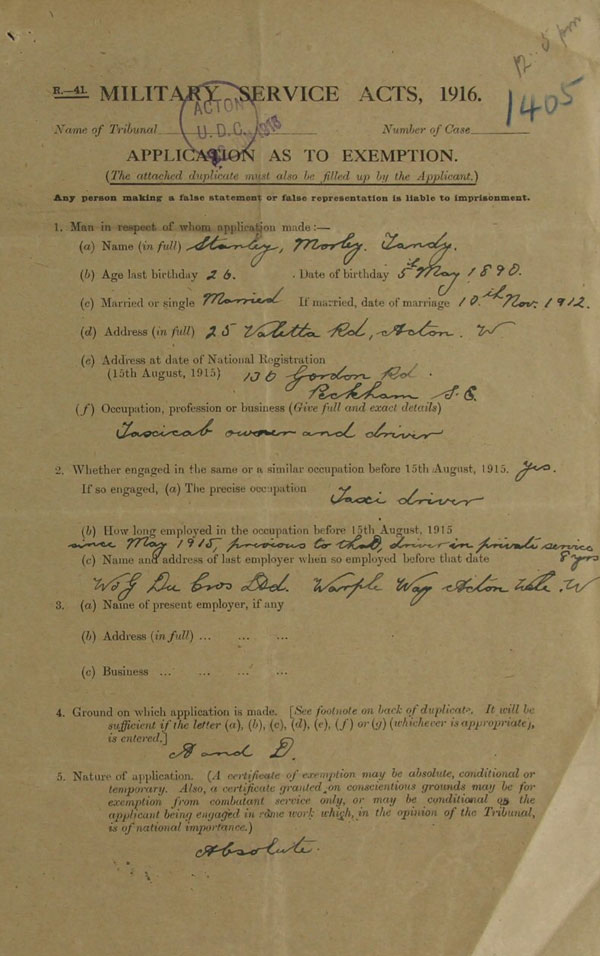
Full application for exemption from military service (catalogue reference: MH 47/15/5)
A notice of decision form, detailing the tribunal’s decision, and conditions of exemption if granted:
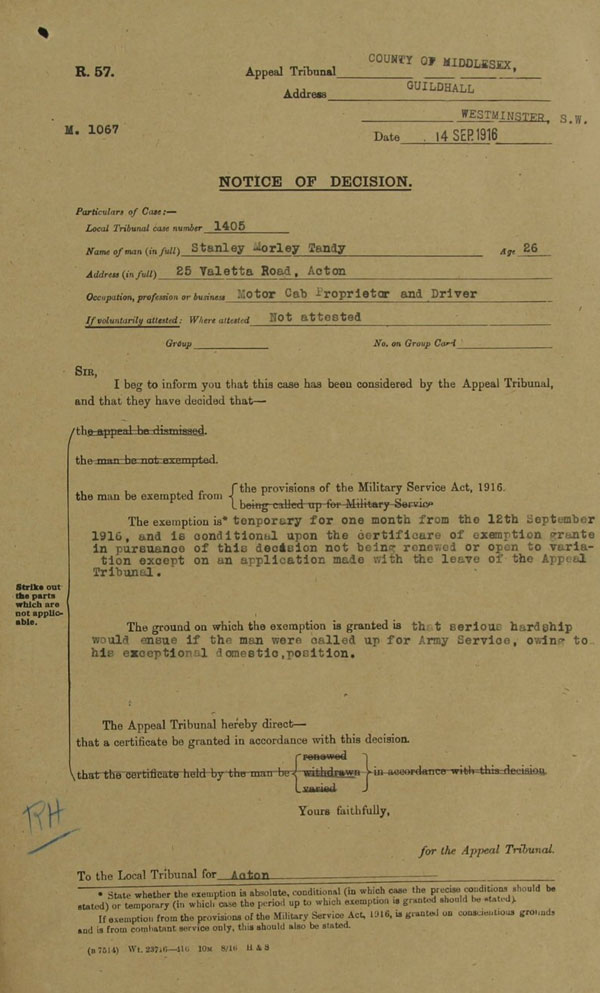
Full notice of decision (catalogue reference: MH 47/15/5)
A pink notice of appeal, giving personal details, the grounds for appeal, local tribunal summary and the decision of the appeal tribunal:
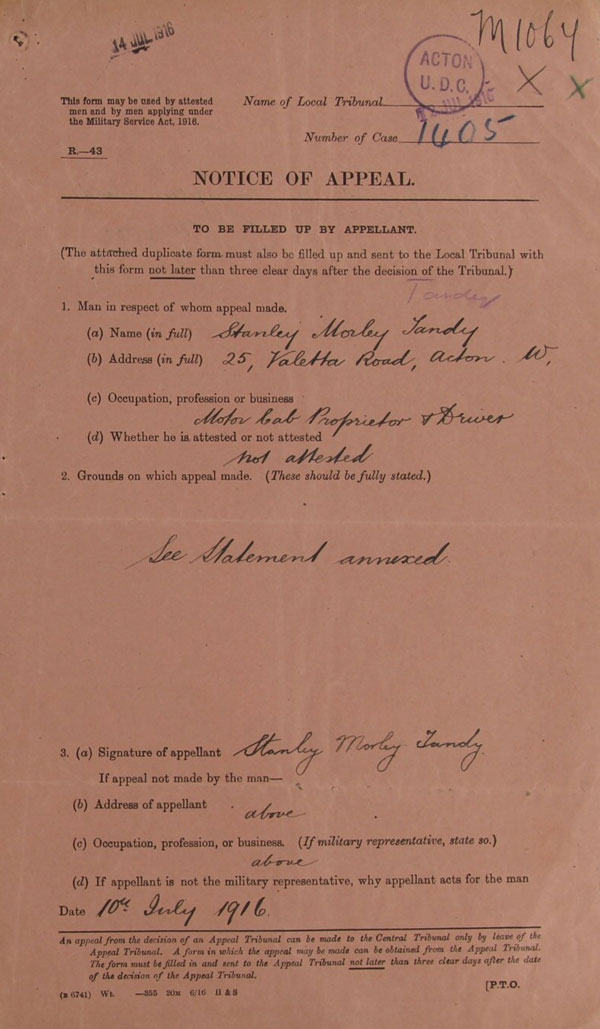
Full notice of appeal (catalogue reference: MH 47/15/5)
Why can’t I find what I’m looking for?
If you cannot find a Middlesex tribunal case paper, browse the rest of the MH 47 series as it contains letter books and administrative lists which may include references to cases not in the case papers.
Please note, these records are for the Middlesex Appeal Tribunal and the Central Appeal Tribunal only. Most tribunal records were destroyed after the war by government order.
Some incomplete sets of records relating to local tribunals are held at local record offices. Search for ‘military service tribunals’ on our catalogue to find out what records are held elsewhere. Refine your results using the filters. Alternatively, open and read our list of records of First World War Military Service Tribunals for England and Wales held at national and local record offices.
A set for Lothian and Peebles in Scotland was retained, contact the National Records of Scotland for further information.
What are these records?
These are applications for the unpaid wages or pensions of deceased officers or their widows. Frequently the applications are from next of kin.
These records, in series ADM 45, cover officers of the Royal Navy and Royal Marines, and civilian employees of the Royal Navy and Naval Dockyards.
What information do they contain?
The records frequently include:
- officers’ date of death
- rank
- name and address of the claimant
- date the claim was admitted and examined
- total value of the effects claimed
Sometimes supporting documents were supplied. Therefore you may find:
- birth and/or marriage certificates
- wills
How do I search the records?
You can search and download the records in Discovery (£) by using the search box below.
Search by name of officer/employee or claimant.
Narrow your search by using double quotation marks to find a person’s full name, such as “James Williams”.
What do the records look like?
Below is an example of a record from ADM 45.
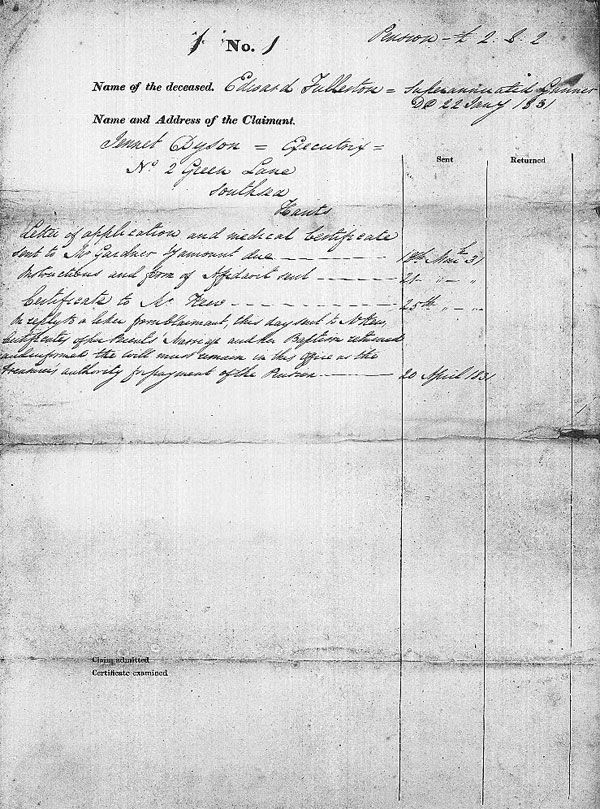
Record of Edward Fullerton (ADM 45/1/1)
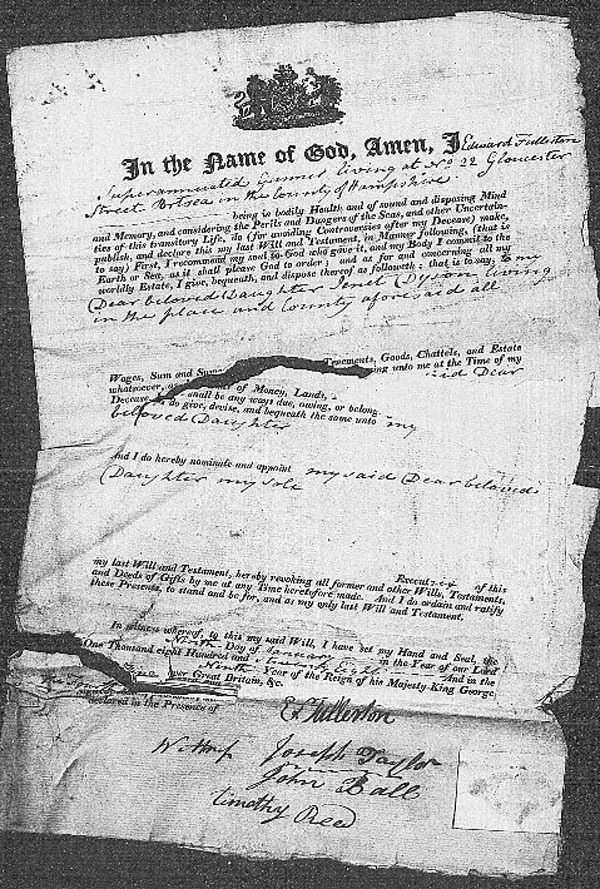
Record of Edward Fullerton (ADM 45/1/1) page 2
Why can’t I find what I’m looking for?
If you are looking for a rating, look in series ADM 44. These ratings’ records are not available to view online.
What are these records?
These are naturalisation petitions completed by individuals applying to become British citizens between 1801 and 1871.
The records include:
- all naturalisation applications to the Secretary of State, 1844-1871
- some naturalisations by private Act of Parliament, 1801-1868
- some letters applying for denization, 1801-1840
Denization entitled people to certain rights, but not the full rights of a British citizen.
These naturalisation and denization papers make up The National Archives’ series HO 1.
What information do they contain?
Until 1844 naturalisation was an expensive procedure which few people could afford. Therefore you can often find applications from royalty.
These case papers can provide quite detailed information on the applicant.
They may contain the following information:
- nationality
- profession
- family details
- birth date
- birth place
- year of arrival into the UK
- address of the applicant
- character reference(s)
How do I search the records?
You can search the records by name in Discovery, our catalogue, using the search box below.
Search by name or country/state of origin.
What do the records look like?
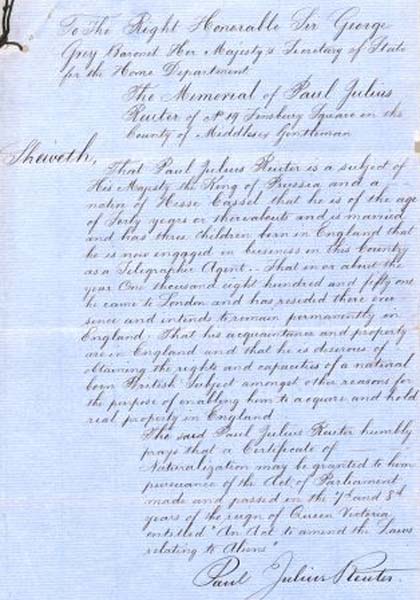
A page from the record for Paul Julius Reuter (catalogue reference: HO 1/79/2403)
Some of these records include seals.The example above is one page from the record for Paul Julius Reuter, founder of Reuters news agency (catalogue reference: HO 1/79/2403).
Why can’t I find what I’m looking for?
If you are looking for enrolled copies of naturalisation certificates for this period, search within C 54.
For records of people naturalised by Private Act of Parliament, see our research guide on Naturalisation, registration and British citizenship.
If you are looking for case papers from 1871 onwards look in HO 45, HO 144, HO 382, and HO 405.
This is a brief guide to researching records of Royal Air Force squadrons, as opposed to records of RAF personnel. Most RAF squadron records have survived and are fairly detailed. They are held in a variety of places, but the majority are at The National Archives.
What do I need to know before I start?
Online records
Operations record books of squadrons (1911-c1963)
Search the operations record books in AIR 27 by squadron number and date range on Discovery, our catalogue (£).
‘Summary of events’ forms, also known as form 540, and ‘detail of work carried out’ forms, also known as form 541, can be found in operation record books. These forms are records of the daily events of all RAF units.
Operations record books for later years are not yet available online but can be viewed at The National Archives at Kew (see below).
Air Ministry Combat Reports (1939-1945)
Search and download Second World War RAF combat reports (AIR 50) in our catalogue (£). The records include reports from squadrons, wings and groups in Fighter, Bomber, Coastal Commands and Fleet Air Arm squadrons. They cover Commonwealth and Allied units based in the United Kingdom including the United States Army Air Force.
Records available only at The National Archives in Kew
To access these records you will either need to visit us, pay for research (£) or, where you can identify a specific record reference, order a copy (£).
Operations record books of squadrons, 1963 onwards
Search AIR 27 by squadron number or name to find relevant operations record books.
Operations record books of stations and miscellaneous units
Search our catalogue for operations record books of stations (AIR 28) and miscellaneous units (AIR 29) for details of the daily events and operations of any RAF unit. You can also add keywords such as training.
Records in other archives and organisations
Non-operational crashes and casualties (1918-present)
The Ministry of Defence Air Historical Branch can provide information on RAF aircraft accidents which occurred over 15 years ago to members of the public in accordance with the provisions of the Freedom of Information Act.
Other resources
Websites
Browse the RAF website for a list of current and historic squadrons and information on their histories, badges, aircraft, and battle honours.
Books
Visit The National Archives’ bookshop for a range of publications on tracing your military ancestors. Alternatively, look in The National Archives’ library catalogue to see what is available to consult at Kew.
Air Force Records for Family Historians by William Spencer (The National Archives, 2008)
The Second World War: A Guide to Records in the Public Record Office by J D Cantwell (PRO, 1998)
1. Why use this guide?
This guide will help you find information about prisoners of war captured by the British.
Very few lists of prisoners of war in British hands have survived and documentation providing biographical information is equally scarce. The records held at The National Archives are predominantly records of:
- general administrative and policy matters
- the implementation of conventions and agreements
2. How to find records
It may be best to start by contacting another organisation, particularly if you are interested in records from the Second World War (see section 7 for details).
To find records held by The National Archives, search our catalogue using keywords. It is not possible to find records using a person’s name (catalogue descriptions for these records do not include names) so, instead, use any of ‘prisoner of war’, ‘POW’ ‘P.O.W’ or ‘P.W.’ plus one or more of the following:
- the nationality of the prisoner
- the eventual outcome for the prisoner (such as resettlement)
- the place, country or region where the camp was based (for example, Egypt or Bermuda) – there were British POW camps on British territory around the world, not just in Britain
- the camp number (for example, 306)
- any other term you think may match a record description
Then filter by date and/or by department to get the most relevant results. Departments responsible for POWs include Admiralty (ADM), Foreign Office (FO), Home Office (HO) and War Office (WO).
A selection of prisoner of war records are available online via Findmypast (£) however these records are predominantly for British prisoners of war.
3. Second World War
The National Archives does not hold comprehensive lists of ex-POWs, detainees, displaced persons (DPs), persons released or tried or former forced labourers from the Second World War but does hold administrative records relating to the same. There are other organisations that may prove better places to start your research if you are looking for records of individual PoWs in British hands – see section 7 for details.
Those records that we do hold relating to enemy POWs include the following:
3.1 POWs, 1939-1945
- incomplete sets of interrogation reports for enemy prisoners (mostly German) held by the British – search within WO 208 for the term ‘interrogation report’ in combination with ‘German’, ‘Italian’ or ‘Japanese’ or browse from WO 208/5521 to WO 208/5556 for interrogation reports of POWs held in the United Kingdom and from WO 208/5507 to WO 208/5520 for interrogation reports of POWs held in British hands in Africa, the Middle East and the Mediterranean
- Control Commission interrogation reports in FO 1050/169
- interrogation reports for enemy airmen in AIR 40/2394-2431 and captured naval survivors in ADM 186/806-809
- lists of enemy POWs in colonial territories in CO 968/35/1-5
- student record cards of prisoners of war who attended the Wilton Park centre prior to repatriation to Germany (and occasionally Austria) in FO 1120
- Reports of Escapes of German POWs in CAB 114/23 and CAB 114/24.
3.2 POW camps and treatment of prisoners, 1939-1945
- lists of POW camps and documentation on the employment of prisoners, principally Italian, in WO 199/404-409 (individuals tend not to be named)
- inspection reports on POW camps in FO 916
- files on individual POW camps in the United Kingdom in FO 939
- reports on the health of POWs and the work of POW hospitals in WO 222
- Prisoner of War Information Bureau (PWIB) records in WO 307, and its overseas sub-bureaux in CO 323, FO 916 and WO 32
- war diaries of a few hospitals, depots and camps in WO 177/1833-1855 – also check British Army Second World War diaries
- files on the internment of POWs in HO 215
- correspondence on the treatment of interned enemy aliens in HO 213/494-498
- location list of prisoner of war camps in the UK in FO 1120/182
- German camp visit reports in FO 1120/206-249
- Employment of German and Italian POWs in CAB 114/25-33
3.3 Ex-PoWs and displaced persons after 1945
The British Element of the Control Commission for Germany assumed full responsibility for the administration of the British occupied zone from 1945. Their files are in the records of the Foreign Office (FO). To identify records, use the printed volumes of Control Commission for Germany, British Element: inventory 1945-1955, available in the reading rooms at The National Archives in Kew, and the associated index to general Foreign Office correspondence. Documents are listed under ‘Displaced persons’ and ‘Prisoners of War’.
3.4 POW policy records
- correspondence with US authorities on general POW policy in CAB 122
- POW-related Prime Minister’s Office papers in PREM 3
4. First World War
The National Archives holds no lists of First World War enemy POWs. For records of individual prisoners it will usually prove more fruitful to contact another organisation (see section 7).
Lists of names of enemy prisoners and internees were routinely forwarded to the Prisoners of War Information Bureau (PWIB) in London, which in turn informed the International Red Cross Headquarters in Geneva. Unfortunately, bombing in 1940 largely destroyed the lists and other documentation compiled by the Bureau.
However, you can find some related records at The National Archives, including:
- two specimen lists of army, naval and civilian German POWs in WO 900/45-46: these give the regiment, ship and usually the home address, place of internment, remarks regarding health, and date of transfer to internment in a neutral country
- a summary of the work and history of the Prisoner of War Information Bureau in WO 162/341
- occasional mentions of enemy POWs by name within the card index of the General Political Correspondence of the Foreign Office: if you find an entry you can often convert it into an FO 383 reference
- files on the employment of enemy POWs in Britain in NATS 1/567-571
- correspondence on enemy merchant seamen taken prisoner in MT 9 and MT 23
5. Boer War, 1899-1902
You can find:
- registers of Boer war prisoners, recorded in prisoner number order and arranged by area of confinement (for example, Natal, Transvaal), in WO 108. Please note, some of these are available on Findmypast (£).
- correspondence on their confinement in CO 537
- correspondence on Dutch, German and French prisoners in FO 2/824-826
- lists of prisoners embarked from or returned to South Africa, with correspondence relating to them in the records of the Admiralty, Transport Department, MT 23
6. Prisoners of war up to 1855
There is no general index to prisoners, so searching for individuals may be hard.
Search our catalogue within ADM 97, ADM 105 and ADM 103 and refine by date.
You can find:
- lists of prisoners, usually arranged by nationality or by place of confinement or parole, in ADM 103: these often include circumstances of their capture and eventual disposal – some of these are available on Findmypast (£)
- prisoners’ petitions in ADM 97
- lists of POW exchanges, for example WO 40/2 and WO 1/905-16
- circumstances of capture and incarceration in WO 1 and WO 4
An alphabetical list of American prisoners compiled by the University of Virginia is available at The National Archives and supplements a general register of American prisoners (1813) in ADM 6/417. Please note, ADM 6/417 is available on Findmypast (£).
Browse lists of enemy prisoners on parole in Britain in HO 28. This is not indexed.
7. Records in other organisations
Visit the International Red Cross website for information on requesting access to their records of POWs and civilian internees in both World Wars.
Visit the Imperial War Museum website for information on accessing photographs of POWs in both World Wars.
Contact the International Tracing Service (ITS) at Bad Arolsen if you are searching for people in concentration camps.
Contact the German Federal Archives (for German POWs) and Ministero della Difesa (for Italian POWs).
The Wiener Holocaust Library has a unique collection of material relating to prisoners of war’s experiences in camps in Europe, the USA and in Britain – see their website for more information.
Try searching for details of British POW camps in local archives around the UK.
You may also find it useful to contact a local history group.
8. Further reading
The following publications are all available in The National Archives’ reference library. There is also a wide range of history titles in our bookshop.
Birke, Booms and Merker (eds), Control Commission for Germany: British Element, Inventory
Panikos Panayi, Prisoners of Britain: German Civilian and Combatant Internees during the First World War (Manchester University Press, 2012)
Lists of Places of Internment (Imperial War Museum) covers the First World War
1. Why use this guide?
Use this guide for advice on how to find individual items among The National Archives prodigious collection of maps of the British Isles and places around the globe. Much of the advice can also be applied to finding plans of buildings, fortifications, civil engineering projects and architectural layouts of numerous other kinds – but for more detailed, targeted advice on finding plans see our guide to architectural drawings. Our collection of maps and plans is estimated to number over six million items. For a more succinct overview of the maps collection see our maps exhibition pages.
To see the maps or plans themselves you will need to visit us or request copies to be sent to you (£). Only a tiny minority of them are available to view online.
The National Archives is not an official place of deposit for published maps, and though we do hold a large number of them, if you are searching for a published map, including published Ordnance Survey maps, you should start your search at a legal deposit library such as the British Library.
For advice on finding Admiralty maps and charts, see our guide to sea charts.
2. The span of the collection
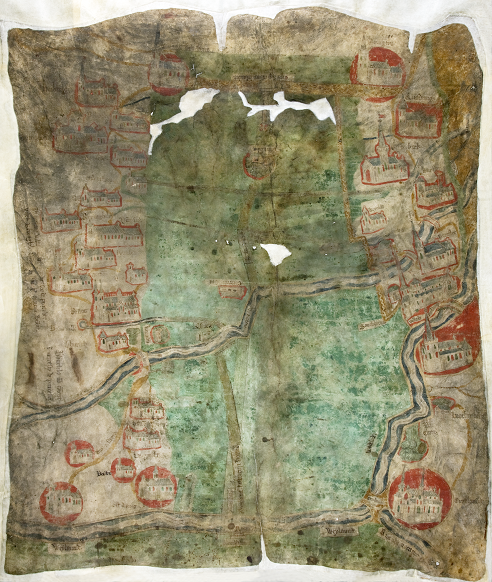
This map from our collection dates from around 1430 and depicts Holland Fen in Lincolnshire (catalogue reference MPCC 1/7).
The National Archives holds central government and court records that have been selected for permanent preservation. Our maps are among these records, and most, broadly speaking, have played a part in the working life of their government department, agency or law court of origin, though some were inherited or acquired in some other way. They reflect countless areas of government and court business, including:
- surveys of numerous kinds
- landholdings of the Crown and government
- taxation policy and collection
- public transport undertakings
- public utilities projects
- cases of litigation relating to land
- military conflicts and campaigns
- British interests overseas
Our oldest maps date back to the medieval period but the bulk of the collection is from the 17th to 20th centuries. Our most recent maps date from around twenty years ago.
Broadly speaking, we hold more maps of areas within England and Wales than Scotland and Northern Ireland (or, before 1922, the whole of Ireland). Our holdings do include maps with large-scale local detail but, in general, for maps of local areas the best place to start is a local county or metropolitan archive. We also have maps of estates, large and small, though, again, The National Archives is not normally the best place to start a search for such material, except for maps of Crown estates.
We hold many maps of places outside the British Isles, covering most areas of the world. However, records and maps once held by the India Office, including those of India, Pakistan, Burma and Bangladesh, are now held at the British Library.
Watch our Spotlight On: Maps video for a brief introduction to maps at The National Archives.
3. Understanding our maps and how they are arranged
As with all the various types of records held at The National Archives, our maps are arranged not according to theme or geographical area but according to the government department or court of law which created or acquired them. Rather than a single coherent collection of maps, it is more accurately a vast and varied assortment of tens of thousands of smaller collections and individual items.
Most of the maps held here have been transferred with the despatches, reports, files or other papers with which they were originally associated in the course of departmental business. These can be tricky to find though many have been identified in our catalogue. There is more advice on this in section 4.
To understand and interpret many of our maps it often helps to also review the text-based records that invariably accompany them.
3.1 Collections created by government departments
A few government departments created their own collections of maps which have subsequently been transferred to The National Archives in discrete record series and as such they are relatively easy to locate. For some departments, such as the Ordnance Survey, Tithe Commission and the Valuation Office, maps were at the very heart of the business in which they were engaged. The Colonial Office, Foreign Office and War Office acquired so many maps that they created their own map collections. In all these instances it is also relatively easy to say which series of records you can expect to find maps in and we provide links to the major collections in subsequent sections of this guide.
3.2 Collections created by The National Archives (and Public Record Office)
The National Archives (and its predecessor the Public Record Office) has itself created record series that consist entirely or largely of maps and plans, drawn from a wide variety of departments (they are listed in the appendix of this guide). Most of these series have been created by extracting maps from the documents with which they were originally held. In some instances these were documents from one coherent series, in other instances they were from a variety of different series and departments. This is done primarily as a preservation measure, usually because each item exceeds the overall size of the parent document of which it formed a part. So that the link between the map and the parent document is not lost, a ‘dummy’ sheet is inserted in the parent document, briefly describing the extracted map and giving its new reference (sometimes referred to as a ‘map extract reference’) while the extracted map itself is also endorsed with the reference of the parent document.
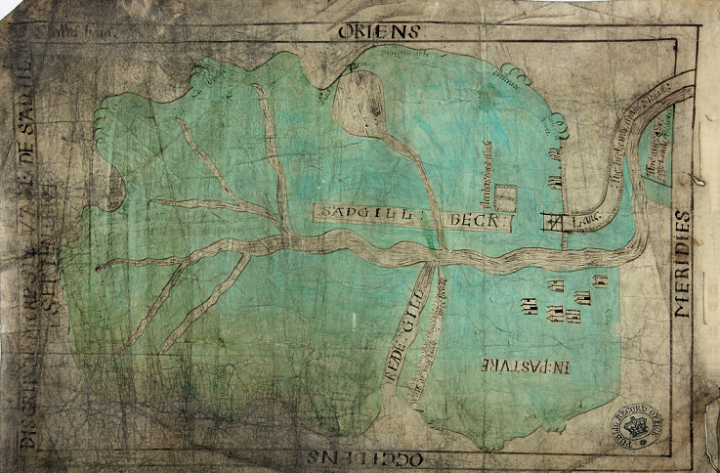
‘Discriptio more sive vasti de Sadgil’: three plans of the moor and waste of Sadgill, Westmoreland (catalogue reference MPB 1/61).
4. How to search for maps
The starting point for most searches at The National Archives is our online catalogue, in which all our records are listed and described in varying degrees of detail. However, some maps are listed in the catalogue in little detail and many others are not listed at all. For a more comprehensive search, and more detailed index descriptions, you will need to visit our building in Kew to consult paper catalogues and calendars. In almost all instances, to see the maps themselves (once you have located references) you will also need to be in our building – though you may be able to request copies of some maps to be sent to you, using our record copying service (£). A tiny minority of our maps are available to view online (see section 5.2 and section 9).
Some maps remain unidentified within the records in which they were transferred. To track down unidentified maps, you will need to evaluate which government department might have created or collected them, in what way, and for what purpose.
4.1 Searching for maps using our online catalogue
You can target map series in the catalogue by going to the series references listed in the appendix and the subsequent sections of this guide. However, some series that are described as consisting of ‘maps and plans’ include material which is not, or not strictly, cartographic, such as topographical, architectural or technical drawings, or, less commonly, photographs, posters and other non-textual items.
Many maps are held within files of predominantly written records, so if you can’t find what you are looking for in a map series you may need to search across our entire catalogue (which you can also do using the advanced search option).
4.2 Searching for maps using published catalogues
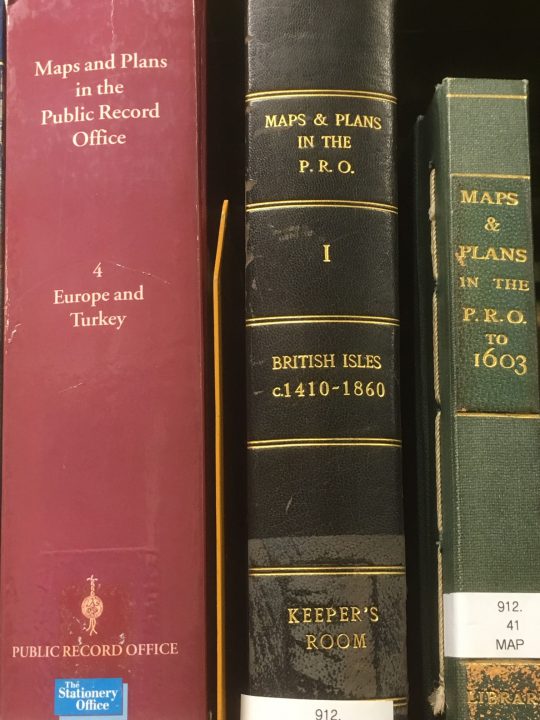
Some of the published catalogues of maps and plans held at The National Archives (previously the Public Record Office).
Four volumes of ‘Maps and Plans in the Public Record Office’ are available in The National Archives reading rooms, as well as in some libraries. These catalogues describe only a fraction of the maps in The National Archives (formerly the Public Record Office) and much of the cartobibliographic information is incomplete. They are, nevertheless, useful finding aids. The four volumes are:
- British Isles c1410-1860 (HMSO, 1967)
- America and West Indies (HMSO, 1974)
- Africa (HMSO, 1983)
- Europe and Turkey (TSO, 1998)
Their contents are arranged topographically under country names in use at the date of publication, and then chronologically within each region, country or place. They contain indexes of draughtsmen, surveyors and cartographers, but not of subjects.
4.3 Searching for maps using the card catalogue
There is a card catalogue, held in drawers in our Map and Large Document Reading Room at our site in Kew. It is arranged topographically, under the names of countries in use at the date of cataloguing. A separate drawer contains a card index to names of draughtsmen, surveyors and cartographers. There is no subject index.
This card catalogue contains information about maps not covered by the published catalogues (see above) as well as maps which have come to light since their publication. The cards list maps small enough to remain in their parent documents. Please note, however, that cards relating to maps extracted from documents and other map series (see Appendix) have been removed and the descriptions entered into our catalogue.
4.4 Searching for maps using the ‘summary catalogues’, ‘draft catalogues’ and calendars
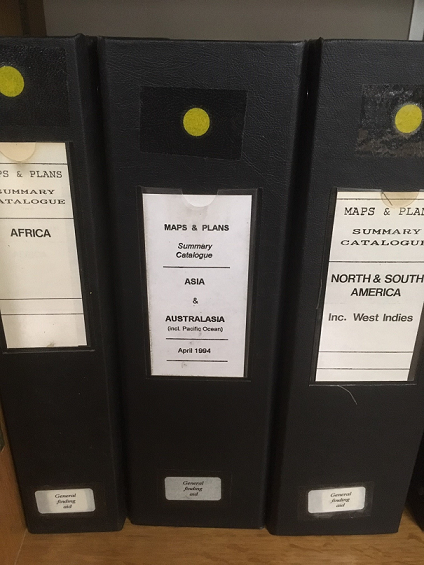
Three volumes of our ‘Summary Catalogues’, located in the Map and Large Document Reading Room at The National Archives in Kew.
A set of maps and plans ‘summary catalogues’, some laid out in calendar form, are available in the Map and Large Document Reading Room at our site in Kew. They provide an index to maps, plans and drawings scattered throughout our collections but not to maps extracted from documents to map-only series (see Appendix). The catalogues provide brief references (though the amount of detail recorded varies) which may relate to just one or a large number of maps. They were compiled in the late 1980s and early 1990s.
These catalogues comprise the following:
- Ten volumes covering the British Isles, arranged by county and country in calendar form
- One volume covering Africa
- One volume covering Asia, Australasia and the Pacific
- One volume covering North America, South America and the West Indies
- Three volumes of subject indexes, covering everything from ‘accidents’ to ‘zoological gardens’, with useful entries such as ‘forests and woods’, ‘harbours’, ‘islands’, ‘rivers’, ‘town plans’ and so on
- Two volumes of draft typescript and manuscript catalogue entries for maps of South-East Asia and Japan
5. Local maps and plans
The best places to start a search for local-area maps are county and metropolitan archives where you may find, for example, diocesan and parish copies of tithe maps, or Valuation Office working plans. You can use our Find an archive tool to get contact details for these local archives or search for map references in their collections using our catalogue (which contains details of collections of over 2,500 archives around the UK).
We do, nevertheless, hold a wide variety of maps that show local detail from around the country, including maps created by the Ordnance Survey (for more on which, see section 6). These historical local maps can be used to identify place names which no longer exists; locate buildings, roads and other features of the landscape that may have changed; and in some instances they document the ownership, value and use of land.
5.1 County maps and town plans
Widely scattered among our records are county maps and plans of towns and cities, some of them very detailed. The series listed below contain significant numbers of these maps and plans.
Click on the reference links to search each series by name of county, city, town or other place name:
- WO 78 – maps from the UK and overseas compiled and collected by the Ordnance Office, the Ordnance Survey and the topographical branches of the War Office and British Army
- MPH 1 – maps from the War Office, many of which were formerly held in WO 78
- MPHH 1 – maps from the War Office, many of which were formerly held in WO 78
- LRRO 1 – maps and plans from the Office of Land Revenue Records and Enrolments
- MPE 1 – maps formerly held by the Office of Land Revenue Records and Enrolments and by the Crown Estate
- MPEE 1 – maps formerly held by the Office of Land Revenue Records and Enrolments
- T 72 – maps and plans of the Municipal and Parliamentary Boundaries Commission
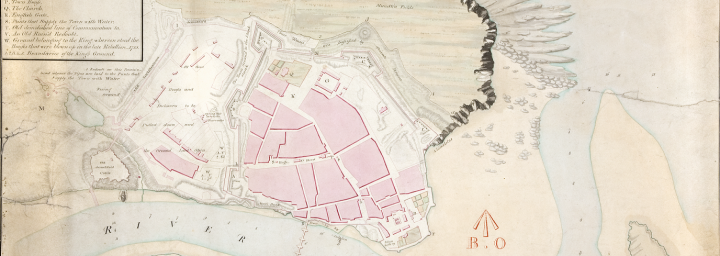
A town plan of Berwick-on-Tweed in Northumberland from 1808 (catalogue reference MPH 1/228/1). This is a cross section of one of four sheets used for military purposes – many of our older town plans were created or acquired for military use.
There are also six series of maps formerly held by the Public Record Office Library which include county, city and town maps, held in the ZMAP department (see section 10).
5.2 1871 census maps
View digital versions of the original registration district maps from the 1871 census (RG 18) on the Cassinimaps (£) website.
5.3 Estate plans
An estate plan is a large-scale plan showing the property of a single owner or corporate body such as a college or a branch of the military. Often they will include elevations of buildings such as churches and manor houses and are held with documents describing the occupiers or lessees.
Though many estate plans are held in local record offices, we do hold significant numbers here, especially for land owned by the Crown. The following National Archives records departments all hold large numbers of maps of estates which are or were formerly owned by the Crown (department codes are in brackets):
- Crown Estate (CRES)
- Forestry Commission (F)
- Land Revenue Record Office (LRRO)
- Office of Works (WORK)
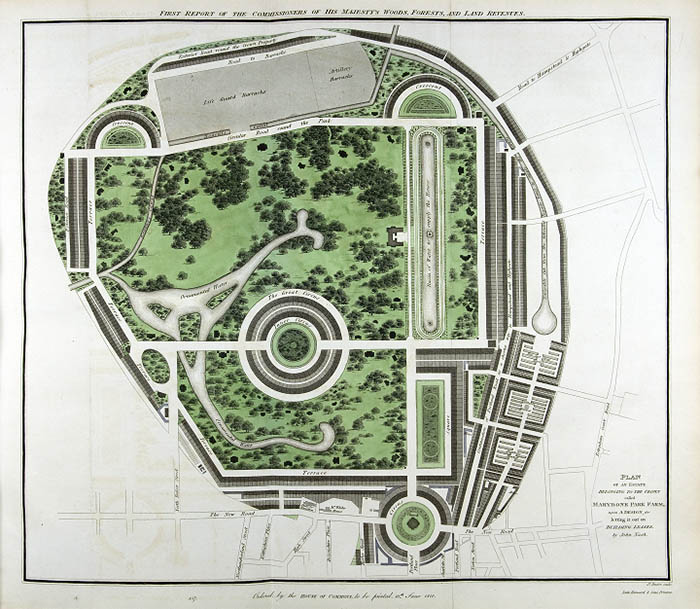
John Nash’s plan of Regent’s Park, a Crown estate originally called Marylebone Park, from 1812 (catalogue reference CRES 60/2).
Other notable sets of estate plans exist within the records of many other departments, among them:
- The Admiralty (ADM)
- The War Office (WO) and the Board of Ordnance division
- The Duchy of Lancaster (DL)
- The Palatinate of Chester (CHES)
- The Palatinate of Durham (DURH)
5.4 Enclosure award maps
Enclosure awards and the maps that accompanied them recorded the ownership and distribution of land and can be used to establish not just the land owners themselves but the extent of the land owned, the rent charge payable on it and local details including roads, rights of way and boundaries. Most of our enclosure maps date from 1800 to around 1850.
For more information see our guide to enclosure awards.
5.5 Tithe surveys
The Tithe Commission, in its work conducting the mid-19th century tithe surveys, accumulated over 10,000 maps of local areas around England and Wales. Most of these were large-scale maps showing significant amounts of detail.
You can view online images of the maps at The Genealogist (£) online. Search for a place by entering the place name in the ‘Keywords’ field.
Alternatively, for those maps not available online, use the box below to search our catalogue for references to tithe maps (IR30) and apportionments (IR 29) by place name.
For more information see our guide to tithe records.
5.6 Valuation Office Survey, 1910-1915
In the work of the Valuation Office Survey, carried out between 1910 and 1915, thousands of Ordnance Survey map sheets were used, annotated by the surveyors. They provide a detailed picture of the landscape, both urban and rural, and the records that accompany them include descriptions and plans of all kinds of buildings, including private houses.
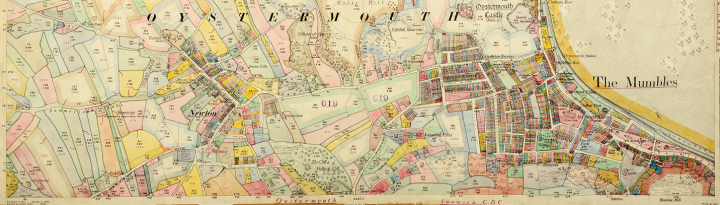
Cross section of a map of the Mumbles district and other districts in Swansea, Wales, marked up for the Valuation Office Survey (catalogue reference IR 131/9/181).
The maps and records are now held within the 124 series of the Valuation Office. For further detail, see our guide to Valuation Office records.
5.7 National Farm Survey of England and Wales, 1941-1943
The National Farm Survey of 1941-1943 was carried out by the Ministry of Agriculture and Fisheries in response to food shortages and the need to increase productivity during a time of war. The survey covered around 300,000 farms and agricultural holdings and has been referred to as a ‘Second Domesday Book’. Ordnance Survey maps were used as a base for the survey. Handwritten detail was added to these base maps showing where each farm lay, its boundaries and its extent.
See our guide to the survey for advice on how to locate individual maps and records.
5.8 Plans deposited with private bills
More than 28,000 plans were deposited in the House of Lords and House of Commons in association with private bills. These include plans relating to:
- canals, navigations and water bills (from 1794)
- docks and harbours (from 1800)
- railways and tramroads (from 1802)
- town improvements, streets and paving (from 1811)
- turnpike roads and bridges (from 1814)
- other infrastructure and local improvement schemes.
Some plans relate to bills that were never introduced or ultimately passed. Others include annotations added during committee stages, showing how proposals were discussed or amended. Plans may include related materials, such maps showing affected areas, and reference books identifying impacted property owners.
Plans deposited with private bills can be found in the catalogue by searching for the bill name under references YHL/PO/PB/3 and YHC/CL/PB/6 using advanced search.
6. Ordnance Survey maps
Among the most significant branches of government to have created or acquired large numbers of maps and deposited them here is the Ordnance Survey (OS), the national mapping agency. Although we do hold some maps published by the Ordnance Survey, held in the ZOS department, we are not an official place of deposit for them. Their normal place of deposit is the British Library and the other legal deposit libraries.
Though originally part of the military when it was established in the 18th century, the Ordnance Survey has long been responsible for government surveying and cartographic work of all kinds including work done for local authorities. Its maps, many of them large scale, cover all parts of the United Kingdom.
You can view digital versions of old Ordnance Survey maps and other historical maps at the National Library of Scotland website, which includes English Ordnance Survey maps and maps from around the British Isles, and on commercial websites such as old-maps.co.uk (£).
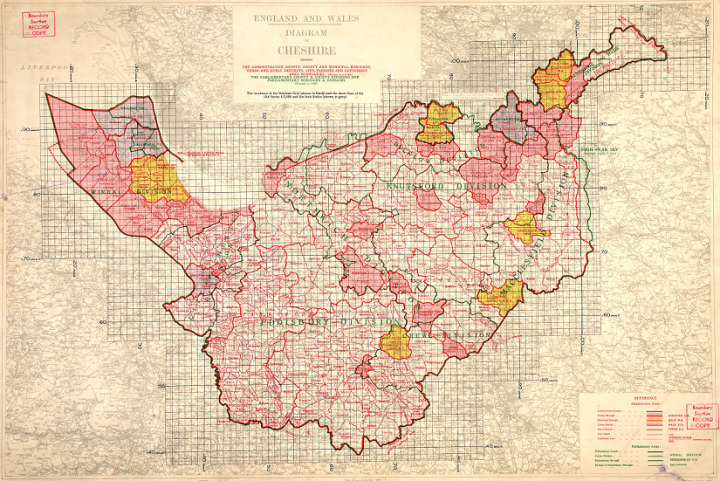
A 1949 map of Cheshire from the Ordnance Survey’s Administrative Area Diagrams Archive (catalogue reference OS 76/204).
The bulk of the OS maps held here are draft and unpublished maps used in the work of the department. Several OS series consist of substantial quantities of OS mapping, often with manuscript annotations or overprinting reflecting their use in the conduct of government business. For more details see our Ordnance Survey research guide.
7. Railway company and transport maps
The records of railway companies prior to the nationalisation of the railways in 1948 are held at The National Archives and include several substantial series of maps and plans, many of which show much detail besides just the railway lines and railway infrastructure that you would expect. Ordnance Survey maps and maps printed by commercial map publishers were used by the railways and include the same level of detail found on any topographical or geographical large-scale map.
Under the Transport Act 1947 the railways, canals, long-distance road haulage and various other types of transport were acquired by the State and operated by the British Transport Commission. Maps and plans of the commission, formerly held among what were known as British Transport Historical Records are now, slightly confusingly, held under railway records references (RAIL) and are as follows:
- RAIL 1029 – plans of proposed and constructed canals and maps of the inland navigation network, but also includes some plans of rivers, wharves and docks.
- RAIL 1030 – principally maps and plans of proposed and constructed railways but includes some Ordnance Survey maps.
- RAIL 1031 – maps and plans of railways and canals but mainly depicted on general maps covering relatively large areas, not maps of individual railway lines. Many show the whole of Great Britain or the whole of England and Wales.
- RAIL 1032 – maps and plans of railway lines formerly held by the Railway Clearing House, a revenue transfer organisation.
- RAIL 1033 – maps, plans and surveys of towns, ports and local areas.
- RAIL 1034 – maps and plans of London and London transport.
- RAIL 1035 – ordnance survey maps, atlases and other general maps as well as station maps.
- RAIL 1036 – maps, plans and surveys from overseas including North American, South American and Japanese railways maps, plus maps of European countries and their railway networks.
- RAIL 1037 – includes sets of Ordnance Survey maps of Yorkshire, Durham, Westmoreland and Cumberland from c.1860 and of other large tracts of northern England from the 19th and early 20th centuries, as well as railway maps from all over the country, but particularly in the north.
- RAIL 1071 – parliamentary deposited plans relating principally to railways but including a few for canals and tramways.
-
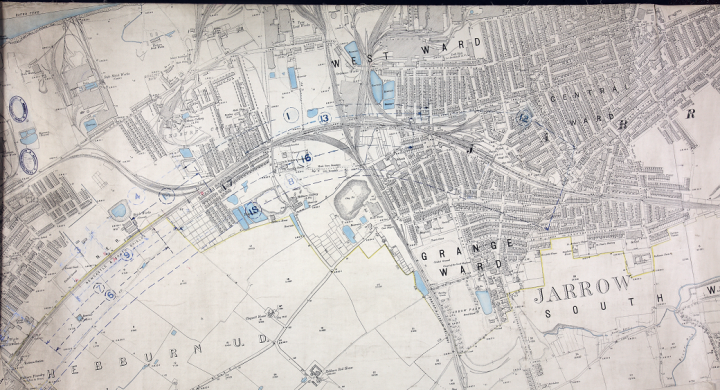
An Ordnance Survey map used for railway planning, showing Hebburn Station near Tyne Dock in north-east England (catalogue reference RAIL 1037/183).
8. Military maps
The National Archives holds multiple thousands of military maps, many of them amassed by the War Office and subsequently the Ministry of Defence. There is a particularly significant collection from the First World War. Large numbers of them are official maps made by or for the British government and armed services, including many trench maps. Others are foreign maps that were acquired and used by the War Office.
There are countless military maps for other wars and campaigns, including the Second World War, though we hold very few separate sets of maps comparable in extent to the First World War maps.
One of the major military map collections, spanning four centuries, is WO 78, an array of over 6,000 sheets, rolls and volumes.
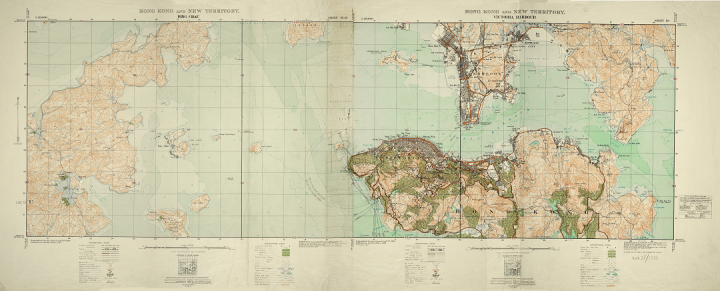
A military survey map of Hong Kong from 1932 (catalogue reference WO 78/5333).
For further detail, see the research guides Military maps of the First World War and Military maps of the Second World War.
9. Overseas maps
We hold maps and plans generated or collected by the various departments of state responsible for the administration of British territories overseas and for the foreign relations of England, Wales and the United Kingdom since the 16th century. These include:
- The State Paper Office (the offices of the Secretaries of State up to 1782)
- The Foreign Office (created in 1782)
- The Colonial Office (created in 1854)
- The Dominions Office (created in 1925)
- The Commonwealth Relations Office (succeeded the Dominions Office in 1947)
- The Foreign and Commonwealth Office (created in 1968)
We hold significant numbers of Irish maps, including a State Papers Ireland collection comprising over 70 maps depicting plantations, fortifications and townships during the reigns of Elizabeth I and James I. Search and download (£) these early Irish maps (MPF 1/35 to 102) from our website.
Among the most significant of the overseas collections are the records of the Foreign Office and the Colonial Office. Some of the most notable overseas map series are:
Use the box below to search our catalogue, by country or place name for maps and plans from the Foreign Office, Colonial Office and War Office map libraries in FO 925, CO 700 and WO 78.
For more detail about these series and other overseas maps, see our guide to overseas maps and plans.
10. Published maps
Sets of published maps, formerly held in the Public Record Office Library, are held under department code ZMAP. There are six series:
- Miscellaneous maps and atlases in ZMAP 1
- Atlases formerly held by HM Customs in ZMAP 2
- Atlases formerly held by Inland Revenue in ZMAP 3
- Maps of London reproduced by the London Topographical Society in ZMAP 4
- Facsimile reproductions of maps and charts in ZMAP 5
- Ordnance Survey of Scotland maps, 1858-1887, in ZMAP 6
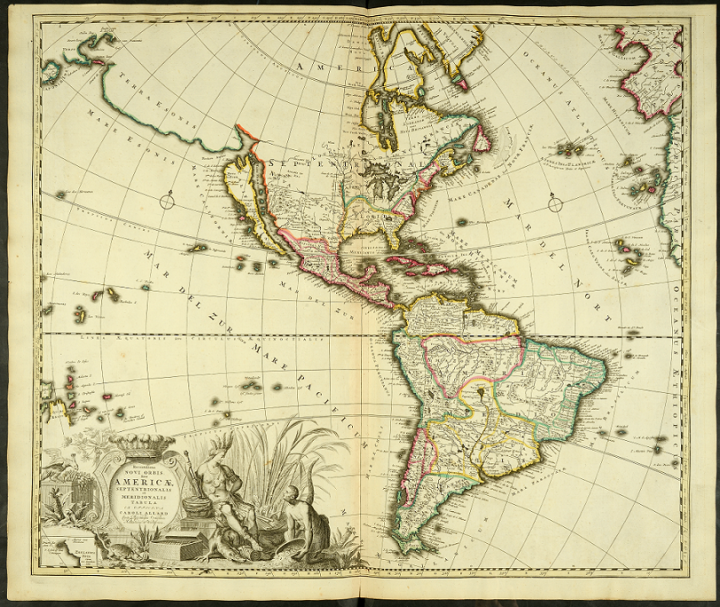
An early 18th century map of America (catalogue reference ZMAP 2/1), one of the published maps held at The National Archives.
See section 6 for details of the published ordnance survey maps held here in department ZOS.
11. Related national archives and libraries with map collections
The following archival institutions and libraries in the UK and Ireland hold collections of maps related, either by provenance or content, to maps held in The National Archives:
- British Library, Map Library – holds vast collections of both manuscript and printed/published mapping, including major holdings of UK Ordnance Survey maps and printed Admiralty charts. It also holds the archives and library of the former India Office.
- National Library of Scotland – more than 200,000 online image of maps of Scotland, England, Wales and beyond plus many more maps in this huge and varied collection.
- National Records of Scotland – holds large numbers of maps and plans.
- Public Record Office of Northern Ireland (PRONI) and the National Archives of Ireland (NAI) both hold records relating to Ireland prior to 1922. From 1922 onwards, holdings of official records are those of the respective governments of Northern Ireland and of the Irish Free State (1922-1949) and Republic of Ireland (since 1949).
12. Further reading and sources of information
12.1 Guides to maps and records at The National Archives
There is no comprehensive survey of National Archives maps, published or among the records. However, some publications, including some published by The National Archives, offer advice on specific records or research topics which include maps. They include:
Geraldine Beech and Rose Mitchell, ‘Maps for Family and Local History’ (2004)
Ian F W Beckett, ‘First World War: The essential guide to sources in The National Archives’ (2002)
J D Cantwell, ‘Second World War: A guide to sources in the Public Record Office’ (rev edn, 1998)
Cliff Edwards, ‘Railway records: a guide to sources’ (2001)
Mary Ellis, ‘Using manorial records’ (1997)
Nick Barratt, ‘Tracing the history of your house’, The National Archives, (2nd edition, 2006)
Janet Foster and Julia Sheppard, ‘British Archives: A Guide to Archive Resources in the UK‘ (4th edn, Palgrave Macmillan, 2002).
12.2 History of maps and mapping
Three publications of general background interest are:
W A Seymour, ed, ‘A History of the Ordnance Survey’ (Dawson, 1980)
Catherine Delano-Smith and Roger J P Kain, ‘English Maps: A History’ (British Library, 1999)
Brian Paul Hindle, ‘Maps for local history’ (B T Batsford, 1998)
12.3 Online sources
See our other online guide to National Archives maps and plans.
A valuable online guide to map holdings in both libraries and archives in the United Kingdom is the Directory of UK Map Collections, maintained by the British Cartographic Society.
A major online gateway to information on the history of cartography, including details about many map collections held in institutions worldwide, is the site ‘Map History/History of Cartography’ maintained by Tony Campbell, formerly Map Librarian of the British Library: maphistory.info/
Read the University of Nottingham Manuscripts and Special Collections guide to using historical maps and plans.
Appendix: Maps extracted from documents and other map series
The table below lists the map series created by The National Archives (and the Public Record Office) by extracting maps from the documents with which they originally existed. For an introduction to these series, see section 3.2.
Some of these series, as the fourth column indicates, contain maps which were drawn from other map series. Nine series of maps were accessioned by The National Archives whose contents were then redistributed into the ‘extracted’ series. In these instances, either the original references (for example, DL 31) or the newly created references (for example, MPC 1) can be used to request and cite the respective maps.
| Department/s from which the maps were extracted | Dates extracted | Catalogue reference | Map series whose maps were transferred to the extracted series |
|---|---|---|---|
| British Transport Commission | – | MPT | |
| Chancery | Before 1989 | MPA and MPAA | |
| Colonial Office | Before 1989 | MPG and MPGG | |
| Court of Common Pleas | Before 1989 | MPL and MPLL | |
| Court of King’s Bench | Before 1989 | MPN and MPNN | |
| Duchy of Lancaster | Before 1989 | MPC and MPCC | Pieces moved to MPC 1 and MPCC 1 from DL 31 (Duchy of Lancaster Maps and Plans) |
| Exchequer | Before 1989 | MPB and MPBB | |
| Foreign Office | Before 1989 | MPK and MPKK | |
| Forestry Commission | Before 1989 | MPO | Pieces moved to MPO 1 from F 2 (Plans of Land entitled to Common Rights under New Forest Acts 1949 and 1964) |
| Office of Land Revenue Records and Enrolments | Before 1989 | MPE and MPEE | Office of Land Revenue Records and Enrolments and predecessors: Associated Departments and successors: Maps and Plans – most pieces from 1 to 3004 were moved to MPE 1, MPEE 1 and MR 1. Pieces subsequently transferred to The National Archives have been kept under their LRRO 1 references |
| Privy Council | Before 1989 | MPQ and MPQQ | |
| State Paper Office | Before 1989 | MPF and MPFF | Pieces moved to MPF 1 from SP 112 (State Paper Office Domestic and Foreign Maps), from pieces 1 to 65 |
| Treasury and Treasury Solicitor | Before 1989 | MPD and MPDD | Pieces were moved to MPD and MPDD 1 from T 62 (Treasury Miscellaneous Maps and Plans Series I) and T 63 (Treasury Miscellaneous Maps and Plans Series II) |
| War Office | Before 1989 | MPH and MPHH | Just under 2000 pieces from WO 78, in the range between 291 and 4996, were moved to MPH 1, MPHH 1 (and MR 1), though a few of these have since been returned to their original WO 78 references (pieces subsequently transferred to The National Archives have been kept under their WO 78 references) |
| Various departments (mainly atlases and maps of unusual form) | Before 1989 | MPZ | The single piece from CRES 33 (The Crown Estate Commissioners’s Windsor Estate Map) was moved to MPZ 1/23 |
| Various departments | Since 1997 | MF | |
| Various departments (maps extracted at the Public Record Office, Chancery Lane) | Between 1989 and 1995 | MFC | Pieces moved to MFC 1 from DL 31 (Duchy of Lancaster Maps and Plans) |
| Various departments (maps extracted at the Public Record Office, Chancery Lane) | 1989-1997 | MRC | |
| Various departments (maps extracted at the Public Record Office, Kew) | Between 1989 and 1995 | MFQ | |
| Various departments (maps extracted at the Public Record Office, Kew) | 1989-1997 | MRQ | |
| Various departments | MR 1 maps extracted before 1989 (all sizes); MR 2 – MR 4 maps extracted since 1997 | MR | Pieces moved to MR 1 from DL 31 (Duchy of Lancaster Maps and Plans); SP 112 (State Paper Office Domestic and Foreign Maps), from pieces 1 to 65; WO 78; T 62 (Treasury Miscellaneous Maps and Plans Series I); and T 63 (Treasury Miscellaneous Maps and Plans Series II) |
| Various departments not assigned an individual map extract prefix | Before 1989 | MPI and MPII | 13 maps were moved to MPI 1/136-148 from BT 9 (Board of Trade Maps – this series was created initially for maps extracted from the series BT 1) |
1. Why use this guide?
This guide will tell you how to find records of the Prime Minister’s Office from 1916 onwards.
The guide will also tell you where to look for private papers of British prime ministers going back to the 18th century.
2. Document releases
The National Archives releases government records according to the 30-year rule. Keep track of our document releases on our website.
However, the transition to a 20-year rule means that more recent government records will be transferred to The National Archives in the future.
3. About the Prime Minister’s Office
The Prime Minister’s Office was created in 1916 to support the work of the Prime Minister (then David Lloyd George). It is different from the Cabinet Office, which was created at the same time to support the work of the Cabinet.
The Prime Minister is appointed by the sovereign and is usually the leader of the political party holding the majority of seats within the House of Commons.
The role of Prime Minister has evolved gradually. By common consensus, Sir Robert Walpole (Prime Minister 1721 – 1742) was the first of the line.
Visit the Prime Minister’s Office website for more information.
Watch our Spotlight on: Suez crisis video to see what sort of records you may find.
4. Information included in the records
The records of the Prime Minister’s Office include:
- official correspondence of successive Prime Ministers, from David Lloyd George to Margaret Thatcher
- Second World War policy and operational papers
- recommendations for New Year and birthday honours
- papers relating to the appointments of ministers, bishops and others
The records range widely in their subject-matter and represent a virtual ‘A-Z’ of governmental activity. They also reflect the fact that the role of Prime Minister has expanded considerably since 1945.
The records often include comments written in the margins in the Prime Minister’s own hand, which can reveal their reactions to memoranda and letters and give insights into their approach to the job, the pressures they work under, and aspects of personality. The extent of these ‘marginalia’ varies depending on the style of individual prime ministers.
5. How to search for Prime Minister’s Office records
Search Discovery, our catalogue using keywords and refine your search by the PREM department and by date.
All of these records are held by The National Archives under the department code PREM.
Many Prime Minister’s Office records have been catalogued by subject, and some have been digitised, for example:
- Sir Anthony Eden’s private office papers in FO 954
- selected files from Margaret Thatcher’s administration in PREM 19 are available digitally through Discovery
- PREM 19 files are also available digitally through the Margaret Thatcher Foundation website
However, in some cases the descriptions of files in our catalogue are very brief or general (such as ‘Various’). Experiment with a variety of keywords, or browse our catalogue within the PREM department to learn more about how the records are arranged.
6. Official correspondence
Most of the correspondence in the Prime Minister’s Office collection is official, not private. It consists of:
- letters written by and to the Prime Minister in his or her official capacity
- letters written by and to the Prime Minister’s officers and advisers
There are few papers before 1934, as before that date ministers were allowed to take papers with them as they left office.
Search or browse the correspondence in our catalogue by subject and year. The records series are:
- PREM 1 for 1916-1940 (David Lloyd George, Andrew Bonar Law, Stanley Baldwin, James Ramsay MacDonald, Neville Chamberlain)
- PREM 3 and PREM 4 for 1940-1945 (Winston Churchill), known as the ‘Churchill Papers’
- PREM 8 for 1945-1951 (Clement Attlee)
- PREM 11 for 1951-1964 (Winston Churchill, Anthony Eden, Harold Macmillan, Alec Douglas-Home)
- PREM 13 for 1964-1970 (Harold Wilson)
- PREM 15 for 1970-1974 (Edward Heath)
- PREM 16 for 1974-1979 (Harold Wilson, James Callaghan)
- PREM 19 for 1979-1997 (Margaret Thatcher, John Major)
- PREM 49 for 1997-2010 (Tony Blair, Gordon Brown)
Some paper indexes exist, which might help you if online searching does not bring back the results you want:
- Use the indexes in PREM 4/102-135 to find correspondence for 1939-1940 in PREM 1
- Use Prime Minister’s Office Class List, List and Index Society volume 26 (1976) to find correspondence in PREM 1, PREM 2, PREM 3 or PREM 4
- Use the keys to the subject headings in PREM 8 and PREM 11 in the paper catalogue in the reading rooms at The National Archives
7. Private Office diaries of wartime visits (1941-1945)
Find Private Office diaries of wartime visits made by the then Prime Minister, Winston Churchill, in PREM 10. These include:
- visits to the United States and meetings with President Roosevelt between 1941 and 1945
- visits to Italy in 1944 following the Italian armistice
- a visit to the Second Quebec Conference in 1944
8. Recommendations for honours and awards (1915-1967)
Look in PREM 2 to find recommendations for honours and awards, submitted to the sovereign by the Prime Minister.
These records cover the civil honours and awards that are published twice a year, at New Year and on the sovereign’s official birthday. Read more about the honours process.
The records also deal with the institution of the George Cross and other gallantry awards.
You are unlikely to find detailed information as to why a recipient received an honour or award – the reason may be given, but most entries are very brief indeed.
9. Appointments (1907-1979)
Search the Patronage Papers in PREM 5 to find details of Prime Ministers appointing people to certain ministerial, civil and ecclesiastical roles.
10. Private correspondence
The National Archives does not usually hold private correspondence written by Prime Ministers and their officers.
However, The National Archives holds some private papers relating to various Prime Ministers:
- private papers of Sir Desmond Morton, personal assistant to the Prime Minister from 1939 to 1951, in PREM 7
- ‘Chatham Papers’, comprising the papers of William Pitt (the ‘Elder’), First Earl of Chatham and his son William Pitt (the ‘Younger’) in PRO 30/8
- Russell Papers relating to John, First Earl Russell and his family (1800-1913) in PRO 30/22
- papers of James Ramsay MacDonald and his family in PRO 30/69 and CAB 127/282-295
- personal political papers of David Lloyd George in LG
- personal political papers of Andrew Bonar Law in BL
You can find other papers in private and specialist archives, for example:
- Winston Churchill’s papers, known as the ‘Chartwell Papers’, at Churchill College, Cambridge
- William Gladstone’s papers at the British Library
- Henry Herbert Asquith’s papers at the Bodleian Library
- Neville Chamberlain’s papers at Birmingham University Library
Search the our catalogue to find more collections in archives around the UK.
11. Other useful sources
The archived Cabinet Papers site has themed pages which you can browse, some with links to downloadable documents.
Robert Blake, The Office of Prime Minister (London, 1975)
Vernon Bogdanor, From New Jerusalem to New Labour: British Prime Ministers from Attlee to Blair (Basingstoke, 2000)
John Brooke, The Prime Ministers’ Papers 1801-1902 (London, 1968)
David Butler and Gareth Butler, British Political Facts 1900-1994 (Basingstoke, 1994)
Dod’s Parliamentary Companion Ltd, The Prime Ministers from Walpole to Macmillan (London, 1994)
Cameron Hazlehurst, Sally Whitehead and Christine Woodland, A guide to the papers of British Cabinet Ministers 1900-1964 (Cambridge, 1996)
Peter Hennessy, The Prime Minister: The Office and its Holders since 1945 (London, 2000)
Papers of British Cabinet Ministers 1782-1900 (London, 1982)
Iain Dale, The Prime Ministers (Hodder, 2020)
1. Why use this guide?
This guide will help you find records of the Royal Irish Constabulary, whether you are looking for records of people or policy, reports or correspondence or various kinds of other administrative records created by the service itself and by the governing department in Westminster. The records of service stretch back to 1816, covering service in the Royal Irish Constabulary’s predecessors.
2. What was the Royal Irish Constabulary?
The Royal Irish Constabulary (RIC) was formed as a result of the Irish Constabulary (Ireland) Act 1836 and was responsible for keeping the peace in Ireland, though not of Dublin which retained its own police force, the Dublin Metropolitan Police. Prior legislation, the Constabulary Act of 1822, established Ireland’s first country-wide police force, known as the County Constabulary, made up of four provincial police forces which were subsequently merged to form the RIC. Before 1822, the Irish police force was composed of small groups of sub-constables. It was not until 1867 that what had been known as the Irish Constabulary became the Royal Irish Constabulary.
Initially, the main function of the Royal Irish Constabulary was keeping the peace which in practice involved the suppression of armed rebellion, sectarian riots or agrarian disturbances. Their role expanded when it inherited the functions of the Revenue Police which involved inquiries on behalf of departments of state, collected agricultural statistics, enforced the fishery laws and performed a variety of duties under the laws relating to food and drugs, weights and measures, explosives and petroleum.
From 1920 to 1922, Royal Irish Constabulary ‘Temporary Constables’ made up largely of ex-soldiers and commonly called the Black and Tans, were employed to suppress revolution in Ireland, alongside an Auxiliary Division (ADRIC) of former military officers. These former officers, like the Black and Tans, were mostly First World War veterans, including those who had served in the Royal Flying Corps.
The Royal Irish Constabulary was disbanded on 30 August 1922.
3. How to use this guide and search for records
How you search for RIC records depends on whether you are looking for the records of a person or records of the work and administration of the service.
3.1 Records of a person
For details of an individual’s service in the RIC there are two types of records to search for: service records and pension records. Most of these records have been digitally copied and made available online at Findmypast.co.uk, one of our commercial partners, where you can search and download them (£). For more details see sections 4 and 5 of this guide.
After the disbandment of the service in 1922, pensions continued to be paid by the paymaster general in London, and the service records of members of the force passed to the Home Office which were subsequently transferred to The National Archives.
3.2 Reports, correspondence and other administrative records
These record types do not have online copies and to see these you will need to consult them at our building in Kew. The search for records held at Kew can, however, begin online, using our online catalogue. Section 7 of this guide provide links to key record series that you can search within our catalogue, helping you to target your searches more precisely. By clicking on the series links (for example, CO 906) you will arrive on the respective ‘series description’ pages from where you can search the series, using keywords and/or dates/years. Series description pages provide information on the arrangement of the records and sometimes some of the historical context in which they were created, as well as suggesting related series you could explore.
Use the advanced catalogue search to target the records of one or more entire departments (for example, the Colonial Office or Home Office). Use the department reference, which is always a letter code, to do this (the code for the Colonial Office is CO and for the Home Office it’s HO).
Catalogue search results provide short descriptions of our records and a document reference for each one – you will need the document reference to see the record itself. Bear in mind that a search in our catalogue from the catalogue homepage will also search for records in other archives around the country – keep your eye on the ‘Held by’ field to establish whether the records are here or elsewhere.
4. Royal Irish Constabulary ranks
There were two ways to enter service in the Royal Irish Constabulary, either as a constable or as an officer by obtaining a cadetship. The rank of an individual will determine which records you search in and how you search – there are separate records for constable and officer ranks.
4.1 Officer ranks
In order of seniority, these were:
- Inspector General
- Deputy Inspector General
- Assistant Inspector General
- Commissioner
- County Inspector
- District Inspector 1st Class
- District Inspector 2nd Class
- District Inspector 3rd Class
4.2 Constable ranks
In order of seniority, these were:
| Before 1883 | After 1883 |
|---|---|
| 1st Class Head Constable | 1st Class Head Constable |
| 2nd Class Head Constable | 2nd Class Head Constable |
| Constable | Constable (re-titled Sergeant in 1918) |
| Acting Constable (introduced 1859) | Acting Sergeant (abolished 1918) |
| 1st Class Sub-Constable | |
| 2nd Class Sub-Constable |
5. Service records, 1816-1922
Some service records predate the establishment of the RIC and cover service in the County Constabulary and before. Separate sets of service records, more accurately referred to as registers of service, exist for constables, for officers and for members of the Auxiliary Division (‘Black and Tans’). They are all held in series HO 184. Registers normally provide the following information:
- full name
- age (but not full date of birth nor information about parents)
- height
- religious affiliation
- native county
- trade or calling
- marital status
- native county of wife (but not her name)
- date of appointment
- counties in which the man served
- length of service
- date of retirement and/or death
- reference numbers quoted refer to papers which have not survived
There are two ways to search the registers of service. The easiest way is to search online as this way you can search by first and last name, or by service number or years of service or any combination of these. The alternative is to search the microfilm copies of the registers, held at our building in Kew. This is more cumbersome and time consuming but provides an alternative if you have been unable to find an individual’s records online. Access to the online and microfilm copies is free of charge if you are searching at our building in Kew.
5.1 Searching online
Search Royal Irish Constabulary service records by name online at findmypast.ie (£).
5.2 Searching on microfilm
Search methods differ slightly depending on whether the individual started in the RIC as an officer. If the individual was promoted to an officer rank during his career, there may be two separate records for him.
Follow these steps:
Step 1: Consult the book Royal Irish Constabulary: a complete alphabetical list of officers and men to find a service number. A copy is available behind the enquiries desk in our open reading rooms.
Step 2: Note the service number or if the term ‘cadet’ appears instead of a service number. ‘Cadet’ indicates that the individual started service as an officer.
Step 3: Click on the HO 184 piece ranges hyperlinked below, arranged either by service number or, for individuals who served as officers, by date of appointment:
- Browsing by service number: select a piece from the general register in HO 184/1-43 where the range of numbers shown covers the service number you are looking for (if he served with the Auxiliary Division – the ‘Black and Tans’ – select from HO 184/50-51 instead)
- Browsing by date of appointment: among the four volumes with references between HO 184/45-48, select the one which covers the date of appointment in question
Step 4: Note the HO 184 piece number (for example, HO 184/19)
Step 5: Locate the reel of microfilm for your piece number in our reading rooms
Step 6: Using a microfilm reader, scroll through the reel:
- By service number if your piece number is between HO 184/1 and HO 184/43 – the register records the service history of constables up to the point before they became officers (or their entire service if they were not promoted to an officer rank); the record should indicate the date of appointment if they became an officer and in these cases there may be a second record in HO 184/45-48 (go back to step 3)
- By date of appointment if your piece number is between HO 184/45 and HO 184/48
5.3 Transcriptions of some service records
Browse an incomplete set of transcriptions of service records on the website Ireland: Genealogy Project Archives. They are arranged by county under the heading ‘military and constabulary’.
6. Pension records, from 1873 onwards
6.1 Online records
Search the Royal Irish Constabulary pension registers and allowances granted to officers, men and staff, and to their widows and children, between 1873 and 1922, on Findmypast.co.uk (£), drawn mostly from series PMG 48. The original registers were arranged either alphabetically by surname or by pension award number. They normally include the place of residence of the recipient.
6.2 Records not online
There are a small number of pension records unavailable online covering pensions awarded in the final few years of the RIC’s existence:
- Fifteen files documenting pensions and allowances awarded to RIC members and their dependents, including those who served as temporary constables (‘Black and Tans’) after 1919 – search by name in HO 340 or see the descriptions of all fifteen files
- Two files containing pension options for Royal Irish Constabulary servicemen offered when the service was disbanded in 1922 are in CO 904/175 and CO 904/176
6.3 Records in Parliamentary Papers
A list of superannuations awarded to police in Ireland before the unified force was created was published in 1832 in House of Commons Sessional Papers 1831-1832, XXVI 465. Locate the published source via Proquest UK Parliamentary Papers. This is a subscription website you can access on The National Archives’ computers by visiting us at Kew. You may also be able to access it via a large reference library such as a university library.
The list supplies:
• name
• period of service
• amount granted
• nature of injury leading to the superannuation
7. Reports, correspondence and other administrative records
Find information about the work and administration of the Royal Irish Constabulary in CO 904 and CO 906. These records include information on:
- police reports
- papers on criminal offences
- disorders
- attacks on the police
- the Special Branch
- pay
- pensions
- establishments circulars and instructions
- constabulary codes
Other records include:
- Correspondence with the Treasury in series HO 184
- Intelligence notes in series CO 903
- A memorandum on the training and organisation of the force in 1905 in file CO 884/9/3
- Papers relating to RIC involvement in combating the disturbances throughout Ireland between 1916 and 1922 in series WO 35. Reports on assassinations and police operations are included
- Information about the expenditure on the force for the period 1920-1922 can be found in T 192
- Other administrative material can be found in Treasury Board Papers in series T 1 up to 1919, and for the later period in Finance Files in series T 160, Supply Files in series T 161, Establishment Files in series T 162, General Files in series T 163 and Pensions and Superannuation Files in series T 164
- Correspondence of the secretary to the governor of Northern Ireland are in series HO 267 which includes some policy files and a few case files on pensions and compensation claims
8. Records in other archives and organisations
Find background information relating to the Royal Irish Constabulary at the National Archives of Ireland in Dublin. Even though Royal Irish Constabulary service records were passed onto the Home Office in London, it is still possible to find other information in Ireland.
Find a computer database of Irish Constabulary service records from 1822 -1922 at The Police Museum in Northern Ireland. You can also find other items which relate to the history of the Constabulary in Ireland such as uniforms, photographs, medals and other equipment relating to policing in Ireland from the early 19th century to the present day.
9. Further reading
Search The National Archives’ library catalogue to see what is available to consult at Kew.
Learn more about tracing your Irish ancestors including those in the Royal Irish Constabulary by viewing our webinar tracing your Irish ancestry.
Jim Herlihy, The Royal Irish Constabulary: A Complete Alphabetical List of Officers and Men, 1816-1922 (Four Courts Press Ltd, 1999)
Jim Herlihy, The Royal Irish Constabulary: A Short History and Genealogical Guide (Four Courts Press Ltd, 1997)
Jim Herlihy, The black & tans, 1920-1921: a complete alphabetical list, short history and genealogical guide (Four Courts Press Ltd, 2021)
Robert, Kee, The Green Flag: A History of Irish Nationalism (Penguin, 2000)
Neil Cobbett, Guide to Irish Records and Sources (unpublished source)