1. Why use this guide?

This guide will help you to find records held at The National Archives of, and relating to, the British intelligence and security services.

The sensitive nature of intelligence work means that many files, especially those relating to living individuals or covering sensitive material, have been destroyed or retained by the security services themselves and have not been accessioned by The National Archives.

This guide does not cover records from police agencies such as the Special Branch. For advice on Special Branch records see our Metropolitan Police guide.

2. British intelligence agencies

The United Kingdom has several intelligence and security services, often referred to as the agencies. Historically, intelligence was gathered by individual branches of the military. But from 1909 onwards, separate intelligence agencies, operating alongside but independently of the military, have assumed increasingly important roles.

These are separate from police agencies such as the Special Branch or the Anti-Terrorist Branch (SO13) which have now merged to form Counter Terrorism Command (also known as SO15).

The Secret Intelligence Service (MI6) was founded in 1909 as the Foreign Section of the Secret Service Bureau and is responsible for gathering intelligence overseas. It is an agency of the Foreign and Commonwealth Office.

The Security Service (MI5) began in 1909 as the domestic arm of the Secret Service Bureau. It is responsible for protecting the country against threats to national security, which include terrorism, espionage and the proliferation of weapons of mass destruction. MI5 operates under the statutory authority of the Home Secretary, but it is not part of the Home Office.

The Government Communications Headquarters (GCHQ) began as the Government Code and Cypher School (GCCS) in 1919. It is responsible for providing signals intelligence for government and for the prevention and detection of serious crime. Ministerial responsibility for GCHQ lies with the Foreign Secretary.

MI5, MI6 and GCHQ work alongside each other and come under the direction of the Joint Intelligence Committee (JIC). The JIC sets the priorities and co-ordinates the work of the separate intelligence services. It comprises senior officials drawn from the Foreign Office, Ministry of Defence, Home Office, Department of Trade and Industry, Treasury and Cabinet Office, as well as the heads of the MI5, MI6 and GCHQ.

All these agencies work alongside the Ministry of Defence’s own Defence Intelligence Staff (DIS). Prior to the establishment of the DIS, each branch of the military had its own intelligence service (see sections 10, 11 and 12 of this guide).

3. Personnel records

In general, the identities of individuals who worked for the security and intelligence services are protected and therefore records of them are not made available to the public as freely as those from other branches of government. Records of individuals who are still alive usually remain confidential and are retained by the agencies themselves.

For more detailed information on records of individuals for a specific agency see the following sections of this guide.

4. How to search for records

The advice in this section will help you to make a start with your research. Consult the following sections of this guide for further search advice specific to the records of the individual agencies.

4.1 Online records

Only a few collections of intelligence records are available online. You can search within these collections by clicking on the links below and searching by keyword and date, unless otherwise indicated:

4.2 Original documents

Most intelligence records are not available online and to view them you will need to visit us or pay for copies to be sent to you.

Searches begin in our catalogue, which contains descriptions of each record alongside its document reference. You can search the catalogue using keywords and dates. Use the advanced search option to restrict your search results to records of a specific agency using the following department reference codes (click on the codes for accounts of the formation and history of each agency) for:

  • The Security Service (MI5) – KV
  • The Secret Intelligence Service (MI6) – HD
  • Government Communications Headquarters (GCHQ) – HW
  • Special Operations Executive (SOE) – HS
  • Joint Intelligence Committee (JIC) – in CAB (records of Cabinet)
  • Defence Intelligence Staff (DIS) – in DEFE (records of the Ministry of Defence)

You will also find intelligence records among those of other government departments, primarily:

  • Foreign Office (for correspondence, policy and negotiation with other states) – FO and FCO
  • Home Office – HO

Bear in mind that there may be overlap between different departments on any given subject or event. For example, a decision made during a conflict may have been informed by the Security Service (KV) and the Foreign Office (FO) and then discussed by the Cabinet (CAB) before being carried out by the Ministry of Defence (DEFE).

There is a very useful summary of source material on pages 277-279 of Twigge, Hampshire and Macklin’s British Intelligence (see Further reading).

5. MI5 and MI6 records

Access to records from MI5 and MI6 is restricted and many are not available publicly – this is especially true for MI6 files. The records are retained under section 3 (4) of the Public Records Act (1958) and Freedom of Information legislation does not apply to them. The National Archives policy on selecting records from the security services gives more information.

See section 4 for some basic advice on how to use our catalogue to search for records.

5.1 MI5 – The Security Service

Records of the Security Service, better known as MI5, are identified at The National Archives by the department reference KV. Some records have been deliberately destroyed whilst others were destroyed by bombing in 1940.

Records from the First and Second World Wars

A significant cross-section of Security Service records cover the World Wars. Among these are:

  • Historical reports and policy files – in KV 4
  • Second World War diaries of Captain Guy Liddell (head of MI5’s B Division, responsible for counter-subversion) – in KV 4/185-196
  • Records of the London Reception Centre at the Royal Patriotic Schools – these files are scattered across KV 2 and KV 4 and are broken down in more detail in our guide to immigration records. The London Reception Centre was established to process aliens arriving in the UK, to gather intelligence from them on conditions in occupied Europe, and to screen arrivals for possible enemy agents.

Personal Files (PF): individuals monitored by the Security Service

These case files include records of suspected spies, renegades, communist sympathisers and right wing extremists. Search by name and download these records online (£) in KV 2.

PF numbers are sometimes found within files. These indicate there would have been a file opened but these files may not necessarily have survived or have been transferred to The National Archives.

Personnel files: individuals employed by the Security Service

It is not possible to get official confirmation of whether someone who is still alive worked for MI5.

If you believe that a deceased member of your family worked for MI5, you can write to the MI5 Enquiries Team to request information.

5.2 MI6 – The Secret Intelligence Service

Although department reference HD is for records of the Secret Intelligence Service, better known as MI6, there are, confusingly, no records generated by the agency held at The National Archives. The only records since 1909, when the agency was created, held in HD are of Polish military intelligence from 1946 and acquired by the agency. No transfers of records are expected in the foreseeable future.

There are archived versions of the MI6 website from 2006 onwards but otherwise the HD record series all pre-date the creation of the agency and are records inherited by rather than created by the agency.

However, reference is sometimes made to MI6 in files from other departments, such as in Foreign Office record series like FO 1093, which provides an illuminating account of the activities and funding of MI6. Search for “Secret Intelligence Service” or “MI6” in our catalogue to reveal some of the related material.

6. Joint Intelligence Committee records

Most records of the Joint Intelligence Committee (JIC) are among the records of the Cabinet, held in the CAB department, though there are some JIC reports held with the Foreign Office collection in FO. Of particular note are the following series:

7. Signals intelligence and code breaking: GCHQ and GCCS records

Signals intelligence – that is intelligence gathered by the interception of electronic signals as well as other means of communication – is, today, handled by the Government Communication Headquarters (GCHQ).

Records from GCHQ and its predecessor, the Government Code and Cypher School (GCCS), are identified in our catalogue by the department reference HW. The majority of the dozens of record series in HW cover the Second World War.

7.1 Basic searches

Browse the records in HW or use the advanced search option in our catalogue to search for records by department reference with keywords such as:

  • signals intelligence
  • SIGINT
  • code-breaking OR codebreaking
  • cypher OR cipher

7.2 First World War records

There are very few HW record series covering solely First World War records but the following series are worth consulting for any study of First World War British intelligence:

  • Correspondence, working papers and initial drafts of both official and unofficial histories of British signals intelligence in HW 3
  • Official intelligence histories of the First World War written by senior Government Code and Cypher School members of staff in HW 7

7.3 Second World War records

There are dozens of record series in HW covering the Second World War.

In 1939 GCCS was moved to Bletchley Park and was renamed Government Communication Headquarters (GCHQ), also referred to as Station X or BP.

Use the advanced search option to restrict your search results to the HW department and search by keywords, such as:

  • Bletchley Park OR Station X
  • BP
  • Enigma (the name of the German cypher system)
  • BONIFACE (one of the code names used by GCCS)
  • Bombe (the name of a machine used to help decode Enigma messages)
  • Ultra (code name for signals intelligence)

8. Defence Intelligence Staff records

The Defence Intelligence Staff (DIS) is a branch of the Ministry of Defence (MOD). As such, its records are identified by the department reference DEFE, the reference for all MOD records held at The National Archives.

See section 4 for advice on how to use our catalogue to search for records across an entire department or target your search to one of the following series within the DEFE department. Click on the series references and search by subject keywords:

  • Scientific and technical intelligence in DEFE 21 and DEFE 44
  • Defence Intelligence Staff files in DEFE 31
  • Intelligence assessments, reports and studies in DEFE 62, DEFE 63 or DEFE 64
  • Reports and other papers from conferences and working parties in which the DIS participated, in DEFE 65
  • Defence Intelligence Staff Sub-Committee minutes of meetings, correspondence and other files in DEFE 27
  • Papers of R V Jones, the Director of Scientific Intelligence, 1939-1954 in DEFE 40

9. Special Operations Executive (SOE) records

Formed in 1940, the Special Operations Executive (SOE) functioned during the Second World War to promote sabotage and subversion and assist resistance groups in enemy occupied territory.

9.1 Personnel records

The records of SOE personnel are closed during the lifetime of the individuals or until their 100th birthday, when it is assumed they will have died. Where no date of birth is known the opening date of the records has been set at 2030, 100 years after 1930, the assumed birth year of the youngest agents in the field in the last year of the war.

Search the personnel files in HS 9 by first name, surname, year of birth or any combination of these.

If you are interested in a closed file and can demonstrate that the person it relates to is deceased, then you can submit a Freedom of Information request. If it relates to you personally you can make a request under Data Protection legislation using the ‘Data protection leaflet’ on our website.

You can also search the original SOE indexes in HS 11 to HS 20, which can list personal and biographical details of agents as well as contain references to the status of individuals who were known to be enemy intelligence officers, collaborators or traitors or who were in enemy hands or safe houses.

9.2 Other records

Read descriptions of the twenty record series which make up the records of the SOE in department HS. Click on the series references between HS 1 and HS 8 and in HS 10 to search that series by country name and/or subject keyword.

Records relating to SOE operations can also be found in the files of other departments, including the Air Ministry (AIR), War Office (WO), Foreign Office (FO) and Prime Minister’s Office (PREM).

10. British Army intelligence up to 1964

The War Office sections responsible for security and intelligence up until 1964 were the Directorate of Military Operations (DMO) and the Directorate of Military Intelligence (DMI). They were replaced in 1964 by the Defence Intelligence Staff (see section 8).

DMO was responsible for outline operational planning up to the time when an operation Commander was appointed. It also collected information about British forces and the armed forces of close allies.

The focus for DMI was the armed forces of enemy countries, distant allies and neutral countries. It was in close touch with military attaches and missions abroad and was interested not only in military details but also in more general historical, topographical and economic information.

The following record series are particularly useful for studies of:

  • Late 19th century, First World War and inter-war years intelligence – WO 106
  • First World War intelligence – ­WO 157 – this series contains daily “intelligence summaries”
  • First World War intelligence maps – WO 153
  • Second World War intelligence – WO 208

11. Naval intelligence up to 1964

The Naval Intelligence Department (NID), a branch of the Admiralty formed in 1886, provided much of the First World War and pre-First World War code-breaking expertise. The deciphering section formed in October 1914 was known as ‘Room 40’. NID was superceded in 1964 by the Defence Intelligence Staff (see section 8).

NID was concerned with all aspects of enemy and allied shipping including:

  • plotting shipping movements, particularly of enemy surface cruisers and submarines
  • collecting information on the topography of foreign countries, particularly coasts, and on coastal defences

The following record series are particularly useful for studies of:

  • Pre-First World War intelligence – ADM 231 – includes printed NID reports on foreign naval strength, coastal defences and so on
  • First World War naval intelligence – ADM 137 – includes papers of NID in ‘Room 40’, many of them on signals intelligence
  • Second World War naval intelligence – ADM 223
  • Second World War intelligence from intercepted German, Italian and Japanese radio communications – DEFE 3 –  includes decrypted signals and summaries

12. Air Ministry intelligence up to 1964

The Air Ministry gathered intelligence on enemy aircraft, airfields and bombing targets as well as reports on the effectiveness of allied bombing raids (using aerial reconnaissance) and enemy and allied air activity in general. This work was carried out largely by the Air Intelligence Branch. In 1964 the separate intelligence services for each branch of the military were replaced by a unified service, the Defence Intelligence Staff (see section 8).

The following record series are particularly useful for studies of:

  • First World War intelligence – AIR 1 – search for the numerous “intelligence summaries” and “intelligence reports”
  • Second World War and the Air Ministry’s Directorate of Intelligence – AIR 40
  • Second World War intelligence – AIR 24 – these are RAF Operations Record Books and they contain hundreds of intelligence reports – search simply for ‘intelligence’
  • The Air Ministry’s Directorate of Operations and Intelligence and Directorate of Plans 1914-1947 in AIR 9 – search this series for reports and papers by the name of a country or region (for example, East Africa or Pacific), or subject keywords (for example, bombing or chemical warfare)

13. Records in other archives

Visit the webpages of the Consultative Group on Security and Intelligence Records for further help and guidance on intelligence-related records. This group is specifically set up to help the official, archival and academic communities with security and intelligence related material.

The British Library has a collection of intelligence material such as maps, plans and gazetteers on India and SE Asia.

The archives and library at Bletchley Park have a large collection of documents and images relating to the codebreaking work carried on at Bletchley Park.

14. Further reading

14.1 Websites

Consult the history section of the Secret Intelligence Service (MI6) website for information on the organisation’s history and records policy.

Browse the Security service (MI5) website for more information about the organisation.

Browse the history section of the Government Communications Headquarters website for more information about the organisation’s past.

14.2 Books

The following books are all available in The National Archives’ reference library. Use our library catalogue to find a recommended book list. You can buy from a wide range of history titles in our bookshop.

Stephen Twigge, Edward Hampshire and Graham Macklin, British Intelligence (The National Archives, 2008)

Christopher Andrew, The Defence of The Realm: The Authorised History Of MI5 (Penguin, 2009)

14.3 Periodicals

Copies of the Intelligence and National Security journal are available at The National Archives’ Library. Issues of note include:

  • ‘100 Years of British Intelligence’, Special Issue, Vol 27, Issue 1, 2012
  • ‘Whitehall’s Black Chamber: British Cryptology and the Government Code and Cypher School, 1919-1929’, John Ferris, Vol 2 January 1987, pp.54-92
  • ‘Declassification and Release Policies of the UK’s Intelligence Agencies’ and Sir Stephen Lander ‘British Intelligence in the Twentieth Century’, Vol 17 No 2, 2002, pp.7-32

1. Why use this guide?

This guide will help you to search for British Army records of soldiers who served between the 18th and early 20th centuries and covers the service of soldiers who were discharged right up until just before the start of the First World War.

Although Britain has had a regular standing army since around 1660, there are few personnel records before the early 18th century.

The advice here applies to records of non-commissioned officer ranks, which include:

  • Private
  • Lance Corporal
  • Corporal
  • Sergeant
  • Warrant Officer

The Ministry of Defence website gives more detail on British Army ranks. For records of commissioned officers see our British Army officers up to 1913 guide.

2. The surviving records

Finding information on a soldier’s service prior to the First World War presents a different and generally more complicated puzzle than it does from the First World War onwards. Self-contained service records of the kind created and retained for the First World War itself, and subsequently, do not exist. In most cases, a soldier’s service must, instead, be pieced together using the mixture of records that survive. These records typically include regimental muster books and pay lists, discharge papers and pension records. Attestation records were created but relatively few survive and those that do tend to be found only among the papers of those discharged to pensions.

In general, if a soldier died in service or/and did not receive an army pension it is much less likely there will be any detailed record of his service – muster rolls and pay lists may be all that survive.

3. Online records

Many of the most detailed records of soldiers from this period are available online and it is possible to search for these records with no more than a soldier’s name, though you will usually need some way of distinguishing him from other soldiers with the same name, such as his date of birth.

3.1 British Army service, pension and discharge records 1703-1913

Search and download British Army service, pension and discharge records from findmypast.co.uk (£). These records were, in the vast majority of cases, originally retained for pension purposes.

The records include:

  • service records from the Royal Hospital Chelsea 1760-1913 (WO 97) – before 1883 these records are usually only for men who were discharged and received a pension; from 1883 to 1913 the series includes soldiers who were discharged to pension and those who were discharged for other reasons, such as termination of limited engagements or discharge by purchase
  • records of pension payments 1842-1883 (WO 22)
  • Royal Hospital Chelsea admission books, registers and other papers 1702-1933 (WO 23) – view a breakdown of this varied set of records in our catalogue
  • soldiers discharged from the Army between 1787 and 1813 and awarded a Chelsea out-pension (WO 121)
  • soldiers awarded deferred pensions from 1838-1896 (WO 131)
  • Pension records, discharge documents and reports of medical boards on invalids for men who served in foreign regiments 1816-1817 (WO 122)

The records do not usually include:

  • documents of soldiers who died in service (see section 8 for these)
  • documents of soldiers who were discharged by purchase

See sections 4, 5 and 6 for more advice on pension and discharge records, including how to find those that are not online.

3.2 Campaign medals 1793-1949

Search by name in the campaign medal and award rolls (WO 100) on Ancestry.co.uk (£) for records of medals awarded for service. The medal rolls do not usually contain biographical information. You can also search these records on microfilm at The National Archives at Kew, but you will need to know the campaign and the relevant regiment to use these records.

3.3 Soldiers and militiamen discharged due to disability 1715-1913

Download, free of charge, digital microfilm copies of Royal Hospital Chelsea admissions books for soldier with disabilities 1715-1873. These registers list men awarded out-pensions following their discharge from the regular army or the militia on grounds of disability (WO 116/1-165). See our guide to free online records for advice on how to use digital microfilm.

More records of disability pensions are available in series PIN 71 but these records are not available online – see section 4 for more details.

3.4 Soldiers awarded pensions for length of service 1823-1913

Download, free of charge, digital microfilm copies of admission books from Royal Hospital Chelsea for pensions awarded to soldiers for length of service 1823-1913 (WO 117). See our guide to free online records for advice on how to use digital microfilm.

3.5 Imperial Yeomanry in the Boer War (South African War) 1899-1902

Search for and download attestation and discharge papers (£) from findmypast.co.uk for men serving in the Imperial Yeomanry during the Second Boer War, also know as the South African War (WO 128).

See section 10 for advice on finding other Boer War records.

3.6 Soldiers in the Household Cavalry 1799-1920

Search for and download service records of the Household Cavalry (£), including the Life Guards, Royal Horse Guards and Household Battalion 1799-1920 from record series WO 400.

3.7 Soldiers discharged from the Army in Ireland 1783-1822: certificates of service

Search for and download certificates of service (£) from records series WO 119 on findmypast.co.uk for men awarded out-pensions by the Board of Kilmainham Hospital.

3.8 Royal Hospital Chelsea regimental registers of pensioners who served in Canada 1713-1882

Search the Royal Hospital Chelsea regimental registers of pensioners who served in Canada (£) between 1713 and 1882 from record series WO 97 and WO 120 on Ancestry.co.uk.

4. Beyond online records: searching for records at The National Archives in Kew

There remains a significant number of British Army records for soldiers from this period that cannot be viewed online. To view these records, the most significant of which are highlighted in the following sections of this guide, you will either need to visit us to view them in person at our building in Kew, order copies of records to be sent to you (you will need the exact reference for the record) or pay for research.

Where records have not been digitised you will usually need to know which regiment an individual served in to find records of him. This is especially so if he was, like most soldiers, not discharged to pension.

There are various ways to approach this research but the following steps provide a logical order to follow (assuming the soldier did not die in service):

Step 1: Search for a pension record (see sections 5 and 6)

Step 2: Search for the soldier in muster rolls and pay lists (see section 7)

In the absence of a pension record and without a known date of discharge the best place to start a search is in the muster rolls and pay lists. You will need to know either where in the world he served at any point during his service or at least one of the regiments he served with to make a start.

Of limited detail by themselves, tracing a soldier’s career through the muster lists should lead you to a discharge date and would therefore allow you to find a record of discharge – likely to be the most detailed record available if the soldier did not receive an army pension.

Step 3: Search for a record of discharge (see section 8)

Most soldiers were not discharged to pension and for those that weren’t the number and detail of surviving records is likely to be reduced. There are still, however, records which you can search for.

5. Soldiers discharged to pension

Some of the most detailed documents of soldiers’ service up until the First World War are records that were kept for pension purposes. If an individual received an army pension there is a better than average chance that there will be a record for him.

5.1 The royal hospitals for British Army pensioners

Most of the pre-First World War British Army pension records held at The National Archives originate from the Royal Hospital Chelsea in London and the Royal Hospital Kilmainham in Dublin. These were hospitals set up, in 1679 and 1681 respectively, to administer army pensions and look after army pensioners.

The hospitals in Ireland and England reflected the separate army establishments for the two countries, which did not become joined until the Act of Union in 1800.

From the late 17th century, soldiers who left the army with a disabling injury, as invalids or after completing an agreed term of service, were entitled to a pension from one of these two army veterans hospitals.

In December 1822 the payment of Kilmainham out-pensions was taken over by Chelsea Hospital, whilst in-pensioners remained in Kilmainham until 1929, when the last transferred to Chelsea.

5.2 In-pensioners and out-pensioners

Some ex-soldiers became residents of these veterans hospitals and were known as in-pensioners. Most, however, were out-pensioners, receiving a pension administered by the hospitals but not actually residing in them. Both in-pensioners and out-pensioners are often referred to simply as pensioners, or sometimes Chelsea pensioners.

To be eligible for admission as an in-pensioner a man had to be a life pensioner of the army (that is, in receipt of a service or disability pension), aged 55 or more (unless in receipt of a disability pension) and free from the responsibility of supporting a wife or children.

5.3 How to find out if someone received a British Army pension

It is not always possible to find this out other than by looking for a pension record but a useful alternative source is the census. Many individuals are listed on census records as “Army pensioner”.

Censuses from 1841 to 1911 are available to search and view online. For more details on how to access and search for censuses, see our guide to census records.

5.4 How to search for and view pension records

Many of the most significant series of British Army pension records are now available to view online (see section 2). Some records of this type, however, are not available online. Though some can be found searching with a soldier’s name, in general it will help to know when an ex-soldier was drawing his pension, or, even more usefully, to have at least a rough idea of when a soldier was first granted his pension.

Search for the following records by clicking on the series reference below and searching by soldier’s name:

  • Personal case files on pensions awarded for disability arising from service in the Army or Navy before the First World War, including case files for widows of such servicemen, in PIN 71

Search for the following records by clicking on the series references below and using the date boxes to search either by date of admission to pension or by the dates during which an ex-soldier was in receipt of a pension:

  • Pension admission books from Royal Hospital Kilmainham 1704-1922 in WO 118
  • Soldiers awarded out-pensions following their discharge from the regular army or the militia on grounds of disability in WO 116 – some of these records are available to view online (see section 2)
  • Registers of admissions to pensions from Royal Hospital Chelsea arranged by regiment in WO 120. There is a name index for 1806-1836 only, and the volumes for 1839-1843 each have an index included.

Search for the following records by clicking on the references to ranges of piece numbers below and browsing through the range:

  • Pensioners’ certificates from Royal Hospital Chelsea 1799-1892 – only a small sample has been retained, in WO 900/9-38
  • Pensioners’ certificates from Royal Hospital Kilmainham 1798-1817 – only a small sample has been retained, in WO 900/39-42
  • Men discharged with free, free modified, deferred and purchased pensions 1830-1870 in WO 25/3850-3868

6. Soldiers discharged to pension in British colonies and black soldiers

There are discreet sets of records for out-pensioners based overseas.

Records of payments made to pensioners living overseas, whether in British colonies or foreign countries, are held in series WO 22 and WO 23, available to search and download on Findmypast.co.uk (£), as described in section 3.

You can use the ‘Series’ and ‘Additional keywords’ search functions on Findmypast’s British Army Service Records page to search within the records of payments made to British Army pensioners overseas. Select WO 22 and WO 23 from the series list and, to narrow your search further, place a country name in the additional keywords field:
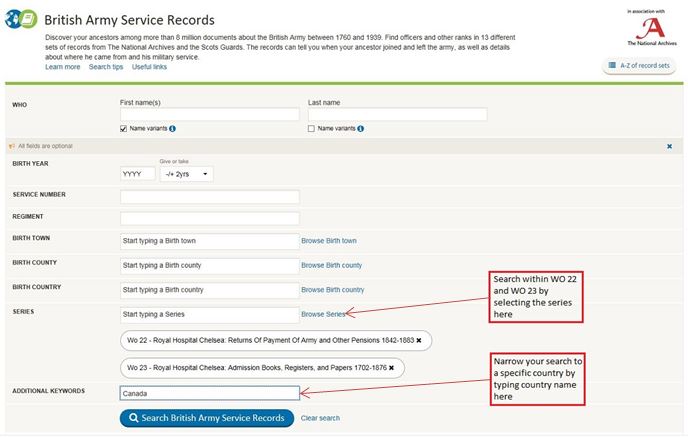
Using Findmypast.co.uk to search for pension records by country of residence

Use Findmypast.co.uk (£) in the same way to search for pension records from a Foreign and Colonial subseries of WO 23 specifically for:

  • a small number of Indian Army pensioners (most records for Indian Army pensioners are held by the British Library)
  • a small number East India Company pensioners (most records for East India Company pensioners are held by the British Library)
  • black soldiers, described in the original records as “negro” pensioners

7. Monthly and quarterly regimental muster rolls and pay lists 1732-1898

Though the appearance of individuals on muster rolls and pay lists are not determiners of whether or not they received a pension, they are particularly useful records for men who were not discharged to pension as they provide the enlistment date, movements and discharge date of all soldiers in the British Army.

Refer to the British Army muster rolls and pay lists c.1730-1898 research guide to find out which series to consult for the period 1732 to 1878. For 1878 to 1898, browse WO 16 to find the relevant regiment or regimental district.

8. Discharge papers 1817-1888

Trying to trace an individual soldier in this way can be time-consuming, with no guarantee of success. The registers are not complete but they are a useful potential source of information. A number of these pieces contain information on soldiers whose discharge document would not be in WO 97 (see section 3).

Discharge dates 1817-1829

  • Soldiers who purchased their discharge (and would therefore not have received a pension) in WO 25/3845-3847

Discharge dates 1830-1838

Discharge dates 1852-1870

  • Soldiers discharged during their first period of service; discharged as ‘incorrigible’, discharged ‘with ignominy’; sentenced to penal servitude or 21 years with militia, 1852-1870 in WO 25/3869-3874
  • Soldiers discharged when a regiment reduced its numbers 1856-1857 in WO 25/3879
  • Soldiers discharged under the terms of the new Limited Service Act 1866-1870 in WO 25/3883
  • Soldiers discharged on return from India 1863-1870 in WO 12/13077-13090

Discharge dates 1871-1888

  • On return from India 1871-1878 in WO 12/13091-13105
  • General register 1871-1884 in WO 121/223-238
  • Gosport discharge depot musters 1882-1888 in WO 16/2284 and WO 16/2888-2916 (there is an index for 1883-1888)

9. Soldiers who died in service

If a soldier died in service the principal personnel records that were retained for soldiers (those used for pension purposes) are less likely to exist. There are, however, some records that were created as a result of a soldier dying in service:

  • Records of deaths and the effects (possessions) of dead soldiers in a subseries within WO 25
  • Registers of authorities to deal with the effects (possessions) of dead soldiers 1810-1822 in WO 25/2966-2971. These records include:
    • regiment
    • period of death
    • amount of effects and credits
    • date of order to agent
    • agent’s name
    • person applying (usually next of kin) and his or her address
  • Soldiers’ effects ledgers 1862-1881 in WO 25/3475-3501 (WO 25/3491-3501 are indexes to WO 25/3475-3490). The National Army Museum holds a set for April 1901-March 1960 (see section 11.3). The ledgers were created as a list of the monies owed to soldiers who died in service. They do not list any personal items that may have been returned to the next of kin. The information they typically contain is:
    • full name
    • regimental number
    • date of death and sometimes the place
    • next of kin
    • monies paid to the next of kin
    • records from 1901-1914 also detail the date of enlistment and trade
  • Less informative but still helpful, as they give the regiment, are an index of effects from 1830 in WO 25/2974 and a register of effects and credits 1830-1844 in WO 25/2975

10. Royal Artillery personnel records

Until 1855 ordnance troops, which included the Royal Artillery, were the responsibility of the Board of Ordnance, not the War Office. There are therefore some series of records specifically for Royal Artillery personnel.

10.1 Royal Artillery service records and other papers

Search by name of a non-commissioned officer or soldier in our catalogue within WO 69 for records of the Royal Artillery which include:

  • description books
  • records of service, including original attestation papers
  • registers of marriages and baptisms
  • registers of deceased soldiers
  • some records of transfer of men to the Army Reserve
  • pension registers
  • description book of the Royal Irish Artillery 1756-1774
  • miscellaneous correspondence

Supplementary records of services are preserved for soldiers in the Royal Artillery, 1791 to 1855, and the Royal Horse Artillery, 1803 to 1863, in WO 69.

10.2 Royal Artillery pension records 1770-1913

Artillery pensions were paid by the Ordnance Office until 1834, when the Royal Hospital Chelsea took over. The records are in the following series:

Date range Description Catalogue reference
1770-1808 Vouchers for artillery pensions WO 18/1-147
1808-1834 Pension minutes WO 47/2760 -2851
1816-1844 Registers of Ordnance pensions WO 54/338-493
1822-1855 Pension minutes WO 55/540-572
1833-1913 Royal Artillery pensions WO 116/125-185
1834 Registers of current Ordnance out-pensions WO 23/141, WO 23/143-145

11. Second Boer War personnel records 1899-1902

The British forces in South Africa during the Second Boer War, also known as the South African War and sometimes imprecisely referred to simply as the Boer War, consisted of:

  • units of the regular army
  • militia units
  • the Imperial Yeomanry (a volunteer mounted infantry regiment set up largely for service in South Africa)
  • forces recruited locally in South Africa itself

Click on the series references below to search or browse these records by unit. These records are of soldiers who enlisted in units locally raised in South Africa.

For records of the Imperial Yeomanry serving in South Africa search for:

Please note that many soldiers and officers who served in the British Army during the Second Boer War also served in the British Army during the First World War (1914-1918). When this happened, then pre-1914 record of service (including Boer War) is more likely to be among First World War service records.

You can search and download campaign medal rolls (WO 100) at Ancestry.co.uk (£). They list militiamen who received the Queen’s (or King’s) South Africa Medal or the Queen’s Mediterranean Medal, while serving with the regular army.

12. Guards Regiments

Service records of the Coldstream Guards, Grenadier Guards, Irish Guards and Welsh Guards are being transferred to The National Archives, to find a service record request a search using one of the forms below.

Form 1: For a deceased person born before 1940

Form 2: For a living person, or your own record, born before 1940

The Scots Guards regiment has its own archive, see below.

Various registers for the Grenadier Guards, including discharge registers, registers of deserters, attestation forms, and enlistment registers from the middle of the 18th century onwards can be found at The National Archives in WO 437.

13. Records in other archives

Regimental museums do not generally hold records of service of their men and officers, although they often hold other records which can be useful to people researching their military ancestors.

13.1 The Scots Guards

The Scots Guards regiment has its own regimental archive. Enlistment registers of the Scots Guards covering 1799-1939, and 1642-1939 for officers, can be searched on Findmypast.co.uk.

For other records of the Scots Guards contact the regimental archives.

13.2 Household Cavalry

Microfilm copies of WO 400 (see section 2.6) are held at the Household Cavalry Museum Archive in Windsor. It’s best to contact the museum for access conditions before visiting.

13.3 Records of soldiers’ effects 1901-1960

The National Army Museum holds records of soldiers’ effects for April 1901 to March 1960. Those from 1901 to 1929 are available on Ancestry (£). For 1930-1960 contact the National Army Museum directly.

14. Further reading

The following publications are available in The National Archives’ library. Those with a link can be bought from The National Archives’ online bookshop:

Amanda Bevan, Tracing Your Ancestors in the The National Archives (The National Archives, 2006)

Christopher Chant, The Handbook of British Regiments (Routledge, Kegan & Paul, 1988)

Norman K Crowder, British Army Pensioners Abroad 1772-1899 (Genealogical Publishing Co Inc, 1995)

Dan Cruickshank, The Royal Hospital Chelsea: the Place and the People (Third Millennium Publishing, 2008)

Jeremy Gibson and Mervyn Medlycott, Militia Lists and Musters 1757-1876: A Directory of Holdings in the British Isles (Federation of Family History Societies, 2004)

Ian S Hallows, Regiments and Corps of the British Army (Arms and Armour, 1991)

E A James, British Regiments 1914-1918 (Naval & Military Press, 2001)

J M Kitzmiller, In Search of the ‘Forlorn Hope’: A Comprehensive Guide to Locating British Regiments and their Records (Manuscript Pub Foundation, 1988)

M E S Laws, Battery Records of the Royal Artillery 1716-1859 (Royal Artillery Institute, 1952)

Gerry Murphy, Where Did That Regiment Go?: The Lineage of British Infantry & Cavalry Regiments at a Glance (The History Press, 2009)

Mustor (muster) Books and Pay Lists (List and Index Society, 1984)

Roger Perkins, Regiments: Regiments and Corps of the British Empire and Commonwealth 1758-1993: A Critical Bibliography of Their Published Histories (Roger Perkins, 1994)

Robert Pols, Dating Old Army Photographs (Family History Partnership, 2011)

Return of the Names of the Officers in the Army Who Receive Pensions for the Loss of Limbs, or for Wounds (Naval & Military Press, 2002)

William Spencer, Army Records: A Guide for Family Historians (The National Archives, 2008)

William Spencer, Records of the Militia and Volunteer Forces 1757-1945 (Public Record Office, 1997)

Waterloo Medal Roll: Compiled From the Muster Rolls (Naval & Military Press, 1992)

1. Why use this guide?

Use this guide for advice on where and how to search for records created by Crown courts in England and Wales.

Since 1972, when Crown courts were established, they have been the courts where all serious offences, including robbery, rape and murder, are tried. The records they have created are usually held in one of three places:

For more detailed advice on records of the Central Criminal Court (the Crown Court in the City of London) see our guide to Criminal court cases: Old Bailey (Central Criminal Court). For advice on finding records from other types of criminal courts see our overview guide.

2. What are Crown courts?

Following a Royal Commission, the Courts Act 1971 established a restructuring of the criminal justice system. Assize courts and quarter sessions courts were replaced by Crown courts, which began life at the start of 1972. Liverpool and Manchester Crown courts had already been established in 1956.

Crown courts hear serious criminal cases such as:

  • robbery
  • burglary
  • grievous bodily harm
  • kidnapping
  • rape
  • murder
  • manslaughter
  • treason
  • riot

A judge has overall responsibility for the court with a jury of twelve people providing the verdict.

Crown courts also deal with:

  • appeals against a magistrates’ court conviction or sentence
  • cases passed from a magistrates’ court for trial or sentencing
The grand, columned exterior of York Crown Court

York Crown Court (source: Andy Farrington via Wikimedia Commons)

There are approximately 80 Crown courts around England and Wales and they include the Central Criminal Court in the City of London, popularly known as the Old Bailey.

3. Record types, the information they contain and what gets kept

Whilst the records are still held at the courts themselves (for the six to seven years after the trial) almost everything is retained. Once records are removed from the courts, some are destroyed. Not all records created by the courts are kept for permanent preservation. For most cases indictments are permanently retained but only a small sample of case files are kept.

3.1 Indictments

The indictment contains key information about the progress of the trial, outcome and appeal (if there is an appeal). The indictment is formally annotated during the trial thereby providing a concise account of the events and decisions that occurred.

Information contained on the indictment includes:

  • defendant’s name, sex and date of birth
  • whether bail or custody was granted
  • date committed for trial, conviction and sentence date
  • trial dates (from/to) added upon completion of the trial
  • the identity of the firm of shorthand writers
  • judge’s name
  • defence counsel names of barristers and solicitors
  • prosecution counsel names of barristers and solicitors
  • offences charged to the defendant listed as separate ‘counts’
  • defendant’s plea to the charges
  • jury’s verdict
  • sentence or order
  • appeal details – date of appeal and whether grounds for appeal granted or refused

A copy indictment is usually attached to the indictment and includes a list of witnesses called to trial, along with repeating much of the information contained within the initial indictment.

3.2 Case files

Information contained within a case file varies from one file to another but can include:

  • committal proceedings (records created at magistrates courts to determine whether a case should be heard by a Crown court)
  • court logs (recording brief case histories, such as dates of hearings)
  • police statements
  • copy indictment (a duplicate of the indictment file itself)
  • evidence for the prosecution
  • list of witnesses with their statements and depositions
  • list of exhibits produced in court
  • photographs of the crime scene
  • sentence
  • detail of appeal if there was one
  • a case file number (which you can help you to find an indictment). This is usually a six-digit number, such as ‘721717’ or ‘91/0108’. The first two numbers indicate the year and the other numbers denote the case number heard by the Crown court that year. In our first example, the case number indicates that the case dates from 1972 and was the 1717th case heard that year.

Crown court files have been selected for permanent preservation partly to represent the wide variety of cases heard by the courts but not all individual case files are kept permanently. Those that are kept tend to be files that record more serious crimes, cases that attracted public interest, or were of significance (either legally or historically), or where the accused was eminent or infamous or if the case generated widespread public concern.

3.3 Transcripts

Court stenographers recorded the proceedings in short hand known as computer aided transcription notes. These are filed separately from the case file and not kept permanently. However, if the defendant lodged an appeal within five years of the conviction then long hand notes were recreated from the original computer aided transcription notes for the appeal and may be found on the criminal appeal case file (see our guide to criminal appeal cases).

4. How to search for records

Before you start a search, bear in mind that The National Archives holds only samples of surviving Crown court case files and that many Crown courts have not yet sent any indictment files at all to The National Archives. Many records remain in the custody of HM Courts and Tribunal Service. For information about these records contact the Ministry of Justice. Consult the HM Courts and Tribunals Service website for contact details of individual Crown courts.

To understand how files are selected for preservation at The National Archives see our Operational Selection Policy for Crown Courts.

Some of the records that we do hold are not accessible to the public as the information within them is sensitive. You can request that a closed file be opened by submitting a Freedom of Information request.

To get an idea of what you might find in Crown court records, see section 3 above.

Stage 1 of a search: case files

Start by looking for case files as they unlock information that will make a search for indictments easier.

Search for case files in one of the two following ways:

Method 1: If you know the Crown court where the case was heard, locate its name in the table in section 5 of this guide and click on the links for case files – this will take you to a catalogue description page for all the case files held for that court at The National Archives. Use the ‘Keyword search’ box to search by name of defendant or the charge.

Method 2: If you do not know the Crown court where the case was heard, try using our advanced search, placing a J in the reference fields and searching with the defendant’s name and/or the charge. The results for this kind of search are likely to be more jumbled than those for Method 1 as they will include results from a variety of other courts.

Sometimes the name of the defendant is not listed in our catalogue, either because the defendant was under age or because it could give away the identity of the victim. To account for this, you should search with the phrase ‘name withheld.’

The naming of a defendant within our catalogue does not imply guilt.

Stage 2 of a search: indictments

To search for an indictment you will need a case number.

If you don’t already have a case number, contact HM Courts and Tribunal Service who can provide you with a case number for some Crown court cases (The National Archives has indexes to cases, and therefore case numbers, only for the Central Criminal Court – the Old Bailey – and only up to 1980).

With a case number you can search for the indictment, in one of the two following ways:

Method 1: Try this method first.

  1. Locate the name of the court in the table in section 5
  2. Click on the series code for that court’s indictments
  3. Click on ‘browse from here by reference’, as shown here:
  4. Look for the case number in the ranges of case numbers displayed in the right-hand panel
  5. Order the record to locate the precise case number you are looking for

Method 2: If you have not found the court listed in section 5 or the indictment is not among those listed for that court, try using our advanced search, placing a J in the reference fields and searching with the name of the court, the word indictments and the year, or a range of years. Some series contain indictments for more than one court.

5. Key to records of Crown court cases

Different Crown courts transfer documents at different rates so some of the record series below are less complete than others. Many Crown courts have not yet sent any indictment files to The National Archives and their records remain in the custody of HM Courts and Tribunal Service.

Click on the links below to view the record series description – the ‘Access conditions’ will indicate whether or not files have been transferred from the Crown Court to The National Archives.

Crown Court Record series in which case files may be held Record series in which indictments may be held Other records for this court
England
Acton J 238 J 239
Aylesbury J 240 J 241
Basildon J 345 J 351
Beverley J 224  see J 220 Kingston upon Hull for 1972-74 J 221 Kingston upon Hull and Beverley
Birmingham J 190 J 191
Bodmin J 305 J 306
Bolton J 208 J 209
Bournemouth (including Dorchester) J 307 J 308
Bradford J 226 J 227
Bristol J 309 J 310
Burnley J 236 J 237
Cambridge J 242 J 243
Canterbury J 244 J 245 also J 207, Maidstone
Carlisle J 289 J 290
Central Criminal Court J 267 J 268, J 336 index J 164 Papers of Sir James Miskin
Chelmsford and Southend-on-sea J 265 J 266
Chester (Wales and Chester Circuit) J 301 J 302
Chichester J 246 J 247
Coventry J 192 J 193
Croydon and Inner London Crown Court J 248 J 249
Derby J 194 J 195
Doncaster J 228 J 229
Dorchester (Bournemouth) J 307  J 308
Dudley J 254 J 175, Wolverhampton and Dudley
Durham J 230 J 231
Exeter J 311 J 312
Gloucester J 313 J 314
Grimsby J 259 J 260 Indictments 740101-740283, dated 1974, are in J 235/30-33
Guildford J 250 J 251
Harrow J 263 J 264
Inner London Crown Court See also Croydon) J 269 J 270
Ipswich and Bury St Edmunds J 261 J 262
Isleworth J 252 J 253
Kingston-upon-Hull and Beverley J 220 J 221
Kingston-upon-Thames J 279 J 280
Knightsbridge J 216 J 217
Knutsford (Wales and Chester Circuit) None J 302
Leeds J 291 J 292
Leicester J 196 J 197
Lewes J 277 J 278
Lincoln and Grimsby J 234 J 235 (Contains some indictments from Grimsby Crown Court for 1974)
Liverpool, Birkenhead and Wirral J 222 J 223 J 108 Stopping up orders etc.
Luton J 218 J 219
Maidstone, Canterbury, Margate and Gravesend J 206 J 207
Manchester and Minshull Street, Manchester J 287 J 288 J 109 Stopping up orders etc.
Middlesex Guildhall J 275 J 276
Newcastle upon Tyne J 212 J 213
Newport (Isle of Wight) J 315 J 316
Northampton J 257 J 258
Norwich J 273 J 274
Nottingham J 188 J 189
Oxford J 186 J 187
Peterborough J 184 J 185
Plymouth J 319 J 320
Portsmouth J 317 J 318
Preston J 285 J 286
Reading J 202 J 203
Salisbury J 329 J 330
Sheffield J 214 J 215
Shrewsbury J 182 J 183
Snaresbrook and Woodsford J 200 J 201
Southampton J 327 J 328
Southwark J 204 J 205
St Albans and Bedford J 271 J 272
Stafford J 180 J 181
Stoke-on-Trent J 178 J 179
Swindon J 325 J 326
Taunton J 323 J 324
Teesside J 283 J 284
Truro J 321 J 322
Wakefield and Huddersfield J 281 J 282
Warrington J 333 J 334
Warwick J 176 J 177
Weymouth J 295 J 296
Winchester J 297 J 298
Wolverhampton, Dudley, Walsall, Warley and West Bromwich J 173 J 175
Wood Green J 198 J 199
Woolwich J 210 J 211
Worcester and Hereford J 255 J 256
York J 232 J 233
Wales
Cardiff J 299 J 300
Merthyr Tydfil J 303 J 304
Newport (Gwent) J 293 J 294
Swansea, Carmarthen and Haverfordwest J 331 J 332

Wales and Chester Circuit
Crown Courts in North Wales were part of the Wales and Chester Circuit, which included the courts at Caernarfon, Dolgellau, Knutsford (Cheshire), Mold and Welshpool.

Indictments can be found in J 302. Some case files are in J 301.

Court Case files Indictments
Caernarfon J 301 J 302
Dolgellau J 302
Knutsford (Cheshire) J 302
Mold J 301 J 302
Welshpool J 302

6. Director of Public Prosecutions files

The Office of Director of Public Prosecutions (DPP) was created in 1879 with powers to institute and conduct criminal proceedings in any of the senior criminal courts – assizes, King’s/Queen’s Bench or Central Criminal Court, and, more recently, Crown Court.

Search or browse case files of the Director of Public Prosecutions in DPP 2 1931-2016. File descriptions include the name of the defendant (recent records are closed).

7. Further reading

The following recommended publications are available in the The National Archives’ Library:

Richard Beeching, Royal Commission on Assizes and Quarter Sessions 1966-69: Report (London, 1969)

Michael Zander, Cases and materials on the English legal system (London, 10th edition, 2007)

1. Why use this guide?

This research guide provides information which will prove useful if you are searching for records of a campaign or service medal awarded to someone who fought with the British armed services prior to the Second World War. Though far less detailed than most service records, documents of campaign medals can provide useful clues to a person’s time in service, particularly where and when they served. These records are distinct from those detailing awards of gallantry and bravery medals, information on which can be found in the British military gallantry medals research guide.

2. Campaign and service medal categories

2.1 What are campaign medals?

Campaign or war medals were awarded to members of the armed services and eligible civilians, for taking part in a campaign or for service in time of war. Awards for service in a particular battle within a war often took the shape of clasps attached to medal ribbons.

2.2 What are long service and good conduct medals?

These medals were awarded to warrant officers, non-commissioned officers and other ranks. They were not dependent on having seen action.

2.3 What are commemorative medals?

Commemorative medals are not awarded for military service and are not worn on service uniforms. Instead, they are awarded for attendance at a particular event or for service in a non-military operation.

3. First World War Campaign and service medal records

3.1 Medal rolls

Information about the award of campaign medals is recorded on medal rolls. These are usually arranged by regiment/battalion (for the Army) or by ship (for the Royal Navy), then by rank, then name. Medal rolls are lists of men entitled to a particular medal, they do not give detailed information about individuals, recording only:

  • the recipients’ regimental/service number
  • a note of the clasps to which he or she was entitled
  • whether the medal was received or not (a tick against the name indicates it was received; a cross against the name indicates that the delivery of the medal failed or that it was returned)

3.2 Medal index cards

Medal index cards were used for recording First World War campaign medals issued to individuals. They contain more detail than the medal roll. Unlike the long lists which make up the medal rolls, for which these cards provided the index, each medal index card is unique to the soldier for whom it was completed.

Typically each card contains:

  • regiment or other unit (but not battalion)
  • service number
  • rank
  • list of medals awarded
  • a reference to the medal roll

Less consistently, cards may also contain:

  • the date the soldier first entered a theatre of war
  • the theatre of war in which the soldier served

In the space on the card headed ‘Remarks’ the following information is sometimes recorded:

  • date of death
  • if the soldier was taken prisoner
  • cause of discharge (usually indicated by a code reference to the King’s Regulations)

4. How to find records of campaign medals

4.1 Before 1914

For records of medals awarded for service before 1914, search by name on the Ancestry (£) website. There are separate search pages for the Army (sourced from WO 100) and for the Royal Navy and Royal Marines (sourced from ADM 171).

4.2 First World War, 1914-1918

All servicemen, some women, and some civilians, were eligible for one or more campaign medals if they served abroad. These records are the nearest we have to a full ‘roll-call’ for the First World War. The medal rolls are variously arranged and accessed for each service. Details of what each medal was awarded for can be found in Appendix 1 below.

a. Army and Royal Flying Corps
For the Army and the Royal Flying Corps there are medal index cards as well as medal rolls. There are medal index cards for over 5.5 million men who served abroad in the First World War. Army officers were not automatically issued campaign medals, they had to apply for them, so there may not be a card for an officer. Each card should contain the soldier’s name, corps (regiment), rank, regimental number, perhaps the first theatre of war served in and the date of entry to it, as well as other remarks and of course the medals awarded. The cards are in document series WO 372 but copies can be viewed online and are name-searchable. Each card also provides a reference number which refers to an entry on the medal rolls (WO 329). These medal rolls are available online via Ancestry (£) and you can search them by name and regimental number. The only additional information sometimes available on the rolls is the soldier’s battalion number, which you will need if you want to find the battalion war diary: see British Army operations in the First World War.

b. Royal Navy, Royal Marines and Royal Naval Air Service
Search for an individual by name on the Ancestry (£) website. The original medal rolls are in series ADM 171, split into several sequences as detailed in the table below. Entries in the medal rolls are in alphabetical order, so there is no need for an index. Explanations of the abbreviations used in some of the medal rolls can be found in Appendix 2 below.

Service and rank Series reference
Royal Navy: Officers ADM 171/89, ADM 171/90 and ADM 171/91
Royal Navy: Ratings ADM 171/94-119
Royal Marines: Officers ADM 171/92 and ADM 171/93
Royal Marines: NCOs and Men ADM 171/167
Royal Naval Reserve: Officers ADM 171/92 and ADM 171/93
Royal Naval Volunteer Reserve: Ratings ADM 171/125
Mercantile Marine Reserve: Ratings ADM 171/130
Miscellaneous: e.g. WRNS, canteen staff ADM 171/133

c. Royal Air Force
Though RAF airmen did receive campaign medals, there are no medal rolls in The National Archives for men who joined after the formation of the RAF in April 1918, only for those who had already served with the Royal Flying Corps and went on to serve in the RAF. See the Royal Air Force personnel research guide for more information.

4.3 Inter-war period, 1920-1939

Army medal rolls for the inter-war period can be searched by name on the Ancestry (£) website. The original documents are available in WO 100/411-493. A number of other campaign medal rolls for the Army up to 1939 can be found in WO 100/398-410, including medal rolls for operations in Iraq, Africa and India. Royal Naval and Royal Air Force campaign medal rolls for the inter-war period are not kept at The National Archives. Write to the relevant Medal Offices at the addresses given in section 7 below.

4.4 Second World War, 1939–1945

Second World War army medal cards are available to search and download through Forces War Records (charges apply).

The medal cards are application cards, known as C.S. 20, which soldiers of the British Army and other units administered by the War Office could fill out and send to the War Office after the war to claim the campaign medals that they were entitled to. There are approximately 1.7 million cards for personnel from various army units. Read the blog on Forces War Records for more information.

The cards are in boxes with many cards having closed information, access to individual cards is only available online.

4.5 Post 1945

For campaign medal records for after the Second World War contact the Armed Services Medal Office at the address given in section 7 below.

5. How to find records of long service and good conduct medals

These medals were awarded to warrant officers, non-commissioned officers and other ranks. They were not dependent on having seen action.

5.1 Army

Use Discovery (£), our catalogue to browse record series WO 101 and WO 102 and to search WO 32, using ‘code 50’ as your keyword.

5.2 Royal Navy and Royal Marines

See ADM 171, ADM 1 and ADM 201.

5.3 RAF

Search the Air Ministry Orders in series AIR 72 for Long Sevice and Good Conduct Medal, George V.

6. How to find records of commemorative medals

For recipients of the Jubilee Medal 1897; the Royal Victorian Medal 1901 (for taking part in Queen Victoria’s funeral); the Coronation Medals 1901 and 1911; and the Delhi Durbar Medals 1903 and 1911, see WO 100, WO 330 and ADM 171.

Rolls for the 1935 Jubilee are in QLIB 4 and for the 1937 Coronation in QLIB 5.

The 1953 Coronation and 1977 Jubilee rolls are available in The National Archives’ Library.

Medals have been awarded for service in the Arctic between 1818 and 1855 and 1875 and 1876. Service between these dates included the search for the North West Passage and the searches for Sir John Franklin. The Polar Medal was introduced for Arctic and Antarctic exploration from 1904.

The National Archives’ Library has a copy of The Polar Medal Roll (1902-1999), which includes alphabetical and chronological lists of awards, with National Archives references to the main sources in ADM 1, ADM 171 and the London Gazette (online and in ZJ 1).

7. Replacing and claiming medals

Refer to the Ministry of Defence Medal Office for details of medals and eligibility.

8. Further reading

Visit the National Archives’ bookshop for a range of available publications about British military campaign and service medals. The following recommended publications are available in the The National Archives’ library. The National Archives’ library also holds medal rolls for all major wars.

‘A Handbook of British and Foreign Orders, War Medals and Decoration Awarded to the Army and Navy’: chiefly described from those in the collection of A A Payne, IRCP, MRCS of which there are some 2,500 (Polstead, 1981)

W H Fevyer and J W Wilson, ‘The 1914 Star to the Royal Navy and Royal Marines’ (London, 1995)

Lawrence L Gordon, ‘British Battles and Medals’: A description of every campaign medal and bar awarded since the Armada, with the historical reasons for their award and the names of all the ships, regiments and squadrons of the Royal Air Force whose personnel are entitled to them (1979)

E C Joslin, A R Litherland and B T Simpkin, ‘British Battles and Medals’ (London, 1988)

William Spencer, ‘Medals: The Researcher’s Guide’ (Kew, 2006)

9. Appendix 1: First World War campaign medals and what they were awarded for

Medal Awarded for
1914 Star For service under fire in France and Belgium, 5 August to 22 November 1914. Includes sailors serving ashore.
1914-1915 Star For service in all other theatres of war, 5 August 1914 to 31 December 1915; and for service in France and Belgium, 23 November 1914 to 31 December 1915.
British War Medal For service abroad (including India) 5 August 1914 to 11 November 1918, or 1919-1920 in Russia.
Victory Medal For military and civilian personnel who served in a theatre of war.
Territorial Force War Medal For members of the Territorial Forces who joined before 30 September 1914 and served in a theatre of war between 5 August 1914 and 11 November 1918.

10. Appendix 2: Abbreviations found in ADM 171

Interpretation of the abbreviations used in some of the medal rolls:

1914 ST. or 14 ST. = 1914 Star 1914 ST. C. = 1914 Star and Clasp
ST. = 1914–1915 Star B. = British War Medal
V. = Victory Medal

Comments and remarks:

R. = Run (See F. below)
D. = Discharged with Disgrace
DUPS. = Duplicates issued
I.C.1000/1914, etc. = Refers to relevant N.L. (Wills paper)

Issued details:

S. = Self A.M. = Issued to Air Ministry for disposal to man
FR. = Father W.O. = Issued to War Office for disposal to man
MR. = Mother B.o.T. = Issued to Board of Trade for disposal to man
SR. = Sister By A.M. = Issued by Air Ministry (for service in RAF)
BR. = Brother By W.O. = Issued by War Office (for service in Army)
W. = Wife By B.o.T. = Issued by Board of Trade (for service in the Merchant Service)
WW. = Widow F. = Forfeited (“R”(Run) or “D”(Discharged with Disgrace) normally a code or reason is given
DR. = Daughter C. of P. = Commissioner of Police
GODMR. = Godmother N.O…… = Navy Office Wellington etc.
GODFR. = Godfather D.N.D. Ottawa = Dept.of National Defence Ottawa
GRDMR. = Grandmother Nav.Rep. = Naval Representation, Commonwealth of Australia
GRDFR. = Grandfather B.N.M. Athens = British Naval Mission to Greece
UNIV. LEG. = Universal Legatee D.R.I.M. = Director Royal Indian Marine
RES. LEG. = Residual Legatee 392000 etc. = Refers to relevant medal issue paper
LEG. REP. = Legal Representative
EXECR. = Executor
EXECX. = Executrix
ADMINR. = Administrator
ADMINX = Administratix

1. Why use this guide?

If you know of an individual who received a British military medal or award for an act of bravery, gallantry or for meritorious service between 1854 and c1990 and you want to find out whether a record of the award and why it was awarded exist, this guide will be of use. Among the numerous medals and awards covered by the guide are the:

  • Victoria Cross (VC)
  • Distinguished Service Order (DSO)
  • Military Cross (MC)
  • Military Medal (MM)
  • Mention in Dispatches (MiD)

For advice on civilian gallantry awards consult our Civilian gallantry medals guide. There are separate records for the award of campaign medals (awarded purely for service) – see our British Army campaign and service medals guide for advice on finding these.

2. The records of gallantry medals and awards

2.1 Public announcements

Almost all gallantry awards to British nationals are publicly announced in the official government newspaper, the London Gazette. This public announcement is often the only record that survives of an award. Announcements also appeared, where appropriate, in the colonial or dominion gazettes.

2.2 Recommendations and citations

A recommendation is a full statement, usually supplied by a commanding officer, of why a medal should be awarded to an individual.

A citation is a brief official statement, taken from the recommendation, of why a medal was awarded.

Whether a record of a citation or a recommendation survives depends, largely, on the type of award. Occasionally citations are published in the London Gazette but not always at the same date as the announcement. A citation or recommendation may sometimes survive in the service record of the individual.

2.3 Registers

For some medals there are registers and lists of recipients covering a specific war, year or range of years.

3. How to find records

Find out where to look for records of a particular medal by consulting the table below. The following general advice will also help you get started:

3.1 Online records

In some cases, to view records you will need to find document references and either order copies or visit us to view the original documents in person. The following records, however, can be viewed or downloaded online:

3.2 Basic search tips for finding original documents

You can use our catalogue to search for records. Search with the name of a medal using the advanced search to target the records of the respective record departments for each branch of the military, as follows:

  • British Army, 1854-1990 – the majority of medal records are held in WO and DEFE
  • Royal Air Force, Royal Flying Corps and Royal Naval Air Service, 1914-1985 – the majority of medal records are held in AIR and, more precisely, for 1914-1918 in AIR 1, and from 1939 in AIR 2
  • Royal Navy and Royal Marines, 1854-1982 – the majority of surviving recommendations are in series ADM 1 (accessed by using the indexes and registers in series ADM 12) and ADM 116

3.3 Public announcements and published citations

In most cases, the best place to start is the London Gazette, available on The Gazette website, though for many medals a citation was not published (see the table below for medal-by-medal details). You can search the Gazette by name, service number, publication date and type of award. You will need to know roughly when the award was announced or ‘gazetted’. There was always a delay between the gallant deed, the actual award of a medal, and publication in the London Gazette. The Gazette indexes available at The National Archives can help to establish a date.

3.4 Recommendations, registers and unpublished citations

Check published sources, such as those in the further reading section of this guide, before you start a search for records of recommendations or citations as they may provide exact document references and additional information. The table below provides links to the record series most likely to contain information on individual awards.

3.5 Table of record sources for gallantry medals

Click on the London Gazette links to search the Gazette by name, service number, publication date and type of award. Click on the document series references and search by name of medal. The online records can be searched by name of recipient.

Gallantry medal or award Official announcements and, where noted, officially published citations Record series in which you may find recommendations, citations, registers or lists of medal recipients
Air Force Cross London Gazette (ZJ 1) AIR 1, AIR 2(1) or AIR 30
Air Force Medal London Gazette (ZJ 1) AIR 1, AIR 2(1), AIR 30 or HO 144
British Empire Medal London Gazette (ZJ 1) ADM 1, ADM 116, ADM 171, AIR 2(1), MT 9 or PREM 2. For 1935-1990 see the online copies of WO 373, recommendations for military honours and awards.
Conspicuous Gallantry Medal London Gazette (ZJ 1) ADM 1 code 85, ADM 116, ADM 171/75, AIR 2(1) or AIR 30
Distinguished Conduct Medal London Gazette (ZJ 1) includes citations for First World War awards ADM 171, AIR 1, PMG 34, PMG 36, WO 3, WO 32WO 146 and WO 391. For 1935-1990 see the online copies of WO 373, recommendations for military honours and awards.
Distinguished Flying Cross London Gazette (ZJ 1) includes citations for many Second World War awards AIR 1, AIR 2(1) or AIR 30
Distinguished Flying Medal London Gazette (ZJ 1) includes citations for many Second World War awards ADM 1 Code 85, ADM 116 Code 85, AIR 1, AIR 2(1) or AIR 30
Distinguished Service Cross London Gazette (ZJ 1) ADM 1, ADM 116, ADM 137, ADM 171 or AIR 1
Distinguished Service Medal London Gazette (ZJ 1) ADM 1, ADM 116, ADM 171/75, ADM 137 or AIR 1
Distinguished Service Order London Gazette (ZJ 1) includes citations for First and Second World War awards (although not for First World War New Year or Birthday Honours awards). Extracts from pre-publication copies of announcements are in series WO 389. ADM 1, ADM 116, ADM 171, AIR 1, AIR 2(1), AIR 30 or WO 32. For 1935-1990 see the online copies of WO 373, recommendations for military honours and awards. The DSO register (1886-1945), in series WO 390, is available online – browse the 13 volumes of the register by date (see section 3.1).
Empire Gallantry Medal London Gazette (ZJ 1) ADM 1ADM 116, ADM 171, AIR 2(1), HO 250, T 336 or MT 9. Please note, HO 250 is also available to view online via Ancestry (£).
George Cross London Gazette (ZJ 1) includes citations for many Second World War awards AIR 2(1), MT 9, PREM 2, WO 32, WO 330 or T 336. Search the Civil Defence Gallantry Awards (HO 250) by name on Ancestry.co.uk (£). For 1935-1990 see the online copies of WO 373, recommendations for military honours and awards.
George Medal London Gazette (ZJ 1) includes citations for many Second World War awards ADM 1, AIR 2(1), MT 9, PREM 2 or WO 330 or T 336. Search the Civil Defence Gallantry Awards (HO 250) by name on Ancestry.co.uk (£). For 1935-1990 see the online copies of WO 373, recommendations for military honours and awards.
Indian Distinguished Service Medal Gazette of India, available at the British Library For 1935-1990 see the online copies of WO 373, recommendations for military honours and awards.
Indian Order of Merit Gazette of India, available at the British Library For 1935-1990 see the online copies of WO 373, recommendations for military honours and awards.
King’s African Rifles DCM See the colonial gazettes for the colonies of East Africa.
Read The African DCM by J Arnold for more information.
CO 445 and CO 534
Mentions in Despatches London Gazette (ZJ 1) ADM 1, ADM 116 or AIR 2(1). Search and download Mentions in Dispatches 1914-1920 as recorded on medal index cards (WO 372/24). For 1935-1990 see the online copies of WO 373, recommendations for military honours and awards.
Meritorious Service Medal London Gazette (ZJ 1) and colonial and dominion gazettes. AIR 1, AIR 30, PMG 34, PMG 36, WO 23, WO 32, WO 101. Search and download Meritorious Service Medal awards 1914-1920 as recorded on medal index cards (WO 372/24).
Military Cross London Gazette (ZJ 1) includes citations for First World War awards (although not New Year or Birthday Honours awards). AIR 1, WO 32 or WO 389 online (indexed by WO 389/9-24). For 1935-1990 see the online copies of WO 373, recommendations for military honours and awards.
Military Medal London Gazette (ZJ 1). Usually, announcements in the London Gazette are the only surviving record for the First World War. Citations are very occasionally given in full – usually for women only. ADM 171, AIR 1, WO 32 or WO 326. Search and download awards of the Military Medal 1914-1920 as recorded on medal index cards (WO 372/23). For 1935-1990 see the online copies of WO 373, recommendations for military honours and awards.
New Zealand Cross CO 212 or WO 32
Order of the Bath, Military Division London Gazette (ZJ 1) AIR 2(1), ADM 171, WO 104 or WO 32. For 1935-1990 see the online copies of WO 373, recommendations for military honours and awards.
Order of the British Empire For 1935-1990 see the online copies of WO 373, recommendations for military honours and awards.
Queen’s Gallantry Medal London Gazette (ZJ 1) For 1935-1990 see the online copies of WO 373, recommendations for military honours and awards.
Royal Red Cross London Gazette (ZJ 1) AIR 2 code 30, AIR 30, WO 145 or WO 32 code 50. For 1935-1990 see the online copies of WO 373, recommendations for military honours and awards.
Sea Gallantry Medal ADM 1 or BT 261
Victoria Cross London Gazette (ZJ 1) includes citations for First and Second World War awards ADM 116, ADM 171, AIR 1, AIR 2/5010 (for 1943-1944), AIR 2/5867 (for 1944-1946), AIR 30, CAB 10, PMG 35 or WO 32. For 1935-1990 see the online copies of WO 373, recommendations for military honours and awards. Consult the Victoria Cross register (WO 98/8) online or the alphabetical list of recipients of the Victoria Cross, August 1914 to October 1920 in WO 98/6.
West African Frontier Force DCM See the colonial gazettes for the colonies of West Africa.
Read The African DCM by J Arnold for more information.
CO 445

Footnotes: (1) Recommendations in AIR 2 are arranged by old Air Ministry file reference number, not name. Contact the Ministry of Defence who may be able to supply you with the file reference.

Bear in mind that medals issued by the British Army were not awarded exclusively to British Army soldiers – they could be awarded to personnel from the other armed services too. During the Second World War, for example, some members of the Royal Air Force received British Army awards. The same is true of the Royal Navy and RAF, so that, for example, a number of airmen of the Fleet Air Arm, a branch of the Royal Navy, received RAF awards.

4. Foreign awards to Britons and British awards to foreign servicemen and women (from 1854)

4.1 Announcements

These awards tend to be announced in the London Gazette under the heading ‘Foreign Orders’.

For draft versions of London Gazette announcements 1914-1928 browse WO 388 by reference. Some of these pre-publication announcements are annotated. The documents in this series (WO 388) are arranged by country. WO 388/6 to 15, including indexes in WO 388/8 to 15, are available to download online (you can download the indexes free of charge).

4.2 Recommendations

Military awards exchanged between British and foreign armies from 1946 onwards are searchable by name and award in the recommendations (WO 373) online. These can include those not appearing in the London Gazette.

4.3 Lists

You can find some lists of Foreign Awards within FO 83 (before 1906) and FO 372 (after 1906). Locate files containing these lists using the Foreign Office correspondence indexes at The National Archives. It is thought that these lists are not comprehensive.

5. Regulations and policy files (from 1854)

In general, you can search our catalogue by the medal name or its abbreviation to see if there are any policy files. There are some specific series which document the regulations governing the award of medals. They are:

For policy files on medals, see series ADM 1 code 85, ADM 116 code 85, AIR 1, AIR 2, HO 45 code 30, MT 9 code 6, T 300 and T 333 and WO 32 code 50.

6. The design and manufacture of medals (1805-1986)

Orders for gallantry medals (especially in the 19th century) may be accompanied by details of recipients and of the action that led to the award. Try series MINT 16, MINT 20, MINT 24 and MINT 25. Search our catalogue with key words such as ‘awards’ or ‘decorations’.

7. Replacing and claiming medals

Contact the Ministry of Defence for campaign and other medals issued after 1939. Medals issued before 1939 can no longer be replaced.

8. Further reading and other resources

Online resources

Major military awards of the First World War, available from The Gazette website.

The Ministry of Defence’s British armed forces medals booklet, available from GOV.UK. Lists the medals awarded for service in the British armed forces, accompanied by an image for each medal.

Lists of Victoria Cross recipients announced in The Gazette for the First World War in 1914, 1915, 1916, 1917, 1918 and 1919.

A list of Victoria Cross recipients announced in The Gazette during and after the Second World War

Books

Visit the National Archives’ bookshop for a range of available publications about British military gallantry medals. All of the publications below are available in The National Archives’ Library for consultation at our building in Kew.

Scott Addington, For Conspicuous Gallantry: Winners of the Military Cross and Bar during the Great War. vol. 1, two bars and three bars (Matador, 2006)

Peter Edward Abbott, Recipients of the Distinguished Conduct Medal, 1855-1909 (London, 1975)

Peter Edwards Abbott and John Michael Allen Tamplin, British Gallantry Awards (London, 1981)

Christopher K Bate and Martin G Smith, For Bravery in the Field: Recipients of the Military Medal, 1919-1939, 1939-1945, 1945-1991 (1991)

John D Clarke, Gallantry Medals and Decorations of the World (Barnsley, 2001)

O’ Moore Creagh and EM Humphris, The Distinguished Service Order 1886-1923: A Complete Record of the Recipients of the Distinguished Service Order from its Institution in 1886, to the 12th June 1923, with Descriptions of the Deeds and Services for which the Award was Given and with Many Biographical and Other Details (London, 1978)

Michael Maton, Honour the Air Forces: Honours and Awards to the RAF and Dominion Air Forces during the Second World War (Honiton: Token Publishing, 2004)

Michael Maton, Honour the Armies: Honours and Awards to the British and Dominion Armies during the Second World War (Honiton: Token Publishing, 2006)

Michael Maton, Honour the Officers: Honours Awards to British, Dominion and Colonial Officers during World War I (Honiton: Token Publishing, 2009)

Michael Maton, Honour The Recipents of Foreign Awards (Honiton: Token Publishing 2013)

Phil McDermott, For Conspicuous Gallantry: The Register of the Conspicuous Gallantry Medal, 1855-1992 (Uckfield, 1995)

Philip McDermott, For Distinguished Conduct in the Field: The Register of the Distinguished Conduct Medal 1920-1992 (Polstead, 1994)

Ian McInnes, The Meritorious Service Medal: The Immediate Awards 1916-1928 (Dallington, 1992)

William Spencer, Army Service Records of the First World War (The National Archives, 2001 & 2008)

William Spencer, Army Records for Family Historians (3nd edn, The National Archives, 2008)

William Spencer, Air Force Records: A Guide for Family Historians (The National Archives, 2008)

William Spencer, Medals: The Researcher’s Guide (Kew, 2006)

Rob W Walker, Recipients of the Distinguished Conduct Medal, 1914-1920 (Birmingham, 1981)

List of the Recipients of the Victoria Cross (War Office, 1953)

Victoria Cross and other awards issued with Army Orders…

This is a guide to the records of British Army soldiers who served in the First World War. Some First World War veterans continued to serve with the army after the war and for the records of these soldiers you should follow the advice in our guide to British Army soldiers of the Second World War. However, many of the records in the First World War collections cover service up to 1920.

The ranks covered by the records detailed in this guide include Private, Lance Corporal, Corporal, Sergeant, Sergeant Major and Warrant Officer – but not commissioned officer ranks.

For the service records of soldiers serving in the armies of Commonwealth countries (such as Canada, New Zealand or South Africa) you will need to contact the respective archives of those countries.

How to get started

To uncover details of a soldier’s service in the First World War you should begin by searching for the following three types of records:

  • Service record: If it survives it is likely to be the most detailed record for an individual soldier that you will find but most service records for First World War soldiers were destroyed following bomb and fire damage at the record office.
  • Medal records: Low on detail but far more likely to have survived than a service record and a reliable way to identify a soldier’s service number and unit. Most soldiers were issued with campaign medals; some were also awarded medals for gallantry and meritorious service.
  • Unit war diaries: You will need to know which unit a soldier served with to effectively search these records; in most diaries only officers are mentioned by name.

Whether other records survive or ever existed for a soldier depend upon a number of variable factors. If, for example, a soldier was wounded, taken prisoner or was granted an army pension, records may survive recording these events.

Online records

Many records held at The National Archives are available online, some of them on partner websites, others on our own website. For details of other online First World War records, see the Records in other archives and organisations listed below.

Soldiers’ service records, pension and campaign medal records, 1914–1920

Search military records of non-commissioned officers and other ranks on Ancestry.co.uk (£) and Findmypast.co.uk (£) including service records (WO 363), pension records (WO 364) and campaign medal cards.

These cover regular soldiers who may have enlisted as early as 1892 for 22 years’ service as well as a small number of stray service records of pre-war soldiers who did not serve from 1914–1920.

The records include:

  • soldiers discharged between 1914 and 1920
  • soldiers killed in action between 1914 and 1920
  • soldiers who served in the war and died of wounds or disease without being discharged to pension
  • soldiers who were demobilised at the end of the war

The records do not usually include:

  • regular soldiers who continued in the army after 1920
  • soldiers who transferred to another service, taking their service record with them

The British Army contained regiments from parts of the former colonies. The service records in WO 363 and WO 364 include regiments such as:

  • the West African Field Force (such as Nigerian, Gold Coast, Sierra Leonean and Gambian Regiments but the records are of British Army non-commissioned officers of European descent only)
  • British West Indies Regiment
  • the West India Regiment

They do not include the service records for soldiers serving in the armies of Commonwealth countries (such as Canada, New Zealand or South Africa). You will need to contact their respective archives for advice on how to locate these records.

Note that military records collections searched on both Ancestry and Findmypast also contain other types of military record from before and after the First World War.

Household Cavalry service records, 1799–1920

Search and download (£service records (WO 400) of non-commissioned officers and other ranks who served in one of the Household Cavalry regiments during the First World War.

These records can also be searched on Findmypast.co.uk.

Medal roll index cards, 1914–1920

These cards, along with the medal rolls to which they form an index (see below), were created primarily to record the awarding of campaign medals. Campaign medals were awarded to all soldiers who served in a theatre of conflict overseas. In some instances the cards also record gallantry awards.

Search by name or regimental (service) number for First World War army medal index cards (WO 372) on our website (£).

Campaign medal rolls, 1914–1920

Search the campaign medal rolls (WO 329) on Ancestry (£) by name, regimental (service) number and regiment. You may find abbreviations on a roll entry – some of these abbreviations are explained in our guide to army medal index cards.

The British War and Victory medal entries may give you a battalion/unit number which will help you to find a unit war diary.

Silver War Badge rolls, 1914–1920

Search the Silver War Badge rolls (WO 329) on Ancestry (£) by recipients’ name, regimental number or by badge number. Alternatively you can search by regiment.

The badge was awarded to all of those military personnel who were discharged as a result of sickness or wounds contracted or received during the war, either at home or overseas.

Announcements of the award of gallantry medals and honours

Search the London Gazette on The Gazette website for the official announcements of British Army soldiers’ gallantry awards.

Unit war diaries from the Western Front, Mesopotamia and Gallipoli, 1914–1922

Search by unit name and number for the war diaries of British Army units that served on the Western Front and in Mesopotamia on our website (£) and for units that served in the Gallipoli Campaign at the Dardanelles on Ancestry.co.uk (£).

See below for advice on searching for the war diaries of units that served elsewhere in the world during the war.

British military medical records 1912-1921

A representative selection of several types of medical records relating to the diagnosis and medical treatment of service personnel during the First World War can be found in series MH 106.

The first 2078 boxes of the series are admission and discharge registers from military hospitals and casualty clearing stations, field ambulances, an ambulance train and a hospital ship. Search MH 106 admission and discharge registers by name or regimental number on Findmypast (charges apply) in the collection British Armed Forces, First World War Soldiers’ Medical Records. Details of service personnel may include year of birth, service number, rank and hospital admission date.

The series also contains 306 boxes of medical case sheets and medical cards for individual service personnel. The case sheets were selected to illustrate the diversity of diseases contracted, the type of injuries received and the kinds of treatments prescribed to the war wounded, and the medical cards relate to individuals from selected regiments.

To search the case sheets and cards go to MH 106 and search by name, regimental number, unit, and condition, injury and disease. These records are only available as original records and cannot be downloaded.

Prisoner of war records, 1914–1918

See our guide to records of British prisoners of the First World War for details of the prisoner of war records available online.

Records available only at The National Archives in Kew

To access these records you will either need to visit us to see the documents for free at our building in Kew or, where you can identify a specific document reference, order a copy (£) to be sent to you.

Pension case files, 1914–1920

Search our catalogue (below) for pension case files in record series PIN 26. Only a 2% sample of these records survive.

British military medical sheets and cards 1914-1920

These are selected records drawn from series MH 106, itself a representative, rather than a complete, selection of various kinds of medical records from various theatres of the First World War.

Search MH 106 in our catalogue by name, service number or unit for a sample of British servicemen’s medical sheets and medical cards. The detailed catalogue descriptions may mean that consultation of the original records is unnecessary.

The hospital admission and discharge records from this series are available to view online (see section above) but are not searchable by name in our own catalogue.

Unit war diaries from Russia, British colonies and other theatres of operations, 1914–1922

Search by unit name and number for document references to unit war diaries in series WO 95 using the series search. Use this search tool if you are looking for the war diaries of units that served in Russia, British colonies and theatres of operations other than the Western Front, Mesopotamia and Gallipoli – for these latter three see the advice on online diaries in the previous section.

For more detailed advice see our guide to British Army operations in the First World War.

Service records of Guards regiments

Service records of the Coldstream Guards, Grenadier Guards, Irish Guards and Welsh Guards are being transferred to The National Archives, to find a service record request a search using one of the forms below.

Form 1: For a deceased person born before 1940

Form 2: For a living person, or your own record, born before 1940

Various registers for the Grenadier Guards, including discharge registers, registers of deserters, attestation forms, and enlistment registers from the middle of the 18th century onwards can be found at The National Archives in WO 437.

Records in other archives and organisations

The Scots Guards

The Scots Guards regiment has its own regimental archive. Enlistment registers of the Scots Guards covering 1799-1939, and 1642-1939 for officers, can be searched on Findmypast.co.uk.

For other records of the Scots Guards contact the regimental archives.

Soldiers’ effects ledgers, 1901-1960

Search the soldiers’ effects ledgers (£) covering April 1901 to March 1960 (from The National Army Museum) by name or regiment on Ancestry.co.uk. These list monies owed to a soldier who died in service.

You may be able to purchase a transcript from the ledgers which usually show:

  • full name
  • regimental number
  • date, and sometimes place, of death
  • next of kin and monies paid to them

Ledgers from 1901 to 1914 also show the soldier’s trade and date of enlistment.

First World War pension record cards for servicemen killed or injured

Search among the First World War pension record cards on Fold3.com (£).

You can also search on Ancestry.co.uk (£) but for images of the records you will need to go to Fold3.com.

The cards record details of the pension entitlements of soldiers and other servicemen killed or injured in the war, both of officers and other ranks, and of the widows and dependants of deceased soldiers.

The much larger collection of originals are in the care of The Western Front Association (WFA) but had previously been held locally, around the country, and then by the Ministry of Defence. Read the WFA’s articles on the records for more information.

Absent Voters Lists, 1918–1921

Search for a soldier by name in the Absent Voters Lists, taken from electoral registers held at the British Library, on  Ancestry.co.uk (£) and on Findmypast.co.uk (£).

The Absent Voter Lists enabled servicemen and women away from home to vote by proxy or by postal application. They record the address, service number and regimental details of each person.

Other resources

Books

Read ‘First World War Army Service Records’ by William Spencer (The National Archives, 2008).

Use our library catalogue to find a recommended book list. The books are all available in The National Archives’ reference library, or you may be able to find them in a local library.

You can also search our bookshop for a wide range of history titles.

1. Why use this guide?

This guide will help you find records at The National Archives relating to military operations in the Second World War, planned and carried out by the:

  • British Army
  • Indian Army
  • Canadian, New Zealand, South African or Indian forces (also known as dominion forces) under British command
  • Allied and colonial troops under British command

The focus of the guide is on War Office records. However, as the army, naval and air services were more integrated than ever before during the war, you can also find many other related operational files in the records of Royal Air Force operations and Royal Navy operations.

The records include details of:

  • invasions
  • battles
  • secret operations
  • daily activities of army units (as recorded in unit war diaries)

The guide does not cover records of:

2. How to search

A search for documents at The National Archives usually begins in our online catalogue. The catalogue contains short descriptions of the records and a document reference for each – you will need the document reference before you can see the record itself. You can search the catalogue using keywords and dates. Use the advanced search option to restrict your search results to records of a specific government department (and its predecessors) – departments are identified by a letter code. The department in which to focus searches for British Army records is the War Office –  department code WO.

For a general description of the records, read The Second World War: A Guide to Documents in the Public Record Office by John Cantwell (PRO, 1998).

Only a small percentage of these records are available to view online so, in most cases, to see them you will have to either visit us in Kew or, if you can locate document references, order copies.

Try searching the catalogue by:

  • name of battle (for example, ‘Gazala’)
  • name of operation (for example, ‘Overlord’)
  • name of country or region where an operation took place (for example, Sicily or Belgium)
  • name of army unit – many army units have been catalogued using abbreviations (for example, ‘Fd. Regt.’ instead of ‘Field Regiment’), and the formatting is not consistent (sometimes, for example, you should search for ‘8th army’, other times for ‘8 army’); you may have to format your search in multiple different ways to ensure greater success

Keep in mind that not all records have been catalogued in detail and that speculative searching in documents is often necessary. There is more search advice in the following sections of this guide should help you to focus searches

3. Unit war diaries

All units, from battalions and brigades to divisions and whole armies, maintained a daily record of events, often with appendices of signals and orders.

There are three ways that you can use our catalogue to search for a unit war diary but whichever way you search, keep in mind the advice in section 2 on searching for army units.

Search method 1

Using the advanced search, search with the name and number of the unit, restricting your search results to records of the War Office (department reference WO – see section 2) and to a specific date, year or range of years.

Search method 2

If you know the theatre of war where the unit was fighting (see section 9 for help with this) you can target your search to a specific series.  For example, if you know a regiment was fighting in Mesopotamia, you can target your search to the diaries of the Middle East forces by searching in record series WO 169.

Search method 3

There is an ongoing project to make Second World War unit war diaries (1939-1946) available online. Search for these records online, by soldiers’ names, units and other details, at Ancestry.co.uk (charges apply).

Click on the appropriate record series in the table below to target your search to a theatre of operations. Search with the unit name and number.

Description Record series
War Office directorates WO 165
Home forces WO 166
British expeditionary force WO 167
North-West expeditionary force WO 168
Middle East forces WO 169
Central Mediterranean forces WO 170
North-West Europe WO 171
South-East Asia command WO 172
West Africa forces WO 173
Madagascar WO 174
British North Africa forces WO 175
Various smaller theatres WO 176
Medical services WO 177
Military missions WO 178
Dominion forces WO 179
GHQ Liaison Regiment* WO 215
Special services WO 218
Ships Signals sections* WO 257
Royal Marine Commandos DEFE 2

*These series include associated papers

4. Headquarters papers

The records of the military headquarters of each theatre of operation, and of the forces under their command, are the most important sources of information on the planning and conduct of military operations. Search or browse the following record series:

Description Record series
British expeditionary force in France 1939-1940 WO 197
North West expeditionary force in Norway 1940 WO 198
Home forces WO 199
Middle East forces WO 201
Military missions WO 202
Far East forces including ABDA and SEAC WO 203
Allied forces in North Africa, Italy and France 1942-1945 WO 204, WO 228
21st Army Group in Northern Europe 1943-1945 WO 205, WO 229
SHAEF WO 219, WO 229
North African and Mediterranean theatres: maps WO 234
East Africa command WO 276
Combined operations DEFE 2

5. War Office directorates

While the directorates were primarily concerned with administration, their records frequently include reports on actions and campaigns. Use our catalogue to search the following series, or browse them by clicking on the links:

Description Record series
Directorate of military operations and intelligence WO 106
Quarter-master general including exercises and plans, especially combined operations WO 107
Directorate of military operations: appreciation files WO 190
Directorate of military operations: collation files WO 193
Directorate of artillery WO 196
Directorate of military intelligence including weekly intelligence summaries and intelligence reviews WO 208
Directorate of military training particularly lessons learned from operations WO 231
Directorate of tactical investigation particularly studies of individual operations WO 232
Directorate of air WO 233
Directorate of army psychiatry WO 241
Directorate of signals including signal plans and instructions for operations WO 244
Directorate of staff duties WO 260
Directorate of supplies and transport WO 272
Engineer in Chief papers including reports on planning and operations WO 227

6. Records of Cabinet and high command

6.1 Cabinet

To find records of the Cabinet Office, search our catalogue restricted to the department CAB and the relevant year range. Our research guide Cabinet and its committees gives more guidance.

The records include:

  • defence committees, for example in CAB 69
  • Chiefs of Staff committees, for example in CAB 79
  • War Cabinet daily situation reports in CAB 100
  • War Cabinet telegrams in CAB 105
  • Secretariat files in CAB 120 – these document the personal intervention of the Prime Minister

The archived Cabinet Papers site has themed pages on war, the empire and diplomacy, which you can browse, some with links to downloadable documents.

6.2 Prime Minister’s Office

Browse Prime Minister’s Office operational papers in PREM 3. The confidential (policy) papers in PREM 4 may also contain operational information.

6.3 War Office councils and committees

Browse the following series:

  • minutes of War Office council, Army council and their committees in WO 163
  • Inter-Services security board minutes in WO 283 (contain information on the co-ordination of operational security and the control of code names)
  • secret papers concerning defence issues in CAB 121

7. Other operational records

Search within WO 32 for reports of operations, using the following search terms in our catalogue:

  • ‘Code 0’ (for overseas operations)
  • ‘Code 46′(for narratives of operations)
  • ‘Code 95’ (for reports of invasions)

Browse WO 33 for reports on actions with the enemy.

Browse the combined operations headquarters records in DEFE 2 or search by special service brigade, commando unit or the code name of the operation. This record series covers all amphibious and some airborne operations.

Search by operation codename or browse WO 233 and AIR 39 for airborne operations.

8. Official histories and narratives

Search or browse the following record series:

  • narratives and reports written by the official historians of the Second World War in CAB 106 and CAB 101
  • official historical studies of the war, mostly published in the 1950s, in WO 277
  • notes and papers of a 1947 course on the D-Day landings and ensuing campaigns in WO 223
  • medical historians’ papers that include narratives of medical units in action in WO 222

9. Orders of battle

The Orders of Battle and related records give the overseas locations of units during a particular battle or campaign. They show the distribution of divisions and regiments in numerical order and provide the station of each battalion or company. This information can help you trace a unit war diary.

Browse, search or consult the following for the locations of British and Dominions forces:

Browse or search the following for the locations of Allied and enemy forces:

10. Private papers

Private and private office papers contain some information about operations. Consult the papers of:

  • Field-Marshal Earl Alexander of Tunis in WO 214
  • the Chief of the (Imperial) General Staff in WO 216
  • the Permanent Under Secretary in WO 258
  • the Secretary of State in WO 259

11. Parliamentary records

Discussions in Parliament on army operations can be found in Hansard, which is available online on the Parliament website. Please note there are some volumes missing from the online data.

Other relevant records may be found in published Parliamentary papers. You can access these online via Proquest UK Parliamentary Papers. This is a subscription website you can access on The National Archives computers by visiting us at Kew. You may also be able to access it via a large reference library such as a university library.

The personal political papers of Lord Beaverbrook, who was a minister during the Second World War, contain a large amount of material relating to Second World War operations. See our separate research guide on Beaverbrook papers.

This is a guide to searching for records of British Army officers who served in the First World War. Some First World War veterans continued to serve with the army after the war and for the records of these officers you may need to read the advice in our guide to British Army officers in service after 1918. However, many of the records in the First World War collections cover service up to 1920.

Officer ranks covered by this guide include Lieutenant, Captain, Major, Colonel, Brigadier and General.

How to get started

To uncover details of an officer’s service in the First World War you should begin by searching for the following three types of records:

  • Service record: If it survives it is likely to be the most detailed record for an officer that you will find but they are not available online. To see them you will need either to visit us or order a copy (£) to be sent to you.
  • Medal records: Low on detail but, unlike service records, available online. All soldiers of all ranks who served in a theatre of war were issued with at least one campaign medal; some were also awarded medals for gallantry and meritorious service though there are few surviving records of this type.
  • Unit war diaries: Among the records available online, unit war diaries hold the most promise for a picture of an officer’s time at war. You will need to know which unit, often a battalion, an officer served with to effectively search these records. If you do not know the exact unit in which he served you may be able to find out by consulting the medal records.

Whether other records survive or ever existed for an officer depend upon a number of variable factors. If, for example, an officer was wounded or taken prisoner, records may survive recording these events.

Online records

First World War British Army Lists

Search the British Army Lists 1882–1962 by name on the Fold3 website (£) – you can search the lists at Ancestry.co.uk (£) but for images of the lists you will need to go to Fold3.com. These online versions include all the First World War lists, originally published at monthly or quarterly intervals.

Monthly Army Lists contain lists of officers by regiment and include details of:

  • promotions and appointments
  • deaths of officers, with date and cause
  • regiment’s location

Quarterly Army Lists feature lists of regular army officers by rank in seniority order and include details of:

  • promotions, with dates
  • gallantry medals
  • war service since April 1881 (in January issue only, 1909–1922)

British military medical records, 1912-1921

A representative selection of several types of medical records relating to the diagnosis and medical treatment of service personnel during the First World War can be found in series MH 106.

The first 2078 boxes of the series are admission and discharge registers from military hospitals and casualty clearing stations, field ambulances, an ambulance train and a hospital ship. Search MH 106 admission and discharge registers by name or regimental number on Findmypast (charges apply) in the collection British Armed Forces, First World War Soldiers’ Medical Records. Details of service personnel may include year of birth, service number, rank and hospital admission date.

The series also contains 306 boxes of medical case sheets and medical cards for individual service personnel. The case sheets were selected to illustrate the diversity of diseases contracted, the type of injuries received and the kinds of treatments prescribed to the war wounded, and the medical cards relate to individuals from selected regiments.

To search the case sheets and cards go to MH 106 and search by name, regimental number, unit, and condition, injury and disease. These records are only available as original records and cannot be downloaded.

Unit war diaries from the Western Front, Mesopotamia and Gallipoli, 1914–1922

Search by unit name and number for the war diaries of British Army units that served on the Western Front and in Mesopotamia on our website (£) and for units that served in the Gallipoli Campaign at the Dardanelles on Ancestry.co.uk (£).

See below for advice on searching for the war diaries of units that served elsewhere in the world during the war.

Campaign medal index cards, 1914–1920

For details of First World War campaign medals awarded to both officers and other ranks, search and download (£British Army medal index cards (WO 372) from our catalogue. These cards provided an index to the medal rolls (see below).

Not all officers applied for their campaign medals. If an officer did not apply, there will be no medal index card.

Campaign medal rolls, 1914–1920

Search by name, regimental number and regiment the campaign medal rolls (WO 329) on Ancestry (£). You may find abbreviations on a roll entry – some of these abbreviations are explained in our guide to British Army medal index cards.

The campaign medal roll usually contains the same information as the medal index card, but it may also provide the battalion or equivalent unit number.

Silver War Badge rolls, 1914–1920

Search the Silver War Badge rolls (WO 329) on Ancestry (£) by recipients’ name or by badge number.

The badge was awarded to all of those military personnel who were discharged as a result of sickness or wounds contracted or received during the war, either at home or overseas.

Official announcements of commissions and gallantry awards in the London Gazette

Search the London Gazette, the official journal of the British government, on The Gazette website for announcements of British Army officers’ commissions and gallantry awards.

Prisoner of war records, 1914–1918

See our guide to records of British prisoners of the First World War for details of the prisoner of war records available online.

Birth, marriage and death certificates (1755–1908)

Search certificates of marriage, death, burial and the birth of officers’ children in WO 42 (1755–1908) on Ancestry. Some records from the late nineteenth century could relate to First World War officers.

The records can also be browsed, but not name searched, in our catalogue and downloaded. There are printed index books to these records in the reading rooms at The National Archives at Kew.

Records available only at The National Archives in Kew

To access these records you will either need to visit us, pay for research (£) or, where you can identify a specific record reference, order a copy (£).

Officers’ service records, 1914–1922

There are over 217,000 British Army officers‘ service records for the First World War held by The National Archives. An officer’s file originally had three parts but two of these were destroyed by enemy action in September 1940. What remains was heavily weeded prior to 1940 and in many cases this means that nothing remains for many officers.

Search our catalogue for references to officers’ service records by name in record series WO 339 and WO 374:

The content of the files varies – some have simply a note of the date of death whilst others contain attestation papers for those commissioned from the ranks, a record of service, personal correspondence and other items.

Alternatively, click on the links below to search more specifically for references to:

  • records of officers who finished serving before 1922, by first and last name in WO 339. WO 339 includes officers who were given a temporary commission in the regular army, those who were commissioned into the Special Reserve of officers and those who were regular army officers before the war.
  • records of officers given a Territorial Army commission or a temporary commission, by first and last name, regiment and rank, in WO 374.
  • officer’s long numbers in the online indexes in WO 338 – this is only worthwhile if you have not found anything in WO 339 or WO 374 (please be aware that the online indexes are very large files and only suitable for download on a fast and unlimited broadband connection). Long numbers for officers in the WO 374 series start with the first letter of the surname and the first vowel of the surname. The number for Anderson, for example will start with AE (references starting with a P refer to records which are still held by the Ministry of Defence). To search WO 374 with an officers name and number, remove the initials from the number. For example if the long number is AE/279, simply search for Anderson 279.

Famous army officers

Search by name among the service records of a few notable individuals (WO 138), such as Wilfred Owen and Field Marshal Douglas Haig, in our catalogue.

Unit war diaries from Russia, British colonies and other theatres of operations, 1914–1922

Search by unit name and number for document references to unit war diaries of British Army units that served in Russia, British colonies and other theatres of operations. This series of records, WO 95, also contains diaries for units located on the Western Front, in Mesopotamia and Gallipoli, but for advice on locating those diaries see the Online records section of this guide.

For more detailed advice see our guide to British Army operations in the First World War.

Records in other archives and organisations

Sandhurst registers, 1783–1964

Visit the Sandhurst Collection website to search by name and download (£) the registers of cadets who attended the Royal Military Academy Sandhurst 1783–1964. These contain the cadets’ dates of attendance and may also include other personal information such as date of birth, school attended, religion and their father’s profession.

First World War pension record cards for servicemen killed or injured

Search among the First World War pension record cards on Fold3.com (£) – you can also search on Ancestry.co.uk (£) but for images of the records you will need to go to Fold3.com.

The cards record details of the pension entitlements of soldiers and other servicemen killed or injured in the war, both of officers and other ranks, and of the widows and dependants of deceased soldiers.

The much larger collection of originals are in the care of The Western Front Association (WFA) but had previously been held locally, around the country, and then by the Ministry of Defence. Read the WFA’s article on the records for more information.

Absent Voters Lists, 1918–1921

Search for a soldier by name in the Absent Voters Lists, taken from electoral registers held at the British Library, on Findmypast.co.uk (£) and Ancestry.co.uk (£).

The Absent Voter Lists enabled servicemen and women away from home to vote by proxy or by postal application. They record the address, service number and regimental details of each person.

Indian Army records

Records of officers in the Indian Army are held at the British Library.

Other resources

Printed British Army Lists

Consult the official published Army Lists to trace an officer’s career in the British Army. These are the original printed versions of the online lists described above. There are monthly lists (1798–1940), quarterly lists (1879–1922 and 1940–1950) and half-yearly lists (1923–1950), as well as the ongoing modern Army List (1951–), for the regular army in this period. All the monthly lists and the quarterly lists for 1940–1950 include officers of colonial, militia and territorial units. All lists contain dates of commission and promotion.

Books

Choose from a wide selection of First World War books at The National Archives bookshop. The following publications are available at The National Archives’ Library at Kew:

The Cross of Sacrifice: An Alphabetically Compiled record of British Officers who Died in Service of Their Country, Identifying Where They Died and are Commemorated by S D and D B Jarvis (Roberts Medals, 1993)

Officers Died in the Great War (Samson Books, 1979)

Commissioned Officers in the Medical Services of the British Army 1660–1960 by A Peterkin (The Wellcome Historical medical Library, 1968)

The Roll of Honour: A Biographical Record of Members of His Majesty’s Naval and Military Forces who Fell in the Great War by the Marquis de Ruvigny (London Stamp Exchange, 1987)

First World War Army Service Records by William Spencer (The National Archives, 2008)

1. Why use this guide?

This guide will help you find records at The National Archives of military operations and actions, including invasions and battles, in the First World War, planned and carried out by the:

  • British Army at home and overseas
  • Indian Army
  • Canadian, New Zealand, South African or Indian forces (also known as dominion forces) under British command
  • Colonial forces under British command
  • Royal Flying Corps

There is also advice on tracing records of the daily activities of army units (as recorded in unit war diaries).

This guide focuses on War Office records (department code WO), covering the British Army only. The guide does not cover records of:

2. British Army structure

During the First World War, the British Army was divided into a complicated hierarchical structure of numerous units and sub-units. The structure, down to battalion level, was as follows:

1. General Headquarters/British Expeditionary Force (BEF)

2. Army (Western Front only; by October 1916 the BEF consisted of the 1st, 2nd, 3rd, 4th and 5th Armies)

3. Corps (consisted of two or more divisions)

4. Division (consisted of three or four regiments/brigades)

5. Regiment/Brigade (regiments consisted of two or more battalions; brigades consisted of four or more battalions from different regiments)

6. Battalion (usually 300-1300 soldiers)

3. How to conduct a general search

You can search Discovery, our catalogue, using keywords.

Not all of the records have been catalogued in detail, and many cannot be viewed online. To view records which are not online you will need to visit The National Archives at Kew or pay for research.

Many army units have been catalogued using abbreviations (for example, ‘Fd. Regt.’ instead of ‘Field Regiment’), so you may have to experiment with different search terms and formats.

However, keyword searching can be a good way to begin. Try searching by:

  • name of battle (for example, ‘Somme’)
  • name of operation or campaign (for example, ‘Gallipoli Campaign’)
  • name of a theatre of war (for example, ‘Western Front’ or ‘Dardanelles’)
  • name of army unit – try different formats (for example, ‘Royal Field Artillery’ or ‘RFA’)

Restrict your search to the appropriate date range and search within reference WO.

Consult the Dictionary of military and technological abbreviations and acronyms (Routledge and Kegan Paul, 1983) by Bernhard Pretz for help with deciphering the text in some operations records, particularly unit war diaries.

For further general guidance, consult The First World War: the Essential Guide to Sources in the UK National Archives by IFW Beckett (Public Record Office, 2002).

4. Unit war diaries 1914-1922

First World War unit war diaries cover the hostilities as well as some post-war operations, including the Army of Occupation.

They were kept by:

  • British, Dominion, Indian and Colonial units in the United Kingdom, France, Flanders, Italy, Gallipoli, Mesopotamia, Palestine, Salonika and Russia
  • the Royal Flying Corps
  • specialist units, such as military hospitals

You may be able to find unit war diaries for Commonwealth countries (such as Canada, New Zealand or South Africa) and former colonial forces serving in the British Army such as the units of the West African Field Force, British West Indies Regiment and the West India Regiment.

4.1 All units except Royal Flying Corps

Many of the unit war diaries in series WO 95 have been digitised. For more information and instructions on how to search, see our guide to British Army war diaries 1914-1922. If you are looking for the unit war diaries of Gallipoli and the Dardanelles campaign (WO 95/4263-4359) then these are available via Ancestry (£).

Alternatively, use our catalogue to search the entire collection, including those diaries that have not been digitised. Use all or part of the regiment or unit name and battalion number (15, not 15th) as keywords, restricting your search to reference WO 95.

If you can’t find the diary you’re looking for in WO 95, try a search in WO 154, a series containing information on courts martial extracted from WO 95.

In most cases, there are copies of diaries with the regiments themselves or in regimental museums. Use Find an archive to find a regimental museum.

4.2 Royal Flying Corps

Search our catalogue, searching within AIR 20 or AIR 1, for Royal Flying Corps unit war diaries. Your search terms should take one of the following formats:

  • a squadron or wing number AND “R.F.C.”
  • a squadron number AND “Royal Flying Corps”

For further information and search tips about war diaries see our webinar on Tracing British battalions or regiments during the First World War.

5. Records of Cabinet

To find records of the Cabinet Office, search our catalogue restricted to the department CAB and the relevant year range. Our research guide Cabinet and its committees gives more guidance.

The records include:

  • drafts of official war histories and narratives in CAB 44
  • correspondence, maps, papers, personal accounts, photographs and private war diaries used to prepare official war histories in CAB 45
  • information on the East Africa campaign and other documents used to prepare official histories in CAB 103

The archived Cabinet Papers site has themed pages on war, the empire and diplomacy, which you can browse, some with links to downloadable documents.

6. Other operational records

There are numerous other records series that contain details of First World War operations and campaigns. Some of the most significant are:

  • correspondence and papers of military headquarters in WO 158
  • miscellaneous papers including short histories of the campaigns in Russia and the Dardenelles in WO 161
  • intelligence summaries in WO 157
  • photographs of Gallipoli, Palestine, and Italian Campaigns in WO 317, WO 319 and WO 323

There are other records series which cover a broader range of years and subjects and contain details of First World War operations. Use the advanced search option in our catalogue to search within one or all of the following references:

You can also browse these series in our catalogue. Please be aware that this may prove time consuming as they are very large.

For advice on map collections, see our Military maps of the First World War research guide.

7. Orders of Battle and deployment of units

Published in several volumes, the Order of Battle of Divisions list month by month the location of each unit, and the division or army to which they were attached. They are arranged by division (not by regiment).

Similarly, within WO 95 are several sets of files covering orders of battle, British military missions and deployment of units.

The paper version of the catalogue for WO 95, in the reading rooms at The National Archives at Kew, is accompanied by separate indexes which provide details of the allocation of battalions to fields of battle as well as their reallocation from one brigade or division to another.

8. Parliamentary records

Discussions in Parliament on army operations can be found in Hansard, which is available online on the Parliament website. Please note there are some volumes missing from the online data.

Other relevant records may be found in published Parliamentary papers. You can access these online via Proquest UK Parliamentary Papers. This is a subscription website you can access on The National Archives computers by visiting us at Kew. You may also be able to access it via a large reference library such as a university library. 

The personal political papers of David Lloyd George contain a large amount of material relating to First World War operations. See our separate research guide on Lloyd George papers. 

9. Further reading

Visit The National Archives bookshop for a range of publications on British Army operations in the First World War. You can also search The National Archives’ library catalogue to see what is available to consult at Kew.

M Brown, The Imperial War Museum book of the First World War; a great conflict recalled in previously unpublished letters, diaries, documents and memoirs (Sidgwick & Jackson, 1991)

Peter Chasseaud, Topography of Armageddon: a British trench map atlas of the Western Front, 1914-1918 (Mapbooks, 1991)

Douglas Haig, Douglas Haig: War diaries and letters, ed. Gary Sheffield and John Bourne (Weidenfeld & Nicolson, 2005)

Alfred Chevallier Parker, The diaries of Parker Pasha, ed. H V F Winstone (Quartet Books, 1983)

William Spencer, First World War Army Service Records (The National Archives, 2008)

Robert Alan Watson, War Diaries of John Alan Watson RGA: 13th Siege Battery April 1915 – October 1915, 76th Siege Battery April 1916-December 1916 (1994)

Guide reference: Military Records Information 11

This is a guide to locating records of merchant seamen in service since the end of the First World War, including records from the Second World War, and up to the last decades of the 20th century. These are records of seamen serving on British registered vessels but the seamen themselves need not have been British to appear in the records.

For service records of seamen serving after 1972 go to the Maritime and Coastguard Agency.

What do I need to know before I start?

The records with the most detail

There are three principal sources of service details for merchant seamen up to 1972 (from 1972 go to the Maritime and Coastguard Agency). They are:

  • Central Index Register, 1918-1941 (also known as the Fourth Register of Seamen)
  • Central Register of Seamen, 1941-1972 (also known as the Fifth Register of Seamen)
  • Seamen’s Pouches, 1940-1972 (created primarily as files for paperwork supporting applications for discharge – files can contain paperwork from both the Fourth and Fifth Registers)

If the seaman was only employed temporarily, or was an apprentice, he may not have been issued with a discharge ‘A’ number or a British Seaman’s Identity Card in which case he is unlikely to appear in the registers.

Access to full details of seamen born less than 100 years ago may be restricted.

How to trace a ship

Sometimes the only way to track down a record of a seaman is to trace the records of the ships he served on. You can use the CLIP (Crew List Index Project) website to trace a ship by the:

  • ship’s name
  • ship’s port of registration
  • ship’s official number

How to interpret abbreviations in the records

See our guide to Abbreviations in merchant seamen records for further help interpreting information in these records.

Online records

Central Index Register (aka Fourth Register of Seamen), 1918-1941

Search and download registry cards from the Central Index Register (BT 348, BT 349, BT 350 and BT 364) of merchant seamen employed between 1918 and 1941 on Findmypast.co.uk (£). The originals are held by Southampton Archives.

For details of what sort of information the records may provide read the descriptions of BT 348, BT 349, BT 350 and BT 364 in our catalogue.

The Central Index Register, or Fourth Register of Seamen, was started in 1913 and maintained until 1941. The entries for 1913-1918 were destroyed, therefore the register covers the period from the last two months of 1918 to 1941.

Second World War medals

Search and download (£) records of Second World War campaign medals issued to merchant seamen (BT 395) on our website.

Second World War Roll of Honour

Search the Shipping and Seamen First and Second World War Rolls of Honour (BT 339) on Ancestry (£). The Roll of Honour lists merchant seamen who died in service during the war or who were declared ‘missing, presumed dead’. The information in these records usually includes:

  • rank or rating
  • name of ship
  • date of death or presumed death

Records available only at The National Archives in Kew

To access these records you will either need to visit us, pay for research (£) or, where you can identify a specific record reference, order a copy (£).

Central Register of Seamen (aka Fifth Register of Seamen), 1941-1972

Browse the catalogue descriptions of records from the Central Register of Seamen 1941-1972 in BT 382 (the records themselves were known as CRS 10 forms). Our catalogue descriptions are arranged alphabetically in ranges of surnames.

The registers are filed in eight parts according to the nationality or ‘origin’ of the seamen and other criteria (each part has been assigned its own subseries in BT 382). Select from one of the eight subseries of the register to target your browsing of the series more efficiently (for seamen of European origin you should look for records in both Part 1 and Part 2).

These CRS 10 forms are often referred to as seamen’s docket books and can include the following details (for the full list of possible details see the series description of BT 382):

  • date of birth
  • place of birth
  • rank or rating
  • a list of ships and their official numbers with date and place of engagement
  • F or H (for Foreign or Home trade voyage)
  • date and place of discharge from the ship

Seamen’s pouches, issued 1940-1972 but covering service 1913-1972

Merchant seamen who were discharged from the navy between 1940 and 1972 had their records filed in what became known as ‘seamen’s pouches’. Some of the seamen discharged during this period had been in service as far back as 1913 and the records reflect this. Use the box below to search our catalogue, by name in BT 372 and BT 391 to see if a seaman’s pouch survives. Not every pouch survives and many were destroyed before any were transferred to The National Archives.

Details provided may include:

  • surname and initials
  • place of birth
  • date of birth
  • ships a seaman served on

For more details see the series descriptions for BT 372 and BT 391.

In a third series, BT 390, you can browse references to seamen’s pouches for service in the Second World War. They are arranged in alphabetical ranges, though a few describe individual seamen. You can try a search with a specific name and learn something about what the records contains from the BT 390 series description.

Agreements and crew lists, 1861-1994

The National Archives holds the following proportions of agreements and crew lists after 1861:

  • 1861-1938: 10%
  • 1939-1950: 100%
  • 1951-1994: 10%

Use the box below to search for these agreements and crew lists by ship’s official number in BT 99, BT 380, BT 381 and BT 100. For the more celebrated and famous ships you can also search by ship’s name. Discover a ship’s official number at the Crew List Index Project website (CLIP) or the Miramar Ship Index (£).

Not all agreements and crew lists are searchable on our catalogue by ship’s number. You may need to browse catalogue descriptions for records from 1951 onwards in BT 99 as the ships’ numbers are not itemised and are, instead, displayed in ranges.

For more information read Crew lists, agreements and log books of merchant ships after 1861.

Merchant Navy apprentices

Browse the indexes of apprentices registered in the merchant navy in BT 150. Please note the indexes for 1824-1910 are available online; indexes up to 1953 are on microfilm.

Surviving apprentices’ indentures are in BT 151, 1845-1962, and BT 152, indentures for fishing, 1895-1935. Please note only a sample of the indentures was preserved, a two-month sample for every five years except 1960-1962, for which years the sample covers the entire year.

Browse BT 151 and BT 152 by date in Discovery to find your microfilm number.

Merchant Navy gallantry awards for the Second World War, 1939-1947

Search our catalogue by name of person or ship in T 335 to find what the award was, the person’s rank at the time, and the ship they were serving on.

Narrow your search by using double quotation marks to find a ships’s or person’s full name, such as “Sydney Star” or “John Williams”.

You can find out more about what these records tell us in the T 335 series description.

Records in other archives and organisations

Merchant seamen serving after 1972

Records of merchant seamen serving after 1972 are not held by The National Archives. For further advice contact the Maritime and Coastguard Agency.

Agreements and crew lists (1861-1994)

Look at the websites of other archives and organisations which hold agreements and crew lists, including the Maritime History Archive in Newfoundland, the National Maritime Museum, the National Records of Scotland, the National Archives of Ireland, and local archives.

Other resources

Books

Read My Ancestor was a Merchant Seaman by Christopher and Michael Watts (Society of Genealogists, 2002).

Read Tracing your Ancestors in The National Archives by Amanda Bevan (The National Archives, 2006).

You can also browse titles at The National Archives’ shop and search for further publications available at The National Archives’ Library in Kew.

Also in Help with your research