1. Why use this guide?
Use this guide for advice on finding records at The National Archives of:
- British and Commonwealth prisoners of war (POWs) held captive by German, Italian or Japanese forces in the Second World War
- POWs from Allied countries taken prisoner in the Second World War (we hold far fewer of these)
- life in the camps and attempts to escape, both successful and unsuccessful
- British and Commonwealth POWs taken prisoner in the Korean War
Some of these records are available to view and download online but many are not and you may therefore need to visit us in Kew to see documents.
Most of the records are of military personnel but there are some records of civilian POWs held here too.
For records of prison guards and other camp personnel who may have been tried for crimes committed in the camps read our guide to records of war crimes.
2. An introduction to the records held at The National Archives
There is no definitive POW record for any given individual and there are no case files containing all the POW records held for each individual. Instead, for any prisoner, there is usually a variety of possible records and you may need to conduct a series of separate searches before you have exhausted the possibilities. We hold a very wide variety of records specific to POWs but you may also find details of an individual’s time in a camp in their military service records, which themselves require a separate search. Read our overview of Second World War records for links to other guides with advice on service records.
Among the many records specific to POWs at The National Archives are:
- questionnaires completed by liberated POWs revealing personal information as well as prisoners’ experiences in the camps
- individual reports of capture, evasion or escape attempts from prisoners of war camps in central Europe
- escape maps and plans
- records of Merchant Navy prisoners of war
- accounts of conditions and treatment in prisoner of war camps
- records of enquiries into missing personnel and POWs’ recommendations for awards to civilian helpers (Europe only)
Many POW records held at The National Archive have no online version and to see these you will need to consult them at our building in Kew or pay for copies to be emailed to you. The search for records held at Kew can, however, begin online, by searching for document references in our online catalogue.
The following abbreviations for German prisoner of war camps are found in our records:
- Stalag (Stammlager) – in most cases, a camp for NCOs and enlisted men
- Oflag (Offizierlager) – a camp for officers only
- Stalag Luft (Stammlager Luftwaffe) – a camp for Air Force officers administered by the Luftwaffe
- Dulag (Durchgangslager) – a transit camp where captured aircrew were processed and interrogated before being sent to a permanent camp
- Milag and Malag – in most cases, a camp for men of the British Merchant Navy and Royal Navy
3. Online records
Though many records are not available to view online there are some key sets of records that are. They are all covered in this section.
Various selected lists and other records of POWs in Europe and the Far East, Second World War
Among the very wide variety of different prisoners of war records 1715-1945 digitized from National Archives collections on Findmypast (£) there are many from the Second World War. Some of the most significant are listed below – click on the record series links to learn more about the original records:
- Lists of Prisoners of War from the War Office’s Directorate of Prisoners of War (from record series WO 392)
- Japanese Index Cards of Allied Prisoners of War and Internees, partly in Japanese (from record series WO 345) – for help with translation see the Dutch National Archives’ guide on translating Japanese POW cards (this link will download as a PDF file)
- Around 13,500 allied prisoners of war and civilian internees held in Singapore camps (from record series WO 367)
- Registers and other records of POW deaths across Europe and the Far East from the War Office Casualties (L) Branch of the Department of the Permanent Under Secretary of State (from record series WO 361)
- POW lists and rolls from Air Ministry intelligence reports and papers (from record series AIR 40)
- Merchant Navy POW deaths (from record series BT 373)
- Foreign Office and Colonial Office records of POWs
POW liberation questionnaires, Second World War
Search among the POW liberation questionnaires on Ancestry (charges apply), digitized versions of National Archives records from series WO 344. The questionnaires relate to POWs captured by both Germany and Japan.
The online images and indexes on Ancestry exclude individuals born less than 100 years ago. These are available as originals for consultation at The National Archives in Kew. In these instances, browse through WO 344 in our catalogue, ordered by surname ranges, to pick out the range and therefore the document applicable to the name you are searching for.
As well as giving personal details like name, rank, number, unit and home address, these records can include:
- the date and place of capture
- main camps and hospitals in which imprisoned and work camps
- serious illnesses suffered while a prisoner and medical treatment received
- interrogation after capture
- escape attempts
- sabotage
- suspicion of collaboration by other Allied prisoners
- details of bad treatment by the enemy to themselves or others.
In addition, the liberated POWs were given the opportunity to bring to official notice any other matters, such as courageous acts by fellow prisoners or details of civilians who assisted them during escape and evasion activities.
Escape and evasion reports, Second World War
Search The National Archives catalogue for escape and evasion reports in WO 208 by the name of an individual. These are individual accounts of escape attempts or capture, or awards for those who assisted escape attempts. The reports cover prisoners held in Europe and North Africa.
Not all of the records from WO 208 have been digitised and many are therefore not viewable online and won’t be findable with a name search in our catalogue. If you are unable to find an online version, see section 5 below for advice on finding original documents in WO 208.
British Prisoners of War database, Second World War
Search the British Army Prisoners of War, 1939-1945 database on Ancestry.co.uk £ for listings of Second World War British Army, Navy and Air Force POWs. These are not National Archives records.
Among the information you can find on an individual POW in these records is:
- rank
- regiment or other military unit detail
- POW number
- camp type, number and location
Notifications of deaths, 1939-1942
Among the Foreign Returns sent to the General Register Office, held in series RG 32 at The National Archives, are notifications of prisoner of war deaths. You can search for online versions at bmdregisters.co.uk (£). Use the advanced search on the BMD Registers site and search in the following way:
- Enter the names you are searching for
- From the dropdown options in the ‘Search within’ box, select RG 32
- From the dropdown option in the ‘Event type’ box, select Deaths & Burials
- In the ‘Year of Event’ box, type 1940 (records dating from within 5 years of 1940 will be returned)
4. How to search for original records across our entire collection
Many POW records held at The National Archive have no online version and to see these you will need to consult them at our building in Kew or pay for copies to be emailed to you. The search for records held at Kew can, however, begin online, by searching for document references in our online catalogue.
The key to a successful search is knowing what search terms to search with and which record series to search within, though you can try speculative searches across our entire collection from the catalogue homepage. Most of the records are not searchable by the prisoner’s name so you will probably need to try the following keyword search terms instead:
- ‘prisoner of war’
- country names, for example Italy, Germany, Japan, Korea with the term ‘prisoners of war’
- ‘camp’ as a single keyword, or camp name or number
- ‘prisoner of war list’
- ‘awards’ and ‘helpers’
- ‘civilian’ and ‘prisoner ‘, ‘internment’ or ‘internees’
- ship or glider name, aircraft type and number for missing personnel
- type of service, i.e. Royal Air Force and ‘prisoner’ or ‘Merchant’ and ‘prisoner of war’ for merchant seamen PoWs
The above search terms will return higher proportions of relevant results when you target specific record series using the advanced search of our catalogue. Sets of record series collectively make up record departments, most of which represent the central government departments which originally collected and created the records. Use the following reference codes to target specific departments in which PoW records are held:
- WO for War Office records
- AIR for Air Ministry records
- ADM for Admiralty records
- FO for Foreign Office records (use our guide to Correspondence of the Foreign Office, 1920-1951 for more advice on finding FO records)
- CO for Colonial Office records
- DO for Dominions Office records
- MT for Ministry of Transport records
The rest of this guide provides advice on which record series within these large departments are specifically, and in some cases exclusively, series of PoW records and how to search through them.
5. Second World War POWs in Europe and the Far East – name searchable original records
Not all the original records of POWs are searchable by name in our catalogue but a significant proportion are. We have created a bespoke search tool, below, for many of these, covering multiple series, to make searching for POW records in our catalogue by name easier. Search here either by surname only, by surname plus initial/s or by surname and forename/s (try all three alternately as different combinations may return different results):
Below is a list of the record series covered by this search – click on the series links for more details on each series:
- ADM 358, Missing naval personnel
- AIR 40, RAF escapees among records of the papers of the Air Ministry’s Directorate of Intelligence
- AIR 81, RAF missing personnel – these files may contain missing person and casualty action sheets, death certificates, personal letters and correspondence, exhumation reports, investigation reports, questionnaires by repatriated personnel and personal effects of POWs; you can also search these records by the place, date or location of the incident in which air crew went missing or by the type of aircraft (for example, Blenheim)
- BT 373, Merchant Navy prisoners of war – you can also search these records by ship and some of the records are available online at Findmypast (£) – see section 3
- CO 1070, Colonial Office card index of allied internees and some prisoners of war captured in Hong Kong and Malaya (index cards for names A-D are missing)
- WO 208, Escape and evasion reports
- WO 416, German record cards of British and Commonwealth POWs and civilian internees – not all the records in this series are yet open to the public as records remain closed for those born less than 100 years ago
Records of escape and evasion
Among the various records of the War Office’s Directorate of Military Operations and Intelligence held in series WO 208 are a number of different types of files relating to POWs who escaped camps or who evaded capture in enemy territory. Key among these are the escape and evasion reports covering prisoners held in Europe and North Africa. Files in WO 208 include:
- individual accounts of capture, escape attempts or awards for those who assisted escape attempts
- detailed recommendations for honours and awards made to foreign civilians and military personnel who assisted allied escape and evaders (in range WO 208/5451-5460)
- details of individuals who assisted evaders in Belgium and Luxemburg, Denmark, France, Greece, Holland, Hungary, Yugoslavia, Italy and Poland which may provide limited personal information (in range WO 208/5461-5480)
- special questionnaires made by individuals about work of escape committees, escape aids, German Censorship and collection of geographic information which might assist future escape attempts (in range WO 208/5437-5450)
You should use one or both of the following two ways to find an escape and evasion report in WO 208:
- search by name for a reference to a report in WO 208 which you can use to order the original document – if the reference for the report itself does not appear in search results you may find a reference to one of the index cards once used to access the reports and this should, in turn, provide a catalogue reference to the report in WO 208 (each index card listing provides a prisoner’s name, rank, number and corps)
- search by name at Findmypast.co.uk (£) – this should provide either the report itself or a WO 208 index card reference which you can search for in our catalogue which will in turn provide a catalogue reference to the report in WO 208 (as above)
There are other series that cover POW escape and evasion records:
- Reports of Royal Air Force POWs who escaped or evaded capture in AIR 40/1545-1552. These reports include internal indexes. Read our guide on RAF personnel for other records of RAF POWs.
- escape and evasion maps produced by MI9 between 1940 and 1945 in series WO 418. Escape maps and plans can also be found within the escape and evasion reports in WO 208.
Records of liberated prisoners
The two most significant sets of records created to document the experiences and individual details of prisoners were:
- Liberation questionnaires – these were questionnaires put to liberated prisoners to document their experiences. As indicated in section 3, you can search for these questionnaires online at Ancestry.co.uk, though the online images and indexes exclude individuals born less than 100 years ago. The original questionnaires are arranged in alphabetical surname ranges (separately for Germany and Japan). You can browse WO 344 by these ranges.
- Liberation and interrogation reports – these reports may provide more details than the liberation questionnaires. Some contain details of escape attempts, intelligence details and so on. Search for liberation reports by surname and either first name or initials in WO 208 or the search box above. Search results may include other types of documents held in WO 208.
However, not all interrogation reports are searchable by name in our catalogue. If your name search fails then you should try consulting the card index for these records. sorted by prisoners’ names, in the reading rooms at The National Archives. Use the guide ‘reports by prisoners of war, Second World War’ available in the reading rooms for guidance on how to find references and the explanation of the appendices.
Lists of prisoners of war
These are lists held in record series WO 392. Most of the lists are available online at Findmypast (see section 3) but the following is available only as an original document:
- WO 392/21 – Lists of members of the Allied Forces held prisoner in Italian hands, including personnel from the British Army, Australian Army, Canadian Army, New Zealand Army, South African Army, Indian Army, naval forces and air forces.
6. Second World War POWs in Europe – name searchable printed sources
At our library in Kew we hold several printed and published sources which between them provide details of approximately 169,000 British and Commonwealth prisoners of war of all ranks held in Germany or German-occupied territory. They can provide key details which may also prove vital in a search for original documents:
- Prisoners of war, British Army, 1939-1945
- Prisoners of war, naval and air forces of Great Britain and the Empire, 1939-1945
- Prisoners of war, armies and other land forces of the British Empire, 1939-1945 (2nd edn, Polstead, 1990)
For each prisoner they include:
- name
- rank
- service number
- regiment
- prisoner of war number
- final camp location
7. Second World War POWs in Europe – camp reports and prisoner accounts
We hold a variety of records which contain details on conditions and prisoner treatment in the camps. These are not name searchable records and to find records in the series listed in this section you will need to try some of the keywords suggested in section 4.
POW camp reports, 1941-1947
POW reports were compiled by the Red Cross and supply details of camp conditions.
Search by camp name in WO 224 for some details of POW camps. Also browse using our catalogue in:
- FO 916 and WO 224 for reports from various sources on internment camps
- CO 980 and HO 215 for conditions of Far East camps
Consult CAB 101/199 and WO 32/14550 for some reports made by former PoWs.
Prisoner of war accounts in Nazi persecution files
Search among the correspondence and claims files in the Foreign Office claims department records, in series FO 950, for accounts from Britons imprisoned on enemy territory during the Second World War. Search with terms like ‘POW’ and ‘prisoner’ and, less reliably, with the names of individuals.
Some records relating to individuals are closed and the claimants’ names have been withheld under the Data Protection Act. You can request the opening of closed records in FO 950 under the Freedom of Information Act 2000 by filling out our Freedom of Information enquiry form. In your request please specify the series reference FO 950 and the full names of the claimants you are researching.
8. Second World War POWs in the Far East – original records
There are online records of POWs in the Far East (see section 3) but here we cover those that are not viewable online. To see these records you will need to visit our building in Kew or pay for copies to be sent to you.
Many of the sources described in section 5 cover POWs in the Far East, including:
Lists of prisoners of war
These are lists held in record series WO 392. Most of the lists are available online at Findmypast (see section 3) but the following is available only as an original document:
- WO 392/24 – British POWs held in Japan or Japanese occupied territories
Hospital registers for prisoner of war camps in the Far East, 1942-1947
These hospital registers (WO 347) kept by the prisoners of war, provide medical details such as:
- date admitted to hospital
- date of discharge, transfer or death
- sometimes the ailment/ disease admitted for
They also provide personal details such as unit, age and religion.
You will need to start your search by consulting the indexes. Browse the indexes in WO 347/60-200 and choose the relevant surname range. Once you have ordered the document identify the relevant index card and make a note of the two part reference given – for example 1/13. 1 is the book number and 13 the page number. Use this to identify the relevant book within WO 347/14-59, the book numbers run sequentially.
9. Second World War – records of War Crimes
Among the case files of the War Crimes Group (NW Europe), which investigated war crimes, are cases of crimes committed against Allied Prisoners of War. Search in series WO 309 and WO 311 using keywords in relation to the crimes themselves to track down these records.
For further information, consult our research guide to records of War Crimes 1939-1945.
10. Korean War POWs – original records
The following records contain lists of POWs held in Korea:
- WO 208/3999 (1951-1953)
- WO 308/54 (1954)
- DO 35/5853-5863 (1952-1955)
11. Beyond The National Archives: records held elsewhere
Search the Commonwealth War Graves Commission for prisoners of war who died in captivity.
Search the Imperial War Museum for personal records of Allied prisoners of war, including interviews, letters, and diaries.
Search the National Archives of Australia and Australian War Memorial for details on Australian prisoners of war.
Search the Auckland Museum for details of New Zealand prisoners of war.
Search the Library and Archives Canada for details of Canadian prisoners of war.
Search the US National Archives for details of American prisoners of war.
The International Committee of the Red Cross Archives holds lists of prisoners of war and internees of all nationalities for the Second World War. At present they are only taking search requests enquiries that meet certain criteria – see their website for further information.
The Wiener Holocaust Library has a unique collection of material relating to prisoners of war’s experiences in camps in Europe, the USA and in Britain – see their website for more information.
Contact the American National Archives and Records Administration for records of over 100,000 helpers and correspondence files of the Allied Screening Commission, and the routing slips of the Commission’s paying and investigating officers.
1. Why use this guide?
Use this guide for advice on how to find records of criminal trials held at the assize courts in England, from 1559 to 1971, and Wales, from 1831 to 1971. For information on Welsh trials from 1543–1830, consult the National Library of Wales website. Their Crime and Punishment database contains records of criminal trials as well as other information relating to criminals, punishment and crime in Wales.
Assize courts tended to deal with the more serious criminal offences, although this was not always the case. Cases heard by assize courts typically included homicide, theft, rape and assault among other crimes.
Up to 1733 most assize court records are in Latin.
2. What were assize courts?
Assize courts were the foundation, along with the courts of quarter sessions, of the criminal court system in England and Wales up until 1971. Based in the main county towns in England and Wales, cases were only heard at the courts twice yearly, when judges from the higher courts in London visited and presided over cases.
Often known simply as ‘the assizes’, the courts originally dealt predominantly with property disputes, but their remit soon widened to include criminal cases as well as cases passed on from the central Westminster courts. By about the mid-13th century the courts were dealing with cases of:
- homicide
- theft (stolen goods were often under-valued as worth less than 12d to avoid making it a capital offence)
- highway robbery
- rape
- assault
- coining
- forgery
- witchcraft
- trespass
- vagrancy
- recusancy
- infanticide
Assize courts also heard civil cases, the records of which are covered in our civil assizes guide.
2.1 The timetable
For much of their history the assize courts sat twice yearly, for Lent and Summer assizes. Typically, Lent assizes, also referred to as Spring assizes, were heard in March/April and Summer assizes in July/August, although there could be variations. By the 19th century and into the 20th century the courts sat more regularly, with Spring, Summer, Autumn and Winter assizes.
2.2 Judges’ circuits
England and Wales were divided into judicial circuits, each circuit making up the areas covered by the visiting judges. Up until 1876 there were six circuits. They were:
- Home, Norfolk and South-Eastern circuits
- Midland circuit
- Northern and North-Eastern circuits
- Oxford circuit
- Welsh circuits including Chester
- Western circuit
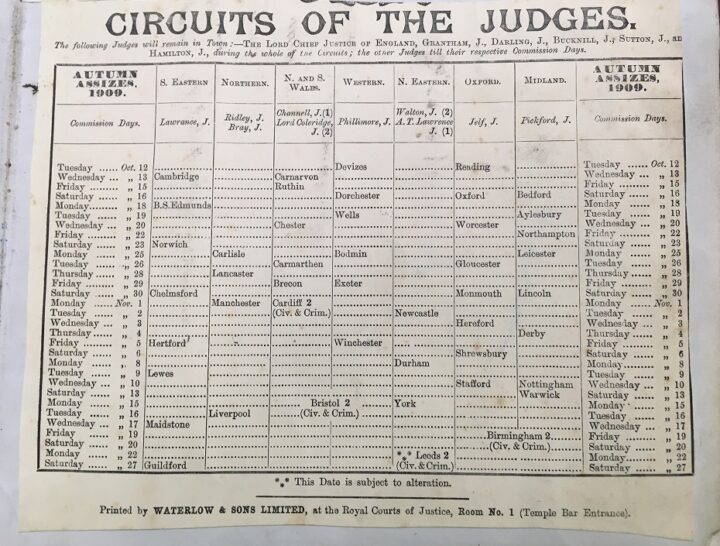
The judges’ circuits with scheduled dates for the Autumn assizes in 1909. As shown in the image, there were seven circuits at this time (catalogue reference ASSI 2/49).
3. Record types and the information they contain
Not all assize records have survived as the assize clerks sometimes destroyed them when they ran out of space. Earlier records are less likely to have been kept than later ones.
In terms of information about people, assize records, most commonly, give details of the accused. Typically this includes the name, occupation and place of abode of the accused, but some or all of this information can be unreliable as aliases were often used and other false details were given. The place of abode mentioned is often where the crime took place rather than where the accused lived.
3.1 Crown and gaol books (aka minute books or agenda books)
The best place to begin a search in the assize records is in the Crown and gaol books, also known as minute books or agenda books. These usually list:
- names of the accused
- charges against the accused
- plea
- verdict
- sentence
There may be a separate series of minute books for offences such as the failure of local communities to keep local roads and bridges in a good state of repair. These kinds of ‘public office’ offences were considered criminal offences.
3.2 Indictments
These are the formal statements of the charge against the accused, usually annotated with plea, verdict and sentence.
Indictments were filed in large unwieldy bundles together with other related records, depending on the period and the circuit. Bundled in with indictment records you may also find details of jury panels, coroners’ inquisitions, examinations and depositions, gaol calendars, trial minutes, commissions, presentments of non-criminal offences and recognizances (which give names, parishes of residence and occupation and are usually far more accurate than those given on the indictments themselves).
Each indictment usually gives:
- name of the defendant together with any aliases
- his or her occupation
- a parish of residence
- the date of the alleged offence (by regnal year)
- details of the alleged offence, together with the name of the victim
- a list of prosecution witnesses
The details of the defendant should be treated with caution, especially before the late 19th century. The defendant’s occupation was normally given as ‘labourer’ and the parish of residence is invariably the parish in which the alleged offence took place. The alleged offence is defined by lengthy and formal phrases and some, especially in cases of serious misdemeanour, such as perjury or libel, are several membranes long.
Until 1916, assize indictments were either handwritten or partly printed and partly written on parchment. After 1916 all indictments were prepared using standard, usually pre-printed, forms. These give the jurisdiction and venue, the name of the defendant, the plea, a summary statement of the charge or charges and particulars of the charges.
3.3 Depositions and examinations
Depositions, sometimes known as sessions papers, consist of pre-trial witness statements. However, the survival rate for these records is relatively poor and those that do survive have been heavily weeded. Only depositions in capital cases, usually murder and riot, tend to survive.
Deposition files, especially those from the mid-20th century or later, may also contain items used as trial exhibits, including:
- photographs
- maps
- appeal papers
3.4 Transcripts
Transcripts of what was actually said in court do not normally survive with the records held at The National Archives. A collection of contemporary pamphlet accounts of what was said in court during mostly celebrated trials for the period 1660-1908 is available on microfiche in the reading rooms at The National Archives.
The Old Bailey Online website provides detailed proceedings (although not complete transcripts of what was said) for trials at the London central criminal court.
3.5 Other records
Other assize records can include:
- pleadings
- statements of claim, defence and counterclaim
- draft minutes of trials
- correspondence of the assize clerks, mostly administrative
- coroners’ inquisitions
- jury lists
- financial business including fees and costs
- estreats (records of fines and forfeits)
4. How to search for records
As most assize court records remain available only in their original paper or parchment form (copies are not available online), to search for them and see them you will need to visit us at our building in Kew. Alternatively, if you can establish the record series and document references within the series, you can use our record copying service to have copies sent to you for a charge. Either way, you will need to follow these steps to locate records:
Step 1: Establish where and when the trial took place
If you do not know the date or at least the year of a trial and the county in which the trial took place, you may find your search hits a dead end very quickly. Consult our criminal court cases overview guide for advice on using newspapers, criminal registers and calendars to try to establish these facts.
Step 2: Decide which type of record to look for
Usually, the best place to begin a search in the assize records is the crown and gaol books. To decide which kind of record will be most useful for your research see the information on record types in section 3.
Step 3: Identify the record series
All assize court records at The National Archives are identified by the department code ASSI. You will also need a series number (each circuit has its own set of series) to narrow your search. To find the right record series refer to the keys in the appendices of this guide. For English counties use Appendix 1; for Welsh counties use Appendix 2.
By searching or browsing the right series you will hopefully find a piece number that covers the records of the trial in question. Once you have the piece number you can view the original records in person at The National Archives in Kew or pay for copies to be sent to you.
5. Related records and alternatives
There are some other scattered records outside of the ASSI department at The National Archives which relate to criminal trials at assize courts. There are also records and accounts of trials elsewhere, in other archives and libraries.
5.1 Transcripts held by government departments and other courts
There are court transcripts for some trials among Court of Appeal, Director of Public Prosecutions or Treasury Solicitor and Home Office records. There are sometimes additional notes which can provide insight into a trial. The following record series are the best place to start if you are looking for court transcripts:
- Treasury Solicitor and Director of Public Prosecutions: Transcripts of Proceedings in Selected Criminal Trials (1846-1958) in DPP 4
- Treasury Solicitor: Transcripts of Proceedings (1812-1963) in TS 36
- Court of Criminal Appeal and Supreme Court of Judicature, Court of Appeal, Criminal Division: Case Papers (1945-1993) in J 82
5.2 Records of payments and expenses, c.1715-1832
Payments and expenses incurred by sheriffs in the punishment of prisoners were often recorded. These records can include lists of prisoners tried or transported, accounts for maintenance in prison or expenses for carrying out an execution. They provide a useful alternative for the many missing assize records from this period.
You cannot search these records by keyword. Instead, click on the links below to browse through the records by year ranges:
- Sheriff’s assize vouchers are held in a subseries of E 389and consist of pieces E 389/241 to E 389/257, covering the period 1715-1832. To use this series effectively you will need to refer to the E 389 paper list in the reading rooms at Kew.
- Payments to sheriffs which refer to individual prisoners are in T 90/146-170, covering the period 1733-1822
- Entry books of warrants of payments for the period 1676-1839 are in T 53/1-68.
5.3 Judicial reviews at the Court of King’s Bench
The Court of King’s Bench would sometimes direct an assize court to send the records of a trial for review, a process known as certiorari. There are copies of indictments within the records of writs of certiorari in KB 9.
For more advice on records of the King’s Bench, see King’s Bench 1675-1875 research guide.
5.4 Miscellaneous DPP, HO and PCOM records
The following National Archives departments contain records of various kinds related to trials held at the assize courts:
- Director of Public Prosecutions (department code DPP)
- Home Office (department code HO)
- The Prison Commission (department code PCOM)
The Office of Director of Public Prosecutions (DPP) was created in 1879 with powers to institute and conduct criminal proceedings in any of the senior criminal courts – assizes, Crown Court, King’s/Queen’s Bench or Central Criminal Court.
Before 1879, the Home Office gave advice on prosecutions to police forces and magistrates’ clerks and gave directions to the Treasury Solicitor (TS) to institute proceedings in important cases, notably those involving political crimes.
Director of Public Prosecutions and Treasury Solicitor files on cases can be searched for by surname of the defendant.
Search or browse case files of the Director of Public Prosecutions in DPP 1 1889-1930, and DPP 2 1931-2016 (recent records are closed), and transcripts of certain trials in DPP 4 1846-1958.
Treasury Solicitor’s files on criminal cases can be found in various series, including case papers in TS 11, TS 18 and TS 22; and transcripts of proceedings in TS 36.
Appendix 1: Key to records of criminal cases in the English assizes 1559-1971
Click on the links in the table to search or browse through the respective series in our catalogue. See section 4 for detailed advice on how to search. For advice on whether to browse or search, see our Discovery help pages.
Of the pre-19th century depositions that have survived, most are from northern counties. Of the pre-19th century Midland circuit records, most that survive are from after 1818.
Bristol assize records prior to 1832 are held by Bristol Record Office.
In 1830 the palatinate of Chester (Cheshire) joined the assizes court system. Durham and Lancaster (Lancashire) merged into the assizes system in 1876. Prior to these years you will need to consult the Palatinate of Chester court records, the Palatinate of Durham court records or the Palatinate of Lancaster court records.
| County | Crown & Gaol Books | Indictments | Depositions | Other | |||
|---|---|---|---|---|---|---|---|
| Bedfordshire | 1863-1876 1734-1863 1876-1945 |
ASSI 32 ASSI 33 ASSI 11 |
1658-1698 1693-1850 1851-1971 |
ASSI 16 ASSI 94 ASSI 95 |
1832-1876 1876-1971 |
ASSI 36 ASSI 13 |
ASSI 34, ASSI 38, ASSI 39, ASSI 15, ASSI 90 |
| Berkshire | 1657-1971 1847-1951 |
ASSI 2 ASSI 3 |
1650-1971 | ASSI 5 | 1719-1971 | ASSI 6 | ASSI 4, ASSI 9, ASSI 10, ASSI 93, ASSI 89 |
| Bucks | 1863-1876 1734-1863 1876-1945 |
ASSI 32 ASSI 33 ASSI 11 |
1642-1699 1695-1850 1851-1971 |
ASSI 16 ASSI 94 ASSI 95 |
1832-1876 1876-1971 |
ASSI 36 ASSI 13 |
ASSI 34, ASSI 38, ASSI 39, ASSI 15, ASSI 90 |
| Cambridgeshire | 1902-1943 1863-1971 1734-1863 |
ASSI 31 ASSI 32 ASSI 33 |
1642-1699 1692-1850 1851-1971 |
ASSI 16 ASSI 94 ASSI 95 |
1834-1971 | ASSI 36 | ASSI 34, ASSI 38, ASSI 39, ASSI 90 |
| Cheshire | 1532-1831 1831-1938 1835-1883 1945-1951 |
CHES 21 ASSI 61 ASSI 62 ASSI 79 |
1341-1659 1831-1945 1945-1971 |
CHES 24 ASSI 64 ASSI 83 |
1831-1944 1945-1971 |
ASSI 65 ASSI 84 |
ASSI 59, ASSI 63, ASSI 66, ASSI 67, ASSI 91 |
| Cornwall | 1730-1971 1670-1824 |
ASSI 21 ASSI 23 |
1801-1971 | ASSI 25 | 1861-1971 1951-1953 |
ASSI 26 ASSI 82 |
ASSI 24, ASSI 30, ASSI 92 |
| Cumberland | 1714-1873 1665-1810 |
ASSI 41 ASSI 42 |
1607-1876 1877-1971 |
ASSI 44 ASSI 51 |
1613-1876 1877-1971 |
ASSI 45 ASSI 52 |
ASSI 43, ASSI 46, ASSI 47, ASSI 93 |
| Derbs | 1818-1945 | ASSI 11 | 1868-1971 1662,67,87 |
ASSI 12 ASSI 80 |
1862-1971 | ASSI 13 | ASSI 15, ASSI 88 |
| Devon | 1746-1971 1670-1824 |
ASSI 21 ASSI 23 |
1801-1971 | ASSI 25 | 1861-1971 1951-1953 |
ASSI 26 ASSI 82 |
ASSI 24, ASSI 30, ASSI 92 |
| Dorset | 1746-1971 1670-1824 |
ASSI 21 ASSI 23 |
1801-1971 | ASSI 25 | 1861-1971 1951-1953 |
ASSI 26 ASSI 82 |
ASSI 24, ASSI 30, ASSI 92 |
| Durham | 1770-1876 1753-1858 1858-1944 |
DURH 15 DURH 16 ASSI 41 |
1582-1877 1876-1971 |
DURH 17 ASSI 44 |
1843-1876 1877-1971 |
DURH 18 ASSI 45 |
DURH 19, ASSI 46, ASSI 47, ASSI 87, ASSI 93 |
| Essex | 1734-1943 1826-1971 |
ASSI 31 ASSI 32 |
1559-1688 1689-1850 1851-1971 |
ASSI 35* ASSI 94 ASSI 95 |
1825-1971 | ASSI 36 | ASSI 34, ASSI 38, ASSI 39, ASSI 90 |
| County | Crown & Gaol Books | Indictments | Depositions | Other | |||
| Glos | 1657-1971 1847-1951 |
ASSI 2 ASSI 3 |
1662-1971 | ASSI 5 | 1719-1971 | ASSI 6 | ASSI 4, ASSI 9, ASSI 10, ASSI 89, ASSI 93 |
| Hampshire | 1746-1971 1670-1824 |
ASSI 21 ASSI 23 |
1801-1971 | ASSI 25 | 1861-1971 1951-1953 |
ASSI 26 ASSI 82 |
ASSI 24, ASSI 30, ASSI 92 |
| Herefordshire | 1657-1971 1847-1951 |
ASSI 2 ASSI 3 |
1627-1971 | ASSI 5 | 1719-1971 | ASSI 6 | ASSI 4, ASSI 9, ASSI 10, ASSI 89, ASSI 93 |
| Hertfordshire | 1734-1943 1826-1971 |
ASSI 31 ASSI 32 |
1573-1688 1689-1850 1851-1971 |
ASSI 35 ASSI 94 ASSI 95 |
1829-1971 | ASSI 36 | ASSI 34, ASSI 38, ASSI 39, ASSI 90 |
| Hunts | 1902-1943 1863-1971 1734-1863 |
ASSI 31 ASSI 32 ASSI 33 |
1643-1698 1693-1850 1851-1971 |
ASSI 16 ASSI 94 ASSI 95 |
1851-1971 | ASSI 36 | ASSI 34, ASSI 38, ASSI 39, ASSI 90 |
| Kent | 1734-1943 1826-1971 |
ASSI 31 ASSI 32 |
1559-1688 1689-1850 1851-1971 |
ASSI 35 ASSI 94 ASSI 95 |
1812-1971 | ASSI 36 | ASSI 34, ASSI 38, ASSI 39, ASSI 90 |
| Lancashire | 1524-1843 1686-1877 |
PL 25 PL 28 |
1660-1867 1877-1971 |
PL 26 ASSI 51 |
1663-1867 1877-1971 |
PL 27 ASSI 52 |
PL 28 ASSI 46, ASSI 53, ASSI 93, ASSI 86 |
| Leics | 1818-1864 1864-1875 1876-1945 |
ASSI 11 ASSI 32 ASSI 11 |
1653, 1656 1864-1875 1876-1971 |
ASSI 80 ASSI 35 ASSI 12 |
1862 1863-1875 1876-1971 |
ASSI 13 ASSI 36 ASSI 13 |
ASSI 15, ASSI 34, ASSI 38, ASSI 39, ASSI 88 |
| Lincolnshire | 1818-1945 | ASSI 11 | 1868-1971 1652-1679 |
ASSI 12 ASSI 80 |
1862-1971 | ASSI 13 | ASSI 15, ASSI 88 |
| London & Middlesex | 1834-1949 | CRIM 6 | 1834-1957 1833-1971 |
CRIM 4 CRIM 5 |
1839-1971 1923-1971 |
CRIM 1 CRIM 2 |
CRIM 7, CRIM 8, CRIM 9, CRIM 10, CRIM 11, CRIM 12, CRIM 13 |
| Monm | 1657-1971 1847-1951 |
ASSI 2 ASSI 3 |
1666-1971 | ASSI 5 | 1719-1971 | ASSI 6 | ASSI 4, ASSI 9, ASSI 10, ASSI 89, ASSI 93 |
| Norfolk | 1902-1943 1863-1971 1734-1863 |
ASSI 31 ASSI 32 ASSI 33 |
1606-1699 1692-1850 1851-1971 |
ASSI 16 ASSI 94 ASSI 95 |
1817-1971 | ASSI 36 | ASSI 34, ASSI 38, ASSI 39, ASSI 90 |
| Northants | 1818-1864 1864-1876 1876-1945 |
ASSI 11 ASSI 32 ASSI 11 |
1659-1660 1864-1675 1876-1971 |
ASSI 80 ASSI 95 ASSI 12 |
1862 1864-1875 1876-1971 |
ASSI 13 ASSI 36 ASSI 13 |
ASSI 15, ASSI 34, ASSI 38, ASSI 39, ASSI 88 |
| County | Crown & Gaol Books | Indictments | Depositions | Other | |||
| Northumberland | 1714-1944 1665-1810 |
ASSI 41 ASSI 42 |
1607-1971 | ASSI 44 | 1613-1971 | ASSI 45 | ASSI 43, ASSI 46, ASSI 47, ASSI 87, ASSI 93 |
| Notts | 1818-1945 | ASSI 11 | 1868-1971 1663-4, 82 |
ASSI 12 ASSI 80 |
1862-1971 | ASSI 13 | ASSI 15, ASSI 88 |
| Oxford | 1657-1971 1847-1951 |
ASSI 2 ASSI 3 |
1661-1971 1688 |
ASSI 5 PRO 30/80 |
1719-1971 | ASSI 6 | ASSI 4, ASSI 9, ASSI 10, ASSI 89, ASSI 93 |
| Rutland | 1818-1864 1864-1876 1876-1945 |
ASSI 11 ASSI 32 ASSI 11 |
1667, 1685 1864-1875 1876-1971 |
ASSI 80 ASSI 95 ASSI 12 |
1862 1864-1873 1876-1971 |
ASSI 13 ASSI 36 ASSI 13 |
ASSI 15, ASSI 34, ASSI 38, ASSI 39, ASSI 88 |
| Shropshire (Salop) |
1657-1971 1847-1951 |
ASSI 2 ASSI 3 |
1654-1971 | ASSI 5 | 1719-1971 | ASSI 6 | ASSI 4, ASSI 9, ASSI 10, ASSI 89, ASSI 93 |
| Somerset | 1730-1971 1670-1824 |
ASSI 21 ASSI 23 |
1801-1971 | ASSI 25 | 1861-1971 1951-1953 |
ASSI 26 ASSI 82 |
ASSI 24, ASSI 30, ASSI 92 |
| Staffs | 1657-1971 1847-1951 |
ASSI 2 ASSI 3 |
1662-1971 1662 |
ASSI 5 ASSI 80 |
1719-1971 | ASSI 6 | ASSI 4, ASSI 9, ASSI 10, ASSI 89, ASSI 93 |
| Suffolk | 1902-1943 1863-1971 1734-1863 |
ASSI 31 ASSI 32 ASSI 33 |
1653-1698 1689-1850 1851-1971 |
ASSI 16 ASSI 94 ASSI 95 |
1832-1971 | ASSI 36 | ASSI 34, ASSI 38, ASSI 39, ASSI 90 |
| Surrey | 1734-1943 1826-1971 |
ASSI 31 ASSI 32 |
1559-1688 1689-1850 1851- |
ASSI 35 ASSI 94 ASSI 95 |
1820-1971 | ASSI 36 | ASSI 34, ASSI 38, ASSI 39, ASSI 90 |
| Sussex | 1734-1943 1826-1971 |
ASSI 31 ASSI 32 |
1559-1688 1689-1850 1851-1971 |
ASSI 35 ASSI 94 ASSI 95 |
1812-1971 | ASSI 36 | ASSI 34, ASSI 38, ASSI 39, ASSI 90 |
| Warw | 1818-1945 | ASSI 11 | 1868-1971 1652, 1688 |
ASSI 12 ASSI 80 |
1862-1971 | ASSI 13 | ASSI 15, ASSI 88 |
| Westmor | 1714-1873 1718-1810 |
ASSI 41 ASSI 42 |
1607-1876 1877-1971 |
ASSI 44 ASSI 51 |
1613-1876 1877-1971 |
ASSI 45 ASSI 52 |
ASSI 43, ASSI 46, ASSI 47, ASSI 53, ASSI 86, ASSI 93 |
| Wilts | 1746-1971 1670-1824 |
ASSI 21 ASSI 23 |
1729 1801-1971 |
ASSI 25 ASSI 25 |
1861-1971 1951-1953 |
ASSI 26 ASSI 82 |
ASSI 24, ASSI 30, ASSI 92 |
| Worcs | 1657-1971 1847-1951 |
ASSI 2 ASSI 3 |
1662-1971 | ASSI 5 | 1719-1971 | ASSI 6 | ASSI 4, ASSI 9, ASSI 10, ASSI 89, ASSI 93 |
| Yorks** | 1658-1811 1718-1863 1864-1876 1876-1944 |
ASSI 42 ASSI 41 ASSI 11 ASSI 41 |
1607-1863 1868-1875 1876-1971 |
ASSI 44 ASSI 12 ASSI 44 |
1613-1863 1868-1875 1876 1971 1877-1971 |
ASSI 45 ASSI 13 ASSI 45 ASSI 52 |
ASSI 15, ASSI 43, ASSI 46, ASSI 47, ASSI 87, ASSI 93 |
* You can search by name and the term ‘assize’ for the calendars of Essex Assizes indictments in ASSI 35 (1558-1714) on the Essex Record Office catalogue.
** For Yorkshire there are two series of Crown & Gaol Books for the earlier period so you will need to check both.
Appendix 2: Key to records of criminal cases in the Welsh assizes 1831-1971
Click on the links in the table to search or browse through the respective series in our catalogue. See section 4 for detailed advice on how to search. For advice on whether to browse or search, see our Discovery help pages.
| County | Crown & Gaol Books | Indictments | Depositions | Other | |||
|---|---|---|---|---|---|---|---|
| Anglesey | 1831-1938 1835-1883 1945-1951 |
ASSI 61 ASSI 62 ASSI 79 |
1831-1945 1945-1971 |
ASSI 64 ASSI 83 |
1831-1944 1945-1971 |
ASSI 65 ASSI 84 |
ASSI 59, ASSI 63, ASSI 66, ASSI 67 |
| Breconshire | 1841-1842 1844-1946 1945-1951 |
ASSI 74 ASSI 76 ASSI 79 |
1834-1945 1945-1971 |
ASSI 71 ASSI 83 |
1837-1971 1945-1971 |
ASSI 72 ASSI 84 |
ASSI 73, ASSI 77 |
| Caernarvonshire | 1831-1938 1835-1983 1945-1951 |
ASSI 61 ASSI 62 ASSI 79 |
1831-1945 1945-1971 |
ASSI 64 ASSI 83 |
1831-1944 1945-1971 |
ASSI 65 ASSI 84 |
ASSI 59, ASSI 63, ASSI 66, ASSI 67 |
| Cardiganshire | 1841-1842 1844-1946 1945-1951 |
ASSI 74 ASSI 76 ASSI 79 |
1834-1945 1945-1971 |
ASSI 71 ASSI 83 |
1837-1971 1945-1971 |
ASSI 72 ASSI 84 |
ASSI 73, ASSI 77 |
| Carmarthenshire | 1841-1842 1844-1946 1945-1951 |
ASSI 74 ASSI 76 ASSI 79 |
1834-1945 1945-1971 |
ASSI 71 ASSI 83 |
1837-1971 1945-1971 |
ASSI 72 ASSI 84 |
ASSI 73, ASSI 77 |
| Denbighshire | 1831-1938 1835-1883 1945-1951 |
ASSI 61 ASSI 62 ASSI 79 |
1831-1945 1945-1971 |
ASSI 64 ASSI 83 |
1831-1944 1945-1971 |
ASSI 65 ASSI 84 |
ASSI 59, ASSI 63, ASSI 66, ASSI 67 |
| Flint | 1831-1938 1835-1883 1945-1951 |
ASSI 61 ASSI 62 ASSI 79 |
1831-1945 1945-1971 |
ASSI 64 ASSI 83 |
1831-1944 1945-1971 | ASSI 65 ASSI 84 |
ASSI 59, ASSI 63, ASSI 66, ASSI 67 |
| Glamorganshire | 1841-1842 1844-1946 1945-1951 |
ASSI 74 ASSI 76 ASSI 79 |
1834-1945 1945-1971 |
ASSI 71 ASSI 83 |
1837-1971 1945-1971 |
ASSI 72 ASSI 84 |
ASSI 73, ASSI 77 |
| Merionethshire | 1831-1938 1835-1883 1945-1951 |
ASSI 61 ASSI 62 ASSI 79 |
1831-1945 1945-1971 |
ASSI 64 ASSI 83 |
1831-1944 1945-1971 |
ASSI 65 ASSI 84 |
ASSI 59, ASSI 63, ASSI 66, ASSI 67 |
| Montgomeryshire | 1831-1938 1835-1883 1945-1951 |
ASSI 61 ASSI 62 ASSI 79 |
1831-1945 1945-1971 |
ASSI 64 ASSI 83 |
1831-1944 1945-1971 |
ASSI 65 ASSI 84 |
ASSI 59, ASSI 63, ASSI 66, ASSI 67 |
| Pembrokeshire | 1841-1842 1844-1946 1945-1951 |
ASSI 74 ASSI 76 ASSI 79 |
1834-1945 1945-1971 |
ASSI 71 ASSI 83 |
1837-1971 1945-1971 |
ASSI 72 ASSI 84 |
ASSI 73, ASSI 77 |
| Radnor | 1841-1842 1844-1946 1945-1951 |
ASSI 74 ASSI 76 ASSI 79 |
1834-1945 1945-1971 |
ASSI 71 ASSI 83 |
1837-1971 1945-1971 |
ASSI 72 ASSI 84 |
ASSI 73, ASSI 77 |
Appendix 3: Latin abbreviations still used in the records after 1733
Until 1733 (with the exception of the period of the interregnum), records were written in Latin and in distinctive legal scripts. The annotations on indictments are often in Latin abbreviations which remained in use even after 1733.
| Latin abbreviation | Full Latin version | English translation |
|---|---|---|
| ca null | catalla nulla | no goods/chattels to forfeit |
| cog ind | cognovit indictamentum | confessed to the indictment |
| cul | culpabilis | guilty |
| ign | ignoramus | we do not know, that is, no case to answer |
| non cul nec re | non culpabilis nec retraxit | not guilty and did not flee |
| po se | ponit se super patriam | puts himself on the country (that is, opts for jury trial and pleads not guilty) |
| sus | suspendatur | let him be hanged |
Appendix 4: Further reading
J S Cockburn’s publications are invaluable guides to assize records. His history of assizes is particularly valuable, with sage advice on the pitfalls of taking the records at face value.
J S Cockburn, A History of English Assizes, 1558-1714 (1972)
J S Cockburn, Calendars of Assize Records (various publications covering the home circuits)
L Knafla, Kent at Law 1602 (1994)
D T Hawkings, Criminal Ancestors (2009) – also covers assizes and related records
1. Why use this guide?
This guide tells you the type of records we hold on courts martial and desertion, and provides you with guidance on how to search for them.
This guide to courts martial and deserters covers:
- different types of courts martial in the 17th, 18th, 19th and 20th centuries and how they were administered
- First World War courts martial (and subsequent pardons)
- where to find records of courts martial at The National Archives
- records of deserters held at The National Archives and elsewhere
If you are looking for courts martial following the Easter Rising, read the guide Ireland’s Easter Rising 1916 instead.
2. What is a court martial?
A court martial is a court convened to try an offence against military discipline, or against the ordinary law, committed by a person in one of the armed services. Courts martial were also used to try civilians when martial law was in force.
2.1 Types of courts martial
Various types of courts martial existed. They are sometimes listed by initials:
General court martial (GCM)
This was army’s highest tribunal, dealing with commissioned officers and the most serious cases involving other ranks. It could only be convened by the Crown or its deputy (for example, the commander in chief, or governors general). At least 13 commissioned officers had to be present if ‘at home’ (serving in the British Isles, Ireland, non-British territories or small British possessions), or five if ‘overseas’ (the British colonies), together with a judge advocate. Decisions were confirmed by the person who issued the warrant (that is, the Crown or its direct deputy).
Field general court martial (FGCM)
This type of court martial was often used in wartime. Only three commissioned officers needed to be present. The decision had to be unanimous for the death penalty to be imposed.
General regimental court martial (GRCM) or district (or garrison) court martial (DCM)
More limited in jurisdiction, these courts could not try commissioned officers or charges carrying the death penalty, transportation or prison sentences of more than two years. It required seven officers at home or five if overseas. Details of the sentence were sent up to the Judge Advocate General’s office. The general regimental court martial was replaced by the district court martial in 1829.
Regimental court martial (RCM)
The regimental court martial was used for ranks other than commissioned officers who were charged with lesser offences. They may be noted in war diaries, but no records were sent to the Judge Advocate General’s Office. Some of the records of these courts may survive among the records preserved by individual regiments.
3. How do I search the records?
Records can be searched by name online at Forces War Records or by consulting original documents at The National Archives.
If the records you require are not online, it would be helpful if you know the rank of the individual, type of court and approximate date before you start your research – this will help you narrow down relevant record series listed in the guide.
3.1 Online records
Some records are searchable online by name and can be viewed on Forces War Records.
See section 4 for more information.
3.2 Original documents at The National Archives
Start your search by identifying relevant records series listed below.
Browse or search relevant record series by date to locate document references using Discovery, our catalogue. The records are not searchable by name on our catalogue.
For more guidance on how to conduct a search or how to browse the catalogue, read Discovery help.
For records which are not viewable online, you will either need to visit The National Archives or order digital or paper copies to be sent to you.
You can order copies from the catalogue description in Discovery (you should register an account in Discovery before you request copies).
4. What can I view online?
Search by name and download the following registers of courts martial online:
| Description of records | Details in the records | Online source | Dates | Catalogue references |
|---|---|---|---|---|
| Field General Courts Martial and Military Courts registers from the Judge Advocate General’s Office | Name, rank, regiment, place of trial, nature of charge and sentence for each prisoner | Forces War Records (£) – you can search for records at Ancestry.co.uk but images of the records are exclusive to Forces War Records. |
1909-1918 |
Series WO 213, pieces 1-25 |
| District Courts Martial registers, Home and Abroad from the Judge Advocate General’s Office | Name, rank, regiment, place of trial, nature of charge and sentence for each prisoner | Forces War Records (£) – you can search for records at Ancestry.co.uk but images of the records are exclusive to Forces War Records. | 1829-1979 | Series WO 86, pieces 1-94 |
| General Courts Martial registers, Confirmed at Home from the Judge Advocate General’s Office | Name, rank, regiment, place of trial, nature of charge and sentence for each prisoner | Forces War Records (£) – you can search for records at Ancestry.co.uk but images of the records are exclusive to Forces War Records. |
1666-1704 & 1806-1930 |
Series WO 92, pieces 1-3 & 8-10 |
5. The Judge Advocate General
Almost all the surviving records of army courts martial came to The National Archives via the office of the Judge Advocate General, the legal officer responsible to the Crown for military law. His duties, and those of the judge advocates answerable to him, were to prepare the case, summon courts martial and administer the oath to witnesses. After the hearing the judge advocate would submit a report of the proceedings to the relevant authority for confirmation. Before 1951 soldiers had no right of appeal, although the confirming officer would often reduce the sentence.
The submitted reports on individual courts martial, 1715-1790, are in WO 71/34-64 for both home and overseas cases. Cases from 1806-1904, to be confirmed at home, are in WO 91. There is a joint index to WO 91 and WO 92, for 1806-1833, in WO93/1A. Other submissions, 1880-1938, are in WO 209.
5.1 Miscellaneous records of the Judge Advocate General
| Type of record | Dates | Catalogue reference |
|---|---|---|
| Statistics | 1914-1954 | WO 93/49 |
| Particulars of death sentences carried out | 1941-1953 | WO 93/40 |
| War trials | 1944-1969 | WO 93/60-68 |
| Changi prisoner of war camp, Malaya | 1942-1944 | WO 93/46-48 |
5.2 Judge Advocate General case index system, 1991-1999
The office of the Judge Advocate General has a database with continuing registers of Army and Royal Air Force court martial cases at home and abroad and cases in civilian standing courts for 1991 to 1999. Browse LCO 60 to find and download cases from this database. It contains the following details:
- date and type of trial
- defendant’s unit
- rank
- service number
- name of the Judge Advocate
- charges brought
- court
In the case of standing civilian court hearings the relationship of the defendant to service personnel is recorded.
6. Registers of courts martial, 1796-1963
The Judge Advocate General’s office compiled registers of general and field courts martial, giving name, rank, regiment, place of trial, charge, finding, and sentence. These are in
- WO 90 (abroad, 1796-1960 – with a volume for India)
- WO 92 (home, 1666-1704, 1806-1960 – with registers for part of the Boer War).
Part of WO 92 is available online – see section what can be viewed online.
An index for 1806-1833 is in WO 93/1A.
Later registers for 1909-1963 are in WO 213 (see section what can I view online).
7. First World War courts martial
7.1 Death sentences
Death sentences were passed by the British Army in courts martial between 1914 and 1924 for offences such as sleeping on duty, cowardice, desertion, murder, mutiny and treason. Death sentences were passed on over 3,000 British soldiers, members of Dominion, Colonial and foreign forces, and several British and foreign civilians. Over 90% of these sentences were later changed to other punishments, such as hard labour or penal servitude.
For all offences except mutiny, see Death sentences passed by the military courts of the British Army, 1914-1924 by G Oram and J Putkowski. This gives lists of sentences by date and surname. Each entry gives a reference number. Add WO to the front of this number, and you have the full National Archives document reference.
Most records of courts martial are in:
- Field General Courts Martial and Military Courts Registers in WO 213 (see section what can I view online)
- General Courts Martial Registers, confirmed at home in WO 92
- General Courts Martial Registers, abroad in WO 90
7.2 Mutinies
Over 2,000 men were charged with mutiny between 1914 and 1922. You may find it useful to consult British Army Mutineers, 1914-1922 by J Putkowski. This lists mutinies by:
- surname
- unit
- mutinies at home by date
- mutinies abroad by date
Each entry gives a full National Archives document reference, including the internal page number. When ordering one of these documents, leave out the page number.
Most records of courts martial of mutineers are in:
- WO 86 – see section 4 for what can be viewed online
- WO 90
- WO 92 – see section 4 for what can be viewed online
- WO 213 – see section 4 for what can be viewed online
7.3 Other offences
For courts martial which did not pass a death sentence, try the records described in section 9, or contact the relevant regimental museum.
7.4 Australian and Canadian forces
Name rolls of courts martial, 1915-1919, contain court martial records of the Australian Imperial Force (WO 93/42) and the Canadian Expeditionary Force (WO 93/43).
8. Trials of commissioned officers, 1668-1993
Commissioned officers could be tried only by general or field general courts martial: these are indexed between 1830 and 1904 in WO 93/1B. The records are mostly in WO 71, which includes original papers in the case (such as warrants, letters and depositions, sometimes described as ‘papers’) as well as entry books of the trial proceedings. There are several series of records in WO 71:
| Type of record | Dates | Catalogue reference |
|---|---|---|
| Papers | 1668-1879 | WO 71/121-343 |
| Papers | 1851-1914 | Destroyed by bombing in 1940: look at the registers instead |
| Proceedings | 1692-1796 | WO 71/13-64 (3 series) |
| Proceedings | 1914-1993 | WO 71/387-1586 (closed for 30-100 years) |
| Special cases and senior officers: papers | 1780-1824, 1879 | WO 71/99-120 and WO 343 |
| Ireland: special returns: papers | 1800-1820 | WO 71/252-264 |
| Irish civilians | 1916-1921 | WO 71/344-386 |
9. Trials of non-commissioned officers and other ranks, 1688-1986
Non-commissioned officers and other ranks could be tried by any of the courts martial, so you may have to look in two sets of records. For the most serious offences tried at general and field general courts martial, the records are as described for officers (see section 8). For less serious offences tried at general regimental and district garrison courts martial, consult:
| Type of record | Dates | Catalogue reference |
|---|---|---|
| Proceedings | 1914-1993 | WO 71/387-1586 |
| Registers: home and abroad | 1812-1829 | WO 89 |
| Registers: home and abroad | 1829-1971 | WO 86 (see section 4 for what can be viewed online) |
| London area: registers | 1865-1875 | WO 87 |
| India: registers | 1878-1945 | WO 88 |
| Registers: field courts martial and military courts | 1909-1963 | WO 213 (see section 4 for what can be viewed online) |
Records of minor offences tried at regimental courts martial are not held by The National Archives, but may be held at regimental museums.
10. Deserters
There are registers of deserters, 1811-1852, in WO 25/2906-2934. Until 1827 they are kept in three series: cavalry, infantry and militia (the latter up to 1820 only). After 1827 they are arranged by regiment. These registers give descriptions, dates and place of enlistment and desertion, and outcome. There are registers of captured deserters, 1813-1845, in WO 25/2935-2951, with indexes up to 1833 in WO 25/2952, WO 25/2953, and WO 25/2954. Deserters who surrendered themselves under proclamation, 1803-1815, are in WO 25/2955. On capture, some deserters were sentenced to imprisonment on the Savoy hulk: there are unindexed registers for the hulk, 1799-1823 (WO 25/2956).
Local newspapers and (for 1828 to 1845) the police newspapers Hue and Cry and the Police Gazette carried details of deserters, giving name, parish and county of birth, regiment, date and place of desertion, a physical description and other relevant information. For deserters in Australia (HO 75) consult Fitzmaurice, Army deserters from HM Service.
11. Other records
| Type of record | Dates | Catalogue reference |
|---|---|---|
| Correspondence of the secretary at war | 1684-1861 | WO 4 |
| Judge Advocate General: letters, etc. | 1696-1850 | WO 72 |
| Judge Advocate General: letter books (indexed) | 1715-1962 | WO 81 |
| Deputation books, recording deputy judges advocate | 1751-1910 | WO 85 |
| Judge Advocate General: registers of in-letters | 1817-1951 | WO 82 |
| Correspondence of the commander in chief | 1833-1857 | WO 3/541-568 |
| Judge Advocate General: charge books | 1857-1948 | WO 84 |
| Documents of the Courts Martial Committee | 1938-1940 | WO 225 |
| Registers of warrants for holding courts martial | 1854-1856 | WO 28 |
12. Pardons for First World War servicemen
Amendments to the Armed Forces Act 2006 have established pardons for any person who was executed for a range of predominantly disciplinary offences committed during the war.
For more details please see Section 359 of the Armed Forces Act 2006. The original records of the offence are held in series WO 71.
13. Records held elsewhere
Records of minor offences tried at regimental courts martial are not held by The National Archives, but may be held at regimental museums.
Some of the records the Regimental court martial (RCM) may survive among the records preserved by individual regiments. Contact individual regiments for more information.
14. Further reading
Some or all of the recommended publications below may be available to buy from The National Archives’ shop. Alternatively, search The National Archives’ library to see what is available to consult at Kew.
Alphabetical guide to War Office and other military records preserved in The Public Record Office (Public Record Office Lists & Indexes: LIII) [covers 1676-1902 and has a large number of entries relating to courts martial procedure. Available at The National Archives]
B Barton, ‘The secret court martial records of the 1916 Easter Rising’ (The History Press, 2008)
R W Bennet,, ‘Military Law in 1839’, Journal of the Society for Army Historical Research, XLVIII (1970), 225-241
C M Clode, ‘Military forces of the Crown’, 2 vols (BiblioBazaar, 1869)
Y Fitzmaurice, ‘Army deserters from HM Service’ (Fitzmaurice, 1988)
G Oram and J Putkowski, ‘Death sentences passed by the military courts of the British Army, 1914-1924’ (Frances Boutle, 1998)
J Putkowski, ‘British Army mutineers, 1914-1922’ (Frances Boutle, 1998)
J Putkowski and J Sykes, ‘Shot at dawn’ (Pen & Sword, 1998)
G Rubin, ‘Murder, mutiny and the military: British court martial cases 1940-1966’ (Frances Boutle, 2005)
J Stuart-Smith, ‘Military law; its history, administration and practice’, Law Quarterly Review, LXXXV (1969), 478-504
F B Wiener, ‘Civilians under military justice’ (University of Chicago Press, 1967)
1. Why use this guide?
This guide will help you to find records created by the Foreign Office since its birth in 1782, and by its successor, the Foreign and Commonwealth Office, and now held at The National Archives.
The records of the Foreign Office provide a wealth of information on British relations with foreign states from 1782 to the present day and can also provide insights into the history of domestic issues in countries around the world.
The guide provides advice on the different ways in which you will need to use our own catalogue as well as the indexes and registers created by the Foreign Office itself to find individual records. There is also advice on how to find treaties dating back to 1695 and now held among Foreign Office records.
2. What were the Foreign Office and the Foreign and Commonwealth Office?
The Foreign Office was created in 1782 and became the Foreign and Commonwealth Office in 1968. It was the government department responsible for the conduct of British relations with nearly all foreign states between those dates (British colonies and dominions were dealt with by separate departments).
From 1968, the Foreign and Commonwealth Office assumed these roles, in addition to administering the remaining British dependencies and managing relations with the Commonwealth (previously the responsibility of the Commonwealth Office).
In September 2020 the Department for International Development was merged with the Foreign and Commonwealth Office to form the Foreign, Commonwealth and Development Office.
For further details, see the administrative histories in Discovery, our catalogue, for departments FO and FCO.
3. Online and published records
Most in-depth research into Foreign Office records requires a visit to our site in Kew. There are, however, some online and published resources which allow you to search for and view a limited number of records without having to visit.
A scattered selection of records have been reproduced either in published volumes or online. These include:
- Foreign Office records on the Adam Matthew website including records on the Middle East (1839-1969 and 1971-1981), Latin America (1833-1969), China (1919-1980), India, Pakistan and Afghanistan (1947-1980)
- Foreign Office (and Colonial Office and Cabinet Office) records showcasing the story of the rich and complex history of the countries located in the Arabian Gulf on the Arabian Gulf Digital Archive. The archive contains material dating from 1820 to 2004. This is a joint project between the National Archives of the United Arab Emirates and The National Archives of the United Kingdom. You can search and download records from the website using OCR keywords, date ranges and document references. The archive is available in both English and Arabic versions.
- Search UK Treaties Online for the text of treaties as published in the UK Parliament Command papers
- Secret Files from World Wars to Cold War (Intelligence and Foreign Policy files 1873-1953)
- Private Office Papers of various ministers and officials (1824-1968) in FO 800 (these are digital microfilm records and are free to download from our website)
- Other digital microfilm records free to download from our website
- Indexes to Foreign Office correspondence between 1906 and 1920, in FO 1111, and between 1920 and 1951, in FO 409
- The published records described in the Further reading section of this guide
4. How to search for original records: getting started
Most Foreign Office and Foreign and Commonwealth Office records held at The National Archives are not viewable or downloadable online. To view them you will either need to visit our building in Kew, find references to records on our online catalogue with which you can order copies, or pay for research to be done for you.
Foreign Office records are held in record department FO and Foreign and Commonwealth Office records in FCO.
To search for records you will need to do one or both of the following, depending on the type of record and the date of the record:
- Keyword searches in our online catalogue
- Use the printed indexes and registers at our building in Kew
For details on when and how to use these resources see the following sections of this guide.
5. General correspondence
The most numerous type of Foreign Office record is general correspondence. There are tens of thousands of records of general correspondence at The National Archives, ranging from letters, both personal and official, telegrams and despatches, to reports, notes and memos and anything else that was sent from one place or person to another in the business of the Foreign Office.
How you search for correspondence depends on when it was created and the changing registry systems of the Foreign Office down the years.
For detailed advice on how to search for general correspondence from different periods see the following guides:
- Foreign Office correspondence 1782-1890
- Foreign Office correspondence 1891-1905
- Foreign Office correspondence 1906-1919
- Foreign Office and Foreign and Commonwealth Office correspondence 1920 onwards
6. Confidential print 1820s-1970s
Consulting confidential print is a good way to gain a summary overview of Foreign Office political correspondence before accessing the extensive, more detailed holdings in the main general correspondence series referred to in section 5.
6.1 What were confidential prints?
From the late 1820s, correspondence of particular significance began to be printed in several copies and distributed to officials in the Foreign Office, to the Cabinet, to other departments and to British missions abroad. These copies were known as confidential print.
By 1906 nearly every important despatch or telegram was printed routinely but the practice of confidential prints died out in the 1970s with the arrival of photocopying.
Confidential prints vary from a single document to a substantial volume of papers, and are numbered individually, roughly in order of printing.
6.2 How to search for confidential prints
A good starting point is the FO Division 2 description in our catalogue which lists record series of confidential prints on particular countries, regions and subjects. To search for specific documents you can either:
Click on the link to any series in the list and search by year using the ‘date range’ boxes.
or
Use the following fields and search terms in the advanced search:
- All of these words: the name of the country or subject of interest
- Exact word or phrase: confidential print
- Search within references: FO
- Date: the dates/years within which the records were created
7. Records from embassy and consular archives
7.1 What do embassy and consular records consist of?
These records include:
- original despatches received from the Foreign Office by British diplomatic and consular posts abroad and draft replies
- local correspondence with the government and other authorities of the foreign state
- correspondence with other British representatives, agents and private individuals
- registers of births, deaths and marriages of British subjects abroad
- consular court records
- commercial records of various kinds
- papers about British churches and cemeteries
- papers about the estates of British subjects
7.2 How to search for embassy and consular records
Please note that not all embassy and consular records have survived.
Basic searches by country and year
Use our catalogue to search for document references with the advanced search, using the boxes to restrict your search results to FO and FCO references, specific years and searching with combinations of the following keywords:
- country name
- either ‘Embassy’, ‘Consulate’, ‘Consular Archives’ or ‘Legation’
Specific subject searches
The only way to search for these records by subject is to visit us at our building in Kew and use the registers of embassy and consulate correspondence that exist from the 1820s onwards.
To use the registers follow these steps:
1. Use the advanced catalogue search to identify a document reference for the relevant register, using the country name AND “Embassy and Consulates” AND “registers” as keywords. You can restrict your search by year or date. With the document reference you can order the document (you can order documents in advance).
2. Once you have the register, select the appropriate section within it (to/from Foreign Office; to/from government of the host country; Commercial, Treaty etc.).
3. Consult the left-hand pages for incoming correspondence, the right-hand page for outgoing correspondence. They look like this:
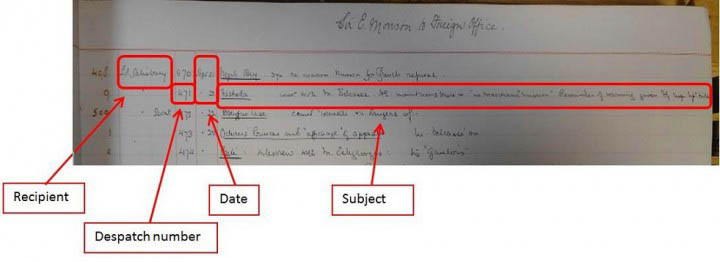
Page from a Foreign Office register for embassy and consular records.
4. Armed with the details of the relevant entries from the register, return to the advanced catalogue search to identify and order the relevant volume of correspondence, using the country name AND “embassy and consulates” AND “general correspondence” as keywords, and restrict to the relevant year.
5. The volumes of correspondence (an example is shown below) are arranged by author and recipient, then by date. Within the relevant volume, look for the despatch number.
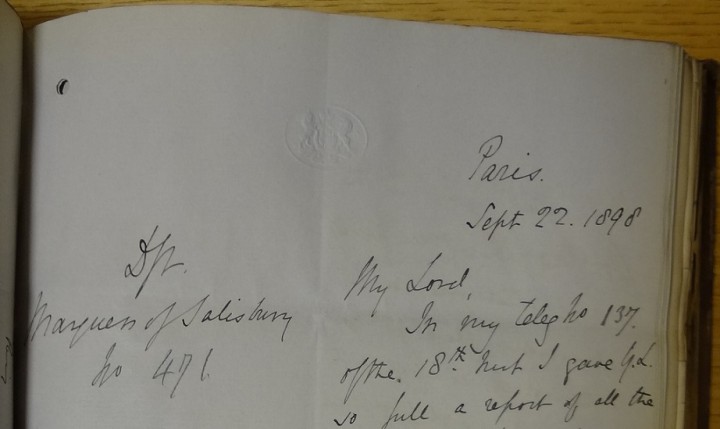
Despatch 471 in a volume of embassy and consular correspondence from 1898.
8. Treaties 1695-present
8.1 Records of treaties: ‘Full Powers’, protocols and ratifications
Distinct sets of records were created at different stages of the treaty process, and these are held in different record series.
Before a treaty is made, the parties exchange the Full Powers or authorisations granted to their plenipotentiaries.
The document reciting the agreed terms of the treaty, signed and sealed by the plenipotentiaries of each side is the Protocol.
Following the signing and sealing of the Protocol, ratifications were drawn up, and signed and sealed by the head of state of each party and exchanged, or sometimes deposited in an agreed place if there were several parties.
8.2 How to search for records of treaties at The National Archives
Follow the links in the table below to search the respective series by one or more of the following:
- the state(s) with which the UK signed the treaty
- the subject of the treaty
| Subjects | Dates | Series |
|---|---|---|
| Treaty Protocols (with full powers of other parties, and subsidiary documents, mostly 1775 to 2001) | 1695-2003 | FO 93 |
| Ratifications of treaties (mostly up to 2001) | 1782-2005 | FO 94 |
| Full powers of British plenipotentiaries and entries or drafts of ratifications | 1813-1967 | Pieces within FO 83 |
| Protocols and ratifications of multilateral treaties (mostly from 1969) | 1907-2002 | FO 949 |
| Protocols and ratifications of EEC treaties (mostly from 1973) | 1953-1997 | FO 974 |
| Draft full powers and draft ratification instruments | 1968 onwards | FCO 3 |
| Protocols and ratifications of treaties (mostly from 2001) | 1962 onwards | FCO 85 |
The texts of many treaties as published in UK Parliament Command papers can be downloaded at UK Treaties Online.
9. Private and private office papers
Private and private office papers relating to foreign affairs held at The National Archives fall under three main categories:
9.1 Private papers given directly to The National Archives
These are private papers of diplomats and politicians involved in foreign affairs directly gifted to, or deposited with, The National Archives (previously the Public Record Office).
Browse through our catalogue references for these from PRO 30/1-99 or search for them by name of author or place of origin using the advanced search and entering PRO 30 in the first reference box.
You can also find private papers held in archives elsewhere using our catalogue. Search by author name and click on the record creators tab within your search results.
9.2 Unregistered papers returned to government after retirement
These are unregistered papers of mostly (though not entirely) 19th century politicians, diplomats and officials taken away on retirement but subsequently returned to government.
Search for references to these using the advanced search in our catalogue, searching by surname, year range and entering department code FO in the reference box.
Anthony Eden’s papers (FO 954) are available online.
9.3 Private office papers surrendered to government on retirement
These are the private office papers of mostly 20th century politicians, diplomats and officials surrendered to government on retirement.
Search for private office papers by author surname using the search forms in the FO 800 and FO 794 series descriptions.
Private office papers of officials of the Foreign and Commonwealth Office since 1968 are in series FCO 73.
10. Records of international commissions and conferences
The papers of a large number of bilateral or multilateral international commissions, from 1790-1967 are among the Foreign Office records at The National Archives.
The records of British delegations to international conferences from 1814-1976 are in held in both FO and CAB departments.
Search for the records of a commission or conference using the advanced search , restricting your search to reference FO (and, for conferences, CAB) and searching with one or more of the following terms:
- The name of the commission or conference
- The word ‘commission’ or ‘international conference’ and a geographic reference such as the name of a city, country or region
- The word ‘commission’ or ‘conference’ and a subject reference such as ‘military’, ‘financial’, ‘fisheries’ or ‘slave trade’
See our catalogue series divisions for FO and CAB for further details.
11. Records of wartime departments and missions
We hold records of various departments and missions that operated within the Foreign Office during the First and Second World Wars.
11.1 First World War
Search for references to records created by the following agencies and departments set up by the Foreign Office in the First World War by clicking on the references and using the series-specific search boxes:
- Arab Bureau in FO 882
- Contraband Department in FO 382
- Foreign Trade Department in FO 833
- Jedda Agency in FO 686
- Prisoners of War and Aliens Departments in FO 383
- Restriction of Enemy Supplies Department in FO 845
- Trade Clearing House and War Trade Intelligence Department and Finance Section of the Ministry of Blockade in FO 902
For background details see the description for FO Division 12 to which the above series belong.
11.2 Second World War
Search for references to records created by the following agencies and departments set up by the Foreign Office in the Second World War by clicking on the references and using the series-specific search boxes:
12. Records of the Allied Administration of Germany and Austria after the Second World War
The Foreign Office inherited the records of a number of the organisations through which the Allies administered what are now Germany and Austria after the Second World War. These were:
- The Control Offices, based in London
- The Control Commissions, based in Germany and Austria
- The Civil High Commission, which instigated de facto self-government in West Germany from 1948 until 1955 (when normal diplomatic relations were resumed)
12.1 What kinds of records are held at The National Archives?
The surviving records of the Control Commission for Germany (British Element) are held at The National Archives but are incomplete as only a small percentage of the files were selected for permanent preservation. The overwhelming majority of these are administrative in nature and rarely contain personal details.
In addition to the above, there are numerous files and material on denazification generally including:
- policy and applications
- some name lists
12.2 How to search for records
For a breakdown of the record series relating to the Allied Administration, see the FO Division 14 page.
In addition, the records of the Allied Kommandatura, the four power body that administered Berlin until the end of the Cold War, are in FO 1112.
The file descriptions used by the Control Commission were very broad and this is reflected in the record descriptions in our catalogue. A keyword search of our catalogue is therefore of limited value but it may be worth completing the following fields in the advanced search with the terms provided:
- All of these words: a keyword relevant to your search e.g. censorship
- Exact word or phrase: Control Commission for Germany
- Within references: FO
- Date: 1945 to 1950
You should also consult Akten der Britischen Militärregierung in Deutschland: Sachinventar 1945-1955 (11 Volumes, published by KG Saur 1993). These volumes, available from The National Archives library, provide brief details (in English and occasionally German) of the Control Commission documents for Germany (the “G documents”) as well as the associated National Archives references.
12.3 Looted art
Foreign Office and Treasury documents concerning looted art have been identified and digitised in partnership with the Commission for Looted Art in Europe. To search them use the form in our research guide Looted art 1939-1961.
13. Intelligence records of the Foreign Office 1795-1985
The primary series of records relating to intelligence matters within the Foreign Office are the records of the Permanent Undersecretary of State in FO 1093.
From the FO 1093 series description, search by year and subject or, instead, browse through the document descriptions for the whole series.
Other significant record series include the reports of intelligence agents from 1795-1815 in FO 38 and details of the funding of British intelligence operations before 1909, known as the Secret Vote, in HD 1 and HD 2.
14. Further reading
Some or all of the publications below may be available to buy from The National Archives’ bookshop. Alternatively, search The National Archives’ library catalogue to see what is available to consult at Kew.
Published copies of records
British Documents on the Origins of the War, Documents on British Foreign Policy, Documents on British Policy Overseas (13, 68 and 18 Volumes respectively, HMSO and Routledge, 1926 onwards). Selections of documents (mostly general correspondence) covering the build up to the First and Second World Wars and the Cold War respectively.
British Documents on Foreign Affairs (over 200 volumes, University Publications of America, 1983 onwards). Selection of Confidential Prints from mid-19th to mid-20th century.
British and Foreign State Papers (168 Volumes, HMSO 19th century to 1977). Published copies of major treaties from 1812 to 1967.
Secondary material
FCO Historians, A guide to researching FCO history (Foreign and Commonwealth Office)
Michael Roper, The Records of the Foreign Office, 1782-1968 (Public Record Office, 2002)
Louise Atherton, Never Complain, Never Explain: Records of the Foreign Office and the State Paper Office 1500-c.1960 (Public Record Office, 1994), includes well-explained guidance on how to use the registers and indexes to Foreign Office correspondence
James Cronan and Keith Mitchell, Foreign Office records 1782 to 1986: A guide to country series (List & Index Society, 2017)
1. Why use this guide?
This guide provides advice on finding records held at The National Archives known as muster rolls, pay lists and description books. You can use these records to trace the outline of a soldier’s service in the British Army between c.1730 and 1898. If a soldier did not receive an army pension then these may be the only records that survive for him.
For more information on soldiers’ records from this period see our guide to British Army soldiers up to 1913.
2. What were muster rolls?
Regimental musters, from the early 18th century onwards, were taken every month or quarter (frequency varied over the years) for pay and accounting purposes. They, along with pay lists, were effectively the main everyday service records kept by the army of men in active service.
Muster rolls and pay lists contain soldiers’:
- enlistment dates
- movements
- discharge dates
From 1868 to 1883 there may be quarterly lists which contain details of ‘men becoming non-effective’. They are found at the end of each quarter (or the beginning for regiments stationed in India). They provide a soldier’s:
- birthplace
- trade
- date of death or discharge
From about 1868 musters may also include Marriage Rolls giving details of children and wives occupying married quarters.
3. How to search for musters and pay lists c.1730-1878
To trace a man’s army career by way of the musters, you will have to know the name of his regiment.
The musters are bound together in annual volumes for each regiment and are held in the War Office (WO) series, listed below.
Each series is searchable in Discovery, our catalogue. Search by name of regiment and specify the appropriate record series from the table below. If you are searching within WO 69, search by name of non-commissioned officer or soldier within WO 69.
To view the muster roll or pay list itself you will need to order the original document. The first entry for a recruit in a muster book usually gives his age, place of enlistment and trade.
Please note, a small selection of muster rolls and pay lists from WO 12 are available online via Ancestry (£). You can browse these by regiment. For those covering the date of the Battle of Waterloo you can also search by an individual’s name.
| Type | Date range | Description | Record series |
|---|---|---|---|
| General Series | 1732-1878 | Household troops, cavalry, guards, regular infantry, special regiments and corps, colonial troops, foreign legions and regiments, and regimental, brigade and other depots | WO 12 Please note, a selection are available online via Ancestry (£) – some of them are name searchable |
| Artillery | 1708-1878 | WO 10, WO 69, WO 54 | |
| Engineers | 1816-1878 | From 1816 to 1856, the musters are principally of the Royal Corps of Sappers and Miners, and list only NCOs and other ranks. The two merged in 1856, as the Royal Engineers | WO 11, WO 54 |
| Militia and Volunteers | 1780-1878 | WO 13, WO 68 | |
| Crimean War | 1854-1856 | British troops sent to the Scutari Depot | WO 14 |
Records of some soldiers’ children may be found among the papers of the Duke of York’s School and the Royal Hibernian School in WO 143, from 1801.
4. How to search for musters and pay lists 1878-1898
From 1878 to 1898, all muster rolls and pay lists are in WO 16. From 1888 onwards, the series contains only muster rolls, there are no longer any pay lists and by 1898 muster rolls were no longer kept by the War Office either. There are some difficulties in using WO 16, caused by the re-organisation of the Army in 1881.
4.1 Re-organisation of the Army: the Cardwell-Childers reforms
The Childers reforms of 1881 (a process which began with the Cardwell reforms of the 1870s) led to major changes within infantry (foot) regiments:
- Infantry regiments, which had been known by numbers (for example, 28th Foot), were to become known by a title, usually a county
- Regiments from the 26th Foot onwards were paired together to form new regiments (for example, the 28th Foot and the 61st Foot became the Gloucester Regiment)
- Each ‘new’ regiment was to have two battalions, as the first 25 Foot regiments already did
- The lower number became the 1st battalion and the higher number became the 2nd battalion (thus, the 28th Foot and the 61st Foot became the 1st and 2nd Battalions respectively of the Gloucester Regiment)
- All infantry regiments were placed into numbered regimental districts
4.2 Searching WO 16
The arrangement of WO 16 reflects the re-organisation of the army following the Cardwell-Childers reforms. If you are working backwards through the musters, you may need to find the previous regimental number of a 2nd battalion. To do this, you should consult the Army List. Each volume of the Army List has an alphabetical list of regiments: find the title of the regiment, and turn to the page indicated which lists the various designations over time of its component parts. You may also need to know the relevant regimental district numbers, a key to which can be found in the record summary of WO 16.
5. How to find description books
These give a description of each soldier, his age, place of birth, trade and service, and are in WO 25/266-688, which can be searched by regiment in our catalogue. The books themselves are in alphabetical order of soldiers’ names. The overall dates are 1756 to 1900, but for most regiments there are volumes for the first half of the 19th century only. Similar description books for depots, 1768 to 1908, are in WO 67. There are also description books for the Royal Artillery, 1749-1863 and 1773-1876, in WO 54/260-309 and WO 69/74-80, respectively, and for the Royal Irish Artillery, 1756-1774, in WO 69/620.
Description books of sappers, miners, artificers and the like, 1756-1833, are in WO 54/310-316.
6. The British Foreign Legion 1854-1856
During the Crimean War, men were recruited abroad to form the British German Legion, the British Italian Legion, and the British Swiss Legion. These forces were formed as a result of the Enlistment of Foreigners Act 1854 and they became known collectively as the British Foreign Legion. A total of 14,000 men were recruited, although none saw active service: they were disbanded after the war. The musters, service records and attestation papers of the German and Swiss Legions are in WO 15, searchable by regiment in our catalogue. Those of the Italian Legion no longer survive. See Mercenaries for the Crimea by C C Bayley (London, 1977).
7. Further reading
Watch our webinar on Army musters – more than just accounts which tells you what you can discover in the records.
Some or all of the recommended publications below may be available to buy from The National Archives’ shop. Alternatively, search The National Archives’ Library to see what is available to consult at Kew.
Mustor (muster) books and pay lists: General series: Cavalry (Swift, 1984)
Amanda Bevan, Tracing your Ancestors in the The National Archives (The National Archives, 2006)
J Gibson and M Medlycott, Militia lists and musters, 1757-1876: a directory of holdings in the British Isles (Federation of Family History Societies, 2004)
William Spencer, Army Records: A guide for family historians (The National Archives, 2008)
William Spencer, Records of the Militia and Volunteer Forces 1757-1945 (Public Record Office, 1997)