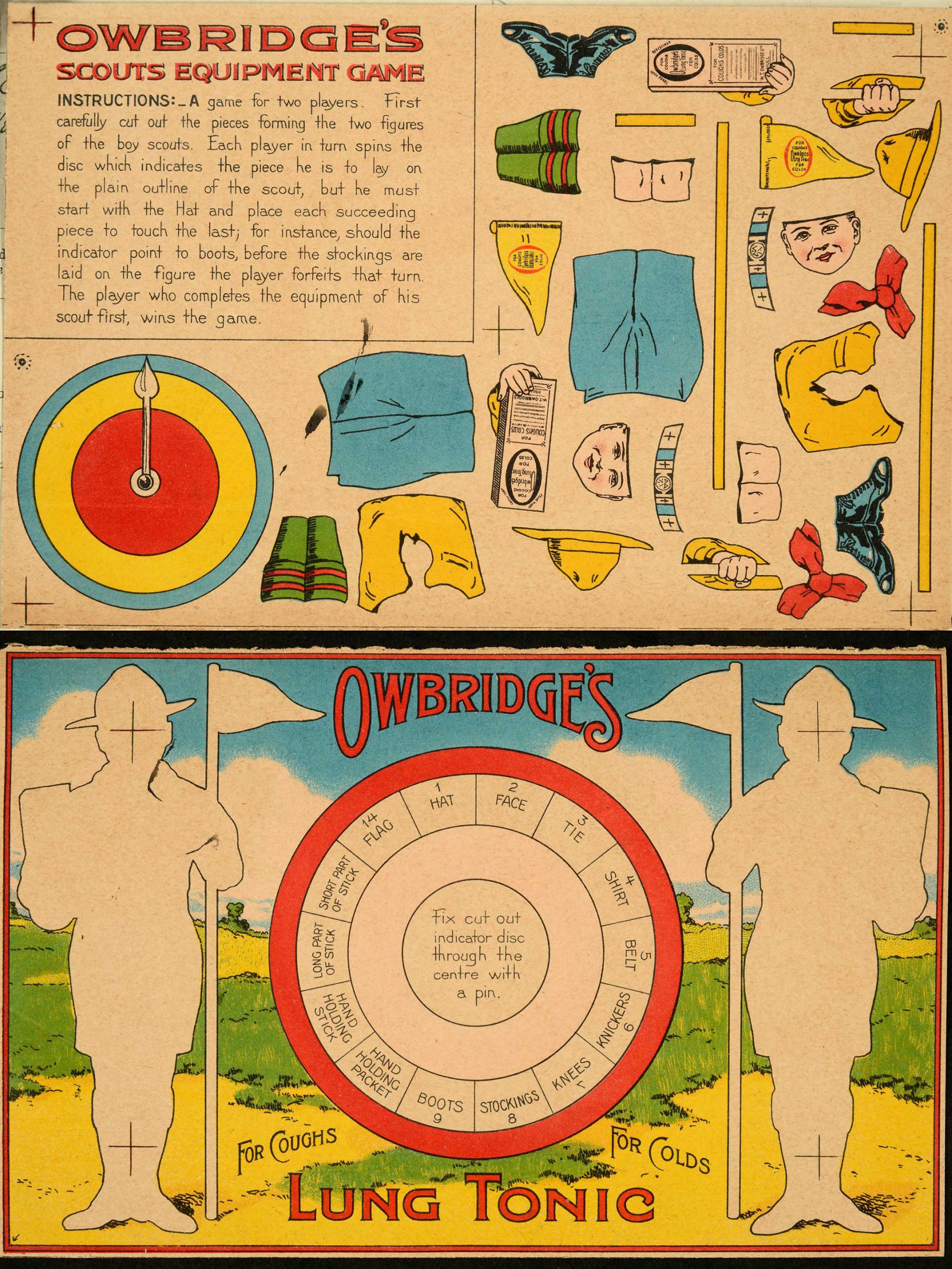
Owbridge’s Scout Equipment game, 1912, Catalogue ref: COPY 1/321 f343
This is a different sort of game. It is interesting because it was made by a company that sold cough syrup. The makers have included their name in the title of the game. The game is based on the scouts’ organisation which started five years before.
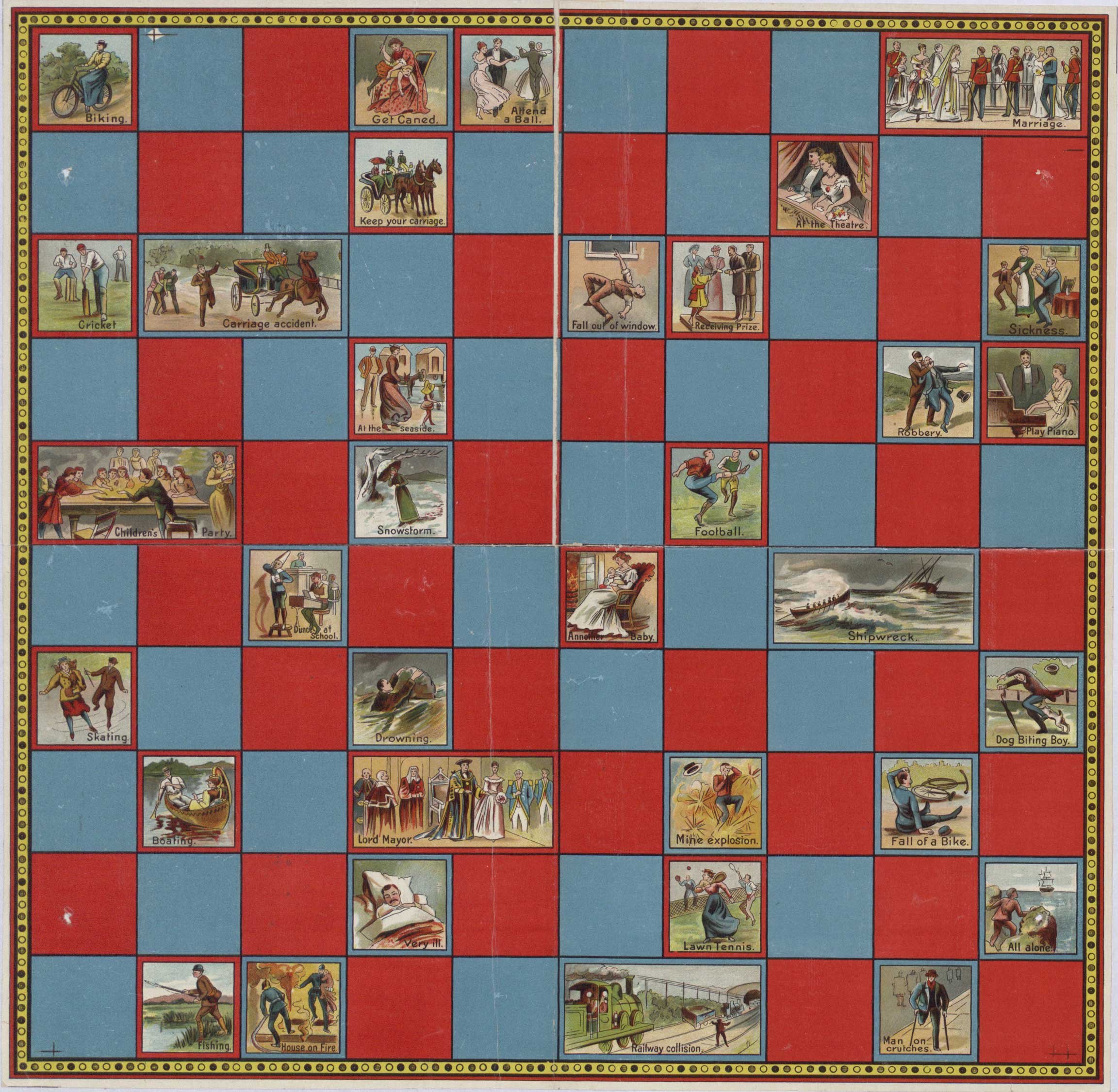
Board for a game called ‘Ups and Downs of Life: A capital game for young and Old’, 1899, Catalogue ref: COPY 1/146 f15
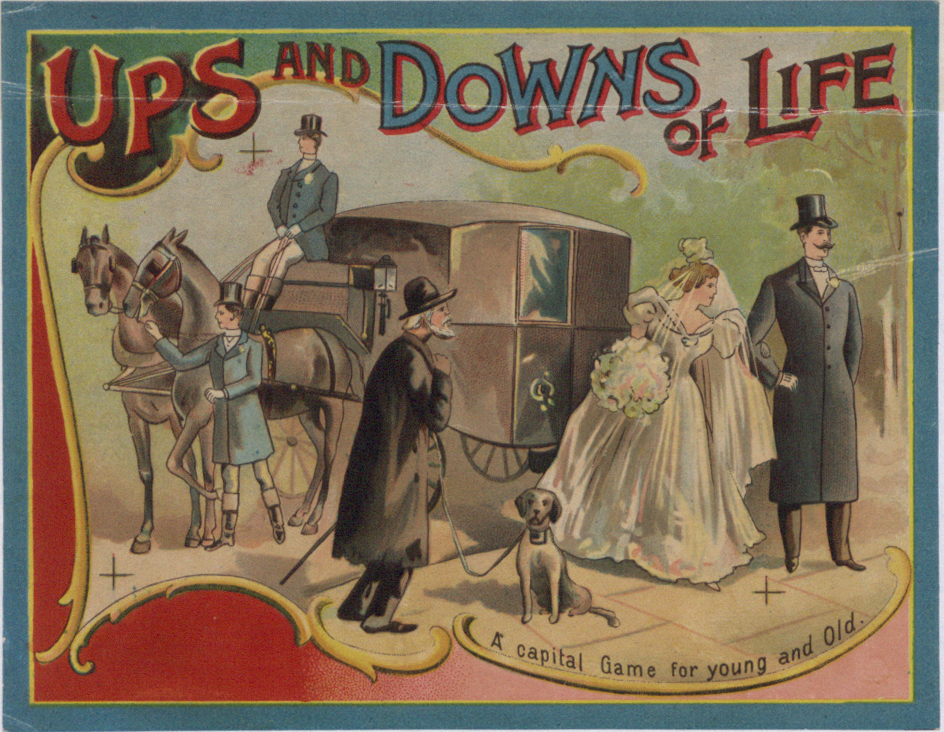
Box lid for a game called ‘Ups and Downs of Life: A capital game for young and Old’, 1899, Catalogue ref: COPY 1/146 f17
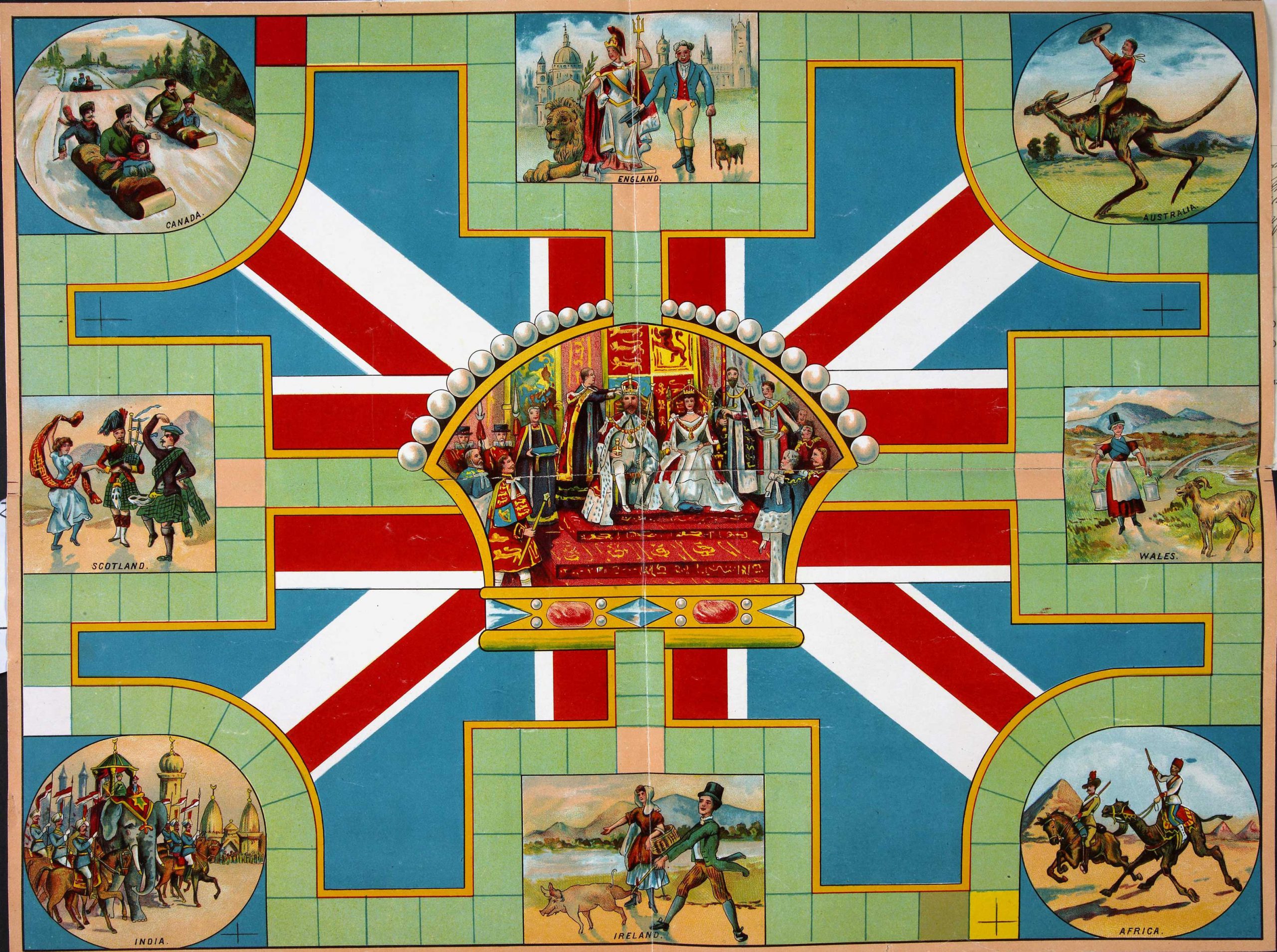
Board for a board game called ‘Royal Coronation: The game for all true Britons’, 1901 Catalogue ref: COPY 1/180 f247
Queen Victoria died in 1901 after a reign of 64 years. Her eldest son, Edward was crowned as King Edward VII at the age of 59. His wife Alexandra also became Queen. A coronation is a special ceremony when a king or queen received the crown. They were also given the orb (a globe with a cross on it) and a sceptre (a staff or wand) held in the hand. All these objects represented the power and authority of the new king or queen.
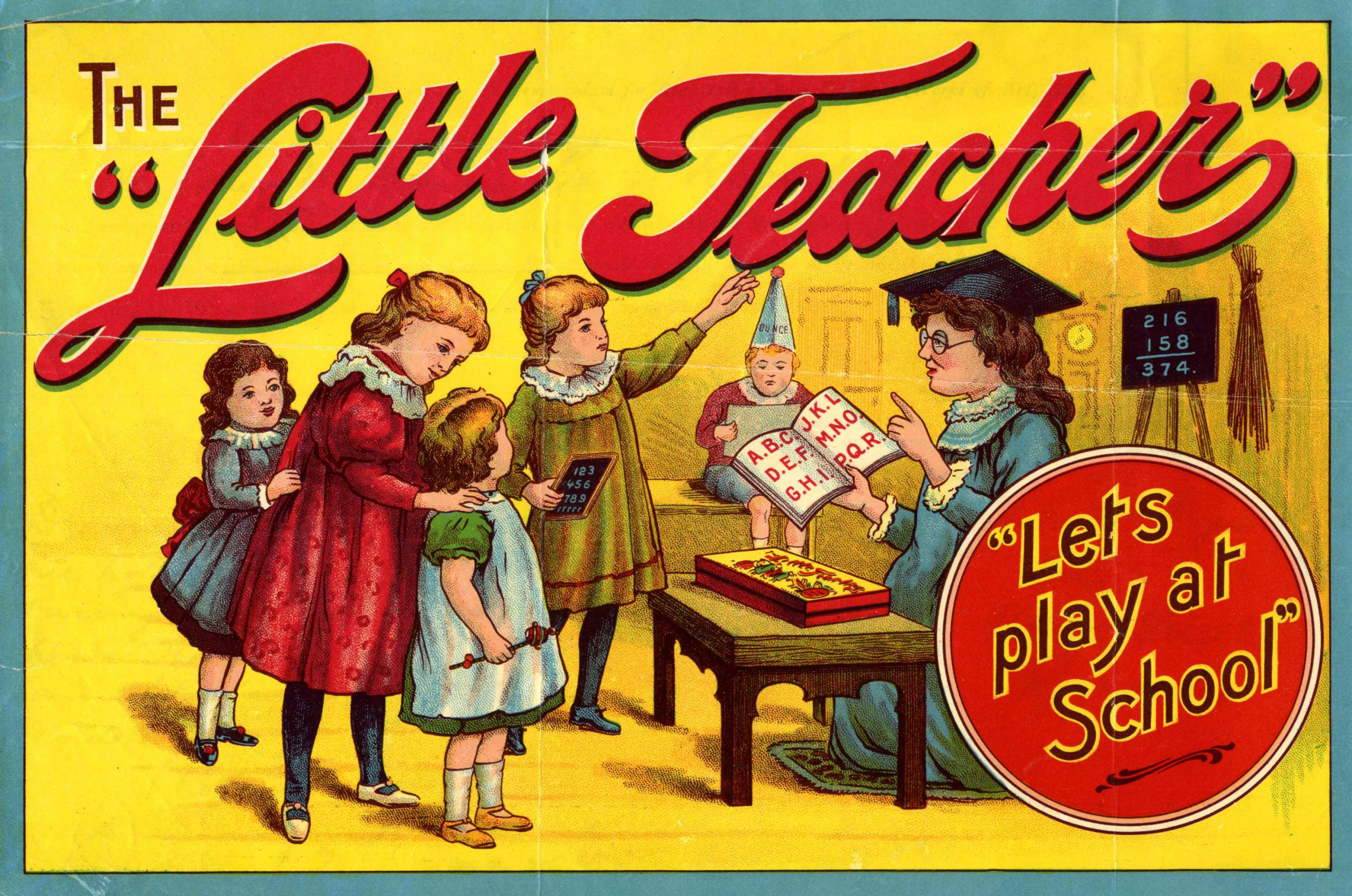
Box lid for a game called ‘The Little Teacher’, 1908, Catalogue ref: COPY 1/275 f225
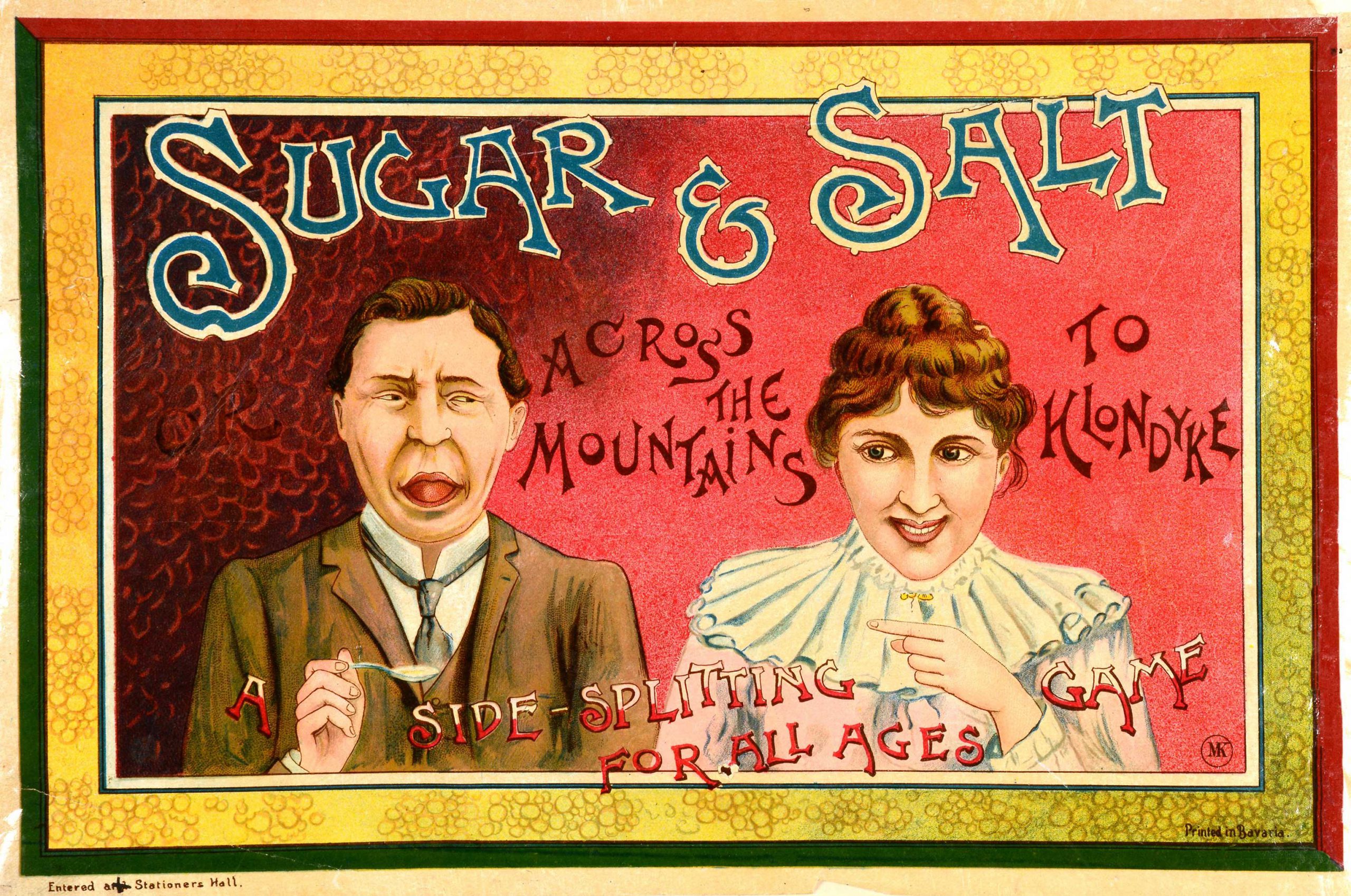
Many board games, not on sale today, were devised in the late 19th and early 20th centuries and some of their designs are held at The National Archives. The board games used in this lesson are very interesting as historical sources as they can reveal something about the society that made them. How did people in the past like to have fun? Were their games very different from ours?
Board games were highly valued as a form of entertainment for Victorian or Edwardian children as they were not too physical or noisy, allowing them to be ‘seen and not heard’. They could be played at home with the whole family or a group of children under the watchful eye of a parent or governess. They offered a change from the usual ‘parlour games’ that the Victorians favoured such as ‘Charades’ or ‘Pin the tail on the donkey’.
Use this lesson to find out if the design of a board game can tell us anything about life in the past.
What can we learn from old board games?According to the Guardian newspaper in April 2020, ‘sales of board games and jigsaw puzzles soared 240%’ in the first week of lockdown against covid-19. Clearly, they offered a great way for families to spend time together at home.
Similarly, Victorians and Edwardians enjoyed board games and were familiar with games like chess, backgammon and draughts. Another traditional board game, Ludo, which originated from India in the 6th century known as pachisi, came to Britain in 1891, patented by Alfred Collier. A form of ‘Monopoly’ called the ‘Landlord’s Game’ was invented in 1903, and later became ‘Monopoly’ when copyrighted by Parker Brothers in 1935 then Hasbro in 1991.
Family and marriage were highly valued by the Victorians, and board games based on the end goal of marriage were not unusual. For example, in a board game called ‘Maricout’ (1882) players had to move around the board facing a range of setbacks during courtship. It emphasised Victorian values rewarding players who landed on squares holding specific virtues, including honesty and humility and highlighted the importance of acquiring, wealth and status in society- epitomised by the acquisition of carriages and servants. Another game called ‘The New Game of Married First or Wedding Bells’ (1904) followed a similar approach.
Edwardian board games were often educational and covered topics like history, science or geography. There were games based on the life of Dick Turpin: ‘The Game of Dick Turpin’s ride to York’ (1904), or the ‘Game of Scouts’ (1909), the ‘Boer War Game’ (1900) or even one called the ‘Game of Lord Gordon-Kitchener’ (1900). There was a somewhat tasteless game about the Titanic entitled: ‘The new game across the Atlantic, from Liverpool to New York without touching icebergs’ (1912).
Some games signalled moral values such as good behaviour, for example ‘The Little Teacher game’ (1908) and the importance of work. The game of ‘Temperanzo’ (1909) was designed to warn against the perils of drink and the importance of taking the pledge for adults. Children could play at shops with ‘The Play Town Post Office game’ (1909) or with ‘the Railway Bookstall game’ (1908). Other games were based upon nursery rhymes or fairy tales where the winner triumphed over evil characters during the course of the game, the ‘Enchanted Forest’ (1911).
New printing techniques meant companies could produce a wide range of board games fairly cheaply. The games were often very colourful and highly illustrated to make them appear more attractive to children. Sometimes instructions were printed on the board itself. The designs often involved a race with other players along a circuit or path in some shape or form. Counters or buttons were used to move along the board.
The number of moves was determined by teetotum or spinning top marked with letters or numbers to show the result of each spin. Dice were not often favoured as they were associated with gambling. Some games incorporated hazards or rewards, like in ‘Snakes and Ladders’ when players were sent backwards or forwards. In more sophisticated games, the players picked up cards which aided or impeded their progress in terms of ‘disasters’ or ‘windfalls’ according to the theme of the game.
What to expect in the onsite workshop:
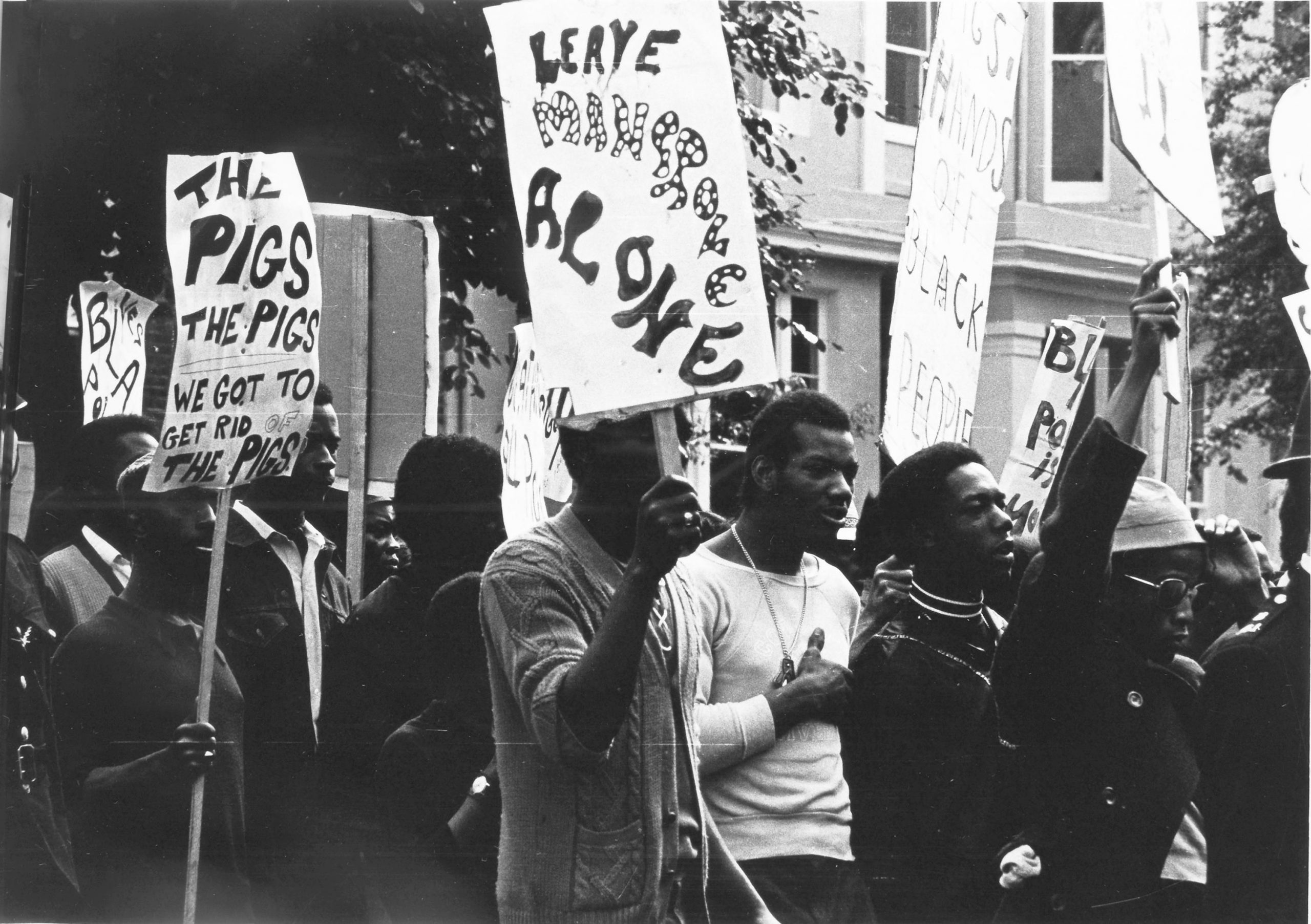
In the onsite workshop students will investigate the ground-breaking case of the Mangrove Nine. This session develops skills in critically examining sources and assessing the limitations of an archival collection. This session explores themes of institutional racism, police discrimination and Black resistance.
The two-hour workshop is led by an experienced history educator in an inspiring learning space at The National Archives in Kew. Students handle a range of original documents including police witness statements, photographs and newspaper reports.
What to expect in the online workshop:
In the online workshop in your classroom students will investigate the ground-breaking case of the Mangrove Nine. This session explores themes of institutional racism, police discrimination and Black resistance. Students will examine a range of documents, from police witness statements to newspaper reports, assessing their strengths and limitations.
The one-hour online session in your classroom is led by an experienced history educator, you only need a microphone, large screen and webcam to take part. Interactive activities encourage students to discuss their ideas and work in groups using high-quality materials provided in advance by the Education team.
*Note we will adapt the timing of the workshop to fit with your lesson times.
How much can documents from The National Archives reveal about the Mangrove Nine?All activities must be booked in advance.
Tel: +44 (0)20 3908 9162
What to expect in the onsite workshop:
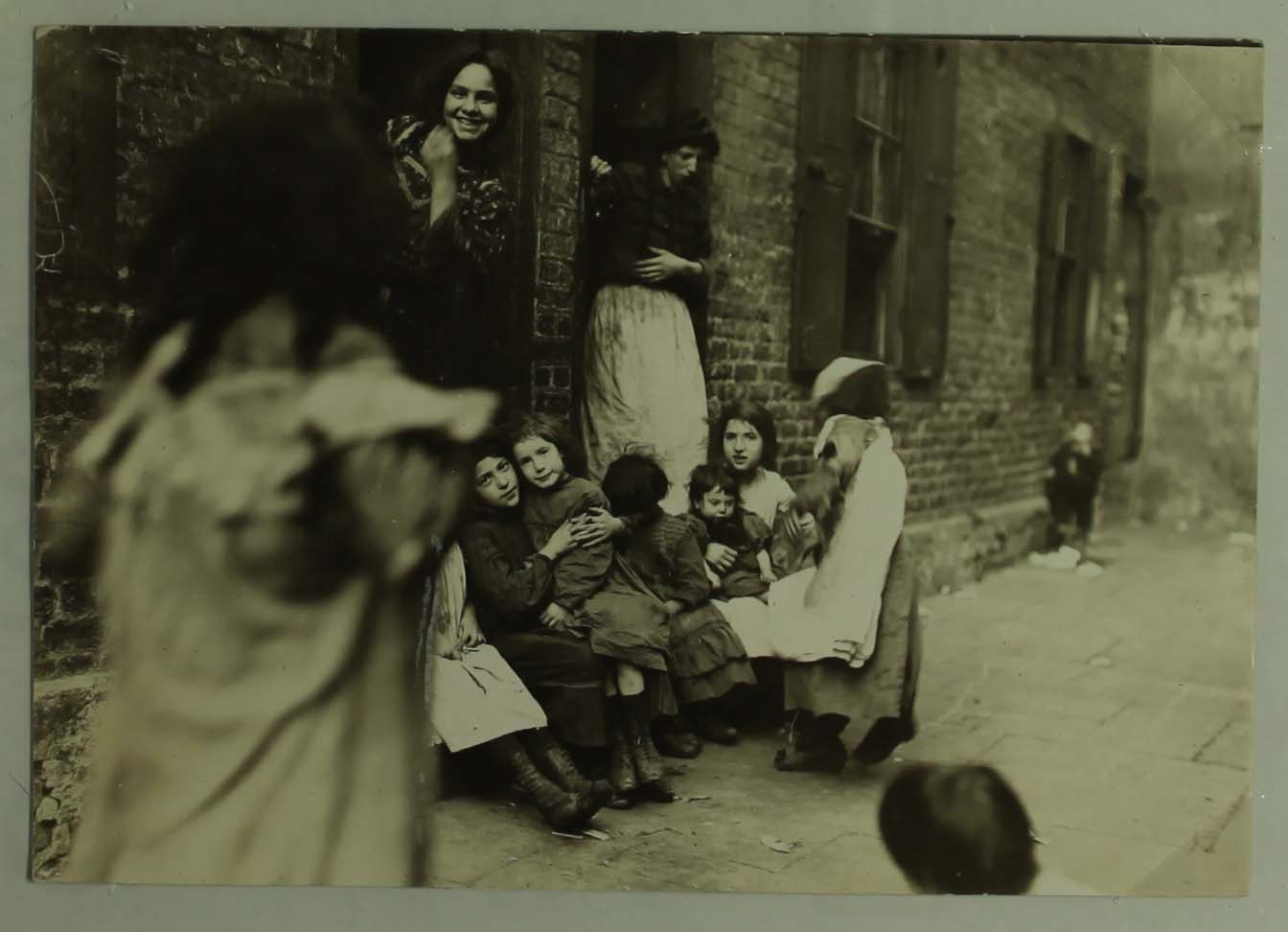
In the onsite workshop students investigate what made Whitechapel in 1888 an area where policing was challenging. Themes such as poverty, immigration, women’s lives and housing are explored. This session develops skills in assessing a source’s usefulness for a particular historical enquiry.
The two-hour workshop is led by an experienced history educator in an inspiring learning space at The National Archives in Kew. Students handle a range of original documents including census records, maps and Metropolitan Police records
What to expect in the online workshop:
In the online workshop in your classroom students will investigate what Whitechapel was like in 1888 by exploring a range of documents including a photograph, the census and register for a homeless shelter. This session develops skills in assessing a source’s usefulness for a particular historical enquiry.
The one-hour online session in your classroom is led by an experienced history educator, you only need a microphone, large screen and webcam to take part. Interactive activities encourage students to discuss their ideas and work in groups using high-quality materials provided in advance by the Education team.
*Note we will adapt the timing of the workshop to fit with your lesson times.
Connections to the curriculum:
- EDEXCEL GCSE History (9-1) Crime and Punishment Through Time
- OCR GCSE History B (9–1) Schools History Project: Crime and Punishment, c.1250 to present
All activities must be booked in advance.
Tel: +44 (0)20 3908 9162
 What made them unhealthy?
The industrial revolution had a massive impact on the growth of towns. In 1700 Manchester was a small village with less than 10,000 inhabitants. By 1801 Greater Manchester had become a city of 328,609 people. Liverpool, Leeds and Huddersfield were similar in size. By 1851 the population of Manchester had increased to 1,037,001 and the north of England contained half the population of the country. London too had grown from of a population of 1,011,157 in 1801 to 2,651,939 in 1851 and by 5,571,968 by 1891.
People came to the towns in search of work. The development of steam power meant that factories did not have to be located near rivers using water for power. Factories offered higher wages than agricultural work. Their workforce was often forced to live in crowded back-to-back housing, built by factory owners near to the factory. Rows of houses were separated from each other by a court, or strip of muddy ground. There were no bathrooms, toilets, running water or heating apart from a single fireplace also used for cooking. People would have to share a water pump and privy in the street which probably served at least twenty houses. The privies often overflowed and the waste often soaked into wells that supplied the water pump, or flooded into the court which was turned into an open sewer running between the houses. These cramped houses were often home to four or five families, possibly with lodgers and another family living in the cellar. The cellars themselves were damp, dark and frequently subject to flooding.
Extracts in this collection from the ‘Second Report of Commissioners of Inquiry into the State of Large Towns and Populous. Districts, 1842’ [HO 45/416] for example, describe conditions in Birmingham, Hull, Manchester, Liverpool Sunderland, Aberdeen and Edinburgh. The extracts also provide some insight into the work of the commission, how it gathered its evidence and made recommendations. Taken with several ‘nuisance letters’ from private individuals to the General Board of Health about a range of different ‘nuisances’- piles of rubbish and waste, poor drains or sewers or livestock in the streets or effects of a nearby gasworks for example, [MH13/261] we get a graphic insight into living conditions in the towns.
Unsurprisingly, the average life expectancy contrasted greatly between town and countryside and also shows a great disparity between social classes. In 1840, 57% of the poor children living in Manchester died before they were 5 years. In rural areas this was 32%. An agricultural worker in Rutland had a life-expectancy of 38, a factory worker in Liverpool, a life expectancy of 15 years. Urban living was not conducive to good health for the poorer classes particularly and cholera thrived in situations where there was an impure water supply. Documents here also explore the response to cholera from quack cures, like the cholera bath [MH 13/245/120] or use of brandy, [HO 44/25] to government advice in 1831 [HO 44/24/57] capturing the palpable fear with which this disease was held.
The layout of an industrial town reflected its class divisions. The poorest lived in the central slums near the factories. Extracts from a report [HO 44/24/87] sent to the Home Office from by the Medical Secretary for Visiting District Committees of the local Board of Health for St Margaret and St John the Evangelist also provide a picture of living conditions in Westminster in 1831 for example. Surrounding the centre of city, skilled trades’ people lived in small terraced houses. Moving further away, the middle classes built their semi-detached villas in Turnham Green like the design shown [COPY 1.39 f348] in this collection. Larger detached homes with running water and large gardens existed in the more rural suburbs, and may have had the look of the ‘country house’ in the cut out source. [COPY 1/ 59 f258]. These homes later became more comfortable as they were supplied with electricity, [ZPER 35/9].
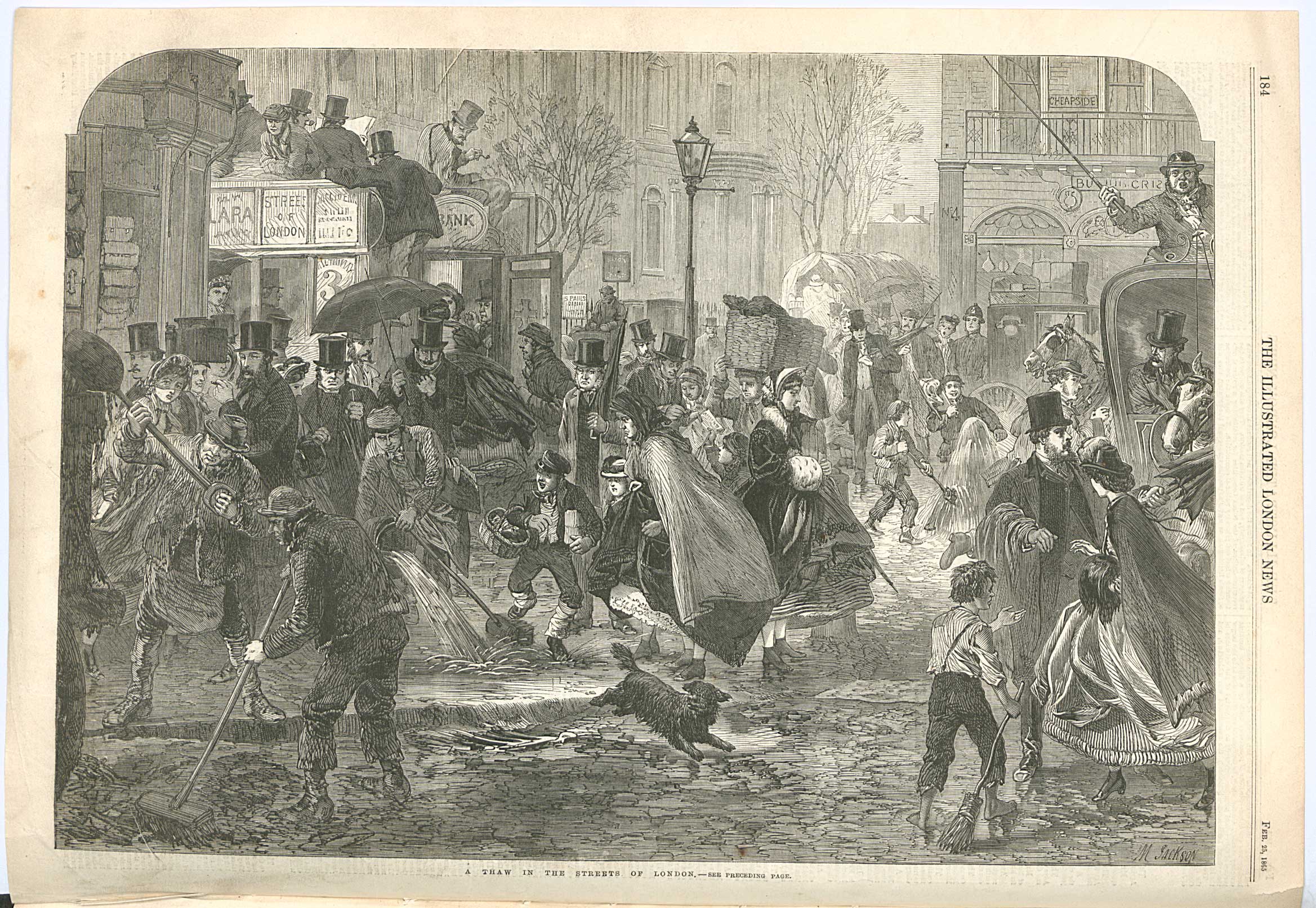
The rapid growth of towns meant there was little attention to urban planning including proper sewage and drainage systems or decent paving. Rubbish and filth accumulated in the streets, there was no systematic rubbish collection or street cleaning. There was no fire service, this was left to private companies. There was no control over air pollution either, so factory smoke and smog were a regular fact of life. London, and the cities in the midlands and north of the country were the unhealthiest places to live. Disease spread rapidly, especially among the urban poor. Cholera, smallpox and typhoid were common causes of death. Public health improved in the city of London with the achievement of Joseph Bazalgette, an engineer who built a sewer network for London in the 1870s. This was crucial in reducing cholera epidemics as it prevented raw sewage being emptied into the Thames.
Many well-off Victorians felt that the slums were caused by the laziness of the poorer classes, however other reformers, writers and campaigners in the second half of the nineteenth century, said that they resulted from poverty, unemployment, or homelessness. [MEPO 2/203]. George Peabody, an American businessman for example, built a number of model homes for the poor, called Peabody Buildings. [ZPER 34/54]
Public health improved in the towns and cities after further government enquiries into over the century. In 1871 a new government department was formed to look after public health. In 1872 the country was split into Sanitary Authorities with a sanitary inspector and a medical officer of health. According to the 1875 Public Health Act all new accommodation was to have running water and proper drainage, and local authorities had to maintain sewers.
In 1875, the Artisans’ and Labourers’ Dwellings Act gave local authorities powers to clear and redevelop slum areas and re-house inhabitants. Birmingham was the first city take advantage of the scheme. Another Act in 1890 expanded these provisions and other towns followed suit.
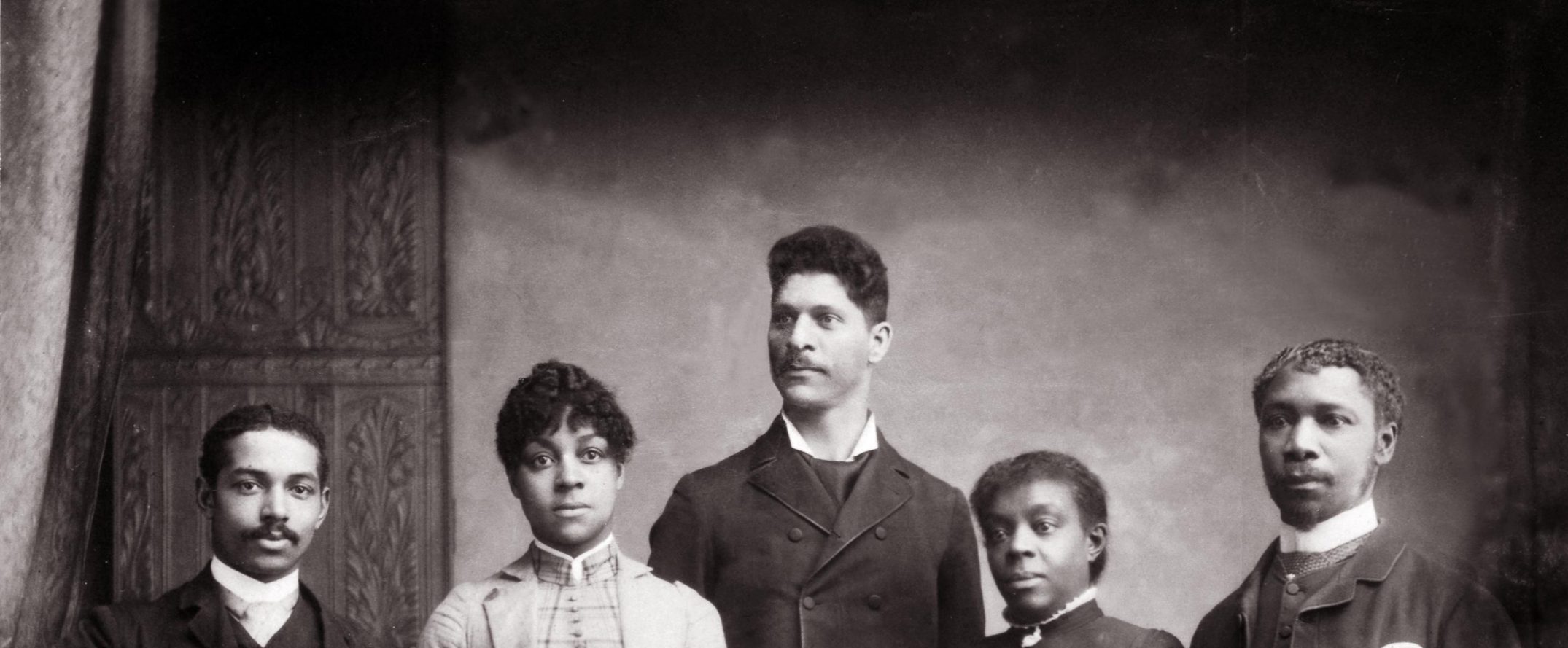
This resource contains a hyperlinked list of National Archives current resources for Black, Asian and Minority Ethnic histories on The National Archives website. It includes education resources, exhibitions, research guides, blog posts and podcasts by staff and external writers and links to external websites.
The intention for this resource is to make it easier for teachers to find resources for teaching a diverse curriculum. We are committed to further improving our resources and continuing to increase the number or Black, Asian and Minority Ethnic histories told through our lessons and collections.
This document will be updated periodically to add new resources that have been made available through our website. It was last updated in March 2025.
In light of the debates around the term ‘Black, Asian and Minority Ethnic,’ and the acronym ‘BAME,’ it might be important to note that it is used primarily for its practicality. Indeed, our records highlight the shifting nature of language as it applies to ‘race’ and racism over time, often inspired by social justice struggles. They provide a broader historical context for the emergence of such terms, and how through ongoing discussions, they are likely to change again in the future.