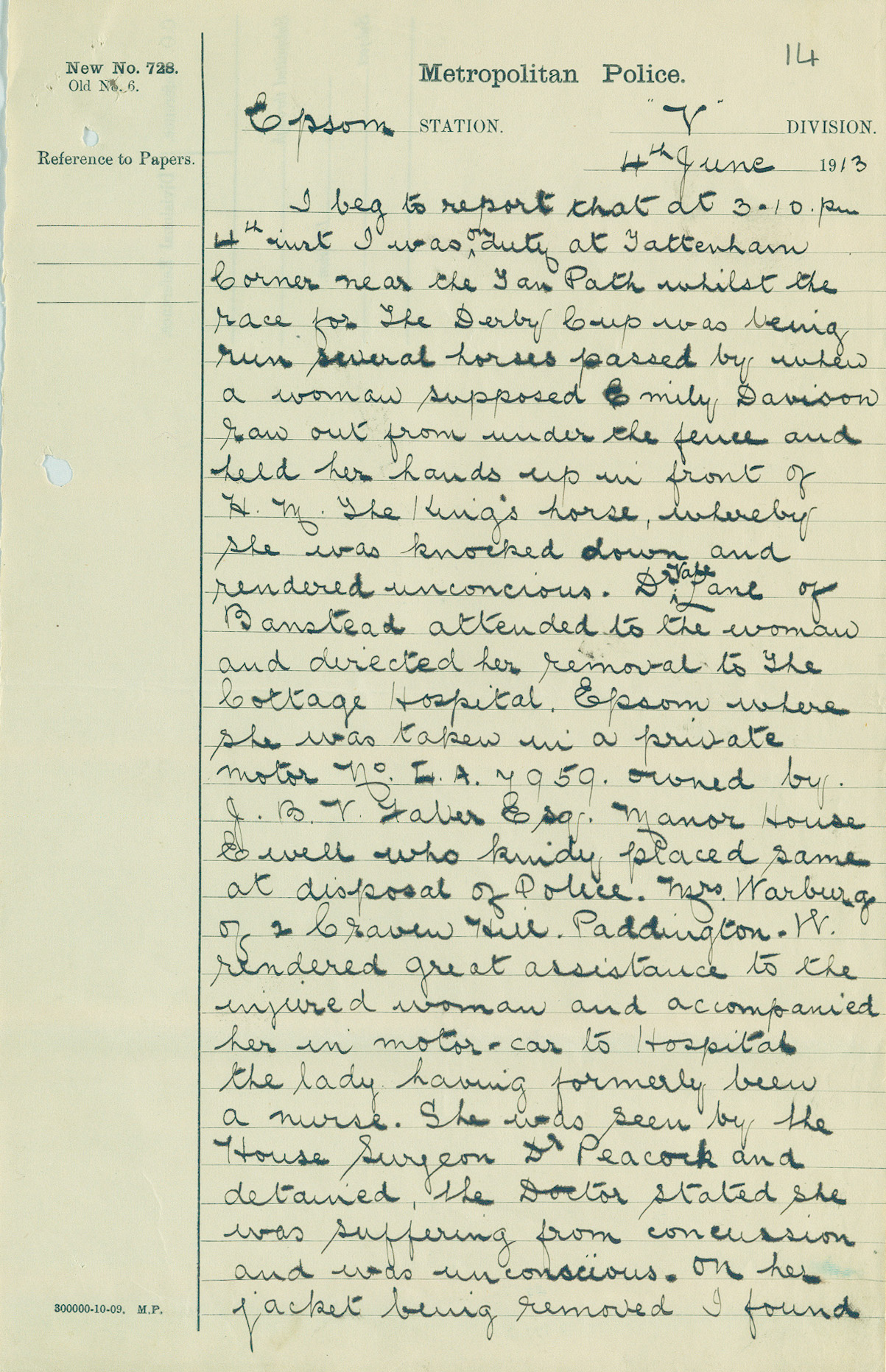
Extract 1 out of 2. A police report on the incident at the Derby, 1913. Catalogue ref: MEPO 2/1551
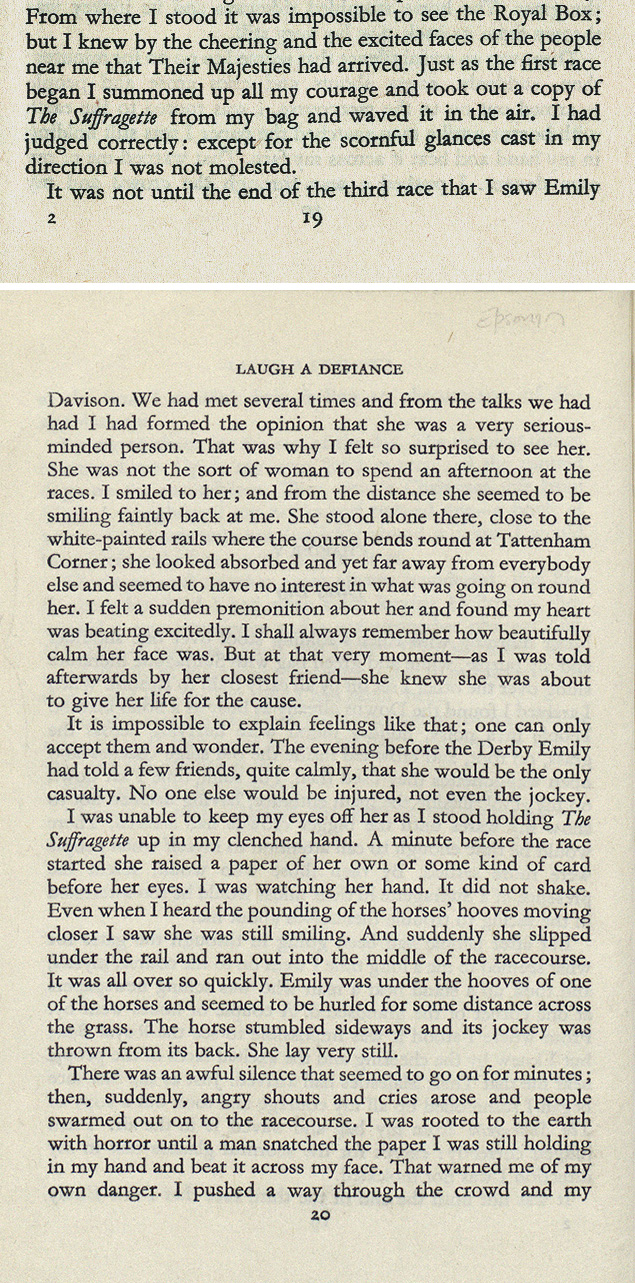
Two extracts from an account by Mary Raleigh Richardson entitled ‘Laugh a Defiance: an autobiography’. Published by George Weidenfeld & Nicolson: an imprint of The Orion Publishing Group, London, 1953.
Mary Richardson was a prominent suffragette present at the Derby who observed what happened to Emily Davison.
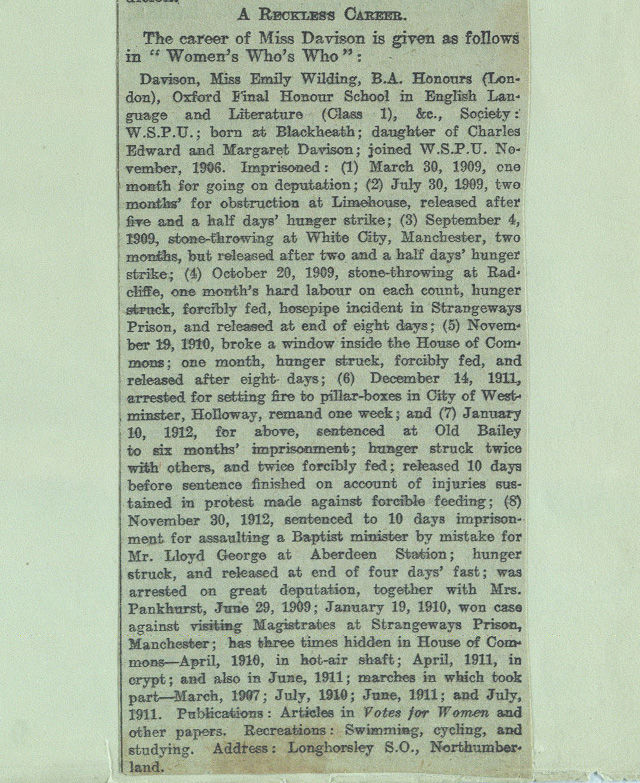
Extract 3 out of 3. Three extracts from an article called ‘Sensational Derby’ in The Morning Post, 5 June 1913, Catalogue ref: HO 144/1150/210696
The Derby is a horse race held each year at Epsom. Suffragist is a term used to describe someone who wants political voting rights given to more people, in this case to women.
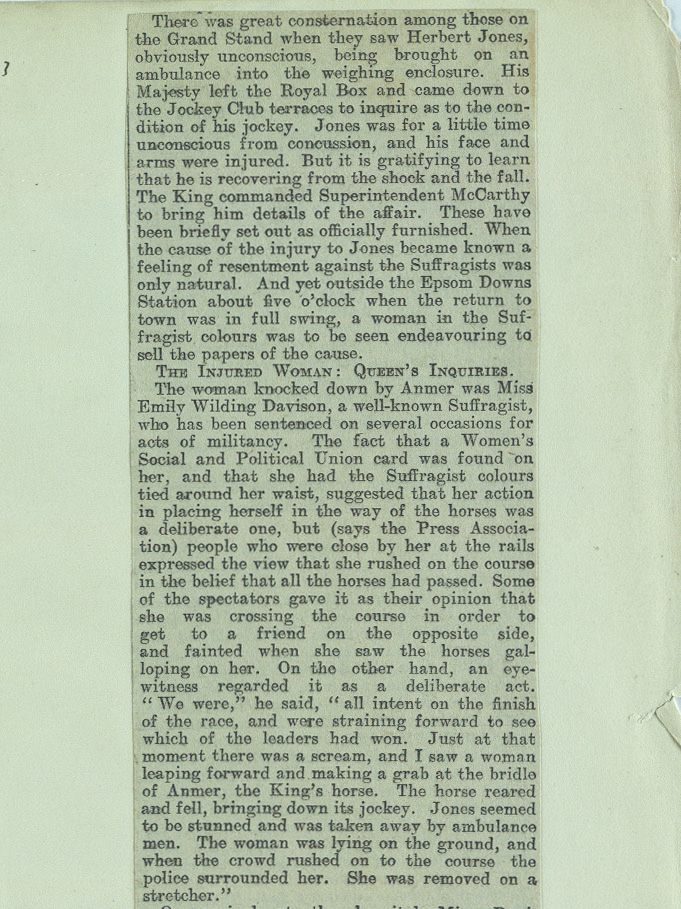
Extract 2 out of 3. Three extracts from an article called ‘Sensational Derby’ in The Morning Post, 5 June 1913, Catalogue ref: HO 144/1150/210696
The Derby is a horse race held each year at Epsom. Suffragist is a term used to describe someone who wants political voting rights given to more people, in this case to women.
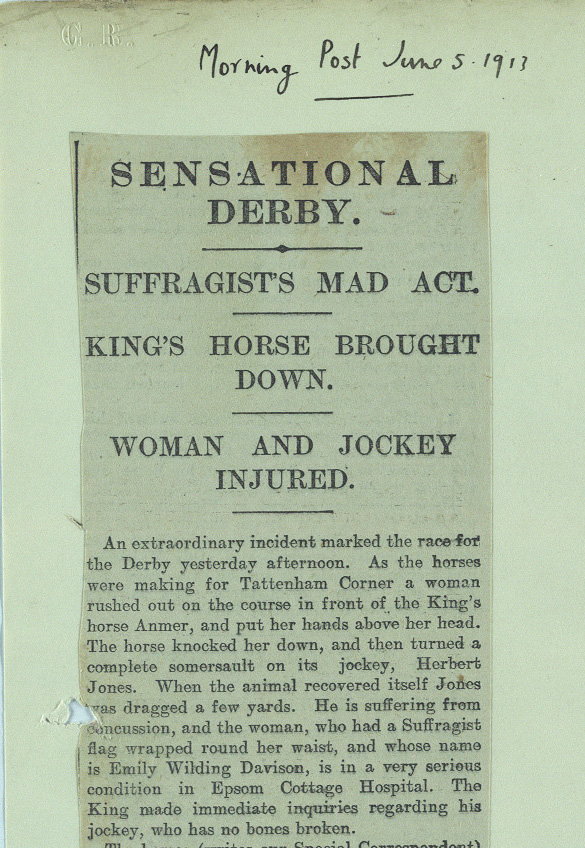
Extract 1 out of 3. Three extracts from an article called ‘Sensational Derby’ in The Morning Post, 5 June 1913, Catalogue ref: HO 144/1150/210696
The Derby is a horse race held each year at Epsom. Suffragist is a term used to describe someone who wants political voting rights given to more people, in this case to women.
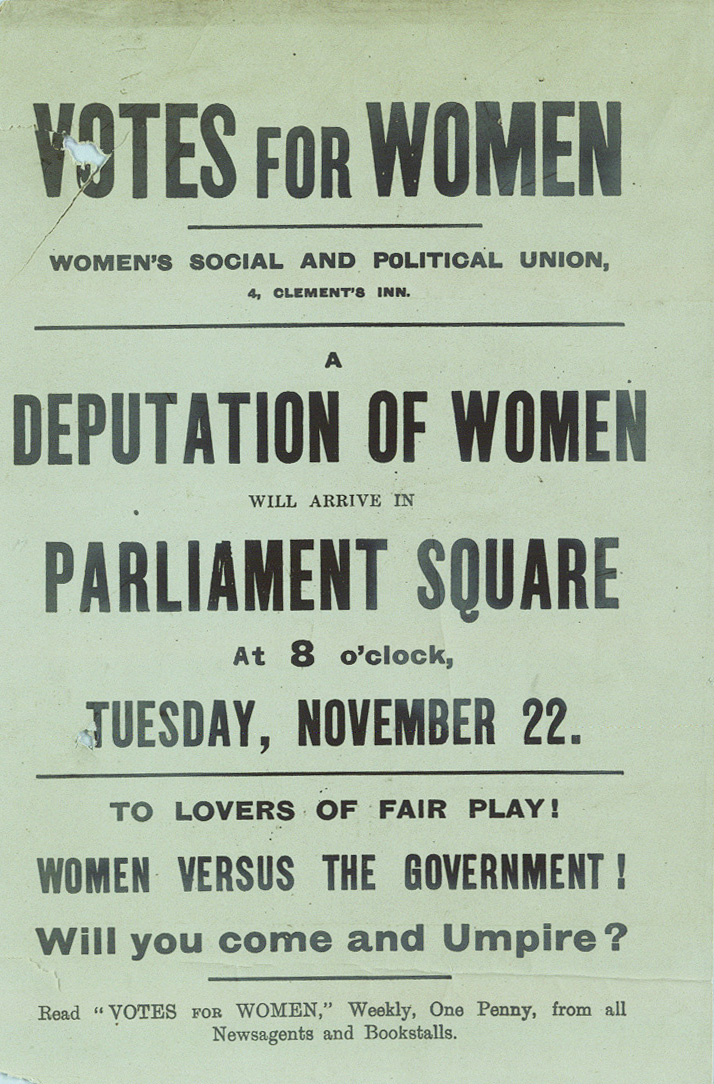
A handbill publicising a demonstration at Parliament on 22 November 1910. Catalogue ref: HO 144/1106/200455
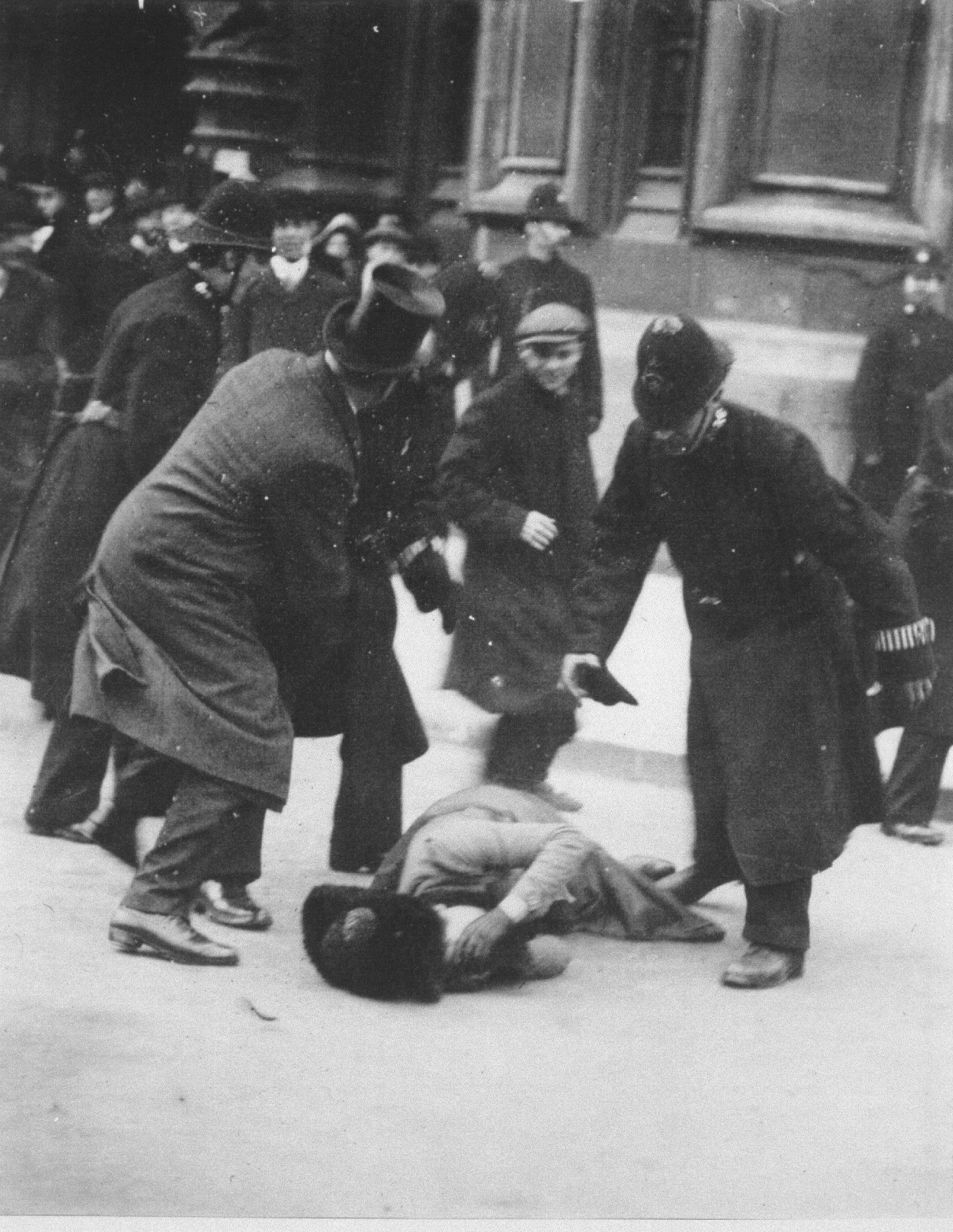
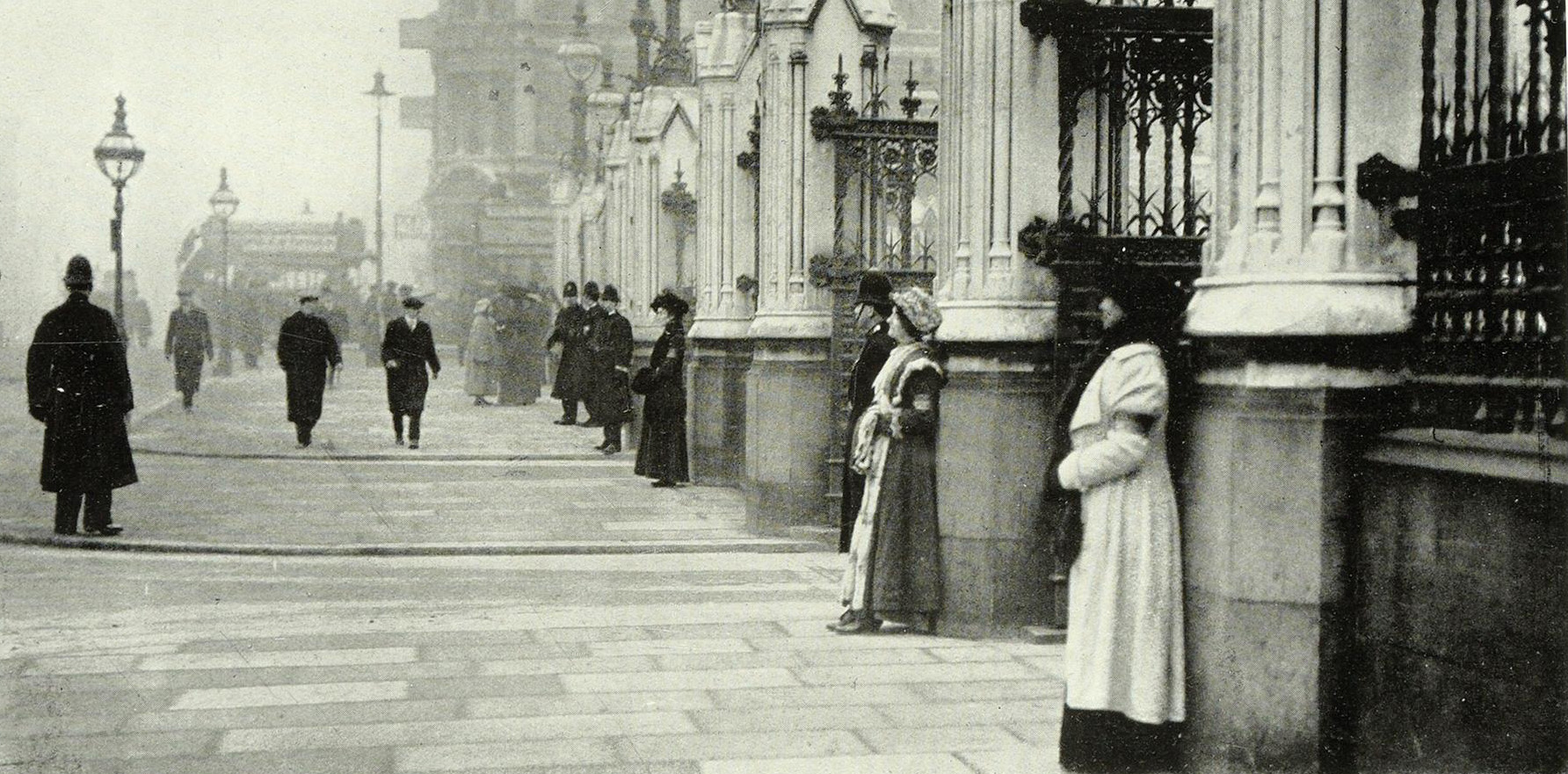
A photograph taken outside the Houses of Parliament on 18 November, Catalogue ref: a. COPY 1/551
The man in the top hat is Dr Herbert Mills, the husband of the woman on the ground, Ernestine Mills.
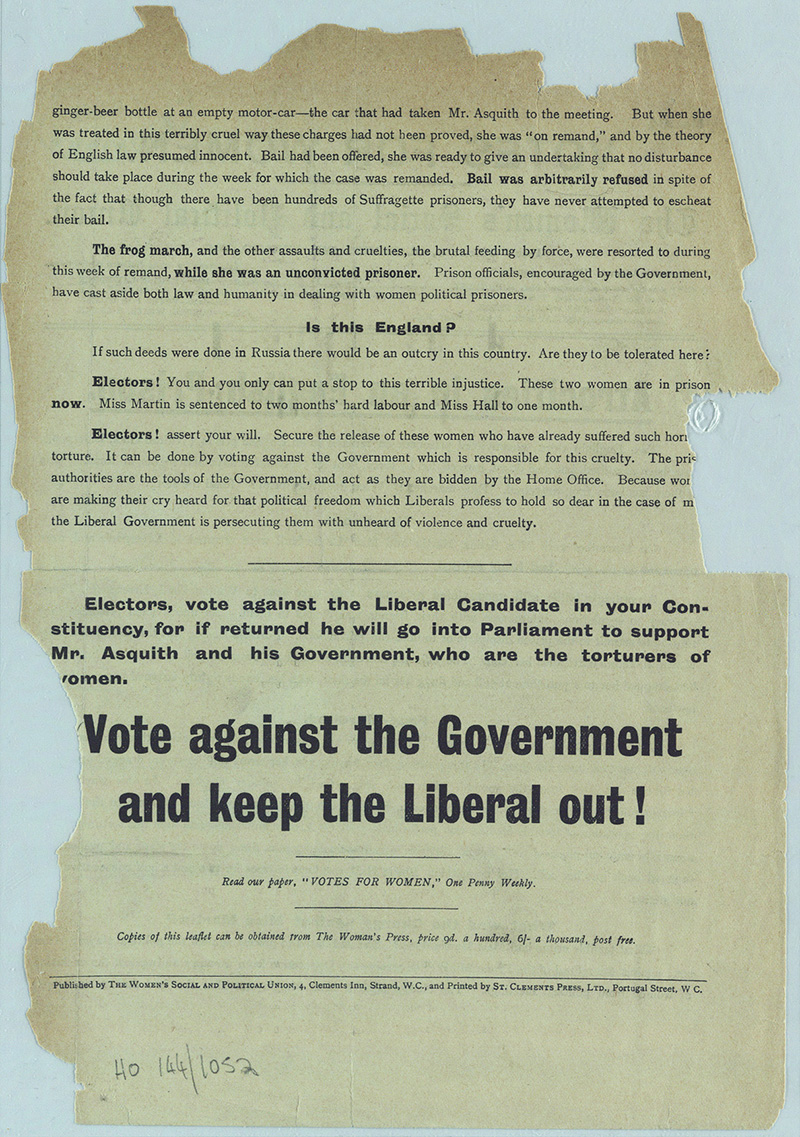
Page 2 out of 2. A leaflet from the Women’s Social and Political Union describing the force-feeding of suffragettes at Walton Gaol, Liverpool, December 1909, Catalogue ref: HO 144/1052/187234)
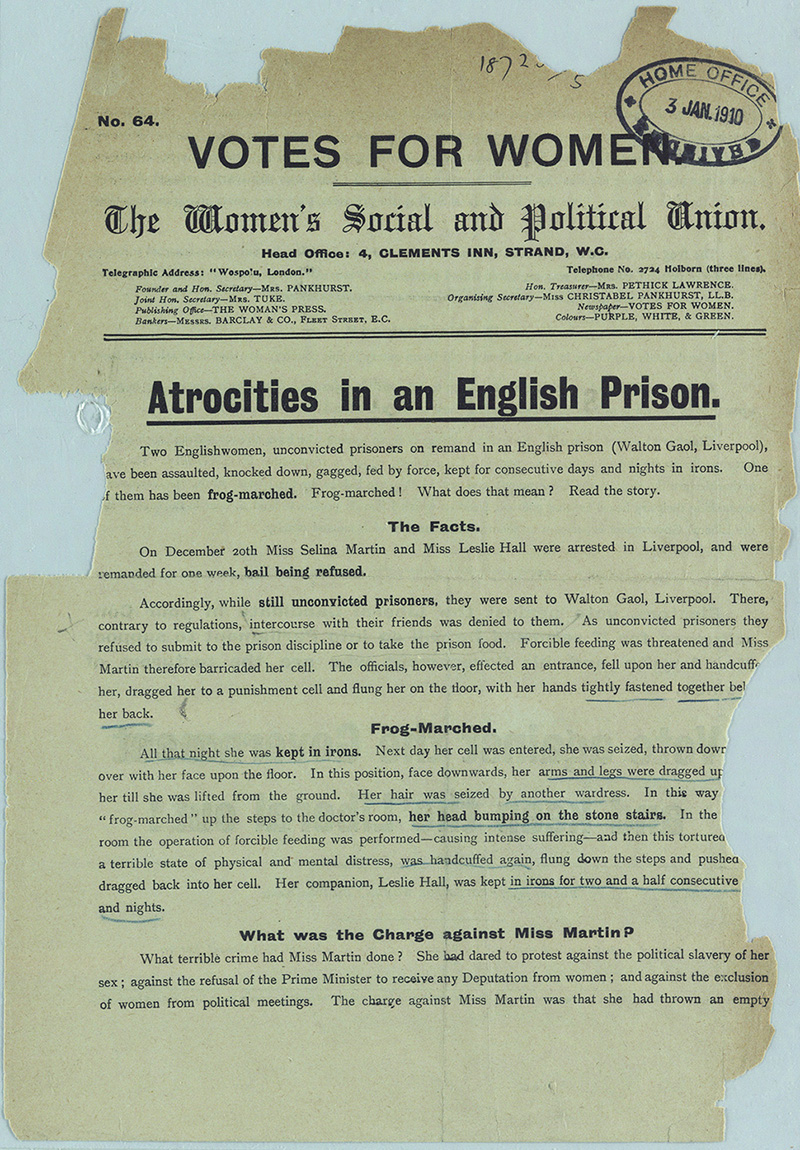
Page 1 out of 2. A leaflet from the Women’s Social and Political Union describing the force-feeding of Suffragettes at Walton Gaol, Liverpool, December 1909. Catalogue ref: HO 144/1052/187234
Throughout the nineteenth century, women played a prominent role in the fight for political rights. In the second half of the century, three major acts were passed extending political rights – but not to women. Women made only limited progress towards being able to control their own affairs and they did not have the right to vote.
At the end of the century, Millicent Fawcett formed the National Union of Women’s Suffrage Societies, and supporters became known as Suffragists. The campaign gained a higher profile through the actions of the Women’s Social and Political Union, formed in 1903 by mother and daughter Emmeline and Christabel Pankhurst.
Use the original documents in this lesson to discover the methods that the Suffragettes used to gain the vote in the twentieth century.
Political reform in 20th century BritainFollowing the 1832 Reform Act, demands for the extension of the right to vote continued. The Reform Acts of 1867 and 1884 extended these rights. In 1867, adult male householders and male lodgers paying £10 for unfurnished rooms could vote and in 1884, men living in the countryside could vote under the same terms.
Important rights for women were also fought for. Campaigners were generally the middle-class women who benefited from various acts improving the legal status of women, such as the Married Women’s Property Acts of 1870, 1874 and 1882. The 1869 Municipal Franchise Act gave the vote to some women rate-payers in local elections and also enabled women to serve as Poor Law Guardians. The 1888 County Council Act also gave women the vote at county and borough council elections, but they could not serve as members. This right was not granted until 1907.
However, in 1897 Millicent Fawcett formed the moderate National Union of Women’s Suffrage Societies (NUWSS) to secure votes for women. The NUWSS was based on a network of local suffrage groups, many of which had been created since the 1860s, when they had attempted to get women included in the terms of the 1867 Reform Act. They lobbied politicians, staged demonstrations, marches and petitions and campaigned to get the support of the public for the cause.
In 1903, Emmeline and Christabel Pankhurst formed the Women’s Social and Political Union. The WSPU disrupted public meetings and boycotted the census. They smashed windows, set post boxes and buildings on fire and staged protests. When they were arrested or imprisoned, they went on hunger strikes. These actions gained much publicity and attention for the cause but the WSPU’s campaign possibly alienated some potential sympathisers.
The protesters often clashed with police and with the public. For example, at demonstrations outside the Houses of Parliament on 18 and 23 November 1910, there was violence and arrests. The police were accused of behaving with unnecessary brutality and 18 November became known as Black Friday. In 1913, the campaign stepped up. Emmeline Pankhurst was imprisoned many times and went on hunger strike and was force fed. On 4 June, Emily Davison was killed at the Epsom Derby.
However, protests were put aside as the women joined in the war effort from 1914-18. In 1918, women were able to vote in general elections for the first time. The Representation of the People Act 1918 widened suffrage by abolishing practically all property qualifications for men and enfranchised women over 30 who met minimum property qualifications.