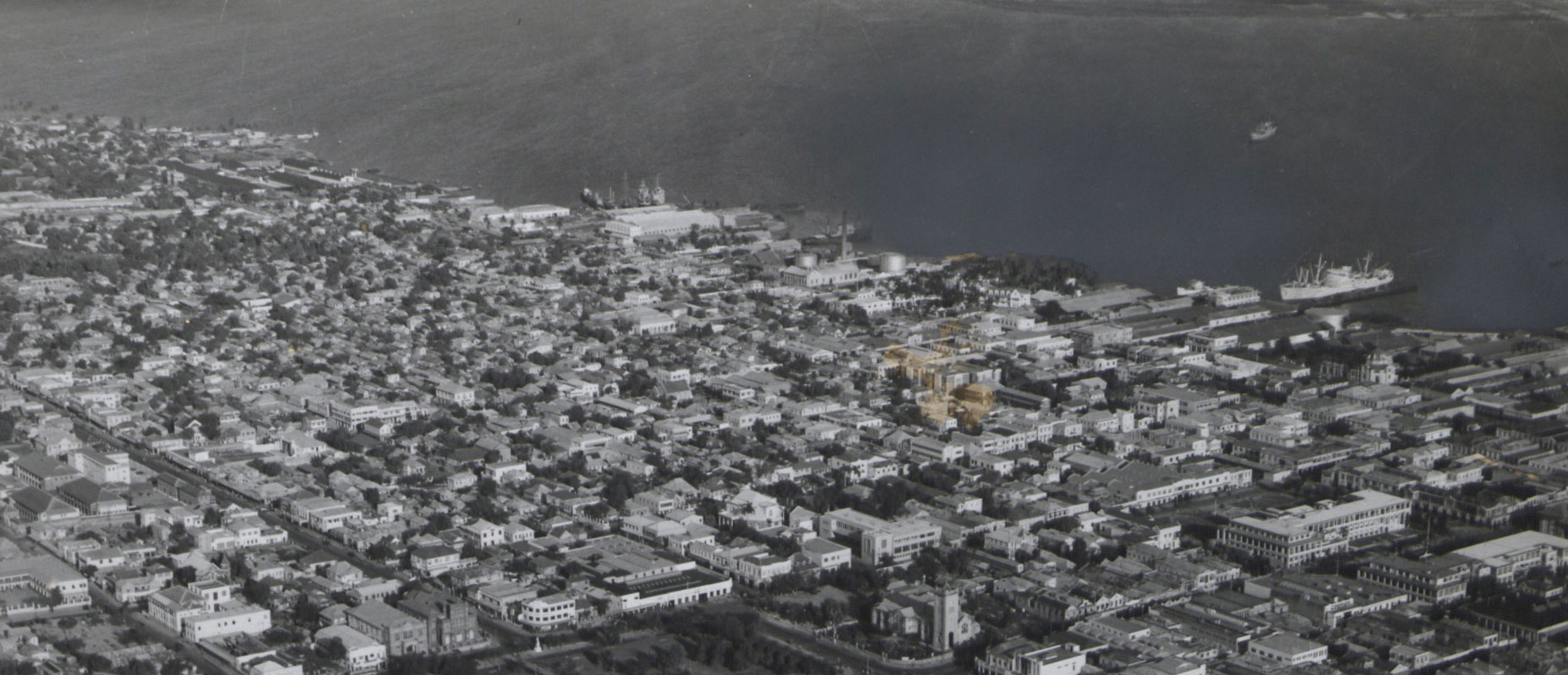
2023 marks 75 years since HMT Empire Windrush docked and its passengers, mostly from the Caribbean, disembarked at Tilbury, Essex. This moment has come to symbolise the wider history of migration to Britain.
Mapping passenger journeys gives a unique insight into individual migration stories and migration patterns. This new website uses passenger lists held at The National Archives to gain greater understanding about migration from the Caribbean to Britain by the so called Windrush generation through a series of interactive maps. The Empire Windrush was not the first post-war ship to bring passengers from the Caribbean. These maps focus on the journeys of the Empire Windrush and its post-war predecessors the Ormonde and the Almanzora, which docked in 1947.
The passenger lists act as a gateway into the individual migration stories of post-war Caribbean migrants. These maps help us understand more about their journeys and their intended onward stays. Find out more about our work on migration to Britain on our Windrush 75 portal.
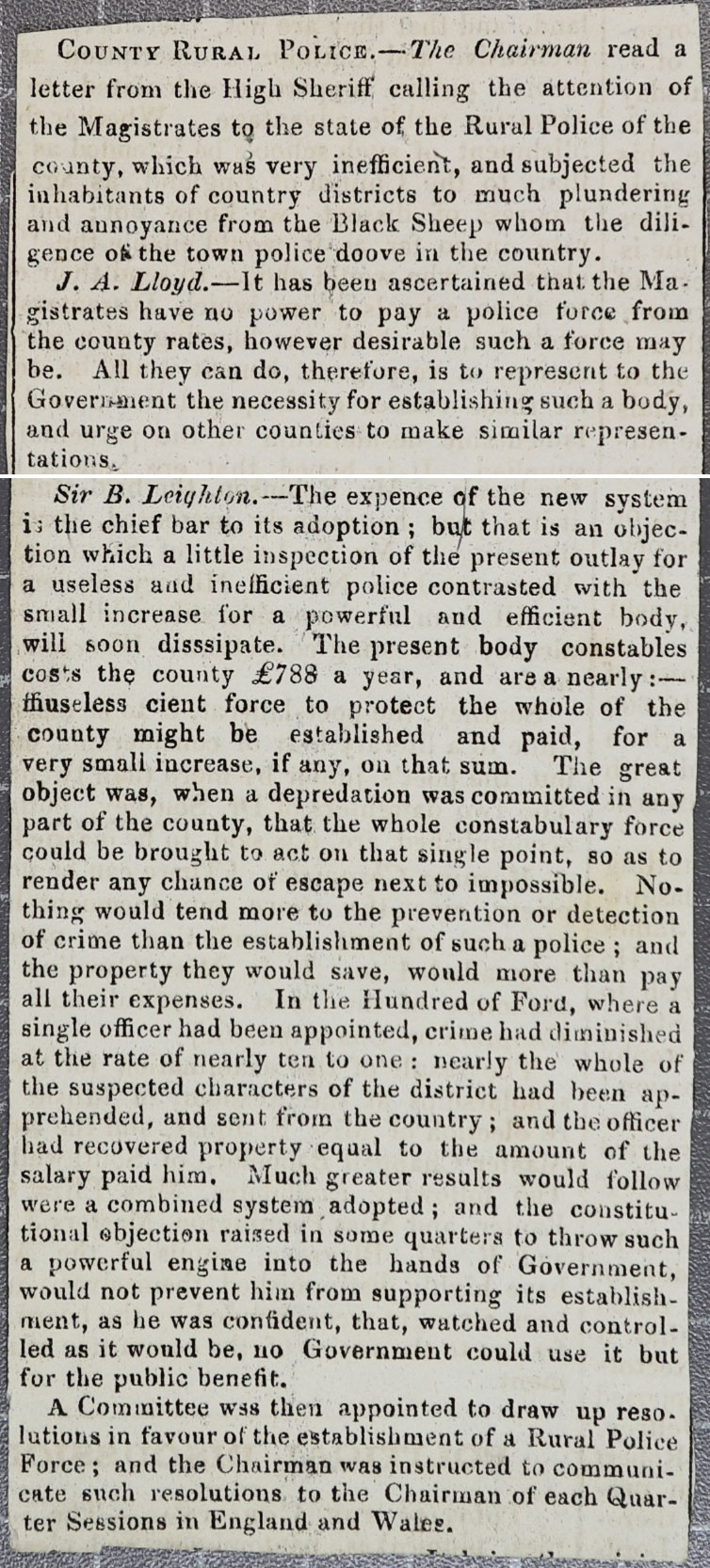
‘Newspaper extracts regarding the establishment of a county rural police force in Shropshire’. c.1835-9. Catalogue Ref. HO 73/3.
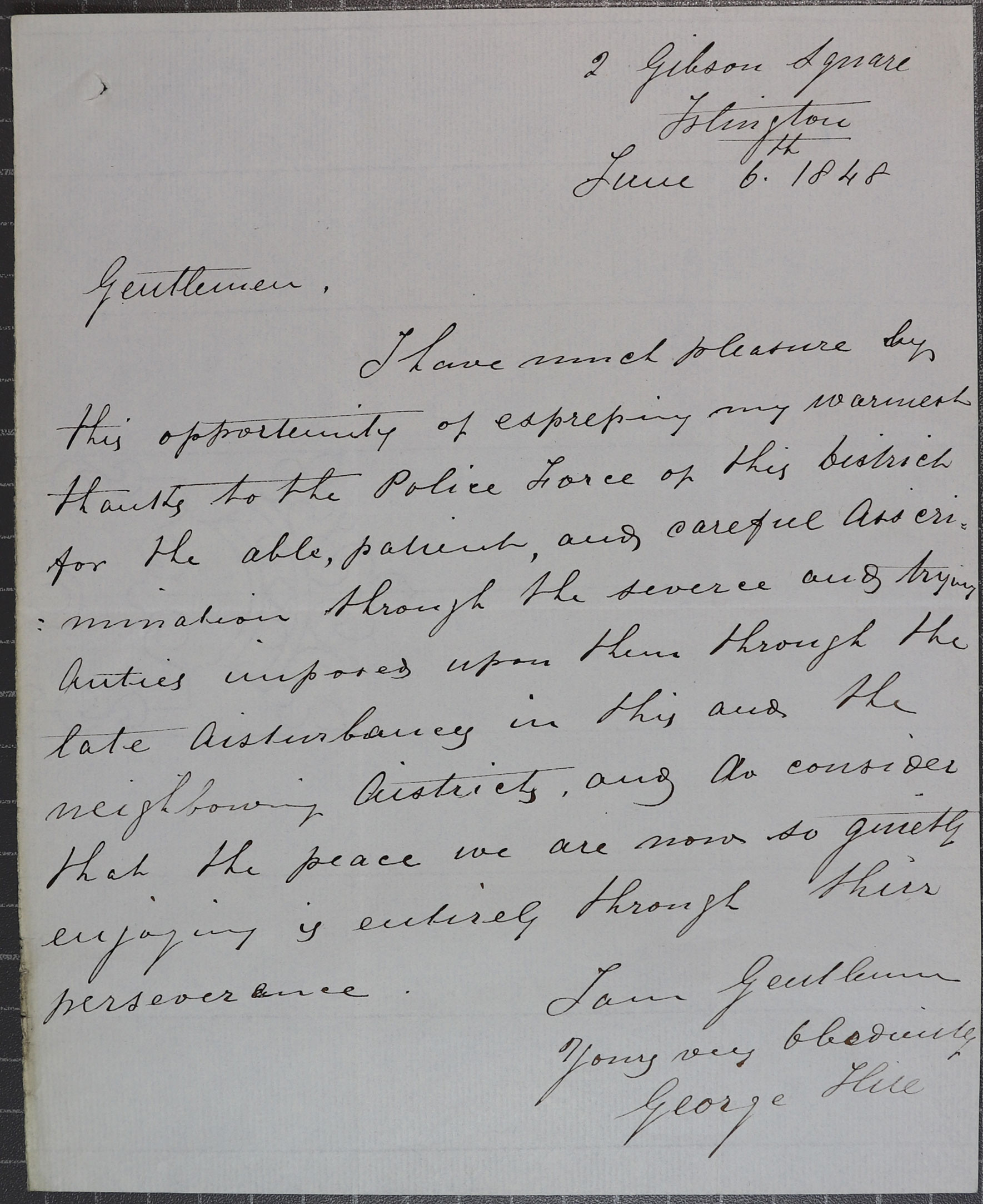
‘A letter regarding the Metropolitan Police Force’. 1848. Catalogue Ref. MEPO 2/67
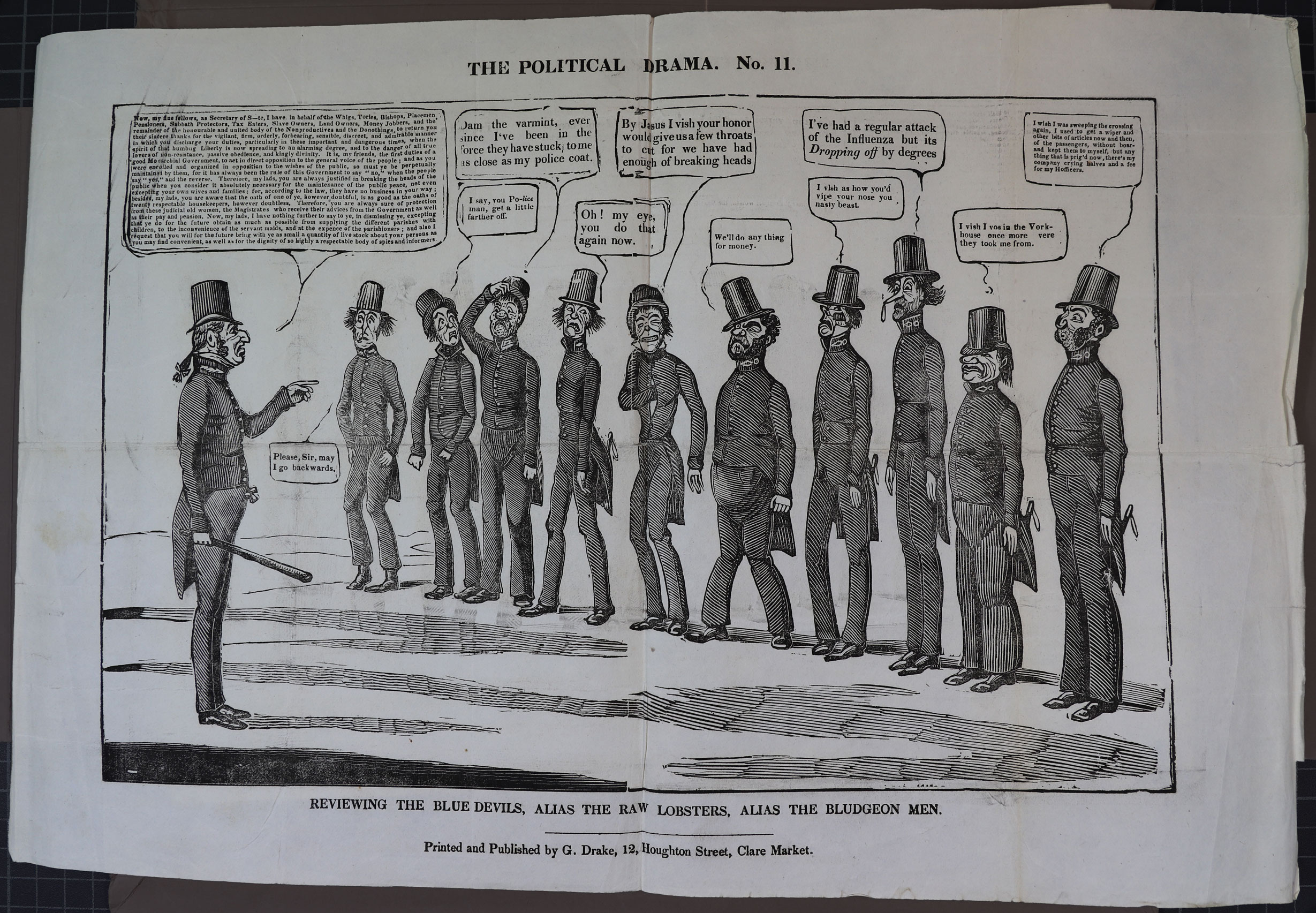
Cartoon entitled: ‘The Political Drama’ with caption: ‘Reviewing the Blue Devils, Alias the Raw Lobsters, Alias the Bludgeon men’, 1833, printed and published by G. Drake, 12, Broughton Street, Clare Market, [London], Catalogue ref: HO 61/9
This cartoon is a contemporary reaction to the creation of the Metropolitan Police Force of London. It shows the British Secretary of State, pictured as a police sergeant, inspecting the newly created police force.
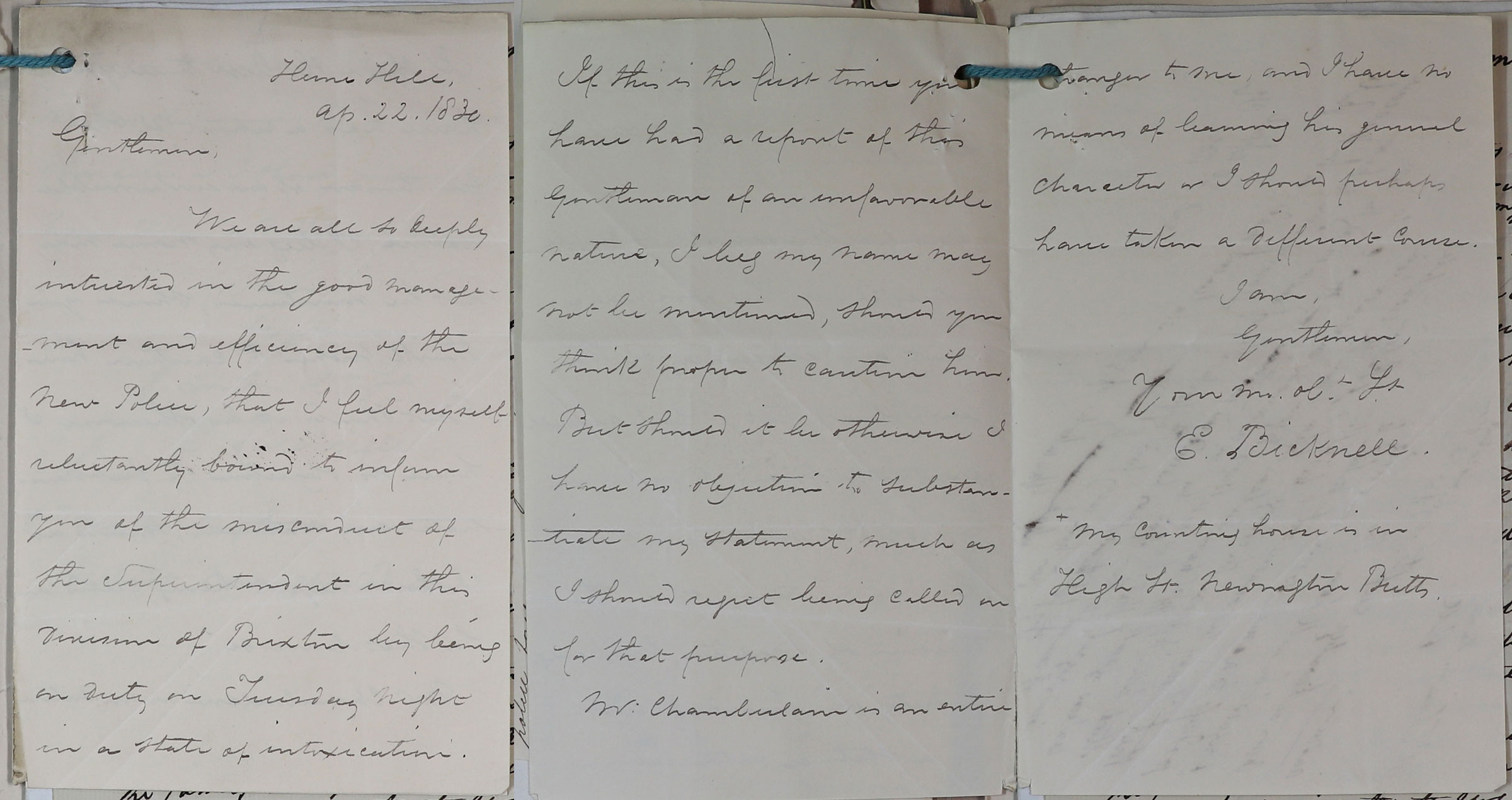
‘A letter regarding the Metropolitan Police Force’. Catalogue ref. MEPO 2/9653.
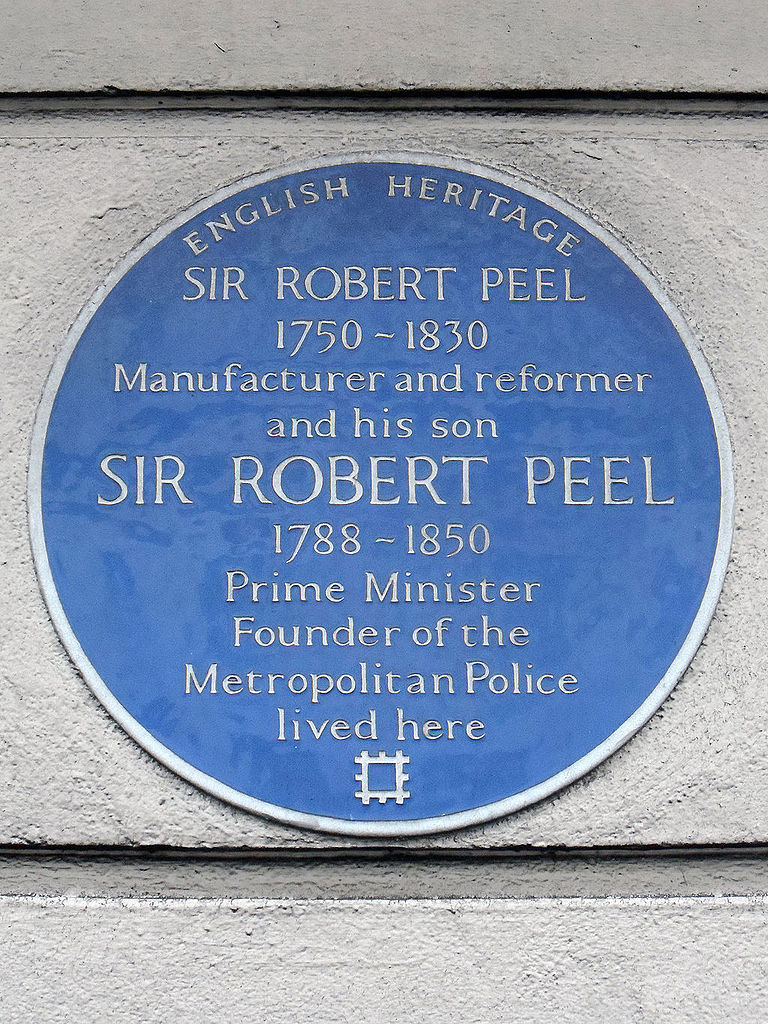
In 1822, Sir Robert Peel was appointed Home Secretary. He would become closely associated with penal reform in Britain. He is remembered especially for the formation of the Metropolitan London Police Force in 1829. Police constables were called ‘bobbies’ or ‘peelers’ in reference to Peel. Before Peel’s reforms, public order in London was a serious concern, with crime rates rising as the population of the city grew. London had previously been policed by an old system of 4,500 night-watchmen, the Hue and Cry, the Bow Street Runners, and 450 constables, who were generally seen as corrupt, inefficient, and jealous of one another’s powers. Peel was convinced that the establishment of a state-funded, professional, and unified police force was the solution.
The Act for Improving the Police in and near the Metropolis in 1829 saw the establishment of the Metropolitan Police Force in central London, including eight superintendents, 20 inspectors, 88 sergeants and 895 constables.
Use this lesson with original documents, to explore the foundation of the Metropolitan Police Force, the nature of the new police force, and contemporary attitudes to this new system of law and order in London.
How was law enforcement changed by Sir Robert Peel’s new Metropolitan Police Force?Gary Mason’s ‘The Official History of the Metropolitan Police’ (2004) gives details of the recruitment criteria for the new police force in 1829: male, under the age of 35, fit and healthy, and at least 5ft7in tall. Once in the force, the constables were paid 21/- (£1.05) a week. This amount was more than a labourer earned, but less than a skilled worker, and they also had to pay for their own blue uniforms. As Dr Claire Kennan has shown, the recruits were subject to strict prohibitions on their behaviour; they could not talk to sex workers, associate with known criminals, or visit public houses (pubs). They also worked a gruelling seven-day week, which was physically demanding. The main method of policing was patrolling their areas on foot, walking up to 10 miles a day across their ‘beat’, and reporting to their superior sergeants.
Recorded crime in London fell significantly after Peel’s reforms, despite continuous population growth in the city. However, Peel’s Metropolitan Police were not celebrated unanimously. Some parishes in London objected to the loss of jurisdiction over the way in which they were policed, particularly in wealthier parishes such as Marylebone. There was also real concern that the state-organised police were in fact a peacetime army, a military force that could be an instrument of political oppression. They were often the subject of derision and hostility in newspapers and other publications. Often, the constables were heckled, spat at, and subject to violence while on duty.
Feelings of resentment and anger towards the police was fuelled, in the early years of the force, by the low quality of those who entered the police force. A stricter position on officers’ behaviour was enforced within two years of the Metropolitan Police’s establishment, which led to a high turnover of recruits, with many officers being dismissed for drunkenness.
Despite some initial challenges, Peel’s police force was a profound success, as crime rates fell continuously over the next century. Another indicator of its success was the 1835 Municipal Corporation Act and the 1839 Rural Constabulary Act which allowed counties to set up their own police forces, and Wiltshire was the first county to do this. Just as in London, there was initial opposition for the establishment of such rural police forces, including fears about the encroachment of a military force in towns and counties, and in the 1850s only 36 out of the 54 counties had created their own police force. With the County Borough Police Act of 1856, it became compulsory for all counties and boroughs to have a police force.
At The National Archives, the Records of the Metropolitan Police Office (MEPO) holds records concerning all aspects of the policing of the metropolis of London.
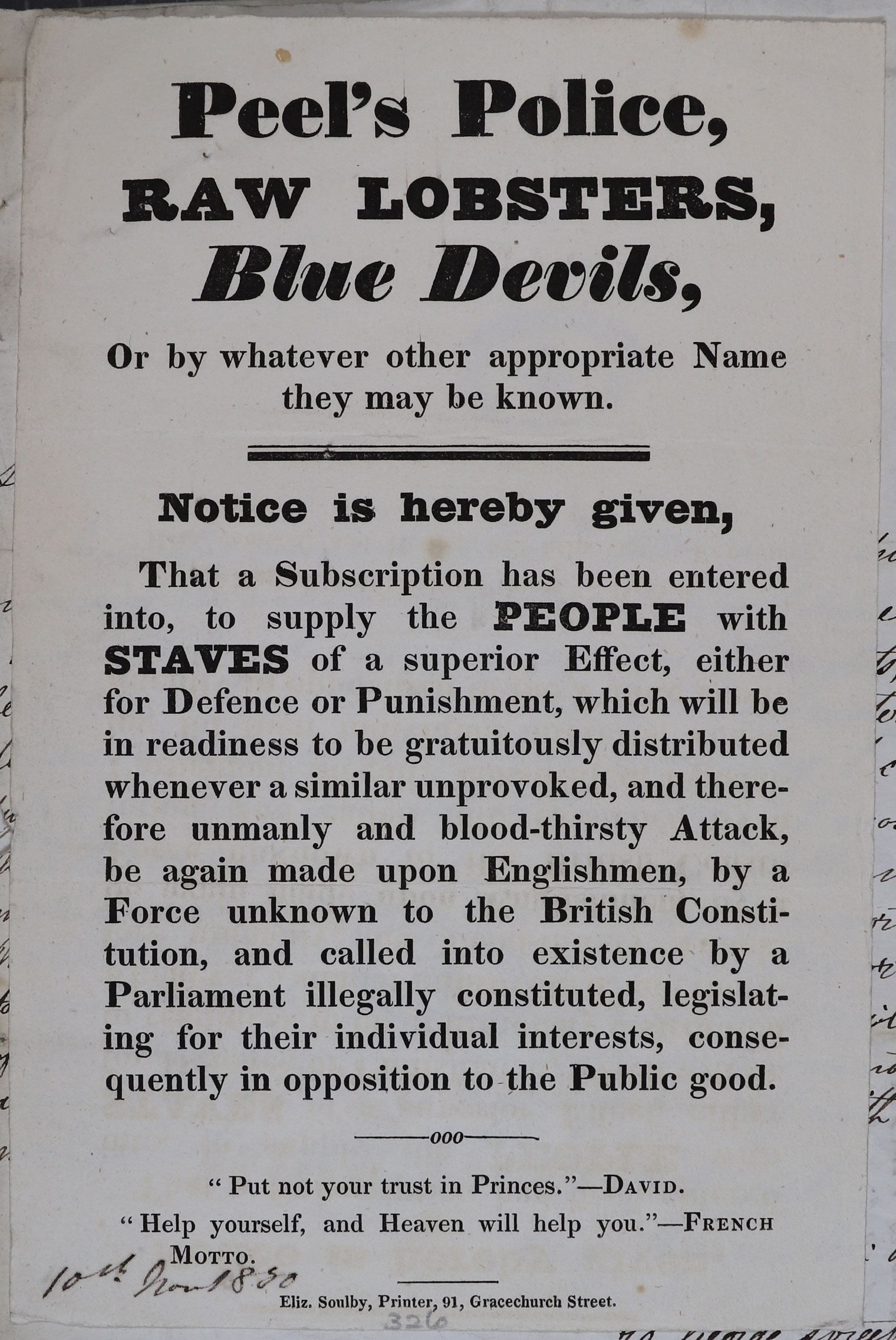
Anti-police handbill, 1830. Catalogue Ref: HO 44/21, f.326
This handbill was written a year after the establishment of the Metropolitan Police.
Lobsters are blue when raw, but when they are heated or exposed to volatile conditions, they turn red, the colour not of police uniforms, but of army uniforms.
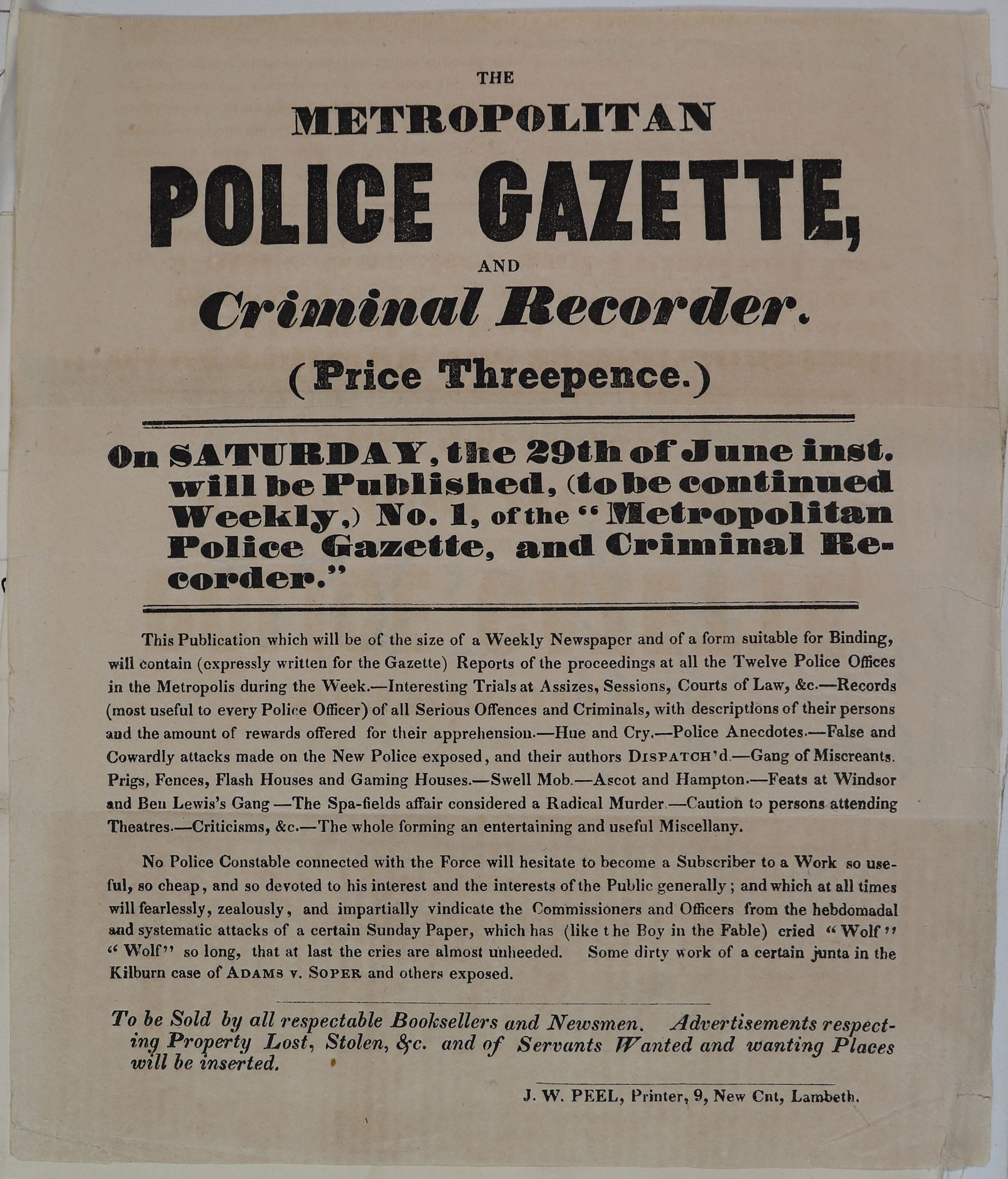
‘The Metropolitan Police Gazette and Criminal Recorder’. 1829. Catalogue Ref: HO 61/9
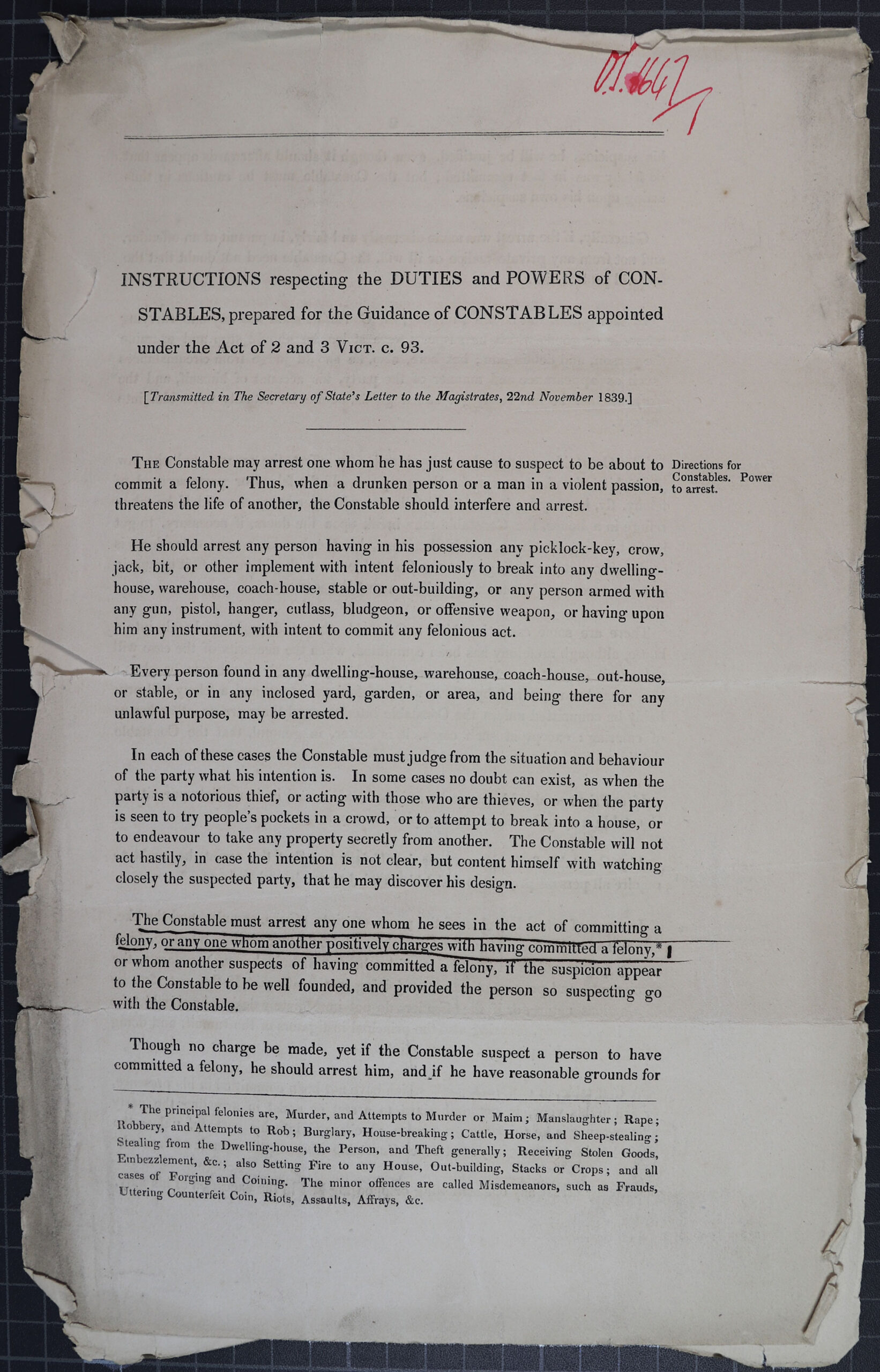
‘Instructions respecting the Duties and Powers of Constables’, 1839. Catalogue Ref. HO 45/6647
This was one of the first attempts to describe the powers of a police constable.
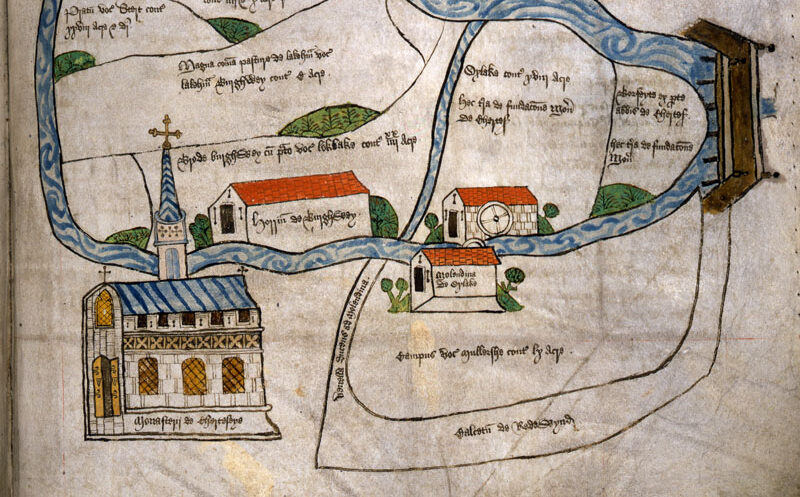
The National Archives and The University of Exeter are running a collaborative CPD project for teachers in and around the area of Chertsey, Surrey.
The project will explore the history of Chertsey Abbey, particularly its dissolution in 1537 and its related historical records. We are keen to work with teachers to explore how they can be used as a local history case study in schools for KS2 – KS5. As such, we are looking for teachers with an interest in teaching local history or Tudors through the lens of Chertsey Abbey to take part between November 2023 – March 2024.
The project will launch as a Twilight CPD session on Wednesday 8th November, with two available sessions:
- 4-5 pm Online via Zoom
- 6-8 pm Onsite at The National Archives. (This session can also be attended virtually, though we would recommend attending onsite if possible.)
These sessions will include advice and activities for teaching the Dissolution and the Reformation, a document display of relevant historical material, and a chance to discuss and share ideas with fellow teachers on the project.
Follow-up sessions and support will then be available throughout the winter and spring terms, during which time teachers should explore the topic with their students in either classwork or a history club, with a feedback session planned for March 2024.
A small amount of funding is available on application for transport costs to The National Archives for those wishing to attend the evening session. To apply please email education@nationalarchives.gov.uk after signing up for the project.
To sign up visit our Eventbrite page.