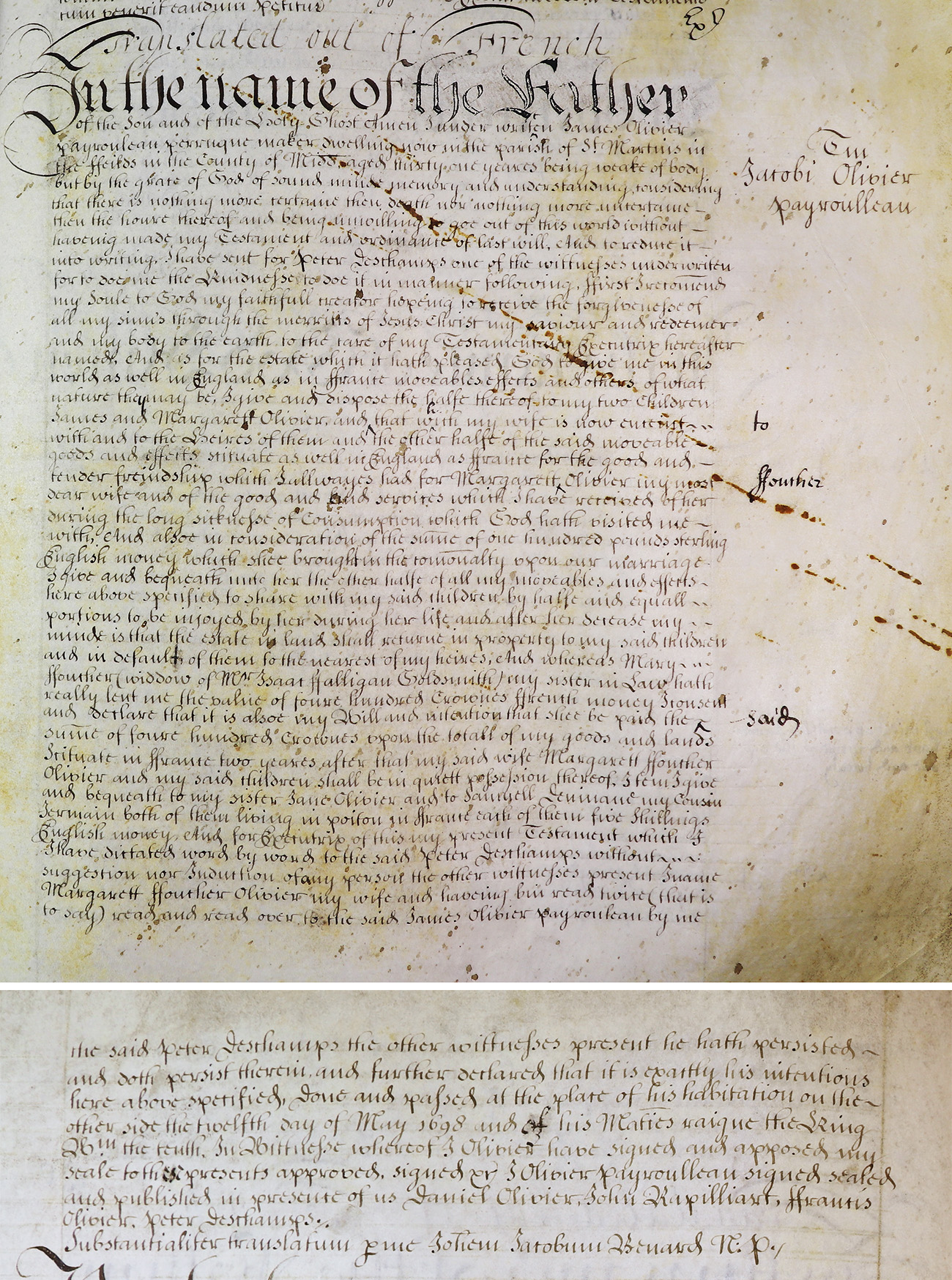
Will of James Olivier Payroulleau, Peruke Maker of Saint Martin in the Fields, Middlesex, 22nd June 1698. Catalogue ref: PROB 11/446/158.
This source is the personal will of James Olivier Payroulleau, a Huguenot refugee from west-central France, a geographical area that had been a stronghold of Protestant resistance in the early seventeenth century.
A peruke, also called periwig, was a man’s wig, popular from the seventeenth to the early nineteenth century. It was made out of long hair, often with curls on the sides, and was sometimes drawn back of the neck.
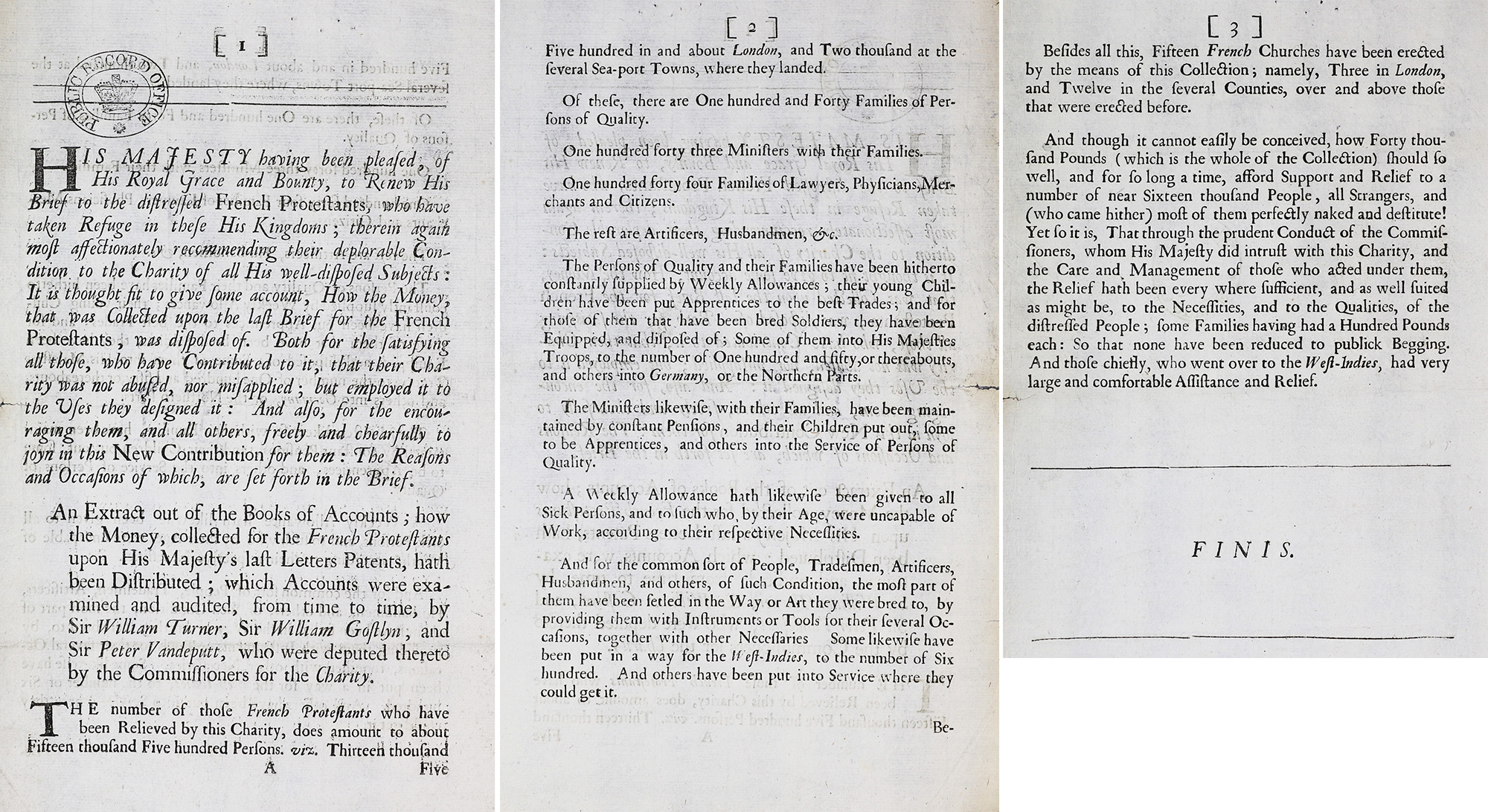
‘A printed tract, an audit of money contributed to a charity to relieve distressed French Protestants’. (c.1685-1688). Catalogue Ref. SP 32/11/203 f.347-8.
This printed tract from the reign of James II (1685-1688) provides a detailed account of how charitable donations from the English have helped Huguenot refugees.
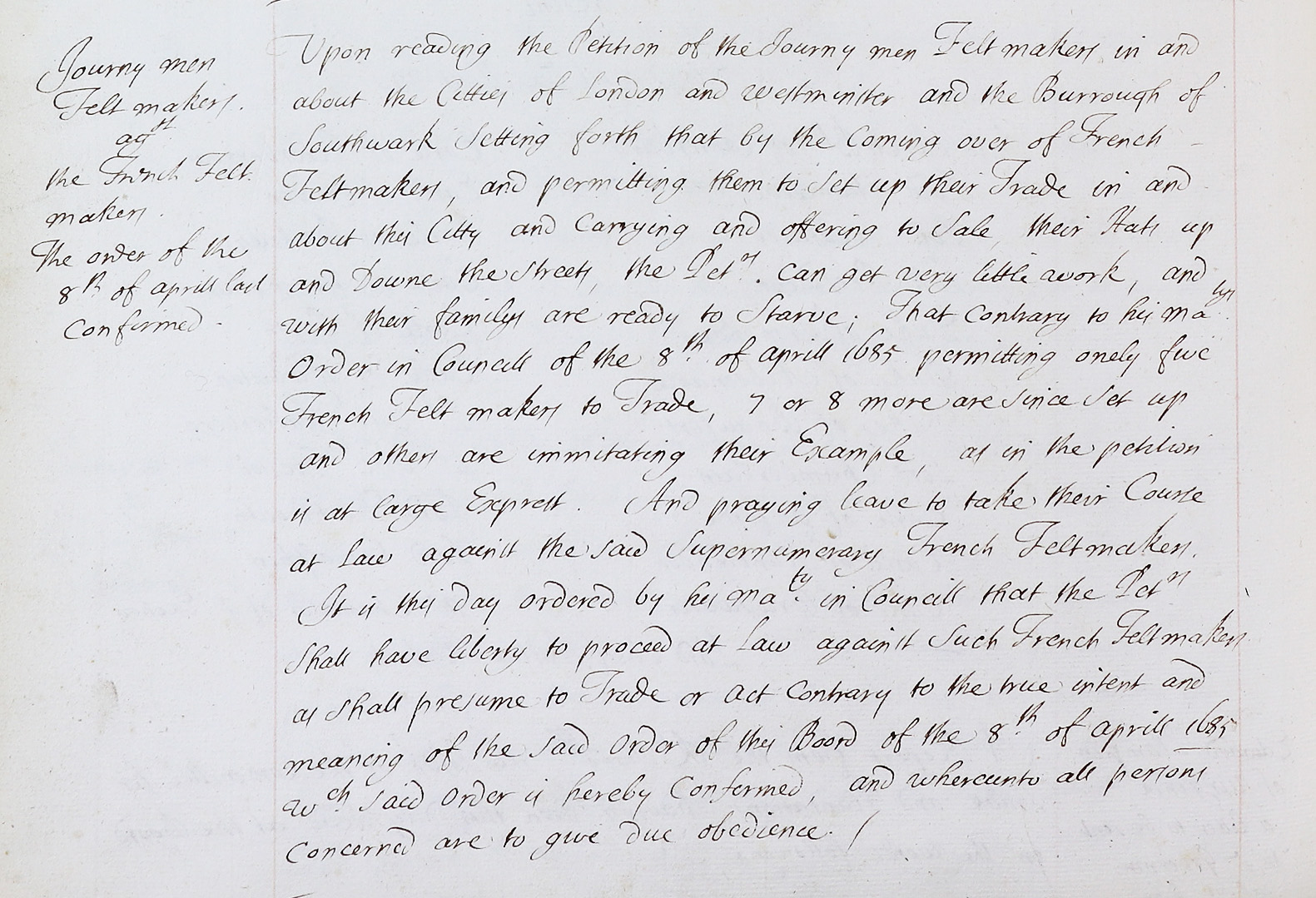
‘Privy Council: Registers. James II.’ Vol 1: 18 December 1685. Catalogue Ref: PC 2/71.f.91v
The registers of the Privy Council consist of the minutes or notes of its proceedings, its orders, some proclamations, committee reports and their papers.
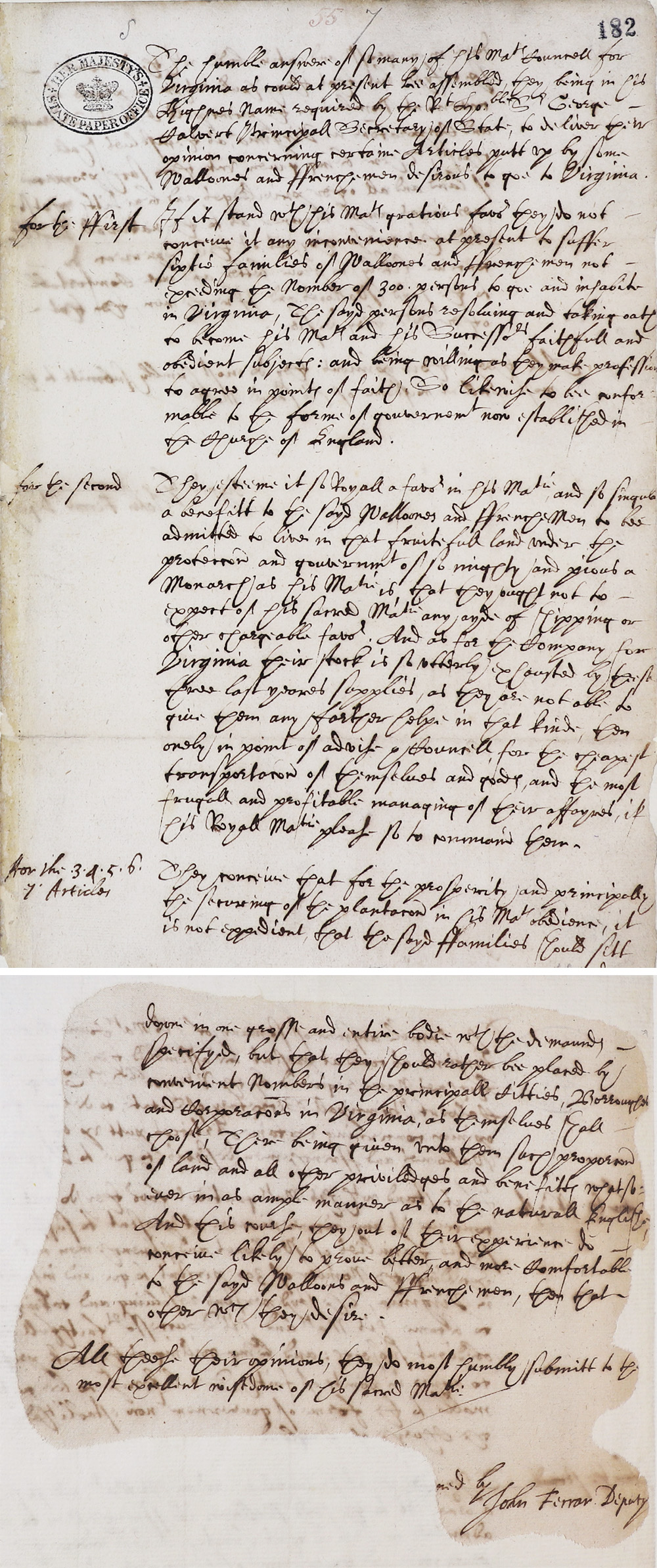
A document entitled: ‘The humble answer of so many of his majesties Councell…their opinion concerning certain Articles putt up by some Walloons and French men desirous to goe to Virginia’, 1621. Catalogue Ref: CO 1/1 f.182-3.
This is a decision from the King and his council to a request from Walloons and Frenchmen who wanted to settle in Virginia in 1621.
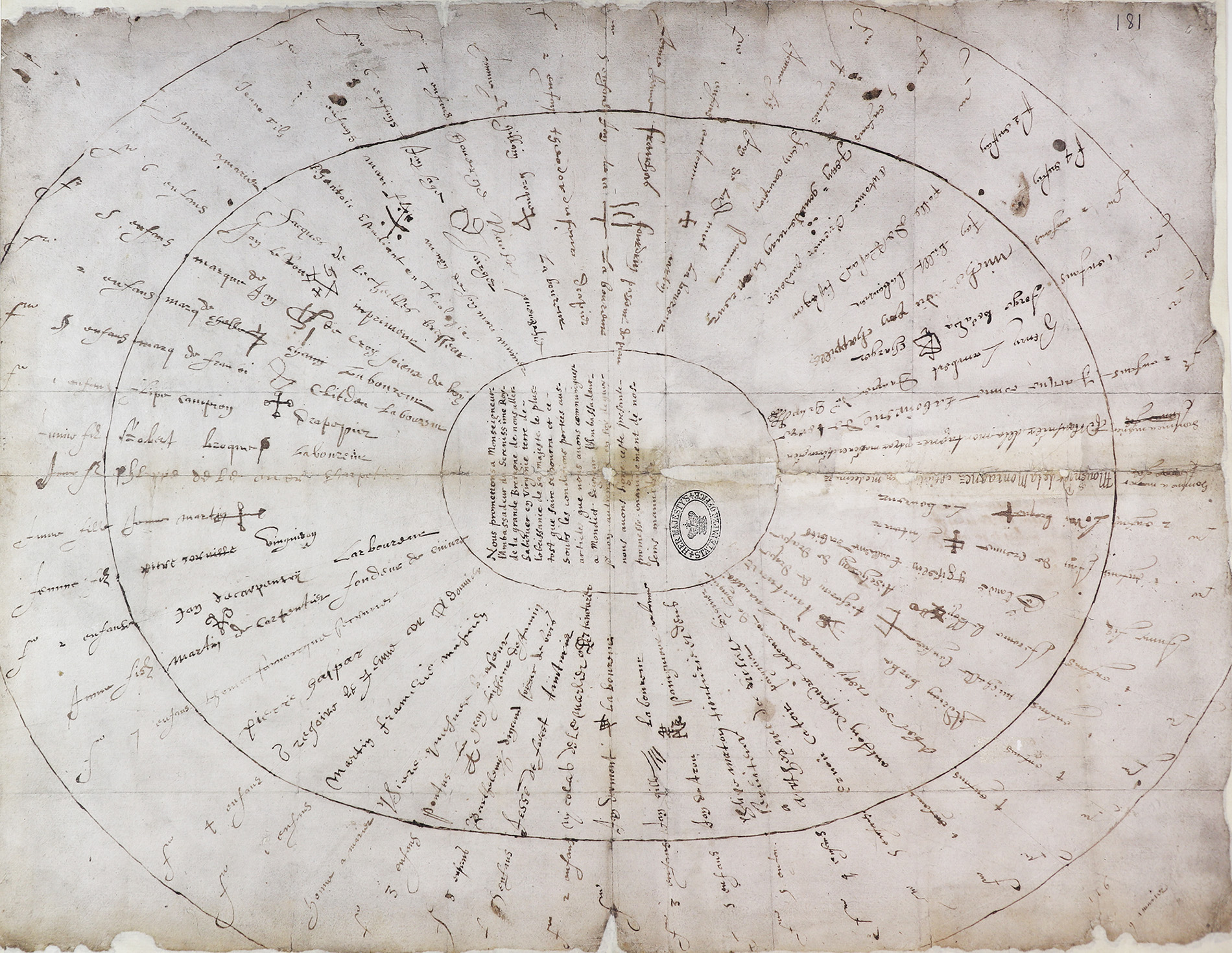
A ‘round robin’ from Walloon emigrants. Catalogue Ref: MFQ 1/565
A round robin was a document written in circular fashion to disguise the order in which it was done. This document is a promise by certain Walloons and French to go and inhabit Virginia, a land under obedience of the Kings of Great Britain’. 1621.
Walloons: French-speaking Protestants from Wallonia, the southern area of Belgium
French Protestants: Huguenots.
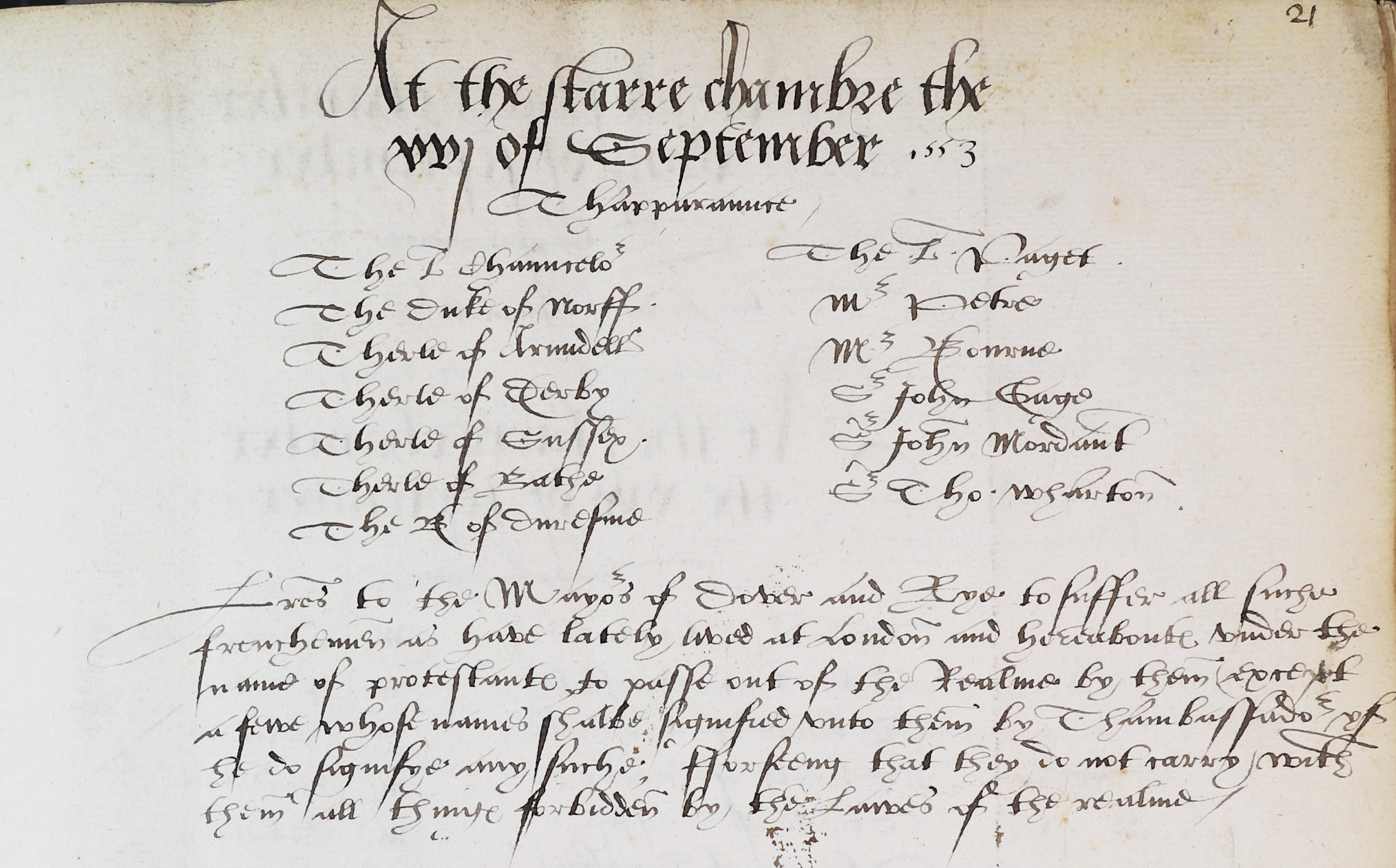
This extract comes from the Privy Council Papers, records which provide insights into the policies and issues of government, September 1553, during the reign of Mary I (1553-1558). Catalogue Ref: PC 2/7 f.21.
The Privy Council was a group of advisers to the monarch. The Star Chamber was named after the star-spangled ceiling of the room where it met in the old palace of Westminster, was effectively the judicial arm of the King’s Council. It became a separate court of law after 1485.
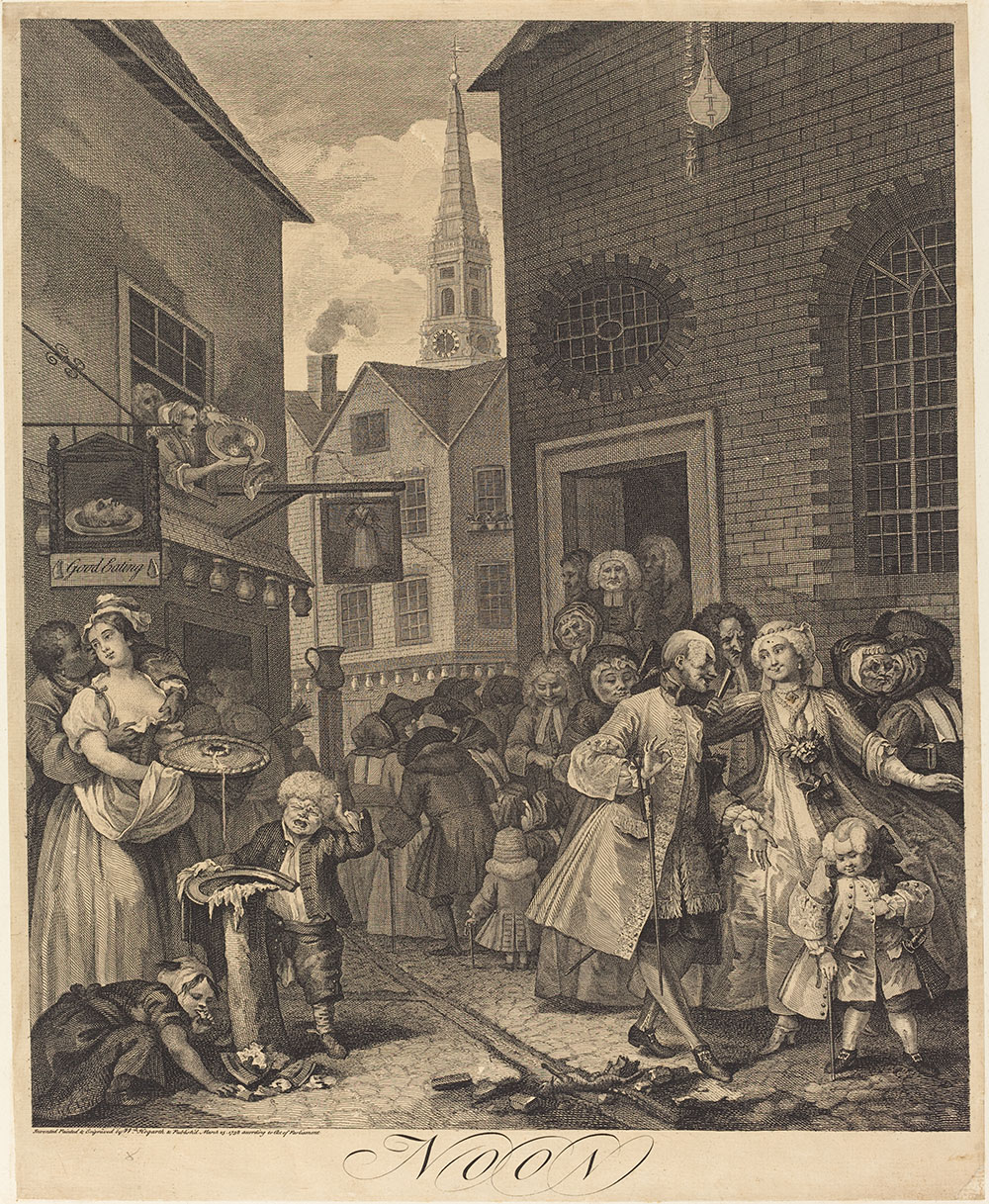
The second plate from William Hogarth’s set of four Times of Day, published in 1738 and derived from paintings made by Hogarth in 1736-7. Each of the four scenes depicts a different area of London. ‘Noon’ shown here shows elegantly dressed French Huguenots leaving the French Chapel in Hog Lane, Soho. Wikimedia Commons
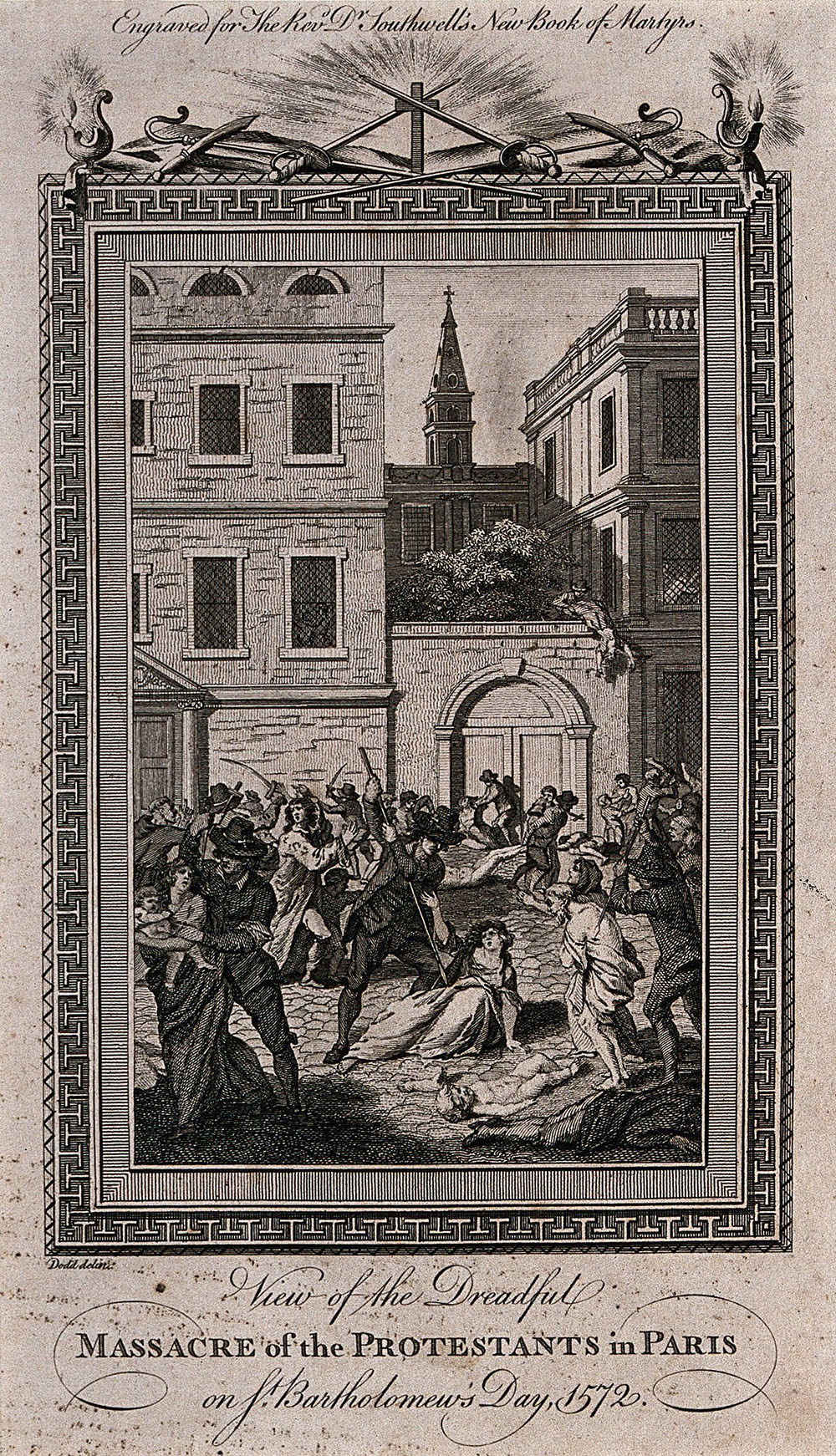
Engraving after Dodd, entitled ‘Engraved for the Reverend Dr Southwell’s New Book of Martyrs’, 1765. The caption below the image reads: View of the Dreadful Massacre of the Protestants in Paris on St Bartholomew’s Day, 1572.’ Wellcome collections, reference: 43147i.
[A more famous work of history of the Protestant martyrs by John Foxe was earlier published in 1563. It was called ‘The Actes and Monuments’, or ‘ Foxe’s Book of Martyrs’.]
The Huguenots were Protestants who fled France and Wallonia (southern Belgium) from the sixteenth to the eighteenth century due to religious persecution during the European Wars of Religion. After the English Reformation, England was seen as a safe place for refugees.
What did Huguenots find when they arrived in England? How did they settle and set up their own religious and economic communities? How did they impact upon English society, especially in urban settings?
This lesson shows that the Huguenots came to England as immigrants and were on occasion in need of economic and governmental support. Importantly, they also brought their skills and expertise as silk-weavers, silversmiths, merchants, vine-growers, wig makers, and hat-makers to England, helping England to expand its global horizons. While Huguenots could be praised for adding value to the English economy, the English could be hostile to what they saw as a threat to their own livelihoods.
Use this lesson to explore the Huguenot experience of migration in seventeenth century England, with original documents ranging from 1553-1765.
What was the experience of Huguenot migrants in seventeenth century England?The Huguenots gave the word ‘refugee’ to the English language. They were French Protestants who followed the teaching of John Calvin, the Protestant reformer. The Huguenots fled to England, Germany, the Netherlands, and the New World between sixteenth and eighteenth centuries in order to escape religious persecution from the Catholic monarchy in France who were caught up in the violent Wars of Religion.
There were two significant waves of Huguenot migration to England. The first influx came in the wake of the 1572 St Bartholomew’s Day Massacre, which saw 70,000 Huguenots across France brutally murdered, and Elizabeth I’s court enter a period of mourning in honour of the Protestant lives lost to the Catholic terror. Migration slowed in the early seventeenth century due to the Edict of Nantes in 1598, instigated by Henry IV of France, who had granted freedom for French Protestants to practice religion without fear. However, the loss of important Huguenot centres in France (despite English military assistance), including La Rochelle in 1628, further weakened the Protestant cause on the continent. Henry IV’s grandson, the fiercely Catholic Louis XIV, slowly chipped away at the rights of Protestants. First came the dragonnades in 1681, a French government policy of intimidation that involved the forced lodging of the king’s soldiers (a “Dragonnade”) in Huguenot homes. The revocation of the Edict of Nantes in 1685 was the death knell for religious toleration, as Huguenots were officially denounced as heretics. Although Louis XIV banned the Huguenot’s right to leave the country, 200,000 Protestants did manage to escape; 50,000 of those went to England, in the second significant wave of migration. England had long been seen as a Protestant haven for those seeking religious persecution. It is suggested that one in six people living in Britain today has Huguenot heritage.
Escaping France by boat, their reception in England was complex. England did provide a safe refuge for Protestants, with significant Huguenot communities established in Spitalfields, Wandsworth, Canterbury, Sandwich, Faversham, and Maidstone. Within defined limits and regulations, the English government provided poor relief to refugees who needed it, and could also provide letters of denization, sanctioning Huguenots to become British subjects.
The government allowed them to practise their trades, and importantly, permitted them to establish their own religious communities, allowing them to worship freely. The Huguenots wasted no time in setting up their own churches. The first French church in Threadneedle Street was founded in 1550; ‘The Strangers Church’ in Soho soon followed. After the Revocation of the Edict of Nantes in 1685, thirty French churches in London were founded, with ten elsewhere in England.
Seventeenth century criticisms of the Huguenots find their parallel in modern day discourses around immigrant groups, with cultural markers of difference such food choices, clothes, and language use being singled out as points for derision. English tradesmen and craftsmen were particularly anxious that the highly skilled Huguenot artisans would take their employment from them. At the same time, the Huguenots made important contributions to the country financially and economically in sectors of industry, including silk, wine, jewellery, paper, and architecture. One such example is James Leman (c.1688-1745). A celebrated silk designer, he was one of the first Huguenots to serve on the Court of Weavers’ Company, and his exquisite silk designs are available to view in the Victoria and Albert Museum in London.
Importantly, Huguenot production in industry reduced the need for the English government to import luxury goods and allowed them to export such goods at a considerable profit. As Owen Stanwood’s book ‘The Global Refuge: Huguenots in an Age of Empire’ (2019) explores, some Huguenots dreamt of building a new Edenic settlement beyond Europe. With the help of their European imperial sponsors, they scattered in North America, the Caribbean, South Africa, and the Atlantic and Indian Oceans, and would be involved in the processes and networks of colonisation and transatlantic slavery.
By the middle of the eighteenth century, the Huguenots had adjusted and assimilated into English society. Many of them had become fluent in English, risen to positions of authority within society, and married into English families. Broadly, the wealthier Huguenot families were able to assimilate faster, while the poorer communities, which remained largely in Spitalfields, retained a distinct identity for longer. In Spitalfields today, you can visit Dennis Severs’ House, a reconstruction of the home of a family of eighteenth-century Huguenot silk weavers.
Telegram from Lord George Curzon to Lord Arthur James Balfour, 10 July 1919. Catalogue ref: FO 608/210/3