
Cartoon by George Cruikshank published by W. Fores, 16 Panton Street, 23 July 1820 (TS 11/115/326 (41))
The caption reads: ‘A scene from Don Giovanni as performed at the King’s Theatre. Don Giovanni by His Majesty. Donna Anna by a celebrated actress, her first appearance on this stage. Leperello by Derry Down Triangle. The other characters by the Corps de ballet.’
The cartoon was based on the famous aria ‘Madamina, il catalogo è questo’ from Mozart’s Don Giovanni, sung by his servant Leporello to Donna Elvira (the caption refers to another female character, Donna Anna). At this point, Act I, Scene V, Leporello gives a detailed account and list of his master’s numerous lovers, a clear attack on George the Prince Regent.
Transcript
[Scroll:]
A List of our wives, the Perditter, Mrs. R., Little P., Dutchess D., Marquise E., Lady G., Mrs. H., Dowager L.J.Jr, &c &c &c
[Left speech bubble:]
Ah my Wife
[Right speech bubble:]
Yes your injured Wife
[Caption:]
A scene from Don Giovanni as performed at the King’s Theatre. Don Giovanni by His Majesty. Donna Anna by a celebrated actress, her first appearance on this stage. Leperello by Derry Down Triangle. The other characters by the Corps de ballet.
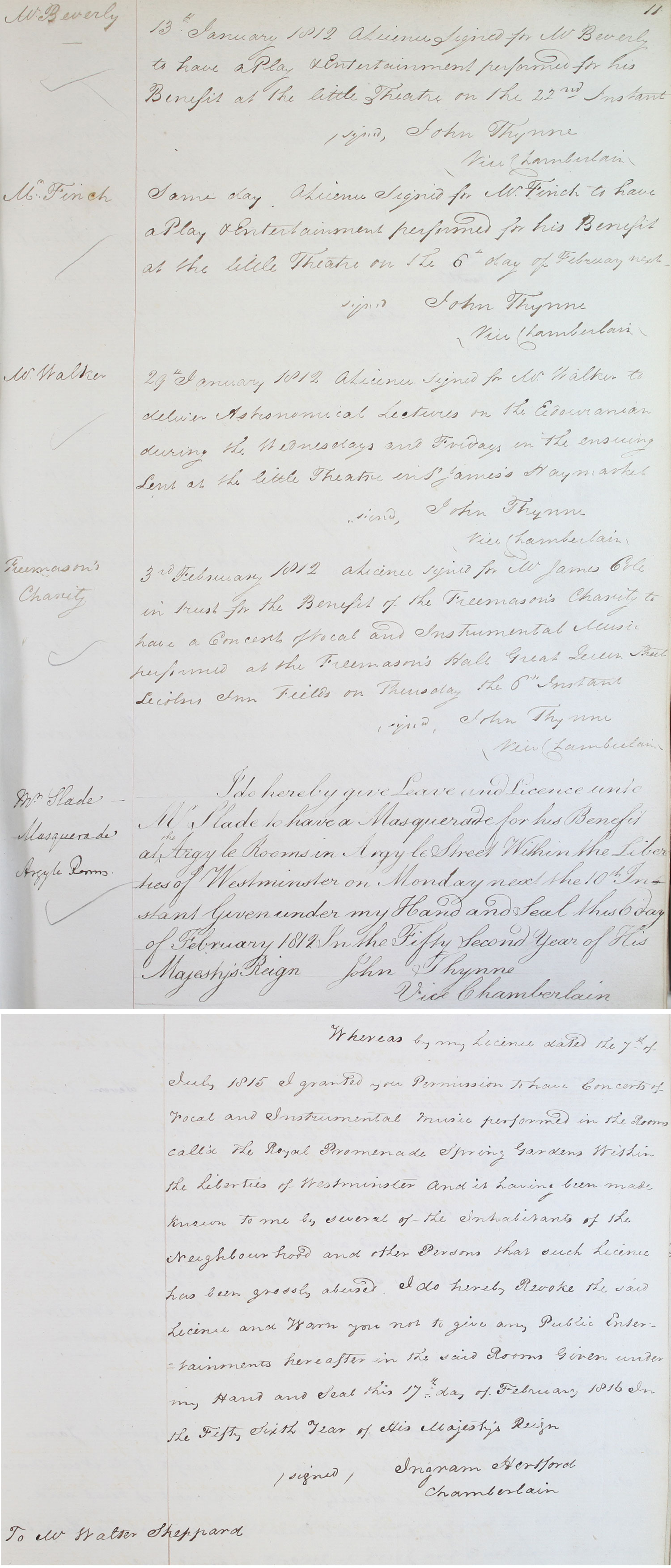
Extract from a ledger produced by the Lord Chamberlain’s office, which recorded the licensing of entertainments and theatres, 1816 (LC 7/10)
Transcript
| Mr Beverly | 13th January 1812. A licence signed for W. Beverly to have a play and entertainment performed for his Benefit at the little Theatre on 22nd instance, signed John Thynne |
| Mr Finch | Same day. A licence signed for Mr. Finch to have a Play and entertainment performed for his Benefit at the little Theatre on the 6h day of February next-: signed John Thynne, Vice Chamberlain |
| Mr. Walker | 29th January 1812. A licence signed for Mr Walker to deliver Astronomical Lectures on the … [un-transcribed] during Wednesdays and Fridays in the ensuing Lent at the little Theatre in St. James Haymarket, signed John Thynne, Vice Chamberlain |
| Freemason’s Charity | 3rd February 1812. A licence signed for Mr James Cole in trust for the Benefit of the Freemason’s Charity to have a Concert of Vocal and Instrumental Music performed at the Freemason’s Hall Great Queen’s Street, Lincolns Inn Fields on Thursday the 6th instant signed John Thynne, Vice Chamberlain |
| Mr Slade-: Masquerade, Argyle Rooms | Mr. Slade to have a Masquerade for his Benefit at the Argyle Rooms, in Argyle Street within the Liberties of Westminster on Monday next the 10th instant. Given under my Hand and Seal this 6th day of February 1812 in the Fifty Second Year of His Majesty’s Reign, John Thynne, Vice Chamberlain |
Whereas by my Licence dated 7th July 1815 I granted you Permission to have Concerts of Vocal and Instrumental Music performed in the Rooms call’d The Royal Promenade Spring Gardens within the Liberties of Westminster and in having been made known to me by several of the inhabitants of the neighbourhood and the persons that such Licence has been grossly abused. I do hereby revoke the said Licence and warn you not to give any Public Entertainments hereafter in the said Rooms, given under my Hand and Seal this 17th day of February 1816 in the Fifty Sixth Year of His Majesty’s Reign, signed Ingram Hertford, Chamberlain.
To Mr Walter Sheppard

Pamphlet about the sugar trade written by John Ashley, plantation owner, Barbados 2 October 1733 (TS 24/3/111)
Transcript
Page 1
THE PREFACE
The following Piece is intended to shew the Incumbrances [restrictions] and Charges that remain on the Sugar Trade, since the passing of the late Act, for the better Securing and Encouraging the Trade of his Majesty’s Sugar Colonies in America, and also to compare the Advantages we may reap by that Act, with those which we yet stand in need of; and thereby manifest the Necessity there is for some further Relief.
The first and most material Point aim’d at, is, that of a direct Exportation of our Sugars from the Plantations to foreign Ports: This Advantage the French have had over us these Seven Years, which has improved their Trade and Plantations to a great Degree, whilst we are visibly declining for want of a more extensive Vent [sale] of our Produce. The reasons for this are herein plainly set forth; and it is here also demonstrated, that the French Planter gains over and above the English Planter at foreign Markets, from 20 to 50 per Cent. on his prime Cost, by this very single Article; which vast Difference must, in a short time, leave them Masters of the Sugar Trade, without some speedy Regulation.
The next Point is that of the Duty of 3 shillings 6 pennies per hundred weight upon Importation into Great Britain;
Page 2
Which, upon Coarse Sugar, is now become a most heavy Duty; since the want of a direct Exportation, together with the great Quantities imported, have brought the Price down to much less than it can possibly be made for, without regarding the Interest on the Value of the Planters’ Land and Stock; so that that Stock and Quantity of Sugar made, together with the British Navigation and Power, must dwindle and abate, before a Living Price can be had, under such Circumstances.
If it should be thought proper to take off any Part of these high Duties, an equivalent is here proposed.
A comparison is also made between these high Charges, and the Duty of four and half percent paid in Barbadoes and the Leeward Islands, tho’ not in Jamaica.
Then the Consumption of Rum by the Inhabitants of Great Britain and Ireland, is briefly recommended.
And in the Conclusion, a Method of Redress, as to the direct Exportation of Sugar, is pointed out.
Some of the Gentlemen Factors and Officers of the Customs, and others, may perhaps, at first View, apprehend some Disadvantages from what is here offered: But it is submitted to all Well-wishers to their Country, whether the two Points herein aimed at, may not be greatly advantageous to his Majesty’s Subjects in general, and not in the least prejudicial in any Respect whatsoever.
Page 3
The Sugar Trade
WITH THE
INCUMBRANCES
THEREON,
Laid Open
As the Sugar Commerce is now justly looked upon to be one of the most beneficial Branches of Trade that belongs to Great Britain, I think I can do no less at this Juncture to serve my Country, than to lay open the remaining Incumbrances [restrictions] on that Trade in as plain a Manner as I am able; and to hint at some Methods for a further relief…

Samples to show different patterns and colours for silk available in 1719 (MFQ 1/134 (2))
The samples show cost per yard, including silk damask, a heavy reversible silk fabric with a pattern woven into it, which was more expensive.
Transcript
½ yard wide, 48 yards long 6d [pence per] yard
Silk Damasks
½ yard wide from 18d to 20d [pence per] yard
½ yard wide
20d [pence per] yard
½ yard wide from 16d to 20d [pence per] yard

A map showing the site and area around St James’s Palace, the principal royal residence – both George I and George II held court there (CRES 2/1648)

Items belonging to Mary Smith, who lived at Christ’s Hospital in London and died in 1810 (C 114/190)
These exhibits were held by the Court of Chancery. At the time of Mary Smith’s death, the Court of Chancery was responsible for deciding who should have control over her estate as she was described as a ‘lunatic’; that’s all we know about her. Anyone with an interest in the estate could bring a case to court, including lawyers, Lunacy Commissioners, creditors or next-of-kin. As part of their evidence, these people could present exhibits such as private papers, diaries, accounts, etc. It was unusual for objects like Mary Smith’s belongings to be entered as exhibits.
The image shows the contents of Mary Smith’s box:
- three miniature portraits in individual cases
- a medal remembering the victory of Frederick II of Prussia over the French and Austrians at Rossbach in 1757
- a silver pill box and a gold watch
- hatpins and buckles
- silver spoons and coins
- a jewellery case with jewellery including a cross, some rings and a locket with the picture of a small girl

A design for a mill to grind and refine sugar (a highly important commodity in the Georgian period), John Fleming 1773-1776 (C 73/15 m.21(2))
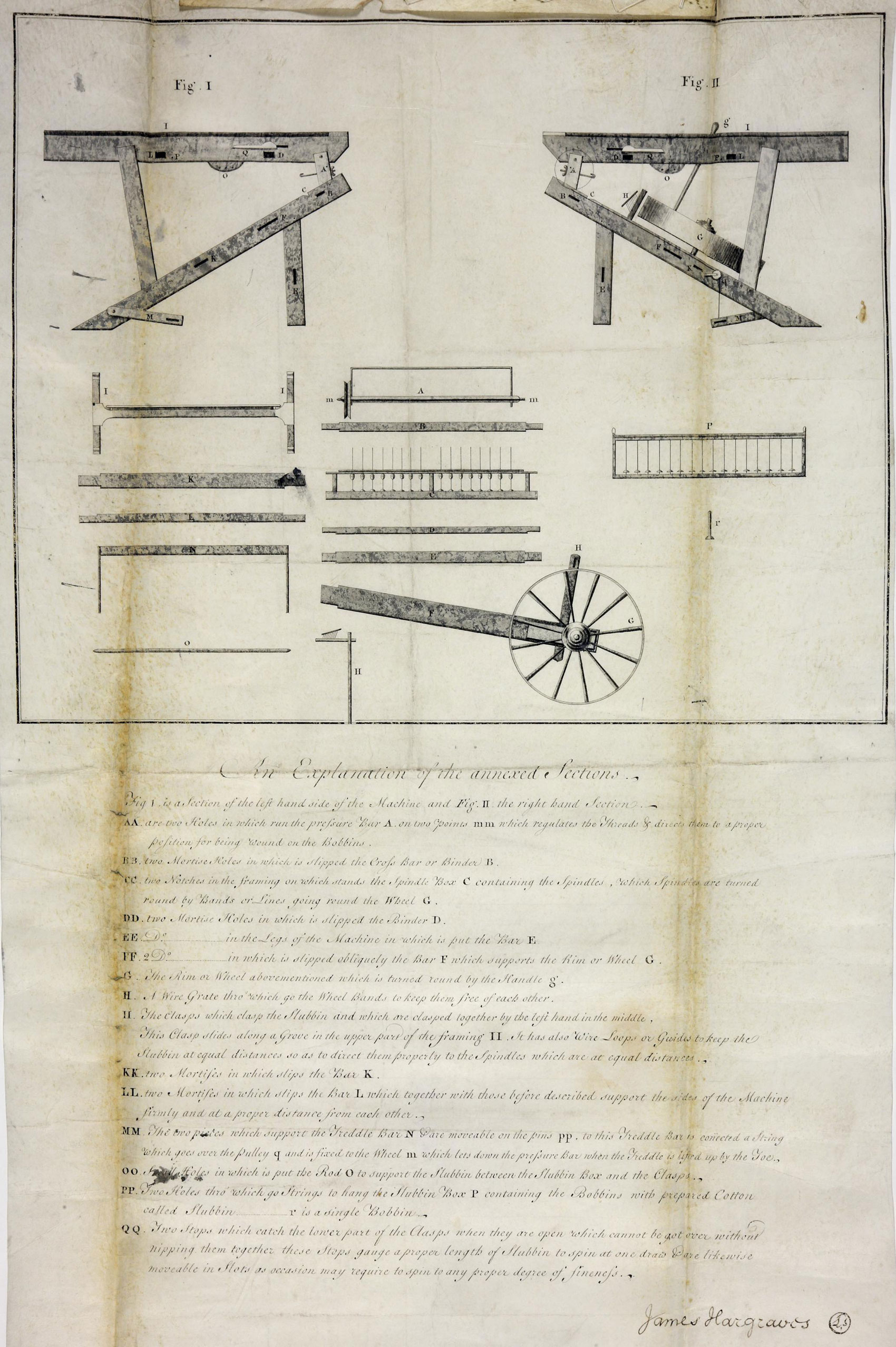
Specification for James Hargreaves’ Spinning Jenny, 1764 (C210/11)
This was a multi-spindle spinning machine. It meant that a spinner could produce more yarn at a time of increased demand from weavers involved in the manufacture of cloth.
Transcript
An Explanation of the Annexed Sections
Fig. I. is a section of the left hand side of the Machine and Fig. II is the right hand Section.
- A. are two Holes in which run the pressure Bar A. on two points mm which regulates the Threads & directs them to a proper position for being wound on Bobbins.
- B. two Mortise Holes in which is slipped the Cross Bar or Binder B
- two Notches in the framing on which stands the Spindle Box C containing the Spindles which spindles are turned round by Bands or Lines going round Wheel G
- two Mortise Holes in which is slipped the Binder D
- Ditto in the Legs of the Machine is put the Bar E
- Ditto in which is slipped obliquely the Bar F which supports the Rim or Wheel G
- The Rim or Wheel above mentioned which is turned round by the handle g
- A wire Grate through which go the Wheel Bands to keep them free of each other
- The clasps which clasp the slubbin [short fibres to be spun into thread] and which are clasped together by the left hand in the middle. This clasp slides along a Groove in the upper part of the framing II. It has also Wire Loops or Guides to keep the Slubbin at equal distances so as to direct them properly to the Spindles which are at equal distances.
- K. two Mortises in which slips the Bar K
- L. two Mortises in which slips the Bar L which together with those before
described support the sides of the Machine firmly and at a proper distance
from each other.
- M. The two pieces which support the Treddle Bar N are moveable on the
pins pp, to this Treddle Bar is connected a String which goes over the
pulley q and is fixed to the Wheel m which lets down the pressure Bar
when the Treddle is lifted up by the Toe.
- O. [word unclear] Holes in which is put the Rod O to support the Slubbin
between The Slubbin Box and the Clasps.
- P. The two holes through which go strings to hang the slubbin Box P
containing the bobbins with prepared Cotton called Slubbin___r is a single
bobbin.
- Q. Two stops which catch the lower part of the Clasps when they are open
Cannot be got over without nipping them together, these stops gauge a
Proper length of slubbin to spin at one draw and are likewise
moveable in slots as occasion may require to spin any proper degree of
fineness.
James Hargraves
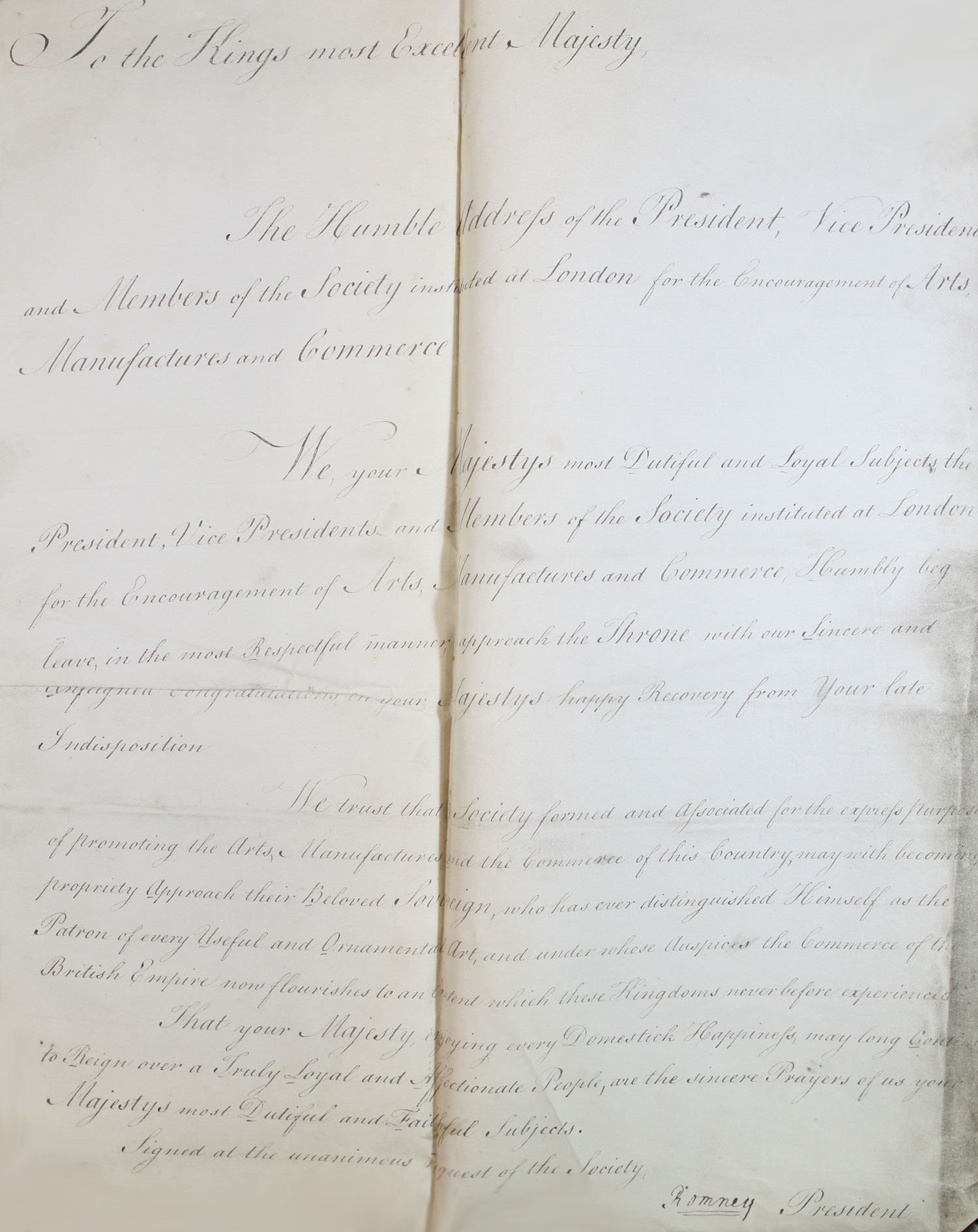
An address from the members of the Society for the Encouragement of Arts, Manufacturers and Commerce to the King from Lord Romney, President of the Society, 2 April 1789 (HO 55/18/22)
The Royal Society was founded by William Shipley in 1754. The letter notes George III’s recovery from illness; this was a reference to his a mental condition, possibly a symptom of the genetic disease porphyria.
Transcript
To the Kings most Excellent Majesty
The Humble Address of the President, Vice President and Members of the Society for the Encouragement of Arts, Manufacturers and Commerce
We your Majesty’s most Dutiful and Loyal Subjects, the President, Vice President and Members of the Society instituted at London for the Encouragement of Arts, Manufactures and Commerce Humbly beg leave in the most respectful manner approach the Throne with our Sincere and unfeigned congratulations on your Majesty’s happy Recovery from your late Indisposition.
We trust that Society formed and associated for the express purposes of promoting the Arts, Manufactures and Commerce of this country may with becoming propriety Approach the Beloved Sovereign, who has ever distinguished Himself as the Patron of every Useful and Ornamental Art, and under whose Auspices the Commerce of the British Empire now flourishes to an extent which these Kingdoms never before experienced.
That your Majesty enjoying every Domestick Happiness may long continue to Reign over a Truly Loyal and Affectionate People, are the Sincere Prayers of us your Majesty’s most Dutiful and Faithful Subjects.
Signed at the unanimous request of the Society,
Romney [Lord] President

A list of ships employed in the Trade to Africa from the Port of Bristol, 1749 (CO 388/45 pt.1 f.5)
Transcript
| On the Gold Coast | Number of Slaves | Value of Ships & Cargoes |
| 1. Tryton | 150 | 10,000 |
| 2. Antilope | 230 | 5,000 |
| 3. Juno | 250 | 5,700 |
| 4. Alexander | 450 | 8,500 |
| 5. Volunteer | 320 | 5,600 |
| 6. Molly | 230 | 5,200 |
| 7. Jamaica Packet | 360 | 7,000 |
| 8. Spy | 320 | 6,000 |
| 9. Swift | 280 | 5,200 |
| 10. Two Brothers | 300 | 5,700 |
| 11. Baltimore | 280 | 5,500 |
| 12. Polly | 400 | 7,500 |
| 13. Fly | 220 | 4,600 |
| 14. Jason | 360 | 6,600 |
| 15. Sylvia | 250 | 5,400 |
| 16. Sybella | 180 | 3,400 |
| 17. Cornwall | 300 | 6,200 |
| 5180 | 103,100 |
For the Bight of Benin, Bonny & Calabar
[A bight is a curve in the coastline which forms an open bay. To the east of the Bight of Benin is the Bight of Bonny (formerly Bight of Biafra). The bight is part of the Gulf of Guinea. Calabar was a major port in the transportation of African slaves. 85% of slave ships that transported slaves from Calabar came from Bristol and Liverpool merchants.]
| 18. Planter | 470 | 6,200 |
| 19. Indian Prince | 350 | 4,900 |
| 20. Success | 320 | 4,400 |
| 21. John & Martha | 430 | 5,700 |
| 22. King David | 350 | 5,000 |
| 23. Matilda | 320 | 4,400 |
| 24. Greyhound | 450 | 6,000 |
| 25. Charming Betty | 400 | 5,400 |
| 26. Africa | 320 | 4,300 |
| Continued over | 3,410 | 46,300 |