
Statement at the trial of Bruno Tesch, owner of the company which produced and distributed Zyklon B gas to the camps (catalogue reference WO 309/625)
Transcript
STATEMENT
By
Dr. Bruno TESCH
Dr. Bruno TESCH, having been duly sworn, states:–
My name is Dr. Bruno TESCH, born on 14th August 1890, in Berlin, and living at HAMBURG-BLANKENESE, Wittspark 14.
In 1924 I founded, together with Mr. STABENOW, the firm of TESCH & STABENOW, which, since 1927, has been under the direction of the Deutsche Gasellschaft für Schaedlingsbekaempfung. Our firm had the sole right to supply Cyan-Gas in the form of Zyklon B to the country east of the ELBE. On the foundation of the firm I held thirty-three and a third percent of the shares; in 1927, some time before the alleged suicide of my colleague, STABENOW, I acquired another eleven and two-thirds percent, so that my share was forty-five percent. In 1942 I acquired the remaining fifty-five percent and was therefore sole proprietor of the firm.
In 1933 I joined the NSDAP and in the same year became a supporting member of the SS.
Since 1927 Mr WEINBACHER was the Prokurist of the firm. All incoming orders went through his hands, and in my absence, approximately two hundred days a year, he took over the managament [sic] of the firm. Dr. Joachimhans DROSIHN was the biological adviser of the firm. He, too, was travelling most of the time. Mr. ZAUN was the head book-keeper. Mr. SEHM was a book-keeper. He had no reason to wish me ill; on the contrary he should be thankful as I once helped him in a situation.
I kept no ‘black book’ in which I recorded the misdeeds of my employees. Neither did I keep a sealed envelope about Dr. DROSIHN.
I wrote very exact travel reports about my journeys, which on my return I divided evenly over my secretaries for typing. My private secretary was Miss RATOKE; but also Mrs. UENZELMANN and Miss BIAGINI and the others wrote my reports.
I was never told in BERLIN at a conference, or by any other source, that Zyklon B gas should be used against human beings. I mentioned this fact in none of my travel reports and I have never spread no[r] heard such a rumour in my office.
Except Zyklon gas, my firm also supplied circulation plant for gas chambers of 10 cbm size. Chambers of the capacity of more than 50 cbm are not known to me, and therefore I did not know that the SS was our best customer. I also know nothing of the huge deliveries which we made to AUSCHWITZ in the years 1942-43. Since 1943 all orders of state customers went through the Haupt-sanitaetspark, BERLIN. Our firm never supplied the Wirtschafts-Verwaltungs Hauptaert (WVHA) either directly or indirectly. My accounts books were checked by Dr. PLINKER and I only know the yearly and monthly general balance.
SUMMARY PRODUCTION No. 10
Of sales of ZYKLON B to Concentration Camps during 1942 and 1943, extracted from Exhibits HG and HH.
| KZ Camp | 1942 | 1943 | ||||
| DATE | Kg | RM | DATE | Kg | RM | |
| AUSCHWITZ | 6 Feb | 480.0 | 3,038.0 | 13 Jan | 1,004.4 | 6026.0 |
| 9 Mar | 516.0 | 3,266.0 | 19 Jan | 1,026.0 | 6156.0 | |
| 3 Jun | 50 | 317.0 | 29 Jan | 999.0 | 5,994.0 | |
| 3 Aug | 495.0 | 3,133.0 | 24 Mar | 999.0 | 5,994.0 | |
| 6 Aug | 1,756.8 | 11,120.0 | 10 Mar | 999.0 | 5,994.0 | |
| 31 Aug | 1,008.0 | 6,381.0 | 22 Mar | 999.0 | 5,994.0 | |
| 8 Sep | 504.0 | 3,190.0 | 29 Mar | 1,018.0 | 6,108.0 | |
| 8 Oct | 489.6 | 3,099.0 | 31 Jul | 216.0 | 1,231.0 | |
| 8 Oct | 489.6 | 3,099.0 | 30 Apr | 1,018.0 | 6,108.0 | |
| 28 Oct | 1,497.6 | 9,480.0 | 17 Aug | 810.0 | 4,617.0 | |
| 9 Dec | 192.0 | 1,152.0 | 30 Aug | 972.0 | 5,540.0 | |
| 7,478.6 | 44,575.0 | 14 Sep | 999.0 | 5,694.0 | ||
| 30 Nov | 999.0 | 5,694.0 | ||||
| 31 Dec | 116.5 | 699.0 | ||||
| 12,174.9 | 71,849.0 | |||||
| SACHSEN-HAUSEN | 10 Feb | 72.0 | 456.0 | 22 Jan | 192.0 | 1,152.0 |
| 25 Mar | 96.0 | 608.0 | 5 Feb | 192.0 | 1,152.0 | |
| 24 Apr | 96.0 | 608.0 | 26 Feb | 288.0 | 1,728.0 | |
| 15 Jun | 96.0 | 608.0 | 8 Mar | 288.0 | 1,728.0 | |
| 18 Jul | 96.0 | 608.0 | 17 Feb | 192.0 | 1,152.0 | |
| 13 Aug | 96.0 | 608.0 | 18 Mar | 288.0 | 1,728.0 | |
| 31 Aug | 96.0 | 608.0 | 6 Apr | 288.0 | 1,728.0 | |
| 28 Sep | 96.0 | 608.0 | 6 Jul | 288.0 | 1,641.0 | |
| 28 Oct | 96.0 | 608.0 | 31 Aug | 288.0 | 1,641.0 | |
| 6 Nov | 96.0 | 576.0 | 28 Sep | 288.0 | 1,641.0 | |
| 26 Nov | 192.0 | 1,152.0 | 17 Dec | 288.0 | 1,641.0 | |
| 15 Dec | 192.0 | 1,152.0 | 31 Dec | 33.6 | 201.0 | |
| 23 May | 118.0 | 683.0 | 2913.6 | 17,133.0 | ||
| 1,438.0 | 8,883.0 | |||||
| NEUEN- GAMME | 3 Mar | 24.0 | 152.0 | 21 Jan | 60.0 | 360.0 |
| 9 Jun | 12.0 | 76.0 | 29 Jan | 60.0 | 360.0 | |
| 14 Aug | 12.0 | 76.0 | 17 Feb | 60.0 | 360.0 | |
| 9 Sep | 36.0 | 228.0 | 10 Mar | 60.0 | 360.0 | |
| 9 Nov | 36.0 | 216.0 | 10 Jun | 60.0 | 342.0 | |
| 18 Dec | 60.0 | 360.0 | 30 Aug | 60.0 | 342.0 | |
| 180.0 | 1,108.0 | 19 Oct | 60.0 | 342.0 | ||
| 31 Dec | 7.0 | 42.0 | ||||
| 427.0 | 2,508.0 | |||||
| GROSS-ROSEN | NIL | 8 Jan | 60.0 | 360.0 | ||
| 27 Feb | 120.0 | 720.0 | ||||
| 8 Jun | 124.5 | 710.0 | ||||
| 17 Sep | 125.0 | 713.0 | ||||
| 429.5 | 2503.0 | |||||
| LUBLIN | nil | 19 Jul | 513.0 | 2,924.0 | ||
| 14 Sep | 999.0 | 5,694.0 | ||||
| 31 Dec | 115.5 | 693.0 | ||||
| 1,627.5 | 9,311.0 | |||||
- Signed A. ZAUN.
PRODUCTION No. 10
| KZ Camp | 1942 | 1943 | ||||
| DATE | Kg | RM | DATE | Kg | RM | |
| RAVENSBRUCK | NIL | 19 Apr | 114.0 | 684.0 | ||
| 10 Jun | 114.0 | 650.0 | ||||
| 15 Sep | 90.0 | 313.0 | ||||
| 19 Oct | 30.0 | 171.0 | ||||
| 31 Dec | 3.5 | 21.0 | ||||
| 351.5 | 2039.0 | |||||
(Signed) Alfred ZAUN
Hamburg, the 26th of October 1945
Sworn before me Capt. R.A. Nightingale Int. Corps of No. 2 War Crimes Investigation Team this twenty-eighth day of October 1945.
(Signed) R.A. Nightingale
Capt

Illustration of mistreatment at a concentration camp by Violet le Coq, a prisoner of war (catalogue reference: RW 2/2)

Women guards on trial at Lüneburg for their crimes at the Auschwitz and Bergen-Belsen camps (catalogue reference: WO 235/19)

Summary of interview with Dr Bendel, a doctor in the crematoria of Birkenau camp (catalogue reference: WO 309/625)
Transcript
Summary of examination of:
PRODUCTION No. 24
Charles Sigismund BENDEL Occupation: Doctor
Address: 2 Rue Meilhao, PARIS.
Duly sworn, states:–
I am 30 years of age, of Roumanian nationality, born at PIATRA.
My permanent home address is as above and I am at present living there.
I first came to AUSSCHWITZ on 10th. December 1943 and remained until 18th. January 1945. At Camp TZIGANE I was employed as a doctor. That lasted 3 months. From June 1944 until the evacuation I was at the crematorium in BIRKENAW.
The crematorium for AUSCHWITZ is actually at BIRKENAW and there my job was to look after medically the 900 men who worked at the crematorium. These 900 men were not allowed any contact with other prisoners.
There were two gas chambers, underground, roughly 10 metres long, 5 metres wide and 1 1/2 metres high, each one. These two gas chambers supplied corpses to crematorium 1 and 2.
For crematoriums 3 and 4 there were two other gas chambers measuring each one 6 metres long and 3 metres wide and 1 1/2 metres high.
In the case of the gas chambers for crematoriums 1 and 2 the gas was poured in through the roof. In the case of the gas for crematoriums 3 and 4 the gas was put in through small windows in the wall.
I do not know who constructed the gas chambers, but I know they were built in 1942. They were made of reinforced concrete and were very strong. The hermetic doors were very strongly made of wood.
I want to say now that I was at BIRKENAW from 27th. February 1944 until 18th January 1945.
At BIRKENAW the disinfecting of clothes was done by boiling them; there was no disinfestation by gas. I know that disinfecting of clothes at AUSCHWITZ itself was done by use of a gas chambers which was also used for killing people.
At BIRKENAW the gas used for killing people was prussic acid, also called ZYKLON B.
The quantities of gas ZYKLON B used were as follows. For the two large gas chambers attached to crematoriums 1 and 2 it required two tins for each chamber. For the smaller gas chambers attached to crematoriums 3 and 4 it required one tin for each chamber. The tins were cylindrical with a diameter of 20-30 centimetres and about 50 centimetres tall. To kill a chamber full of people required 3-5 minutes.
The gas used to be delivered to the crematoriums by an ambulance of the Red Cross. It used to arrive about 5 minutes after a transport of prisoners had arrived for extermination at the crematorium. I do not know where it was stored.
In the two large gas chambers it was usual to put in each one 1,000 people, and the two small ones 500 people each.
The tins of gas were always brought to BIRKENAW from AUSCHWITZ.
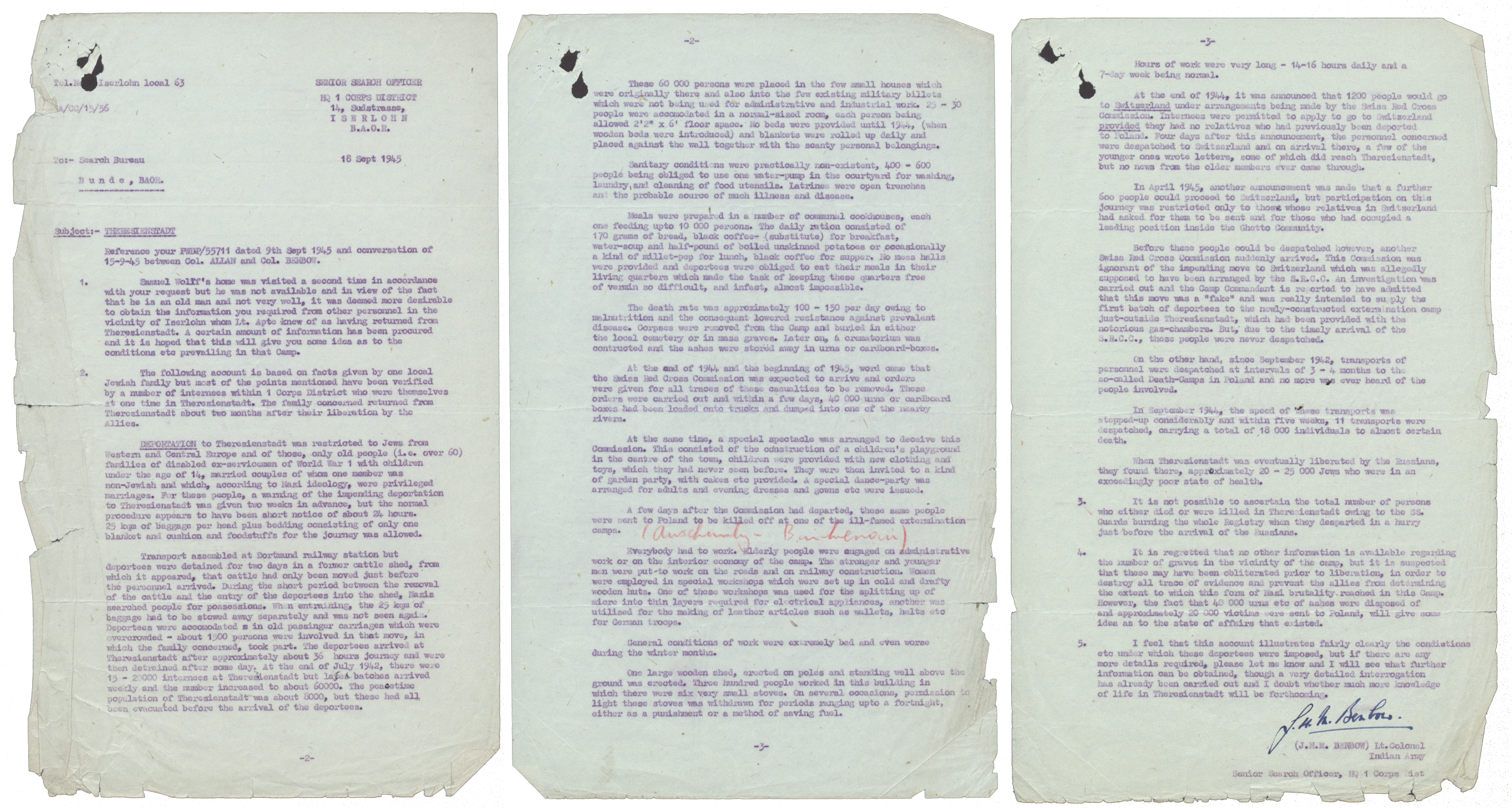
Report on eyewitness accounts of Theresienstadt (catalogue reference: WO 309/377)
Transcript
Senior Search Officer
HQ 1 Corps District
14, Sudstrasse,
Iserlohn
B.A.O.R.
To: – Search Bureau
Bunde, BAOR. 18 Sept 1945
——————–
Subject: – Theresienstadt
Reference your PWDP/55711 dated 9th Sept 1945 and conversation of 15-9-45 between Col. ALLAN and Col. BENBOW.
1. Samuel Wolff’s home was visited a second time in accordance with your request but he was not available and in view of the fact that he is an old man and not very well, it was deemed more desirable to obtain the information you required from other personnel in the vicinity of Iserlohn whom Lt. Apte knew of as having returned from Theresienstadt. A certain amount of information has been procured and it is hoped that this will give you some idea as to the conditions etc prevailing in that Camp.
2. The following account is based on facts given by one local Jewish family but most of the points mentioned have been verified by a number of internees within 1 Corps District who were themselves at one time in Theresienstadt. The family concerned returned from Theresienstadt about two months after their liberation by the Allies.
DEPORTATION to Theresienstadt was restricted to Jews from Western and Central Europe and of those, only old people (i.e. over 60) families of disabled ex-serviceman of World War 1 with children under the age of 14, married couples of whom one member was non-Jewish and which, according to Nazi ideology, were privileged marriages. For these people, a warning of the impending deportation to Theresienstadt was given two weeks in advance, but the normal procedure appears to have been short notice of about 24 hours. 25kqm of baggage per head plus bedding consisting of only one blanket and cushion and foodstuffs for the journey was allowed.
Transport assembled at Dortmund railway station but deportees were detained for two days in a former cattle shed, from which it appeared, that cattle had only been moved just before the personnel arrived. During the short period between the removal of the cattle and the entry of the deportees into the shed, Nazis searched people for possessions. When entraining, the 25 kqm of baggage had to be stowed away separately and was not seen again. Deportees were accommodated in old passinger [sic] carriages which were overcrowded – about 1500 persons were involved in that move, in which the family concerned, took part. The deportees arrived at Theresienstadt after approximately about 36 hours journey and were then detrained after some day. At the end of July 1942, there were 15-20000 internees at Theresienstadt but later batches arrived weekly and the number increased to about 60000. The peacetime population of Theresienstadt was about 8000, but these had all been evacuated before the arrival of the deportees.
2
These 60000 persons were placed in the few small houses which were originally there and also into the five existing military billets which were not being used for administrative and industrial work. 25-30 people were accommodated in a normal-sized room, each person being allowed 2’2” x 6’ floor space. No beds were provided until 1944, (when wooden beds were introduced) and blankets were rolled up daily and placed against the wall together with the scanty personal belongings.
Sanitary conditions were practically non-existent, 400-600 people being obliged to use one water-pump in the courtyard for washing, laundry and cleaning of food utensils. Latrines were open trenches and the probable cause of much illness and disease.
Meals were prepared in a number of communal cookhouses, each one feeding upto 10000 persons. The daily ration consisted of 170 grams of bread, black coffee- (substitute) for breakfast, water-soup and half-pound of boiled unskinned potatoes or occasionally a kind of millet-pep for lunch, black coffee for supper. No mess halls were provided and deportees were obliged to eat their meals in their living quarters which made the task of keeping these quarters free of vermin so difficult, and infact [sic], almost impossible.
The death rate was approximately 100-150 per day owing to malnutrition and the consequent lowered resistance against prevalent disease. Corpses were removed from the Camp and buried in either the local cemetary or in mass graves. Later on, a crematorium was constructed and the ashes were stored away in urns or cardboard-boxes.
At the end of 1944 and the beginning of 1945, word came that the Swiss Red Cross Commission was expected to arrive and orders were given for all traces of these casualties to be removed. These orders were carried out and within a few days, 40000 urns or cardboard boxes had been loaded onto trucks and dumped into one of the nearby rivers.
At the same time, a special spectacle was arranged to deceive this Commission. This consisted of the construction of a children’s playground in the centre of the town, children were provided with new clothing and toys, which they had never seen before. They were then invited to a kind of garden party, with cakes etc provided. A special dance-party was arranged for adults and evening dresses and gowns etc were issued.
A few days after the Commission had departed, these same people were sent to Poland to be killed off at one of the ill-famed extermination camps.
Everybody had to work. Elderly people were engaged on administrative work or on the interior economy of the camp. The stronger and younger men were put-to work on the roads and on railway construction. Women were employed in special workshops which were set up in cold and drafty wooden huts. One of these workshops was used for the splitting up of micre into thin layers required for electrical appliances, another was utilised for the making of leather articles such as wallets, belts etc for German troops.
General conditions of work were extremely bad and even worse during the winter months.
One large wooden shed, erected on poles and standing well above the ground was erected. Three hundred people worked in this building in which there were six very small stoves. On several occasions, permission to light these stoves was withdrawn for periods ranging upto a fortnight, either as a punishment of a method of saving fuel.
3
Hours of work were very long – 14-16 hours daily and a 7-day week being normal.
At the end of 1944, it was announced that 1200 people would go to Switzerland under arrangements being made by the Swiss Red Cross Commission. Internees were permitted to apply to go to Switzerland provided they had no relatives who had previously been deported to Poland. Four days after this announcement, the personnel concerned were despatched to Switzerland and on arrival there, a few of the younger ones wrote letters, some of which did reach Theresienstadt, but no news from the older members ever came through.
In April 1945, another announcement was made that a further 600 people could proceed to Switzerland, but participation on this journey was restricted only to those whose relatives in Switzerland had asked for them to be sent and for those who had occupied a leading position inside the Ghetto Community.
Before these people could be despatched however, another Swiss Red Cross Commission suddenly arrived. This Commission was ignorant of the impending move to Switzerland which was allegedly supposed to have been arranged by the S.R.C.C. An investigation was carried out and the Camp Commandant is reported to have admitted that this move was a ‘fake’ and was really intended to supply the first batch of deportees to the newly-constructed extermination camp just-outside Theresienstadt, which had been provided with the notorious gas-chambers. But, due to the timely arrival of the S.R.C.C., these people were never despatched.
On the other hand, since September 1942, transports of personnel were despatched at intervals of 3-4 months to the so-called Death-Camps in Poland and no more was ever heard of the people involved.
In September 1944, the speed of these transports was stepped-up considerably and within five weeks, 11 transports were despatched, carrying a total of 18000 individuals to almost certain death.
When Theresienstadt was eventually liberated by the Russians, they found there, approximately 20-25000 Jews who were in an exceedingly poor state of health.
3. It is not possible to ascertain the total number of the persons who either died or were killed in Theresienstadt owing to the SS. Guards burning the whole Registry when they desparted [sic] in a hurry just before the arrival of the Russians.
4. It is regretted that no other information is available regarding the number of graves in the vicinity of the camp, but it is suspected that these may have been obliterated prior to liberation, in order to destroy all trace of evidence and prevent the allies from determining the extent to which this form of Nazi brutality reached in this Camp. However, the fact that 40000 urns etc of ashes were disposed of and approximately 20000 victims were sent to Poland, will give some idea as to the state of affairs that existed.
5. I feel that this account illustrates fairly clearly the conditions etc under which these deportees were imposed, but if there are any more details required, please let me know and I will see what further information can be obtained, though a very detailed interrogation has already been carried out and I doubt whether much more knowledge of life in Theresienstadt will be forthcoming.
(J.H.M. Benbow) Lt. Colonel
Indian Army
Senior Search Officer, HQ 1 Corps Dist

Telegram describing the deteriorating situation in transit camps (catalogue reference: FO 916/847)
Transcript
[CYPHER] Departmental No.1.
From Berne to Foreign Office
Mr Norton
No. 3767 D.8.00p.m. 11th August, 1944.
11th August, 1944 R.2.00a.m. 12th August, 1944
() () () ()
My telegram 3229.
The Swiss Government inform me orally that Bergen-Belsen is the Transit Camp to which all jews eligible for repatriation are temporarily sent.
The Jewish camp at Westerbork in Holland is in process of being dissolved. The usual number of inmates fluctuates between 40,000 and 50,000. The present number is approximately 2,000. The Jews are evacuated from Westerbork in three directions; those eligible for repatriation fall to Bergen-Belsen; technicians and persons likely to be of use to the German war effort are sent to Theresienstadt in Czechoslovakia those who are considered useless are sent to Ausschwitz for elimination.
O.T.P.

Telegram from the British Foreign Office to Moscow requesting a public declaration against increased German violence (catalogue reference: FO 371/42809)
Transcript
[This telegram is of particular secrecy and should be retained by the authorised recipient and not passed on]
[CYPHER] WAR CABINET DISTRIBUTION
FROM FOREIGN OFFICE TO MOSCOW.
No.2107 D.4.55a.m. 14th July 1944.
13th July 1944.
Repeated to Washington No.6325.
QQQQQQ
My immediately preceding telegram
[Begins]
You will remember that on the 17th December 1942, a declaration was issued in the names of the Governments of the Soviet Union, the United States and the United Kingdom, and of the other Allies, calling attention to the bestial measures of extermination which the German authorities were applying to the Jewish population in the areas occupied by them, and solemnly affirming that those responsible for these crimes should not escape retribution.
2. In spite of an unbroken series of military reverses during the past two years and the certainty of final defeat the Germans are in no way desisting from their barbarous treatment of the Jews. Indeed the contrary would appear to be the case. All our information goes to show that since the Germans occupied Hungary measures of gassing and burning have been applied with ever increasing ferocity by the Germans and that the present Hungarian Government are collaborating as willing accomplices in these outrages. As a result appeals are frequently made to His Majesty’s Government to issue some further declaration condemning these crimes. It has occurred to me that, given the victorious advance of the Soviet Armies and retribution for these crimes would enter Hungary together, might have the effect of at least reducing the scale of these horrible outrages against the Jewish population.
O.T.P.

Churchill’s letter to Lord Melchett on the topic of the reported massacre of Hungarian Jews (catalogue reference: FO 371/42809)
Transcript
COPY 10 Downing Street, Whitehall, S.W.1.
PRIVATE 13 July, 1944
My dear Henry,
You wrote to me on 1 July about the German plans for the massacre of the Hungarian Jews.
I have forwarded your letter to the Foreign Secretary and fear that I can add nothing to the statement he made in the House on 5 July in replying to Silverman’s Question.
There is no doubt in my mind that we are in the presence of one of the greatest and most horrible crimes ever committed. It has been done by scientific machinery by nominally civilized men in the name of a great state and one of the leading races of Europe. I need not assure you that the situation has received and will receive the most earnest consideration from my colleagues and myself but, as the Foreign Secretary said, the principal hope of terminating it must remain the speedy victory of the Allied Nations.
Yours sincerely,
(sd) WINSTON S. CHURCHILL
The Lord Melchett.

Lichtheim Telegram, 1 July 1944, describing ‘deportation’ and disappearance of Jews sent to concentration camps (catalogue reference: FO 916/847)
Transcript
Copy of Telegram from Lichtheim, Geneve, 1.7.44.
To Linton 2.7.44.
Received your message stop number of Jews transferred from Westerbork to Bergen and Theresienstadt is not known stop full list names both camps and other particulars especially names certificate holders not obtainable stop redcross or neutral envoys cannot visit these camps stop have many names tehresienstadt where number inmates during last two years about fortythousand while deportations were constantly going on probably to make room for newcomers stop only certain privileged categories can write stop Bergen mainly used for certificate holders from Holland eligible for exchange stop candidates for exchange fifth July apparently all from Bergen stop number Jews bearers foreign passports Vittel was between fourhundred and fivehundred stop of these twohundred eightythree been transferred from Poland received certificates stop of this group hundredsixtythree are said to have been deported two months ago to unknown destination while hundred twenty remained owing illhealth but unknown what then happened stop American efforts to save or ascertain fate this group have failed stop Drancy now only transitcamp for deportees stop deportations starting whenever number inmates reaches thousand to fifteenhundred.
Lichtheim
Clarified Transcript
Received your message. The number of Jews transferred from Westerbork to Bergen and Theresienstadt is not known. The full list names both camps and other particulars especially names certificate holders not obtainable. Red Cross or neutral envoys cannot visit these camps. They have many names Theresienstadt where the number of inmates during last two years was about 40,000 while deportations were constantly going on probably to make room for newcomers. Only certain privileged categories can write. Bergen is mainly used for certificate holders from Holland eligible for exchange. Candidates for exchange on the fifth July are apparently all from Bergen. The number of Jews, bearers of foreign passports [in/to] Vittel, was between 400 and 500. Of these 283 who had been transferred from Poland received certificates. Of this group 163 are said to have been deported two months ago to unknown destination while 120 remained owing to ill health but it is unknown what then happened to them. American efforts to save or ascertain the fate of this group have failed. Drancy is now only a transitcamp for deportees. The deportations starting whenever the number of inmates reaches 1,000 to 1,500.
Lichtheim

Description of the persecution of Jews in Holland (catalogue reference: FO 371/42806)
Transcript
Information about Dutch Jewry
(May 1944)
There were 140.000 Jews in Holland at the beginning of the war (incl. 26.000 non dutch Jews)
Deported to Poland (including all orphanages, old-age homes, hospitals, lunatic-asylum Apeldoorn, and all Jews from Vught-camp excepting a few hundred working in Vught for Philips) 110.000
Bergen-Belsen 4.000
Westerbork 2.500
Theresienstadt 2.000
In hiding (estimated) 15.000
Married to Christians etc, deceased (all estimated) 6.000
(The number of Jews who are free in Amsterdam – there are none in the provinces – is negligible)
The ‘star’ of which I enclose one, had to be worn as from May 1942; the deportations started July 15th 1942 Up to December 31st 1942 40.000 Jews had been deported.
Wieringen on March 20th 1941 210 pupils (boys and girls with the Jewish manager) were brought to Amsterdam about 60 pupils and 20 people from the staff were allowed to remain in order to finish the harvesting of that years crops; they were allowed to remain until August 1st 1941 when the Werkdorp was finally liquidated.
About 60 of the pupils were sent to Mauthausen;
“ 100 were deported to Poland
“ 50 are still in Westerbork and Bergen-Belsen
“ 60 are in hiding.
The dutch authorities paid an indemnity for the property they took over; (although it were the Germans who ordered the liquidation; this money was used to keep two ‘Homes’ in Amsterdam for the remaining pupils until they too were finally dispersed in the great razzias on May 26th and June 20th 1943. The equipment of the carpentershop and the smithy and metalshop was used in trainingschools in Amsterdam and finally brought to Westerbork.
The following data were given to me in Vienna on my way through to Constantinople by the assistant of Dr Löwenherz who could not come personally;
Data July let 1944: Vienna Free Jews … 180
In hiding ………………………………………….. 2000
Versippte (Intermarriage etc) ………… 6- 8000
Sent to Theresienstadt 15000 (of whom 3800 still there)
Sent to Poland…………………………………… 48000
The rest (there were 210.000) emigrated or died.
9000 Hungarian Jews had come through Vienna on their way to Poland; 41000 were still expected. (We saw two transports of 1000 each, one in Vienna and one on the way to Hungary) 310000 jews in Budapest had not yet been interfered with.
Haifa, August 12th 1944