Friendship in adversity
Elizabeth and Robert seem to have been friends from around the age of eight in the early 1540s. He was the son of a royal courtier, John Dudley, and probably began his career serving in the household of Elizabeth's half-brother Prince Edward, later Edward VI. A court connection seems the likeliest way that Elizabeth and Robert spent enough time together to forge a lifelong bond.
In June 1550 their association survived Robert's marriage, aged 18, to Amy Robsart, daughter of a Norfolk knight. The marriage seems to have been a romantic attachment, suggesting Robert's emotional character as he began to build his career.
His connection to Elizabeth probably deepened during the succession crisis of July 1553 when his father, John Dudley, then Duke of Northumberland, failed in his attempt to put his daughter-in-law Lady Jane Grey (Jane Dudley) on the throne in place of Elizabeth's half-sister, Mary. Robert and his brothers were imprisoned in the Tower of London for over a year, with Elizabeth also spending two months there in spring 1554. This might have been crucial in cementing their connection.

Transcript
Therefor ons again kneling with humblenes of my hart, bicause I am not suffer’d to bow the knees of my body I humbly crave to speke with your higthnis wiche I wolde not be so bold to desire if I knewe not my selfe most clere as I knowe my selfe most tru, and as for the traitor Wiat he migth paraventur writ me a lettar but on my faithe I never receved any from him and as for the copie of my lettar sent to the frenche kinge I pray God confound me eternally if ever I sent him word, message, token or lettar by any menes, and to this my truth I wil stande in to my dethe.
I humbly crave but only one worde of answer from your selfe.
Your hignes most faithful subject that hathe bine from the beginninge, and wylbe to my ende.
Elizabeth
Modern English
Therefore once again kneeling with humbleness of my heart because I am not suffered to bow the knees of my body, I humbly crave to speak with your highness, which I would not be so bold to desire if I knew not my self most clear as I know myself most true, and as for the traitor Wyatt, he might peradventure write me a letter but on my faith, I never received any from him, and as for the copy of my letter sent to the French king, I pray God confound me eternally if ever I sent him word, message, token, or letter by any means, and to this my truth I will stand in to my death.
I humbly crave but only one word of answer from your self.
Your highness’ most faithful subject that has been from the beginning and will be to my end.
Elizabeth
The Tide Letter, Elizabeth’s plea to her half-sister Queen Mary that she was innocent of plotting against her. The diagonal lines prevented other incriminating text from being added. Catalogue reference: SP 11/4/2, fol 3v
The Queen’s favourite
We can't know how much contact they had, but Robert gained favour quickly when Elizabeth was crowned in November 1558. He became Master of the Queen's Horses and was gifted Kew House near Richmond Palace in Surrey. His wife Amy seems to have stayed at Cumnor House in Oxfordshire, as Elizabeth used her royal authority to insist that Robert became her constant companion at court.
Robert tried to forge his own way, and was an MP by 1559, but his personal connection to the Queen brought him little political weight. In fact, his reputation suffered deeply from the death of his wife on 8 September 1560.
Amy Dudley was found with a broken neck and two small head wounds at the bottom of the staircase at the house of Anthony Forster, esq, a neighbour at Cumnor. The coroner recorded that ‘Lady Amy…by misfortune came to her death and not otherwise’, yet suicide had probably also been considered.
Robert’s enemies suggested that he, and by the strength of their intimacy, the Queen, had arranged the accident. The unclear verdict also highlighted Robert’s apparent neglect of Amy, who had never been part of his courtly life.

Inquisition as an indenture held at Cumnor in the aforesaid county [of Oxfordshire] on 9 September in the second year of the reign of the most dread Lady Elizabeth, by the grace of God, queen of England, France, and Ireland, defender of the faith, etc, before John Pudsey, gentleman, coroner of the said Lady queen in the as aforesaid county. On inspection of the body of Lady Amy Dudley, late wife of Robert Dudley, knight of the most noble Order of the Garter, [...] on 8 September in the aforesaid second year of the reign, being alone in a certain chamber within the home of a certain Anthony Forster, esq, in the aforesaid Cumnor, and intending to descend the aforesaid chamber by way of certain steps called ‘Steyres’ in English, there and then accidentally fell precipitously [...] and then sustained two injuries to her head (called ‘dyntes’ in English), one of which was a quarter of an inch deep and the other two inches deep – but truly also by reason of the accidental injury or of that fall and of Lady Amy’s own bodyweight falling down the aforesaid stairs [...] then broke her neck, on account of which certain fracture of the neck the same Lady Amy there and then died instantly. And the aforesaid Lady Amy was found there and then without any other mark or wound on her body. And thus, the jurors say on their oath that the aforesaid Lady Amy in the manner and form aforesaid by misfortune came to her death and not otherwise, as they are able to agree at present. [...]
Oxfordshire coroner’s inquest into Amy Dudley’s death, 9 September 1560. Catalogue reference: KB 9/1073, no. 80
After his wife’s death, Elizabeth should have been free to marry Robert, but her choice was not straightforward. A monarch’s marriage was usually a high political decision, built on negotiations over international alliances or the control of factions at home, but Elizabeth clearly was minded to put love first.
Robert was a known quantity and an ally in promoting the Protestant religion. To his enemies, however, he could not escape the fact that his father and grandfather had both been beheaded as traitors, and his wife’s death further stained his character.
Elizabeth, as the nation’s figurehead, had to command respectful loyalty to maintain power. Marriage to Robert risked undermining that. He did, however, remain at court in the early 1560s as her favourite, but dependent, companion – a specific and unprecedented role. Nor did Elizabeth marry anyone else, despite protracted negotiations with the Archduke of Austria and French Duke of Anjou.
A husband in all but name
Robert's political power grew when he joined the Privy Council in 1562 and became Earl of Leicester in September 1564. Elizabeth’s narrow escape from death with smallpox in October 1562 might also have strengthened their relationship. Robert was her constant friend, with a role as her eyes and ears at court and elsewhere.
Elizabeth was reluctant to allow Robert to leave court for long periods on his new lands in the Midlands and North Wales. He tried to mitigate this by offering lavish entertainments for the Queen on her summer visits to his castle at Kenilworth.

View of the Elizabethan Gardens at Kenilworth Castle in 2022.
Robert's absences from Elizabeth were marked by many letters from both, and although few have survived, Dudley’s role resembled that of a husband in all but name – often apologising for being away.
We know the tone of their relationship from the contents of a bundle of his letters that Elizabeth kept by her bedside until her death. From 1570 onwards, his nickname of ‘eyes’, with the ‘óó’ symbol, appeared consistently. Elizabeth’s correspondence to Robert was almost all destroyed, perhaps because the letters revealed surprisingly intimate and passionate dimensions of the Virgin Queen that Elizabeth became.
Robert remained concerned about the issue of Elizabeth’s potential marriage and the succession of the Crown. The longer the Queen went without marrying and having children or putting a clear alternative plan in place, the greater the chances that the next ruler of England would come to power through violence. This was even more likely as Mary, Queen of Scots, a Catholic, remained the leading candidate through ancestry. Robert was therefore drawn into questions of international politics and religion, as Elizabeth proved inflexible over the terms of her marriage negotiations.
A secret marriage
Once it was clear that Robert could never marry Elizabeth, in around 1570, he began a relationship with Douglas Sheffield, the unusually named daughter of Lord Howard of Effingham. The illegitimate son she bore, also named Robert, and some of the heartfelt letters he wrote during this affair, indicated his deep desire to have heirs.
As that liaison ended, Robert risked the Queen's anger more directly by secretly marrying Lettice Knollys, the widow of the Earl of Essex (and a grand-niece of Anne Boleyn). Elizabeth was annoyed that Robert went to live with his wife and, perhaps vindictively, in November 1578, demanded early repayments on a £5,000 loan.

I am sure I shall get nothing by my going [to Holland] but hazard of life and spending my living. You shall see inside a letter I received from her majesty. I pray you keep it safe until I come, for she does take every occasion by my marriage to withdraw any good from me, but I have settled my only care above and [it] makes me care the less for worldly matters here.
Extract from a letter from Robert to Thomas Walsingham discussing his relationship with the Queen, 1 September 1585. Catalogue reference: SP 12/182, fol. 1
Robert did soon have an heir. His son, also named Robert Dudley, was born in June 1581. As Robert inevitably began to spend more time away from the Queen, however, he and his wife were subject to very hostile gossip from pro-Catholic writers.
Support and suspicion
In 1584 the first circulation of a pamphlet called Leicester’s Commonwealth appeared in London. It tried to destroy Robert's reputation with a range of allegations, including that he had:
- Successfully plotted to murder his first wife,
- Banished his second wife from court for attempting to outdress the Queen,
- Poisoned his relatives and rivals, and
- Unnaturally influenced the Queen.
Nevertheless, Elizabeth stood by Robert, supporting him in legal affairs and maintaining the flow of gifts. But things changed again when Robert's son tragically died aged only three, on 19 July 1584.
In response to his grief, that autumn Robert agreed to lead a major English military expedition to the Netherlands, in support of a rebellion against Spanish rule. Preparations in 1585 drew him apart from Elizabeth and emphasised the dangers he would face, both of which aroused the Queen’s anger and concern.

She used very pittyfull words to me of hir fear she shall not lyve & wold not have me from hir.
Robert’s account of the Queen’s feelings after staying with her all night on 27 September 1585. Catalogue reference: SP 12/182, no. 41
When separated from Robert, Elizabeth grew suspicious and jealous. She heard on 15 January 1586 that he had accepted the direct request of the States General of the Netherlands to become its governor-general. Elizabeth demanded that he resign immediately.
Although she soon recognised that he was trying to strengthen England’s position, the Queen's fierce public rebuke made it difficult for Robert to exercise real authority in his demanding roles overseas.

Rob. I am afraid you will suppose by my wandering writings that a midsummer moon hath taken large possession of my brains this month, but you must needs take things as they come in my head, though order be left behind me.... Now will I end, that do imagine I talk still with you, and therefore lothly say farewell, ô, ô [i.e. two eyes], though ever I pray God bless you from all harm and save you from all foes, with my million and legion of thanks for all your pains and cares. As you know ever the same E R.
Letter from Elizabeth to Robert as the extent of his efforts in the Netherlands became known, 19 July 1586. Catalogue reference: SP 84/9, fol 38
Loyal to the end
Robert’s work abroad contributed directly to English preparations to resist the Spanish Armada of 1588, and the invasion of England it intended to bring about. He organised Elizabeth’s visit to Essex in early August, where she made her famous inspiring speech to the troops at Tilbury. He seems to have worked to the point of exhaustion at the time.

Lastly for myself, I see most gracious lady, you know what will most comfort a faithful servant, for there is nothing in this world I take such joy in that I do in your good favour. And it is no small favour to send to your poor servant thus to visit him. I can give your majesty no recompense but such sacrifice which I owe to God, which is a thankful heart and next my soul to him to offer body, life, and all to do your majesty able service. And so will pray to that God not only for present victory over all your enemies, but longest life to see the end of all those that wish you evil. And make me so happy as to die in your service. From Gravesend ready to go to your poor but most willing soldiers, this Saturday the 27 of July.
Letter from Robert to Elizabeth from Gravesend on 27 July 1588, as he led final preparations to resist the Spanish attack. Catalogue reference: SP 12/213 fol 79
After a visit to court and a recuperative trip to his castle at Kenilworth, Robert was suddenly taken ill. An infection arising from malaria has been suggested. His final letters to Elizabeth seem to contain feelings of reflection on any offence he had caused in his efforts to balance an independent married life with his – almost captive – attachment to the Queen.
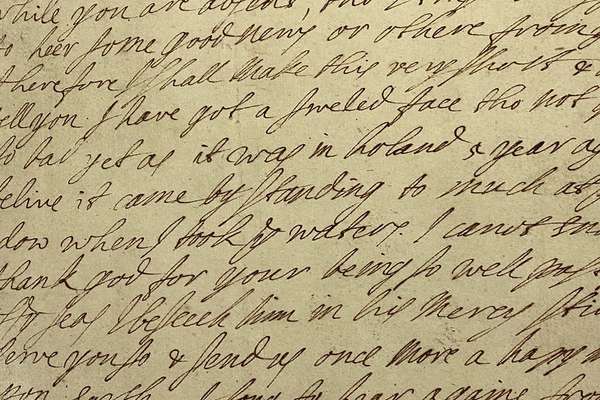
Robert died at Cornbury House on 4 September 1588 as he travelled to the spa at Buxton. This letter was found in a box by Elizabeth’s bedside upon her death – 14 years later – in 24 March 1603. Kept alongside others from Robert, this one has the words ‘his last letter’ written by Elizabeth herself upon the back.

I most humbly beseech your Majesty to pardon your póór
old servant to be thus bold in sending to know how my
gracious lady doth, and what ease of her late pain she
finds, being the chiefest thing in this world I do
pray for & for her to have good health and long life.
For my own poor case, I continue still your medicine
and find it amends much better than with any other
thing that hath been given me. Thus hoping to
find perfect cure at the bath, with the continuance
of my wonted prayer for your Majesty’s most happy
preservation, I humbly kiss your foot. From
your old lodging at Rycote, this Thursday morning
ready to take on my Journey,
By your Majesty’s most faithful and obedient servant
R. Leicester
Even as I had writ thus
much, I received Your Majesty’s token by
Young Tracey
Robert’s final letter to Elizabeth, written on 29 August 1588 from Rycote house near Thame in Oxfordshire – a place they both knew well – suggesting their familiarity and mutual affection. Catalogue reference: SP 12/215, fol. 114
Listen
Robert Dudley's final letter to Elizabeth I, read aloud by an actor
Audio transcript for "Robert Dudley's final letter to Elizabeth I, read aloud by an actor"
I most humbly beseech your Majesty to pardon your poor old servant to be thus bold in sending to know how my gracious lady doth, and what ease of her late pain she finds, being the chiefest thing in this world I do pray for, for her to have good health and long life. For my own poor case, I continue still your medicine and find that it amends much better than with any other thing that hath been given me. Thus hoping to find perfect cure at the bath, with the continuance of my wonted prayer for your Majesty’s most happy preservation, I humbly kiss your foot. From your old lodging at Rycote, this Thursday morning ready to take on my Journey, By your Majesty’s most faithful and obedient servant, R. Leicester.
He added a postscript:
Even as I had writ thus much, I received Your Majesty’s token by Young Tracey

Section of the back of Robert's letter, showing Elizabeth's note: 'his last letter'.
Eventually the pair’s letters were absorbed into the archive of the secretaries of state, the monarch’s chief advisors, and rearranged into date order. Though deeply personal, they survive now as records, a permanent reminder of the intimate link between the Queen and her favourite subject.