‘I love you more than my life'
The reign of Britain’s only joint monarchs – King William III and Queen Mary II (1689–1694) – was marked outwardly by religious controversy, war and disputed succession. But, as our records show, the personal life they shared in those troubled times was loving and deeply romantic.
‘I love you more than my life, and desire only to please you’, Mary wrote to William on 3 July 1690, shortly after he had left London for Ireland. He had gone there to wage war against Mary’s father, the deposed King James II.

Transcript
Whitehall Jully 13/3 1690
If you knew in what fear I am yt my letter I write yesterday
did not overtake ye post yow oud pity me for tho tis but one
days difference, yet I woud not for any thing seem to have
mist an opertunity of writeing to you & indeed as hapy
as I was a tuesday night I woud have write had Ld Not: [i.e. Lord Nottingham]
assured me ye message should follow next morning early & so
he was certaine it woud come time enough, but when ye
letter came in from Ld Torrington & wt was to be done being
thought nessessery to acquaint you with he stopt ye mess: [i.e. messenger]
without telling me, this I troble you with for my
own justification & I hope if ye post shoud have got long
before the messenger you will forgive me, I shall never be
so careless more for I own t’was ys, to much & ye care of
my eye shall never more hinder m as you will see by
this yt I write at a time when it does ym no good.
as for what has bin done this morning you will have
a perticular account, I shall onely acquaint you with
my part in it, when the Lds have unanimously agred
to send too of theire number and woud have me choose
them, I desired help & that they woud name, upon
wch Ld [?had] precedence offered his service, Ld Monmouth said
… [two more pages, then ending ] …
… I love you more than my life & desire onely to please you.
Modern English
Whitehall July 13/3 1690
If you knew in what fear I am that my letter I wrote yesterday
did not overtake you by post, you would pity me, for though it is but
one day's difference, yet I would not for anything seem to have
missed an opportunity of writing to you, and indeed, as happy
as I was on Tuesday night, I would have written had Lord Nottingham
assured me the message should follow the next morning early, and so
he was certain it would come in time enough, but when the
letter came in from Lord Torrington and what was to be done being
thought necessary to inform you that he stopped the messenger
without telling me, I trouble you with this for my
own justification and I hope if the post should have arrived long
before the messenger you will forgive me, I shall never be
so careless again for I own it was too much and the care of
my eye shall never again hinder me as you will see by
this that I write at a time when it does me no good.
As for what has been done this morning you will have
a particular account, I shall only inform you of
my part in, when the Lords have unanimously agreed
to send two of their number and would have me choose
them, I desired help and that they would name, upon
which Lord had precedence offered his service, Lord Monmouth said...
I love you more than my life and desire only to please you.
Mary's letter to William, 3 July 1690. Catalogue reference: SP 8/7/73, f.150
James had been forced from the throne 18 months earlier by a Dutch-led invasion of England. William was at its head. After that, with William’s troops patrolling the streets of London, parliament offered him the crown jointly with Princess Mary. It was a sequence of events commonly known as the Glorious Revolution.
By the time of the Glorious Revolution their love was not in question – but it had not always been that way. In 1677, when Mary’s father told her she was to marry her cousin William of Orange, the Dutch Stadtholder (the head of state of the Dutch Republic), she had ‘wept all that afternoon and all the following night’. Lady Mary Stuart was only 15. William was 11 years older and four inches shorter. She was beautiful, romantic, cultured and passionate. He was unfashionable, abrupt and plain.
Despite this, their marriage would become a personal success as well as a political one. Mary adapted well to life in Holland following their marriage. For 11 years she was very happy there. Mary felt loved in Holland and resented a different attitude to her she felt while in England.

Queen Mary II; King William III, by Wallerant Vaillant, after Unknown artist.
Mezzotint, 1677
NPG D9227
National Portrait Gallery, London
Separated by war
By the autumn of 1688, a new reality arrived. William left on his perilous invasion of England. He asked the governing body of the Dutch Republic, the States-General, to ‘take care of my adored wife who has always loved this country as if it were her own.’
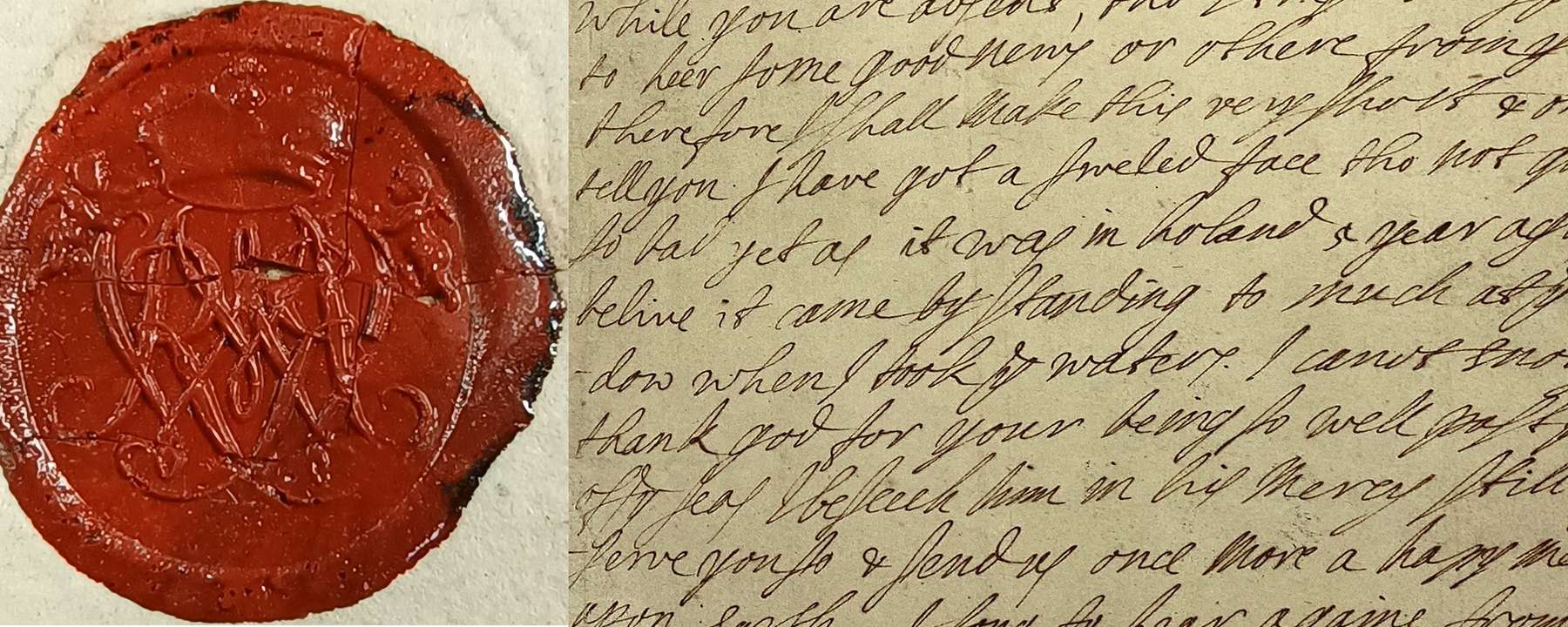
From 1688, William often went off to war. In the summer of 1690, the theatre was Ireland. While he was away, Mary wrote to her husband from Whitehall Palace at every available post, sometimes daily. Her 35 surviving letters in William’s Chest (a cabinet used by William to preserve his papers) all speak of Mary’s concern for his welfare.
In the first of Mary's letters, despatched three days after her asthmatic husband landed at Carrickfergus, she wrote:
I long to hear again from you how the air of Ireland agrees with you, for I must own I am not without my fears, for the loving you so entirely as I do, and shall till death.
Catalogue reference: SP 8/7/56, f.108b

Transcript
Whitehall, June ye 29/19 1690
You will be weary of seeing every day a leter from me
It May be, yet being apt to flatter myself I will hope
you will be as wiling to read as I to write, & indeed
tis the onely comfort I have in this world, besides is
of trust on god, I have nothing to say to you at present
that is worth writeing & I think it unreasonable
to troble you with my griefe wch must continue
while you are absent, tho I trust every post
to heer some good news or othere from you,
therefore I shall make this very short & onely
tell you I have got a sweled face tho not quite
so bad yet as it was on holand 5 years ago, I
belive it came by standing to much at ye win-
dow when I took the waters. I canot enough
thank god for your being so well past the dangers
of ye seas I beseech him in his Mercy still to pre-
serve you so & send us once more a hapy meeting
upon earth, I long to hear againe from you
how ye aire of Irland agrees with you for I
must own I am not without my fears for ye loving
you so intirely as I do & shall till death.
Modern English
Whitehall, June the 29/19 1690
You may be weary of seeing every day a letter from me,
yet being apt to flatter myself, I will hope
you will be as wiling to read as I to write. Indeed,
it is the only comfort I have in this world, besides
a trust in God. I have nothing to say to you at present
that is worth writing and I think it unreasonable
to trouble you with my grief which must continue
while you are absent. Although I trust every post
to hear some good news or other from you.
Therefore, I shall make this very short and only
tell you I have got a swollen face though not quite
as bad yet as it was on Holland 5 years ago, I
believe it came by standing to much at the
window when I took the waters. I cannot
thank God enough for your being so well past the dangers
of the seas. I pray him in his Mercy still to preserve
you so and send us once more a happy meeting
upon earth. I long to hear again from you
how the air of Ireland agrees with you, for I
must own I am not without my fears, for the loving
you so entirely as I do, and shall till death.
Mary's letter to William, 19 June 1690. Catalogue reference: SP 8/7/56, f.108b
Mary’s anxiety for William would be unimaginable ‘to any who loves lesse than myself’, she told her husband. As she explained, her public duties forced her to put a brave face on everything: ‘I must grin when my heart was ready to break and must talk when my heart is so oppressed I can scarce breath’, she wrote, although conceding, ‘I dissemble very ill to those who know me’.
Her friends did not necessarily include those of her sister Anne. Sarah Churchill, Countess of Marlborough, her sister's political ally, was definitely not one. Even so, she pitied Sarah on account of ‘great compassion for wives when their husbands go to fight’. Sarah's husband was then heading to join William in Ireland.
Queen regnant
When not on campaign, William took sole control of administration. As Queen regnant, in his absence, Mary was left in formal charge of government, heading a nine-man cabinet council. She had overall constitutional responsibility but lacked effective authority, and Mary found her duties tiresome. ‘Do but continue to love me’ she wrote to her husband ‘and I can bear all things else with ease’. She had lots to bear.
A defeat at sea by the French, off Beachy Head, East Sussex, during the Nine Years War (1689-97) – a conflict between England and a European alliance against France – left the Royal Navy in disarray. Sensitive decisions had to be taken about the Royal Navy's management including the appointment of admirals. The cabinet council itself was divided and suspicious of French and Jacobite influence (James' II supporters), and it was sometimes in ‘great heat’. Some members believed that ‘what’s decided in council is next day reported to France’.

Transcript
Whitehall, July 1/June 21 1690
I received yesterday with great joy your letter
of ye 26/16 from Belfast from whence I see you intended if
it pleased God to march last thing [to]day, I pray God you
may still find ye Irish aire beter & beter, I hope he
will of his mercy give ye all ye success we can desire,
I must now tell you a thing myself at large wch I suppose
you may have heard of last post, for after I have write
my letter & sent it away Ld Not: Ld Chamberlaine & Ld
Marlborough came to me, the Lds of the cabinet council
had recommended some persons to be reprieved uin order
to transportation & Ld Ch: prest extremely hard yt ?Macquine
might be pardoned, I told him yt haveing spoke to you
about him ye last anssere you gave was yt he must
be hanged having deserved it, but he assure dme yt
you had received othere information since & woud
certainly pardon him wear you heer, so yt at last with
ye rest which I thought was all I could do upon his
importunity after wt you had said in any othere casse then
yt of a mans life you may be sure I would not have
bin persuaded so far after wt you had said but I
thought there was too much cruelty in refusing yt for
the first time...
… I have still ye
same complaints to make that I have not time to say
wch would a litle ease my heart, but I hope in God I
shall have such news form you as will give
no reason, yet your absence is enough, but since
it please God I must have patience, do but con-
tinue to love me & I can bear all things else with ease
Modern English
Whitehall, July 1/June 21 1690
With great joy, I received your letter
yesterday of the 26/16 from Belfast, from where I see you intended
if it pleased God to march last thing today. I pray to God you
may still find the Irish air better and better, and I hope he
will of his mercy give you all the success we can desire,
I must tell you something...
... After I wrote
my letter and sent it, Lord Nottingham, Lord Chamberlaine and Lord
Marlborough came to me. The cabinet council
had recommended someone be reprieved in order
for transportation. Lord Chamberlaine pressed extremely hard that Macquine
might be pardoned. I told him, that having spoken to you
about him the last answer you gave was that he must
be hanged having deserved it. But he assured me that
you had received other information since and would
certainly pardon him wear you here. So that at last with
the rest, which I thought was all I could do upon his
importunity, after what you had said in any other case then
that of a man’s life, you may be sure I would not have
been persuaded so far after what you had said. But I
thought there was too much cruelty in refusing that for
the first time...
... I have still the
same complaints to make that I have not time to say
which would a little ease my heart. But I hope in God I
shall have such news form you as will give
no reason, yet your absence is enough. But since
it pleases God I must have patience, do but continue
to love me and I can bear all things else with ease.
Mary's letter to William, 21 June 1690. Catalogue reference: SP 8/7/58, f.111
Some decisions Mary made in William's absence were a matter of life and death. On one occasion, as recorded in her letter on 24 June, she was requested to pardon a man sentenced to death as previously agreed by William. However, with a man's life at stake, she wrote, 'in any other case then yet of a mans life you may be sure I would not have been persuaded so far after what you had said but I thought there was too much cruelty in refusing.'
All this the Queen meticulously passed on to the King, her letters a curious blend of the official report and the love letter. They were very often written last thing after a busy day. ‘I am now in my bed having bathed and am so sleepy I can say no more but that I am ever and entirely yours’.
William’s letters, which we do not hold, also sometimes reached her after she went to bed and were received with great relief. But when delays stopped the post, anxiety mounted.
You cannot imagine the miserable condition I was in last night. I think had not your letter come as it did I should have taken sick with fear for your dear person.
Catalogue reference: SP 8/7/56
Her own letters always ended with romantic endearments. ‘My heart is more yours than my own’. Or ‘Farewell. I will tro[u]ble you with no more, but onely desire you, whatever happen[s], to love me, as I shall you, till death’, she wrote.

Transcript
Whitehall the 2 July/22 June 1690 at half 10 at night.
As I awas ready to go into my bed Ld Nottingham
came and brought me a letter of wch he is going
to give you an account, for my own part I shall
say nothing to it but that I trust God will pre-
serve us you where you are & poor I heer,
Me thinks Ld Torrington has made no hast thay
say he ?stays for Ld Pembroks regiment, he
allso has not been very quike for he received
it at 8 this evening & kept it till now yt he
has sent it open to Ld Nott: I thank God I
am not much afraide, I think too little, wch
makes me fear tis want of apprehending
ye danger, yt wch trobles the most in all things
is your absence & ye fears I am in something
may be done to hinder us heering from you, in
yt casse I don’t know what will become of us,
I still trust in God who is our onely help.
Farewell I will troble you with no more but
?onely desire you whatever happens to love me
as I shall you till death.
Modern English
Whitehall the 2 July/22 June 1690 at half 10 at night.
As I was ready to go into my bed Lord Nottingham
came and brought me a letter of which he is going
to give you an account. For my own part I shall
say nothing to it but that I trust God will preserve
us, you where you are, and poor I here.
I think Lord Torrington...
he stays for Lord Pembroks regiment, he
also has not been very quick for he received
it at 8 this evening and kept it till now yet he
has sent it open to Lord Nottingham: I thank God I
am not much afraid, I think too little, which
makes me fear this want of apprehending
your danger, yet which troubles the most in all things
is your absence and the fears I am in something
may be done to hinder us hearing from you. In
yet case I don’t know what will become of us,
I still trust in God who is our only help.
Farewell I will trouble you with no more, but
I only desire, whatever happens to you, love me
as I shall you, till death.
Mary's letter to William, 22 June 1690. Catalogue reference: SP 8/7/60, f.117
A delayed return
William’s return from Ireland was continually delayed. ‘[T]is impossible to believe how impatient I am for that, nor how much I love you which will not end but with my life’.

Transcript
Whitehall, Aug the 23/13 1690
Tho I have nothing to say to you worth writing yet
I canot lett any expresse go without doing it & M Hop
It seems belives this bussines of ye Swedish ships to
Considerable to stay but till to morrow, the comistion
Of ye admiralty have resolved to come to me to morrow
With some names for flags [i.e., appointment as admirals], Mr Russell recommends
Churchill & Ellmor because he says nothing has
bin done for ym tho thay both wear trusted
when you came over & have bin ever very treu
to your interest, but I think if it be possible to
lett ym alone till you come, tho Mr Russell seems
to thinkit cannot be delayed, I shall heer (if it must
be so) what ye othere comistioners think & do as
well as I can, I have ben this day at Kensington
wch looks really very well at least to a pore body
like me who have bin so long condemned to this
place & see nothing but watter or walls,
I have received a letter from Ld Dursley who I su-
posse will write of ye same thing to your self & therefore
shall not do it; I am very impatient for another
letter, tis impossible to belive how impatient I am
for yt nor how much I love you wch will not end
but with my life.
Modern English
Whitehall, August the 23/13 1690
Though I have nothing to say to you worth writing yet,
I cannot let any express go without doing it and my hope
It seems believes this business of the Swedish ships too
Considerable to stay but till tomorrow. The commission
of the admiralty have resolved to come to me tomorrow
with some names for flags [appointment as admirals]. Mr Russell recommends
Churchill and Ellmor, because he says nothing has
been done for them, though they both were trusted
when you came over and they have been faithful
to your interest, but I think if it be possible to
wait until you come. Though Mr Russell seems
to think it cannot be delayed, I shall hear (if it must
be so) what the other commissioners think and will do as
well as I can. I have today been at Kensington,
which looks really very well, at least to a poor someone
like me who has been so long condemned to this
place and see nothing but water or walls.
I have received a letter from Lord Dursley, who I suppose
will write of the same thing to you, and therefore
shall not do it. I am very impatient for another
letter. It is impossible to believe how impatient I am
for you, neither how much I love you, which will not end
but with my life.
Mary's letter to William, 13 August 1690. Catalogue reference: SP 8/7/140, f.291
Kensington Palace was prepared for his homecoming. Their apartments were aired and ready, she assured her husband, although smelling of paint. Soon after he left, she had told him that visiting the ‘place made me think how happy I was there when I had your dear company’.
In one of her final letters during William’s absence, Mary wrote:
I need not repeat hither how much I love you, nor how impatient I am to see you. You are kind enough to be persuaded of both, and I shall make it my ende[a]vo[u]r while I live never to give you cause to change your opinion of me, no more than I shall my kindness for you, which is much above imagination.
Catalogue reference: SP 8/7/149, f.310

Transcript
Whitehall Aug ye 29/19 1690
Last night when it was just a week since I had heard from you
I received yours of ye 20/10 after I was abed, I was ex-
tream glad to find by it you had past the Shanon
but canot be without fears since the enemy have
still an army together, wch tho it has once more
run away from you may yet grow desperate
for ought I know & fight at last, these are things
I cannot help fearing, & as long as I have these fears
you may belive I cant be eassy, yet I must look merry
if it be possible & force myself to talk or presently
every body thinks alls lost this is no small part
of my penance but all must be endured as long
as it pleases God, & I hav still abondant cause
to praise him who has given you this new
advantage, I pray God continues to blesse you &
make us all as thankfull as we ought. But I must
own the thought of your staying longer is very
uneasy to me God give me the patience I hope you
be so kind as to write oftener while you are away …”
[ … TWO MORE PAGES, ENDING …]
I need not repeat
hither how much I love you nor how impatient
I am to see you, you are kind enough to be persuaded
of both & I shall make it my endever while I live
never to give you cause to change your opinion
of me no more yn I shall my kindness for you
wch is much above imagination.
Modern English
Whitehall August the 29/19 1690
Last night, when it was just a week since I had heard from you
I received your letter of the 10, after I was in bed. I was very
glad to find by it you had past the Shannon,
but cannot be without fears since the enemy have
still an army together, which though it has once more
run away from you, may yet grow desperate,
for ought I know, and fight at last. These are things
I cannot help fear, and as long as I have these fears
you may believe I cannot be easy. Yet, I must look merry,
if it be possible, and force myself to talk, or presently
every body thinks all is lost. This is no small part
of my penance, but all must be endured as long
as it pleases God, and I have still abundant cause
to praise him, who has given you this new
advantage. I pray God continues to bless you and
make us all as thankful as we ought to be. But,
the thought of you staying longer is very
uneasy to me. God give me the patience I hope you
be so kind as to write more often while you are away...
... I need not repeat
here how much I love you, neither how impatient
I am to see you. You are kind enough to be persuaded
of both and I shall make it my endeavour while I live
never to give you cause to change your opinion
of me no more than I shall for my kindness for you,
which is much above imagination.
Mary's letter to William, 19 August 1690. Catalogue reference: SP 8/7/149, f.310
Later years
Campaign ended, William returned to London – and to the woman he loved – in early September 1690.
However, their relationship was no fairy tale. There were rumours of infidelity on both sides, and gossips also hinted at same-sex attractions for both William and Mary. There is also evidence of at least one miscarriage, early in their marriage, confirmed by a letter from James II to William from April 1678.
At the end of 1694, four years after the King’s Irish campaign, Mary died unexpectedly of smallpox. She was only 32 years old. The grief and tears of her famously buttoned-up husband was widely reported. William never married again. He kept a strand of Mary's hair in a locket he wore around his neck ever after. He was buried next to Mary in Westminster Abbey when he died in 1702.
From the evidence of King William’s Chest, it seems impossible to ignore the deep love shared between King William III and Queen Mary II. Sitting among more unemotional official records of the UK government, the heartfelt sentiments contained in Mary’s love letters are quite a precious thing.
Records featured in this article
-
- From our collection
- SP 8
- Title
- King William III's Chest
- Date
- 1670–1698