













Teaching resource
Letters from the First World War: The trenches, part one
The letters collected here were all written from the trenches between 1914 and 1915. They are part of a series of connected teaching resources.
Teaching resource
This collection of letters and transcripts from our teaching resource series relate to First World War soldiers' experience of training in England before they were sent abroad.

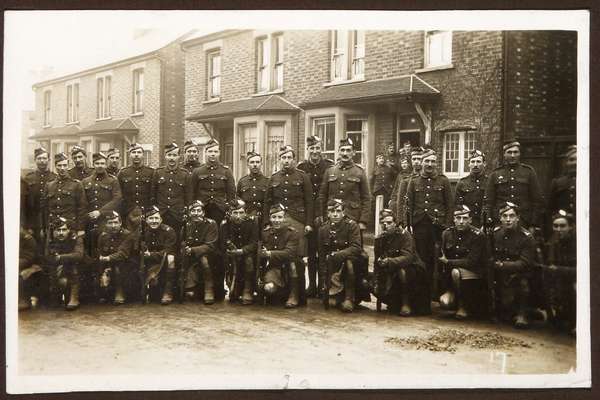
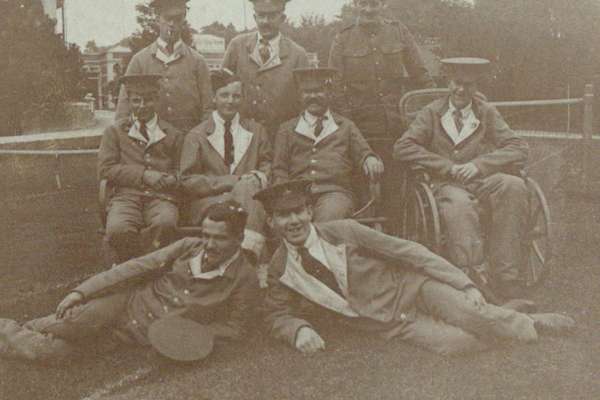
Photograph of Private George Giles and others. Catalogue reference: RAIL 253/516
These are some of the many letters sent by staff of the Great Western Railway Audit office at Paddington who had enlisted to fight in the First World War.
You can discover more letters from the First World War in our collections about Different fronts, Hospital, Railheads, The trenches, part one and The trenches, part two.

Photograph of Private George Giles and others. Catalogue reference: RAIL 253/516

Dear Mr J.[ones]
Just a line to let you know that I’m still alive and am moving to King’s Lynn on Wednesday next. Will write you later. How do you like the photo? Best regards to the office. From,
H. Giles
Letter from George Giles, 17 May 1915, Churn Camp, Oxford, England. Catalogue reference: RAIL 253/516

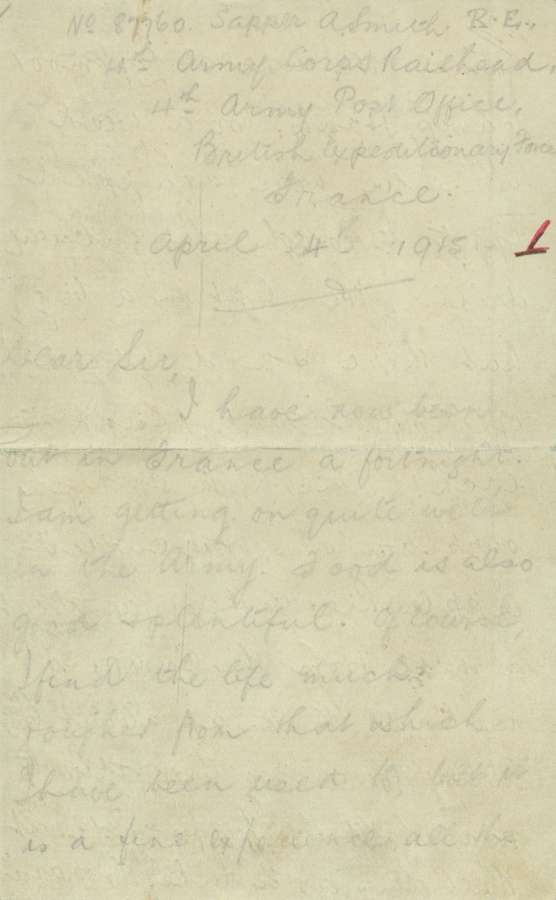
Dear Sir,
I have now been out in France a fortnight. I am getting on quite well in the army. Food is also good and plentiful. Of course, I find the life much rougher from that which I have been used to, but it is a fine experience all the [same].
Letter from Arthur Smith, 4 April 1915, France. Catalogue reference: RAIL 253/516
Listen
Training – drill before breakfast:
Dear Sir,
I have now been out in France a fortnight. I am getting on quite well in the army. Food is also good and plentiful. Of course, I find the life much rougher from that which I have been used to, but it is a fine experience all the same.
We were at Longmoor camp for a week where we were equipped and put through elementary drills. We slept in a big hut there and had a sack of straw and three blankets each. The huts, of which ours was one, were called Apple Pie and they are about a mile from the camp, so we had to be up about six every morning in order to march down for parade at the camp. The parade was at 7.15am. Some mornings we had an hour’s drill before breakfast. It was about 11pm I should think, when we arrived at Longmoor on 31st March, and consequently we went straight to our hut. No light was provided so we had to fish about for our beds in the dark. Fortunately it was moonlight, and after some time a lantern was brought. We were only too glad when getting up time came the next morning. It was before six. We were marched down to the camp and were inspected by the Sergeant Major and after waiting some time went into breakfast. Roast sausage was the chief item on the menu but to our amazement no knives and forks were supplied for us…Well, the only thing was to convey the sausages to our mouths with fingers.
The nearest thing to a knife and fork that some had was a pair of nail scissors so these were used. Personally I did not know whether to feel shocked or to laugh at the situation; it ended in the latter. We Audit fellows got to one table and we had to have a good laugh before we could eat much. It was a hopeless situation to be in. Don’t let this discourage anyone from coming but I warn him to bring a knife and fork with him. After the first day we were issued with kits and we treasure our knives and forks now. We came across on the mail boat Hantonia from Southampton to Havre. … We had to sleep in huts there on the docks but the sleeping accommodation was better. We Audit fellows were able to keep together till last Saturday night, when Pond and I were sent off to different railheads. He is at 3rd Corps Railhead. We had to travel in horseboxes and during night time. We travelled in this manner Saturday, Sunday and Monday nights. French shunting is severe and we were shaken up. Saturday and Sunday we were about 30 in the trucks, Monday 17.
We were fortunate enough to get out into every town at which we stopped during the day. On Tuesday night another young fellow and I were stranded at a station somewhere in France, and we were instructed by the military authorities to sleep in the goods shed. We had to sleep on the deck of the shed and shunting was going on during the night. This was about the limit, I thought.
I arrived finally at my destination about midday last Wednesday. Now I live in a truck at a small French station. There are two other Sappers and a Lieutenant here. We deal chiefly with gifts and comforts sent to the troops…
We are out in the country. I think this railhead is about seven miles from the firing line. Can hear the guns and see the star shells at night. I must ask you kindly to excuse me for writing in pencil because I have no pen and ink here. Would you mind letting this letter be treated as to the whole of the statistical department, please sir. With kindest regards to all. I am yours obediently,
Arthur Smith

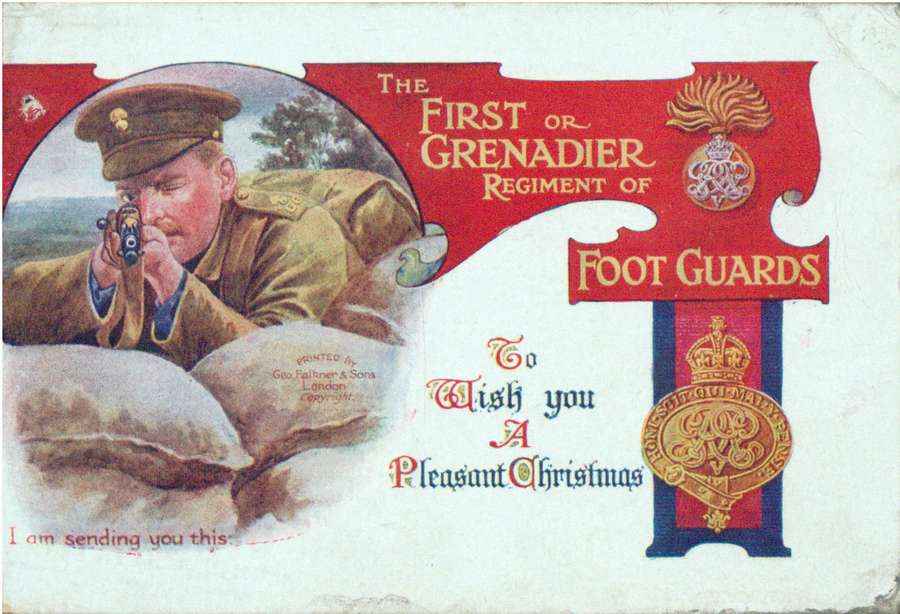
THE FIRST OR GRENADIER REGIMENT OF
FOOT GUARDS
I am sending you this
To
Wish you
A
Pleasant Christmas
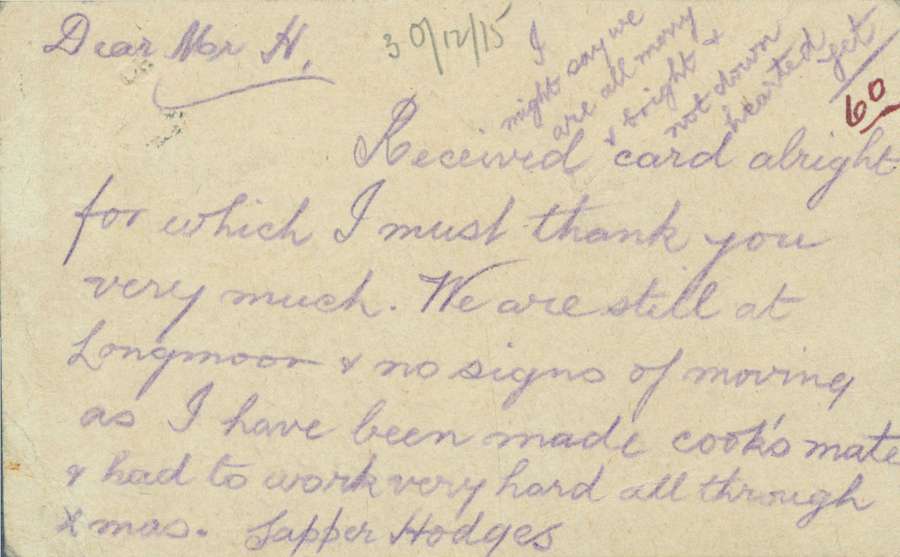
Postcard sent by Sidney Broad Hodges, 30 December 1915, Longmoor, England. Catalogue reference: RAIL 253/516

I might say we are all merry and bright and not down hearted yet.
Dear Mr Hunt,
Received card alright for which I must thank you very much. We are still at Longmoor and no signs of moving as I have been made cook’s mate and had to work very hard all through Xmas.
Sapper Hodges
Postcard sent by Sidney Broad Hodges, 30 December 1915, Longmoor, England. Catalogue reference: RAIL 253/516

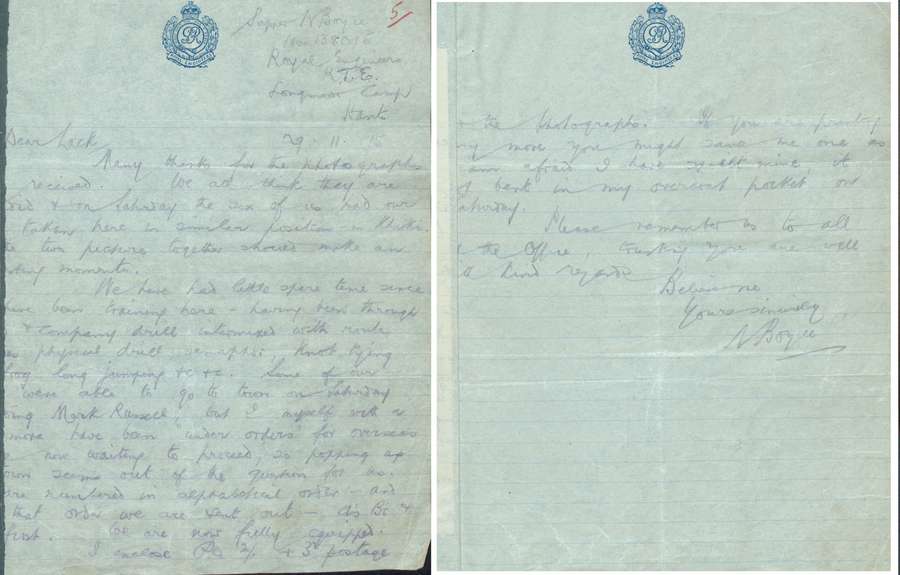
Dear Lack,
Many thanks for the photographs received. We all think they are good and on Saturday the six of us had out photo taken here in a similar position– in khaki. The two pictures together should make a lasting memento.
We have had little spare time since we have been training here. Having been through company drill mixed with route marches, physical drill, semaphore, knot tying and frog, long jumping etc. Some of our men were able to go to town on Saturday… but I myself with a few others have been under orders for overseas service now waiting to proceed, so popping up town seems out of the question for us. We are numbered in alphabetical order, and in the order we are sent out. We are now fully equipped. I enclose … postage for the photographs. If you are printing any more you might save me one as I am afraid I have spoilt mine, it got bent in my overcoat pocket on Saturday. Please remember me to all at the office…
N. Boyce
Letter from Nicholas Boyce, 9 November 1915, Longmoor Camp, England. Catalogue reference: RAIL 253/516
Listen
Nicholas Boyce, training – we are now fully equipped:
Dear Lack,
Many thanks for the photographs received. We all think they are good and on Saturday the six of us had out photo taken here in a similar position– in khaki. The two pictures together should make a lasting memento.
We have had little spare time since we have been training here. Having been through company drill mixed with route marches, physical drill, semaphore, knot tying and frog, long jumping etc. Some of our men were able to go to town on Saturday… but I myself with a few others have been under orders for overseas service now waiting to proceed, so popping up town seems out of the question for us. We are numbered in alphabetical order, and in the order we are sent out. We are now fully equipped. I enclose … postage for the photographs. If you are printing any more you might save me one as I am afraid I have spoilt mine, it got bent in my overcoat pocket on Saturday. Please remember me to all at the office…
N. Boyce

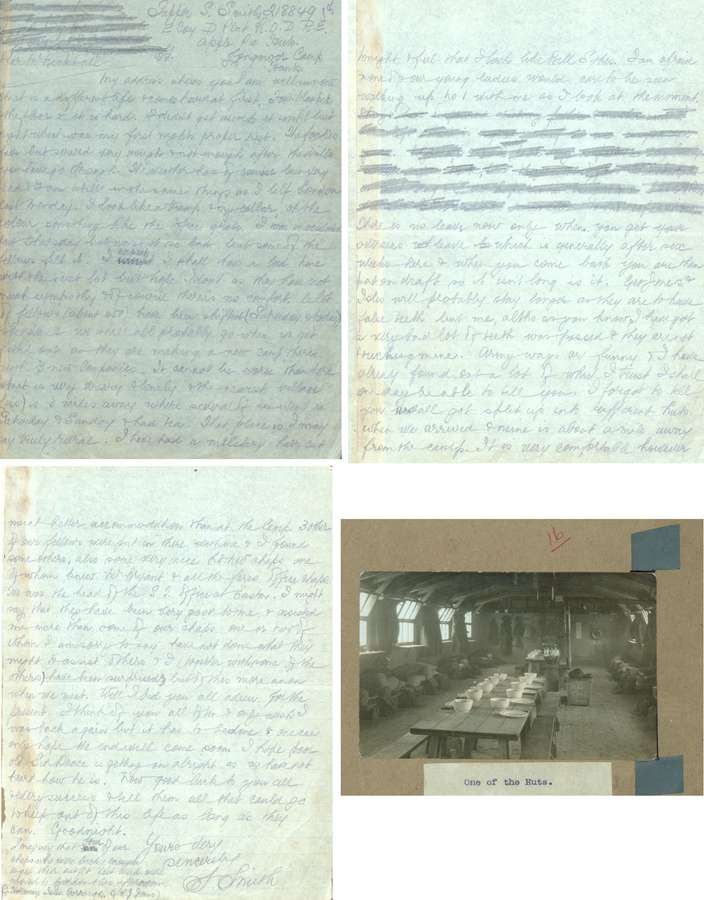
Dear Mr Beak and all,
My address shows you I am well in now. Oh it is a different life and comes hard at first, four blankets on the floor and it is hard. I didn’t get used to it until last night which was my first night’s proper rest. The food is fair but served very rough and not enough after the drills you have to go through. The weather has of course been very bad and I am still in the same things as I left London last Monday. I look like a tramp and my collar, of the colour, something like the office grate. I was inoculated last Thursday but was not so bad but some of the fellows felt it. I expect I shall have a time with the next lot but hope I don’t as they have not got much sympathy and of course there is no comfort. A lot of fellows (about four hundred and fifty) have been shifted (Saturday and today) to Bordon and we shall all probably go when we get fitted out as they are making a new camp there with three new companies. It cannot be worse than here which is very dreary and lonely and the nearest village (Liss) is three miles away where several of us went on Saturday and Sunday and had tea. That place is I may say, truly rural. I have had a military hair cut tonight and feel that I look like Bill Sykes. I am afraid none of our young ladies would care to be seen walking up number 1 (platform at Paddington Station) with me as I look at the moment. (censored.)
There is no leave now, only when you get your overseas leave which is generally after six weeks here and when you come back you are the put on the draft so it isn’t long is it? George Jones and Isles will probably stay longer as they are to have false teeth but me, although as you know, I have got a very bad lot of teeth was passed and they are not touching mine. Army ways are funny and I have already found out a lot of which I trust I shall one day be able to tell you.
I forget to tell you we all got split up into different huts when we arrived and mine is about a mile away from the camp. It is very comfortable however much better accommodation than at the camp. Three other of our fellows were put in there with me and I found some others, also some very nice London & North Western Railway chaps, one of whom knew Mr Bryant and all the Fares office chaps. He was the head of the Season Ticket Office at Euston. I might say that they have been very good to me and assisted me more than some of our chaps, one or two of whom I am sorry to say have not done what they might to assist others and I (together with some of the others) have been surprised but of this more anon when we meet. Well I bid you all adieu for the present. I think of you all often and only wish I was back again but it has to be done and one can only hope the end will come soon. I hope poor old Syd Douce is getting on alright as we have not heard how he is. Now good luck to you all and every success and tell them all that could go to keep out of this life as long as they can. Goodnight.
I may say that four of our chaps who were lucky to get their outfit last week were moved to Bordon this afternoon: G. Holloway, Isles, Borrough, G.R.J. Jones. Yours very sincerely,
S. Smith.
Letter from Sidney Smith, undated, Longmoor Camp, England. Catalogue reference: RAIL 253/516
Listen
Sidney Smith, training – had a military haircut:
Dear Mr Beak and all,
My address shows you I am well in now. Oh it is a different life and comes hard at first, four blankets on the floor and it is hard. I didn’t get used to it until last night which was my first night’s proper rest. The food is fair but served very rough and not enough after the drills you have to go through. The weather has of course been very bad and I am still in the same things as I left London last Monday. I look like a tramp and my collar, of the colour, something like the office grate. I was inoculated last Thursday but was not so bad but some of the fellows felt it. I expect I shall have a time with the next lot but hope I don’t as they have not got much sympathy and of course there is no comfort. A lot of fellows (about four hundred and fifty) have been shifted (Saturday and today) to Bordon and we shall all probably go when we get fitted out as they are making a new camp there with three new companies. It cannot be worse than here which is very dreary and lonely and the nearest village (Liss) is three miles away where several of us went on Saturday and Sunday and had tea. That place is I may say, truly rural. I have had a military hair cut tonight and feel that I look like Bill Sykes. I am afraid none of our young ladies would care to be seen walking up number 1 (platform at Paddington Station) with me as I look at the moment. (censored.)
There is no leave now, only when you get your overseas leave which is generally after six weeks here and when you come back you are the put on the draft so it isn’t long is it? George Jones and Isles will probably stay longer as they are to have false teeth but me, although as you know, I have got a very bad lot of teeth was passed and they are not touching mine. Army ways are funny and I have already found out a lot of which I trust I shall one day be able to tell you.
I forget to tell you we all got split up into different huts when we arrived and mine is about a mile away from the camp. It is very comfortable however much better accommodation than at the camp. Three other of our fellows were put in there with me and I found some others, also some very nice London & North Western Railway chaps, one of whom knew Mr Bryant and all the Fares office chaps. He was the head of the Season Ticket Office at Euston. I might say that they have been very good to me and assisted me more than some of our chaps, one or two of whom I am sorry to say have not done what they might to assist others and I (together with some of the others) have been surprised but of this more anon when we meet. Well I bid you all adieu for the present. I think of you all often and only wish I was back again but it has to be done and one can only hope the end will come soon. I hope poor old Syd Douce is getting on alright as we have not heard how he is. Now good luck to you all and every success and tell them all that could go to keep out of this life as long as they can. Good luck,
S. Smith
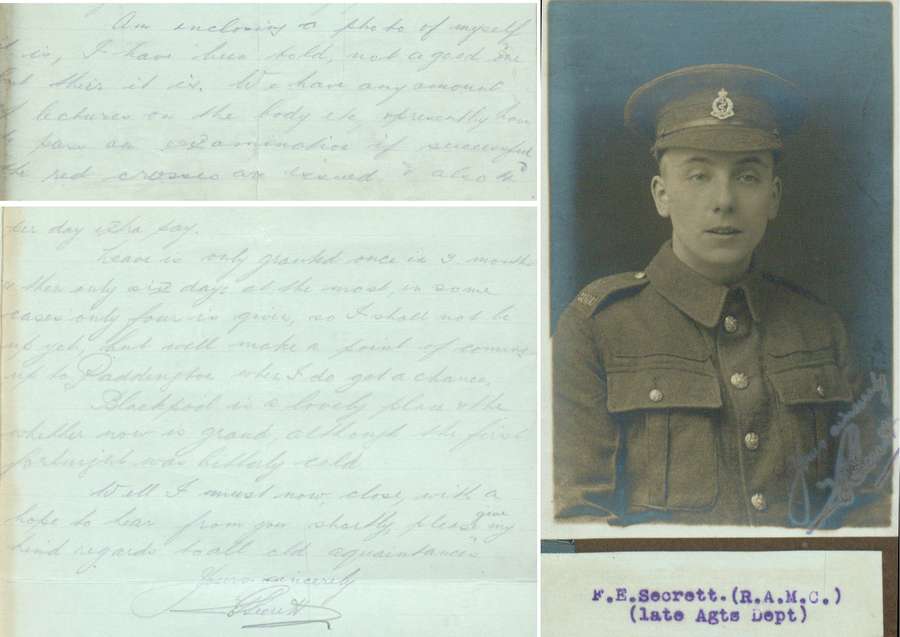
From 1916 newly enlisted Royal Army Medical Corps (RAMC) officers were taught how to cope with the types of injuries they would encounter at the front or at a casualty clearing station. They learnt about hygiene, the prevention of infection and the importance of clean water and safe food.

… Am enclosing a photo of myself, it is, I have been told, not a good likeness, but there it is. We have any amount of lectures on the body etc., and presently have to pass an examination, if successful the red crosses are issued and also 4d (pennies) per day extra pay.
Leave is only granted once in nine months and then only six days at the most, in some cases only four is given, so I shall not be up yet, but will make a point of course of coming up to Paddington when I do get a chance.
Blackpool is a lovely place and the weather now is grand, although the first fortnight was bitterly cold.
Well I must now close, with a hope to hear from you shortly, please give my kind regards to all acquaintances.
F. Secrett
Letter from Frank Edward Secrett, Royal Army Medical Corps, 29 April, 1917, Blackpool training depot, England. Catalogue reference: RAIL 253/516
This was included in the newsletter for the Great Western Railway Paddington Audit office in May 1916.
It was probably sent in by one of their staff who was training at a camp in Scotland and then typed out by the office. It provided a wonderful insight into the training schedule and possible thoughts surrounding it!

The Routine of a Soldier’s Life told in a few well-known hymns
Composed by members of Heather Tent, Scotland
5.30 am. Revielle. Christians Awake.
6.45 am. House Parade. Art though weary thou languid.
7.00 am. Breakfast. Meekly wait and murmur not.
8.15 am. Company parade. When he cometh.
8.45 am. Manoeuvres. Fight the good fight.
11.15 am. Swedish Drill. Here we suffer grief and pain
1.00 pm. Dinner. Come ye thankful people come.
2.15 pm. Rifle Drill. Go labour on.
3.15 pm. Lecture by Officer. Abide with me.
4.30 pm. Dismiss. Praise God from whom all blessings flow.
5.00 pm. Tea. What means this eager anxious throng?
6.00 pm. Free for the night. Oh what will the harvest be?
6.30 pm. Out of bounds. Oh Lord how happy shall we be.
10.00 pm. Last post. All are safely gathered in.
10.15 pm. Lights out. Peace Perfect Peace.
10.30 pm. Inspection of Guards. Sleep on beloved.
GOD SAVE THE KING
Routine of a soldier’s life told in a few well-known hymns composed by members of Heather Tent, Scotland. Catalogue reference: RAIL 253/516
Frank lost his right arm in the war.

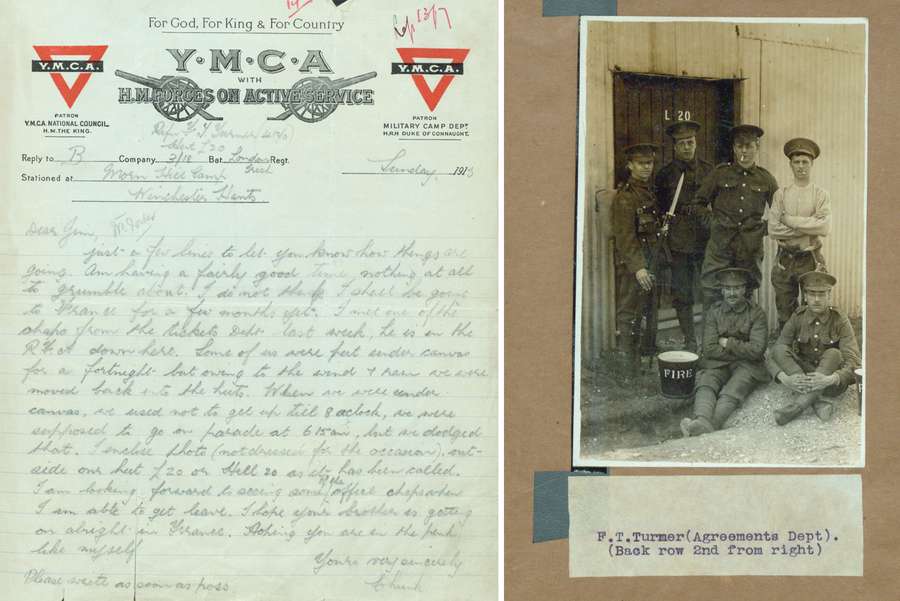
Dear Jim (Mr Porter)
Just a few lines to let you know things are going. Am having a fairly good time nothing at all to grumble about. I don’t think I shall be going to France for a few months yet. I met one of the chaps from the tickets department last week he is in the R.F.C. down here. Some of us were feet under canvas for a fortnight but owing to the wind and rain we were moved back to the huts. When we were under canvas, we used not get up till 8 o’clock, we were supposed to go on parade at 6.15am, but we dodged that. I enclose photo (not dressed for the occasion) outside our hut L20 or Hell 20 as it has been called. I am looking forward to seeing some of the office chaps when I am able to get leave. I hope your brother is getting on alright in France. Hoping you are ‘in the pink’ like myself,
Yours very sincerely
F. Turner
Please write as soon as poss.
Letter from Frank Thayer Turner, 13 July 1916, Morn Hill Camp, Winchester, England. Catalogue reference: RAIL 253/516
Listen
Frank Thayer Turner, training – in the pink:
Just a few lines to let you know things are going. Am having a fairly good time nothing at all to grumble about. I don’t think I shall be going to France for a few months yet. I met one of the chaps from the tickets department last week he is in the R.F.C. down here. Some of us were feet under canvas for a fortnight but owing to the wind and rain we were moved back to the huts. When we were under canvas, we used not get up till 8 o’clock, we were supposed to go on parade at 6.15am, but we dodged that. I enclose photo (not dressed for the occasion) outside our hut L20 or Hell 20 as it has been called. I am looking forward to seeing some of the office chaps when I am able to get leave. I hope your brother is getting on alright in France. Hoping you are ‘in the pink’ like myself,
Yours very sincerely
F. Turner
Please write as soon as poss.

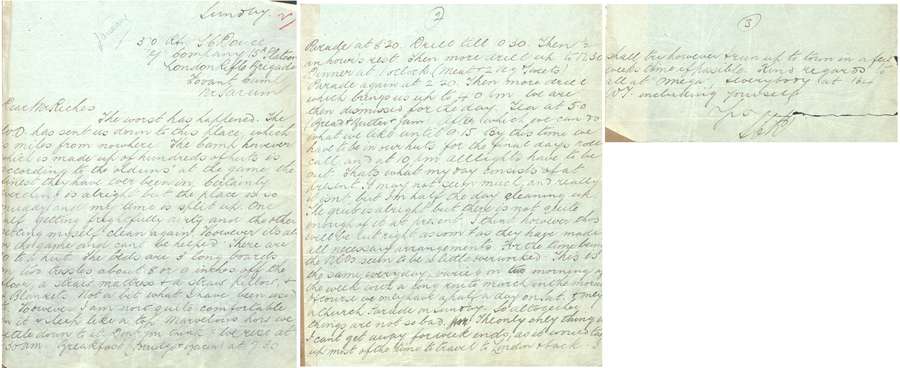
Dear Mr. Riches
The worst has happened. The War Office has sent us down to this place which is miles from nowhere. The camp however is made up of hundreds of huts is according to the ‘old uns’ at the game the finest they have ever been in, certainly everything is alright but the place is so muddy and my time is split up. One half getting frightfully dirty and the other getting myself clean again. However it’s all in the game and can’t be helped. There are twenty to a hut. The beds are three long boards on two trestles about eight or nine inches off the floor, a straw mattress and a straw pillow, and four blankets. Not a bit what I have been used to. However I am now quite comfortable in it and sleep like a top. Marvellous how you think we settle down to it. Don’t you think? We rise at 6.30am. Breakfast (porridge and bacon) at 7.30. Parade at 8.20. Drill till 10.30. Then half an hour’s rest. Then more drill up to 12.30. Dinner at 1 o’clock (meat and two vegetables and sweets). Parade again at 2.20. Then more drill which brings us up to 4pm. We are then dismissed for the day. Tea at 5pm (bread, butter and jam). After which we can do what we like until 9.15. By this time we have to be in our huts for the final day’s roll call and at 10pm. All lights have to be out. That’s what my day consists of at present. It may not seem much, and really it isn’t, but I am half the day cleaning up. The grub is alright but there is not quite enough of it at present. I think however this will be right as soon as they have made all necessary arrangements. For the time being the Non-Commissioned Officers seem to be a little overworked. This is the same every day, varied on two mornings a week with a long route march in the morning. Of course we only have half a day on Saturday and only a Church parade on Sunday. So altogether things are not so bad. The only thing is I can’t get away for weekends, as it would take up most of the time to travel to London and back. I shall try however and run up to town in a few weeks’ time if possible. Kind regards to all at ‘Omega’, and everybody at 164, W.1, including, yourself.
Yours, S.C.D.
Letter from Sydney Charles Douce, January 1916, Fovant Camp, Wiltshire. Catalogue reference: RAIL 253/516
Listen
Sydney Charles Douce, training – the grub's alright:
Dear Mr. Riches
The worst has happened. The War Office has sent us down to this place which is miles from nowhere. The camp however is made up of hundreds of huts is according to the ‘old uns’ at the game the finest they have ever been in, certainly everything is alright but the place is so muddy and my time is split up. One half getting frightfully dirty and the other getting myself clean again. However it’s all in the game and can’t be helped. There are twenty to a hut. The beds are three long boards on two trestles about eight or nine inches off the floor, a straw mattress and a straw pillow, and four blankets. Not a bit what I have been used to. However I am now quite comfortable in it and sleep like a top. Marvellous how you think we settle down to it. Don’t you think? We rise at 6.30am. Breakfast (porridge and bacon) at 7.30. Parade at 8.20. Drill till 10.30. Then half an hour’s rest. Then more drill up to 12.30. Dinner at 1 o’clock (meat and two vegetables and sweets). Parade again at 2.20. Then more drill which brings us up to 4pm. We are then dismissed for the day. Tea at 5pm (bread, butter and jam). After which we can do what we like until 9.15. By this time we have to be in our huts for the final day’s roll call and at 10pm. All lights have to be out. That’s what my day consists of at present. It may not seem much, and really it isn’t, but I am half the day cleaning up. The grub is alright but there is not quite enough of it at present. I think however this will be right as soon as they have made all necessary arrangements. For the time being the Non-Commissioned Officers seem to be a little overworked. This is the same every day, varied on two mornings a week with a long route march in the morning. Of course we only have half a day on Saturday and only a Church parade on Sunday. So altogether things are not so bad. The only thing is I can’t get away for weekends, as it would take up most of the time to travel to London and back. I shall try however and run up to town in a few weeks’ time if possible. Kind regards to all at ‘Omega’, and everybody at 164, W.1, including, yourself.
Yours, S.C.D.

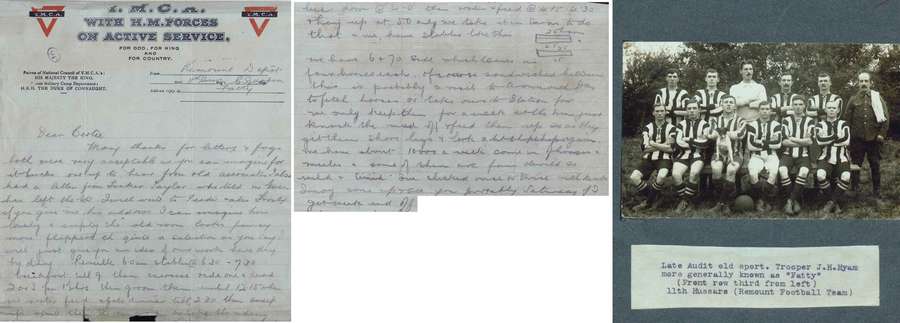
Dear Bertie,
Many thanks for letters and fags both were very acceptable as you can imagine for it bucks one up to hear from old associates. I also had a letter from “Tinker” Taylor who told me Gwen has left the Great Western Railway Company. I will write to Ferdi [Ferdinand] and ask Frosty if you give me his address. I can imagine how lovely and empty the old room looks, fancy more flappers eh, quite a selection as you say. I will just give you an idea of our work here day by day. Reveille 6.00am, stables at 6.30-7.30, breakfast till 9. Then exercise ride one and lead two or three [horses] for one and a half hours, then groom them until 12.15, then we water and feed and go to dinner till 2.30 then sweep up … [Letter damaged]
Bed [horses] down at 4pm then water and feed at 4.15 to 4.30 and hay up at 5pm, only we take it in turns to do that and we have stables like this. [Fatty has drawn a rough sketch of the stables which house the horses].
We have six and seven a side which leaves us four horses each. Of course, sandwiched between this is probably a visit to Avonmouth Docks to fetch horses or take ours to the station for we only keep them for a week at the time just to knock the mud off and feed them up so as they get their shore legs and look a bit shipshape again. We have about 10,000 a week come in of horses and mules and some of them are fair devils, so wild and timid.
I may come and see you probably Saturday if I get the weekend off…
Fatty
Photo caption: Late Audit old sport. Trooper J. H. Hyam more generally known as “Fatty” (Front row third from left)
11th Hussars (Remount Football Team)
Letter from James Walter Hyam, undated, England. Catalogue reference: RAIL 253/516

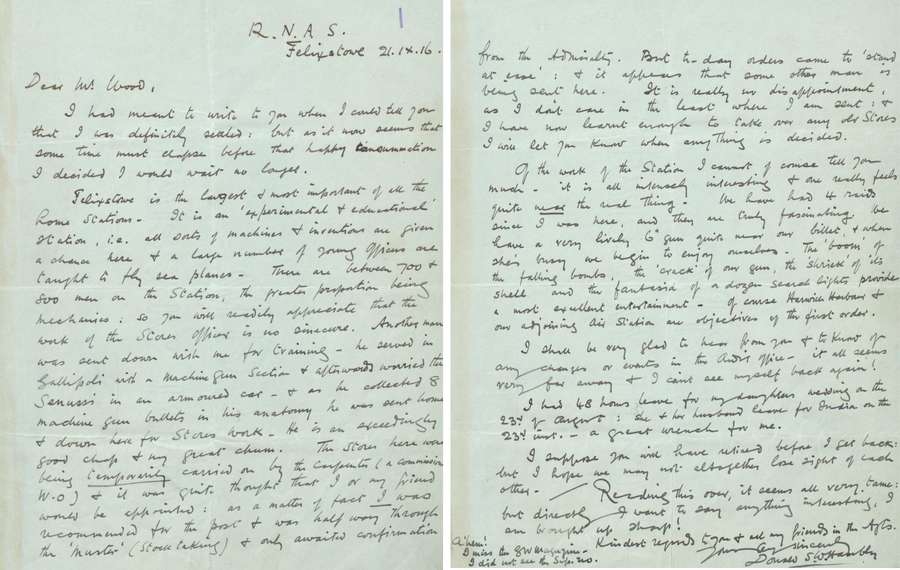
Dear Mr Wood.
I had meant to write to you when I could tell that I was definitely settled, but as it now seems that some time must lapse before that happy consummation I decided that I would wait no longer.
Felixstowe is the largest and most important of all the home stations. It is an ‘experimental and educational’ station, i.e. all sorts of machines and inventions are given a chance here and a large number of young officers are taught to fly sea planes. There are between seven hundred and eight hundred men on the station, the greatest proportion being mechanics. So you will readily appreciate that the work of the Stores Officer is no sinecure. Another man was sent down with me for training, he served in Gallipoli with a machine gun section and afterwards worried the Senussi (a reference to Western Desert campaign in North Africa) in an armoured car and as he collected eight machine gun bullets in his anatomy he was sent home and down here for stores work. He is an exceedingly good chap and my great chum. The stores here were being temporarily carried on by the carpenter, a commissioned Warrant Officer and it was quite thought that I or my friend would be appointed, as a matter of fact I was recommended for the post and was halfway through the ‘muster’ (stock taking) and only awaited confirmation from the Admiralty.
But today orders came to ‘stand at ease’ and it appears that some other man is being sent here. It is really no disappointment, as I didn’t care in the least where I am sent, and I have now learnt enough to take over any old stores. I will let you know when anything is decided.
Of the work of the station I cannot of course tell you much, it is all intensely interesting and one really feels quite near the thing. We have had four raids since I was here, and they are truly fascinating. We have a very lively six inch gun, quite near our billet and when she’s busy we begin to enjoy ourselves. The boom of the falling bombs, the crack of our gun, the shriek of its shell and the fantasia of a dozen search lights provide a most excellent entertainment, of course Harwich Harbour and our adjoining Air Station are objectives of the first order.
I shall be very glad to hear from you and to know any changes or events in the Audit office, it all seems very far away and I can’t see myself back there again!
I had forty-eight hour’s leave for my daughter’s wedding on the 23rd of August, she and her husband leave for India on the 23rd instant, a great wrench for me.
I suppose you will have retired before I get back, but I hope we may not altogether lose sight of each other. Regarding this over, it seems all very tame but directly I want to say anything interesting, I am brought up sharp! Kindest regards to you and all my friends in the Agreements.
Yours very sincerely,
Donald S.W, Hambly
A’ hem! I miss the GW magazine. I did not see September number.
Letter from Donald Stewart Wharton Hambly, 21 September 1916, Felixstowe, England. Catalogue reference: RAIL 253/516
All letters in this collection have been transcribed, and audio versions of selected letters are available too. The documents should offer students a chance to develop their powers of evaluation and analysis. Teachers may also wish to use the collection to develop their own resources.
You may spot spelling or grammatical errors in the transcripts as we have transcribed the letters as they stand. However, we have not included full digital images for several letters as these would have proved too difficult to read online. In such cases we have shown part of the letter in order to provide a sense of the original.
Within this online resource and the other resources in this series it is possible to find more than one letter from the same person, or find references within the letters to those who have written. For this reason is it is helpful to see the letters as a whole group to get the most out of them and appreciate the nature of the collection.
The Great Western Railway Company formed four companies of Royal Engineers as many men from the company, including these clerical workers from Paddington, had enlisted to serve. Due to their knowledge and understanding of the railways, many became Railway Troops based at railheads.
Unsurprisingly, in the letters many men showed a keen interest in all matters connected with railways or engines, including other Great Western Railway ‘fellows’ and the Great Western Railway Magazine. Some soldiers mentioned having received the magazine or asked for it to be sent out. It included photographs of all those who served in the First World War from the GWR as a whole and employees could catch up on company business and or news of sporting or social events.
‘Our family has had to pay the penalty of war that so many thousands of families have done, for I am now the only one out here’
These few words, written by Frederick Ernest Andrews on 16 October 1917 from France, come from this collection of letters from staff at the Audit office for the Great Western Railway (GWR) based at Paddington, London.
What makes this collection of soldiers’ letters so different from all others is the fact that it reveals the stories of a particular group of men who varied in class and education, who were writing back to their colleagues and bosses in the office while on active service during in the First World War. Many men enlisted from the GWR to fight, but these letters come exclusively from those worked at its Audit office. Staff at Paddington covered a range of different roles in insurance, accounting or ticketing for the Great Western Railway.
The letters belong to the RAIL series (which includes the records of the railway companies) at The National Archives. They are arranged in 12 carefully bound folders, rather like a series of scrapbooks. Starting from August 1915, each part represented what was known as the office newsletter, a collection of letters, photographs postcards, field cards and contemporary newspaper cuttings from those who had gone to fight. Every newsletter opened with a news section listing those who had written and sent photos to the office and those who recently left to company to serve at the front. The totals of all men in khaki from the Audit office were given too. The news section also provided information about those who had died, been injured, visited the office on leave or been promoted. The newsletters were circulated within the office departments and read by men when they came home on leave. Friends or relatives who had been sent their own letters or photographs often lent them or typed them out to be circulated as part of the regular Audit office newsletter.
The Audit office raised enough money through collections and the sale of Christmas cards, to create a temporary roll of honour for the office at Paddington to commemorate those who had fallen in battle by August 1915. Photographs of the Roll of Honour were sent out to several employees as their correspondence reveals.
After the war had ended and troops had returned, the GWR was able to quantify the contribution that it had made to the cause. The contribution made by the Audit office was high: 55.5% of male staff enlisted, whereas the average rate of enlistment across the GWR was 32.6%. This amounted to 184 men, 17 of whom lost their lives.
On 11 November 1922, The Great Western Railway War Memorial, dedicated to all 2,524 staff who had died in battle was unveiled on platform 1, Paddington station.
Teaching resource
The letters collected here were all written from the trenches between 1914 and 1915. They are part of a series of connected teaching resources.
Teaching resource

These letters, sent from the trenches on the Western Front, date from 1916–1918. They are part of a series of connected teaching resources.
Teaching resource
This collection of records, part of our series on letters from the First World War, features soldiers posted to India, Greece, Turkey and Malta.
Teaching resource
This collection from our Letters from the First World War teaching resource series features letters that relate to soldiers' experience of medical treatment.
Teaching resource

Letters in this collection relate to soldiers' experience at the railheads on the Western front. Part of series of resources on First World War letters.