








Teaching resource
Letters from the First World War: The trenches, part one
The letters collected here were all written from the trenches between 1914 and 1915. They are part of a series of connected teaching resources.
Teaching resource
Letters in this collection relate to soldiers' experience at the railheads on the Western front. Railheads were the nearest points to the front from which men and supplies travelled by train and were then taken to the battle line by motor vehicle or horse.

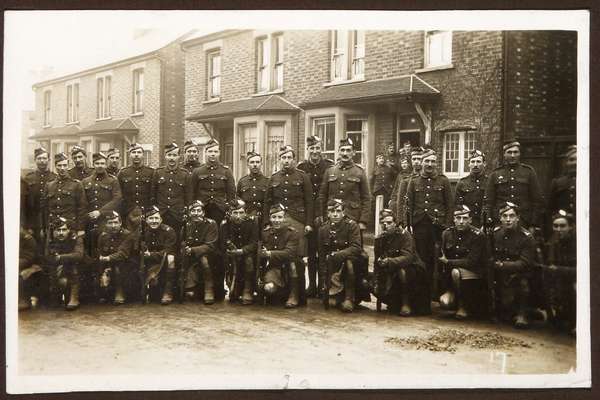
Photograph of John Higgs of the Royal Engineers. Catalogue reference: RAIL 253/516
These are some of the many letters sent by staff of the Great Western Railway Audit office at Paddington who had enlisted to fight in the First World War.
You can discover more letters from the First World War in our collections about Different fronts, Hospital, Training, The trenches, part one and The trenches, part two.

Dear Mr Hunt
Many thanks for your long and interesting letter which I was very pleased to receive. I am sorry I have been unable to answer it before but I have been constantly moving about from one place to another lately, and have had no opportunity of writing letters. Well I am very pleased to say I am feeling very fit and well, and quite enjoying the life. When writing to you last, I was attached to the 4th Division and was stationed at a small village where we were living in tents. We were stationed there about six weeks. Just over a week ago I was transferred to another place about eighty miles from the other one. I travelled by motor lorry with the Supply column and it took us all day from 7.30am till about 9 o’clock in the evening to do the journey. It was a glorious trip, the scenery being very fine. Almost as good as our office outing, only not quite such comfortable travelling. We put up for the night in a small village, sleeping in the lorry with some empty petrol cans for a bed. Next morning I was taken to the railhead where I was stationed until yesterday being only in that place just a week. While there we were all still sleeping in tents, but I was fortunate enough to have my meals with the Post Office Staff so have had a rest from being my own cook. Yesterday afternoon, just as I was going for my tea, I was sent for and told to pack up my things and catch a train to another railhead as I had to take charge as the A.M.F.O* for three Divisions there. As there is usually a man attached to each division, this was rather a large order. I only had about twenty miles or so to go, but it took from 5 o’clock till after 9pm to get there. These French trains are very rapid.
I am now attached to the 51st (Highland) Division, the same division as Williams, a number of his lot were here today, but he was not with them. We shall probably only be here for a few days and will then move to another village further on. I was very surprised to hear of Mr Pritchard’s death. I also heard that Mr Crossley is also dead. We are having glorious weather here at present and very hot at times. Glad to hear you are having a soft time on the old section.
I was very pleased to hear about the collection of letters and photos from the troops that you are sending round the office and will certainly send you a photo later on. I have has some taken but have not received them yet. Have you heard from Ferdie or Gray at all? We all had our photos taken at Longmoor before we came out here a group of six. Unfortunately, I only had a few copies and they have all been sent away. Ferdie and Gray are still at the Base, I believe, but Arthur Smith is at one of the railheads somewhere. Well I don’t think I can tell you any more news at present. Will write again later and send photo.
Kindest regards to all.
Yours sincerely,
M.P. Pond
Letter from Montague Percy Pond, 31 July 1915, France. Catalogue reference: Catalogue reference: RAIL 253/516

Dear Dada,
Many thanks for the Slough paper and magazines. Was very sorry to see that Jefferies and How have lost their lives. I heard from Arthur this morning and he tells me that Fred Blane has died of wounds in the Dardanelles. I expect you remember him in the “Windsor Operatic Society”. [Line censored]…
Harold White (Ginger) who lived with Arthur has joined the Royal Artillery Garrison and is now at Plymouth. Arthur has sold the motorbike. Petrol is too expensive he says. Since I wrote last I have been moved to a little village about 2½ miles out of the town I was in then. It is a dead and alive hole with only a few houses and two cafes, only one of which is open. The other has had all the windows blown out.
We expect to move further on still in a day or two. We have changed our truck for a much larger one and have made ourselves very comfortable. It is about 30 feet long, so we have divided it off (with our ground sheets for curtains) at one end to make a bedroom, and the rest of the truck we have fitted up with desks and cupboards. I spent the other evening making a table out of bacon boxes etc. At present we are living very well indeed, with bacon and kidneys for breakfast, steaks and vegetables for dinner, jam and honey etc. for tea and bread and cheese and pickles for supper. Not bad for “active service”. The Post Office cook still does all our cooking. There are four of us on the staff here now. One attached to each of the three divisions, and one learning the work who will probably leave soon to take charge of a division. There have been plenty of aeroplanes over here lately. A German came over the other evening and our people shelled it for about half an hour. I don’t know whether it was brought down or not. I had a nice long letter from Mr Hunt yesterday. He sent me photo of the “Roll of Honour” and told me all the latest Audit office news. Well, I don’t think I have much more to tell you at present so will conclude with love to all,
Yours, affectionately,
Mont.
Letter from Montague Percy Pond, 9 October 1915, France. Catalogue reference: RAIL 253/516

My Dear Bertie
… I am pleased to say I am still in the same job and getting to understand the run of things. It is very interesting work, as you would imagine. It is a real line here, sometimes we are pushed and carry on till the early hours of the morning. I might say there is no grumbling about tea money, overtime or bonus quotas putting in as much as eighteen hours a day sometimes and it would not do to send deputations to the chief who is also hard at it, in his room; there is a special way of dealing with such in the army.
Of course one never knows how long this may last I may have marching orders to proceed elsewhere any day. Each day is absolutely a day unto itself here. We don’t count tomorrow.
I see you have been visited with a blizzard, we also have had a severe touch of winter and at the present moment it is snowing hard outside. The shutters are closed and the work is being carried on by lamplight, this is necessary owing to the glass having recently left the windows in small fragments some souvenirs [shells] having called upon us. When the weather is fine we are fresh air fiends now both day and night except that we close the shutters when snowing or raining. The latter it is often doing.
There are hosts of interesting things I could write you about but these will do later on when I have the pleasure of seeing you. Lieut. Dunton’s crowd was hereabouts, but I did not run up against him.
I suppose the Derby entries have commenced to run now. I met another GW fellow the other day, Sergeant Gregory, a Slough fellow. I think George Jones would know him. I have seen this fellow at Paddington but did not know him to speak to.
I had a letter from Longmoor Camp. Must correct information. J. Higgs is in the Railway Transport Engineers with another friend of mine, Watton of Windsor who was in the Finance office…
Letter from Mark Anthony Russell, 4 February 1916, France. Catalogue reference: RAIL 253/516

Sapper J.R.H. Higgs. R.E. (Railway Troop).
Photograph of John Higgs of the Royal Engineers, who is mentioned in Mark Anthony Russell's letter. Catalogue reference: RAIL 253/516

My Dear Elton and all,
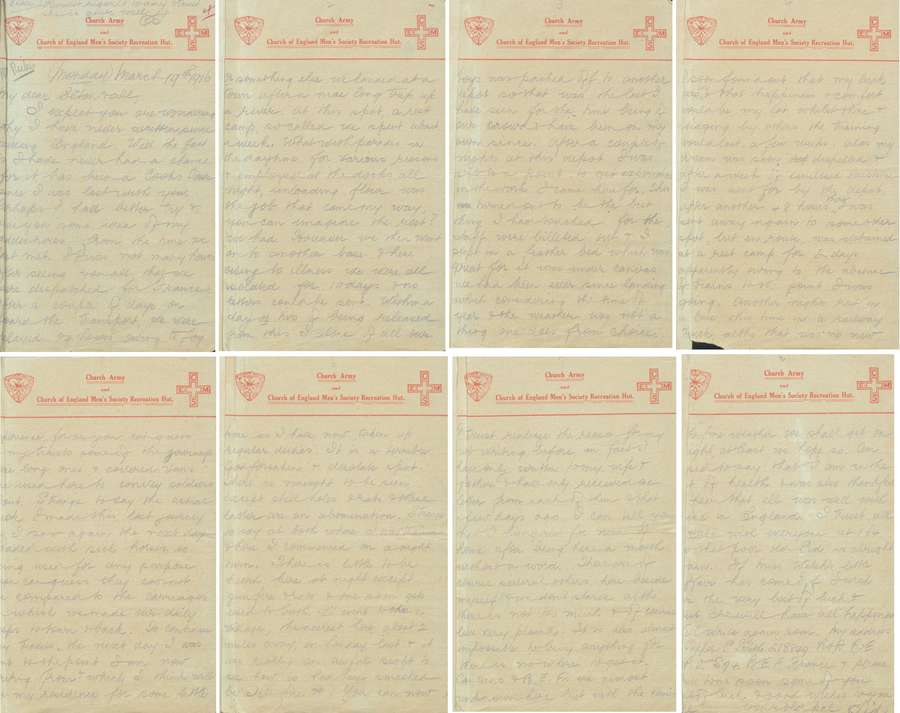
I expect you are wondering why I have never written since leaving England. Well the fact is I have never had a chance for it has been a Cook’s Tour since I was last with you. Perhaps I had better try and give you some idea of my adventures from the time we last met. It was not many hours after seeing you all that we were dispatched for France…We landed at a town after a nice long trip… At this spot, a rest camp so called, we spent about a week. What with parades in the daytime for various reasons and employed at the docks all night, unloading flour was the job that came my way you can imagine the rest we had. However we then went on to another base and here owing to illness, we were all isolated for ten days and no letters could be sent. Within a day or two of being released from this I alone of all our boys was packed off to another depot so that was the last I have seen for the time being of our crowd, and have been on my own since. After a couple of nights at this depot I was sent to a point to get experience in the work I came here for. This turned out to be the best thing I had touched for the staff were billeted out and I slept in a feather bed which was great for it was under canvas… I soon found out that my luck was in and that happiness and comfort would be my lot whilst there… Alas my dream was soon dispelled, and after a week of civilised existence, I was sent for by the depot. After another 48 hours there I was sent away again to some other spot, but en route, was detained at a rest camp for two days, apparently owing to the absence of trains to the point I was going…
Covered vans are used here to convey soldiers about. Strange to say the actual truck I made this last journey in I saw again the next day loaded with sick horses, so being used for any purpose you can guess they cannot be compared to the carriages in which we made our daily trips to town and back. To continue my travels, the next day I was sent to the point I am now writing from, and which I think will be my residence for some little time as I have now taken up regular duties. It is a terrible, Godforsaken and desolate spot. There is naught to be seen except shell holes and rats and these latter are an abomination…There is little to be heard here at night except gun fire and rats and one soon gets used to both. I went to a village, the nearest here, about two miles away, on Sunday last and it was really an awful sight to see how it had been smashed by shell fire. You can now I trust realise the reason for my not writing before, in fact I have only written to my wife and father, and have only received one letter from each of them and that was a few days ago. I can tell you that I hunger for news of home after being here a month without a word… It is also almost impossible to buy anything for there is nowhere to get it…
I trust all is well with everyone at 164 and that poor old Sid is alright again. If Miss Welsh’s little affair has come off I wish her the very best of luck and trust she will have all happiness… Please write to me soon some of you. Lots of luck, and good wishes to you all. Your old pal,
Sid
Letter from Sidney Smith, 19 March 1916, France. Catalogue reference: RAIL 253/516
Listen
Sidney Smith, railhead – gunfire and rats:
My Dear Elton and all,
I expect you are wondering why I have never written since leaving England. Well the fact is I have never had a chance for it has been a Cook’s Tour since I was last with you. Perhaps I had better try and give you some idea of my adventures from the time we last met. It was not many hours after seeing you all that we were dispatched for France…We landed at a town after a nice long trip… At this spot, a rest camp so called, we spent about a week. What with parades in the daytime for various reasons and employed at the docks all night, unloading flour was the job that came my way you can imagine the rest we had. However we then went on to another base and here owing to illness, we were all isolated for ten days and no letters could be sent. Within a day or two of being released from this I alone of all our boys was packed off to another depot so that was the last I have seen for the time being of our crowd, and have been on my own since. After a couple of nights at this depot I was sent to a point to get experience in the work I came here for. This turned out to be the best thing I had touched for the staff were billeted out and I slept in a feather bed which was great for it was under canvas… I soon found out that my luck was in and that happiness and comfort would be my lot whilst there… Alas my dream was soon dispelled, and after a week of civilised existence, I was sent for by the depot. After another 48 hours there I was sent away again to some other spot, but en route, was detained at a rest camp for two days, apparently owing to the absence of trains to the point I was going…
Covered vans are used here to convey soldiers about. Strange to say the actual truck I made this last journey in I saw again the next day loaded with sick horses, so being used for any purpose you can guess they cannot be compared to the carriages in which we made our daily trips to town and back. To continue my travels, the next day I was sent to the point I am now writing from, and which I think will be my residence for some little time as I have now taken up regular duties. It is a terrible, Godforsaken and desolate spot. There is naught to be seen except shell holes and rats and these latter are an abomination…There is little to be heard here at night except gun fire and rats and one soon gets used to both. I went to a village, the nearest here, about two miles away, on Sunday last and it was really an awful sight to see how it had been smashed by shell fire. You can now I trust realise the reason for my not writing before, in fact I have only written to my wife and father, and have only received one letter from each of them and that was a few days ago. I can tell you that I hunger for news of home after being here a month without a word… It is also almost impossible to buy anything for there is nowhere to get it…
I trust all is well with everyone at 164 and that poor old Sid is alright again. If Miss Welsh’s little affair has come off I wish her the very best of luck and trust she will have all happiness… Please write to me soon some of you. Lots of luck, and good wishes to you all. Your old pal,
Sid

Dear Mr Hunt,
I was very pleased to receive your letter for which many thanks. It took nearly a fortnight to reach me as I have changed about a good deal lately from one division to another and it has followed me around. I am pleased to say I am still keeping very fit and going on in about the same way. I think the last time I wrote we were living in trucks. Well we have now moved into huts about ten feet square, which are very comfortable although not quite as large as the trucks. They are well built and stand about a foot from the ground so keep very dry. We have two of them, one which we use as an office and the other to sleep and live in. We also have a tent which we use for keeping kits etc. in, but we shall probably sleep in it when the weather is a bit warmer.
We have had some lovely weather lately, quite like summer but rather cold at night. We had a great deal of snow last month also plenty of rain and wind, and were over the tops of our boots in mud. We are stationed at a very small village which stands very high (about 600 feet above sea level) you can guess it is a bit breezy at times. It is a one-eyed hole with only two cafes and no shops. We have all our meals cooked at one of the cafes, and we live very well although there is not very much variation in the menu. I have managed to have one or two musical evenings lately. The fiddle I bought appears to be a fairly good one but my fingers are not quite so nimble as they were. I am afraid I shall have to put in a month or two’s practice before I get back to where I was before I came out here. Glad to hear you have taken it up again. We shall be able to get a band for our next ‘lamb’ dinner whenever that will be.
Things do not seem to make much of a move round this way. We get plenty of aeroplanes over and see a good many fights in the air. There have also been a good many shells dropped not very far away from us, but we have managed to dodge them so far although, one of our fellows, who comes from the Midland Railway and who I worked with for some time, has been wounded and sent to base. There is only one G.W. man anywhere near me as far as I know and that is Colcott from Chief Goods Manager’s Office but he is some distance away and I hadn’t seen much of him. I was surprised to hear that Morris had gone into the R.F.C. (Royal Flying Corps) after being rejected for the Infantry. I was also surprised and sorry to hear about Jack Symons. I had heard nothing about it. How did it happen? It must be very quiet at the office now with so many gone. (Censored line). As you say it is quite a change from the old days. I have not yet come across any of those who joined the R.E. (Royal Engineers) Transport lately. Did you know that Arthur Watton has joined?
We had a concert party belonging to one of the divisions stationed round here, staying in the village last week, and they gave us a show two nights running. They had a proper stage with scenery and footlights, everything complete. They were very good indeed. The programme consisted of songs, sentimental and otherwise, also a ‘Sketch’ and some Charlie Chaplin pictures which were very laughable as usual. Well, I don’t think I can tell you much more at present. Please remember me to all at the office.
Kind regards,
Yours sincerely,
M.P. Pond
Letter from Montague Percy Pond, 5 April 1916, France. Catalogue reference: RAIL 253/516

Dear Mr Slater
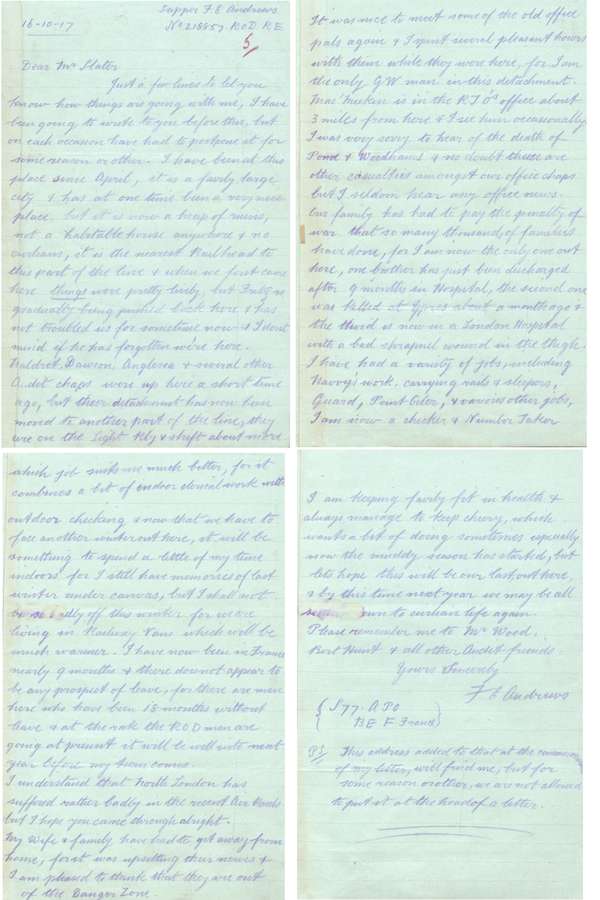
Just a few lines to let you know how things are going with me, I have been going to write to before this, but on each occasion I have had to postpone it for some reason or other. I have been at this place since April. It is a fairly large city and has at one time been a very nice place, but it is now a heap of ruins, not a habitable house anywhere and no civilians, it is the nearest railhead to this part of the line and when we first came here things were pretty lively, but Fritz is gradually being pushed back here and has not troubled us for some time now I don’t mind if he has forgotten we’re here. Naldrett, Dawson and Anglesey and several other Audit chaps were up here a short time ago, but their detachment has now been moved to another part of the line, they are on the Light Railway and shift about more.
It was nice to meet some of the old office pals again and I spent several pleasant hours with them while they were here, for I am the only G.W. man in this detachment. McMeeken is in the Railway Transport Officer’s office about three miles from here and I see him occasionally. I was very sorry to hear of the deaths of Pond and Woodhams and no doubt there are other casualties amongst our office chaps but I seldom hear any office news. Our family has had to pay the penalty of war that so many thousands of families have done, for I am now the only one out here, one brother has just been discharged after nine months in hospital, the second one was killed at Ypres about a month ago and the third is now in a London hospital with a bad shrapnel wound in the thigh. I have had a variety of jobs, including navvy’s work, carrying rails and sleepers, guard, point oiler and various other jobs. I am now a checker and number taker which job suits me much better, for it combines a lot of indoor clerical work with outdoor checking and now that we have to face another winter out here, it will be something to spend a little of my time indoors for I still have memories of last winter under canvas, but I shall not be so badly off this winter for we are living in railway vans which will be much warmer. I have now been in France nearly nine months and there does not appear to be any prospect of leave, for there are more here who have been eighteen months without leave and at the rate the R.O.D. men are going at present it will be well into next year before my turn comes.
I understand that north London has suffered rather badly in the recent air raids but I hope you came through all right. My wife and family have had to get away from home, for it was upsetting their nerves and I am pleased to think that they are out of the danger zone. I am keeping fairly fit in health and always manage to keep cheery, which wants a bit of doing sometimes especially now the muddy season has started, but let’s hope this will be our last out here and by this time next year we may be all settling down to civilian life again. Please remember me to Mr Wood, Bert Hunt and all other Audit friends. Yours sincerely
F.E. Andrews…
Letter from Frederick Ernest Andrews, 16 October 1917, France. Catalogue reference: RAIL 253/516
Listen
Frederick Ernest Andrews – we are living in the railway vans:
Dear Mr Slater
Just a few lines to let you know how things are going with me, I have been going to write to before this, but on each occasion I have had to postpone it for some reason or other. I have been at this place since April. It is a fairly large city and has at one time been a very nice place, but it is now a heap of ruins, not a habitable house anywhere and no civilians, it is the nearest railhead to this part of the line and when we first came here things were pretty lively, but Fritz is gradually being pushed back here and has not troubled us for some time now I don’t mind if he has forgotten we’re here. Naldrett, Dawson and Anglesey and several other Audit chaps were up here a short time ago, but their detachment has now been moved to another part of the line, they are on the Light Railway and shift about more.
It was nice to meet some of the old office pals again and I spent several pleasant hours with them while they were here, for I am the only G.W. man in this detachment. McMeeken is in the Railway Transport Officer’s office about three miles from here and I see him occasionally. I was very sorry to hear of the deaths of Pond and Woodhams and no doubt there are other casualties amongst our office chaps but I seldom hear any office news. Our family has had to pay the penalty of war that so many thousands of families have done, for I am now the only one out here, one brother has just been discharged after nine months in hospital, the second one was killed at Ypres about a month ago and the third is now in a London hospital with a bad shrapnel wound in the thigh. I have had a variety of jobs, including navvy’s work, carrying rails and sleepers, guard, point oiler and various other jobs. I am now a checker and number taker which job suits me much better, for it combines a lot of indoor clerical work with outdoor checking and now that we have to face another winter out here, it will be something to spend a little of my time indoors for I still have memories of last winter under canvas, but I shall not be so badly off this winter for we are living in railway vans which will be much warmer. I have now been in France nearly nine months and there does not appear to be any prospect of leave, for there are more here who have been eighteen months without leave and at the rate the R.O.D. men are going at present it will be well into next year before my turn comes.
I understand that north London has suffered rather badly in the recent air raids but I hope you came through all right. My wife and family have had to get away from home, for it was upsetting their nerves and I am pleased to think that they are out of the danger zone. I am keeping fairly fit in health and always manage to keep cheery, which wants a bit of doing sometimes especially now the muddy season has started, but let’s hope this will be our last out here and by this time next year we may be all settling down to civilian life again. Please remember me to Mr Wood, Bert Hunt and all other Audit friends. Yours sincerely
F.E. Andrews
All letters in this collection have been transcribed, and audio versions of selected letters are available too. The documents should offer students a chance to develop their powers of evaluation and analysis. Teachers may also wish to use the collection to develop their own resources.
You may spot spelling or grammatical errors in the transcripts as we have transcribed the letters as they stand. However, we have not included full digital images for several letters as these would have proved too difficult to read online. In such cases we have shown part of the letter in order to provide a sense of the original.
Within this online resource and the other resources in this series it is possible to find more than one letter from the same person, or find references within the letters to those who have written. For this reason is it is helpful to see the letters as a whole group to get the most out of them and appreciate the nature of the collection.
The Great Western Railway Company formed four companies of Royal Engineers as many men from the company, including these clerical workers from Paddington, had enlisted to serve. Due to their knowledge and understanding of the railways, many became Railway Troops based at railheads.
Unsurprisingly, in the letters many men showed a keen interest in all matters connected with railways or engines, including other Great Western Railway ‘fellows’ and the Great Western Railway Magazine. Some soldiers mentioned having received the magazine or asked for it to be sent out. It included photographs of all those who served in the First World War from the GWR as a whole and employees could catch up on company business and or news of sporting or social events.
‘Our family has had to pay the penalty of war that so many thousands of families have done, for I am now the only one out here’
These few words, written by Frederick Ernest Andrews on 16 October 1917 from France, come from this collection of letters from staff at the Audit office for the Great Western Railway (GWR) based at Paddington, London.
What makes this collection of soldiers’ letters so different from all others is the fact that it reveals the stories of a particular group of men who varied in class and education, who were writing back to their colleagues and bosses in the office while on active service during in the First World War. Many men enlisted from the GWR to fight, but these letters come exclusively from those worked at its Audit office. Staff at Paddington covered a range of different roles in insurance, accounting or ticketing for the Great Western Railway.
The letters belong to the RAIL series (which includes the records of the railway companies) at The National Archives. They are arranged in 12 carefully bound folders, rather like a series of scrapbooks. Starting from August 1915, each part represented what was known as the office newsletter, a collection of letters, photographs postcards, field cards and contemporary newspaper cuttings from those who had gone to fight. Every newsletter opened with a news section listing those who had written and sent photos to the office and those who recently left to company to serve at the front. The totals of all men in khaki from the Audit office were given too. The news section also provided information about those who had died, been injured, visited the office on leave or been promoted. The newsletters were circulated within the office departments and read by men when they came home on leave. Friends or relatives who had been sent their own letters or photographs often lent them or typed them out to be circulated as part of the regular Audit office newsletter.
The Audit office raised enough money through collections and the sale of Christmas cards, to create a temporary roll of honour for the office at Paddington to commemorate those who had fallen in battle by August 1915. Photographs of the Roll of Honour were sent out to several employees as their correspondence reveals.
After the war had ended and troops had returned, the GWR was able to quantify the contribution that it had made to the cause. The contribution made by the Audit office was high: 55.5% of male staff enlisted, whereas the average rate of enlistment across the GWR was 32.6%. This amounted to 184 men, 17 of whom lost their lives.
On 11 November 1922, The Great Western Railway War Memorial, dedicated to all 2,524 staff who had died in battle was unveiled on platform 1, Paddington station.
Teaching resource
The letters collected here were all written from the trenches between 1914 and 1915. They are part of a series of connected teaching resources.
Teaching resource

These letters, sent from the trenches on the Western Front, date from 1916–1918. They are part of a series of connected teaching resources.
Teaching resource
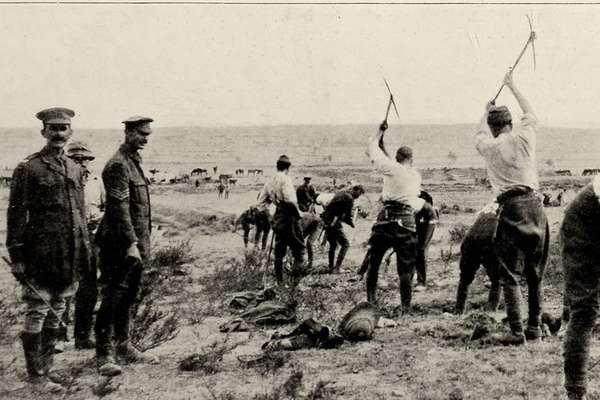
This collection of records, part of our series on letters from the First World War, features soldiers posted to India, Greece, Turkey and Malta.
Teaching resource
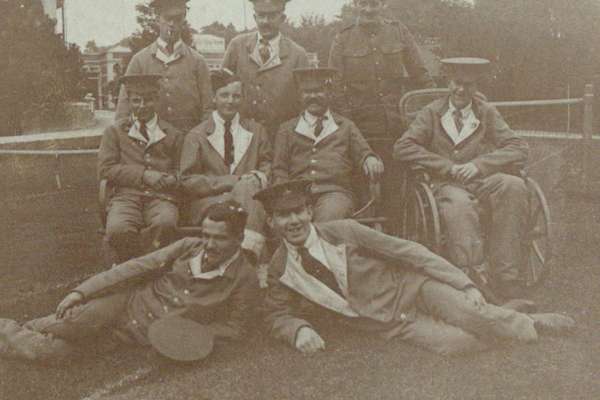
This collection from our Letters from the First World War teaching resource series features letters that relate to soldiers' experience of medical treatment.
Teaching resource

These letters and transcripts, part of a series of connected resources, relate to soldiers' experience of training in England before they were sent abroad.