


Teaching resource
Letters from the First World War: The trenches, part one
The letters collected here were all written from the trenches between 1914 and 1915. They are part of a series of connected teaching resources.
Teaching resource
This collection from our Letters from the First World War teaching resource series features letters that relate to soldiers' experience of injury and medical treatment.

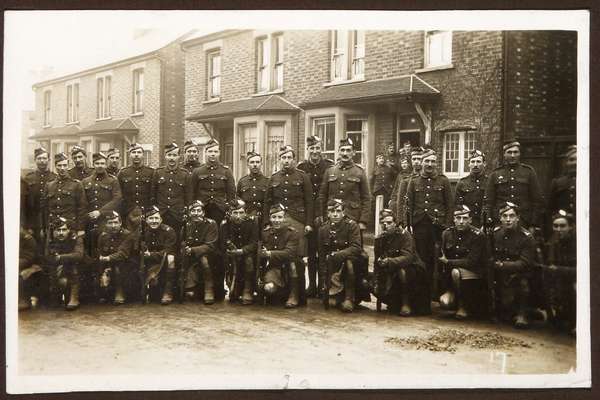
Photograph of a group of soldiers, which was labelled 'A. E. Rippington'. Catalogue reference: RAIL 253/516
These are some of the many letters sent by staff of the Great Western Railway Audit office at Paddington who had enlisted to fight in the First World War.
You can discover more letters from the First World War in our collections about Different fronts, Railheads, Training, The trenches, part one and The trenches, part two.

Dear Effie,
You were doubtless surprised to get a postcard from up here, don’t know why they sent us such a long way north, it is alright but I think London would have suited me better, could have seen my pals sometimes. I am not allowed to get out of bed yet, tried the other night and fell down in a fit serves me right for disobeying orders. I have the piece of shell which fractured my skull and shall look after it for a souvenir. The doctors say I was very lucky not to have been put right out. It was a heavy piece (British) would not have been wounded by anything less. We were in an advanced post sticking beyond our front line called the “Duck’s Bill” and naturally pretty close to the German trenches. In fact they surrounded us… [Lines censored]
I hear from Bedford that the company has been told to prepare for the Dardanelles. I don’t know where he is though, have heard nothing from him. We are having a concert with our ward this afternoon and we have plenty of visitors in every afternoon, some very fair women taking them generally, and very decent too, treat everybody alike. Remember me kindly to Mrs Lewis. I shall make a more determined attempt to see you if I get a sick leave which is most probable. Well, have no more news at present. How about taking up a post in your department when this lot is over, it would suit me to have headquarters in London for a time, mustn’t count chickens though. Goodbye Old boy,
regards,
Billy
Letter from William Albert Hastings, 4 October 1915, Northumberland War Hospital, Newcastle. Catalogue reference: RAIL 253/516

Dear Father,
I do hope you and mother have not been worrying much about me as I am getting on all right. My wound is well now and the broken bone is my only trouble- the two ends took the wrong turning first time so a couple of days ago they put them on the right road again. I ought not to be left with a short leg as there is about 40lb weight on the end of it, in fact I should not be surprised if it finishes off ahead of the other. One good thing is I get very little pain except when I am moved.
Did you get my postcard? I haven’t had an answer yet but expect letters take a long while. I believe I asked you to send me some fruit but as things take such a long while to get here I am afraid it would be bad, besides they take French money here, and as I drew £5 from the Field Cashier only a few days before I was wounded I am quite well off and the orderly will buy fruit for me in the town.
I expect you are surprised to get a letter when I said on the post card that I should only be allowed to write once from this hospital, but a fresh order has come out and one letter a month is allowed.
Well, I have written quite enough about myself I think. I am longing to get a letter from you and mother, it seems ages since I heard from you. Have you taken a house in Uxbridge yet or are you waiting until Auntie and Uncle move there. I do hope you are getting a little more used to the lonely house. Please remember me to everybody and give my love to all relations next time you write and tell them I should like to hear from them if they would write although I shan’t be able to answer their letters. Have you heard how Frank is getting on, I meant to write him but put it off too long.
I expect my kit has been sent home, hasn’t it? I am afraid your field glasses are lost as I left my equipment in the wood when I was hit. I am awfully sorry if they are but perhaps one of the men picked them up. I arrived here with only one boot and only one puttee, so will you send me a pair of puttees and a tie out of my kit. I shall be supplied with boots when I leave here, which won’t be for a while I expect. One thing I shall be very glad to get will be some books.
We are very well treated here, and the Belgian sisters from the convent are very good and often bring us grapes or apples.
I didn’t get a very long run for my money, did I? It is rotten being out of the show, not that I wanted the war to last long, far from it, but while it was on I liked to have a finger in the pie, but it is no good grumbling and the best thing to do is to hope it will soon be over so that I can soon be home with you both again. Please give my kind regards to Kate. Very best, love to you both. Cheer up and don’t worry about me.
Your loving son, (2nd Lieutenant Mayo)
Charlie.
P.S. I hope you can read this, it is awkward writing lying down.
Letter from Charles Douglas Mayo, 22 October 1915, Courtrai, Belgium. Catalogue reference: RAIL 253/516

Dear Ernie,
Thanks very much for your letter and kind wishes. My wounds are getting on all right and they have discovered eleven in all. It is hard not to be able to get up, but I suppose a month will soon be slip by. My people came to see me yesterday and the day before.
You ought to see my face. They cannot shave me because I have scraps of shell sticking in, and as I had not had a shave for about a week before I was wounded, I look a pretty picture.
Well old chap, I am glad I am wounded to get out of that hell, and if you ever meet a chap that says he wants to go back call him a liar.
If you could manage to come down at any time I should be delighted. I have not received any letter from Dalton but perhaps will get it later. That will be the time old chap when I look into the office on my way home. We’ll manage to get a drink then. Well I must close now and I expect you will have quite enough trouble to read what I have written already. Hoping to be with you all,
Your old pal, Rip.
Letter from Albert Edwin Rippington, undated, England. Catalogue reference: RAIL 253/516

Dear Gerald,
No doubt, perhaps you had thought I had forgotten old friends at Paddington, but such is not the case. We so not have much spare time for letter writing now. To tell you of all our adventures since we left England would take too long here to relate but I will save for when I come home. Perhaps you have heard, we were only at Farnborough four days, before we were sent over there. By God, old chap we did have a time of it, the first fortnight. Living on bully beef and biscuits, travelling day and night and sleeping anywhere and doing long tramps with full kit on nearly done us in as we had no training. We managed to stick it through, but I thought poor Percy Smith would have to give in as he was very queer with toothache. The first six weeks we moved about from place to place doing all sorts of fatigue work, bar our own. Lambert, Smith, Collins and myself are now settled down in H— the place where Mr Laker’s son was so long at. Collins and Lambert have been fortunate enough to get temporary clerical work during the last months.
I was promised one when on the 17th of last month I was wounded by a bomb from a taube which landed clean through our billet at 12 o’clock at night, when we were all sound asleep. I caught it in the thigh, but luckily it was only a flesh wound, but I had some awful bruises from the debris which fell on it. I have been in hospital ever since at the base, but I am pleased to say I am now nearly well again and in a convalescent camp three miles from there, overlooking the sea. We are not allowed to put our address at the heading of a letter so I will put it here:
2AM /W.P. Mansbridge No.16929, Royal Flying Corps No. G 21 Hut no. 6 Convalescent Depot, A.P.O. S.17, British Expeditionary Force. After I am discharged from here, I shall be sent up to the base and then up the line with the “best of luck” as the Tommies say out here. I am hoping to get back to H— as I was so happy and with such decent fellows there, but I don’t think it probable. Lambert, Smith and myself, often used to talk of old times and wondered how things were at Paddington. I daresay Gerald, there are not many young fellows left in the Audit are there, has Mr Horsley gone? Do drop me a line when you have time, as I assure you old boy, it is a real treat to hear Paddington news. I have never felt in better health, army life certainly agrees with me also with Lambert. Billy Button is at headquarters, got a cushy job. I believe I saw him once there, but I have no idea where the other G.W. fellows are. I am afraid I am not very fluent with my French yet, I could have done with your services on several occasions. How are Mr Slater and other members of the Stats. (or is that department disbanded?) Please remember kindly to them. (Lines censored)
Cannot stop to write more now as I am just off to a concert in the Y.M.C.A. hut in the camp here. (Lines censored)
Yours very sincerely
Dick Mansbridge
P.S. I am only about 12 miles from where you used to go to, so perhaps you can guess the place I am at, E- – – – – s. [Etaples]. Do you ever hear anything of the other boys out here?
Letter from William Perrin Mansbridge, 17 March 1916, France. Catalogue reference: RAIL 253/516

Dear Mr Hunt,
Many thanks for your most welcome and interesting letter safely received, and I am pleased to hear of the latest news about friends at the office and others in different parts of the world.
I have not had a line from H. Martin for many months, but I hear he has had leave recently, and no doubt he gave you a call. I hoped to have had that pleasure before this time, but I expect to be seeing you one of these fine days.
I am still a patient in hospital, and although at times the life is monotonous in this quiet place, it is preferable to France so I won’t grumble. The weather has been so rough and wild of late, that a lot our time is spent by the fireside, and many pleasant hours are passed in comparing notes with men who are patients from minesweepers.
We have had different men from this branch of the Navy for several weeks, and at present five are in my ward. Two of these are survivors from a minesweeper that was blown up by a German mine nearly a fortnight ago, just outside Dartmouth Castle. They are still clearing the sea outside here and the boats return to anchor in the river at night, and the pals of these men visit them this evening. The officers are also very good in calling and leaving gifts and the wounded Tommies share in the fruits thereof!
I have heard from Scotland that the 8th Argylls suffered heavily a short time ago in France, and in the newspapers today I notice the names of nine officers who I knew in France, including the Captain of my company who is killed. I don’t know if the 6th Seaforths, who are in the same brigade, were in action at the same time, but I shouldn’t be surprised, anyhow I hope [Gilbert] Williams came through safely if he was there.
I am enclosing two privilege forms, and will be glad if you will get them signed and returned. I have had some nice afternoons at Torquay and Paignton and was there during the rough weather a short time ago, when the Brixham trawler was wrecked and sea was so rough.
I hope this letter will find you very well and undisturbed at the old job. With kind regards to Messrs Taylor, Symons, and Woodhams and accept the same yourself.
Sincerely yours, ‘Frosty’.
Letter from R.C.S. Frost, 23 November 1916, Dartmouth, England. Catalogue reference: RAIL 253/516

Dear Sir,
I expect you wonder what has become of me as you have not heard from me for such a long time. The reason is that since the 20th September I have been suffering with enteric [typhoid]. The exact diagnosis of my case being para typhoid B. I have not been up three weeks until next Friday, but since I first got out of bed I have made splendid progress. I was in an isolation hospital in France for six weeks and previous to that in a General Hospital for eight days. I arrived here late last Wednesday night after a very decent journey. This is a beautiful palace surrounded by a park in which we can walk about and we are allowed to go to the post office which is quite near. I am quite happy and comfortable here, it is a splendid hospital. We have a concert or cinema nearly every night in the big hall. Food is good and plentiful. How long it will be before I am considered fit again I have no notion, as a rule it takes months for a person to get right again.
It is a very funny and beastly complaint. During to the whole time I have been in hospital I have received every attention and kindness. During the months of July and August when I was in the Somme district I had a very rough time, was nearly worked to death and had little sleep. At one period we had to commence work at 2am but we were supposed to rest in the day but we could not get any. However, it was all in a good cause and we got through it. Ambulance trains were loaded up at the station where I was and we saw some awful sights. English and German wounded. Perhaps I picked my fever up at this place, but one never knows. While I was in the isolation hospital in France I was kept for three weeks and two days on liquids but I am pleased to say that the doctor has now put me on ordinary diet. With the kindest regards and best wishes to all, I remain yours obediently.
A. Smith
Letter from Arthur Smith, 19 November 1916, Addington Park War Hospital, England. Catalogue reference: RAIL 253/516
Listen
Hospitals – beastly complaint:
Dear Sir,
I expect you wonder what has become of me as you have not heard from me for such a long time. The reason is that since the 20th September I have been suffering with enteric (typhoid). The exact diagnosis of my case being para typhoid B. I have not been up three weeks until next Friday, but since I first got out of bed I have made splendid progress. I was in an isolation hospital in France for six weeks and previous to that in a General Hospital for eight days. I arrived here late last Wednesday night after a very decent journey. This is a beautiful palace surrounded by a park in which we can walk about and we are allowed to go to the post office which is quite near. I am quite happy and comfortable here, it is a splendid hospital. We have a concert or cinema nearly every night in the big hall. Food is good and plentiful. How long it will be before I am considered fit again I have no notion, as a rule it takes months for a person to get right again.
It is a very funny and beastly complaint. During to the whole time I have been in hospital I have received every attention and kindness. During the months of July and August when I was in the Somme district I had a very rough time, was nearly worked to death and had little sleep. At one period we had to commence work at 2am but we were supposed to rest in the day but we could not get any. However, it was all in a good cause and we got through it. Ambulance trains were loaded up at the station where I was and we saw some awful sights. English and German wounded. Perhaps I picked my fever up at this place, but one never knows. While I was in the isolation hospital in France I was kept for three weeks and two days on liquids but I am pleased to say that the doctor has now put me on ordinary diet. With the kindest regards and best wishes to all, I remain yours obediently.
Arthur Smith
All letters in this collection have been transcribed, and audio versions of selected letters are available too. The documents should offer students a chance to develop their powers of evaluation and analysis. Teachers may also wish to use the collection to develop their own resources.
You may spot spelling or grammatical errors in the transcripts as we have transcribed the letters as they stand. However, we have not included full digital images for several letters as these would have proved too difficult to read online. In such cases we have shown part of the letter in order to provide a sense of the original.
Within this online resource and the other resources in this series it is possible to find more than one letter from the same person, or find references within the letters to those who have written. For this reason is it is helpful to see the letters as a whole group to get the most out of them and appreciate the nature of the collection.
The Great Western Railway Company formed four companies of Royal Engineers as many men from the company, including these clerical workers from Paddington, had enlisted to serve. Due to their knowledge and understanding of the railways, many became Railway Troops based at railheads.
Unsurprisingly, in the letters many men showed a keen interest in all matters connected with railways or engines, including other Great Western Railway ‘fellows’ and the Great Western Railway Magazine. Some soldiers mentioned having received the magazine or asked for it to be sent out. It included photographs of all those who served in the First World War from the GWR as a whole and employees could catch up on company business and or news of sporting or social events.
‘Our family has had to pay the penalty of war that so many thousands of families have done, for I am now the only one out here’
These few words, written by Frederick Ernest Andrews on 16 October 1917 from France, come from this collection of letters from staff at the Audit office for the Great Western Railway (GWR) based at Paddington, London.
What makes this collection of soldiers’ letters so different from all others is the fact that it reveals the stories of a particular group of men who varied in class and education, who were writing back to their colleagues and bosses in the office while on active service during in the First World War. Many men enlisted from the GWR to fight, but these letters come exclusively from those worked at its Audit office. Staff at Paddington covered a range of different roles in insurance, accounting or ticketing for the Great Western Railway.
The letters belong to the RAIL series (which includes the records of the railway companies) at The National Archives. They are arranged in 12 carefully bound folders, rather like a series of scrapbooks. Starting from August 1915, each part represented what was known as the office newsletter, a collection of letters, photographs postcards, field cards and contemporary newspaper cuttings from those who had gone to fight. Every newsletter opened with a news section listing those who had written and sent photos to the office and those who recently left to company to serve at the front. The totals of all men in khaki from the Audit office were given too. The news section also provided information about those who had died, been injured, visited the office on leave or been promoted. The newsletters were circulated within the office departments and read by men when they came home on leave. Friends or relatives who had been sent their own letters or photographs often lent them or typed them out to be circulated as part of the regular Audit office newsletter.
The Audit office raised enough money through collections and the sale of Christmas cards, to create a temporary roll of honour for the office at Paddington to commemorate those who had fallen in battle by August 1915. Photographs of the Roll of Honour were sent out to several employees as their correspondence reveals.
After the war had ended and troops had returned, the GWR was able to quantify the contribution that it had made to the cause. The contribution made by the Audit office was high: 55.5% of male staff enlisted, whereas the average rate of enlistment across the GWR was 32.6%. This amounted to 184 men, 17 of whom lost their lives.
On 11 November 1922, The Great Western Railway War Memorial, dedicated to all 2,524 staff who had died in battle was unveiled on platform 1, Paddington station.
Teaching resource
The letters collected here were all written from the trenches between 1914 and 1915. They are part of a series of connected teaching resources.
Teaching resource

These letters, sent from the trenches on the Western Front, date from 1916–1918. They are part of a series of connected teaching resources.
Teaching resource
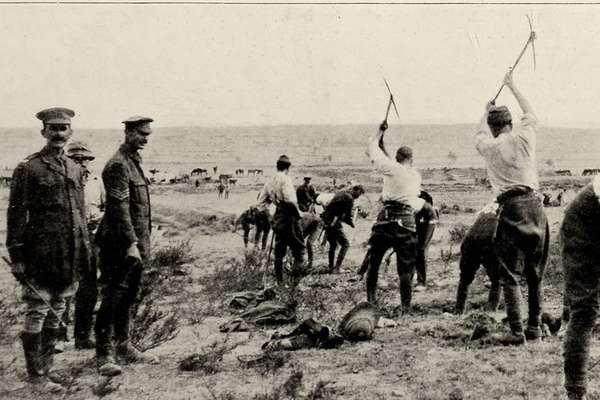
This collection of records, part of our series on letters from the First World War, features soldiers posted to India, Greece, Turkey and Malta.
Teaching resource

Letters in this collection relate to soldiers' experience at the railheads on the Western front. Part of series of resources on First World War letters.
Teaching resource

These letters and transcripts, part of a series of connected resources, relate to soldiers' experience of training in England before they were sent abroad.