
















Teaching resource
Letters from the First World War: The trenches, part one
The letters collected here were all written from the trenches between 1914 and 1915. They are part of a series of connected teaching resources.
Teaching resource
This collection of records, part of our series on letters from the First World War, features the correspondence of soldiers who were posted further afield than the Western Front. It includes locations such as Malta, Turkey, India and Greece.

Photograph labelled 'Excavating new dugouts at the Dardanelles'. Catalogue reference: RAIL 253/516
These are some of the many letters sent by staff of the Great Western Railway Audit office at Paddington who had enlisted to fight in the First World War.
You can discover more letters from the First World War in our collections about Hospital, Railheads, Training, The trenches, part one and The trenches, part two.
Beaumont was a member of volunteer army as a young man. He was a life governor of Richmond Hospital, London and held an MBE (Military Division).

Dear Mr Wheeler
Just a few lines to let you know of my whereabouts. This is our fifth Sunday at sea. We left Southampton on Thursday October 29th shortly before midnight and our convoy of ten huge liners each with about 1700 to 2000 territorial troops on board assembled in the English Channel early next morning.
We were escorted by British warships as far as our first port of call- Malta the French warships to Port Said. After staying one night there we proceeded through the Suez Canal. We lay off the Port of Suez six days waiting for another escort then on through the Red Sea to Aden where we stayed four days waiting for our Japanese escort. When it arrived it brought with it an immense convoy of over 80 huge liners transports filled with New Zealand and Indian troops. This in addition to a convoy of thirty five vessels that came into Suez whilst we lay there. So it may truly be sung that “Britannia rules the waves.”
It has been a most delightful and interesting voyage and the weather is now so hot that hundreds of troops are compelled to sleep on deck nightly as the heat is much too great below. We landed two cases of fever at Aden. Fortunately it does not appear to have spread any further so far.
We expect to reach Bombay on Wednesday next, December 2nd then three or four days’ train journey to Fyzabad, some distance north of Lucknow. Shall be very glad to get there, as five weeks on board a crowded troop ship with very little opportunity for exercise is getting rather irksome, especially, when we get no ‘Daily Paper’, only a little wireless war news, occasionally.
I am glad to say that I am wonderfully fit and well. Our food has been wholesome and plentiful. Trusting you are well, with my best wishes for as Happy a Christmas as is possible under prevailing war conditions, and a Prosperous New Year in due course. Also please convey same to Messrs Wood, Welsh, Davis and others. Hoping to see you again on the termination of our successful conclusion of the war.
Believe me, yours faithfully,
H. Beaumont
Will you also convey my respects to Mr Price please?
Letter from Harry Beaumont, 29 November 1914, SS Grantully Castle (Beaumont was travelling on a troop ship sailing in convey out to India). Catalogue reference: RAIL 253/516

Dear Arthur,
I expect you are wondering why I have not written, but it is an awful effort to get all correspondence off, and be on active service at the same time. I can’t say that I am enjoying myself out here. It’s awfully hot, and we are eaten up by millions of flies. Life in the trenches is not a picnic either we have about four or five days out of them and eight or nine in them. When we are out supposed to be resting, we have to go on working parties, digging etc., then wherever we are, we are always under shell fire, so it’s not much rest after all. The last shell we had in camp, there was four killed and seventeen wounded.
We have been under fire for three months now, and we should like a rest as the strain is tremendous on one’s nerves. I don’t think the troops in France get it quite as bad. Then again, the only comforts we have are sent from home, as the country here is quite barren, and we cannot buy anything in shops, I would give a quid for a pint of beer down the club. Our food consists of half a loaf of bread per day, bacon and tea for breakfast, Bully beef and biscuits for dinner and Jam for tea and cheese. Lime juice is served out about four times per week, that is a drop is put into a dixie of water and a cup full served out per man, and rum is served out twice a week (sometimes) that is about four table spoonful each.
We live in a trench and it is a mercy it don’t rain otherwise we’d be washed away. The fighting just lately has been terrible. Our shells knock the enemy all ways and the sight in the trenches that we take is awful. We wear our respirators because of the awful smell of the dead. I’ll never get the sight out of my eyes, and it will be an everlasting nightmare. If I am spared to come home, I’ll be able to tell you all about it, but I cannot possibly write as words fail me. I can’t describe things.
Wouldn’t it be nice to be at Walmer again and you come down and see me again, I did enjoy that time, and also seeing Billy Dawson and Richardson. There seem to be a lot of French troops out here, but there seems to be no relief for us. Nobody loves us now Churchill has gone, we are nobody’s pets. It’s the army first here, except when there is work to be done, and then the Naval Division have to do it. You know both my brothers have commissions in the 4th Bedfordshires and are at Dovercourt. My wife tells me she has sent me three boxes of stuff, I received one box, and I fear that one transport has been floundered [sunk] and another has been torpedoed, so I expect that is where my other two boxes are. It’s awfully disappointing because I do look forward so to a bit of chocolate and a few biscuits from home. We get cigarettes and baccy served out to us, but it is too hot to smoke much, so that I don’t miss that so much. I get a bath in a biscuit tin when I can, but when in the trenches I have to go all the time without a wash, so you can tell I am used to being dirty.
How are they all down the club, and is Emmie still there, and is she better or not? Is Paice going to Looe this year? And where are you spending your holidays? Lord how I’d like a holiday, I am so tired and would give anything to get away from this continual banging.
Please remember me to all fellows who are left in the office. Mr Miller and Goff & Hills and George Williams, and all the boys generally. I can’t write to all separately, also for details of my experiences you must wait until I get back, if ever I do, of which sometimes I despair.
The papers tell you pretty full accounts, although they are rather anticipating events as to our advancing. Now I must close old chap, and thank you very much for all your kindness. Wishing you all the best
Yours very sincerely,
Harold Watts.
Photo caption: Excavating new dug-outs at the Dardanelles.
Letter from Thomas Harold Watts, 18 June 1915, Dardanelles, Turkey. Catalogue reference: RAIL 253/516
Listen
Thomas Harold Watts, Dardanelles – ‘an everlasting nightmare’:
Dear Arthur,
I expect you are wondering why I have not written, but it is an awful effort to get all correspondence off, and be on active service at the same time. I can’t say that I am enjoying myself out here. It’s awfully hot, and we are eaten up by millions of flies. Life in the trenches is not a picnic either we have about four or five days out of them and eight or nine in them. When we are out supposed to be resting, we have to go on working parties, digging etc., then wherever we are, we are always under shell fire, so it’s not much rest after all. The last shell we had in camp, there was four killed and seventeen wounded.
We have been under fire for three months now, and we should like a rest as the strain is tremendous on one’s nerves. I don’t think the troops in France get it quite as bad. Then again, the only comforts we have are sent from home, as the country here is quite barren, and we cannot buy anything in shops, I would give a quid for a pint of beer down the club. Our food consists of half a loaf of bread per day, bacon and tea for breakfast, Bully beef and biscuits for dinner and Jam for tea and cheese. Lime juice is served out about four times per week, that is a drop is put into a dixie of water and a cup full served out per man, and rum is served out twice a week (sometimes) that is about four table spoonful each.
We live in a trench and it is a mercy it don’t rain otherwise we’d be washed away. The fighting just lately has been terrible. Our shells knock the enemy all ways and the sight in the trenches that we take is awful. We wear our respirators because of the awful smell of the dead. I’ll never get the sight out of my eyes, and it will be an everlasting nightmare. If I am spared to come home, I’ll be able to tell you all about it, but I cannot possibly write as words fail me. I can’t describe things.
Wouldn’t it be nice to be at Walmer again and you come down and see me again, I did enjoy that time, and also seeing Billy Dawson and Richardson. There seem to be a lot of French troops out here, but there seems to be no relief for us. Nobody loves us now Churchill has gone, we are nobody’s pets. It’s the army first here, except when there is work to be done, and then the Naval Division have to do it. You know both my brothers have commissions in the 4th Bedfordshires and are at Dovercourt. My wife tells me she has sent me three boxes of stuff, I received one box, and I fear that one transport has been floundered [sunk] and another has been torpedoed, so I expect that is where my other two boxes are. It’s awfully disappointing because I do look forward so to a bit of chocolate and a few biscuits from home. We get cigarettes and baccy served out to us, but it is too hot to smoke much, so that I don’t miss that so much. I get a bath in a biscuit tin when I can, but when in the trenches I have to go all the time without a wash, so you can tell I am used to being dirty.
How are they all down the club, and is Emmie still there, and is she better or not? Is Paice going to Looe this year? And where are you spending your holidays? Lord how I’d like a holiday, I am so tired and would give anything to get away from this continual banging.
Please remember me to all fellows who are left in the office. Mr Miller and Goff & Hills and George Williams, and all the boys generally. I can’t write to all separately, also for details of my experiences you must wait until I get back, if ever I do, of which sometimes I despair.
The papers tell you pretty full accounts, although they are rather anticipating events as to our advancing. Now I must close old chap, and thank you very much for all your kindness. Wishing you all the best
Yours very sincerely,
Harold Watts.

Dear Mr Rogers,
Just a few lines to let you know I am still alive and have up to now succeeded in dodging those small pieces of lead which have been so frequently flying about the Peninsular [Dardanelles]. I expect you are wondering how I got here, also why Con. [convalescent] Camp. I will try and tell you briefly what happened since our leaving Egypt. We left Alexandria 13th August and landed at the new landing at Sulva Bay on the 18th under shell fire. Not a very nice kick off. Our first engagement was on the 21st when we took part in the big fight for Hill 70 and 971. I expect you read about it in the papers, for I see the Daily Sketch had a page full of it. They spoke of us as the Irresistable Yeomanry; very glowing words of our charge also. It was a very stiff go and we were fighting from 3pm the 21st until dark on the 22nd and never stopped advancing and retiring the whole time. We had the Hill on the night of the 21st but could not hold it, because no support was sent up, so the Yeomanry (those of us who were left) had to retire at night after charging and capturing three lines of Turkish trenches. Our Brigade (Berkshire, Buckinghamshire and Dorset Yeomanry) was ordered to do the charging for the Division and I think we did fairly well from what the General said in his report. Of course we suffered pretty heavy. After five days on the Peninsular we did not have an Officer left in our regiment, and only barely half the men. I have seen a few of our Officers in the casualty list, but no men. I was very pleased to get the GRW Magazine while resting in dugouts on Chocolate Hill. I hope no more of the Audit boys have fallen since the last I saw. I suppose you are still pretty slack in the office. I find I’ve run away from the tale, but here in the Y.M.C.A. tent it is so crowded and the piano on the go, it is rather difficult to write. After resting from the big fight three days we went into the trenches for spells of five days, on one case seven days. After five weeks I caught dysentery and had to come away. I was put on a hospital ship and brought to St. Patrick’s Hospital, Malta. During those five weeks I was pretty lucky. The only close bullet was one through my right sleeve and grazing my arm. We all have some very narrow shaves from shrapnel. I had the sandbags of my dugout knocked down one day, but fortunately I was down to get water. Probably, if I had been inside I would have caught it properly. I expect to be here about a fortnight to three weeks before I go back. I am hoping the boys will be across before that, and the Turkish army cut in two.
I suppose the office still looks more empty than it ever did. How is Mr Jackson getting on in France? I see his regiment has been in action. I have often wondered how he would get on in trench warfare. I suppose McConnel is still going strong. Will not stop for more now as I shall lose the mail. Kind regards to Mr Cox and all the men on the section. Hope you are still enjoying the best of health and still dodging the bombs. Hope to write again soon. Yours truly,
E.J. Cowles.
Letter from Ernest John Cowles, 29 September 1915, Malta. Catalogue reference: RAIL 253/516

Dear Nic,
First of all I must thank you and… the others who sent me their kind letters of sympathy in regard to my brother Sam. We all felt it very much at home and it was a great shock to our parents naturally, but it can’t be helped, as he was killed in a good cause.
I suppose you have heard how we left Bedford early on Sunday 18/7/15 and had a lovely trip down the old firm to Keyham, we were well laden and I was glad to get aboard and get to my berth in which I am very comfortable with two other Warrant Officers. The men and Sergeants are on the troop deck and none too comfortable but are jogging along alright now.
The first part of the voyage the sea was very quiet, we passed Gibraltar in a fog at night, so couldn’t see it. We then skirted the coast of Algeria and had a pleasant run to Malta where we stopped a full day. The higher officials went ashore for a few hours (including myself) and had a good time. I cannot mention troops or ships so refrain from doing so but there was a hell of a lot.
Our next stop was Alexandria for three days, where we had another look round including a route march for the Battalion. The sea is fairly rough at this end, rather surprising, but a lovely colour, light blue at day and dark at night. All lights out at 8.00, perfect darkness, there is no twilight to speak of, being dark at 7.30pm.
We then wondered where we were off to but eventually reached Port Said, stopped a day, went ashore, and off we go to the Dardanelles which we expect to reach tonight.
Our kits have been left behind in Egypt and all we have got we stand in. We are now passing through the Aegean sea, full of rocky islands, very much like the highlands of Scotland. Bullen has just lost his helmet over the side, but is otherwise well…
I am in the best of health at present and hope to go through alright. I expect you heard I got married a week before I left, a lot of us did the same thing, it was quite a common occurrence.
Our old boat is a captured German liner and is full up but we have got a Greek crew with a few Portuguese thrown in and so are a mixed lot, especially with Welsh men aboard. How are things going at the office, I have been away nearly a year… I shall be glad to hear from you now and again just to keep in touch… I must close now as they say a mail is being collected before we land… Yours sincerely,
George
Letter from George Shipley, 6 August 1915, at sea on route to the Dardanelles, Turkey. Catalogue reference: RAIL 253/516
Listen
George Shipley, Dardanelles – ‘got married a week before’:
Dear Nic,
First of all I must thank you and… the others who sent me their kind letters of sympathy in regard to my brother Sam. We all felt it very much at home and it was a great shock to our parents naturally, but it can’t be helped, as he was killed in a good cause.
I suppose you have heard how we left Bedford early on Sunday 18/7/15 and had a lovely trip down the old firm to Keyham, we were well laden and I was glad to get aboard and get to my berth in which I am very comfortable with two other Warrant Officers. The men and Sergeants are on the troop deck and none too comfortable but are jogging along alright now.
The first part of the voyage the sea was very quiet, we passed Gibraltar in a fog at night, so couldn’t see it. We then skirted the coast of Algeria and had a pleasant run to Malta where we stopped a full day. The higher officials went ashore for a few hours (including myself) and had a good time. I cannot mention troops or ships so refrain from doing so but there was a hell of a lot.
Our next stop was Alexandria for three days, where we had another look round including a route march for the Battalion. The sea is fairly rough at this end, rather surprising, but a lovely colour, light blue at day and dark at night. All lights out at 8.00, perfect darkness, there is no twilight to speak of, being dark at 7.30pm.
We then wondered where we were off to but eventually reached Port Said, stopped a day, went ashore, and off we go to the Dardanelles which we expect to reach tonight.
Our kits have been left behind in Egypt and all we have got we stand in. We are now passing through the Aegean sea, full of rocky islands, very much like the highlands of Scotland. Bullen has just lost his helmet over the side, but is otherwise well…
I am in the best of health at present and hope to go through alright. I expect you heard I got married a week before I left, a lot of us did the same thing, it was quite a common occurrence.
Our old boat is a captured German liner and is full up but we have got a Greek crew with a few Portuguese thrown in and so are a mixed lot, especially with Welsh men aboard. How are things going at the office, I have been away nearly a year… I shall be glad to hear from you now and again just to keep in touch… I must close now as they say a mail is being collected before we land… Yours sincerely,
George

Dear Arthur,
I really must make this effort to write to you and let you know how I am progressing. Well so far as a little internal trouble I’m keeping fairly fit now that the cold weather has started, and on my present job I can doctor myself, I am prepared to stick this campaign until further orders.
We are now in our winter quarters and a very nice place it is. Right on the edge of the cliffs, with a beautiful sea below, it reminds me very much of Cornwall. Then just across is the island of Imbros, and the sunlight on those mountains is sometimes marvellous. On a quiet, warm day, with the birds singing, one wonders if there is a war on, but the blooming shells soon drive that idea away. It’s jolly cold now though, but we have been served out with nice thick underclothes, and waterproofs, and top boots and except for always living in the ground, our comforts have been looked after as far as possible. Our food is as good as anyone could want, also I’m now used to a lot that before I’d turn my nose up at, and so long as the ships can land the goods I don’t think we shall be so badly off.
Mind it does blow, and the sea gets awfully rough and then no ships can come near us. We have the sea on three sides and the Turks on the fourth, so we are truly between the devil and the deep sea. The Turks still find some ammunition from somewhere whether our guns and the warships knock the very dickens out of them. It’s very exciting to watch a battle especially now it’s on our side the guns are not like at Antwerp where we were the ones potted. Now I am too sleepy to continue and as the firing has quieted down I’m going to sleep and continue tomorrow.
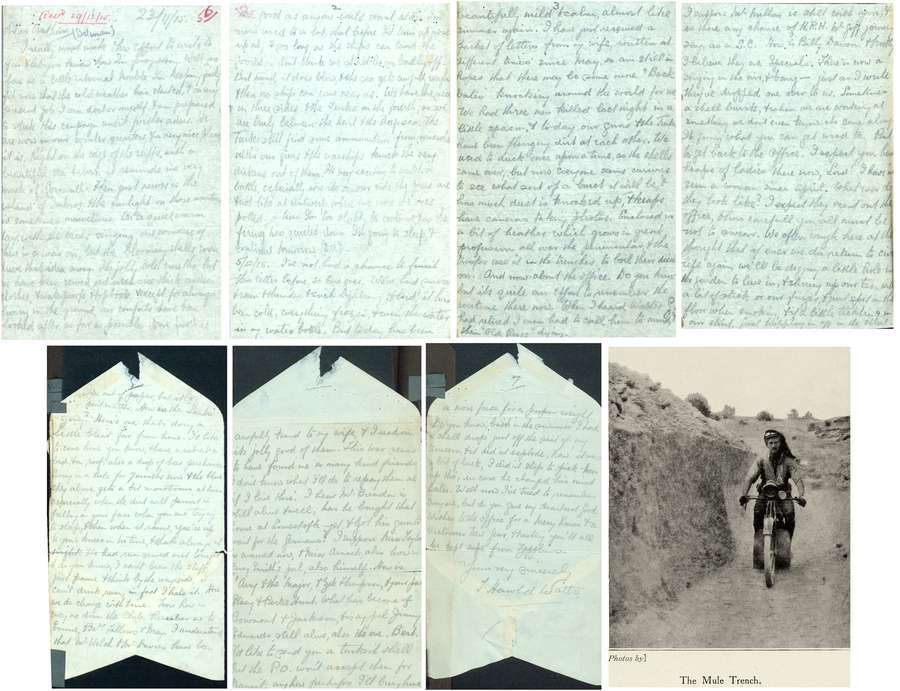
5/12/15. I’ve not had a chance to finish this letter before, so here goes. We’ve had snow and rain and thunder and such lightening, and Lord it has been cold, everything frozen and even the water in my water bottle. But today has been beautifully mild and calm, almost like summer again. I have just received a packet of letters from my wife, written at different times since May, so am still in hopes that there may be some more back dates knocking around the world for me. We had three men killed last night in a little spasm, and today our guns and the Turks have been flinging dirt at each other. We used to duck once upon a time, as the shells came over, but now everyone seems curious to see what sort of a burst it will be and how much dust is knocked up, and heaps have cameras taking photos.
Enclosed is a bit of heather which grows in great profusion all over the peninsular. And the troops use in the trenches to boil their dixies on. And now about the office. Do you know but, it’s quite an effort to remember the routine now…
I suppose Mr Millow is still with you and is there any chance of H.R.H. Goff joining say as a S.C. (probably Senior Clerk)? There is now a singing in the air and bang just as I write they’ve dropped one over to us. Sometimes a shell bursts, and when we are working at something we don’t even know it’s come along. It’s funny what you can get used. But to get back to the office. I expect you have heaps of ladies there now, lord I haven’t seen a woman since April. What do they look like? I expect they scent out the office, and how careful you all must be not to swear. We often laugh here at the thought that if ever we do return to civil life again, we’ll be digging a little hole in the garden to live in and stirring up our tea with a bit of stick or our finger and just spit on the floor when smoking and if a little tickling in our shirt, just hopping it off in the street.
Letter from Thomas Harold Watts, 23 November 1915, Dardanelles, Turkey. Catalogue reference: RAIL 253/516
Listen
Thomas Harold Watts, Dardanelles – ‘heaps have cameras taking photos’:
Dear Arthur,
I really must make this effort to write to you and let you know how I am progressing. Well so far as a little internal trouble I’m keeping fairly fit now that the cold weather has started, and on my present job I can doctor myself, I am prepared to stick this campaign until further orders.
We are now in our winter quarters and a very nice place it is. Right on the edge of the cliffs, with a beautiful sea below, it reminds me very much of Cornwall. Then just across is the island of Imbros, and the sunlight on those mountains is sometimes marvellous. On a quiet, warm day, with the birds singing, one wonders if there is a war on, but the blooming shells soon drive that idea away. It’s jolly cold now though, but we have been served out with nice thick underclothes, and waterproofs, and top boots and except for always living in the ground, our comforts have been looked after as far as possible. Our food is as good as anyone could want, also I’m now used to a lot that before I’d turn my nose up at, and so long as the ships can land the goods I don’t think we shall be so badly off.
Mind it does blow, and the sea gets awfully rough and then no ships can come near us. We have the sea on three sides and the Turks on the fourth, so we are truly between the devil and the deep sea. The Turks still find some ammunition from somewhere whether our guns and the warships knock the very dickens out of them. It’s very exciting to watch a battle especially now it’s on our side the guns are not like at Antwerp where we were the ones potted. Now I am too sleepy to continue and as the firing has quieted down I’m going to sleep and continue tomorrow.
5/12/15. I’ve not had a chance to finish this letter before, so here goes. We’ve had snow and rain and thunder and such lightening, and Lord it has been cold, everything frozen and even the water in my water bottle. But today has been beautifully mild and calm, almost like summer again. I have just received a packet of letters from my wife, written at different times since May, so am still in hopes that there may be some more back dates knocking around the world for me. We had three men killed last night in a little spasm, and today our guns and the Turks have been flinging dirt at each other. We used to duck once upon a time, as the shells came over, but now everyone seems curious to see what sort of a burst it will be and how much dust is knocked up, and heaps have cameras taking photos.
Enclosed is a bit of heather which grows in great profusion all over the peninsular. And the troops use in the trenches to boil their dixies on. And now about the office. Do you know but, it’s quite an effort to remember the routine now…
I suppose Mr Millow is still with you and is there any chance of H.R.H. Goff joining say as a S.C. (probably Senior Clerk)? There is now a singing in the air and bang just as I write they’ve dropped one over to us. Sometimes a shell bursts, and when we are working at something we don’t even know it’s come along. It’s funny what you can get used. But to get back to the office. I expect you have heaps of ladies there now, lord I haven’t seen a woman since April. What do they look like? I expect they scent out the office, and how careful you all must be not to swear. We often laugh here at the thought that if ever we do return to civil life again, we’ll be digging a little hole in the garden to live in and stirring up our tea with a bit of stick or our finger and just spit on the floor when smoking and if a little tickling in our shirt, just hopping it off in the street.
I am out of paper (he is writing this on envelope), but it don’t matter. How are the lambs going? Here’s one that’s doing a little doing a little bleat far from home. I’d like to come you know, and have a rub at a bed and a roof, also a drop of beer perchance. Living in a hole for seven months now and the blue sky above gets a bit monotonous at times especially when the dirt will persist in falling on your face when you are trying to sleep and when it rains you’re up to your knees in no time, and that’s always at night. We had rum served out tonight and do you know, I can’t bear the stuff, just pause and think by the wayside, I can’t drink rum, in fact I hate it. How we do change by time. Now how is everyone down the club? Remember me to Emmie and Mrs Fellows and May. I understand that Mr Welsh and Mr Davies have been awfully kind to my wife, and I reckon its jolly good of them. This war seems to have found me so many kind friends, I don’t know what I’ll do to repay them all if I live through this…
What has become of Beaumont and Jackson, and is my pal Jimmy Edwards still alive,… Bert I’d like to send you a Turkish shell but the post office won’t accept them for transit, anyhow perhaps I’ll bring home a nose fuse for a paper weight. Do you know back in the summer I had a shell drop just off the seat of my trousers and it did not explode. Kaw! It was a bit of luck, I didn’t stop to pick him up though, in case he changed his mind later. Well now I’ve tried to remember everyone, but do you give heartiest good wishes to the office for a Merry Xmas and a victorious New Year and trusting you’ll all be safe from Zeppelins. Yours very sincerely,
T. Harold Watts

Dear Mr Welsh,
We were only out here a matter of a few hours before we went into the trenches; we were there for eight days and then came on to what is called a Rest Camp. I suppose it is called that to distinguish it from the trenches because the men are at work all day road and trench making and it comes under both rifle and artillery fire. We got here at 7 o’clock yesterday morning and were shelled at 9 o’clock.
In the trenches it was fairly bad, they are so narrow and smelly and one is being potted at and shelled all the time. A turn of eight days was really quite long enough because it is strenuous work and even when you do turn in for a rest you have to be ready to turn out at once on an alarm.
The country is really quite pretty and just like the hills and valleys of South Wales, but there are no brooks or rivers. It rains hard for a month each year usually about this time and then there is no more until the next rainy season. But although it is so gloriously sunny something is wrong with the place and it really isn’t as healthy as it looks. I think the flies have something to do with it as well as the heat and the still unburied dead bodies about. There are millions and millions of flies here and they are all over everything. Put a cup of tea down without a cover and it is immediately covered with dead ones, they are all round your mouth and directly you open it to speak
[...]
Photo caption: Captain H. W. Cronin (Outside his tent after landing somewhere in the Dardanelles)
Letter from Harold William Cronin, 3 October 1915, Dardanelles. Catalogue reference: RAIL 253/516
Listen
Dardanelles – millions of flies:
Dear Mr Welsh,
We were only out here a matter of a few hours before we went into the trenches; we were there for eight days and then came on to what is called a Rest Camp. I suppose it is called that to distinguish it from the trenches because the men are at work all day road and trench making and it comes under both rifle and artillery fire. We got here at 7 o’clock yesterday morning and were shelled at 9 o’clock.
In the trenches it was fairly bad, they are so narrow and smelly and one is being potted at and shelled all the time. A turn of eight days was really quite long enough because it is strenuous work and even when you do turn in for a rest you have to be ready to turn out at once on an alarm.
The country is really quite pretty and just like the hills and valleys of South Wales, but there are no brooks or rivers. It rains hard for a month each year usually about this time and then there is no more until the next rainy season. But although it is so gloriously sunny something is wrong with the place and it really isn’t as healthy as it looks. I think the flies have something to do with it as well as the heat and the still unburied dead bodies about. There are millions and millions of flies here and they are all over everything. Put a cup of tea down without a cover and it is immediately covered with dead ones, they are all round your mouth and directly you open it to speak or to eat in they pop. It is a game. We have all got nets of course, we should have been worried, no medicine by now if we hadn’t.
We get plenty of bully beef and army biscuits, but bread and fresh meat is still a luxury and it is not possible to buy anything. It must have been a “No Man’s Land” because there are no houses or buildings of any kind to be seen and except the flies, the only living things are green canaries and lizards.
We live in dugouts built up the reverse sides of the hills. They are just holes really, but all the same they can be made very comfortable with a bit of digging and a few waterproof sheets. They are not shell proof by any means and the one I slept in during my first night here was knocked in completely by a shell pitching right into it. Fortunately I was not at home at the time. We have another now and I must try and get a photo of it and let you see what it is like. I must send you one of our
Mess dugout too.
Everything here is named after the Regiment responsible for the making or taking. For instance the road we made from our trenches to this camp is called “New Bedford Rd” and the ridge we took and now occupy is called on the army maps, Bedford Ridge. I have just been filling in and colouring my map and find it is one of the most, if not the most, advanced line of the lot. Standing on that ridge it is possible to see what a lot of country we have taken and now hold, but there is nothing to get wildly excited about. Each position is strengthened as much as possible before another attempt is made to push on and the whole thing is just steady progress. Something might happen suddenly, I only hope it does.
We have had some very big ships out here and they have been bombarding the forts heavily now for some few days, and there are cruisers, monitors etc. standing in the bay helping the land batteries to shell the trenches. You see a flash and then wait a long time before hearing the boom and the shriek of the shell passing over our heads, almost together, then look round quickly and see the burst of the shell in or over the trenches sometimes before hearing the explosion. The first we know of shells aimed at us is the bang of the explosion, and it is too late to get out of the way. Three officers were laid flat on their backs the other day without any hurt except to their dignity and farther on six men were buried without one being injured. It isn’t always like that though.
There is quite good bathing here when we can find time to go. As the beach is in full view of the enemy, and comes under their shell fire, it would not appeal to the nervous. We never keep closer together than ten yards when we are undressing and swimming in hopes that the Turk will not consider one man worth the price of a shell. We have had some casualties through the men keeping too close together, but after washing out of a teacup for a week or more it is worth a bit of risk to get rid of some of the trench dust and smell and feel and look clean again. And really is the best bathing I’ve ever had. The water is quite warm and clear.
All the hospital work is done on board a ship that stands in the bay. If the cases are serious or lengthy they are transferred to one of the hospital ships that calls daily and then go to either one of the bases or back to England. We land troops night or day in spite of the fact that they come under fire so it is possible for a man to be on his way back wounded, by the same ship that bought him from the base, without ever having landed.
We had a grand voyage out. All the officers had either staterooms or 1st Class cabins and the food mostly was just the same as we should have had on an ordinary cruise to India or Australia, wherever it is that the Cruise Line calls. The usual cabin stewards and waiters were in attendance and it was difficult to remember that we were not exactly on a pleasure trip. We did enjoy those two weeks…
Kind regards,
Yours sincerely,
Harold William Cronin, Lieutenant.

Dear Nic [Boyce],
Thanks very much for your interesting letter… I wondered when I would hear from someone at the office. Also many thanks for your good wishes and congratulations on my marriage which I have conveyed to my wife. I am sure she will thank you all very much.
Well to tell you a little about our experiences, we started off mysteriously one Sunday from Devonport on the captured German liner Derflinger, not a bad boat. The Warrant Officers had 2nd class quarters it was all right. Food was very fair. Submarine pickets every night for one of the four companies, lights out… at seven or half past. Stole by Gibraltar at night in a fog expecting it to be torpedoed. We did reach Malta in due course after skirting north African coast, spent a day there, went ashore, had a few drinks which we needed being very hot and then on to Alexandria for three days, ashore every night[...]
Letter from George Shipley, 8 November 1915, Gallipoli, Turkey. Catalogue reference: RAIL 253/516
Listen
Dardanelles – parched with the heat:
Dear Nic,
Thanks very much for your interesting letter… I wondered when I would hear from someone at the office. Also many thanks for your good wishes and congratulations on my marriage which I have conveyed to my wife. I am sure she will thank you all very much.
Well to tell you a little about our experiences, we started off mysteriously one Sunday from Devonport on the captured German liner Derflinger, not a bad boat. The Warrant Officers had 2nd class quarters it was all right. Food was very fair. Submarine pickets* every night for one of the four companies, lights out… at seven or half past. Stole by Gibraltar at night in a fog expecting it to be torpedoed. We did reach Malta in due course after skirting north African coast, spent a day there, went ashore, had a few drinks which we needed being very hot and then on to Alexandria for three days, ashore every night, not a bad place, of course the lower men didn’t go, except for a route march on the Saturday. Our movements were kept very secret and we couldn’t find out what was to be done with our division, we then pushed to Port Said and had a day there. All of a sudden, we received orders to sail and soon found we were off to Gallipoli as we were passing through the Aegean sea, which is as you know full of pretty islands. Some hours before reaching Lemnos, the naval guns could be heard booming and we ran into the magnificent harbour there full of shipping and life. After a day there, we pushed on to Imbros 4½ miles from Sulva Bay during the afternoon they treated us to a naval shelling of Achi Baba, which is really the other side of the peninsula, but they shoot over the hills and mountains here. It was a fine sight and many of our chaps went sick at once. At night (Sunday 9/8/15) our good ship made for Anafarta Bay where a new landing had been effected two days before. 900 rounds, four days’ rations each, as much as a man is expected to carry and they dumped us over the side in lighters [a type of flat-bottomed barge] at 7am, a short journey through the boom defences and we were ashore waiting for something to turn up.
Bivouacked on the beach and were put on unloading lighters till about 10 when the Turks spotted us and started shelling, two men killed and four wounded to start with and we lost a few more, wounded during the day although naturally we took what cover we could. I had one or two near me whilst getting a timber out of the hold of a lighter but managed to dodge them all right. At night my company received orders to take picks and shovels up into the firing line which was about five miles away half way up Chocolate Hill… Well Nic the 10th were soon in the thick of it as we advanced across the salt lake in extended order.
Rifle fire now we had to dodge and many of our chaps got hit rather seriously I have since found out. I was glad of a rest at the foot of the hill but had to push on again and deliver the goods, after feeling about in the dark for some time our guide led us in single file up behind the firing line, where we laid down, bullets were whistling round but we managed to escape them… The enemy were yelling for all they were worth and I was glad when our captain ordered us down again to the beach. This took us some hours and when we reached the place, the other three had gone up to reinforce the firing line, so up we went again the next day about 6pm, nearly all things are done here in the dark as we are in view all the time. We again advanced across the take from Lala Baba, my heels were nearly raw through new boots and I eventually had to rest for a fortnight later on. Well on our right was a hill burning furiously with many a chap caught in the flames and so perishing (not our regiment).
We finished on rather a feathered bed and did not find the other Company ‘til next day, it was a night, we were all parched with the heat, and no water. Dried up and had to dig ourselves in, it’s no light job this hiding being… like an ostrich, ‘til you make a hole large enough to get into and make yourself head cover.
Yours sincerely,
George

Dear Bertie,
Many thanks for your long and interesting letter, which has now reached me, I will to it at length at a more opportune moment.
As you will see by above address I have left India. The regiment left the N.W. Indian frontier in January where the winter had been bitterly cold and embarked at Karachi after a three day’s train journey, then six day’s most pleasant voyage to Aden where we landed and now join part of the Aden Field Force. I have been stationed with a strong detachment on the desert in close proximity to a Turkish force who frequently shelled us, but without any material damage. The heat after the cold winter in India is very trying, scorching hot sun, endless sand and myriads of torturing flies. Life is very different here as compared to India. I never pictured myself riding across the Arabian dessert on a camel. Am pleased to say I am splendidly fit and well, but should be glad when the struggle is over and hope I shall be amongst those who return home safely.
Trusting you are well. Best of wishes, kind regards to the remnants of the Audit staff. Yours most sincerely
Harry Beaumont
Letter from Harry Beaumont, 2 March 1917, Aratia, Yemen. Catalogue reference: RAIL 253/516
Listen
Harry Beaumont – hot sun, endless sand:
Dear Bertie,
Many thanks for your long and interesting letter, which has now reached me, I will to it at length at a more opportune moment.
As you will see by above address I have left India. The regiment left the N.W. Indian frontier in January where the winter had been bitterly cold and embarked at Karachi after a three day’s train journey, then six day’s most pleasant voyage to Aden where we landed and now join part of the Aden Field Force. I have been stationed with a strong detachment on the desert in close proximity to a Turkish force who frequently shelled us, but without any material damage. The heat after the cold winter in India is very trying, scorching hot sun, endless sand and myriads of torturing flies. Life is very different here as compared to India. I never pictured myself riding across the Arabian dessert on a camel. Am pleased to say I am splendidly fit and well, but should be glad when the struggle is over and hope I shall be amongst those who return home safely.
Trusting you are well. Best of wishes, kind regards to the remnants of the Audit staff. Yours most sincerely
Harry Beaumont
In March 1919 Jarrett was promoted to Acting Assistant Chief Accountant of Uganda Railway. In 1935 he became Colonial Treasurer for St Helena.

Photograph caption (left)
Fred Jarrett (late of Stats. Dept) has seen field service in East Africa and ranks as a First Class Warrant Officer. He left England March 10th 1913 with Arthur Shipley of the Goods, who has also seen service with the East African Mounted Rifles. Both hope to be home on leave in the near future. (Since receiving this report, Fred has arrived in England on leave)
Extract of office newsletter (top right)
Frederick Jarrett late of the Stats. Dept who took part in the East African campaign in the early stages of the war was returning from leave in England, and left London on October 11th. At 7.40am, on October 20th the boat was torpedoed without warning in the Mediterranean and sank in seven minutes, but fortunately all passengers were saved being picked up by French torpedo boat although all baggage and cargo were lost. Fred states that he lost all he possessed with the exception of a pair of pyjamas (in which he had to take a lifeboat) his raincoat and wallet, and that the whole affair seems like a dream now but was real enough at the time. The passengers were landed in Algeria where they were well treated, and subsequently returned to England over land via Marseilles. He will make another attempt to dodge the submarines on November 18th when he sails for Mombassa on the Balmoral Castle via the Cape, there being too much excitement in the Mediterranean at present.
Extract of office newsletter (bottom right)
… Fred Jarrett, late of Stats. Dept. sends two interesting Photos of himself and herein can be seen a little account of his doings abroad with his friend Arthur Shipley, brother of our late colleague George Shipley.
A typed extract, photographs and an account from Frederick Jarrett, August-November 1916, East Africa. Catalogue reference: RAIL 253/516

Private H. Bullen, late of the Passengers dept, went through 11 months of Dardanelles campaign… Later moved to Malta, then to Egypt and Aden. Now encamped near Mount Sinai.
Dear Percy,
…I am sorry I have been so long replying to your letter, but I have had my hands rather full just lately, so hope you will not mind. As I cannot get at my kit bag at present I shall only be able to write you a short letter because I have nearly run out of paper envelopes, so I shall have to make up for it next time.
Well my dear Percy I am glad to know yourself and all at home are in the best of health and please convey to your father and mother my appreciation of their good wishes sent to me.
I received your previous budget, but it arrived after I sent you the field postcard, my word it must take you a good time to write all those sheets of foolscap, but I delight in reading them, since being out here I find I cannot write an interesting letter. I am afraid my letters must often bore you, I have read your letter carefully and noted all the news about the office and some of our friends who are doing their share overseas, but the chief item you mention is poor old Rippington, it is the first time I have heard about him, poor old chap. I guess he was pleased to see you and I am sure it was an excellent idea of yours to send him some luxuries in the way of food with the proceeds of the money you collected for him at the office.
I sincerely hope our friends out in France will come out of the terrible ordeal safely, I note that Bob Court and several others have gone and my brother has been out there some weeks now, also I have two cousins who have been out there some considerable time and been in the thick of the fighting, I hope the advance will mean the rounding up of the Huns and from the latest news received here everything seems to be going well at present, am looking forward to seeing the office soon…
We are not having such an easy time as one would imagine, the heat is still very intense and the flies very troublesome and we have anything from an elephant to a cockroach creeping over our blankets at night time; the chameleon is our chief pet and will crawl over one’s body just like a tame mouse and the different colours they can change their body to suit the thing they settle on is wonderful.
Now I must close Percy as you will see the paper is nearly filled up, so hope you will not mind this time, please remember me to all at home and all inquiring friends… With best wishes…
Private H. Bullen
Letter from Henry Bullen, 24 July 1916, Egypt. Catalogue reference: RAIL 253/516

Dear Mr Welsh,
A lot has happened since I last wrote to you and we have moved, and moved, and moved again, and still we are moving. There is nothing at all to say about the actual coming off. We were told to pack up, and having done so, were marched off and soon afterwards were making up a four for Bridge in quite a comfortable cabin and enjoying the unwanted luxury of electric light.
The only thing that struck one in coming away was that nothing had altered and it might easily have been the night I landed. The same old beach apparently full up with boxes of bully beef, tinned milk and jam, the same old destroyer, with its search light playing on the shore, keeping up its systematic bombardment and the same old swish of bullets around and dropping into the water. No sooner was Christmas here than we were packing up again, to come on here. A large town a few miles on the interior, it is a filthy rotten smelly hole and we always carried loaded revolvers and walked about in batches and were never out after dark. Probably the people are not ill disposed to us but some of them looked pretty villainous and it was better to be on the safe side…
We have had quite a good time and the regular hours and regular meals have backed everyone up well and now we are all as fit as ever- apparently.
Thanks very much for the Xmas card it was a bit late but then all our Xmas letters and parcels were on account of the way we have been moving about; we lost a good mail, too, on the Persia (S.S. Persia, which was torpedoed and sunk in December 1915). I am enclosing a few photos that might be of interest to you. I have some more snaps coming later on and will let you have some if they turn out to be any good. With kind regards. Yours sincerely,
H.W. Cronin
Letter from Harold William Cronin, 18 January 1916, Egypt. Catalogue reference: RAIL 253/516
Listen
Harold William Cronin, Egypt – we are all as fit as ever:
Dear Mr Welsh,
A lot has happened since I last wrote to you and we have moved, and moved, and moved again, and still we are moving. There is nothing at all to say about the actual coming off. We were told to pack up, and having done so, were marched off and soon afterwards were making up a four for Bridge in quite a comfortable cabin and enjoying the unwanted luxury of electric light.
The only thing that struck one in coming away was that nothing had altered and it might easily have been the night I landed. The same old beach apparently full up with boxes of bully beef, tinned milk and jam, the same old destroyer, with its search light playing on the shore, keeping up its systematic bombardment and the same old swish of bullets around and dropping into the water. No sooner was Christmas here than we were packing up again, to come on here. A large town a few miles on the interior, it is a filthy rotten smelly hole and we always carried loaded revolvers and walked about in batches and were never out after dark. Probably the people are not ill disposed to us but some of them looked pretty villainous and it was better to be on the safe side…
We have had quite a good time and the regular hours and regular meals have backed everyone up well and now we are all as fit as ever- apparently.
Thanks very much for the Xmas card it was a bit late but then all our Xmas letters and parcels were on account of the way we have been moving about; we lost a good mail, too, on the Persia (S.S. Persia, which was torpedoed and sunk in December 1915). I am enclosing a few photos that might be of interest to you. I have some more snaps coming later on and will let you have some if they turn out to be any good. With kind regards. Yours sincerely,
Harold William Cronin

Dear G.,
I guess you wonder what has become of me after this long silence, but you will see I am a good distance away from the homeland now. I arrived here early in April and since the start have been getting on quite well. You may be interested to know that Gray from your department is also here. It is rather strange that I should rub against him.
The weather is brilliant, cloudless skies day after day, but it is very hot. There are plenty of mosquitoes about. They are very tantalising. A net is practically a necessity for sleeping purposes. I am billeted in a warehouse, it is a very old place, and has stood hundreds of years. I should think, according to its general appearance.
I have not picked up the lingo yet, but French is chiefly spoken, and I much regret not having studied it more when I had the opportunity at home. This town is a queer sort of place as compared with some of the French towns we know, and am sure I shall not wish to see it again when once I leave. The cafés are not so gay as the French, but I manage to have fun occasionally. We have got a piano and gramophone to amuse ourselves with. I hope we shall be able to have another trip to Paris, when the war has cleared up, but of course when is a question nobody can answer yet awhile. Shall be very pleased to hear some news of you, and conclude now with all the best.
Yours sincerely, Frank.
Letter from Francis Witt, 28 May 1916, Salonika, Greece. Catalogue reference: RAIL 253/516
Listen
Francis Witt, Greece – not picking up the lingo:
Dear Mr Burgoyne,
I guess you wonder what has become of me after this long silence, but you will see I am a good distance away from the homeland now. I arrived here early in April and since the start have been getting on quite well. You may be interested to know that Gray from your department is also here. It is rather strange that I should rub against him.
The weather is brilliant, cloudless skies day after day, but it is very hot. There are plenty of mosquitoes about. They are very tantalising. A net is practically a necessity for sleeping purposes. I am billeted in a warehouse, it is a very old place, and has stood hundreds of years. I should think, according to its general appearance.
I have not picked up the lingo yet, but French is chiefly spoken, and I much regret not having studied it more when I had the opportunity at home. This town is a queer sort of place as compared with some of the French towns we know, and am sure I shall not wish to see it again when once I leave. The cafés are not so gay as the French, but I manage to have fun occasionally. We have got a piano and gramophone to amuse ourselves with. I hope we shall be able to have another trip to Paris, when the war has cleared up, but of course when is a question nobody can answer yet awhile. Shall be very pleased to hear some news of you, and conclude now with all the best.
Yours sincerely,
Frank

Dear Mr Wood,
Just a few lines to let you know I arrived safely after visiting several places which I am not allowed to mention. This place is quite oriental as the fronts of the houses are for the most part looked after and kept in repair, while the backs are allowed to go, and it gives one a shock to see a fine building in the front, and then to go to the back and see it all neglected and ready to fall down. It is very hot here during the day[...]
Letter from David Joseph Robertson, 21 April 1916, Salonika, Greece. Catalogue reference: RAIL 253/516
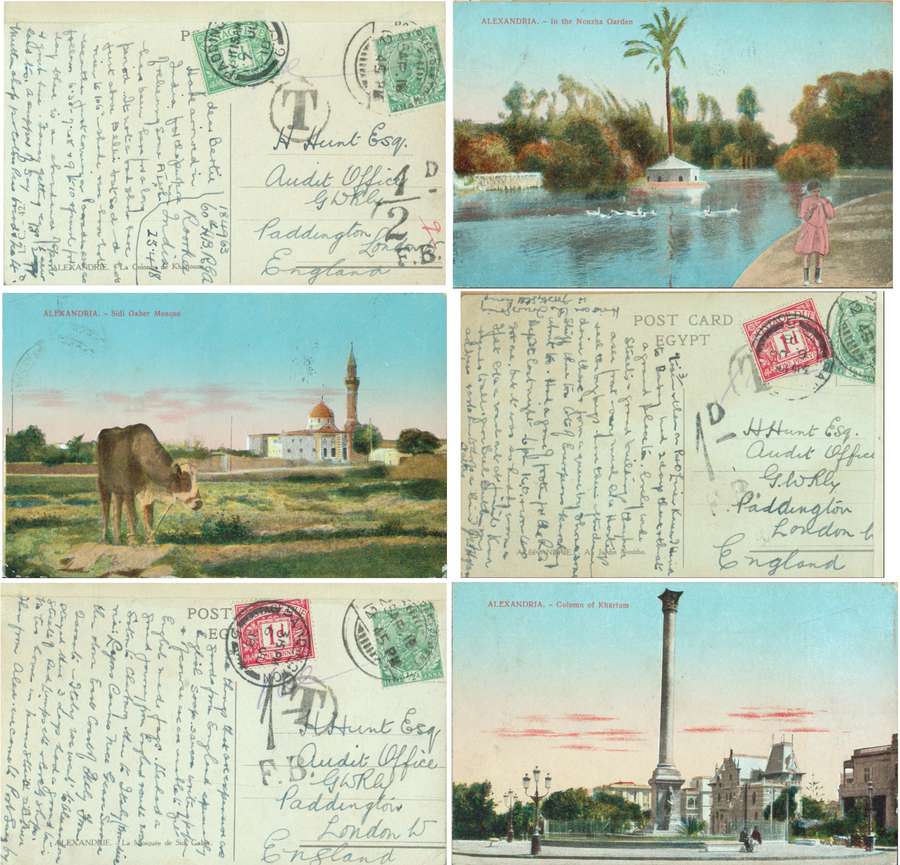
When James Hyam, also nick-named 'Fatty', wrote from India he used these three postcards which showed different scenes from Alexandria in Egypt where he had ‘a grand time’ en-route to India.

My Dear Bertie,
Have arrived in India for the purpose of relieving some A1 (military fitness category meaning capable of active service overseas) men here who have been here for a long period. It’s not a bad show here just above Delhi but so d____d hot: risen to 106 degrees in the shade and we have more hot weather just coming. Our parades are as follows 6.30-7.45 and 9 to 10 and finish for day. There is an abundance of sport and grub here. Fancy getting eggs laid too. A supper of say ½ new mutton chop, potatoes, peas, broccoli and tea 4d.
The things that are expensive are goods from England especially English soap, sauces, writing paper and of course we are unable to get English made fags. We had a grand journey from England; route was Southampton to Cherbourg then to Italy. In Italy we went to Alexandria, stayed there three days had a grand time, streets of red lamps etc. and lovely shops. No two houses in main stretch are alike. Then from Alexandria we come to Port Suez by train
then on P. and O. Liner Kaiser I. Hind to Bombay had two days there and that’s a grand place too, lovely wide streets and grand buildings. They have a sea front very much like Hastings and all the big boys have their after dinner drive there and form a queue by shore. Some stuff there too. Lots of Europeans knocking about too. Had a game of footer for the Railway Operatives depot last night, 6pm, with King’s Own and won… But it was so ruddy warm and I felt like a wash out at finish. Kind regards to all. Give Bill Butler my address and ask him to drop a line.
J.W. Hyam, Fatty.
How are the tours going is Frosty still serving?
Postcards from James Walter Hyam, 15 April 1918, Roorkee, India. Catalogue reference: RAIL 253/516

Dear Bertie,
Just a few lines to let you know how we are getting on out here, I forgot when I last wrote you last and what news I told you. We marched down from the hills, 9,000 feet up in the Himalaya Mountains last October to Rawalpindi, then shortly afterwards out to camp returning just before Xmas. In February I obtained a furlough and had a fine tour of places of interest, down to Delhi then right across India to Calcutta, had several letters of introduction from brother Freemasons to awfully nice people there and had a most enjoyable time, spent a few days at Agra on the return journey, travelled roughly just over 3,000 miles with several nights in the train. A few days after returning the regiment was placed under orders to march 83 miles to Noushera on the frontier border, where over 10,000 British and native troops were concentrated, a similar number at Peshawar farther down the frontier, in readiness for threatened trouble with the Afghans, whom German intriguers had been amongst. Noushera was a cruel place, nothing but a dust heap at the foot of the mountain. We spent several weeks there, training in mountain warfare, my word, it was chronic, the terrific heat and the awful climbing for miles day after day, with all transport on mules and camels through the rocky mountain passes. At one bivouac we encountered bad water, and about forty of our fellows went down with enteric fever [typhoid]. One died, but the others pulled through as they had been inoculated; a wonderful thing inoculation has proved to be in India.
Well in spite of the hard time, we returned to Rawalpindi in fine condition after the Afghan trouble had subsided for the time being, it is always liable to break out at any moment and we are always in readiness to move at any time.
Then we changed to another barracks in Rawalpindi in April, and have been stationed on the plains all the summer. The heat has been intense; one never goes outside after 10am; after tiffin at 1 o’clock the barracks and in fact everywhere is dead to the world until between 5 and 6pm, when sports such as tennis, cricket hockey and swimming at the baths are possible.
Every soldier has a punkah (fan) swinging over his bed all night and during the hours off duty during the day. Many men sleep out on the barrack square on their beds at night. During the past few weeks the monsoon has been on, with torrential rain which I would fail to describe. Now the intense heat of the sun is draining the moisture out of the earth with the result that it is like living in the moist fern house at Kew Gardens, only worse, and many men are being bowled over with fever. Ever since arriving at India, getting on for two years ago, I have been as fit as a fiddle and enjoyed exceptional health, until a fortnight ago, when I was suddenly taken ill with sandfly fever, a most painful, lowering form of fever, and was carried to hospital and also found to be suffering from pleurisy. I was in bed several days subsisting on a small quantity of milk with the result that when I was allowed to get up I was too weak to stand. I was discharged after ten days and am getting on quite alright now, and am leaving on next furlough to a hill station in the Himalayas shortly to recuperate. In November we are on the move again, marching about 80 miles to a big camp, for manoeuvres of several weeks, returning again just before Christmas. But marching eighty miles in five days under an Indian sun is very different to cloudy England. Every regiment in India, both regular and territorial, is being heavily reinforced by drafts from England. We have had three drafts one consisting of nearly 300 men, then another of 67, now another of 84, bringing us up to nearly 1,100 men. There are thousands of British troops, mostly Terriers (members of the Territorial army) (there are only eight regular infantry regiments left in India) stationed at various frontier places, and all sorts of rumours prevalent about a big expedition moving during the next few months, all possible preparations are being made for it, well, if the Indian govt. make as disastrous a muddle of it when the fighting does come off as they made over the Mesopotamia campaign, then with foes like the ferocious Afghans there will be a terrible price to pay in life, for the country and the terrific heat will be enough without having to fight every inch of the way.
Letter from Harry Beaumont, 18 August 1916, Rawalpindi, India. Catalogue reference: RAIL 253/516
Listen
Harry Beaumont, India – bowled over with fever:
Dear Bertie,
Just a few lines to let you know how we are getting on out here, I forgot when I last wrote you last and what news I told you. We marched down from the hills, 9,000 feet up in the Himalaya Mountains last October to Rawalpindi, then shortly afterwards out to camp returning just before Xmas. In February I obtained a furlough and had a fine tour of places of interest, down to Delhi then right across India to Calcutta, had several letters of introduction from brother Freemasons to awfully nice people there and had a most enjoyable time, spent a few days at Agra on the return journey, travelled roughly just over 3,000 miles with several nights in the train. A few days after returning the regiment was placed under orders to march 83 miles to Noushera on the frontier border, where over 10,000 British and native troops were concentrated, a similar number at Peshawar farther down the frontier, in readiness for threatened trouble with the Afghans, whom German intriguers had been amongst. Noushera was a cruel place, nothing but a dust heap at the foot of the mountain. We spent several weeks there, training in mountain warfare, my word, it was chronic, the terrific heat and the awful climbing for miles day after day, with all transport on mules and camels through the rocky mountain passes. At one bivouac we encountered bad water, and about forty of our fellows went down with enteric fever [typhoid]. One died, but the others pulled through as they had been inoculated; a wonderful thing inoculation has proved to be in India.
Well in spite of the hard time, we returned to Rawalpindi in fine condition after the Afghan trouble had subsided for the time being, it is always liable to break out at any moment and we are always in readiness to move at any time.
Then we changed to another barracks in Rawalpindi in April, and have been stationed on the plains all the summer. The heat has been intense; one never goes outside after 10am; after tiffin at 1 o’clock the barracks and in fact everywhere is dead to the world until between 5 and 6pm, when sports such as tennis, cricket hockey and swimming at the baths are possible.
Every soldier has a punkah (fan) swinging over his bed all night and during the hours off duty during the day. Many men sleep out on the barrack square on their beds at night. During the past few weeks the monsoon has been on, with torrential rain which I would fail to describe. Now the intense heat of the sun is draining the moisture out of the earth with the result that it is like living in the moist fern house at Kew Gardens, only worse, and many men are being bowled over with fever. Ever since arriving at India, getting on for two years ago, I have been as fit as a fiddle and enjoyed exceptional health, until a fortnight ago, when I was suddenly taken ill with sandfly fever, a most painful, lowering form of fever, and was carried to hospital and also found to be suffering from pleurisy. I was in bed several days subsisting on a small quantity of milk with the result that when I was allowed to get up I was too weak to stand. I was discharged after ten days and am getting on quite alright now, and am leaving on next furlough to a hill station in the Himalayas shortly to recuperate. In November we are on the move again, marching about 80 miles to a big camp, for manoeuvres of several weeks, returning again just before Christmas. But marching eighty miles in five days under an Indian sun is very different to cloudy England. Every regiment in India, both regular and territorial, is being heavily reinforced by drafts from England. We have had three drafts one consisting of nearly 300 men, then another of 67, now another of 84, bringing us up to nearly 1,100 men. There are thousands of British troops, mostly Terriers (members of the Territorial army) (there are only eight regular infantry regiments left in India) stationed at various frontier places, and all sorts of rumours prevalent about a big expedition moving during the next few months, all possible preparations are being made for it, well, if the Indian govt. make as disastrous a muddle of it when the fighting does come off as they made over the Mesopotamia campaign, then with foes like the ferocious Afghans there will be a terrible price to pay in life, for the country and the terrific heat will be enough without having to fight every inch of the way.
I had a very interesting letter from Mr Wood some time ago which I answered recently, also had one from Mr Price a few days ago. I can quite picture the changes which must have occurred in the staff of the Audit since I left. Of course you are over the age limit, so have not been called upon. I expect if, and when, I do return safely that life in England will seem very different under the altered conditions. I shall be glad to get home again and only wish I could see a prospect of doing so, with the conclusion of this terrible war. I have had a very enjoyable time in India (apart from soldiering which I always did enjoy, although I think I have had sufficient now) having made the acquaintance of awfully nice residents in ‘Pindi, and by virtue of rank, being allowed the privilege of wearing mufti makes it so much more comfortable when going out of barracks than being in a tight uniform in the climate.
I hear regularly from my wife and little one every week. Am glad to say they are well.
Please convey my kind regards to all those left in the office that I know. Trusting you are all fit and well and that we shall meet again before many more months elapse.
With best wishes
Yours most sincerely
Harry Beaumont

I left Aldershot on March 16th and travelled as far as Durban via Sierra Leone and Cape Town on the White Star Liner Suevic. This part of the journey was delightful, the food and accommodation was very good for a troopship. Of course this is accounted for by the fact that it is an Australian troopship. Everything was done that could be to make the journey enjoyable for the one thousand seven hundred men on board. We stayed just outside Sierre Leone for three days but were not allowed to leave. We arrived at Cape Town on Saturday afternoon four weeks after leaving Keyham and had a route march round the town the same evening. The next day we were allowed to roam about at will all day and a right jolly time we had although it was very hot indeed for winter. Cape Town is a beautiful place and the inhabitants made our visit very enjoyable.
The patriotism of the South African is wonderful to us after the coolness of the English (especially Aldershot). On the Monday we sailed for Durban arriving there on the Thursday evening after a rather rough journey round the Cape. We did not land till the Saturday afternoon and then bid goodbye to the Suevic. She went on to Australia. We had two weeks at Durban and had a glorious time in a rest camp on Ocean Beach. Every day we went bathing and only had parades up to 12 noon each day. The trams were free to us all over the city and invitations were showered upon us by the English residents. You can rest assured that we were very sorry to leave such a delightful spot, still all good things come to end and we finally had to go on board the Laconia belonging to the Cunard company for four weeks’ misery, we lay in the harbour for one week longing to go ashore before we started on the last stage of our journey to India. This ship was actually lousy (infested with lice) and we had to put up with a shirt inspection every day. The food was bad and very little of it and to back it all up the canteen was rotten as well. I was glad to get to Bombay and get off such a rotten ship. I lost a stone in weight during that four weeks.
We arrived in India during the monsoon period and have had plenty of rain more than we like I can assure you.
Kirkee is only about hundred miles from Bombay and is about six thousand feet above the sea. We will while here never have the extremes of weather as the climatic conditions are considered to be ideal here.
Strange as it may seem to English people native women do most of the work here, and actually act as bricklayers’ labourers carrying pans of ‘mortar’ on their heads, the men do very little indeed. Sunday is the same as any other day to them. As they have their own religious days when they have what they call Ram Jamees. All cartage is done by oxen and is rather slow and cumbersome. Kirkee Bazar is about three quarters of an hour’s walk from Pashan Camp and is rather interesting but is very dirty, children run about naked and the drainage and dwellings are very bad indeed. Cigarettes made by the Turkish tobacco company Bandra can obtained for eleven annas (former unit of Indian currency) per 100 (eleven pence) and are very good indeed, being better than the Nebka. Poona is the nearest city and is about five miles away. I walked there last Thursday to have a look round, this place boasts of one or two hotels and an Italian restaurant but is otherwise an exact counterpart of Kirkee and quite as dirty. The Italian restaurant is very good and is quite the equal of most London restaurants.
We do not receive a very many letters out here, as the mail is so uncertain, we never know when the next one will arrive.
When you are writing you must let me know all the news, I wonder whether your section will ever be established again as it was before.
Since I came out here I have taken up signalling and find it very useful, there is just a possibility I might be able to learn wireless, if so I don’t doubt that it might be useful to me, when we get back to Blighty if there is half a chance to do so I will cease it.
Our Battalion is at Aden and unless the signalling alters my destination I will eventually find myself there. It is not exactly the place I should choose if I had my own way but of course there is no choice about it.
Well I think I have given you all the news now and am sure you are tired of reading this letter by now, so will close with best wishes to you all from, yours sincerely,
Kenneth W. Sharland
Letter from Kenneth William Sharland, 26 July 1917, Pashan Camp, Kirkee, India. Catalogue reference: RAIL 253/516
Listen
Kenneth William Sharland – troop ship, this ship was actually lousy:
Dear Mr Biggs
The writing mood is on me so I take the opportunity to send you a few lines to let you know how I am getting on, at the same time hoping that at some future date I may have the pleasure of hearing from you. Your letter is bound to be very interesting to me as I have not seen or heard from anybody at Paddington for over six months.
I left Aldershot on March 16th and travelled as far as Durban via Sierra Leone and Cape Town on the White Star Liner Suevic. This part of the journey was delightful, the food and accommodation was very good for a troopship. Of course this is accounted for by the fact that it is an Australian troopship. Everything was done that could be to make the journey enjoyable for the one thousand seven hundred men on board. We stayed just outside Sierre Leone for three days but were not allowed to leave. We arrived at Cape Town on Saturday afternoon four weeks after leaving Keyham and had a route march round the town the same evening. The next day we were allowed to roam about at will all day and a right jolly time we had although it was very hot indeed for winter. Cape Town is a beautiful place and the inhabitants made our visit very enjoyable.
The patriotism of the South African is wonderful to us after the coolness of the English (especially Aldershot). On the Monday we sailed for Durban arriving there on the Thursday evening after a rather rough journey round the Cape. We did not land till the Saturday afternoon and then bid goodbye to the Suevic. She went on to Australia. We had two weeks at Durban and had a glorious time in a rest camp on Ocean Beach. Every day we went bathing and only had parades up to 12 noon each day. The trams were free to us all over the city and invitations were showered upon us by the English residents. You can rest assured that we were very sorry to leave such a delightful spot, still all good things come to end and we finally had to go on board the Laconia belonging to the Cunard company for four weeks’ misery, we lay in the harbour for one week longing to go ashore before we started on the last stage of our journey to India. This ship was actually lousy (infested with lice) and we had to put up with a shirt inspection every day. The food was bad and very little of it and to back it all up the canteen was rotten as well. I was glad to get to Bombay and get off such a rotten ship. I lost a stone in weight during that four weeks.
We arrived in India during the monsoon period and have had plenty of rain more than we like I can assure you.
Kirkee is only about hundred miles from Bombay and is about six thousand feet above the sea. We will while here never have the extremes of weather as the climatic conditions are considered to be ideal here.
Strange as it may seem to English people native women do most of the work here, and actually act as bricklayers’ labourers carrying pans of ‘mortar’ on their heads, the men do very little indeed. Sunday is the same as any other day to them. As they have their own religious days when they have what they call Ram Jamees. All cartage is done by oxen and is rather slow and cumbersome. Kirkee Bazar is about three quarters of an hour’s walk from Pashan Camp and is rather interesting but is very dirty, children run about naked and the drainage and dwellings are very bad indeed. Cigarettes made by the Turkish tobacco company Bandra can obtained for eleven annas (former unit of Indian currency) per 100 (eleven pence) and are very good indeed, being better than the Nebka. Poona is the nearest city and is about five miles away. I walked there last Thursday to have a look round, this place boasts of one or two hotels and an Italian restaurant but is otherwise an exact counterpart of Kirkee and quite as dirty. The Italian restaurant is very good and is quite the equal of most London restaurants.
We do not receive a very many letters out here, as the mail is so uncertain, we never know when the next one will arrive.
When you are writing you must let me know all the news, I wonder whether your section will ever be established again as it was before.
Since I came out here I have taken up signalling and find it very useful, there is just a possibility I might be able to learn wireless, if so I don’t doubt that it might be useful to me, when we get back to Blighty if there is half a chance to do so I will cease it.
Our Battalion is at Aden and unless the signalling alters my destination I will eventually find myself there. It is not exactly the place I should choose if I had my own way but of course there is no choice about it.
Well I think I have given you all the news now and am sure you are tired of reading this letter by now, so will close with best wishes to you all from, yours sincerely,
Kenneth W. Sharland

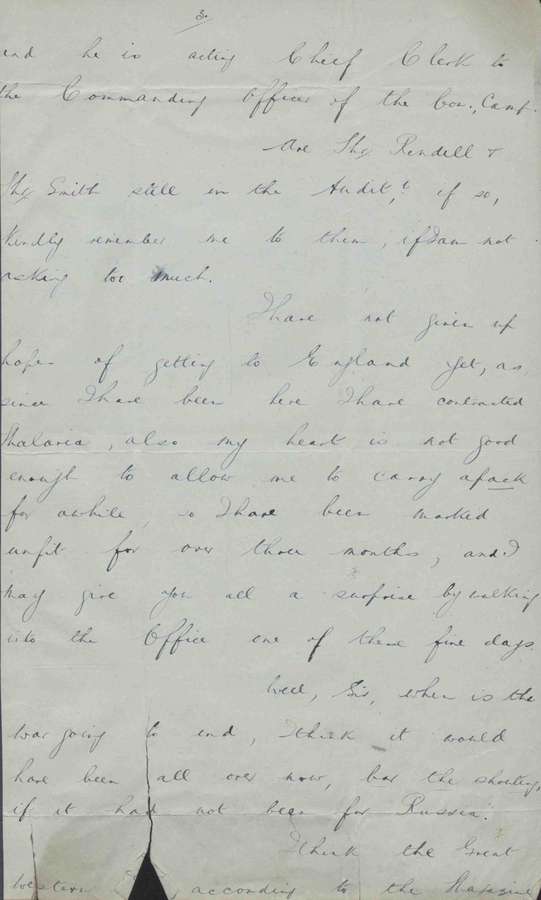
I have not given up hope of getting to England yet, as since I have been here I have contracted malaria, also my heart is not good enough to allow me to carry a pack for a while, so I have been marked unfit for over three months, and I may give you all a surprise by walking into the office one of these fine days.
Well, sir, when is the war going to end, I think it would have been all over now, bar the shouting, if it had not been for Russia.
Letter from James Claude Kibblewhite, 1 September 1917, Malta. Catalogue reference: RAIL 253/516

Dear Bertie,
Just a few lines to let you know how I am getting on. Am having the time of my life out here.
No doubt you have seen the several letters I have written to the office during the past few months, so will not go into further details, except to say that I have been exceedingly fortunate in seeing so much of India in a short time. I shall never forget my trip through the Khyber Pass which has since been the scene of hard fighting, one consequence of which we were hurriedly moved from Fyzabad to Rawalpindi in readiness to reinforce.
You would scarcely credit the feeling of disappointment that exists among the few British regular regiments left in India, over not being ordered to France to take their share in the war. The same feeling also exists in the Territorials… A dragoon then left a few weeks ago to replace heavy casualties among the Norfolk regiment at the Gulf.
As the hot weather commenced the latter part of April, and as many British troops as possible are always sent to the hills (being almost unbearable on the plains), we are fortunate enough to go, and had a three days’ march and climb to this place 8,000 feet up. Well I never in any wild stretch of imagination ever dreamed that I should be soldiering in the Himalayan mountains.
Kuldana, although 8,000 feet up is on the lower Himalaya, and from my bungalow, which is situated on the edge of a steep precipice, I can see lovely views which words fail to describe, a perfect mixture of Devonshire, Scotch and Alpine scenery. Although seemingly only a few miles off, the higher snow clad ranges in full view are from 100 to 150 miles away. I have about 1½ miles trek to our Sergeant’s mess, through beautiful scenery, lovely wild rose bushes climbing up giant pink trees, smothering them in roses, maiden hair fern and all kinds of pretty flowers in the woods. The climate is perfect, lovely English summer weather, with delightful mountain breezes. The heat in India has not distressed me in the least, not even on long arduous marches. I am feeling splendidly fit and well, and trust I shall continue so. We have no end of gaiety; all the married families of the Yorkshire regiment are living in our barracks under our charge, (as their regiments had to remain behind at Pindi, and are being bitten to death almost with mosquitoes.) So we have Cinderella dances about three times a week, whist drives, racquet and tennis parties and have most enjoyable times.
I wish May and Eileen could take an aeroplane trip of a few hours and get to me, it would be ripping for them. I should be glad to hear that you had called to see them on your promised visit of months ago when I was home, they would be awfully glad to see you both. Do drop them a card old boy. Fancy it is 10 months ago today since I left to go to camp, what a lot has transpired since then. I was in the 8th Middlesex 12 months ago, and I see they have lost heavily in France, funny I should have left them, and joined the 6th East Surrey and to pass them at Gibraltar (where they were first) on my way to India.
On the whole I am enjoying life in India immensely; I am acting Company Sergeant Major now, and expect to be promoted to the rank shortly. We are all ‘Tommies’ now. Trusting you are both fit and well. Remember me to Stacey. Yours sincerely,
H. Beaumont
Photo caption: Sergeant Beaumont.
Letter from Harry Beaumont, May 1915, Rawalpindi, India.
All letters in this collection have been transcribed, and audio versions of selected letters are available too. The documents should offer students a chance to develop their powers of evaluation and analysis. Teachers may also wish to use the collection to develop their own resources.
You may spot spelling or grammatical errors in the transcripts as we have transcribed the letters as they stand. However, we have not included full digital images for several letters as these would have proved too difficult to read online. In such cases we have shown part of the letter in order to provide a sense of the original.
Within this online resource and the other resources in this series it is possible to find more than one letter from the same person, or find references within the letters to those who have written. For this reason is it is helpful to see the letters as a whole group to get the most out of them and appreciate the nature of the collection.
The Great Western Railway Company formed four companies of Royal Engineers as many men from the company, including these clerical workers from Paddington, had enlisted to serve. Due to their knowledge and understanding of the railways, many became Railway Troops based at railheads.
Unsurprisingly, in the letters many men showed a keen interest in all matters connected with railways or engines, including other Great Western Railway ‘fellows’ and the Great Western Railway Magazine. Some soldiers mentioned having received the magazine or asked for it to be sent out. It included photographs of all those who served in the First World War from the GWR as a whole and employees could catch up on company business and or news of sporting or social events.
‘Our family has had to pay the penalty of war that so many thousands of families have done, for I am now the only one out here’
These few words, written by Frederick Ernest Andrews on 16 October 1917 from France, come from this collection of letters from staff at the Audit office for the Great Western Railway (GWR) based at Paddington, London.
What makes this collection of soldiers’ letters so different from all others is the fact that it reveals the stories of a particular group of men who varied in class and education, who were writing back to their colleagues and bosses in the office while on active service during in the First World War. Many men enlisted from the GWR to fight, but these letters come exclusively from those worked at its Audit office. Staff at Paddington covered a range of different roles in insurance, accounting or ticketing for the Great Western Railway.
The letters belong to the RAIL series (which includes the records of the railway companies) at The National Archives. They are arranged in 12 carefully bound folders, rather like a series of scrapbooks. Starting from August 1915, each part represented what was known as the office newsletter, a collection of letters, photographs postcards, field cards and contemporary newspaper cuttings from those who had gone to fight. Every newsletter opened with a news section listing those who had written and sent photos to the office and those who recently left to company to serve at the front. The totals of all men in khaki from the Audit office were given too. The news section also provided information about those who had died, been injured, visited the office on leave or been promoted. The newsletters were circulated within the office departments and read by men when they came home on leave. Friends or relatives who had been sent their own letters or photographs often lent them or typed them out to be circulated as part of the regular Audit office newsletter.
The Audit office raised enough money through collections and the sale of Christmas cards, to create a temporary roll of honour for the office at Paddington to commemorate those who had fallen in battle by August 1915. Photographs of the Roll of Honour were sent out to several employees as their correspondence reveals.
After the war had ended and troops had returned, the GWR was able to quantify the contribution that it had made to the cause. The contribution made by the Audit office was high: 55.5% of male staff enlisted, whereas the average rate of enlistment across the GWR was 32.6%. This amounted to 184 men, 17 of whom lost their lives.
On 11 November 1922, The Great Western Railway War Memorial, dedicated to all 2,524 staff who had died in battle was unveiled on platform 1, Paddington station.
Teaching resource
The letters collected here were all written from the trenches between 1914 and 1915. They are part of a series of connected teaching resources.
Teaching resource

These letters, sent from the trenches on the Western Front, date from 1916–1918. They are part of a series of connected teaching resources.
Teaching resource
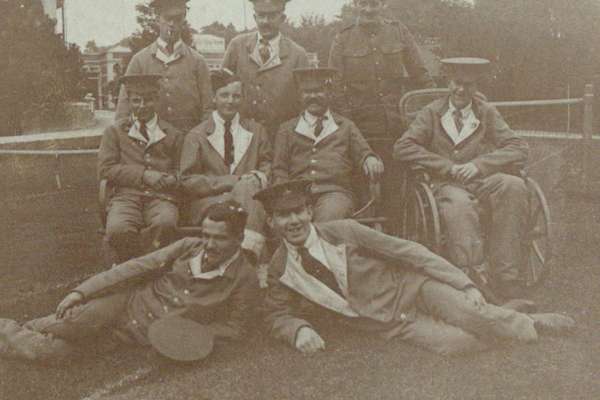
This collection from our Letters from the First World War teaching resource series features letters that relate to soldiers' experience of medical treatment.
Teaching resource

Letters in this collection relate to soldiers' experience at the railheads on the Western front. Part of series of resources on First World War letters.
Teaching resource

These letters and transcripts, part of a series of connected resources, relate to soldiers' experience of training in England before they were sent abroad.