







Teaching resource
Letters from the First World War: The trenches, part one
The letters collected here were all written from the trenches between 1914 and 1915. They are part of a series of connected teaching resources.
Teaching resource
These letters, sent from the trenches on the Western Front, date from 1916–1918. They are part of a series of connected teaching resources.

Postcard from William Charles Davis, January 1917. Catalogue reference: RAIL 253/516
These are some of the many letters sent by staff of the Great Western Railway Audit office at Paddington who had enlisted to fight in the First World War.
You can discover more letters from the First World War in our collections about Different fronts, Hospital, Railheads, Training, and The trenches, part one.

Dear Mr Hunt,
I expect you have heard at the office about me being in England suffering from gas poisoning, and as it is quite a long time since I last wrote to you, no doubt a few lines will be acceptable, to explain matters.
We left the trenches at Vimy Ridge on July 5th, and marching back about 14 miles we eventually reached a village named Ostreville for the purpose of having a divisional rest. The signallers thought an orchard would be very convenient to erect bivouacs in, so when we were busy carrying out this idea an old Frenchman appeared at the scene, and raised objections. However he agreed at last to allow us in at one end of the orchard, thinking, I suppose, that we would wander about his place! We had an enjoyable time here for six days, and then had to return to our old billets near Mount St. Eloi until the whole of the division had retired. We guessed by this move that our ‘rest’ was over, and the following days were spent in marching, and travelling by motor lorries and train until we arrived at Mericourt Station on July 21st near Albert.
After a delightful swim in the river near the billet we marched off the following night, to take part in the ‘big push.’ We slept in an open field that night near Fricourt farm, and were rather rudely awakened by a few German shells landing near us.
For five days we were lying in reserve in this district, and occupied our time in watching an army of men at work in the valley, making roads, railways, boring for water and laying down water pipes, also practicing attacks in the old trenches. It was very interesting to see the great amount of artillery, busy practically all day and night, and to read their messages sent by visual signalling [often using lights] from a ridge across the valley.
Our period in reserve being up, we moved to Mametz Wood to lie there in support for five days, before going into the trenches at High Wood. On arrival at the edge of the wood at night, we were welcomed by a big dose of gas shells and shrapnel, which was applied steadily throughout the night by the German artillery. Having to assist in putting our signalling gear into a hole for safety, I was prevented from using my respirator for the first quarter of an hour, as we could not see on account of the darkness and dust made by the ammunition columns rushing along the road, and it was during this time that I must have breathed in enough gas to put me out of action. Afterwards of course respirators were used, when we were settled in holes by the roadside for the night.
I remained with the battalion until I was sent to the casualty clearing station on August 3rd and reached Rouen hospital the next day. I had to wait until the 9th and crossed the channel from Havre to Southampton on the New Zealand ship Marama, with about 800 other patients, the day after. It was a splendid boat with every convenience for carrying wounded men, and the sisters and orderlies were colonials.
It was last Friday week when I arrived here, and must say it is very comfortable and quiet. I had to remain in bed until last Saturday, but of course I cannot do any route marching yet! So I have to take life quietly, which is no hardship I can assure you after France. I am on an ordinary diet, and taking medicine.
I hear you have Mr Symons back again, is that so? And is he back in the same old spot? I hope he is pretty fit, although I suppose there must be something wrong with him, to be back again.
I suppose things are as quiet as usual with you. Have you had your holidays yet? This is about your time I believe. I shall be glad of a few lines when you have time, to hear the latest about the office. I hope you are keeping fit, also Mr J.B. Taylor and Mr Woodhams and with kind regards to you all. Yours sincerely,
Frosty.
P.S. It is a treat to write a letter without the censor’s shadow over one!
Letter from Richard Charles Stanley Frost, 23 August 1916, Devonport, England. Catalogue reference: RAIL 253/516

Dear Mr Hunt,
Thanks very much for your letter which I received a week or two ago, also for the magazine.
We are in the trenches just now. In fact we seem to spend about three times as much time in as we do out. Also we are in a pretty warm spot, it was about here, towards the end of last summer that the French and German had some of the fiercest fighting of the war. The country around about is a veritable maze of trenches. The fighting at one time was so fierce that there was only time just to bury the dead in the sides of the trenches, and now that the trenches have crumpled one is constantly seeing the bones of men’s legs or their boots, or skulls sticking out from the sides of the trenches, pleasant, eh? There will be a pleasant smell here in the summer. I only hope we are not here then. In places we are only about twenty yards away from Fritz and company. Consequently all times the air is pretty thick with bombs, grenades and trench mortars. These last are pretty hellish sort of toys. They have an explosion like about ten earthquakes rolled into one. But even these are not the worst we have to put up with. The trenches being so close together there is of course any amount of mining going on. So one never knows when the particular lump of earth one is standing on is going to take a trip through the solar regions. When a mine does go up, there is some excitement knocking about I can tell you. Suppose for instance we were going to explode one, all the artillery in the neighbourhood is ranged on the spot and directly the mine is exploded, there is hell let loose on the crater. Of course as soon as he gets the range the enemy replies, so that the air is fairly full of everything that kills quickly. One can on these occasions always rely on a good many casualties. Since we have been in this spasm there have been five exploded in this neighbourhood, while others are expected to go up at any time. So much for conditions here.
How is everything in town? Pretty quiet I suppose. I see you’ve had the zepps (Zeppelins) over again? Is it a fact that one dropped in the Thames? (Lines censored.) That is about all the news, so will close, kindest regards to everybody. Yours very sincerely,
Gilbert Williams
Letter from Gilbert Williams, 6 April 1916. Catalogue reference: RAIL 253/516
Listen
Trenches – a veritable maze:
Dear Mr Hunt,
Thanks very much for your letter which I received a week or two ago, also for the magazine.
We are in the trenches just now. In fact we seem to spend about three times as much time in as we do out. Also we are in a pretty warm spot, it was about here, towards the end of last summer that the French and German had some of the fiercest fighting of the war. The country around about is a veritable maze of trenches. The fighting at one time was so fierce that there was only time just to bury the dead in the sides of the trenches, and now that the trenches have crumpled one is constantly seeing the bones of men’s legs or their boots, or skulls sticking out from the sides of the trenches, pleasant, eh? There will be a pleasant smell here in the summer. I only hope we are not here then. In places we are only about twenty yards away from Fritz and company. Consequently all times the air is pretty thick with bombs, grenades and trench mortars. These last are pretty hellish sort of toys. They have an explosion like about ten earthquakes rolled into one. But even these are not the worst we have to put up with. The trenches being so close together there is of course any amount of mining going on. So one never knows when the particular lump of earth one is standing on is going to take a trip through the solar regions. When a mine does go up, there is some excitement knocking about I can tell you. Suppose for instance we were going to explode one, all the artillery in the neighbourhood is ranged on the spot and directly the mine is exploded, there is hell let loose on the crater. Of course as soon as he gets the range the enemy replies, so that the air is fairly full of everything that kills quickly. One can on these occasions always rely on a good many casualties. Since we have been in this spasm there have been five exploded in this neighbourhood, while others are expected to go up at any time. So much for conditions here.
How is everything in town? Pretty quiet I suppose. I see you’ve had the zepps (Zeppelins) over again? Is it a fact that one dropped in the Thames? (Lines censored.) That is about all the news, so will close, kindest regards to everybody. Yours very sincerely,
Gilbert Williams.

… I must thank you for the cigarettes you sent me, I received them with your letter last night, and I was just on bankruptcy as regards fags, so you can consider you have saved my life. So you are going to have a (pigeon) kill off to reduce numbers, well, they’ll come in handy for the homing pigeon fund, that is if you don’t want them for yourselves. Dad has had my place lime-washed out, he says it looks quite smart again. I think there are only four old birds and two youngsters there now.
The bombs from the Zeps (Zeppelins) shook you up then, they make a nice little row don’t they. I have heard them out here and seen them drop, and a piece of one of the bombs hit me and I was quite 500 yards from where it dropped, of course it did not hurt me, as it was spent. Even the noise from those bombs is not a quarter as loud as one I had drop near me last Saturday, it was a trench mortar bomb and although I was quite 50 yards from it the force of the explosion knocked me over.
Yours very sincerely
Ron
[Newspaper cutting:]
Dyer, Private R.A.W. (14833) 2nd Battalion Bedfordshire Regiment, attached to Signal Company, 47th Division, British Expeditionary Force. Before enlisting, in August last, he was a clerk in the service of the Great Western Railway Company Audit office, Paddington. Has been in France for some time, taking part in the Battle of Neuve Chapelle. At one time he was a member of the Ealing Central H.S. (Pigeon Society) and flew up to Rennes (France) in partnership of a friend, and at the time of enlisting was an hon. member of the society. Private Dyer receives The Homing Pigeon every week from his friend, Mr J.G. Wills.
Letter from Ronald Arthur William Dyer, 7 August 1915. Catalogue reference: RAIL 253/516

Dear Mr Taylor,
No doubt you think that I have forgotten all about you and my friends of the Audit, but never let it be said (this is an army term, if you please.) Truth to tell I have been going to write time after time, but have had to put it off for various reasons. I am taking this opportunity of writing to you, while I am in charge of tonight’s guard. I get this job about once a week now, it’s not so bad, I have three men and a man in waiting; we mount at 5pm and dismiss at 7am. We make ourselves as comfortable as we can, in the guard tent, which just covers over the top of the sand bags, and these have got grass growing out of them now. The sand bags are about 4ft high and make a good protection. April 1st I got my two stripes up, after being a 1st Air Mechanic for 12 months, the Non-Commissioned Officers have a very decent mess here, and everything is ok. I am corporal in charge of wireless, photographic, electrical and all instruments used on aeroplanes, I have had a very good education on all those subjects, but the one I like best is the wireless, it’s far more interesting than photography, which is a very big thing indeed out here, and a lot depends upon a good photograph of the Hun lines…
Yesterday I saw a nice little game between one of ours and one of theirs, after our anti-aircraft fire had taken it up a bit higher, our machine went for it and got well over the top of it, then two more of ours came along and forced it down, she tried all manner of tricks, but down she came alright, and landed a clean machine, not broken in any part, and the two Huns inside it quite well.
We gave a revue (theatrical show) to our chaps here on the 13th, it went off alright, we started at 9pm and gave a two hours show, am enclosing programme, and will forward a photo of myself as the ‘oldest inhabitant’ as soon as I receive them from the Frenchman who took them…Kind regards to all of the section and the remainder of the agreements, and hoping you are fit and well. Good bye. Yours sincerely,
F.R. Morris
Letters from Frederick Ronald Morris, 26 April 1917. Catalogue reference: RAIL 253/516
Listen
Dear Mr Taylor,
No doubt you think that I have forgotten all about you and my friends of the Audit, but never let it be said (this is an army term, if you please.) Truth to tell I have been going to write time after time, but have had to put it off for various reasons. I am taking this opportunity of writing to you, while I am in charge of tonight’s guard. I get this job about once a week now, it’s not so bad, I have three men and a man in waiting; we mount at 5pm and dismiss at 7am. We make ourselves as comfortable as we can, in the guard tent, which just covers over the top of the sand bags, and these have got grass growing out of them now. The sand bags are about 4ft high and make a good protection. April 1st I got my two stripes up, after being a 1st Air Mechanic for 12 months, the Non-Commissioned Officers have a very decent mess here, and everything is ok. I am corporal in charge of wireless, photographic, electrical and all instruments used on aeroplanes, I have had a very good education on all those subjects, but the one I like best is the wireless, it’s far more interesting than photography, which is a very big thing indeed out here, and a lot depends upon a good photograph of the Hun lines…
Yesterday I saw a nice little game between one of ours and one of theirs, after our anti-aircraft fire had taken it up a bit higher, our machine went for it and got well over the top of it, then two more of ours came along and forced it down, she tried all manner of tricks, but down she came alright, and landed a clean machine, not broken in any part, and the two Huns inside it quite well.
We gave a revue (theatrical show) to our chaps here on the 13th, it went off alright, we started at 9pm and gave a two hours show, am enclosing programme, and will forward a photo of myself as the ‘oldest inhabitant’ as soon as I receive them from the Frenchman who took them…Kind regards to all of the section and the remainder of the agreements, and hoping you are fit and well. Good bye. Yours sincerely,
F.R. Morris

Dear Mr Smith,
I hope you will accept my apology for not writing before. It has not been want of will it has been lack of opportunity. I wonder how you all are. I am fairly well now but was very queer for several weeks recently. I also often wonder how you are all getting on and should like to hear.
A matter of about five minutes ago Fritz was bombing us, and I have just got up off the ground where I was laying for about twenty minutes. One fellow has been hit, but not severely by shrapnel. This is his second visit this evening.
It will soon be twelve months since I left you. It seems a very long time ago. I am afraid I have very little I may tell you, so will conclude by asking you to accept my best wishes for the New year and desiring that you will remember me kindly to any enquiring friends. Believe me, dear Mr Smith, sincerely yours,
W. Wiggs
Letter from William Charles Frederick Wiggs, 23 December 1917. Catalogue reference: RAIL 253/516
Listen
William Charles Frederick Wiggs, trenches – Fritz was bombing us:
Dear Mr Smith,
I hope you will accept my apology for not writing before. It has not been want of will it has been lack of opportunity. I wonder how you all are. I am fairly well now but was very queer for several weeks recently. I also often wonder how you are all getting on and should like to hear.
A matter of about five minutes ago Fritz was bombing us, and I have just got up off the ground where I was laying for about twenty minutes. One fellow has been hit, but not severely by shrapnel. This is his second visit this evening.
It will soon be twelve months since I left you. It seems a very long time ago. I am afraid I have very little I may tell you, so will conclude by asking you to accept my best wishes for the New year and desiring that you will remember me kindly to any enquiring friends. Believe me, dear Mr Smith, sincerely yours,
W. Wiggs

Dear Bertie,
Thank you and the other gents very much for the cigarettes which I received yesterday on coming out from the line. We have been having exciting times lately. Our division took a big part in this new advance on the Ancre. In fact, it was our Brigade that captured Beaumont Hamel, and after two days hand fighting the ridge beyond the village. We went over before day break on the 13th November and from there till the evening of 14th we were properly in the midst of it. The greatest handicaps we had were fog and mud. It is really wonderful how the boys kept their direction in the mist which was very thick while the mud began to swallow one up unless one was wary. The Germans thought the village was impregnable, and up to now it has resisted all efforts to capture it. Their artillery and snipers gave us some trouble, but once we were at close quarters with them, they absolutely refused to fight, and were only too eager to be captured. For the most part they were a very measly looking lot and very young and some of them burst into tears when I pointed my bayonet at them. By Jove, Bertie, those Germans look after their creature comforts. Fine deep dugouts and any amount of shirts and socks and cases of soda water etc., I got a souvenir or two, a German helmet and one or two more things. The worst part of the whole business was cleaning up the battlefield afterwards. That’s about all the news. Regards to the Audit agreements section and the rest of the boys. [Lines censored]
Well thanks again for the smokes, and very best wishes to everybody.
Very sincerely yours,
Gilbert Williams
Letter from Gilbert Williams, 25 November 1916, France. Catalogue reference: RAIL 253/516
Please note that this soldier’s surname is spelled incorrectly as ‘Davies’ in the original document.

Sunday
Dear Charlie,
How are things going with you now? I expect like the rest of us will be glad when the better weather sets in for there is no doubt about it, it has been rough lately.
Since I last wrote to you we have shifted to another part of the line and it is a warm shop, for both sides must have all guns they can find and it is nothing but one long duel all day and every day but thank goodness it gives over a bit a night so that one can get on with their work. You see of a night the flashes of the guns can be seen so plainly that is why they do not fire a lot then.
Just on our right our people retook some trenches we had lost, oh what a rough time the poor devils had, snow and mud as much as you like and they had to lay in it for two days and grub could not be got to them. I expect there have been a few more from Paddington called up by now, it seems if the authorities mean to have all the men they want and if they can’t get them one way they will another, and it certainly looks as if they will be wanted for out here. One cannot see any signs of an early settlement. I see by the papers that the air raids have been busy in England again. I suppose you have not seen anything of them yet, has Rory Moore had any more frights? We have the taubes [German aircraft] over our hospital nearly every day or night and I can tell you we got some starts at times. The nearest we have to them since I have been here is just one yard from the main door, at 12.30 it blew in two pairs of double doors and shattered on end of the building to bits but not a great deal of damage to life which after all is the main thing. The arrangements we in work is five or six days up the line and four or five down if you are lucky. Of course at times these arrangements go to pot when there is an attack and we get a warm time and I should like to enlarge on these things but of course you understand I cannot.
Give my kind regards to all and trusting you are well.
Yours Will (Davies)
[Photo caption:]
Corporal W.C. Davies.
(R.A.M.C.)
Letter from William Charles Davis, 15 March 1916. Catalogue reference: RAIL 253/516
Listen
William Charles Davis, trenches – it is a warm shop:
Sunday
Dear Charlie,
How are things going with you now? I expect like the rest of us will be glad when the better weather sets in for there is no doubt about it, it has been rough lately.
Since I last wrote to you we have shifted to another part of the line and it is a warm shop, for both sides must have all guns they can find and it is nothing but one long duel all day and every day but thank goodness it gives over a bit a night so that one can get on with their work. You see of a night the flashes of the guns can be seen so plainly that is why they do not fire a lot then.
Just on our right our people retook some trenches we had lost, oh what a rough time the poor devils had, snow and mud as much as you like and they had to lay in it for two days and grub could not be got to them. I expect there have been a few more from Paddington called up by now, it seems if the authorities mean to have all the men they want and if they can’t get them one way they will another, and it certainly looks as if they will be wanted for out here. One cannot see any signs of an early settlement. I see by the papers that the air raids have been busy in England again. I suppose you have not seen anything of them yet, has Rory Moore had any more frights? We have the taubes [German aircraft] over our hospital nearly every day or night and I can tell you we got some starts at times. The nearest we have to them since I have been here is just one yard from the main door, at 12.30 it blew in two pairs of double doors and shattered on end of the building to bits but not a great deal of damage to life which after all is the main thing. The arrangements we in work is five or six days up the line and four or five down if you are lucky. Of course at times these arrangements go to pot when there is an attack and we get a warm time and I should like to enlarge on these things but of course you understand I cannot.
Give my kind regards to all and trusting you are well.
Yours Will
William Davis sent this card to E.H. Serjent who worked in the Great Western Railway Audit office at Paddington. Davis was also mentioned in the office newsletter for March 1917 for his bravery on the battlefront.

[Postcard front:]
XXa “LIGHT” DIVISION, A few days’ rest in billets, January 1917.
[Reverse:]
With best wishes from W.C. Davis to all at the office.
[Newsletter extract:]
…. (Davis) was presented with a wrist watch and pocket case, and silver pencil case on behalf of his colleagues as a token of their appreciation of the honour bestowed upon in receiving the Military Medal.
Postcard from William Charles Davis, January 1917. Catalogue reference: RAIL 253/516

The last time I wrote I think I told you we had lost our comfortable job on railheads. We have been shifted from General Headquarters and are at the most godforsaken hole there can possibly be in France. We had a rotten journey raining all the time. Reveille* was at 4am and we eventually left the station about 10am. The accommodation consisted of the old cattle trucks, and rations of bully and biscuits. It was a very cold and uncomfortable journey.
We arrived at our destination about 4.30pm and after standing in the rain for 2½ hours with full pack on, we set out on a ten mile march. It’s the worst march I’ve ever done. The majority of us at the finish were absolutely knocked up and were only too glad to crawl into the billets before going to bed, which was about 12pm. They gave us a mug of tea (the first we had since six in the morning) and best of all a ration of rum.
The up to date soldier kit to carry about from place to place consists of 150 rounds of ammunition, inside the pack; overcoat, fur coat, two pairs socks, one pants, one shirt, ground sheet, iron rations [emergency food supply]. Outside pack; Mackintosh and mess tin, in haversack; cleaning kit, hold all, 24lbs rations, soap and towel, and on top of that extras such as handkerchiefs, plate, mug, tobacco, etc, two smoke helmets* in a satchel slung over the shoulder, a respirator in the left flap of a tunic and field dressing on the right, and of course the rifle, in all it’s no light weight on a long march, it takes all one’s strength and staying power to keep going.
We are billeted in a barn and have a sea of mud to get through. We have no boards, so sleep on the ground, fires are not allowed in the billet and at night time it’s devilish cold.
In the village there is a little general shop (now nearly sold out), one pub where they sell something they charge 2½d for and call beer, there are no shops of any description and of course no amusements.
Rations are not so good now (today’s dinner, Sunday, bully beef, stew and two potatoes between 35 men. We have a loaf and a bit (small loaf) and two tins of jam between seven men, the short bread issue being augmented by the world famous army biscuits.
Our captain is a perfect gentleman and about the most popular man in the regiment, the junior captain (an absolute sport) and the platoon officers are all very decent sort of fellows. We appear to be much better off in this respect than before, and certainly think that D. Co. has got as good a selection of officers as any other company in the battalion. One of our fellows ran across a number of Audit R.E.s and they enquired after Maggs and myself.
Freddy or
What’s left of him after some very stiff marching.
Letter from Frederick G. Woodhams, 16 February 1916, France. Catalogue reference: RAIL 253/516

Guaranteeing efficiency and comfort: What the British soldier bears to the firing-line.
Photographs specially taken For "The Illustrated London News" by Clarke and Hyde.
Article from the Illustrated London News about a soldier's equipment, 1915. Catalogue reference: ZPER 34/146s9
Listen
Frederick G. Woodhams, no light weight:
The last time I wrote I think I told you we had lost our comfortable job on railheads. We have been shifted from General Headquarters and are at the most godforsaken hole there can possibly be in France. We had a rotten journey raining all the time. Reveille* was at 4am and we eventually left the station about 10am. The accommodation consisted of the old cattle trucks, and rations of bully and biscuits. It was a very cold and uncomfortable journey.
We arrived at our destination about 4.30pm and after standing in the rain for 2½ hours with full pack on, we set out on a ten mile march. It’s the worst march I’ve ever done. The majority of us at the finish were absolutely knocked up and were only too glad to crawl into the billets before going to bed, which was about 12pm. They gave us a mug of tea (the first we had since six in the morning) and best of all a ration of rum.
The up to date soldier kit to carry about from place to place consists of 150 rounds of ammunition, inside the pack; overcoat, fur coat, two pairs socks, one pants, one shirt, ground sheet, iron rations [emergency food supply]. Outside pack; Mackintosh and mess tin, in haversack; cleaning kit, hold all, 24lbs rations, soap and towel, and on top of that extras such as handkerchiefs, plate, mug, tobacco, etc, two smoke helmets* in a satchel slung over the shoulder, a respirator in the left flap of a tunic and field dressing on the right, and of course the rifle, in all it’s no light weight on a long march, it takes all one’s strength and staying power to keep going.
We are billeted in a barn and have a sea of mud to get through. We have no boards, so sleep on the ground, fires are not allowed in the billet and at night time it’s devilish cold.
In the village there is a little general shop (now nearly sold out), one pub where they sell something they charge 2½d for and call beer, there are no shops of any description and of course no amusements.
Rations are not so good now (today’s dinner, Sunday, bully beef, stew and two potatoes between 35 men. We have a loaf and a bit (small loaf) and two tins of jam between seven men, the short bread issue being augmented by the world famous army biscuits.
Our captain is a perfect gentleman and about the most popular man in the regiment, the junior captain (an absolute sport) and the platoon officers are all very decent sort of fellows. We appear to be much better off in this respect than before, and certainly think that D. Co. has got as good a selection of officers as any other company in the battalion. One of our fellows ran across a number of Audit R.E.s and they enquired after Maggs and myself.
Freddy or
What’s left of him after some very stiff marching.

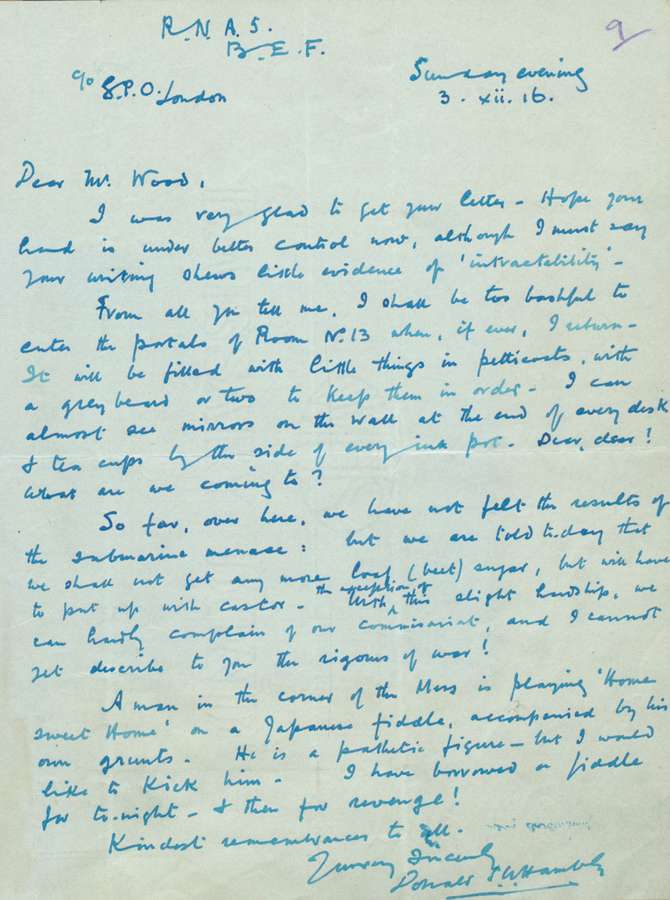
Dear Mr Wood,
I was very glad to get your letter. Hope your hand is under better control now, although I must say your writing shows little evidence of ‘intractability’.
From what you tell me, I shall be too bashful to enter the portals of Room No. 13 when, if ever, I return. It will be filled with little things in petticoats, with a grey beard or two to keep them in order. I can almost see mirrors on the wall at the end of every desk and tea cups by the side of every ink pot. Dear, dear! What are we coming to!
So far, over here, we have not felt the results of the submarine menace, but we have been told today that we shall not get any more loaf (beet) sugar, but will have to put up with caster. With the exception of this slight hardship, we can hardly complain of our commissariat, and I cannot yet describe to the rigors of war!
A man in the corner of the Mess is playing ‘Home Sweet Home’ on a Japanese fiddle, accompanied by his own grunts. He is a pathetic figure, but I would like to kick him. I have borrowed a fiddle for tonight and then revenge!
Yours sincerely,
Donald S.W. Hambly
Letter from Donald Stewart Wharton Hambly, 3 December 1916. Catalogue reference: RAIL 253/516

Dear Mr W.H. Davies,
Just a line to let you know I have not forgotten you. I received a letter on Tuesday 3rd of January 1917 which you sent to me on August 24th 1916. By the marking on the envelope it has been round to various regiments and officers, but it has arrived quite safe at last. I received the letter you wrote in October quite safe. I am sorry I have not written before but we were rather busy when I received your last letter and we could not send more than a field card for about a month. Well I am pleased to tell you that I am still going on first rate. I expect you will be surprised to hear that I have left the Northamptonshire Regiment and am now attached to the Army Printing and Stationary Services. We are opening a new branch in the photography line and I am here as a photographer.
I am unable to tell you more than this up to the present. I expect Harry will be pleased to hear this as he used to give me quite a lot of tuition in this respect.
There are only two of us here up to the present and as the dark rooms are not finished yet we are having an easy time. The Officer is away in England just now getting some more photographic apparatus so we are on our own and I am in charge.
We are billeted with a company of Australian electricians, mechanics, mining and boring engineers and are having a fine time. There are a good lot of fellows and make us very welcome. We had a grand Xmas with them and they know how to enjoy themselves. You can understand what a change this is after being in the line. Just before I came on this job we had over a month in and out of the line waiting to go over the top when the weather was favourable.
We went in for four days then out for a rest for about three days then back again. The water was over our knees in the trenches and it was impossible to use the communication trenches at all. We were holding the front line with two platoons (I should say our boys’ section of the line). Our platoon was twenty two strong including the Officer, and during the bombardment we had eight put out in ten minutes. There were no dugouts of any description there, so you can imagine what it was like to stand there for four nights. We hoped the weather would be alright so that we could go over and get it done with but it was not to be. We were out digging one night when they let us have it for five hours with gas shells, we had two chaps hit with them and put right out.
The sights and smells were awful, as a good many of the chaps lay just as they fell during the advance. It was impossible to bury them. Also there were about a dozen dead horses round about in the mud that were killed by shell fire while bringing up ammunition for the guns. Our guns never cease down there, as soon as one section stop, another lot open out so you can tell there is Somme noise.
The last time we came out, was for forty eight hours’ rest then in again and over, but the troops were in such a bad condition that the doctor sent in a report saying we were not fit for the line so two other regiments in our division went over in our place.
We were held in reserve and I am glad to say not required after all. Well I think this is about all, for now, I have been with the A.P. & S.S. since December 1st and I can tell you, I hope I shall stop here. I have no desire to go back to the line. Kindly remember me to all old friends. With kind regards to yourself and all on Section 4.
Yours sincerely, H.A. Skilling
No. 2 Section Advanced Section
Army Printing & Stationary Service
Letter from Hugh Andrew Skilling, 5 January 1917, France. Catalogue reference: RAIL 253/516

Dear Charles,
Just a line to let you know I am getting on fine. I have been in France since Good Friday morning. Well it is not so bad, but of course not so comfortable as the office work.
We had the Lord Mayor of London over to see us the other Sunday when we were resting, he made a little speech.
How are all at the office? You might remember me to Mr Woodhams, Mr Jones and Mr Cowan and the boys also the girls. I suppose Mr Redford has retired by now.
We have been in the trenches since the 13th and I expect we shall go out shortly. Our little dugout has just been flooded out, a very heavy thunderstorm, but we have run it out. It is rotten to see how the towns have been shelled to pieces. I don’t suppose they will ever be rebuilt.
My brother was home on leave some time ago that is the second time so he has not got off badly. He has been promoted to Sergeant now. He seems to be getting on fine.
Have you seen Ernie Smith? How is he getting on, is he still in the A.P.C. (Army Pay Corps, non-fighting troops)? As I hear a lot have been transferred into line regiments.
Well here’s to the time when the war is all over and we are back in the same old place. The trenches where we were are only 25 to 30 yards from the Huns so had to keep a bit low.
My address is 3343 Lance Corporal J. Davies, No. 1 Platoon D Company, 6th City of London Rifles, B.E.F., France. You might drop me a line to let me know how you are getting on and any news,
Kind regards…
Letter from James Davies, 23 June 1916, France. Catalogue reference: RAIL 253/516
All letters in this collection have been transcribed, and audio versions of selected letters are available too. The documents should offer students a chance to develop their powers of evaluation and analysis. Teachers may also wish to use the collection to develop their own resources.
You may spot spelling or grammatical errors in the transcripts as we have transcribed the letters as they stand. However, we have not included full digital images for several letters as these would have proved too difficult to read online. In such cases we have shown part of the letter in order to provide a sense of the original.
Within this online resource and the other resources in this series it is possible to find more than one letter from the same person, or find references within the letters to those who have written. For this reason is it is helpful to see the letters as a whole group to get the most out of them and appreciate the nature of the collection.
The Great Western Railway Company formed four companies of Royal Engineers as many men from the company, including these clerical workers from Paddington, had enlisted to serve. Due to their knowledge and understanding of the railways, many became Railway Troops based at railheads.
Unsurprisingly, in the letters many men showed a keen interest in all matters connected with railways or engines, including other Great Western Railway ‘fellows’ and the Great Western Railway Magazine. Some soldiers mentioned having received the magazine or asked for it to be sent out. It included photographs of all those who served in the First World War from the GWR as a whole and employees could catch up on company business and or news of sporting or social events.
Challenges for Britain, Europe and the wider world 1901 to the present day
A/AS Level English Literature courses with options to study the ‘War Poets’. Teachers could use these letters to support contextual study
‘Our family has had to pay the penalty of war that so many thousands of families have done, for I am now the only one out here’
These few words, written by Frederick Ernest Andrews on 16 October 1917 from France, come from this collection of letters from staff at the Audit office for the Great Western Railway (GWR) based at Paddington, London.
What makes this collection of soldiers’ letters so different from all others is the fact that it reveals the stories of a particular group of men who varied in class and education, who were writing back to their colleagues and bosses in the office while on active service during in the First World War. Many men enlisted from the GWR to fight, but these letters come exclusively from those worked at its Audit office. Staff at Paddington covered a range of different roles in insurance, accounting or ticketing for the Great Western Railway.
The letters belong to the RAIL series (which includes the records of the railway companies) at The National Archives. They are arranged in 12 carefully bound folders, rather like a series of scrapbooks. Starting from August 1915, each part represented what was known as the office newsletter, a collection of letters, photographs postcards, field cards and contemporary newspaper cuttings from those who had gone to fight. Every newsletter opened with a news section listing those who had written and sent photos to the office and those who recently left to company to serve at the front. The totals of all men in khaki from the Audit office were given too. The news section also provided information about those who had died, been injured, visited the office on leave or been promoted. The newsletters were circulated within the office departments and read by men when they came home on leave. Friends or relatives who had been sent their own letters or photographs often lent them or typed them out to be circulated as part of the regular Audit office newsletter.
The Audit office raised enough money through collections and the sale of Christmas cards, to create a temporary roll of honour for the office at Paddington to commemorate those who had fallen in battle by August 1915. Photographs of the Roll of Honour were sent out to several employees as their correspondence reveals.
After the war had ended and troops had returned, the GWR was able to quantify the contribution that it had made to the cause. The contribution made by the Audit office was high: 55.5% of male staff enlisted, whereas the average rate of enlistment across the GWR was 32.6%. This amounted to 184 men, 17 of whom lost their lives.
On 11 November 1922, The Great Western Railway War Memorial, dedicated to all 2,524 staff who had died in battle was unveiled on platform 1, Paddington station.
Teaching resource
The letters collected here were all written from the trenches between 1914 and 1915. They are part of a series of connected teaching resources.
Teaching resource
This collection of records, part of our series on letters from the First World War, features soldiers posted to India, Greece, Turkey and Malta.
Teaching resource
This collection from our Letters from the First World War teaching resource series features letters that relate to soldiers' experience of medical treatment.
Teaching resource

Letters in this collection relate to soldiers' experience at the railheads on the Western front. Part of series of resources on First World War letters.
Teaching resource

These letters and transcripts, part of a series of connected resources, relate to soldiers' experience of training in England before they were sent abroad.