

















Teaching resource
Cold War on File: Europe and Korea

This set of documents relates to the nature of the Cold War and how it progressed in Europe and through the Korean War.
Teaching resource
This set of documents relates to the early stages of the Cold War. Students and teachers can use this resource to develop their own questions on the nature of the wartime alliance during the Second World War, the causes of the conflict that followed, and how key figures responded to it.

Photograph of Churchill, Truman and Stalin at the Potsdam Conference, 1945. Catalogue reference: CO 1069/892
Records provided here give context for a study of the Cold War. They refer to the Yalta and Potsdam Conferences, which bridge the period of wartime co-operation and the post war tensions that followed. They also explore the attitudes and responses of important individuals in the early stages of the Cold War – Stalin, Truman and Churchill – through various cabinet discussions and foreign office reports.
You can discover more documents in our Cold War on File collections about Europe and Korea and The threat of nuclear war.

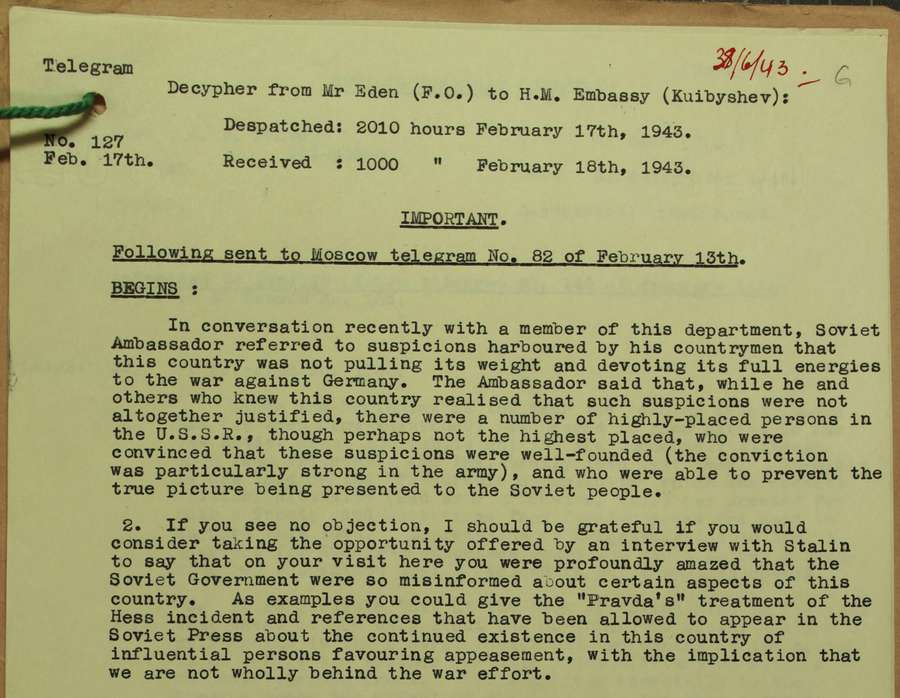
Telegram
Decypher from Mr. Eden (F.O.) to H.M. Embassy (Kuibyshev):
No. 127 Despatched: 2010 hours February 17th, 1943.
Feb. 17th. Received: 1000 hours " February 18th, 1943.
Following sent to Moscow telegram No. 82 of February 13th
BEGINS:
In conversation recently with a member of this department, Soviet Ambassador referred to suspicions harboured by his countrymen that this country was not pulling its weight and devoting its full energies to the war against Germany. The ambassador said that, while he and others who knew this country realised that such suspicions were not altogether justified, there were a number of highly placed persons in the USSR, though perhaps not the highest placed, who were convinced that these suspicions were well founded (the conviction was particularly strong in the army), and who were able to prevent the true picture being presented to the Soviet people.
2. If you see no objection, I would be grateful if you would consider taking the opportunity offered by an interview with Stalin to say that on your visit here you were profoundly amazed that the Soviet Government were so misinformed about certain aspects of this country. As examples you could give the ‘Pravda’s’ treatment of the Hess incident and references that have been allowed to appear in the Soviet press about the continued existence in this country of influential persons favouring appeasement, with the implication that we are not wholly behind the war effort.
Telegram from the British Foreign Secretary Anthony Eden to the British Embassy in Moscow, 17 February 1943. Catalogue reference: FO 181/972/22

See within Soviet Monitor no 3943 Dec. 7 Soviet Monitor no 3941 Dec. 6 ____________ 3944
See, especially, marked passages from “Izvestiza” and “Pravda” articles.
“Pravda” says that the Conference was a logical development of the closest friendship and collaboration between the US, UK and USSR, forged during the war.
“Izvestiza” says that anyone who reads the Declaration will realise that the outcome of the war has been decided beyond doubt.
“Red Star” says that the Declaration proves the complete failure of Hitler’s strategy.
Mass meetings of all sections of the Soviet population have been held to acclaim the Declaration.
Now see N7298, N7382 and N7333
The Soviet reactions to the Tehran Conference are marked by a warmth and interest which are quite new and it is being celebrated in leading articles and at factory meetings in a way which has hitherto been reserved for major events on the home front. The Soviet people are thus getting an education in international affairs such as they have never had before and which is bound to leave a fairly deep mark. Everything now depends on the military business being carried out fully and on time. If they are, we may hope that all will be well. If they are not, the reaction will be even stronger than the present enthusiasm.
Handwritten notes on the cover of a report written by British officials in Moscow in December 1943. Catalogue reference: FO 371/37064

Photograph of Churchill, Truman and Stalin at the Potsdam Conference, 1945. Catalogue reference: CO 1069/892

PROTOCOL OF THE PROCEEDINGS OF THE CRIMEA CONFERENCE
THE Crimea Conference of the Heads of the Governments of the United States of America, the United Kingdom, and the Union of Soviet Socialist Republics which took place from the 4th-11th February, came to the following conclusions-:
I.–World Organisation.
It was decided:
…
C. Voting
“1. Each member of the Security Council should have one vote.
“2. Decisions of the Security Council on procedural matters should be made by an affirmative vote of seven members.
“3. Decisions of the Security Council on all matters should be made by an affirmative vote of seven members, including the concurring votes of the permanent members; provided that, in decisions under Chapter VIII, Section A and under the second sentence of Paragraph 1 of Chapter VIII, Section C, a party to a dispute should abstain from voting.’
…
II. DECLARATION OF LIBERATED EUROPE
The following declaration has been approved:
…
The establishment of order in Europe and the rebuilding of national economic life must be achieved by processes which will enable the liberated peoples to destroy the last vestiges of nazism and fascism and to create democratic institutions of their own choice. This is a principle of the Atlantic Charter – the right of all people to choose the form of government under which they will live – the restoration of sovereign rights and self-government to those peoples who have been forcibly deprived of them by the aggressor nations.
To foster the conditions in which the liberated people may exercise these rights, the three governments will jointly assist the people in any European liberated state or former Axis state in Europe where, in their judgment conditions require,
…
V. REPARATION
The following protocol has been approved:
Protocol
On the Talks Between the Heads of Three Governments at the Crimean Conference on the Question of the German Reparations in Kind
[...]
The British delegation was of the opinion that, pending consideration of the reparation question by the Moscow reparation commission, no figures of reparation should be mentioned. The above Soviet-American proposal has been passed to the Moscow Reparation Committee as one of the proposals to be considered by the Commission.
VI. Major War Criminals
The Conference agreed the question of the major war criminals should be the subject of enquiry by the three Foreign Secretaries for report in due course after the close of the Conference.
Extract from the Yalta Protocol – the agreements signed by Britain, the USA and the USSR at the Yalta Conference, February 1945. Catalogue reference: FO 371/50838

…
When we met at Yalta, in addition to laying out strategic and tactical plans for the complete and final military victory over Germany, there were other problems of vital political consequence.
For instance, first there was the problem of occupation and control of Germany after victory, the complete destruction of her military power, and the assurance that neither Nazi-ism nor Prussian militarism could again be revived to threaten peace and civilisation of the world.
Secondly, again for example, there was the settlement of the few differences that remained among us with respect to the international security organisation after the Dumbarton Oaks Conference. As you remember, at that time and afterward, I said we had agreed 90 per cent. That is a pretty percentage. I think the other 10 per cent was ironed out at Yalta.
Thirdly, there were the general political and economic problems common to all of the areas that would be in the future, or which have been, liberated from the Nazi yoke. We over here find it very difficult to understand the ramifications of many of these problems in foreign lands, but we are trying to.
Fourth, there were the special problems created by Poland and Yugoslavia.
Days were spent in discussing these momentous matters, and we argued freely and frankly across the table. But at the end on every point unanimous agreement was reached. And more important even than the agreement of words, I may say that we achieved a unity of thought and a way of getting along together. We know, of course, that it was Hitler’s hope and the German war lords’ hope that we would not agree – that some slight crack might appear in the solid wall of allied unity, a crack that would give him and his fellow gangsters one last hope of escaping their just doom. That is the objective for which his propaganda machine has been working for many months. But Hitler has failed.
Never before have the major allies been more closely united- not only in their war aims but also in their peace aims. And they are determined to continue to be united, to be united with each other – and with all peace-loving nations – so that the ideal of lasting peace will become a reality.
The Soviet, and British, and United States Chiefs of Staff held daily meeting with each other. They conferred frequently with Marshal Stalin, Prime Minister Churchill, and with me on the problem of co-ordinating the strategic and tactical efforts of the Allied powers. They completed their plans for the final knock-out blows to Germany.
At the time of the Tehran conference, the Russian front, for instance, was removed so far from the American and British front that, while certain long-range strategic co-operation was possible, there could be not tactical, day-by-day co-ordination. They were too far apart. But the Russian troops have now crossed Poland. They are fighting on the eastern soil of Germany herself; British and American troops are now on German soil close to the Rhine River in the west. It is a different situation today from what it was 14 months ago. A closer tactical liaison has become possible for the first time in Europe. That was something else that was accomplished in the Crimean Conference.
…
Extracts from US President Roosevelt’s speech to the US Congress on the Yalta Conference, 1 March 1945. Catalogue reference: FO 371/50839

PRIME MINISTER’S PERSONAL TELEGRAM
SERIAL No. T.895/5
PRIME MINISTER TO PRESIDENT TRUMAN
Personal and Top Secret
No.44
12.5.45
Distribution
The King
Foreign Secretary
Sir Edward Bridges
General Ismay
For Information
War Cabinet
Dominions Secretary
Lord Privy Seal
Minister of Aircraft Production
Minister of Information
Service Ministers
Telegram from Prime Minister Winston Churchill to US President Truman commenting on relations between the Allies after the Yalta conference, 12 May 1945. Catalogue reference: CAB 120/186

OPERATION UNTHINKABLE
REPORT BY THE JOINT PLANNING STAFF
Owing to the special need for secrecy, the normal staff in Service Ministries have not been consulted.
OBJECT
2. The overall or political object is to impose upon Russia the will of the United States and British Empire.
Even though ‘the will’ of these two countries may be defined as no more than a square deal for Poland, that does not necessarily limit the military commitment. A quick success might induce the Russians to submit to our will at least for the time being; but it might not. That is for the Russians to decide. If they want total war, they are in a position to have it.
Page one of report from British Military leaders to Prime Minister Winston Churchill on the chances of ‘Operation Unthinkable’ – a surprise attack on the USSR, 22 May 1945. Catalogue reference: CAB 120/691

3. The only way we can achieve our object with certainty and lasting results is by victory in a total war but in view of what we have said in paragraph 2 above, on the possibility of quick success, we have thought it right to consider the problem on two hypotheses:-
TOTAL WAR
4. Apart from the chances of revolution in the USSR and the political collapse of the present regime – on which we are not competent to express an opinion – the elimination of Russia could only be achieved as a result of:
Occupation of Vital Areas of Russia
5. The situation might develop in such a way that Russians succeeded in withdrawing without suffering a decisive defeat. They would then presumably adopt the tactics which they had employed so successfully against the Germans and in previous wars of making use of the immense distances with which their territory provides them. In 1941 the Germans reached the Moscow area, the Volga and the Caucasus, but the technique of factory evacuation, combined with the development of new resources and Allied assistance, enabled the U.S.S.R. to continued fighting.
6. There was virtually no limit to the distance to which it would be necessary for the Allies to penetrate into Russia in order to render further resistance impossible. It is far as, or as quickly as, the Germans in 1942 and this penetration no decisive result.
Decisive Defeat of the Russian Forces
7. Details of the present strengths and dispositions of the Russian and Allied forces are given in Annexes II and III and illustrated maps A and B. The existing balance of strength in Central Europe, where the Russians enjoy a superiority of approximately three to one, makes it most unlikely that the Allies could achieve a complete and decisive victory in that area in present circumstances. Although Allied organisation is better, equipment slightly better and morale higher, the Russians have proved themselves formidable opponents of the Germans. They have competent commanders, adequate equipment and an organisation which
Page two of report from British Military leaders to Prime Minister Winston Churchill on the chances of ‘Operation Unthinkable’ – a surprise attack on the USSR, 22 May 1945. Catalogue reference: CAB 120/691

though possibly inferior by our standards, has stood the test. On the other hand, only about one third of their divisions are of a high standard, the others being considerably inferior and with overall mobility well below that of the Allies.
8. To achieve the decisive defeat of Russia in a total war would require, in particular, the mobilisation of manpower to counteract their present enormous manpower resources. This is a very long term project and would involve:-
Conclusions
9. We conclude that:-
QUICK SUCCESS
10. It might, however, be considered, as result of a political appreciation, that a quick and limited military success would result in Russia accepting our terms.
11. Before a decision to open hostilities were made, full account would have to taken of the following:-
12. Assuming, however, that it is decided to risk military action on a limited basis, accepting the dangers set out above, we have examined what action we could take in order to inflict such a blow upon the Russians as would cause them to accept our terms, even though they would not have been decisively defeated and, from the military point of view, would still be capable of continuing the struggle.
Page three of report from British Military leaders to Prime Minister Winston Churchill on the chances of ‘Operation Unthinkable’ – a surprise attack on the USSR, 22 May 1945. Catalogue reference: CAB 120/691

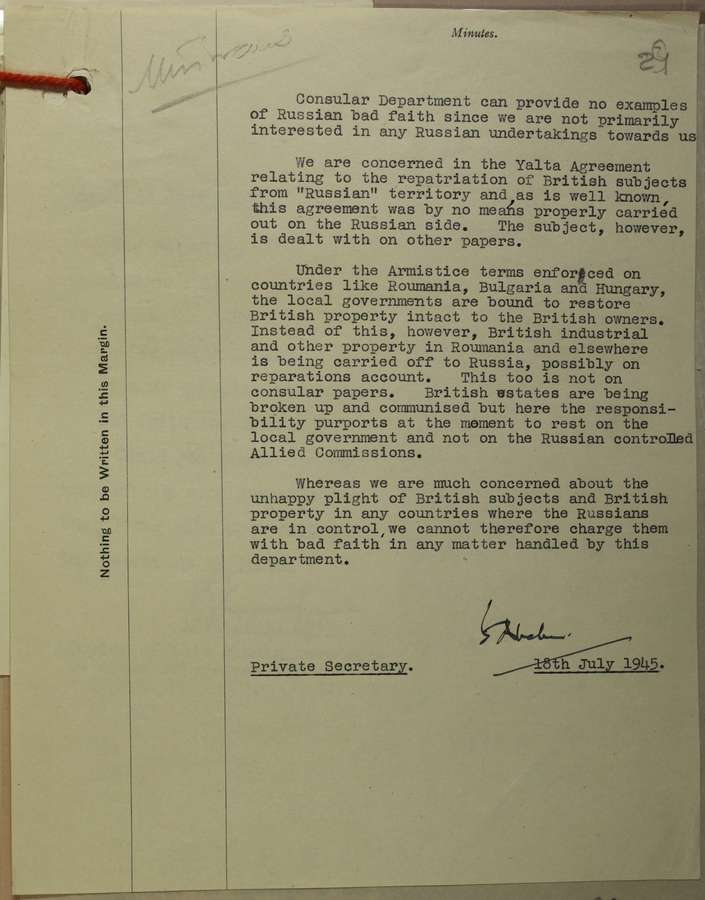
Minutes
Consular Department can provide no examples of Russian bad faith since we are not primarily interested in any Russia undertakings towards us.
We are concerned in the Yalta Agreement relating to the repatriation of British subjects from “Russian” territory as is well known, this agreement was by no means properly carried out on the Russian side. The subject however, is dealt with in other papers.
Under the Armistice terms enforced on countries like Roumania, Bulgaria and Hungary, the local governments are bound to restore British property intact to the British owners. Instead of this, however, British industrial and other property in Roumania and elsewhere is being carried off to Russia, possibly on reparations account. This too is not on consular papers. British estates are being broken up and communised but here the responsibility purports at the moment to rest on the local government and not on the Russian controlled Allied Commissions.
Whereas we are much concerned about the unhappy plight of British subjects and British property in any countries where the Russians are in control we cannot therefore charge them with bad faith in any matter handled by this department.
Private Secretary 18th July 1945
Foreign Office document from July 1945 listing examples of bad faith by the USSR after the war had ended. Catalogue reference: FO 371/47964

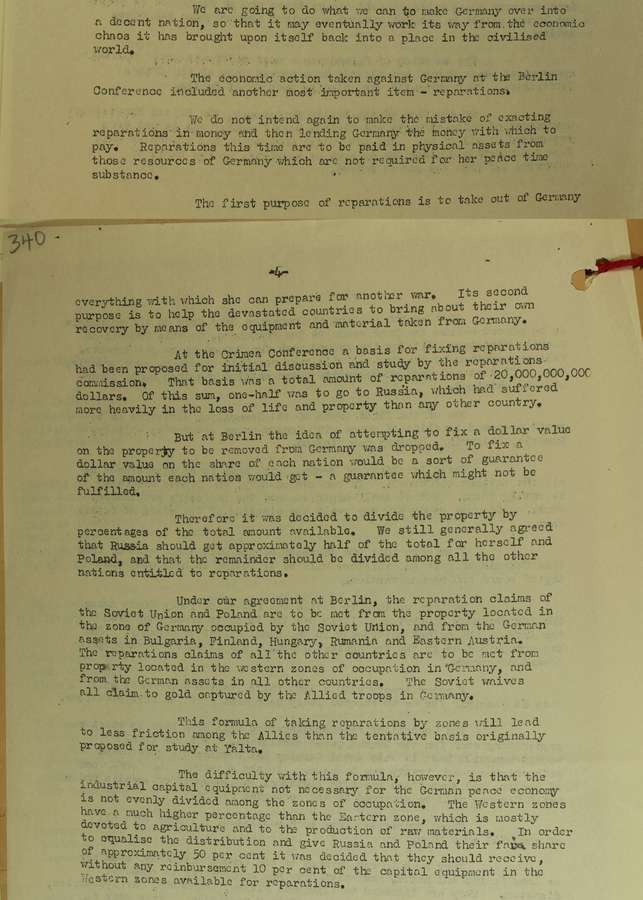
We are going to do what we can to make Germany a decent nation, so that it may eventually work its way from the economic chaos it has brought upon itself back to into a place in the civilised world.
The economic action taken against Germany at the Berlin Conference included another most important item – reparations.
We do not intend again to make the mistake of exacting reparations in money and then lending Germany the money with which to pay. Reparations this time are to be paid in physical assets [e.g. machinery or power plants] from those resources of Germany which are not required for her peace time substance [in other words, the machinery Germany used to support its war effort will be taken away].
The first purpose of reparations is to take out of Germany everything with which she can prepare for another war. Its second purpose is to help the devastated countries to bring about their own recovery by means of the equipment and material taken from Germany.
At the Crimea Conference a basis for fixing reparations had been proposed for initial discussion and study by the reparations commission. That basis was a total amount of reparations of 20,000,000,000 dollars. Of this sum, one-half was to go to Russia, which had suffered more heavily in the loss of life and property than any other country.
But at Berlin the idea of attempting to fix a dollar value on the property to be removed from Germany was dropped. To fix a dollar value on the share of each nation would be a sort of guarantee of the amount each nation would get- a guarantee which might not be fulfilled.
Therefore it was decided to divide the property by percentages of the total amount available. We still generally agreed that Russia should get approximately half of the total for herself and Poland, and that the reminder should be divided among all the other nations entitled to reparations.
Under our agreement at Berlin, the reparation claims of the Soviet Union and Poland are to be met from property located in the zone of Germany occupied by the Soviet Union, and from the German assets in Bulgaria, Finland, Rumania and Eastern Austria. The reparations claims of all the other countries are to be met from property located in the western zones of occupation in Germany, and from the German assets in all other countries. The Soviet waives all claims to gold captured by the Allied troops in Germany.
This formula of taking reparations by zones will lead to less friction among the Allies than the tentative basis originally proposed for study at Yalta.
The difficulty with this formula, however, is that the industrial capital equipment not necessary for the German peace economy is not evenly divided among the zones of occupation. The Western zones have a much higher percentage than the Eastern zone, which is mostly devoted to agriculture and the production of raw materials. In order to equalise the distribution and give Russia and Poland their fair share of approximately 450 per cent it was decided that they should receive, without any reimbursement 10 per cent of the capital equipment in the Western zones available for reparations.
Speech by President Truman on the Potsdam Conference, August 1945. This extract covers the issue of reparations from Germany. Catalogue reference: FO 371/50867

…The Russians’ determination to loot Germany may not be unconnected with their failure to obtain reconstruction credits in the Western countries. Every possible means should be tried of getting them to change their attitude. But if they will not, then the pursuit of truth and justice is a surer guide than any calculations of future alliances. We may not be able to alter what happens in the Russian zone, but we can at least disclaim responsibility for it. And we can follow our own convictions in the West, where what is left of Germany can be given the prospect, in the fullness of time, of achieving liberty, equality and prosperity within a Western Europe that is conscious of its political and economic unity…
Extract from an article in the British journal The Economist, 11 August 1945. Catalogue reference: FO 1062/134
The Economist (text)

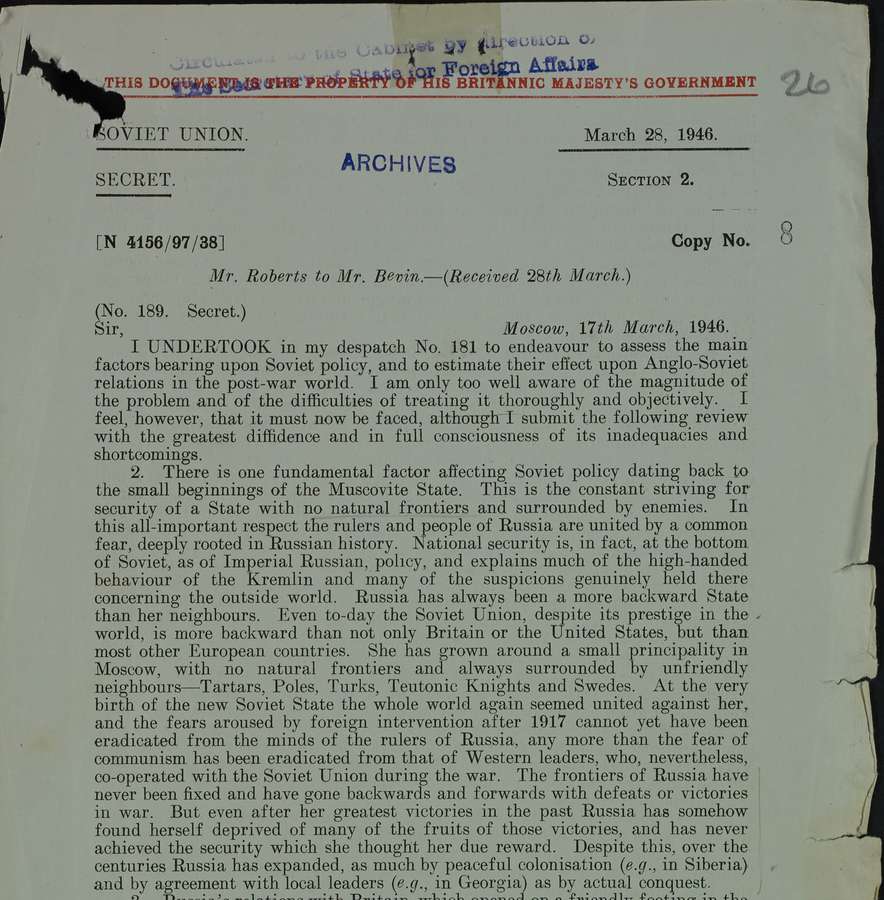
SOVIET UNION.
SECRET.
MARCH 28, 1946.
Section 2.
Mr. Roberts to Mr. Bevin (Received 28th March.)
(No. 189. Secret.)
Moscow, 17th March, 1946.
Sir,
I UNDERTOOK in my despatch No.181 to endeavour to assess the main factors bearing upon Soviet policy, and to estimate their effect upon Anglo-Soviet relations in the post-war world. I am only too well aware of the magnitude of the problem and of the difficulties of treating it thoroughly and objectively. I feel, however, that it must now be faced, although I submit the following review with the greatest diffidence and in full consciousness of its inadequacies and shortcomings.
2. There is one fundamental factor affecting Soviet policy dating back to the small beginnings of the Muscovite State. This is the constant striving for security of a State with no natural frontiers and surrounded by enemies. In this all-important respect the rulers and people of Russia are united by a common fear deeply rooted in Russian history. National security is, in fact, at the bottom of Soviet, as of Imperial Russian, policy, and explains much of the high-handed behaviour of the Kremlin and many of the suspicions genuinely held there concerning the outside world. Russia has always been a more backward State than her neighbours. Even today the Soviet Union, despite its prestige in the world, is more backward than not only Britain or the United States, but than most other European countries. She has grown around a small principality in Moscow, with no natural frontiers and always surrounded by unfriendly neighbours-Tartars, Poles, Turks, Teutonic Knights and Swedes. At the very birth of the new Soviet State the whole world again seemed united against her, and fears aroused by foreign intervention after 1917 cannot yet have been eradicated from the minds of the rulers of Russia, any more than the fear of communism has been eradicated from that of the Western leaders, who, nevertheless, co-operated with the Soviet Union during the war. The frontiers of Russia have never been fixed and have backwards and forwards with defeats and victories in the war, But even after her greatest victories in the past Russia has somehow found herself deprived of many of the fruits of those victories, and has never achieved the security which she thought her due reward. Despite this, over the centuries Russia expanded, as much by peaceful colonisation (e.g. in Siberia) and by agreement with local leaders (e.g. in Georgia) as by actual conquest.
…
Extract from memo from Frank Roberts, British Ambassador in Moscow, to Ernest Bevin, 17 March 1946. Catalogue reference: FO 371/56763

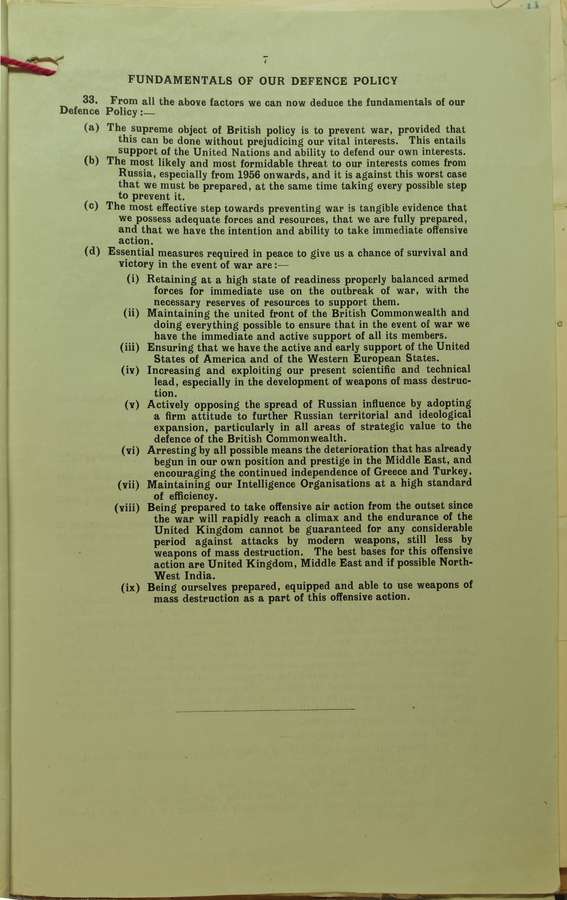
FUNDAMENTALS OF OUR DEFENCE POLICY
33. From all the above factors we can now deduce the fundamentals of our Defence Policy:
a. The supreme object of British policy is to prevent war, provided that this can be done without prejudicing our vital interests. This entails support of the United Nations and ability to defend our own interests.
b. The most likely and most formidable threat to our interests comes from Russia, especially from 1956 onwards, and it is against this worst case that we must be prepared, at the same time taking every possible step to prevent it.
c. The most effective step towards preventing war is tangible evidence that we possess adequate forces and resources, that we are fully prepared, and that we have the intention and ability to take immediate offensive action.
d. Essential measures required in peace to give us a chance of survival and victory in the event of war are:
i. Retaining at a high state of readiness properly balanced armed forces for immediate use on the outbreak of war, with the necessary reserves of resources to support them.
ii. Maintaining the united front of the British Commonwealth and doing everything possible to ensure that in the event of war we have the immediate and active support of all its members.
iii. Ensuring that we have the active and early support of the United States of America and of the Western European States.
iv. Increasing and exploiting our present scientific and technical lead, especially in the development of weapons of mass destruction.
v. Actively opposing the spread of Russian influence by adopting a firm attitude to further Russian territorial and ideological expansion, particularly in all areas of strategic value to the defence of the British Commonwealth.
vi. Arresting by all possible means the deterioration that has already begun in our own position and prestige in the Middle East, and encouraging the continued independence of Greece and Turkey.
vii. Maintaining our Intelligence Organisations at a high standard of efficiency.
viii. Being prepared to take offensive air action from the outset since the war will rapidly reach a climax and the endurance of the United Kingdom cannot be guaranteed for any considerable period against attacks by modern weapons, still less by weapons of mass destruction. The best bases for this offensive action are United Kingdom, Middle East and if possible North- West India.
ix. Being ourselves prepared, equipped and able to use weapons of mass destruction as a part of this offensive action.
Extract from report to the British Cabinet in 1947 summarising future British policy towards the USSR. Catalogue reference: CAB 21/1800

…
8. The hollowness of the Declaration on Liberated Europe was demonstrated only a fortnight after Yalta by the Moscow-directed coup in Bucharest. A similar pattern prevailed in other countries occupied by the Red Army. By the summer of 1947 Communist regimes had been established in Bulgaria, Romania, Hungary, the Soviet occupation zone in Germany, and Yugoslavia, as well as in Poland.
Conclusion
9. It was not in accordance with the Yalta declarations but in direct breach of them that sooner or later internal communist subversion backed by Soviet troops of occupation imposed the take-over of the countries of Eastern Europe. The physical Soviet presence, and corresponding western impotence, and unscrupulous Soviet disregard of the Yalta and later agreements, led to the consolidation of the “Soviet sphere of influence” in Eastern Europe. The process had begun when the Red Army overran Poland (part of which was seized by the USSR under the 1939 Nazi-Soviet Pact) in the summer of 1944. Its culmination, following Soviet rejection of the Marshall Plan in 1947, was the communist coup d’état in Czechoslovakia in February 1948. It is noteworthy that just as no act at Yalta underwrote a Soviet sphere of interest in Europe, so none had assigned Czechoslovakia to such a sphere. The West’s conclusion of the Brussels Treaty in March 1948, with firm US and Canadian support; the creation of a West German state; and the establishment of NATO in April 1949, were the perhaps inevitable Western responses and a further manifestation of the division of the continent- a division which existed before and after Yalta but was not determined by it. Yalta had in this respect been no more than a temporary resting-place on the way to a new balance of power resulting from the war and Stalin’s expansionist ambitions.
Extract from a Foreign Office document published in 1983. It analyses Soviet policy in Eastern Europe since 1945. Catalogue reference: FO 972/80

I have set out in an earlier paper the steps that have been taken by Soviet Russia from the days of the war-time conferences until the present.
There is only one conclusion to draw. After all the efforts that have been made and the appeasement that we followed to try and get a real friendly settlement on a four power basis, not only is the Soviet Government not prepared at the present stage to co-operate in any real sense with any non-Communist controlled Government, but it is actively preparing to extend its hold over the remaining part of continental Europe and, subsequently, over the Middle East and no doubt the bulk of the Far East as well. In other words, physical control of the Eurasian land mass and eventual control of the whole World Island is what the Politburo is aiming at – no less a thing than that. The immensity of the aim should not betray us into believing in its impracticability. Indeed, unless positive and vigorous steps are shortly taken by those other states who are in a position to take them, it may well be that within the next few months or even weeks the Soviet Union will gain political and strategic advantages which will set the great Communist machine in action, leading either to the establishment of a world dictatorship or (more probably) to the collapse of organised society over great stretches of the globe.
4. All our evidence indeed points to the probable staging by the Soviet Government of further efforts in this direction during the next few weeks or months. We cannot be sure where exactly this showdown will take place nor even that it will not occur in several places at once. All we know for certain (since Cominform has proclaimed it openly) is that its object will be the frustration by one means or another of the European Recovery Programme and the consequent development of a situation in which the Communist cause will triumph in many countries largely as result of a process of economic decay. But this does not mean that the Soviet Government are determined to have their way whatever the outside world may say or do. There is no reason even now to suppose that it could possibly welcome the World War which would undoubtedly result from it overstepping the mark. It is commonly accepted Communist doctrine that no issue should be forced until the moment is ripe and victory almost certain. If, therefore, the upholders of true democracy and opponents of dictatorship can present a really united front, and if the necessary economic means are made available by those who have them, the danger of war is, in my opinion, not imminent. Indeed it is my considered view that the only danger of war arises from the non-fulfilment of these two conditions. Provided they are fulfilled I believe that Communism will be forced on the defensive and that for many years at any rate we may look forward to a period of relative calm.
5. On these two “ifs”, however, everything depends. As for the second one we can only do our best to assist the passage of the European Recovery Programme through Congress by continuing to war the Administration of the dangers of delay.
Extract from a report called ‘The Threat to Western Civilisation’ from the Foreign Secretary to the British Cabinet in March 1948. Catalogue reference: CAB 129/25

Every now and again official representatives of the USA and Britain accuse Hungary, Rumania and Bulgaria of violating the peace treaties. Recently such accusations were made by the US State Department and the British Minister of state, McNeil. Both asserted that these countries were not observing the peace treaties which bound them to safeguard human rights and economic interests of the UN and their citizens in these countries. Well, these accusations are absolutely groundless.
In reality, all these countries are strictly observing the terms of the peace treaties. Human rights are not violated in any of them. Political freedom is secured to all citizens irrespective of race, sex, nationality or creed. These rights are embodied in the new constitutions and the possibility of exercising them is safeguarded. Racial discrimination is a crime punishable by law. Women enjoy the same rights as men. There is full freedom of conscience. Freedom of assembly, organisation and the press is secured. The overwhelming majority of the working people of these countries is organised in political TU [Trade Union], cultural and cooperative unions and associations on a democratic basis. There is no censorship in Rumania, Bulgaria and Hungary. An enormous number of newspapers and magazines of the most varied trends are published in the three countries.
When the US state Department and the British Minister McNeil speak of Hungary, Rumania and Bulgaria violating the peace treaty relating to human rights, they are obviously not thinking of honest citizens of these countries who enjoy full political freedom, but of their own agents, spies and wreckers. McNeil even named the people he had in mind. These are the reactionary Fascist groups and gangs who have been convicted of subversive terroristic activities, designed to overthrow the people’s democratic governments of these countries. But the governments of Rumania, Hungary and Bulgaria in no way violated the peace treaties when they adopted measures to frustrate the criminal, anti-democratic activities of Maniu, Petkov, Nagy and their like. On the contrary, these governments acted in full accordance with the treaties, which bind them not to suffer the existence or the activity of organisations of F Fascist type …
BBC translations and summaries of broadcasts by Moscow Radio in 1949. Catalogue reference: FO 371/78332

BRITISH INFORMATION SERVICES
AN AGENCY OF THE BRITISH GOVERNMENT
ADVANCE RELEASE
For release at 3.45 pm., G.S.T
Tuesday, March 5, 1946
SINEWS OF PEACE
Following IS THE Text of an address prepared for delivery by The Right Honorable Winston Churchill, M.P., at Westminster College, Fulton, Missouri, Tuesday,
March 5, 1946.
I am glad to come to Westminster College this afternoon and am complimented that you should give me a Degree. The name “Westminster” is somehow familiar to me. I seem to have heard of it before. Indeed it was at Westminster that I received a very large part of my education in politics, dialectic, rhetoric and one or two other things.
It is also an honour, ladies and gentlemen, perhaps almost unique, for a private visitor to be introduced to an academic audience by the President of the United States. Amid his heavy burdens, duties and responsibilities-unsought but not reconciled from- the President has travelled a thousand miles to dignify and magnify our meeting here today and give me an opportunity of addressing this kindred nation, as well as my own countrymen across the ocean and perhaps some other countries too. The President has told you that it is his wish, as I am sure it is yours, that I should have full liberty to give my true and faithful counsel in these anxious and baffling times. I shall certainly avail myself of this freedom and feel the more right to do so because any private ambitions I may have cherished in my younger days have been satisfied beyond my wildest dreams. Let me however make it clear that I have no official mission or status of any kind, and that I speak only for myself. I can therefore allow my mind, with the experience of a lifetime, to play over the problems which beset us on the morrow of our absolute victory in arms; and try to make sure that what has been gained with so much sacrifice and suffering shall be preserved for the future glory and safety of mankind.
…
A shadow has fallen upon the scenes so lately lighted by the Allied victory. Nobody knows what Soviet Russia and its Communist international organization intends to do in the immediate future or what are the limits if any to their expansive and proselytizing tendencies. I have a strong admiration and regards for the valiant Russian people and for my wartime comrade, Marshal Stalin. There is sympathy and goodwill in Britain- and I doubt not here also- towards the peoples of all the Russias and a resolve to preserve through many differences and rebuffs in establishing lasting friendships. We understand the Russian need to be secure on her western frontiers by the removal of all possibility of German aggression. We welcome Russia to her rightful place among the leading nations of the world. Above all we welcome constant, frequent and growing contacts between the Russian people and our own people on both sides of the Atlantic. It is my duty however, for I am sure you would wish me to state the facts as I see them to you, to place before you certain facts about the present position in Europe.
From Stettin in the Baltic to Trieste in the Adriatic an iron curtain has descended across the Continent. Behind that line lie all the capitals of the ancient states of Central and Eastern Europe. Warsaw, Berlin, Prague, Vienna, Budapest, Belgrade, Bucharest and Sofia, all these famous cities and the populations around them lie in what I must call the Soviet sphere, and all are subject in one form or another, not only to Soviet influence but to a very high and, in some cases, increasing measure of control from Moscow.
…
From what I have seen of our Russian friends and Allies during the war, I am convinced that there is nothing they admire so much as strength, and there is nothing for which they have less respect than for weakness, especially military weakness. For that reason the old doctrine of a balance of power is unsound. We cannot afford, if we can help it, to work on narrow margins, offering temptations to a trial of strength. If the Western Democracies stand together in strict adherence to the principles of the United Nations charter, their influence for furthering these principles will be immense and no one is likely to molest them. If however they become divided or falter in their duty and if these all-important years are allowed to slip away then indeed catastrophe may overwhelm us all.
…
Extracts from Churchill’s Iron Curtain speech given in the USA in March 1946. Catalogue reference: FO 371/51624

[This telegram is of particular secrecy and should not be retained by the authorised recipient and not passed on.]
[CYPHER]
CABINET DISTRIBUTION FROM MOSCOW TO FOREIGN OFFICE
Mr. Roberts
No.987 D. 3.45 p.m. 11th March, 1946
11th March, 1946 R. 8.35 p.m. 11th March, 1946
Repeated to Washington
………………
Important
My telegram No.938
The counterblast has come, but it is ostensibly directed only against Mr. Churchill personally. For once His Majesty’s Government and official British foreign policy are spared although I doubt whether the Soviet public draws the distinction and is much comforted by this.
2. Pravda, only paper appearing today, carried on the back page a two and a half column summary of Mr. Churchill’s speech which is on the whole fair and full . His references to the Soviet Union and in particular his support of your proposal to extend the alliance to fifty years (this is the first hint the Soviet public have had of this) are reproduced with his opening disclaimer that he spoke for anyone other than himself. No attempt was made to disguise his frank statements about the control of atomic energy or the Communist fifth column.
….
4. Most significant omission however was Mr Churchill’s reference to his unavailing warnings before the war [when Churchill warned of the dangers of Hitler and opposed Appeasement]. This is replaced by comment that he made ‘monstrous comparisons’ [ie comparing the USSR with 1930s Germany]. His reference to Russian admiration of strength was also dismissed as a cynical statement designed to support his propaganda for an Anglo-American alliance.
5. On the front page Pravda carries a two and a half column editorial entitled “Churchill rattles the sabre [threatens war]” bitterly attacking his speech. He is accused of having concealed his true views during the war and now returned to his old prejudices against the Soviet Union and the bogey of Bolshevik expansion dating from the time when he was a leading foreign interventionist. His conception of an Anglo-American military alliance is castigated as a reactionary plot against the Soviet Union, which would mean the end of the Big Three and of the United Nations Organisation. Pravda seems to forget that an Anglo-Soviet military alliance already exists. Churchill is coupled with Vandenberg and American reactionaries and the present Greek situation is quoted against him in reply to his criticisms of conditions in Europe behind the iron curtain. Critical American and British comment (“The Times” but not the “Daily Herald”) is quoted with approval, but there is still no mention of Mr. Byrne’s speech.
6. The Pravda article has caused a sensation in Moscow. It is being read everywhere with unusual interest and there is considerable disquiet among the general public. Mr Churchill had been built up here during and after the war as a friend of Stalin and the Soviet Union and he enjoyed the sincere regard and indeed affection of the Soviet public. His fall from grace is therefore all the more disturbing coming as it does after strong attacks upon you personally and upon His Majesty’s Government. As always the Soviet public, however reluctantly, will accept the official view expressed in Pravda.
7. My own impression is that the Soviet authorities were much taken aback by this frank statement by Churchill. They seem genuinely alarmed by many recent signs of American rapprochement with Britain in the face of high-handed Soviet actions and to fear however illogically the establishment of “an Anglo-Saxon bloc” their natural reaction is to endeavour to frighten United States Government and His Majesty’s Government and public opinion in both countries with the bogey of Soviet withdrawal from international-co-operation, as they did after the breakdown of the London Conference of Foreign Ministers last October. The references to the threat to Big Three co-operation and to the United Nations Organisation together are obviously intended to alarm all sections of opinion in the Western Democracies. Finally a gigantic red herring of this is of the greatest help with the Soviet public and possibly also with public opinion in directing attention from Persia, and Manchuria. In effect Churchill’s speech is being used, to justify the warnings about capitalist encirclement contained in recent Soviet propaganda and more particularly in the election speeches here.
…
Foreign Office telegram from Moscow on the reaction to Churchill’s speech in the USSR. Catalogue reference: FO 371/56781

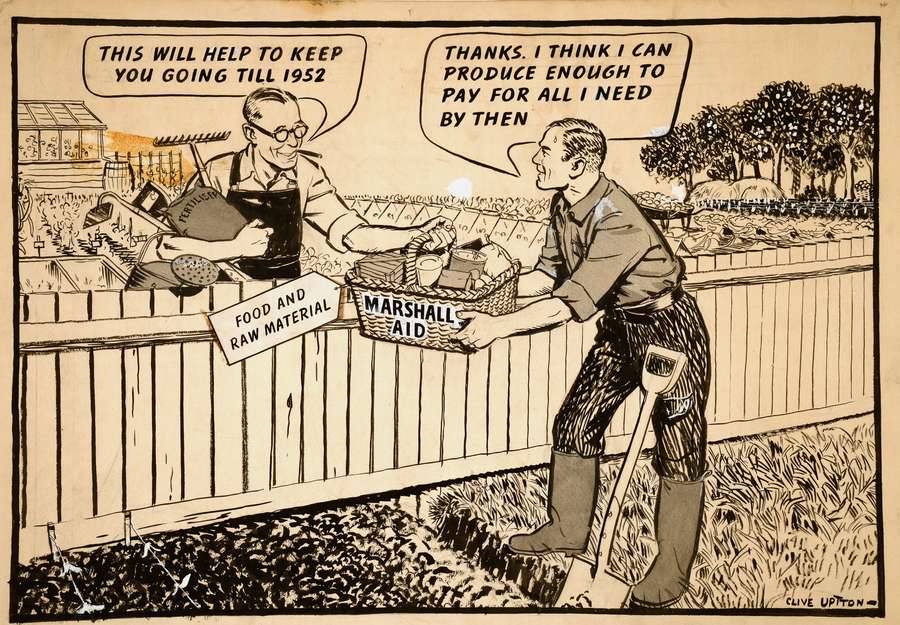
[Clockwise left to right]
[Speech bubble 1:]
This will help to keep you going till 1952
[Speech bubble 2:]
Thanks. I think I can produce enough to pay for all I need by then
[Basket labels:]
Marshall Aid
Food and Raw Material
Political cartoon about the introduction of Marshall Aid by Clive Uptton. Catalogue reference: INF 3/1295

(NOTICE: The following is for publication by Press or Radio upon cabled release expected between 1730 and 2000 GMT, Thursday, June 5. Please take all precautions for safeguard this embargo).
MARSHALL CALLS ON EUROPEAN COUNTRIES TO ORGANISE FOR U.S. AID
CAMBRIDGE, Massachusetts—U.S. Secretary of State Marshall, reiterating U.S. interest in the economic soundings for Europe and U.S willingness to grant aid to achieve that stability, on June 5 called on the nations of Europe to agree among themselves on their requirements and on the maximum utilisation of aid the United States can extend.
The text of Secretary Marshall’s address delivered before the Harvard University Alumni Club, follows:
I need not tell you, gentlemen, that the world situation is very serious. That must be apparent to all intelligent people. I think one difficulty is that the problem is one of such enormous complexity that the very mass of facts presented to the public by press and radio make it exceedingly difficult for the man the street to reach a clear a appraisement of the troubled areas of the earth and it is hard for them to comprehend the plight and consequent reactions of the long-suffering peoples, and the effect of those reactions on their governments in connection with our efforts to promote peace in the world.
In considering the requirements for the rehabilitation of Europe, the physical loss of life, the visible destruction of cities, factories, mines and railroads was correctly estimated, but it has become obvious during recent months that this visible destruction was probably less serious than the dislocation of the entire fabric of European economy. For the past ten years conditions have been highly abnormal. The feverish preparation for war and the more feverish maintenance of the war effort engulfed all aspects of national economies. Machinery has fallen into disrepair or is entirely obsolete. Under the arbitrary and destructive Nazi rule, virtually every possible enterprise was geared into the German war machine. Long-standing commercial ties, private institutions, banks insurance companies and shipping companies disappeared, through loss of capital, absorption through nationalisation or by simple destruction. In many countries, confidence in the local currency has been severely shaken. The breakdown of the business of Europe during the war was complete.
...
The truth of the matter is that Europe’s requirements for the next three or four years of foreign food and other essential products – principally from America – are so much greater than her present ability to pay that she must have substantial additional help or face economic, social, and political deterioration of a very grave character.
The remedy lies in breaking the vicious circle and restoring the confidence of the European people in the economic future of their own countries and of Europe as a whole. The manufacturer and the farmer throughout wide areas must be able and willing to exchange their products for currencies, the continuing value of which is not open to question.
Aside from the demoralising effect on the world at large and the possibilities of disturbance arising as a result of the desperation of the people concerned, the consequences to the economy of the United States should be apparent to all. It is logical that the United States should do whatever it is able to do to assist in the return of normal economic health in the world, without which there can be no political stability and no assured peace. Our policy is directed not against any country or doctrine but against hunger, poverty, desperation and chaos. Its purpose should be revival of a working economy in the world so as to permit the emergence of political and social conditions in which free institutions can exist. Such assistance I am convinced, must not be a piece-meal basis as various crises develop. Any assistance that this Government may render in the future should provide a cure rather than a mere palliative.
Any government that is willing to assist in the task of recovery will find full co-operation I am sure, on the part of the United States Government. Any government which manoeuvres to block the recovery of other countries cannot expect help from us. Furthermore, governments, political parties, or groups which seek to perpetuate human misery in order to profit therefrom politically or otherwise will encounter the opposition of the United States.
…
Extracts from speech by US Secretary of State George Marshall at Harvard University in June 1947 setting out the ‘Marshall Plan’. Catalogue reference: FO 371/62411
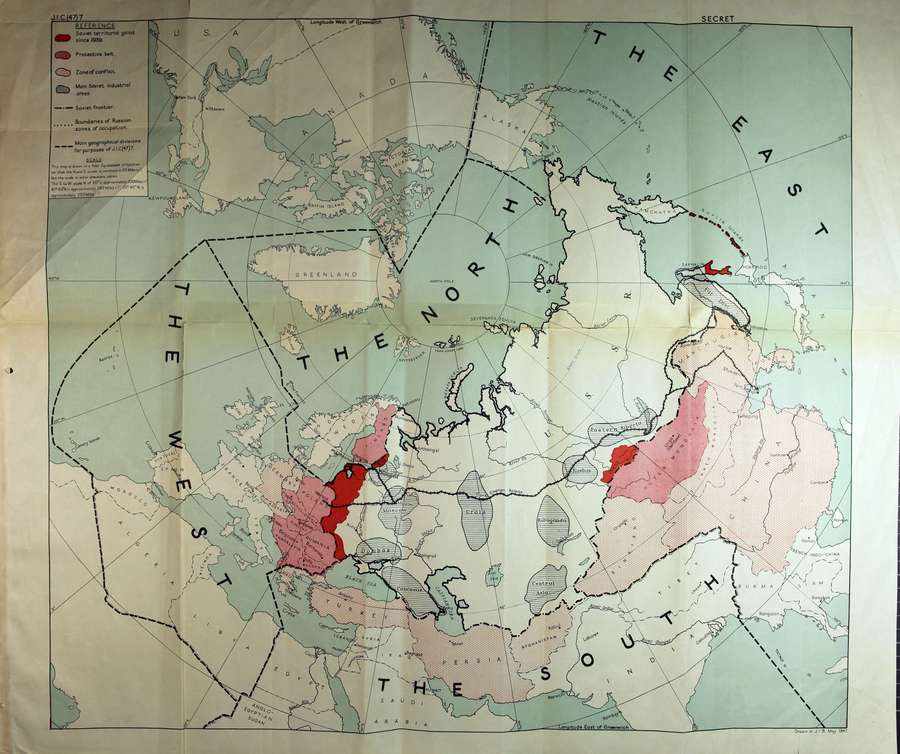
Map of Europe, Asia, and the Middle East. Most of the map is white, except for:
Red areas: Western part of Ukarine and all of modern-day Moldova. Eastern edge of modern-day Ukraine and Western part of modern-day Belarus. All of most of modern-day Lithuania, Latvia, and Estonia. A small eastern section of Finland. Small part of modern-day Russia just above Mongolia. The bottom half of the Sakhalin Oblast and Kurile Islands just beside Japan. None of these regions are labelled or include borders.
Light red areas: Most of Poland. Modern-day Czechia and Slovakia (labelled as Czechoslovakia). All of Albania, Hungary, Romania (labelled Rumania), and Bulgaria. All of an area labelled Yugoslavia (today split into Bosnia and Herzegovina, Croatia, Kosovo, Montenegro, North Macedonia, Serbia, and Slovenia). All of Finland apart from the red area. All of Mongolia (labelled Outer Mongolia).
Dotted (lightest red) areas: Germany, Austria, Greece, Turkey, Iran (labelled Persia), Afghanistan, Korea (with no distinction between North Korea and South Korea), and China (with borders and labels for ‘Sinkiang’ – Xinjiang – Inner Mongolia, and Manchuria, an older English name for Northeast China).
Striped (blue) areas: Area labelled ‘Leningrad’ southeast of Finland. Area labelled ‘Moscow’ surrounding and including Moscow. Area labelled ‘Donbas’ southeast of Kiev. Area labelled ‘Caucasus’ northwest of Iran. Area labelled ‘Urals’ stretching above the Aral Sea. Area labelled ‘Koraganda’ above Lake Balkhash. Area labelled ‘Central Asia’ right above Afghanistan. Area labelled ‘Kusbas’ northwest of Mongolia. Area labelled ‘Eastern Siberia’ north of Mongolia. Area labelled ‘Fast East’ northeast of ‘Manchuria’.

REFERENCE
[Red] = Soviet territorial gains since 1939.
[Light red] = Protective belt
[Dotted (lightest red)] = Zone of conflict.
[Striped (blue)] = Main Soviet industrial areas.
[Line with dashes and dots] = Soviet frontier
[Dotted line] = Boundaries of Russian zones of occupation
[Dashed line] = Main geographical divisions for purposes of J.I.C.(47)7.
SCALE
This map is drawn on a Polar Equidistant, projection so that the N. and S. scale is constant at 305 Miles to 1°, but the scale in other directions varies.
The E. to W. scale N. of 60° is approximately 300 Miles to 1°, 40°-60° N. is approximately 280 Miles to 1°, 20°-40° is approximately 250 Miles to 1°.
British map showing Soviet territorial gains 1939-1947. Catalogue reference: CAB 158/1
The purpose of this document collection is to allow students and teachers to develop their own questions and lines of historical enquiry on the Cold War.
Students could work with a group of sources or single source on a certain aspect. Teachers may wish to use the collection to develop their own resources or encourage students to ‘curate’ their own ‘exhibition’ of the most significant sources on the topic. Another idea would be to challenge students to use the documents to substantiate or dispute points made in the introduction with this collection.
We hope that the documents will offer students a chance to develop their powers of evaluation and analysis and enrich their understanding of this topic.
Who first coined the phrase 'Cold War'?
The consensus among historians is that it was the celebrated author and journalist, George Orwell, in his essay ‘You and the Atom Bomb’ published in the Tribune magazine on 19 October 1945 (though one biographer has traced his use of the phrase back to 1943).
In the 1945 article Orwell reflected on the repercussions of ‘a state which was at once unconquerable and in a permanent state of “Cold War” with its neighbours’. He envisaged ‘the prospect of two or three monstrous super-states’ dominating the world and possessing weapons which can kill millions in seconds. Orwell concluded that the atomic bomb was likely 'to put an end to large-scale wars at the cost of prolonging indefinitely a “peace that is no peace”'.
Looking back at Orwell’s predictions, he possessed amazing foresight. The Cold War (1945–1991) was a confrontation, both military and ideological, between two superpowers, the capitalist United States and the communist Soviet Union (and their respective allies), intensified by the threat of nuclear war. This highly charged stand-off was a thread running through historic developments such as the iron curtain, the Cuban missile crisis and the construction and dismantling of the Berlin Wall.
Because there was so much at stake – arguably, the very future of civilisation – the superpowers avoided direct confrontation but fought a series of savage proxy wars, in Asia, Africa and Latin America, supporting local factions. Orwell’s 'peace that is no peace' prediction was borne out.
Contemplating the Cold War from today’s perspective, one aspect cannot be predicted – the surprises that can emerge from documents you haven’t seen before.
Many narratives are available for the Cold War: it is the subject of many books, documentaries and films. However, this collection of documents shows us that archives still have the capacity to surprise us about this period in history.
For example, it is well-known that Churchill’s famous quotation 'from Stettin in the Baltic to Trieste in the Adriatic, an iron curtain has descended across the Continent' was part of a speech given in Fulton, Missouri, USA, on 5 March 1946. But did you know that he used the phrase ‘iron curtain’ almost a year earlier, in a personal telegram to President Truman on 12 May 1945? This is a heartfelt message in which Churchill expresses his ‘deep anxiety’ about Russian intentions in Eastern Europe.
Another surprise is a report by the Joint Planning Staff which puts forward a plan, little-known today, entitled ‘Operation Unthinkable’, advocating an attack on Soviet Forces to push them out of East Germany and Poland in July 1945. This document has real ‘shock value’: ‘If they [the Russians] want total war, they are in a position to have it’.
The strident language of this document is striking: the intention was ‘to impose on Russia the will of the United States and the British Empire’. However, it is acknowledged that ‘to win would take us a very long time’.
Dramatic language is also a feature of a report called ‘The Threat to Western Civilisation’ from the Foreign Secretary to the British Cabinet in March 1948. This refers to the possibilities of the Soviet Union establishing a ‘world dictatorship’ or the ‘collapse of organised society over great stretches of the globe’. The writing style is so powerful that the words leap from the page.
Yet another example of vivid writing can be seen in a Foreign Office telegram reporting back to London about the uprising in Hungary on 25 October 1956: ‘the populace are terrified of massive reprisals’.
In some cases, document content is not dramatic but is, nonetheless, surprising. A great example of this is the last paragraph of Atomic Spy Klaus Fuch’s confession on 27 January 1950, when he suddenly begins to ‘wax lyrical’ about his admiration for English people: ‘since coming to Harwell I have met English people of all kinds, and I have come to see in many of them a deep-rooted firmness which enables them to lead a decent way of life. I do not know where this springs from and I don’t think they do, but it is there’.
This incongruous piece of reflectiveness at the end of a confession statement shows how Fuchs was somewhat detached from reality at the time he made it – he does not seem to realise the import of what he had just confessed to, the giving of vital atomic secrets to the Soviet Union.
As well as the textual documents, visual sources can also tell a powerful story. Grainy black-and-white photographs of the early days of the construction of the Berlin Wall make us reflect on the predicament of Berliners, looking on at the partially constructed wall, the barbed wire, the turrets, and the ‘death strip’.
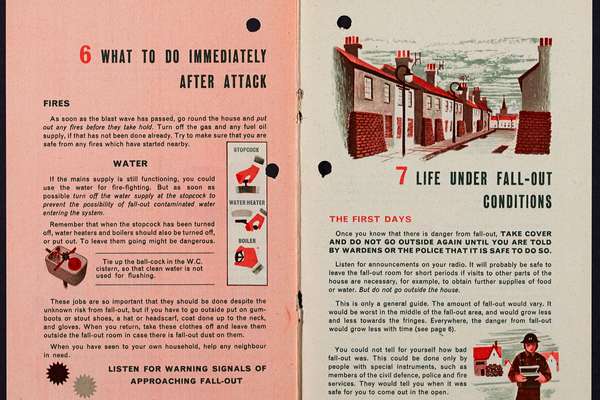
For another striking example of visual material, see the illustrations in the leaflet advising householders on protection against nuclear attack (1963), which are strangely cosy, hinting at elements of normality even during fall-out conditions.
The National Archives is the nation’s memory – we preserve the integrity of the public records, stretching back some 1,000 years. George Orwell truly understood the value of authoritative records: Winston Smith, the anti-hero of Orwell’s 1984, worked in the ‘Ministry of Truth’, falsifying back-numbers of The Times so that the information contained in them corresponded with the current pronouncements of Big Brother’s regime. The corollary of this imagined scenario, of course, is that archives you can trust are essential for a true understanding of the past.
Background information written by Mark Dunton, Principal Records Specialist at The National Archives.
Teaching resource
This set of documents relates to the nature of the Cold War and how it progressed in Europe and through the Korean War.
Teaching resource
This set of documents relates to the development of nuclear weapons during the Cold War, and policies and events that resulted from their existence.