















Teaching resource
Cold War on File: The wartime alliance and the 'iron curtain'
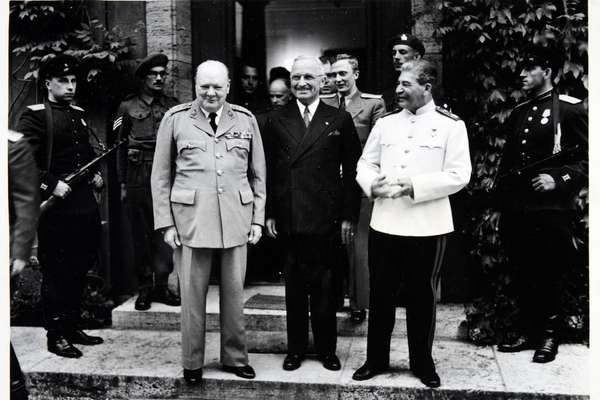
This set of documents relates to the early stages of the Cold War, focusing on the nature of the wartime alliance and the causes of the conflict that followed.
Teaching resource
This set of documents relates to how the Cold War progressed in Europe and through the Korean War. Students and teachers can use this resource to develop their own questions on the nature of various conflicts from Berlin in 1948 to Czechoslovakia in 1968.

Foreign Office map showing occupation of Berlin in 1948. Catalogue reference: FO 371/50831
Records included here highlight the nature of the Cold War, including the conflict over Berlin in 1948, the blockade and airlift. Other sources reflect the conflict in Korea and Soviet actions in Hungary (1956) and Czechoslovakia (1968) as told through political, military or personal themes.
You can discover more documents in our Cold War on File collections about The wartime alliance and the 'iron curtain' and The threat of nuclear war.
This map of Berlin has its borders marked out in green and with a line of dashes and dots.
Inside the city, another green border separates East Berlin and the area is labelled ‘U.S.S.R.’. West Berlin is divided through green borders into three parts. The top part is labelled ‘FRANCE’, the middle part ‘U.K.’, and the bottom part ‘U.S.’.
The area outside of the borders of Berlin is marked by red stripes.

TOP SECRET MAP “A”
P.H.P. (45), 4 (0)
GREATER BERLIN
SCALE 1:200,000
Outer Boundary: [line consisting of repeated pattern of dashes followed by two dots]
Verwaltungsbezirk Boundary: [dotted line]
Sector Boundary: [green line]
Main Railways: [line with vertical dashes across it]
Main Railway Station: [black rectangle]
Main Airfields: [circle containing dot]
Secondary Airfields: [half-black circle]
Built-up Districts: [grey]
Soviet Zone: [diagonal red stripes]
[cross]: Formerly Friedrichs Hein
Foreign Office map showing occupation of Berlin in 1948. Catalogue reference: FO 371/50831

…
The Cabinet were informed that no progress had been made in the quadripartite discussion on the possibility of introducing a single currency for the whole of Berlin, and that early on the previous day it had been announced that the new currency for the Soviet Zone would be introduced into the whole of Berlin. The Military Governors of the Western Zone had countered this by announcing that the new currency for the Western Zones would be introduced into the western sectors of Berlin. Early that morning the Soviet authorities had stopped all rail traffic between Berlin and the Western Zones and all electricity supplied from the eastern to the western sectors of Berlin. It was not yet clear whether these restrictions were designed as a tactical reply to the action taken by the Western powers on the currency question or whether they were the first move in a major offensive to force the Western Powers to withdraw from Berlin. Our Military Governor had been asked for a full report on the situation and this was expected by noon.
The Cabinet recognised that a very serious situation might develop in Berlin; and it was important that the Western Powers should take their stand on a position which they were confident of being able to sustain. The Minister of State undertook to arrange that the Foreign Secretary should be fully informed of the situation without delay. As soon as the promised report on the situation was received, he would also consider, in consultation with the Foreign Secretary and the Prime Minister, whether the British Military Governor in Berlin should be recalled to London for consultation with Ministers.
…
4. The Foreign Secretary informed the Cabinet of the latest developments in the situation in Germany. In view of the suggestions published in the Soviet-controlled press in Berlin, the Foreign Office had issued a statement over the week-end confirming the Government’s intention to maintain their position in Berlin and the United States Government were being asked to make a similar statement. There could be no question of yielding to Soviet pressure; if the Western Allies were forced out of Berlin, the project of Western Union would be fatally weakened. Every effort must be made to increase the existing food stocks for the civil population in the British sector of the city. This could now be done by air alone, and steps had been taken to expand the air services into the city. It seemed possible that the Soviet Government might try to secure an agreement on Four-Power control of the Ruhr in return for permitting the resumption of rail and water traffic into the Western Zones. There was no foundation for their allegation that we were failing to carry out the terms of an agreement on this issue: the United Kingdom Delegation had declined to discuss the matter at the Potsdam Conference
…
The Minister of Defence said that the Chiefs of Staff were consulting the Combined Chiefs of Staff in Washington about the situation. The British Military Governor had confirmed that nothing would be gained by attempting to force through convoys by rail, road or water, since the Soviet authorities could interpose effective technical obstacles. Attention must therefore be concentrated on expanding the use of freight aircraft. At the present time, the Royal Air Force could bring into the city a daily load of 75 tons, but this could be increased very shortly by 400 tons and by, 3rd July, to 750 tons. This was the maximum daily load which could be transported by this means, and it would not be possible to maintain this rate for longer than a month. The Principal Administrative Officers Committee were considering to what extent dehydrated foods could be substituted for other supplies. The United States Air Force were at present transporting 1,000 tons a day by air into their sector. The Military Governor had reported that the Soviet authorities might attempt to interfere with air traffic either by fighter aircraft or by barrage balloons: instructions had been given that the risks of interference by fighters must be accepted but barrage balloons should be shot down.
Extract from British Cabinet minutes in 1948 covering discussions over the Berlin Blockade. Catalogue reference: CAB 128/13
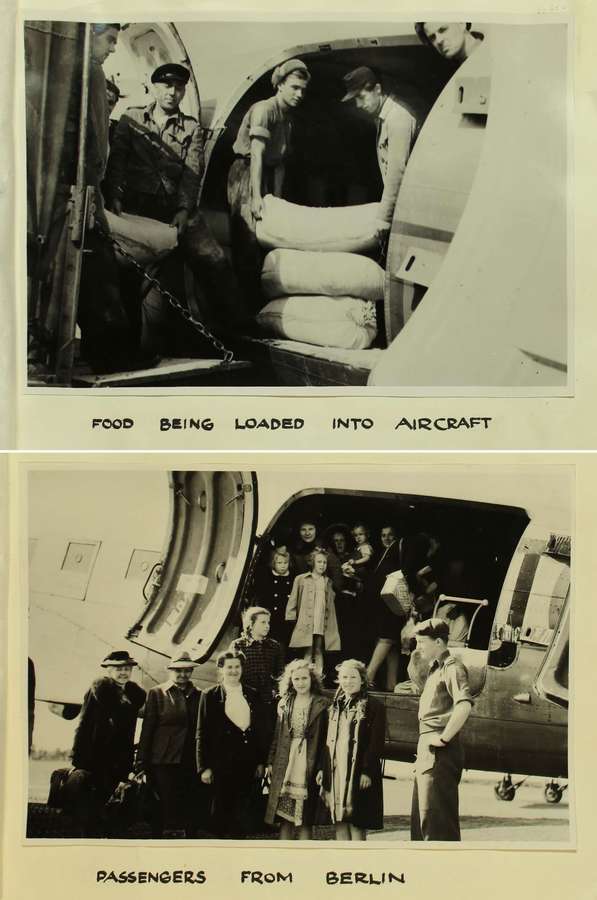
Britain’s ‘Operation Plainfare’ was launched on 28 June 1948, two days after the United States launched ‘Operation Vittles’.

[Caption under first photo:]
FOOD BEING LOADED INTO AIRCRAFT
[Caption under second photo:]
PASSENGERS FROM BERLIN
Photographs from a ‘pictorial record of Operation Plainfare’, dated 27 July 1949. Catalogue reference: AIR 55/118

….
11. All surface transport was now at a standstill and the Western Powers had only one means of communication left. The use of the air corridors to Berlin had been guaranteed in writing by Quadri-partite agreement in November, 1945. Berlin had to be supplied by air or abandoned to the Russians.
Extract from a Report by the British Air Ministry on the Berlin Blockade, published in 1950. Catalogue reference: AIR 55/111

British embassy, Moscow
7th July 1950
Sir
Although the march of events in Korea is too swift and too uncertain to justify an attempt at this stage to draw any but the most tentative conclusions from them, I think that it may be not without interest to record the steps – or, rather, such of them as were visible to an observer in Moscow – which led up to the invasion of South Korea on the 25th June.
2. In retrospect the ideological preparation for the use of force can be detected clearly enough. It must be borne in mind, however, that Korea is only one of the numerous fields in which Soviet propagandists have, for many months past, claimed to see evidence of the aggressive attentions of the United States; so that until the blow actually fell, there was no more reason to suspect the imminence of a Communist coup in Korea than in, say, Persia or Yugoslavia. Indeed until June, the Soviet press seemed to find relatively little interest in the Korean scene. Even the elections held in South Korea on the 30th May under the supervision of the United Nations Commission passed almost unnoticed in the Soviet Press, and it was not until a fortnight later that a minor Soviet commentator asserted that the results had confirmed that the broad masses in South Korea were resolutely condemning the “treacherous policy of the Syngman Rhee clique”.
3. Then, suddenly, on the 8th June, the first move was made by the North Korean authorities in the campaign which was to reach its climax with the invasion of South Korea on the 25th June. The Central Committee of the United Democratic Fatherland Front of North Korea published an appeal for the holding of a general election on August 5th-8th August throughout the whole territory of Korea which was to lead to the “peaceful unification” of all Korea. The appeal significantly demanded that both the rulers of South Korea and the United Nations Commission should be excluded from participation in the elections. On the 17th June Mr. Dulles arrived in South Korea, enabling the official news agency of North Korea to comment a few days later that this visit had revealed clearly that the Americans intended to “frustrate at all costs peaceful unification and to cause fratricidal war” so as to consolidate their dominion in South Korea.
4. As was presumably expected, the appeal of the Fatherland Front was not accepted by the South Koreans, and the North Koreans then passed to the next stage of their campaign which was the publication on the 20th June of a decree by the Presidium of the People’s Assembly of North Korea proposing that the peaceful unification of Korea should now be effected by the merging of the Assemblies of North and South Korea as prelude to the drawing up of a new constitution under which all Korean elections could be held. In this decree, it was now stated not only that the present rulers of South Korea and the United Nations Commission should not participate but also that the former should be arrested and the later expelled. The sinister proposal was also made that the armies and police forces of both countries should be reorganised into single bodies on “democratic foundations”. In effect the decree constituted a demand for the voluntary surrender of South to North Korea. As such, it stood no chance of acceptance, and can only have been intended as the final step in the preparations for the invasion of the 25th June.
5. All these manoeuvres [by the North Koreans] were faithfully reported by the Soviet press, in the form of Tass messages from the North Korean capital. Comment was carefully eschewed, but the agency reports were sufficient to prepare the Soviet reader for ready acceptance of the myth that the North Koreans, so far from attacking their Southern neighbours, were themselves the victims of an unprincipled aggression launched under United States auspices.
…
Extract from a Foreign Office report on the Soviet government’s management of media coverage of the Korean War, 7 July 1950. Catalogue reference: FO 371/86738

TOP SECRET
CHIEFS OF STAFF COMMITTEE
CONFIDENTIAL ANNEX
To
C.O.S. (51) 7TH MEETING (STAFF CONFERENCE)
Held on Monday 8th JANUARY, 1951.
FUTURE OPERATIONS IN KOREA
(Previous Reference: COS (51) 5th Meeting)
THE SECRETARY OF STATE FOR FOREIGN AFFAIRS said that our policy in Korea should be based on the assumption that we should fight it out there whilst, at the same time, trying to localise the conflict. On the assumption that we could hold a line in Korea and build up a position of strength, the Chinese might be persuaded to negotiate. At a meeting of the Commonwealth Prime Ministers the previous week on the suggestion of the Prime Minister of India, the Commonwealth Prime Ministers had been considering delaying for about a week any further action on the Americans’ request for support in introducing a resolution at Lake Success condemning China as an aggressor. However, it appeared from information recently received that the intention of the United Nations’ Command in Korea was to evacuate; in which case we could no longer stall. In order to ensure the greatest measure of support at Lake Success, immediate action seemed necessary.
THE CHIEFS OF STAFF said that as far they knew General MacArthur had been instructed by the United States Joint Chiefs of Staff to hold the line in Korea.
They (the British Chiefs of Staff) had suspected, however, that General MacArthur did not intend to hold any such line. On the contrary, he appeared to be creating an alibi to justify complete withdrawal.
General MacArthur had recently indicated to the Commander-in-Chief, Far East Fleet, that he considered the only alternative to the evacuation of Korea was war with China.
THE CHIEFS OF STAFF still considered that a “limited” war with China would not be possible. They further pointed out that in the event of a final withdrawal from Korea, the evacuation would be considerably impeded, if the Russians decided to give air assistance to the Chinese. In discussion it was pointed out that the kind of action against China for which the United States’ Government appeared to be pressing would almost certainly provoke China to extend hostilities- e.g., a campaign of subversion or guerrilla warfare against China, involving the use of General Chiang Kai Shek’s forces, would certainly have that effect.
It was agreed that, in view of the President of the United States’ assurance to the Prime Minister during the recent discussions in Washington that we should fight it out Korea, it was for consideration whether a telegram on the lines of the above discussion should be sent from the Prime Minister to the President.
The meeting also agreed that during the course of the subsequent discussion with the Commonwealth Prime Ministers, the Chiefs of the Imperial General Staff should indicate that the British Chiefs of Staff were not optimistic about the chances of the United Nations being able to hold on in Korea.
THE COMMITTEE
Took note of the discussion.
Ministry of Defence, S.W.1
10th January, 1951
Notes from a meeting of Chiefs of Staff on policy in Korea, 8 January 1951. Catalogue reference: FO 371/92756

CONFIDENTIAL
FROM BUDAPEST TO FOREIGN OFFICE
Cypher/OTP FOREIGN OFFICE AND WHITEHALL DISTRIBUTION
Mr. Fry
No.430 D. 4.04 p.m. October 25, 1956
October 25, 1956 R. 4.08 pm. October 25, 1956
EMERGENCY
CONFIDENTIAL
…
The Hungarian Tricolours without the Communist emblem, now flying on many public and other buildings throughout the city, while orderly crowds carrying their flags and singing patriotic songs are moving about at will. Without controlling the Government they appear to have come as close to controlling Budapest as is ever likely.
Foreign Office please pass Priority to Moscow and Warsaw as my telegrams Nos. 27 and 18 and Saving to Bucharest, Prague and Bonn as my telegrams Nos. 26, 27 and 6.
[Repeated to Moscow and Warsaw, and Saving to Bucharest, Prague and Bonn]
ADVANCED COPIES
Sir I. Kirkpatrick Private Secretary Sir J. Ward
Head of Northern Department Head of News Department
Head of Information Research Department.
Transcript
CONFIDENTIAL
FROM BUDAPEST TO FOREIGN OFFICE
Cypher/OTP FOREIGN OFFICE AND WHITEHALL DISTRIBUTION
Mr. Fry
No.451 D. 7.02 p.m. October 26, 1956
October 26, 1956 R. 7.38 pm. October 26, 1956
EMERGENCY
CONFIDENTIAL
Use of railway wagons, tram lines, flagstones, and anything else on which they can lay hands, large crowds have, from early this morning, been erecting barricades beyond Var and other hills of Buda. Their intention appears to be to prevent Russian reinforcements entering the town from the south west, one direction from which they might be expected to come.
…
Two Foreign Office telegrams reporting back to London on the situation in Hungary from 25–26 October 1956. Catalogue reference: FO 371/122376

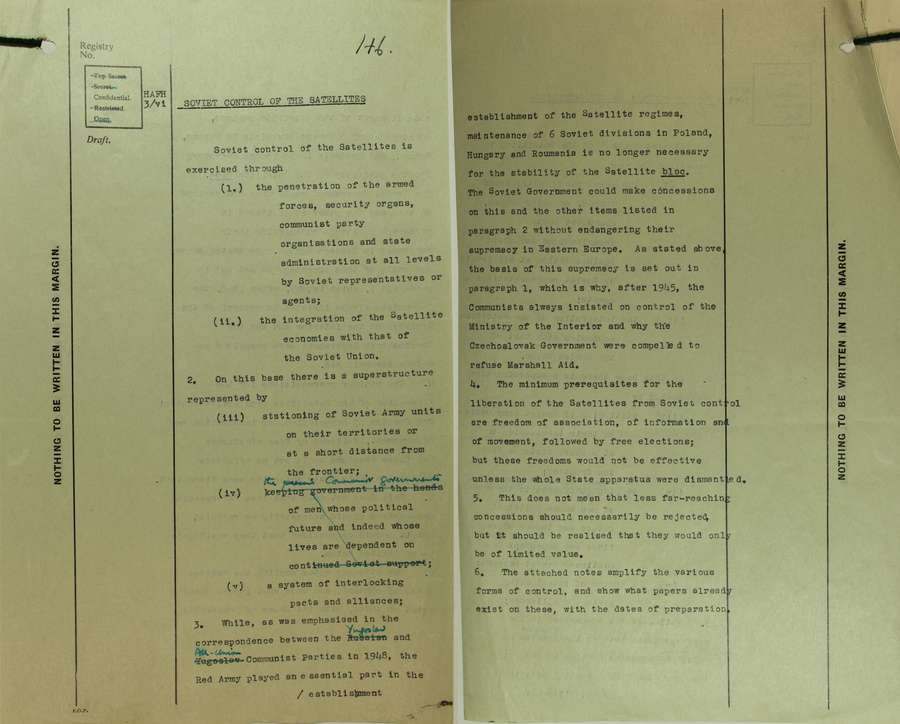
SOVIET CONTROL OF THE SATELLITES
Soviet control of the Satellites is exercised through
(i.) The penetration of the armed forces, security organs, communist party organisations and state administration at all levels by soviet representatives or agents;
(ii.) The integration of the Satellite economies with that of the Soviet Union.
2. On this base there is a superstructure represented by
(iii.) Stationing of Soviet army units on their territories or at a short distance from the frontier;
(iv.) the present Communist governments of men whose political future and indeed whose lives are dependent on continued Soviet support;
(v.) a system of interlocking pacts and alliances;
3. While as we emphasised in the correspondence between the Yugoslav and All-Union Communist Parties [Communist Party of the Soviet Union] in 1948, the Red Army played an essential part in the establishment of the Satellite regimes, maintenance of 6 Soviet divisions in Poland, Hungary and Roumania is no longer necessary for the stability of the Satellite bloc. The Soviet Government could make concessions on this and the other items listed in Paragraph 2 without endangering their supremacy in Eastern Europe. As stated above the basis of this supremacy is set out in paragraph 1, which is why, after 1945, the Communists always insisted on control of the Ministry of the Interior and why the Czechoslovak Government were compelled to refuse Marshall Aid.
4. The minimum prerequisites for the liberation of the Satellites from Soviet control are freedom of association, of information and of movement, followed by free elections; but those freedoms would not be effective unless the whole State apparatus was dismantled.
5. This does not mean that less far-reaching concessions should be necessarily be rejected, but it should be realised that they would only be of limited value.
6. The attached notes amplify the various forms of control, and show what papers already exist on these, with the dates of preparation.
British government analysis of relations between the Soviet Union and its satellite countries in Eastern Europe, 1955. Catalogue reference: FO 371/116114

B.573(R).
December, 1959.
NO HOPE FOR THE HUNGARIANS
Few political conferences can ever have held out less hope for the future than the Hungarian Party Congress, held in Budapest from November 30 to December 4. Three years after the revolt, the Kadar regime has given notice that, despite the complete disenchantment and apathy of the people, the Communisation of the country is to proceed without any relaxation of police State methods.
Soviet troops are to remain in the country and with this promise of continued backing from Moscow the harsh measures to supress dissidence and enforce conformity are to continue-particularly amongst the young and the intelligentsia where unorthodoxy is most prevalent- and the protests of the free world will be defied as before.
Further improvements in the country’s economic situation and the people’s standard of living may be expected-but always in conformity with and subordinate to, the requirements of Soviet bloc plans, which may not always coincide with the welfare of the Hungarian people. In particular, the resumption of the collectivisation drive will cause hardship.
The Congress has probably confirmed most Hungarians in their feeling that the endurance contest which they are waging against the re-imposition of Soviet Communism will be very long and very hard.
As for the stability of the regime internally, its leaders will gain in prestige only among the few sincere party members and the slowly widening circle with a vested interest in its survival. Between the majority of the people and their discredited rulers the gulf may even widen following the brazen and unrepentant speeches from the Congress. On the surface, however, the country will smoothly administered and a kind of modus vivendi [way of life] or co-existence will prevail between the rulers and the governed.
No Soviet Withdrawal
For several months prior, it was strongly rumoured that there would be an announcement at the Congress of the withdrawal of the Soviet troops- now believed to total some four divisions- who have remained in Hungary since they crushed the October, 1956, Uprising. But such hopes were dashed by Kadar in his opening speech:
“Soviet troops will remain in Hungary so long as the international situation makes it necessary”
The continued existence of “organs of repression” which, according to Marxist theory, should gradually “wither away” in Communist States, but which in fact are the most essential and permanent feature, is habitually explained and justified in this way- or even simply by the continued existence of neighbouring non-communist regimes. This argument is less than ever convincing; the fact that the troops are disposed in small garrisons throughout the country, especially on the outskirts of towns that they are composed chiefly of tanks and infantry, clearly indicates the security role they are intended to play. There is, in any case, no conceivable strategic justification for their presence. Hungarian and Soviet spokesmen have never claimed that when Soviet troops intervened they had to fight against anyone but Hungarians.
Kadar threw some interesting light on the hopes and fears of ordinary Hungarians, when he admitted that people had “day dreams about what will happen” if Soviet troops did leave; and that such dreams had recently been encouraged by the Khrushchev-Eisenhower meeting and Camp David talks which “utterly mistaken reactionaries” thought might “lead to a capitalist-Fascist Hungary”. Kadar’s comment on this was: “A hungry pig dreams of acorns”.
Changed Line on Revolution
How to rewrite the “events of October, 1956”, in a way both consistent and satisfactory to the Kadar regime, has been a problem sufficient to defeat the most ingenious party propagandists. No doubt the “party line” on the uprising will continue to vary according to the exigencies of the moment. But at the Congress Kadar produced a new, cut-and-dried account on which the official version will probably be based for some time to come.
Extracts from a Foreign Office report on the state of Hungary, 1959. Catalogue reference: FO 975/129

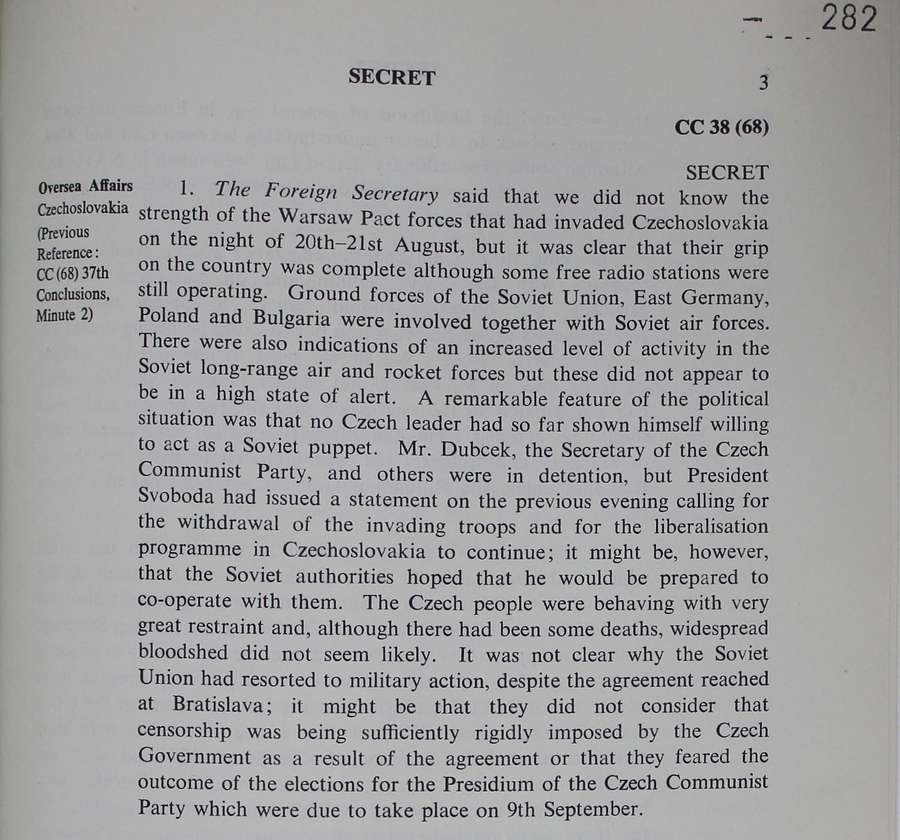
The Foreign Secretary said that we did not know the strength of the Warsaw Pact forces that had invaded Czechoslovakia on the night of 20th-2lst August, but it was clear that their grip on the country was complete although some free radio stations were still operating. Ground forces of the Soviet Union, East Germany, Poland and Bulgaria were involved together with Soviet air forces. There were also indications of an increased level of activity in the Soviet long-range air and rocket forces but these did not appear to be in a high state of alert.
A remarkable feature of the political situation was that no Czech leader had so far shown himself willing to act as a Soviet puppet. Mr Dubcek, the Secretary of the Czech Communist Party, and others were in detention, but President Svoboda had issued a statement on the previous evening calling for the withdrawal of the invading troops and for the liberalisation programme in Czechoslovakia to continue; it might be, however, that the Soviet authorities hoped that he would be prepared to co-operate with them.
The Czech people were behaving with very great restraint and, although there had been some deaths, widespread bloodshed did not seem likely. It was not clear why the Soviet Union had resorted to military action, despite the agreement reached at Bratislava; it might be that they did not consider that censorship was being sufficiently rigidly imposed by the Czech Government as a result of the agreement or that they feared the outcome of the elections for the Presidium of the Communist Party which were clue to take place on 9th September.
Report to the British Cabinet summing up the situation in Czechoslovakia in August 1968. Catalogue reference: CAB 128/43

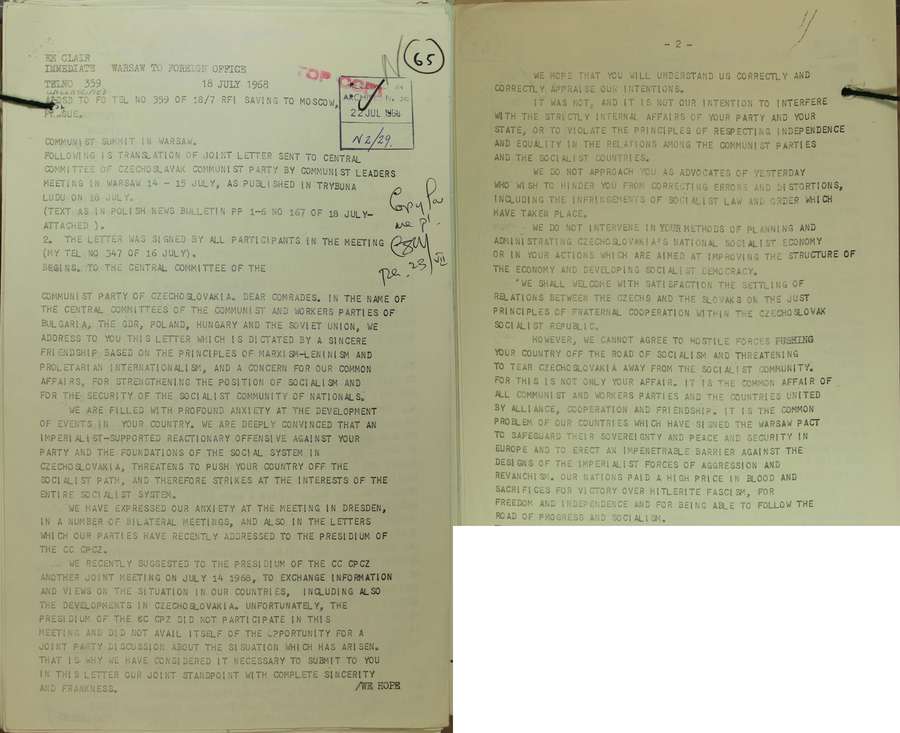
EN CLAIR
IMMEDIATE WARSAW TO FOREIGN OFFICE
TELNO 359
18 JULY 1968
ADDSE TO FO TEL NO 358 OF 18/7 RFI SAVING TO MOSCOW, PRAGUE
22 JULY 1968
Communist Summit in Warsaw.
Following is translation of joint letter sent to central committee of Czechoslovak Communist Party by Communist leaders meeting in Warsaw 14-15 July, as published in Trybuna Ludu on 18 July.
(Text as in Polish News Bulletin pp 1-6 No. 167 of 18 July attached).
Begins. To the central committee of the Communist Party of Czechoslovakia.
Dear Comrades, in the name of the Central Committee of the Communist and the Workers Parties of Bulgaria, the GDR, Poland, Hungary and the Soviet Union, we address to you this letter which is dictated by a sincere friendship based on the principles of Marxist-Leninism and proletarian internationalism, and a concern for our common affairs, for strengthening the position of socialism and for the security of the socialist community of nationals.
We are filled with profound anxiety of the development of events in your country. We are deeply convinced that an imperialist-supported reactionary offensive against your party and the foundations of the social system in Czechoslovakia, threatens to push your country off the socialist path, and therefore strikes at the interests of the entire socialist system.
We have expressed our anxiety at the meeting in Dresden, in a number of bilateral meetings, and also in the letters which our parties have recently addressed to the Presidium of the CC CPCZ.
We have recently suggested to the Presidium of the CC CPCZ another joint meeting on July 14 1968, to exchange information and views on the situations in our countries, including also the developments in Czechoslovakia. Unfortunately the Presidium of the CC CPZ did not participate in this meeting and did not avail itself of the opportunity for a joint party discussion about the situation which has arisen. That is why we have considered it necessary to submit to you in this letter our joint standpoint with complete sincerity and frankness.
We hope that you will understand us correctly and correctly appraise our intentions.
It was not, and it is not our intention to interfere with the strictly internal affairs of your party and your state, or to violate the principles of respecting independence and equality in the relations among the communist parties and the socialist countries.
We do not approach you as advocates of yesterday who wish to hinder you from correcting errors and distortion, including the infringements of socialist law and order which have taken place.
We do not intervene in your methods of planning and administrating Czechoslovakia’s National Socialist economy or in your actions which are aimed at improving the structure of the economy and developing socialist democracy.
We shall welcome with satisfaction the settling of relations between Czechs and the Slovaks on the just principles of fraternal cooperation with the Czechoslovak Socialist Republic.
However, we cannot agree to hostile pushing your country off the road of socialism and threatening to tear Czechoslovakia away from the Socialist Community. For this not only your affair. It is the common affair of all communist and workers parties and the countries united by alliance, cooperation and friendship. It is the common problem of our countries which have signed the Warsaw pact to safeguard their sovereignty and peace and security in Europe and to erect an impenetrable barrier against the designs of the imperialist forces of aggression and revanchism. Our nations paid a high price in blood and sacrifices for victory over Hitlerite fascism, for freedom and independence and for being able to follow the road of progress and socialism.
Telegram from the leaders of the Communist states of Eastern Europe to the government of Czechoslovakia, July 1968. Catalogue reference: FCO 28/47

2. You may think it might be worth considering at this stage some views elaborated in Northern Department on Russian intentions as regards Germany and Berlin. These may be very briefly stated as follows:
i. The Russians regard the preservation of the satellite system as a vital interest;
ii. East Germany is an integral part of the satellite system and there is no prospect that the Russians will agree to her detachment from it, whether by German re-unification on terms acceptable to the West, or otherwise;
iii. Thanks to her indeterminate international status, to the fact that her frontiers are indeterminate and to the Berlin escape-hatch, East Germany is the least satisfactory of all the satellites;
iv. Quite apart from the intrinsic Russian interest in stabilizing East Germany, Khrushchev is under direct pressure from Ulbricht and Gomulka to achieve this. He may also be under pressure from the other satellites and perhaps from China also. The stabilization of the East-German regime may well be regarded in the Communist world as one of the most important tests of the success of Khrushchev’s policy of ‘peaceful co-existence’.
v. We must believe Khrushchev when he says that a ‘settlement’ of the German question this year is necessary. The question is: what is his minimum requirement?
vi. Three elements which he would consider an adequate framework for stabilising East Germany are always present in Khrushchev’s mind when he talks of Germany:
vii. Khrushchev would no doubt prefer to achieve these desiderata [desired wishes] by agreement with the West but does not rate highly his prospects of doing so and he threatens to go as far as he can in this direction by concluding a separate peace treaty with East Germany. No doubt he will try to persuade some of the neutrals as well as the other satellites to sign a treaty.
viii. Khrushchev has said that the conclusion of a separate peace treaty with East Germany would automatically terminate Allied occupation rights in Berlin and would place control of Allied communications to West Berlin in the hands of the East German Government. How seriously should we take this threat?
ix. Once the Russians encourage or permit the East German Government to oppose an armed force Allied entry into West Berlin, the die is cast. They could not order their withdrawal in the face of Allied pressure without discrediting not only the East Germ regime but also their entire policy in East Germany and throughout the satellite system. They would have to choose between this and reinforcing the East German Army- probably by invoking the Warsaw pact- and committing Soviet forces against those of the NATO allies with all the dangers of escalation to nuclear war which this would entail:
x. Given that:-
a. The Russians believe that the Western Allies would use force to maintain their communications to West Berlin, and
b. The Russians will not risk nuclear war,
The conclusion is inescapable that the aim of Russian policy must be to avoid casting the die.
xi. It follows that Russian aims in Germany and Berlin are limited to achieving something that they could represent (perhaps to the Party Congress in October) as a move towards the stabilization of the East German regime.
xii. The very minimum to meet this requirement-and this might be enough-would be the conclusion of a separate peace treaty.
…
3. The conclusions for Western policy would seem to be-:
(i) It is as much in Khrushchev’s interest as it is in ours to avoid a serious crisis over Berlin;
(ii) We should therefore leave him in no doubt that such a crisis would occur if Western access to Berlin were opposed by force of arms;
(iii) We should make it clear to Khrushchev well in advance of the point where he might be tempted to test our reactions by encouraging or permitting East German interference with our communications to Berlin;
(iv) But we have no need to provoke a crisis ourselves by attempting to frustrate Soviet initiatives which do not affect our own vital interests;
(v) We should therefore give very careful consideration to the question of how far we can go towards making it easy for Khrushchev to claim some progress, thereby lowering the temperature generally and reducing the risk of a crisis. Though not essential this might be prudent...
Foreign Office document analysing Soviet leader Khrushchev’s attitude to Germany and Berlin, April 1961. Catalogue reference: FO 371/160534

SECRET
UNITED KINDGOM SECURITY WARNINGS
FROM: H.Q. BERLIN
TO: M.O.D. LONDON
OPERATIONAL IMMEDIATE …
19th November, 1961.
Please pass this information to General Baker at SHAPE [Supreme Headquarters Allied Powers Europe].
This is a LIVE OAK message. Special handling required. Releaseable only to authorised representatives of France, Germany, U.K. And U.S.
At approx.191700Z East German authorities commenced construction work at the Brandenburg Gate. The aim of the work would appear to be to create an anti-visual screen. The work is being carried out by civilians under supervision of the engineers of the East German army. There are approx.150 EGA soldiers guarding the wire boundary whilst the work proceeds. Additional construction work is taking place at the Potsdammer Platz where the main effort would seem to be the digging of a deep ditch around the Platz. Construction work is also taking place in the Wilhelmstrasse and a loudspeaker is proclaiming that this is all being done as a result of the belligerent efforts of the West. Friedrich Str. Crossing remains open.
British Force. We have alerted Tiergarten Coy [Company] and 1 Section and 2 APCS is fwd keeping situation under observation. Normal patrolling of border sector continues. Latest report as at present time of origin is that the anti-visual fence is now approx. nine feet high. The ditch at Potsdammer Platz is estimated to be 6 feet deep and in addition to the loudspeaker propaganda stating the belligerent West is to blame they have also stated that this will be a night to remember. However, all the action at present is of a defensive nature. Work has also been repeated from Bernauer Str. in the French Sector and anti-tank obstacles are also being sited in the area of Friedrichstr but the crossing point remains open.
…
Foreign Office report describing the strengthening of the Berlin Wall, November 1961. Catalogue reference: FO 371/160572
This report was published on behalf of the Government of the Federal Republic of Germany by the Federal Ministry for all-German questions, Bonn and Berlin.

[Above:]
In order to free a field of fire for the Soviet zonal border guards, the workers’ settlement in Klemke-strasse in the district of Reinickendorf has been razed to the ground.
[Below:]
Wall, barbed wire and the death strip along the Blankenfelder Chausee between Berlin-Lübars (West) and Berlin-Blankenfelde (Soviet sector). In the background a watch tower.
Two photographs from a report called ‘Violations of illegal Acts & incidents at the sector border in Berlin since building of the Wall 12-August 1961-15 August 1962’. Catalogue reference: FO 371/163600

FRONTIER SEQUENCE
Germany today. Barbed wire running like a scar across the land, dividing East from West. But from these Eastern Zone watchtowers the alert is not primarily against the west, but against the East Germans who quit their country-refugees who escape through woods, across lakes, on cycles… the routes RE MANY.
REFUGEE SEQUENCE
But for the majority the destination is West Berlin and this suburban road. By train, by bus, on foot, from East Berlin the refugees come to this camp, bringing their world with them in a suitcase.
These are not refugees from hunger or poverty – they are reasonably well fed and clothed. They are fleeing from oppression of the mind. They long to say what they think; to vote freely. Most are young. Nearly 3 million have left East Germany for the West in the last 12 years – and the great majority come through the gateway to freedom in West Berlin first to this camp, then to the airport, and then to West Germany and a new life.
WEST BERLIN SEQUENCE
To the oppressed millions in the Russian colony of East Germany West Berlin is a vital outpost of freedom; but, not for the first time, its very existence is threatened by Russia. Mr. Kruschev wants to expel the Western garrisons which guarantee the West Berliners freedom. This threat to West Berlin and its 2¼ million free men and women is a threat to free people everywhere. For if these people’s rights can be snuffed out by Communism, so can any ones’ rights anywhere. If Berlin is given up, no free people can be safe. Berlin is a world problem.
WAR SEQUENCE
The Western powers’ right to be in Berlin is absolute. It derives from Germany’s unconditional surrender in 1945. As the victorious British and Americans from the West, and the Russians from the East, met along this line…
…
AIRLIFT SEQUENCE
The West gave a determined answer to this cruel blockade… the land routes might be closed but the air was open. Every available plane was pressed into service to carry food and the necessities of life into the blockaded city. Even sea planes were used, landing on Berlin’s lakes… the British, American and French air forces together kept West Berlin alive… Every need of the beleaguered had to be supplied by air- coal and transport, food and newsprint. The narrow airlanes into Berlin were crowded with 600 planes a day…
TRAFFIC FLOWS AGAIN
After nine months the Russians lifted the blockade and traffic flowed again.. The Russians’ first attempt to deny freedom and self-determination to West Berlin had been met firmly- and defeated.
WEST BERLIN SEQUENCE
Life in West Berlin began to return to normal. But normal in a situation like Berlin has a special meaning: it was clear now that the joint 4-Power Government of Berlin abandoned by Russia would not return; some barriers would not come down; traffic flowed uneasily between the West and West sectors of the city and the Brandeburg Gate stood marking the division between East and West-not just a mark between two sectors, but between the two ways of life.
PARADES AND RALLIES
East Berlin, like East German, is a city of rallies, of exhortations. Germany has seen this before in the 1930s.
REVOLUTION SCENES
When in 1953 East Berliners revolted against their rulers; they were answered by Russian tanks… in a way that was to become only too familiar in Hungary three years later. The refugees fled in thousands.
PROPEROUS WEST BERLIN
Those refugees found West Berlin to be a very different city from East Berlin- a city concerned more with reconstruction than with rallies…for, with British, French, American and West German aid, West Berlin was raising itself from the ruins and taking on a prosperous look….
…new flats were replacing the devastation of the war, thriving industries were establishes; and the shops were full…
In 1955 the West Berliners lit an inextinguishable flame in the heart of their city; Freedom; Rights; Peace.
And these might be said to be the principles on which Western Policy towards Berlin is based; principles which offer a threat to no one.
Script of a film called ‘Outpost of Freedom – The Meaning of Berlin Today’, produced by the British Ministry of Information in 1962. Catalogue reference: INF 6/1327
The purpose of this document collection is to allow students and teachers to develop their own questions and lines of historical enquiry on the Cold War.
Students could work with a group of sources or single source on a certain aspect. Teachers may wish to use the collection to develop their own resources or encourage students to ‘curate’ their own ‘exhibition’ of the most significant sources on the topic. Another idea would be to challenge students to use the documents to substantiate or dispute points made in the introduction with this collection.
We hope that the documents will offer students a chance to develop their powers of evaluation and analysis and enrich their understanding of this topic.
Who first coined the phrase 'Cold War'?
The consensus among historians is that it was the celebrated author and journalist, George Orwell, in his essay ‘You and the Atom Bomb’ published in the Tribune magazine on 19 October 1945 (though one biographer has traced his use of the phrase back to 1943).
In the 1945 article Orwell reflected on the repercussions of ‘a state which was at once unconquerable and in a permanent state of “Cold War” with its neighbours’. He envisaged ‘the prospect of two or three monstrous super-states’ dominating the world and possessing weapons which can kill millions in seconds. Orwell concluded that the atomic bomb was likely 'to put an end to large-scale wars at the cost of prolonging indefinitely a “peace that is no peace”'.
Looking back at Orwell’s predictions, he possessed amazing foresight. The Cold War (1945–1991) was a confrontation, both military and ideological, between two superpowers, the capitalist United States and the communist Soviet Union (and their respective allies), intensified by the threat of nuclear war. This highly charged stand-off was a thread running through historic developments such as the iron curtain, the Cuban missile crisis and the construction and dismantling of the Berlin Wall.
Because there was so much at stake – arguably, the very future of civilisation – the superpowers avoided direct confrontation but fought a series of savage proxy wars, in Asia, Africa and Latin America, supporting local factions. Orwell’s 'peace that is no peace' prediction was borne out.
Contemplating the Cold War from today’s perspective, one aspect cannot be predicted – the surprises that can emerge from documents you haven’t seen before.
Many narratives are available for the Cold War: it is the subject of many books, documentaries and films. However, this collection of documents shows us that archives still have the capacity to surprise us about this period in history.
For example, it is well-known that Churchill’s famous quotation 'from Stettin in the Baltic to Trieste in the Adriatic, an iron curtain has descended across the Continent' was part of a speech given in Fulton, Missouri, USA, on 5 March 1946. But did you know that he used the phrase ‘iron curtain’ almost a year earlier, in a personal telegram to President Truman on 12 May 1945? This is a heartfelt message in which Churchill expresses his ‘deep anxiety’ about Russian intentions in Eastern Europe.
Another surprise is a report by the Joint Planning Staff which puts forward a plan, little-known today, entitled ‘Operation Unthinkable’, advocating an attack on Soviet Forces to push them out of East Germany and Poland in July 1945. This document has real ‘shock value’: ‘If they [the Russians] want total war, they are in a position to have it’.
The strident language of this document is striking: the intention was ‘to impose on Russia the will of the United States and the British Empire’. However, it is acknowledged that ‘to win would take us a very long time’.
Dramatic language is also a feature of a report called ‘The Threat to Western Civilisation’ from the Foreign Secretary to the British Cabinet in March 1948. This refers to the possibilities of the Soviet Union establishing a ‘world dictatorship’ or the ‘collapse of organised society over great stretches of the globe’. The writing style is so powerful that the words leap from the page.
Yet another example of vivid writing can be seen in a Foreign Office telegram reporting back to London about the uprising in Hungary on 25 October 1956: ‘the populace are terrified of massive reprisals’.
In some cases, document content is not dramatic but is, nonetheless, surprising. A great example of this is the last paragraph of Atomic Spy Klaus Fuchs' confession on 27 January 1950, when he suddenly begins to ‘wax lyrical’ about his admiration for English people: ‘since coming to Harwell I have met English people of all kinds, and I have come to see in many of them a deep-rooted firmness which enables them to lead a decent way of life. I do not know where this springs from and I don’t think they do, but it is there’.
This incongruous piece of reflectiveness at the end of a confession statement shows how Fuchs was somewhat detached from reality at the time he made it – he does not seem to realise the import of what he had just confessed to, the giving of vital atomic secrets to the Soviet Union.
As well as the textual documents, visual sources can also tell a powerful story. Grainy black-and-white photographs of the early days of the construction of the Berlin Wall make us reflect on the predicament of Berliners, looking on at the partially constructed wall, the barbed wire, the turrets, and the ‘death strip’.
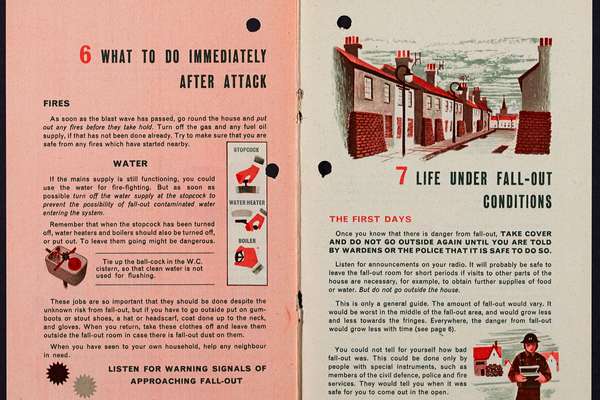
For another striking example of visual material, see the illustrations in the leaflet advising householders on protection against nuclear attack (1963), which are strangely cosy, hinting at elements of normality even during fall-out conditions.
The National Archives is the nation’s memory – we preserve the integrity of the public records, stretching back some 1,000 years. George Orwell truly understood the value of authoritative records: Winston Smith, the anti-hero of Orwell’s 1984, worked in the ‘Ministry of Truth’, falsifying back-numbers of The Times so that the information contained in them corresponded with the current pronouncements of Big Brother’s regime. The corollary of this imagined scenario, of course, is that archives you can trust are essential for a true understanding of the past.
Background information written by Mark Dunton, Principal Records Specialist at The National Archives.
Teaching resource
This set of documents relates to the early stages of the Cold War, focusing on the nature of the wartime alliance and the causes of the conflict that followed.
Teaching resource
This set of documents relates to the development of nuclear weapons during the Cold War, and policies and events that resulted from their existence.