



















Teaching resource
Cold War on File: The wartime alliance and the 'iron curtain'
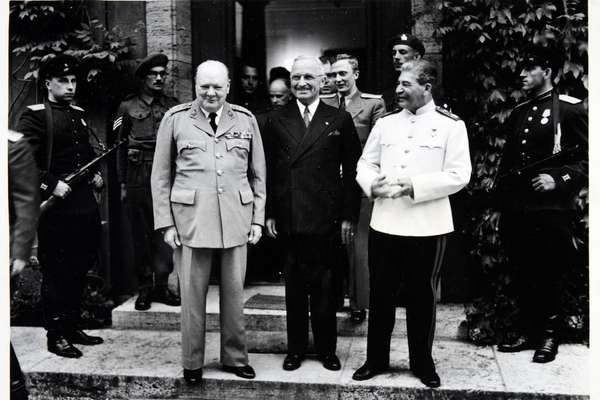
This set of documents relates to the early stages of the Cold War, focusing on the nature of the wartime alliance and the causes of the conflict that followed.
Teaching resource
This set of documents relates to the development of nuclear weapons during the Cold War, and policies and events that resulted from their existence. Students and teachers can use this resource to develop their own questions on the threat of nuclear war in the 1950s and 1960s.

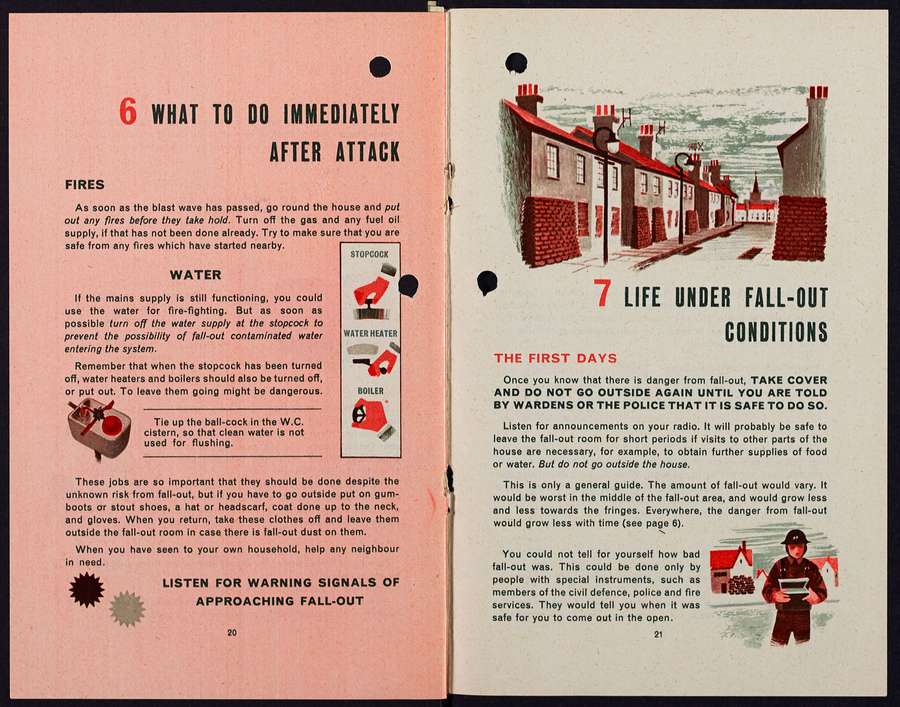
Extract from a leaflet advising householders on protection against nuclear attack, 1963. Catalogue reference: HO 338/57
Records included here concern British defence policy, the Cuban Missile crisis in 1962, civil defence, and protests against nuclear weapons at Aldermaston and Greenham Common.
You can discover more documents in our Cold War on File collections about The wartime alliance and the 'iron curtain' and Europe and Korea.
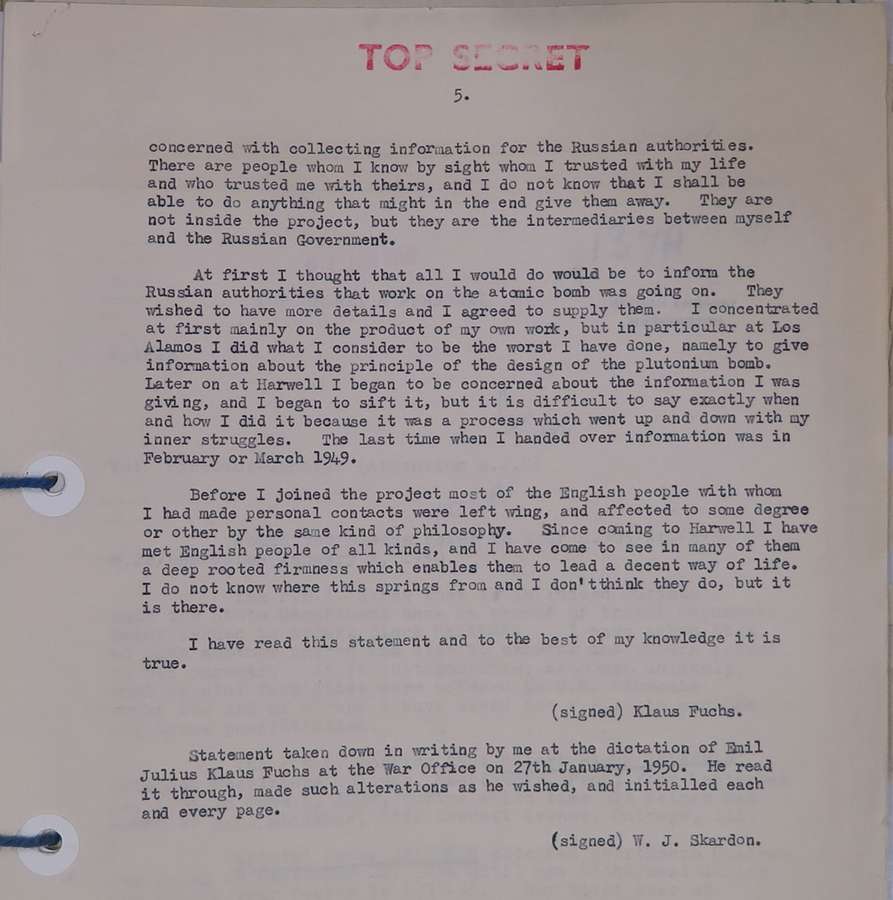
Klaus Fuchs was a German physicist who became a British citizen in 1942. He worked on the American, British, and Canadian Manhattan Project to produce the first nuclear weapons and passed on information about it to the Soviets during and after the Second World War.

…
There are people who I know by sight whom I trusted with my life and who trusted me with theirs, and I do not know that I shall be able to do anything that might in the end give them away. They are not inside in the project, but they are the intermediaries between myself and the Russian Government.
At first I thought that all I would do would be to inform the Russian authorities that work on the atomic bomb was going on. They wished to have more details and I agreed to supply them. I concentrated at first mainly on the product of my own work, but in particular at Los Almos I did what I consider to be the worst I have done, namely to give information about the principle of the design of the plutonium bomb. Later at Harwell I began to be concerned about the information I was giving, and I began to sift it, but it is difficult to say exactly when and how I did it because it was a process which went up and down with my inner struggles. The last time when I handed over information was in February or March 1949.
Before I joined the project most of the English people with whom I had made personal contacts were left wing, and affected to some degree or other by the same kind of philosophy. Since coming to Harwell I have met English people of all kinds, and I have come to see in many of them a deep rooted firmness which enables them to lead a decent way of life. I do not know where this springs from and I don’t think they do, but it is there.
I have read this statement and to the best of my knowledge it is true.
(signed) Klaus Fuchs.
Statement taken down in writing by me at the dictation of Emil Julius Klaus Fuchs at the War Office on 27th January, 1950. He read it through, made such alterations as he wished, and initialled each and every page.
(signed) W.J. Skardon.
Extract from the confession of Klaus Fuchs made in 1950. Catalogue reference: KV 6/134

July 16, 1954.
Madam,
It is my duty to inform Your Majesty that the Cabinet are considering whether it would be right and advantageous for this country to produce the hydrogen bomb, and have meanwhile agreed to the continuation of the preparatory work which has been going on for the last few months. Your majesty will, I understand, be receiving the account of the proceedings in the Cabinet at which this matter was recently discussed. A final decision is to taken before the end of the month.
There is very little doubt in my mind what it will be.
The experts, such as Sir William Penney and Sir John Cockcroft, are confident of our ability to produce the bomb although it will in probability be some two years before it is completed.
I remain, Madam, Your Majesty’s faithful and devoted subject and servant,
“Winston S. Churchill”
Letter from Winston Churchill to Queen Elizabeth II about the decision to produce the H bomb (the hydrogen bomb, a powerful nuclear weapon), 16 July 1954. Catalogue reference: PREM 11/747
The Atomic Weapons Research Establishment was set up in April 1950 at former RAF Aldermaston airfield in Berkshire. The Campaign Against Nuclear Disarmament (CND) advocated unilateral disarmament.

MARCH TO ALDERMASTON
WHY?
BECAUSE we must show our opposition to the Testing, Storing and Manufacture of the H-Bomb in Britain.
If we make no protest now we have given our consent to its use.
“All who are opposed on any ground to Nuclear Weapons, whether possessed by the British, American or Russian Governments, are welcome.”
PROGRAMME OVERLEAF
Walk for a week-end, a day, or an hour
Leaflet from the CND about a planned march to Aldermaston. Catalogue reference: HO 325/149
A Home Defence Review in 1960 looked into the policy on Civil Defence in the event of a nuclear war and the survival of the British public through planned evacuation of major population centres, the building of shelters and public education. This leaflet is aimed at raising public awareness.

[Page 20]
6. WHAT TO DO IMMEDIATELY AFTER ATTACK
FIRES
As soon as the blast wave has passed, go round the hose and put out any fires before they take hold. Turn off the gas and any fuel oil supply, if that has not been done already.
WATER
If the mains supply is still functioning, you could use the water for fire-fighting. But as soon as possible turn off the water supply at the stopcock to prevent the possibility of fall-out of contaminated water entering the system.
Remember that when the stopcock has been turned off, water heaters and boilers should be turned off, or put out. To leave them going might be dangerous.
Tie up the ball-cock in the W.C. cistern, so that clean water is not used for flushing.
These jobs are so important that they should be done despite the unknown risk from fall-out, but if you have to go outside put on gumboots or stout shoes, a hat or headscarf, coat done up to the neck, and gloves. When you return, take these clothes off and leave them outside the fall-out room in case there is fall-out dust on them.
When you have seen to your own household, help any neighbour in need.
LISTEN FOR WARNING SIGNALS OF APPROACHING FALL-OUT
[Page 21]
7. LIFE UNDER FALL-OUT CONDITIONS
THE FIRST DAYS
Once you know that there is danger from fall-out, TAKE COVER AND DO NOT GO OUTSIDE AGAIN UNTIL YOU ARE TOLD BY WARDENS OR THE POLICE THAT IT IS SAFE TO DO SO.
Listen for announcements on your radio. It will probably be safe to leave the fall-out room for short periods if visits to other parts of the house are necessary, for example to obtain further supplies of food or water. But do not go outside the house.
This is only a general guide. The amount of fall-out would vary. It would be worst in the middle of the fall-out area, and would grow less and less towards the fringes. Everywhere, the danger from fall-out would grow less with time (see page 6).
You could not tell for yourself how bad fall-out was. This could be done only by people with special instruments, such as members of the civil defence, police and fire services. They would tell you when it was safe for you to come out into the open.
Extract from a leaflet advising householders on protection against nuclear attack, 1963. Catalogue reference: HO 338/57

…
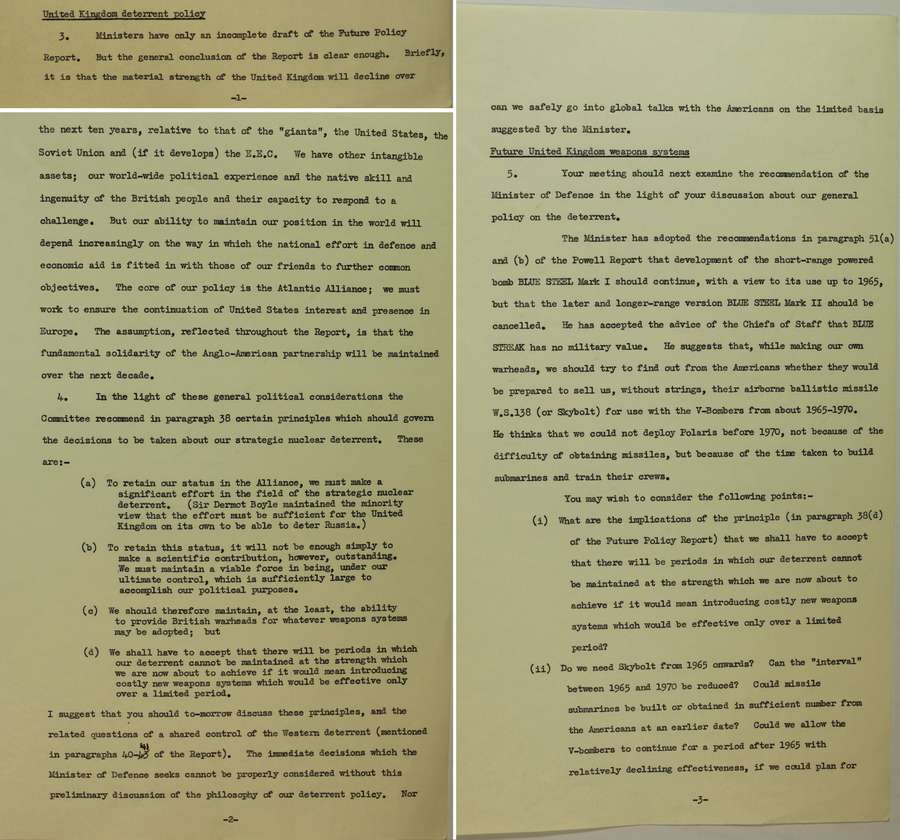
United Kingdom deterrent policy
3. Ministers have only an incomplete draft of the Future Policy Report. But the general conclusion of the Report is clear enough. Briefly, it is that the material strength of the United Kingdom will decline over the next ten years, relative to that of the “giants”, the United States, the Soviet Union and (if it develops) the E.E.C. We have other intangible assets; our world-wide political experience and the native skill and ingenuity of the British people and their capacity to respond to a challenge. But our ability to maintain our position in the world will depend increasingly on the way in which the national effort in defence and economic aid is fitted in with those of our friends to further common objectives. The core of our policy is the Atlantic Alliance; we must work to ensure the continuation of the United States interest and presence in Europe. The assumption, reflected throughout the Report, is that the fundamental solidarity of the Anglo-American partnership will be maintained over the next decade.
4. In the light of these general political considerations the Committee recommend in paragraph 38 certain principles which should govern the decision to be taken about our strategic nuclear deterrent. These are:-
(a) To retain our status in the Alliance, we must make a significant effort in the field of strategic nuclear deterrent. (Sir Dermot Boyle mentioned the minority view that the effort must be sufficient for the United Kingdom on its own to be able to deter Russia).
(b) To retain this status, it will not be enough simply to make a scientific contribution, however outstanding. We must maintain a viable force in being, under our ultimate control, which is sufficiently large to accomplish our political purposes.
(c) We should therefore maintain, at the least, the ability to provide British war-heads for whatever weapons systems may be adopted; but
(d) We shall have to accept that there will be periods in which our deterrent cannot be maintained at the strength which we are now about to achieve if it would mean introducing costly new weapons systems which would be effective only over a limited period.
I suggest that you should tomorrow discuss these principles, and the related questions of a shared control of the Western deterrent (mentioned in paragraphs 40-41 of the Report). The immediate decisions which the Minister of Defence seeks cannot be properly considered without this preliminary discussion of the philosophy of our deterrent policy. Nor can we safely go into global talks with the Americans on the limited basis suggested by the Minister.
Future United Kingdom weapons systems
5. Your meeting should next examine the recommendation of the Minister of Defence in the light of your discussion about our general policy on deterrent.
The Minister has adopted the recommendations in paragraph 51(a) and (b) of the Powell Repot that development of the short-range powered bomb BLUE STEEL Mark 1 should continue, with a view to its use up to 1965, but that the later and longer-range version BLUE STEEL Mark II should be cancelled. He has accepted the advice of the Chiefs of Staff that BLUE Streak has no military value. He suggests that, while making our own warheads, we should try to find out from the Americans whether they would be prepared to sell us, without strings, their airborne ballistic missile W.S.138 (or Skybolt) for use with the V-Bombers from about 1965-1970. He thinks that we could not deploy Polaris before 1970, not because of the difficulty of obtaining missiles, but because of the time taken to build submarines and train their crews.
You may wish to consider the following points:-
(i) What are the implications of the principle (in paragraph 38(a) of the Future Policy Report) that we shall have to accept that there will be periods in which our deterrent cannot be maintained at the strength which we are now about to achieve if it would mean introducing costly new weapons systems which would be effective only over a limited period?
(ii) Do we need Skybolt from 1965 onwards? Can the “interval” between 1965 and 1970 be reduced? Could missile submarines be built or obtained in sufficient number from the Americans at an earlier date? Could we allow the V-bombers to continue for a period after 1965 with relatively declining effectiveness, if we could plan for
…
Report examining the future of British defence policy, 1960. Catalogue reference: PREM 11/2945

SECRET
PRIME MINISTER
Mr Khrushchev’s Monstrous Bomb
The JIC are meeting tomorrow to see whether they can draw any firm conclusions about Mr Khrushchev’s recent boast in Moscow that the Russians had a weapon which could destroy the world.
The experts’ preliminary view is that Mr Khrushchev has not made a great new breakthrough in any technological field: that is to say he has not developed any new rocketry or form of explosion. We have known for some time that he has an enormous nuclear bomb; but the experts still do not believe that he has any method of getting it anywhere. It is possible that he may have some new biological weapon; but again, the experts do not believe that he has discovered any safe method of disseminating it.
Apparently Moscow press and radio are tending to play Mr Khrushchev’s statement down.
We shall hope to know more tomorrow; in particular we hope to have the Americans’ opinion.
Extract from a report by Foreign Office officials in Moscow concerning an alleged new kind of nuclear weapon developed by the USSR in 1964. Catalogue reference: PREM 11/5116

Comrade Deputies, everyone remembers the tense days of October when mankind was anxiously listening to the news coming from the Caribbean. In those days the world was poised on the brink of a thermonuclear catastrophe. What created this crisis? How did it develop? What lessons must be learned from it? These questions call for a penetrating analysis which will help the peace-loving forces better to understand the obtaining situation and to define their tasks in the struggle for the further maintenance and consolidation of peace. But before passing over this analysis, I should like to recall how the Cuban Revolution developed and how relations between the Soviet Union and Cuba took shape.
Having raised the banner of the people’s anti-imperialist revolution, the freedom loving Cuban people rallied behind their leader, Fidel Castro, and his comrades in arms, and by 1959 had cleared their land of the North American brigands and their accomplices. This was a truly heroic struggle worthy of admiration.
...
Relations of sincere friendship based on equality, respect for sovereignty and economic co-operation were established between the Soviet Union and Cuba from the very first few days of her new life. ...“We know”, said Comrade Fidel Castro, “that without the Soviet Union, without the socialist camp, without their assistance, the victory of the revolution in such a small country as Cuba would have been impossible, in the view of the imperialist aggression.”
...
Flouting generally accepted standards of international relations, the reactionary forces of the USA, from the first day of the victory of the Cuban revolution, have done everything to overthrow Cuba’s Revolutionary Government and restore their domination there. They broke off diplomatic relations with Cuba, were and are conducting subversive activity, and established an economic blockade of Cuba.
...
Seeking to justify its aggressive actions, American reaction is repeating that the crisis in the Caribbean was allegedly created by Cuba herself, adding that blame rests also with the Soviet Union, which shipped there rockets and IL-28 bombers. But is this so? It is true that we sent arms there at the request of the Cuban Government. But what motives guided us in so doing? Exclusively humanitarian motives. Cuba needed weapons as a means of deterring aggressors, and not as a means of attack. For Cuba was under a real threat of invasion.
…
By 20th October a large scale build up of US and naval air forces, para-troops and marines had begun in the South of the USA, at the approaches to Cuba. The US Government sent reinforcements to its naval base at Guantanamo, situated on Cuban territory. Big military manoeuvres were announced in the Caribbean. In the course of these “manoeuvres” a landing was to be made on the island of Vieques. On 22nd October the Kennedy Administration announced a quarantine of Cuba. The word ‘quarantine’ by the way, was merely a fig leaf in this case. Actually it was a blockade, piracy on the high seas.
...
In these conditions, if one or the other side had not shown restraint and had not done everything possible to avert the outbreak of war, an explosion with irreparable consequences would have followed. Now, when tension caused by the events in the Caribbean has been reduced, when we are at the last stage of settling the conflict, I should like to report to the Supreme Soviet what the Soviet Government did to put out the approaching flames of war.
…
Which side triumphed? Who won? In this respect one may say it was sanity, the cause of security and peoples that won. The two sides displayed a sober approach and took into account the fact that unless steps were taken that could help to overcome the dangerous development of events, a third world war might break out.
As a result of mutual concessions and compromise, an understanding was reached which made it possible to remove the dangerous tension, to normalise the situation. Both sides made concessions. We withdrew the ballistic rockets and agreed to withdraw the IL-28 aircraft. This gives satisfaction to the Americans. But both Cuba and the Soviet Union received satisfaction too: the American invasion of Cuba has been averted; the naval blockade has been lifted; the situation in the Caribbean area is returning to normal; people’s Cuba exists, is gaining strength and is developing under the leadership of its Revolutionary Government, its dauntless leader, Fidel Castro.
...
Speech by Soviet leader Khrushchev in December 1962 covering the causes and consequences of the Cuban Crisis. Catalogue reference: FO 371/171934

IMMEDIATE
UK EYES ONLY
CABINET
JOINT INTELLIGENCE COMMITTEE
THE THREAT POSED BY SOVIET MISSILES IN CUBA
Report by the Joint Intelligence Committee
Basis of Assessment
2. The assessment is based entirely on photographic evidence so far released to us by the US authorities. A firm UK assessment is difficult until more basic data is available for detailed study by our own phot-interpreters. Our preliminary comments below are based on the immediate advice of staff officers working in this field who have had a brief opportunity to study some of the more significant original photographic cover. We would like to record here our appreciation of the U.S. authorities for permitting this
Surface to Surface Missile Launch sites
3. IRBM [Intermediate range ballistic missiles]
a. US Position: There are two launch areas located about 25nm West of Havana, each of four pads, under construction, which might be ready for operational use by early December 1962.
b. Comment: If these are IRBM they will have a range of 2200 nm, extending from Hudson Bay through California to Lima, and be capable of striking a selection of targets in the USA. We are satisfied that these two launch areas represent surface to surface missile sites capable of launching missiles with nuclear warheads. On the basis of the evidence available we cannot positively identify the sites as being associated with the 2200 nm missile. the sites
If they are not associated with this missile we would expect them to be associated with a missile with a range of up to 1100nm. In the case of these being 1100nm missiles they would still be capable of covering an arc from Washington to the Panama Canal, which would include many significant targets in South East USA. On the basis of the evidence available we cannot assess when the missiles will be operational.
4. MRBM [Medium range ballistic missiles]
(a) US Position: There are three launch areas located some 50 nm South-West of Havana, each of four pads. These are of simple type involving the minimum site preparation. Two are judged to be operational, with missiles and transporter/erectors in position. In each case four missiles are on the pads and four more in a holding position.
(b) Comment: If these are MRBM sites with a range of 1100nm, they could strike targets from Washington to the Panama Canal, as described before in para 3(b) above. We do not disagree with the US assessment but in view of he apparently limited site preparation there is the possibility that these sites are for the 50 nm missile. If this were the case they would cover the whole of the Florida peninsula including Cape Canaveral. On the basis of the evidence at present available we cannot assess whether the missiles are already operational.
(c) US Position: There are two launch areas located 100 nm East of Havana. There are a field type which require no permanent site preparation. They are judged to be operational, with missile trailers and erector/launcher equipment present.
(d) Comment: We do not know the range allocated by the US missiles associated with these areas. In view of the nature of the site, we consider that these may be for missiles with a range of about 300 nm and able therefore to strike at installations in Key West. Because of the limited photography available to us we are unable to see the missiles themselves. However, it must be assumed that they are there, in view of the associated equipment present; although on the basis of the evidence at present available we cannot assess whether the missiles are already operational.
…
Conclusions
10. Our conclusions at this stage are:-
(a) We are in agreement with the US authorities that Soviet MRBM capability is being built up in Cuba which could, in our assessment, be up to 1100 nm range. Based on the evidence available we are not in a position to assess whether the capability extends (as the US authorities believe) to the IRBM, i.e.2200 nm.
(b) Provided nuclear warheads are available, missile units in Cuba could be allocated certain strategic targets on the American Continent at present allocated to other Soviet forces. If all known sites are completed, we estimate that the overall Soviet initial launch capability against the US will have increased significantly by the end of 1962.
(Signed) HUGH STEPHENSON
Chairman, on behalf of
The Joint Intelligence Committee
Cabinet Office, S.W.1
26th October, 1962
TOP SECRET
Report by the British Joint Intelligence Committee on Soviet missiles in Cuba, 26 October 1962. Catalogue reference: Catalogue ref: CAB 129/111

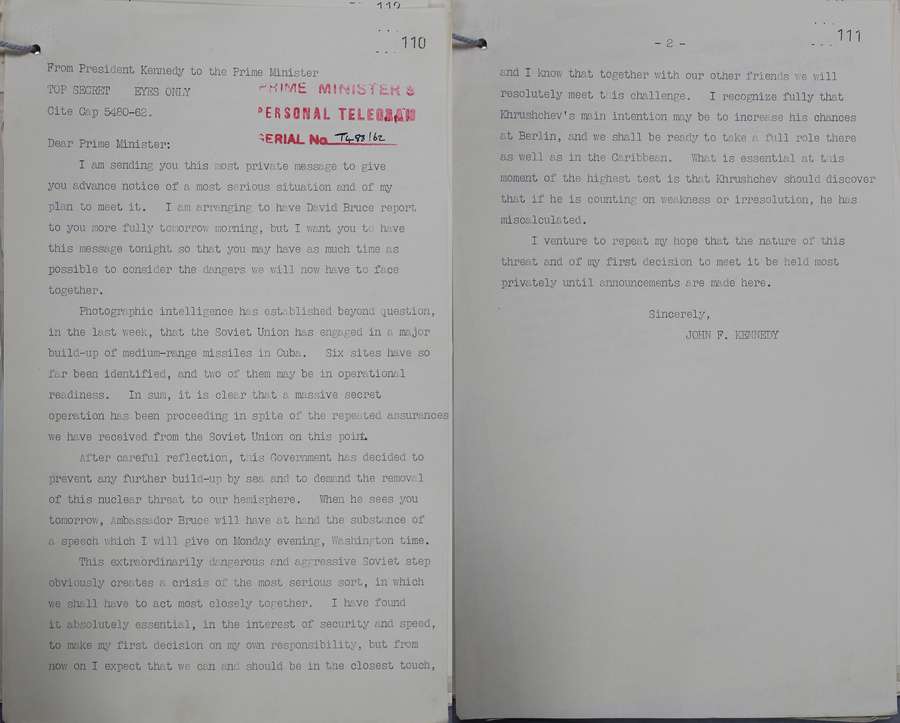
From President Kennedy to the Prime Minister
TOP SECRET EYES ONLY
Cite Cap 5480-62
Dear Prime Minister:
I am sending you this most private message to give you advance notice of a most serious situation and of my plan to meet it. I am arranging to have David Bruce report to you more fully tomorrow morning, but I want you to have this message tonight so that you may have much time as possible to consider the dangers we will now have to face together.
Photographic intelligence has established beyond question, in the last week, that the Soviet Union has engaged in a major build-up of medium-range missiles in Cuba. Six sites have so far been identified, and two of them may be in operational readiness. In sum, it is clear that a massive secret operation has been proceeding in spite of the repeated assurances we have received from the Soviet Union on this point.
After clear reflection, this Government has decided to prevent any further build-up by sea and to demand the removal of this nuclear threat to our hemisphere. When he sees you tomorrow, Ambassador Bruce will have at hand the substance of a speech which I will give on Monday evening, Washington time.
This extraordinary dangerous and aggressive Soviet step obviously creates a crisis of the most serious sort, in which we shall have to act most closely together. I have found it absolutely essential, in the interest of security and speed, to make my first decision on my own responsibility, but from now on I expect that we can and should be in constant touch, and I know that together with our other friends we will resolutely meet this challenge. I recognize fully that Khrushchev’s main intention may be to increase his chances at Berlin, and we shall be ready to take a full role there as in the Caribbean. What is essential at this moment of the highest test is that Khrushchev should discover that if he is counting on weakness or irresolution, he has miscalculated.
I venture to repeat my hope that the nature of this threat and of my first decision to meet it be held most privately until announcements are made here.
Sincerely,
JOHN F. KENNEDY
Personal telegram from President Kennedy to Prime Minister Harold Macmillan, October 1962. Catalogue reference: PREM 11/3689

TOP SECRET
(2 copies sent to Mr. Samuel (F.O) 23.10
RECORD OF A CONVERSATION BETWEEN THE PRIME MINISTER AND PRESIDENT KENNEDY AT 12.30 a.m. on TUESDAY, 1962
President Kennedy:
Prime Minister?
Prime Minister:
Yes, I can hear you well.
President Kennedy:
Prime Minister, I’m glad to talk to you and I appreciate your messages today. I just finished giving my speech. I’m sorry to confront you with all the problems that are going to come out of it, but our strong feeling was that after my statements to them against bringing missiles in after their frequent statements that they weren’t, the fact that this was done in a wholly clandestine way would have left us in November when Mr Khrushchev was planning to come over- he kept saying that he was waiting to so substantially increase his military power that it would have, we think, just unhinged all the Latin America and thrown into question any of our statements about Berlin.
Prime Minister:
Yes, I quite see that. What’s worrying me is how do you see the way out of this? What are you going to do with the blockade? Are you going to occupy Cuba and have done with it or is it going to just drag on?
President Kennedy:
We could not occupy Cuba for some days and we are preparing a potential for that kind of action if it’s necessary but we didn’t start off with that action for two reasons. First because there has to be a gap of some days to assemble the forces which of course will always be public information. And secondly because we want to see a little where we begin to go on this road. We don’t know what’s going to happen in Berlin- we don’t know what’s going to happen any place else. This seemed to be the action we could take which would lessen the chance of an immediate escalation into war of course it bring that result.
Prime Minister:
Yes, that’s quite true. Is your blockade going to extend beyond the military and arms into things like oil and all the rest of it in order to bring down the Castro Government?
President Kennedy:
At the beginning we’re going to confine ourselves to offensive weapons of war on order not to give him a complete justification for Berlin. In other words we’re not shipping offensive weapons of war into Berlin so we’re just confining it to that. But it may be that within the next few days we may need to move it to petroleum, oils, lubricants and other things but we don’t want to do that just now because it gives him an obvious tit for tat in Berlin.
Prime Minister:
What do think Khrushchev’s action will be? In the United Nations to start with some action of a positive kind?
President Kennedy:
He may do what you suggest and make us stop one of his ships by force and then take some action in Berlin. He could seize Berlin or he could put on a blockade there and there are any numbers of things he could do. We just have to expect that whatever it’s going to be it’s going to be unpleasant. But I don’t think anybody is able to predict with certainty what he will do right now but I would suspect that he will do something unpleasant to us in Berlin which I think he is going to do anyway.
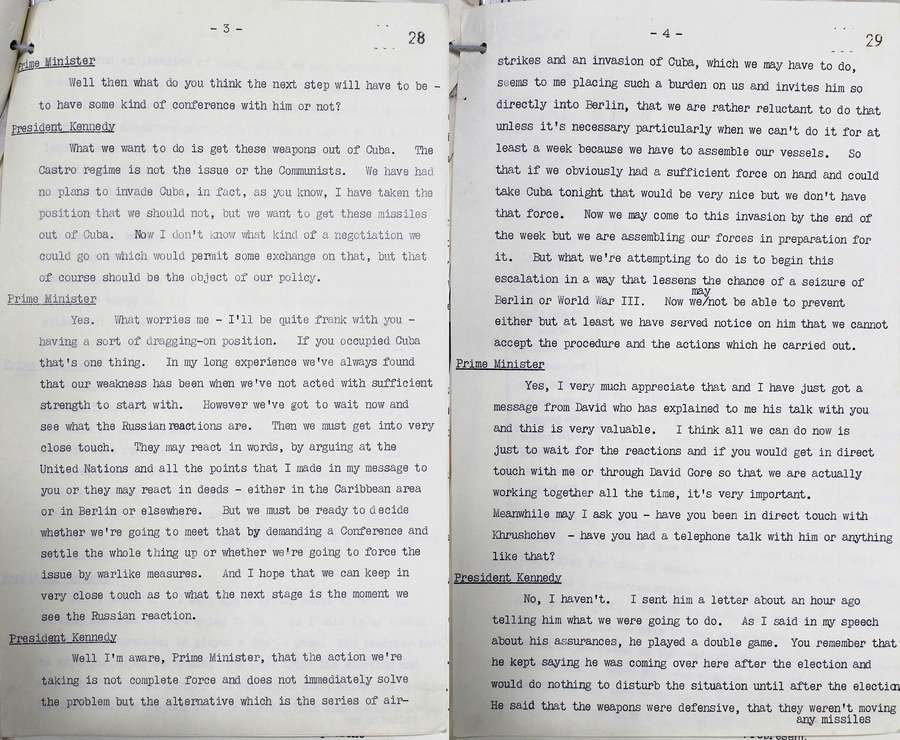
First two pages of a telephone record of a conversation between Prime Minister Harold Macmillan and President John F. Kennedy at 12.30am on 23 October 1962. Catalogue reference: PREM 11/3689

Prime Minister:
Well what do you think the next step will have to be- to have some kind of conference with him or not?
President Kennedy:
What we want to do is get these weapons out of Cuba. The Castro regime is not the issue or the Communists. We have had no plans to invade Cuba, in fact, as you know, I have taken the position that we should not, but we want to get these missiles out of Cuba. Now I don’t know what kind of negotiation we could go on which would permit some exchange or not, but that of course should be the object of our policy.
Prime Minister:
Yes. What worries me- I’ll be frank with you- having a sort of dragging-on position. If you occupied Cuba that’s one thing. In my long experience we’ve always found that our weakness has been when we’ve not acted with sufficient strength to start with. However we’ve got to wait now and see what the Russian reactions are. Then we must get into very close touch. They may react in words, by arguing at the United Nations and all the points that I made in my message to you or they may react in deeds-either in the Caribbean area or in Berlin or elsewhere. But they must be ready to decide whether we’re going to meet that by demanding a Conference and settle the whole thing up or whether we’re going to force the issue by warlike measures. And I hope that we can keep on very close touch as to what the next stage is the moment we see the Russian reaction.
President Kennedy:
Well I’m aware, Prime Minister, that the action we’re taking is not complete force and does not immediately solve the problem but the alternative which is the series of air strikes and the invasion of Cuba, which we may have to do, seems to me placing such a burden on us and invited him so directly into Berlin, that we are rather reluctant to do that unless it’s necessary particularly when we can’t do t for at least a week because we have to assemble our vessels. So that if we obviously had a sufficient force on hand and could take Cuba tonight that would be very nice but we don’t have that force. Now we may come to this invasion by the end of the week but we are assembling our forces in preparation for it. But what we’re attempting to do is to begin this escalation in a way that lessens the chance of a seizure of Berlin or World War III. Now we may not be able to prevent either but at least we have served notice on him that we cannot accept the procedure and the actions which he carried out.
Prime Minister:
Yes, I very much appreciate that and I have just got a message from David who has explained to me his talk with you and this very valuable. I think all we can do now is just to wait for the reactions and if you would get in direct touch with me or through David Gore so that we are actually working together all the time, it’s very important. Meanwhile may I ask you- have you been in direct touch with Khrushchev- have you had a telephone talk with him or anything like that?
President Kennedy:
No I haven’t. I sent him a letter about an hour ago telling him what we were going to do. As I said in my speech about his assurances, he played a double game. You remember that he kept saying he was coming over here after the election and would do nothing to disturb the situation until after the election. He said that the weapons were defensive, that they weren’t moving any missiles
…
Following two pages of a telephone record of a conversation between Prime Minister Harold Macmillan and President John F. Kennedy at 12.30am on 23 October 1962. Catalogue reference: PREM 11/3689

CONFIDENTIAL
By bag
FROM FOREIGN OFFICE TO CERTAIN OF HER MAJESTY’S REPRESENTATIVES
FOREIGN OFFICE AND WHITEHALL DISTRIBUTION
NO.493 Guidance
December 7, 1962
CONFIDENTIAL
Cuba
My telegram Guidance No. 452 [of November 8].
It is now possible to draw up an interim balance sheet of the negotiations between the United States and the Soviet Union over Cuba.
A. on the Russian Side:
(i) Removal of the ground-to-ground MRBMs and IRBMs [medium and intermediate-range ballistic missiles]; this has been carried out to the expressed satisfaction of the Americans, who were able to photograph from a close distance at sea Russians ships taking the missiles away.
(ii) Removal of the Ilyushin 28 bombers; after delays and difficulties (the Russians first stated that these bombers were Cuban property, but Castro later stated that they were Russian property) the Russians gave an undertaking that the bombers would be removed by December 20. They are now being shipped.
(iii) That the removal would take place under United Nations inspection; Castro has rejected United Nations inspection of dismantled installations in Cuba, but for practical purposes the Americans appear satisfied with the substitute arrangements for checking at sea (see (i) above).
(iv) That there should be United Nations inspection in Cuba to verify that no offensive weapons are left on the island, capable of being made operational at some future time, and that no more such weapons are introduced. Castro has stubbornly refused to allow such inspection though recently he has implied that he would permit it there was agreement on reciprocal inspection of Cuban refugee camps in the United [States] and bases in Caribbean countries from which Cuba might be invaded.
During Mikoyan’s 3 weeks’ visit to Cuba there were signs of considerable Cuban irritation but in the end Soviet-Cuban friendship and solidarity were publically re-affirmed by both sides, though with less enthusiasm by the Cubans who are still much concerned about guarantees for their safety.
In the absence of arrangement for international verification the Americans have reserved the right to carry our air reconnaissance over Cuba. The Russians seem to be ready to acquiesce, but the Cuban have threatened to shoot down American aircraft entering Cuban air space. There is thus continuing danger of incidents.
B. On the American side.
(i) The lifting of the “quarantine”; the Americans have done this.
(ii) An undertaking not to invade Cuba, if the Russian part of the bargain is fulfilled; the Americans can reasonably delay giving such an undertaking so long as the inspection element in the Russian part of the bargain is not carried out.
3. In the American-Soviet discussions which are still continuing the Russians have shown no readiness to make concessions but they are evidently anxious to avoid a new flare-up in the crisis, and have been quite willing to postpone a debate in the Security Council until they have come to some arrangement with the Americans.
You may draw on the foregoing non-attributably. You should make it clear that we think the Americans are justified in pressing for the fulfilment of Khrushchev’s pledges.
[Copies to C.R.O. and C.O. for overseas distribution]
British government analysis of the agreements between the US and USSR that ended the Cuban Crisis. Catalogue reference: DEFE 13/482
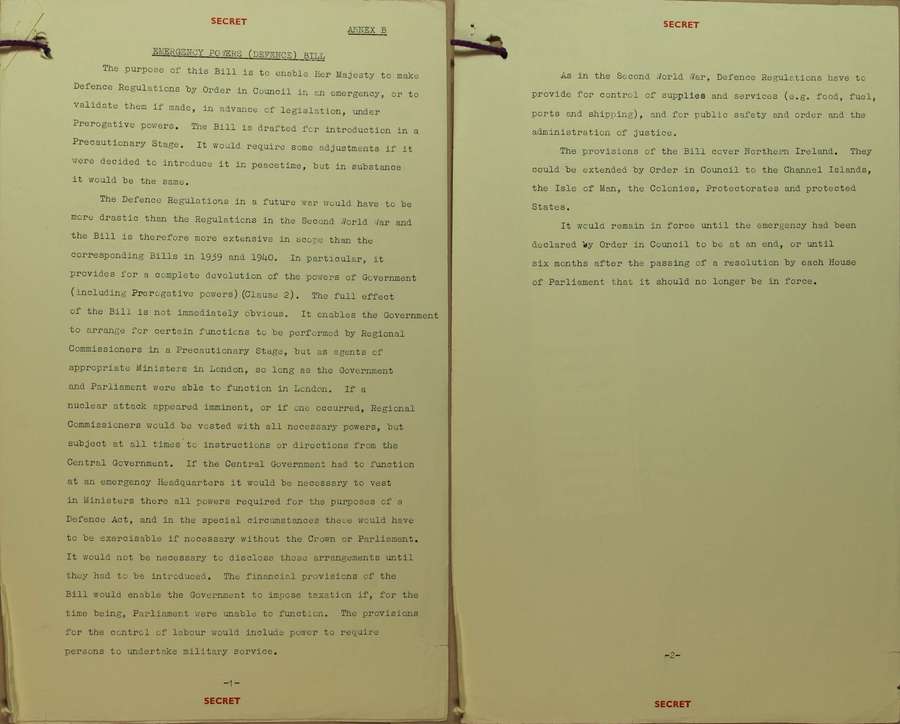
After the Cuban Missile crisis, Britain reviewed its defence planning. The Emergency Powers defence draft Bill enabled the British Government to enforce emergency measures which did not have to be debated in Parliament.

ANNEX B
EMERGENCY POWERS (DEFENCE) BILL
The purpose of this Bill is to enable Her Majesty to make Defence Regulations by Order in Council in an emergency, or to validate them if made, in advance of legislation, under Prerogative powers. The Bill is drafted for introduction in a Precautionary Stage. It would require some adjustments if it were decided to introduce it in peacetime, but in substance it would be the same.
The Defence regulations in a future war would have to be more drastic than the Regulations in the Second World War and the Bill is therefore more extensive in scope than the corresponding Bills in 1939 and 1940. In particular, it provides for a complete devolution of the powers of Government (including Prerogative powers) (Clause 2). The full effect of the Bill is not immediately obvious. It enables the Government to arrange for certain functions to be performed by Regional Commissioners in a Precautionary Stage, but as agents of appropriate Ministers in London, so long as the Government and Parliament were able to function in London. If a nuclear attack appeared imminent, or if one occurred, Regional Commissioners would be vested with all necessary powers, but subject at all times to instructions or directions from the Central Government. If the Central Government had to function at an emergency Headquarters it would be necessary to vest in Ministers there all powers required for the purposes of a Defence Act, and in the special circumstances these would have to be exercisable if necessary without the Crown or Parliament. It would not be necessary to disclose these arrangements until they had to be introduced. The financial provisions of the Bill would enable the Government to impose taxation if, for the time being, Parliament were unable to function. The provisions for the control of labour would include power to require persons to undertake military service.
As in the Second World War, Defence Regulations have to provide for control of supplies and services (e.g. food, fuel, ports and shipping), and for public safety and order and the administration of justice.
The provisions of the Bill cover Northern Island. They could be extended by Order in Council to the Channel Islands, the Isle of Man, the Colonies, Protectorates and protected states.
It would remain in force until the emergency had been declared by Order in Council to be at an end, or until six months after the passing of a resolution by each House of Parliament that it should no longer be in force.
The Emergency Powers defence draft Bill, 1963. Catalogue reference: DEFE 13/892
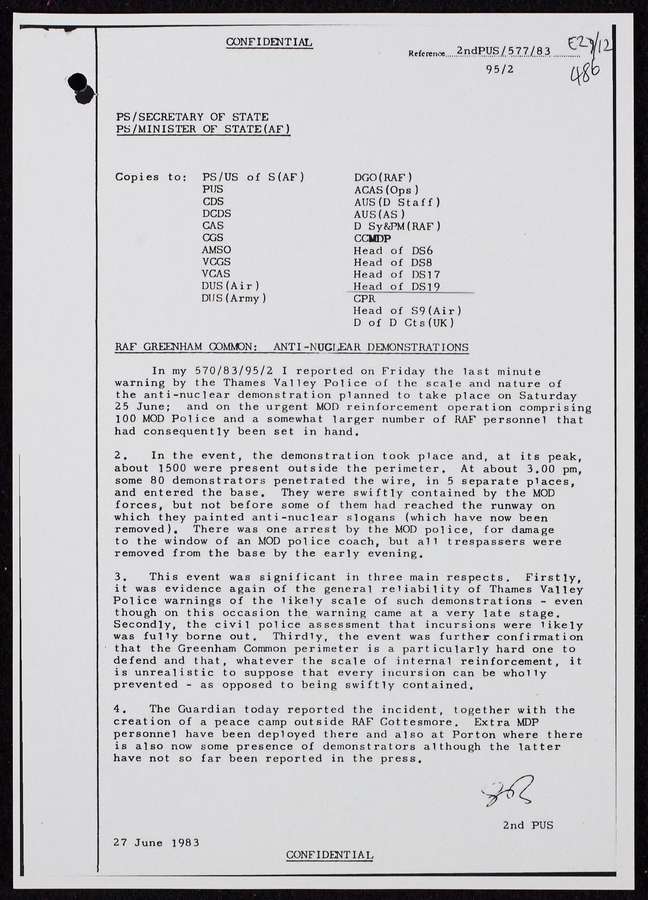
The first Greenham Common Women’s Peace Camp protest, against US Cruise Missiles being placed at RAF Greenham Common, took place in September 1981.

CONFIDENTIAL
PS/SECRETARY OF STATE
PS/MINISTER OF STATE (AF)
…
RAF GREENHAM COMMON: ANTI-NUCLEAR DEMONSTRATIONS
In my 570/83/95/2 I reported on Friday the last minute warning by Thames Valley Police of the scale and nature of the anti-nuclear demonstration planned to take place on Saturday 25 June; and on the urgent MOD reinforcement operation comprising 100 MOD Police and a somewhat larger number of RAF personnel that had consequently been set in hand.
2. In the event, the demonstration took place and, at its peak, about 1500 were present outside the perimeter. At about 3.00 pm, some 80 demonstrators penetrated the wire, in 5 separate places, and entered the base. They were swiftly contained by the MOD forces, but not before some of them had reached the runway on which they painted anti-nuclear slogans (which have now been removed). There was one arrest by MOD police, for damage to the window of an MOD police coach, but all trespassers were removed from the base by the early evening.
3. This event was significant in three main respects. Firstly, it was evidence again of the general reliability of Thames Valley Police warnings of the likely nature scale of such demonstrations- even though on this occasion the warning came at a very late stage. Secondly, the civil police assessment that incursions were likely was fully borne out. Thirdly, the event was further confirmation that the Greenham Common perimeter is a particularly hard one to defend and that, whatever the scale of internal reinforcement, it is unrealistic to suppose that every incursion can be wholly prevented- as opposed to being swiftly contained.
4. The Guardian today reported the incident, together with the creation of a peace camp outside RAF Cottesmore. Extra MDP personnel have been deployed there and also at Porton where there is also now some presence of demonstrators although the latter have not so far been reported to the press.
27 June 1983
CONFIDENTIAL
A report on the Greenham Common demonstration, dated 27 June 1983. Catalogue reference: DEFE 34/3020

BBC2 Threads/On the 8th Day
NUCLEAR WARFARE: THREE MAJOR BBC TELEVISION PROGRAMMES
BBC Television is to transmit three important programmes dealing with the likely effects of a nuclear attack on the United Kingdom. They will broadcast on Sunday 23rd September and Monday 24th September 1984 on BBC 2.
The first programme is a two hour drama documentary based on factual information which covers a 13 year period in the projected life, and death, of the city of Sheffield, during which Britain is devastated by nuclear attacks. The programme is called ‘Threads’, a reference to the intertwining strands of relationships and resources which support life in a big city.
Its author is the Sheffield writer Barry Hines, who wrote the script for the film ‘Kes’. The producer and director is Mick Jackson, who also produced the award winning film ‘A Guide to Armageddon’ in the BBC’s ‘Q.E.D.’ series.
Actors portraying two Sheffield families and the City’s Chief Executive provide the basis for the action. Hundreds of “extras” from the city also take part.
The direct effects of a nuclear blast on the city and its people, and the subsequent long term consequences of nationwide nuclear devastation are depicted in accordance with the research findings of many scientific and professional bodies in Britain, and the United States and the USSR.
The evening after the transmission of ‘Threads’, BB2 will show a documentary programme called ‘On the 8th Day’ produced at Bristol by the BBC Natural History Unit. It takes its title from computer generated maps of the world, which have been used by American and Russian scientists, to predict world temperatures on the eighth day after a nuclear war. Their findings are that, even if only a small proportion of the 55,000 existing nuclear warheads were fired, the whole northern hemisphere would be plunged into a ‘nuclear winter’, a long twilight with freezing temperatures…
Press release from the BBC about new television programmes about nuclear warfare: ‘Threads’ and ‘On The 8th Day’, 1984. Catalogue reference: HO 322/1134
The purpose of this document collection is to allow students and teachers to develop their own questions and lines of historical enquiry on the Cold War.
Students could work with a group of sources or single source on a certain aspect. Teachers may wish to use the collection to develop their own resources or encourage students to ‘curate’ their own ‘exhibition’ of the most significant sources on the topic. Another idea would be to challenge students to use the documents to substantiate or dispute points made in the introduction with this collection.
We hope that the documents will offer students a chance to develop their powers of evaluation and analysis and enrich their understanding of this topic.
Who first coined the phrase 'Cold War'?
The consensus among historians is that it was the celebrated author and journalist, George Orwell, in his essay ‘You and the Atom Bomb’ published in the Tribune magazine on 19 October 1945 (though one biographer has traced his use of the phrase back to 1943).
In the 1945 article Orwell reflected on the repercussions of ‘a state which was at once unconquerable and in a permanent state of “Cold War” with its neighbours’. He envisaged ‘the prospect of two or three monstrous super-states’ dominating the world and possessing weapons which can kill millions in seconds. Orwell concluded that the atomic bomb was likely 'to put an end to large-scale wars at the cost of prolonging indefinitely a “peace that is no peace”'.
Looking back at Orwell’s predictions, he possessed amazing foresight. The Cold War (1945–1991) was a confrontation, both military and ideological, between two superpowers, the capitalist United States and the communist Soviet Union (and their respective allies), intensified by the threat of nuclear war. This highly charged stand-off was a thread running through historic developments such as the iron curtain, the Cuban missile crisis and the construction and dismantling of the Berlin Wall.
Because there was so much at stake – arguably, the very future of civilisation – the superpowers avoided direct confrontation but fought a series of savage proxy wars, in Asia, Africa and Latin America, supporting local factions. Orwell’s 'peace that is no peace' prediction was borne out.
Contemplating the Cold War from today’s perspective, one aspect cannot be predicted – the surprises that can emerge from documents you haven’t seen before.
Many narratives are available for the Cold War: it is the subject of many books, documentaries and films. However, this collection of documents shows us that archives still have the capacity to surprise us about this period in history.
For example, it is well-known that Churchill’s famous quotation 'from Stettin in the Baltic to Trieste in the Adriatic, an iron curtain has descended across the Continent' was part of a speech given in Fulton, Missouri, USA, on 5 March 1946. But did you know that he used the phrase ‘iron curtain’ almost a year earlier, in a personal telegram to President Truman on 12 May 1945? This is a heartfelt message in which Churchill expresses his ‘deep anxiety’ about Russian intentions in Eastern Europe.
Another surprise is a report by the Joint Planning Staff which puts forward a plan, little-known today, entitled ‘Operation Unthinkable’, advocating an attack on Soviet Forces to push them out of East Germany and Poland in July 1945. This document has real ‘shock value’: ‘If they [the Russians] want total war, they are in a position to have it’.
The strident language of this document is striking: the intention was ‘to impose on Russia the will of the United States and the British Empire’. However, it is acknowledged that ‘to win would take us a very long time’.
Dramatic language is also a feature of a report called ‘The Threat to Western Civilisation’ from the Foreign Secretary to the British Cabinet in March 1948. This refers to the possibilities of the Soviet Union establishing a ‘world dictatorship’ or the ‘collapse of organised society over great stretches of the globe’. The writing style is so powerful that the words leap from the page.
Yet another example of vivid writing can be seen in a Foreign Office telegram reporting back to London about the uprising in Hungary on 25 October 1956: ‘the populace are terrified of massive reprisals’.
In some cases, document content is not dramatic but is, nonetheless, surprising. A great example of this is the last paragraph of Atomic Spy Klaus Fuch’s confession on 27 January 1950, when he suddenly begins to ‘wax lyrical’ about his admiration for English people: ‘since coming to Harwell I have met English people of all kinds, and I have come to see in many of them a deep-rooted firmness which enables them to lead a decent way of life. I do not know where this springs from and I don’t think they do, but it is there’.
This incongruous piece of reflectiveness at the end of a confession statement shows how Fuchs was somewhat detached from reality at the time he made it – he does not seem to realise the import of what he had just confessed to, the giving of vital atomic secrets to the Soviet Union.
As well as the textual documents, visual sources can also tell a powerful story. Grainy black-and-white photographs of the early days of the construction of the Berlin Wall make us reflect on the predicament of Berliners, looking on at the partially constructed wall, the barbed wire, the turrets, and the ‘death strip’.
For another striking example of visual material, see the illustrations in the leaflet advising householders on protection against nuclear attack (1963), which are strangely cosy, hinting at elements of normality even during fall-out conditions.
The National Archives is the nation’s memory – we preserve the integrity of the public records, stretching back some 1,000 years. George Orwell truly understood the value of authoritative records: Winston Smith, the anti-hero of Orwell’s 1984, worked in the ‘Ministry of Truth’, falsifying back-numbers of The Times so that the information contained in them corresponded with the current pronouncements of Big Brother’s regime. The corollary of this imagined scenario, of course, is that archives you can trust are essential for a true understanding of the past.
Background information written by Mark Dunton, Principal Records Specialist at The National Archives.
Teaching resource
This set of documents relates to the early stages of the Cold War, focusing on the nature of the wartime alliance and the causes of the conflict that followed.
Teaching resource

This set of documents relates to the nature of the Cold War and how it progressed in Europe and through the Korean War.