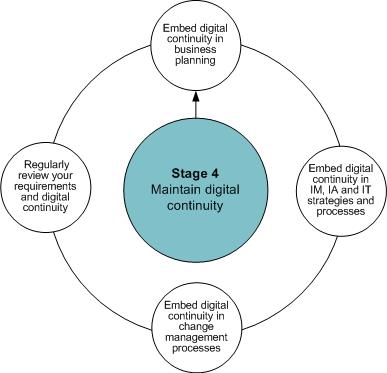
This section explains the ongoing process of embedding digital continuity in your organisation’s business processes and strategies in a way that maintains the usability of your information.
Read more information about Stage 4:
Stage 4: Maintain digital continuity (PDF, 0.09Mb)
Guidance for Stage 4
Embedding digital continuity in information management
This guidance explains how you can maintain digital continuity through good management of information, and ensure these actions are supported at a senior level.
Embedding Digital Continuity in Information Management (PDF, 0.18Mb)
Incorporating digital continuity into your IT strategy
This guidance will help you to understand the principles to follow when including digital continuity in the planning and development of your IT infrastructure.
Incorporating Digital Continuity into your IT Strategy (PDF, 0.10Mb)
Embedding digital continuity in your IT environment
This guidance will help you to embed digital continuity thinking into your organisation’s IT operational management.
Embedding Digital Continuity in your IT Environment (PDF, 0.10Mb)
Change guidance
Our change guidance below helps those responsible for implementing digital continuity across their organisations to manage and protect their digital continuity through change, to ensure business-critical information remains usable.
Change Management for Digital Continuity SROs (PDF, 0.19Mb)
Digital Continuity for Change Managers (PDF, 0.17Mb)
Migrating information between EDRMS
This guidance will help you prepare for migrating information between record management systems. This could be the migration between Electronic Document and Record Management Systems (EDRMS), Enterprise Content Management (ECM) or Content Management Systems (CMS), or from one to the other. It focuses on maintaining the continuity of your information.
Migrating information between records management systems (PDF, 0.29Mb)
Project checklist for records management system migration (PDF, 0.09Mb)
Evaluating your file formats
The guidance below will help you to evaluate your file formats from a digital continuity perspective and employ strategies to maintain the continuity of your digital information.
DROID: user guide (PDF, 0.64 Mb)
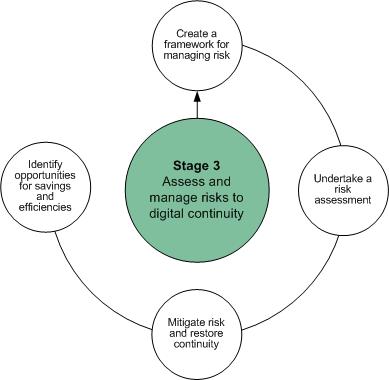
You can manage the risk of losing digital continuity by:
- setting out appropriate governance and risk management structures
- assigning responsibility for the management of risk to digital continuity
- assessing your current level of risk
Read more information about Stage 3:
Stage 3: Assess and manage risks to digital continuity (PDF, 0.13Mb)
Risk assessment handbook
Our risk assessment handbook will help you identify where your information is at risk and take active steps to manage these risks:
Risk Assessment Handbook (PDF, 0.33Mb)
Testing for continuity checklist
The checklist below helps you test that your information asset meets your users’ needs to find, open, work with, understand and trust the information it contains. This is aimed primarily at information asset owners.
Testing for Continuity Checklist (PDF, 0.06Mb)
Managing digital continuity loss
Already lost the ability to use your information as you need? Our guidance below will help you to examine why you have lost continuity, how you may be able to restore it, and how you can prevent it from happening again.
Managing Digital Continuity Loss (PDF, 0.25Mb)
Self-assessment tool
The Information Management Assessment (IMA) programme has produced a tool to assist government organisations in self-assessing the effectiveness of their approach to information and records management. Find out more on our risk assessment page, or register for the tool.
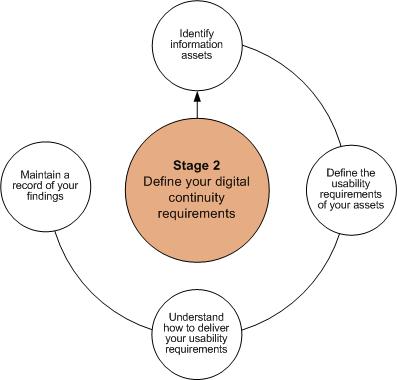
This involves understanding your information, its business value and the nature of the technical and information environment that supports it.
Read more information about Stage 2:
Stage 2: Define your digital continuity requirements (PDF, 0.14Mb)
These two pieces of guidance will help you to define your digital continuity requirements:
Identify information assets and business requirements
This guidance will help you understand the information your organisation holds and how it needs to be used to support your business. It will also help you to document the relationship between your information assets and their business requirements, including how to record that information in an Information Asset Register (IAR).
Identify Information Assets and Business Requirements (PDF, 0.26Mb)
Information Asset Register template (XLS, 0.06Mb)
Mapping the technical dependencies of information assets
The guidance above helps your organisation to identify its information assets and business needs. This guidance will help you to take the next step in Stage 2 of managing digital continuity: mapping these assets to their technical dependencies.
It will help you understand how your technical environment and the way you manage your information assets support your business needs and to understand the risks to your digital continuity.
Mapping the Technical Dependencies of Information Assets (PDF, 0.26Mb)
See our factsheets below for more information on key terms such as information assets, Information Asset Registers (IARs) and Configuration Management Databases (CMDB).
Information assets factsheet (PDF, 0.06Mb)
IAR factsheet (PDF, 0.06Mb)
Configuration management factsheet (PDF, 0.05Mb)
Digital continuity in ICT services procurement and contracts
This guidance provides you with practical information and support to help you maintain the digital continuity of your information when updating ICT services contracts or creating new ones, as well how Information Asset Registers can help you.
Digital Continuity in ICT Services Procurement and Contract Management (PDF, 0.14Mb)
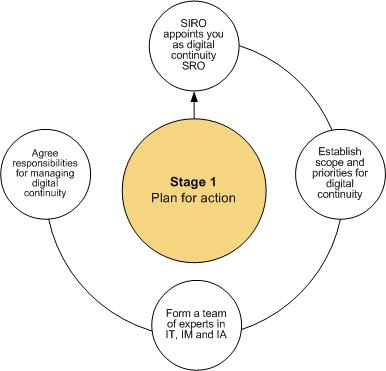
This section of the guidance will help you establish your objectives, who you need to work with, and how to manage digital continuity across the organisation.
Read more information about stage 1:
Stage 1: Plan for action (PDF, 0.11Mb)
If you are involved in managing digital continuity in your organisation, or simply want to know more about digital information management and digital continuity, these key pieces of guidance are a good starting point.
Understanding Digital Continuity (PDF, 0.29Mb)
Managing Digital Continuity (PDF, 0.31Mb)