
Welcome to a special episode of Time Travel TV, to celebrate our 20s People season of events and activities. In this episode you will learn about an interesting person who lived over one hundred years ago.
What can you learn from our documents about a person who lived in the 1920s?
Extract from the Great Roll of the Pipe for the thirteenth year of the reign of King John, A.D 1210-1211. Catalogue Ref: E 372/57, m. 22

Letter to the Constable of Bristol ordering the imprisonment of Jews. Catalogue Ref: C66/10, m. 10

Letter to the Constable of Bristol ordering that Isaac son of Jurnet is delivered to the Tower of London. Catalogue Ref: C66/10, m. 10
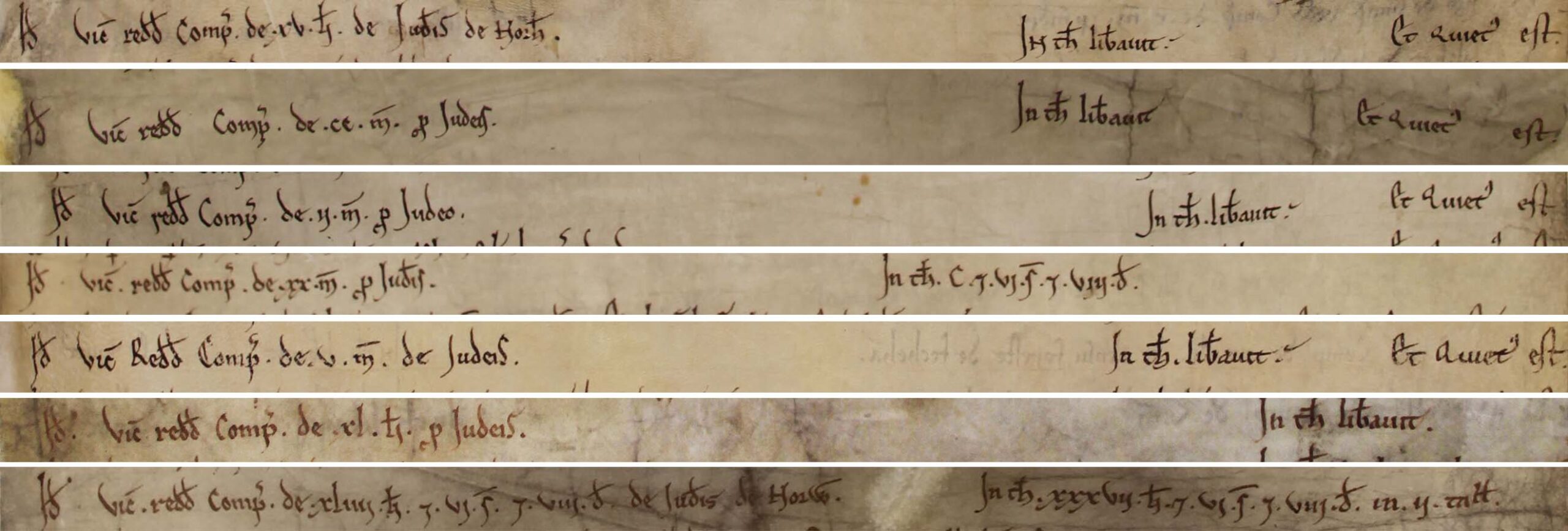
Extracts from the Great Roll of the Pipe for the fifth year of the reign of King Henry Second, A.D 1158-1159. Catalogue Ref: E 372/5.
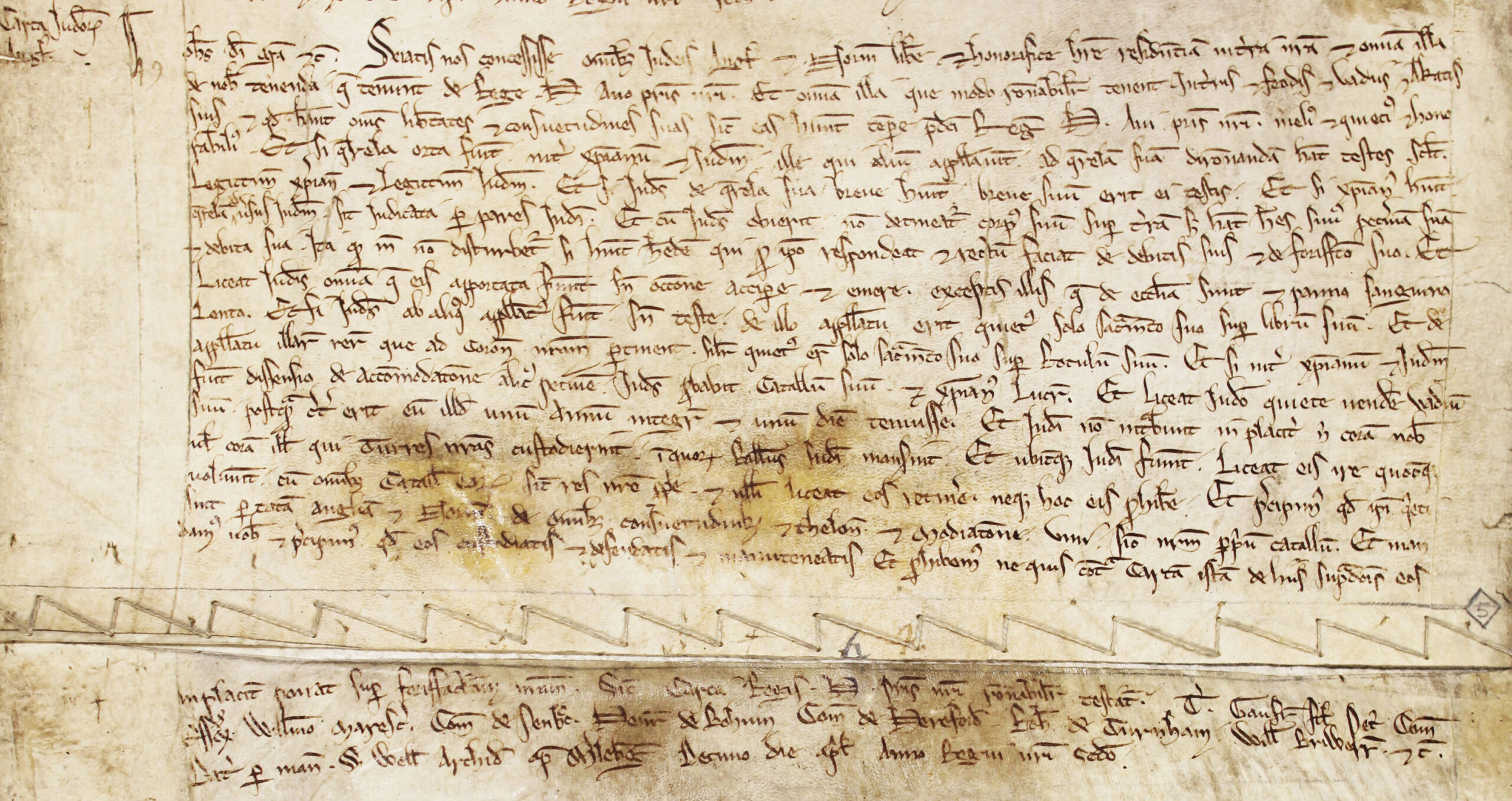
Extract from the Charter of Liberties – King John confirms King Henry I’s liberties to the Jews, c. 1201. Catalogue Ref: C 53/4, m. 4.
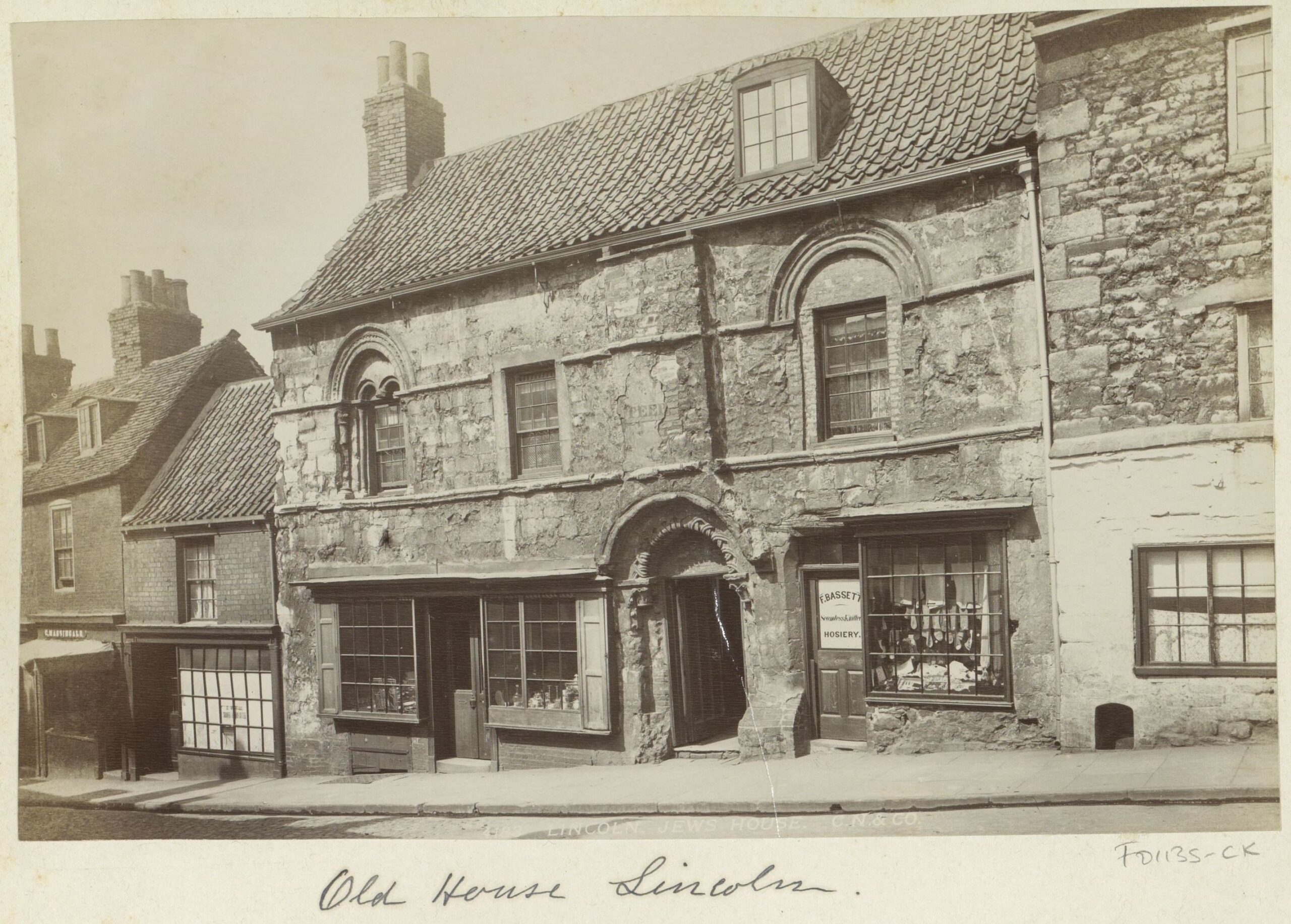
The Norman Conquest prompted the arrival of Jews to England for the first time. William I needed to borrow large sums of money to consolidate his position as the King of England and he turned to Jewish merchants from Rouen, Normandy to provide him with this much-needed income. Lending money with interest or ‘usury’ was forbidden to Christians and considered a sin. As a result, the English king paved the way for Jewish individuals to migrate and settle across the Channel. Jews and Christians now lived alongside each other in settlements across the country.
This lesson explores the origins of England’s medieval interfaith community. Through examining several royal documents, you will consider when and why Jewish families settled in England, their relationship with the English crown and local Christian populations, and how moments of tension and persecution—such as the Clifford’s Tower Massacre, c. 1190—have come to define a period of Christian-Jewish relations that was, in reality, more complex.
Understanding why Jewish individuals settled in England during the eleventh century is important for unravelling the relationships within a growing interfaith community.
Use this lesson to question the role and intentions of the Christian king and to reflect upon the opportunities and challenges of Christian-Jewish relations from c. 1066-1216.
Why did Jews settle in England after 1066?After their invitation from William the Conqueror to settle in England, the Jewish community quickly became an essential part of the English economy: Jews were permitted to loan money at interest, something Christians were forbidden from doing. Initially settling in London, the twelfth century saw Jews move into other important centres such as Norwich and Lincoln. Many of England’s Jews were skilled individuals—who worked as doctors, goldsmiths and poets—but lending money was their primary source of income.
In return for their protection from English kings, England’s Jewish community had to recognise and respect the king as the person in charge of their non-religious affairs and contribute to royal revenue through their moneylending endeavours. This relationship can be traced in its earliest form in documents such as the Leges Edwardi Confessoris—the Laws of Edward Confessor—and the later Charter of Liberties issued under King Richard I and King John. Here it is outlined that Jews may live ‘freely and honourably’ in England and enjoy the same ‘liberties and customs’ as their predecessors for as long as they served the king in charge. This meant that Jewish people had a special relationship with English law. By the end of the twelfth century, they were even primarily administered by their own special court: The Exchequer of the Jews.
The special, protected status of Jewish people was not readily accepted by the Christian population in England. Resentment soon intensified alongside growing anti-Jewish feeling across Europe. This was partly fuelled by something called the ‘blood libel’: false allegations that Jews abducted and murdered Christian children for magical rituals. Such cases led to a shift from a tolerance of Jews in England to increasing hostility.
The Crusades, which began in 1096, were another source of escalating anti-Jewish feeling. Christians trying to reclaim the Holy Land increasingly saw Jews as ‘Christ-killers’ and saw it as God’s mission to fight the so-called enemy at home. This crusading zeal caused many Englishmen to believe that they could legitimately use violence against Jews in God’s name. This famously led to an outbreak of anti-Jewish violence in 1189 at the same time as King Richard I’s coronation and the start of the Third Crusade. Mob violence led to attacks on the Jewish community in London, across East Anglia and Lincolnshire, and the attack on the Jewish community in York in March 1190. Following these attacks, King Richard I introduced a new system where records of Jewish loans had to be kept safely in an archae (chest) in each Jewish settlement (to prevent the records being destroyed as they were at York). Three keys were made for each chest; one for the Jewish clerks, one for the Christian clerks and one for the scribes. This meant that the chest could only be opened, and business transacted, when both Christians and Jews were present.
During the reign of King John (1199-1216), England’s Jewish community were forced to pay large sums of money as taxes (tallages). Famously in 1210, it was recorded that King John summoned the leaders of England’s Jewish community to Bristol where he imprisoned and tortured them, claiming that they had illegally concealed their assets (what they owned) earlier in 1207. Soon thereafter, all the Jews of England were seized and imprisoned, and their bonds (records of loans) confiscated. To free their bonds and themselves from prison, the Jewish community was forced to promise the king 66,000 marks (£1,000,000 in modern money). If they did not pay, Jewish individuals would face continued imprisonment, torture, or expulsion. Roger of Wendover, a chronicler (writer) at the time, described the consequences of one Jewish man who failed to pay on time:
“The King, therefore, ordered his torturers to pull out one of his molar teeth each day until he should have paid the sum of 10,000 marks. For seven days, a tooth was extracted with almost intolerable suffering…” [Roger of Wendover, Flores Historiarum, ed. Coxe, iii, 231]
Although the Jews had a so-called special relationship with the king, this did not mean they were safe from royal persecution.
The kings following William I, offered England’s Jewish community the same protection in return for their civil obedience. They had to recognise and respect the king as the person in charge of their non-religious affairs and contribute to royal revenue through their moneylending activities. This relationship can be traced to its earliest form in documents such as the Laws of Edward the Confessor and the later ‘Charter of Liberties’ issued under King Richard I and King John. Here it said that Jews may live ‘freely and honourably’ in England and enjoy the same ‘liberties and customs’ as their predecessors for as long as they served the king in charge. The financial value of Jews to both the crown and the wider economy is recognised to have created Jews a place in English society. Many historians have used the term ‘the king’s Jews’ in reference to this unusual, even ‘special’ arrangement and have come to understand the experience of the Jewish community predominantly through the eyes of medieval royal government. This lesson explores the experience of Jews through the same ‘eyes of medieval royal government’ to investigate how Jews interacted with the king and the law.
The lesson also focuses on the relationship between Christians and Jews during the reign of King Henry III (1216-1272). Being only nine years old when his father died, the initial years of Henry’s rule saw England managed by a minority government, a council of influential noblemen, and this period is often described as a time of ‘prosperity’ for Jews living in England. Use the sources in this lesson to support or challenge this view. Was their position one of prosperity or persecution?
What was the relationship between Christians and Jews from 1216-72?King Henry III came to the throne in c. 1216. After the ‘chaos’ of his father King John’s reign, especially, for Jews, the heavy taxation and imprisonment of members of their community, the early years of Henry’s reign are often viewed as a successful period in the history of England’s medieval Jewish community. It is even said that the English Jewry recovered rapidly to such an extent that by c. 1241 they were the wealthiest Jewish community in Europe.
There are a variety of documents that survive from the 1220s and 1230s that show Jewish individuals thriving during these early years; especially financial records, such as the Receipt rolls, that preserve the tax contributions made by individual Jews. Records from the Exchequer of the Jews, a specialist administrative centre set up to handle Jewish financial and legal affairs also reveal how Jewish moneylenders used the legal system effectively to ensure debts were repaid to them on time. Some cases appeared outside the Jewish Exchequer in the central royal courts: the king’s court (which travelled around the country), the court at Westminster (known as the common bench), and the Eyre courts that travelled around specific counties at specific times. The cases brought by and against Jews in these courts varied significantly. Some reveal Jewish individuals able to express and voice the prejudice and persecution they received from Christians in their communities, while others highlight vicious and violent accusations brought against Jews and increasingly so from the 1230s onwards.
The growing wealth of England’s Jewish community was due to a number of factors: a booming economy and a widespread demand for cash meant that the business of many Jewish moneylenders flourished at this time. This stirred much resentment within the wider Christian population and contributed to a deteriorating relationship between the two communities. From the 1230s, there was a rise in anti-Jewish incidents and many related to the alleged ritual murder of Christian children: for example, the accusations levelled at the Winchester Jewry in c. 1232, the Norwich Jewry in c. 1233, and the Lincoln Jewry in c. 1255.
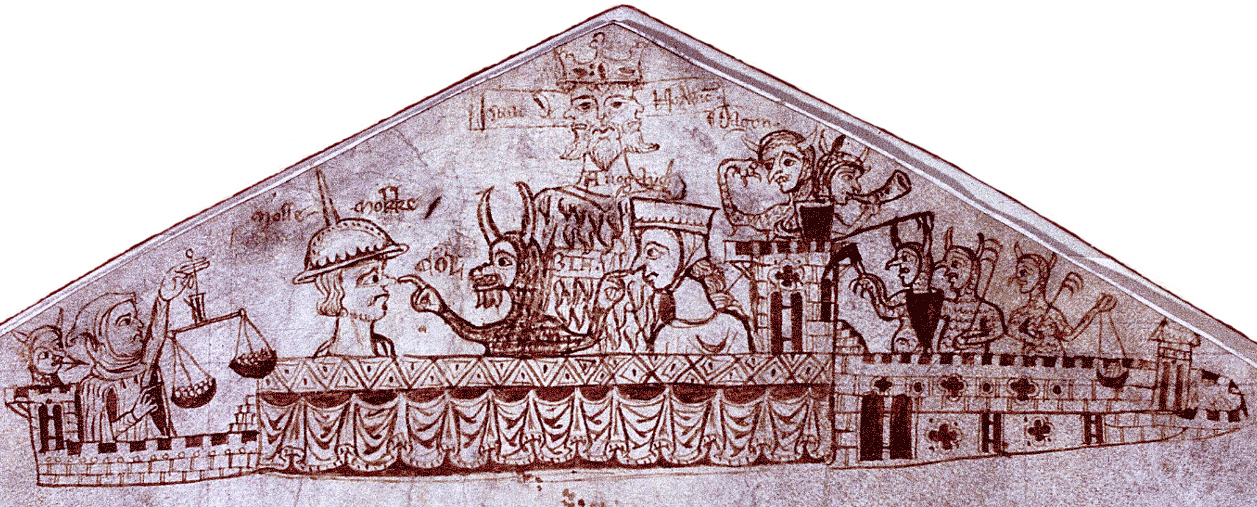
Other evidence also reflects growing resentment of the growing dominance of Jews in local trade and finance. For example, in the 13th century, Norwich was one of the largest and most important towns in England. One of its richest and most powerful residents was Isaac, son of Jurnet, a Jewish moneylender who owned a large amount of property in the city and was a banker to the king. Isaac employed other Jews to collect the money that borrowers in the city owed to him. The most well-known were Mosse Mokke and his wife Abigail. The grotesque cartoon depicting Mosse Mokke in league with the Devil leaves little doubt about how the Jews of Norwich were viewed in 1233. Many Christians viewed Jews in England as the enemies of Jesus Christ.
As relations between Christians and Jews became evermore strained, King Henry III enforced a series of new laws to tighten control over Jewish life. This was known as the Statute of Jewry and it was issued in 1253. It attempted to segregate and isolate Jews. Some of the new conditions included that Jews could only remain in England if they ‘served’ the crown in some way; they had to wear a badge that marked them as Jewish; and no new synagogues could be built. King Henry’s legislation reflected what was happening elsewhere in Europe: other kings were also seen tightening their restrictions over their Jewish communities. The reaction to Henry’s clampdown was so strong that Elias l’Eveske, arch-presbyter (leader) of England’s Jews, asked if they could leave the country. This request was refused.
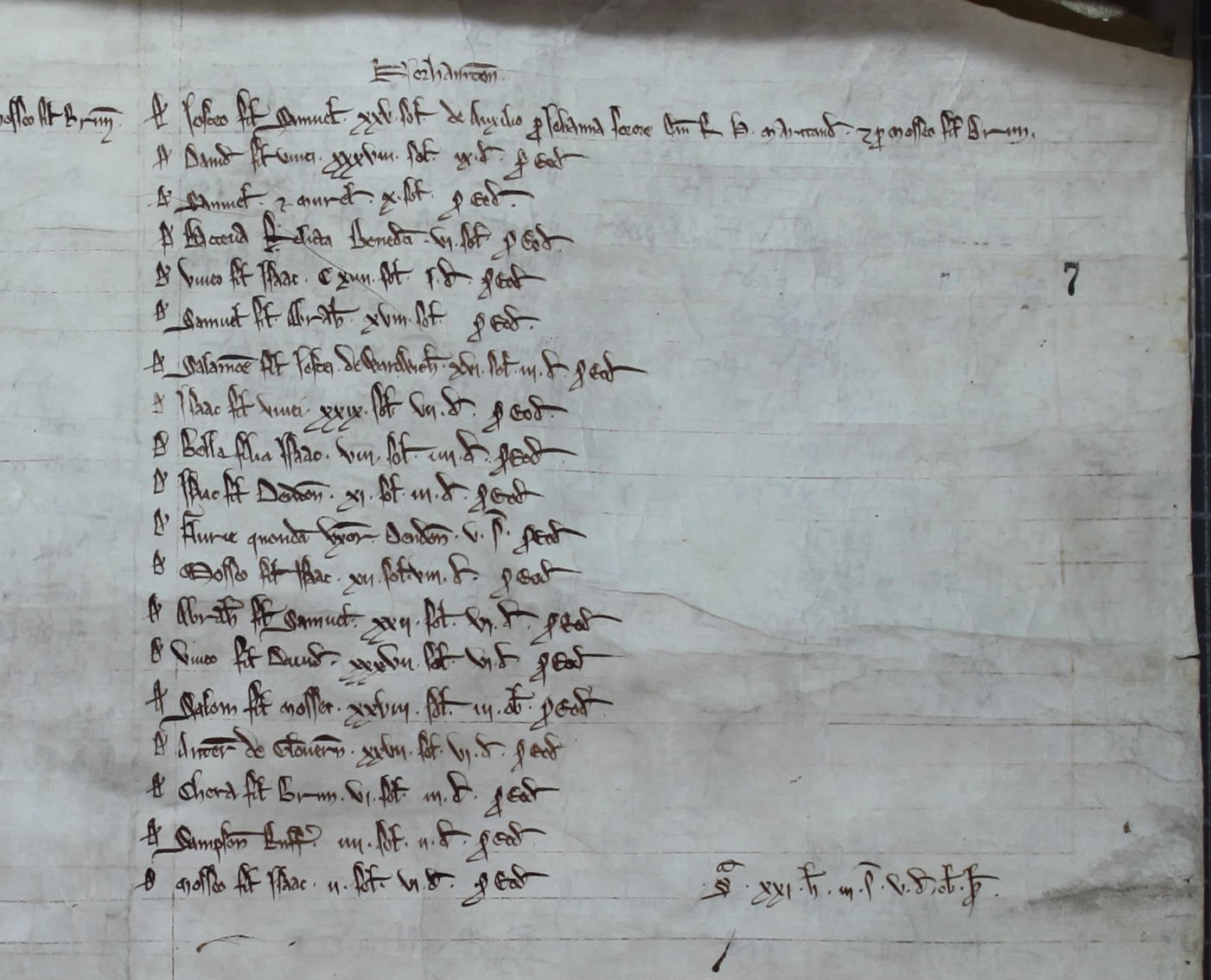
Extract from the Receipt roll for Easter 5, Henry III that records the contributions from the Northampton Jewish community to the c. 1221 tallage, Catalogue Ref: E 401/4, m. 4)
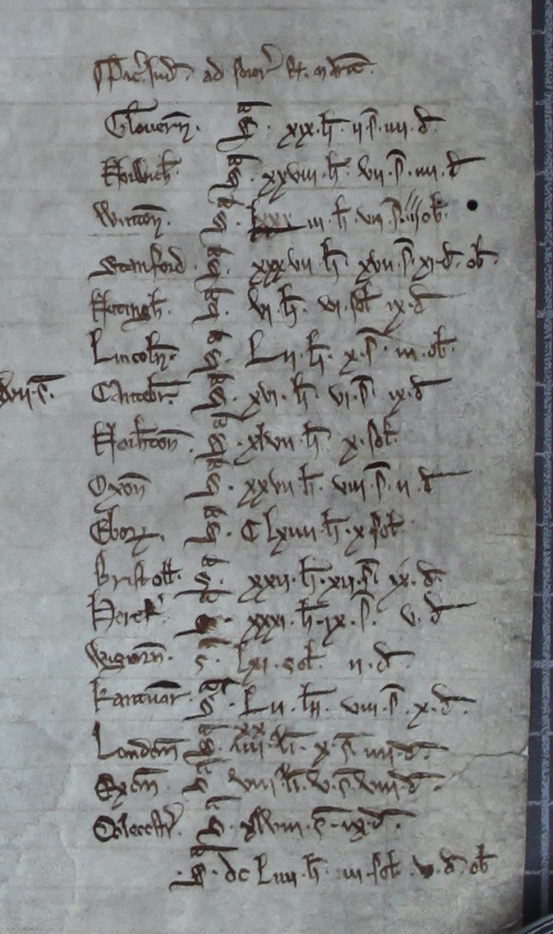
Extract from the Receipt roll for Easter 5, Henry III that records the overall contributions from each of the Jewish settlements across England to the c. 1221 tallage Catalogue Ref: E 401/4, m. 4d).