
Focus:
To encourage pupils to use original sources to find out about how Queen Victoria’s Diamond Jubilee was celebrated in 1897.
Part 1: Pupils engage with the starter source, a photograph of a building decorated to celebrate Queen Victoria’s Jubilee with prompt questions for discussion. A second photograph expands discussion and encourages pupils to think about how Victoria’s Jubilee was celebrated across the country. There is an opportunity to do a creative activity linked to this source.
Part 2: Pupils engage with a different source using a mystery document approach. This source concentrates on how the Queen herself celebrated her Jubilee. There is an opportunity to do a creative activity linked to this source.
Part 3: Pupils build on Part 1 by looking at further sources to show Queen Victoria Celebrated her Jubilee. They can explore differences between past and present. Are we celebrating Queen Elizabeth’s Platinum Jubilee in the same way? What are we doing to celebrate Queen Elizabeth’s Platinum Jubilee?
Teachers may prefer to use any of the original sources here to create their own resources and activities or adapt the activities provided here for use in their schemes of work.
- Let’s take a look at some photographs from the past to find out about Queen Victoria’s Jubilee was celebrated
- What else can these photographs reveal about Victorian times?
- What other documents would help us find out more?
- Are we celebrating Queen Elizabeth II’s Platinum Jubilee in the same way?
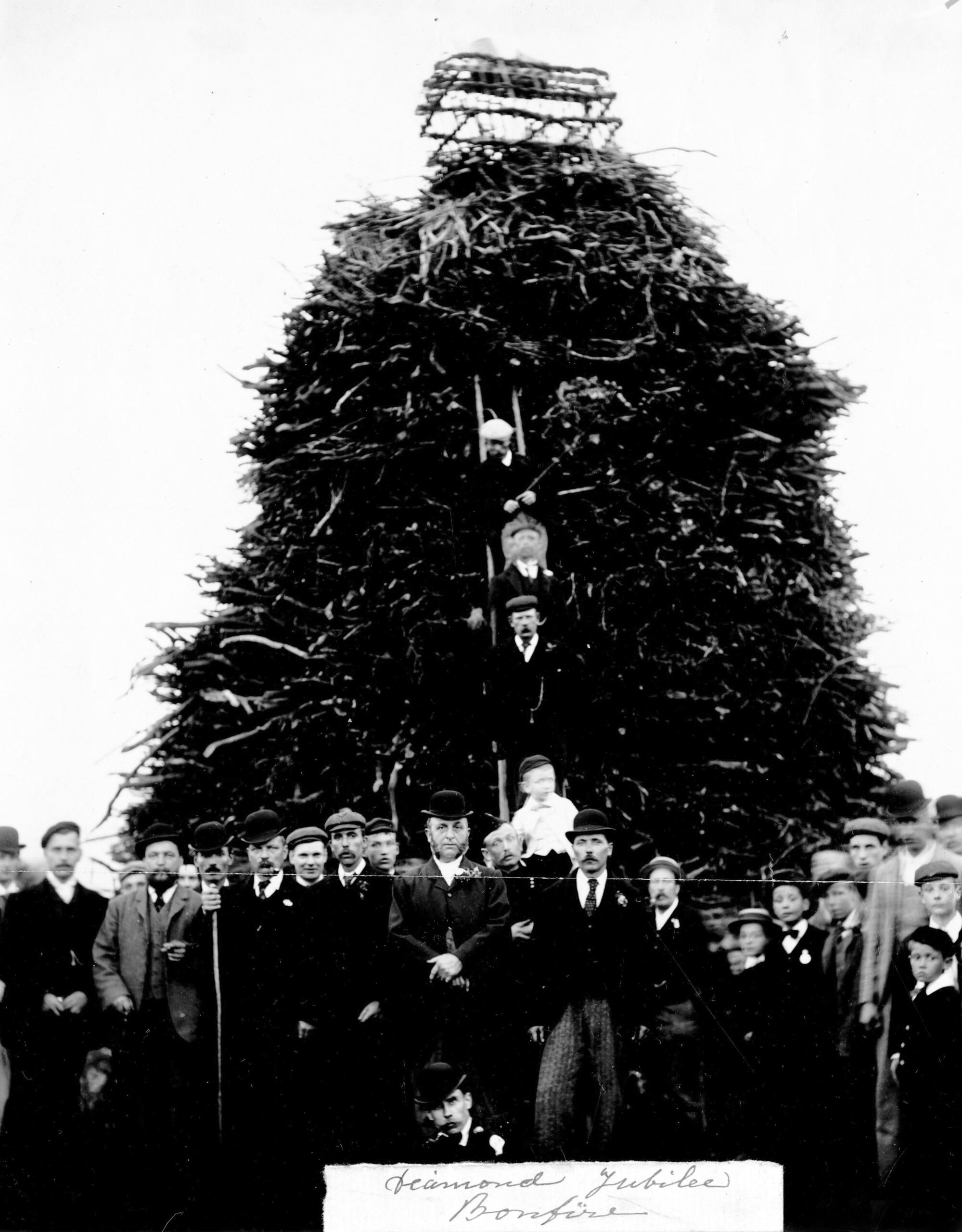
Diamond Jubilee Bonfire, Chippenham, Wiltshire, 1897, Catalogue ref: COPY 1/431/4
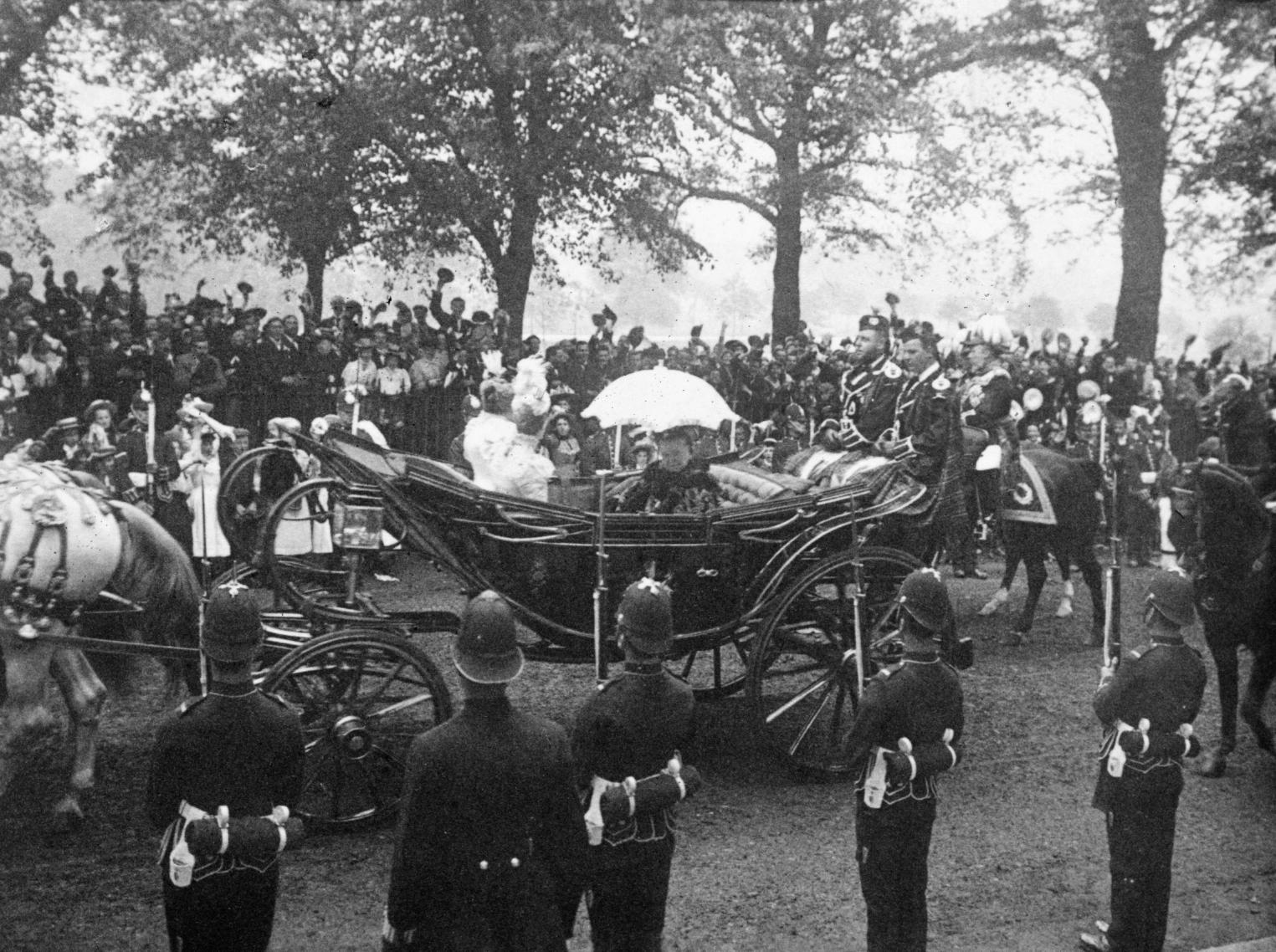
Queen Victoria Diamond Jubilee, 1897, Catalogue ref: COPY 1/431/3
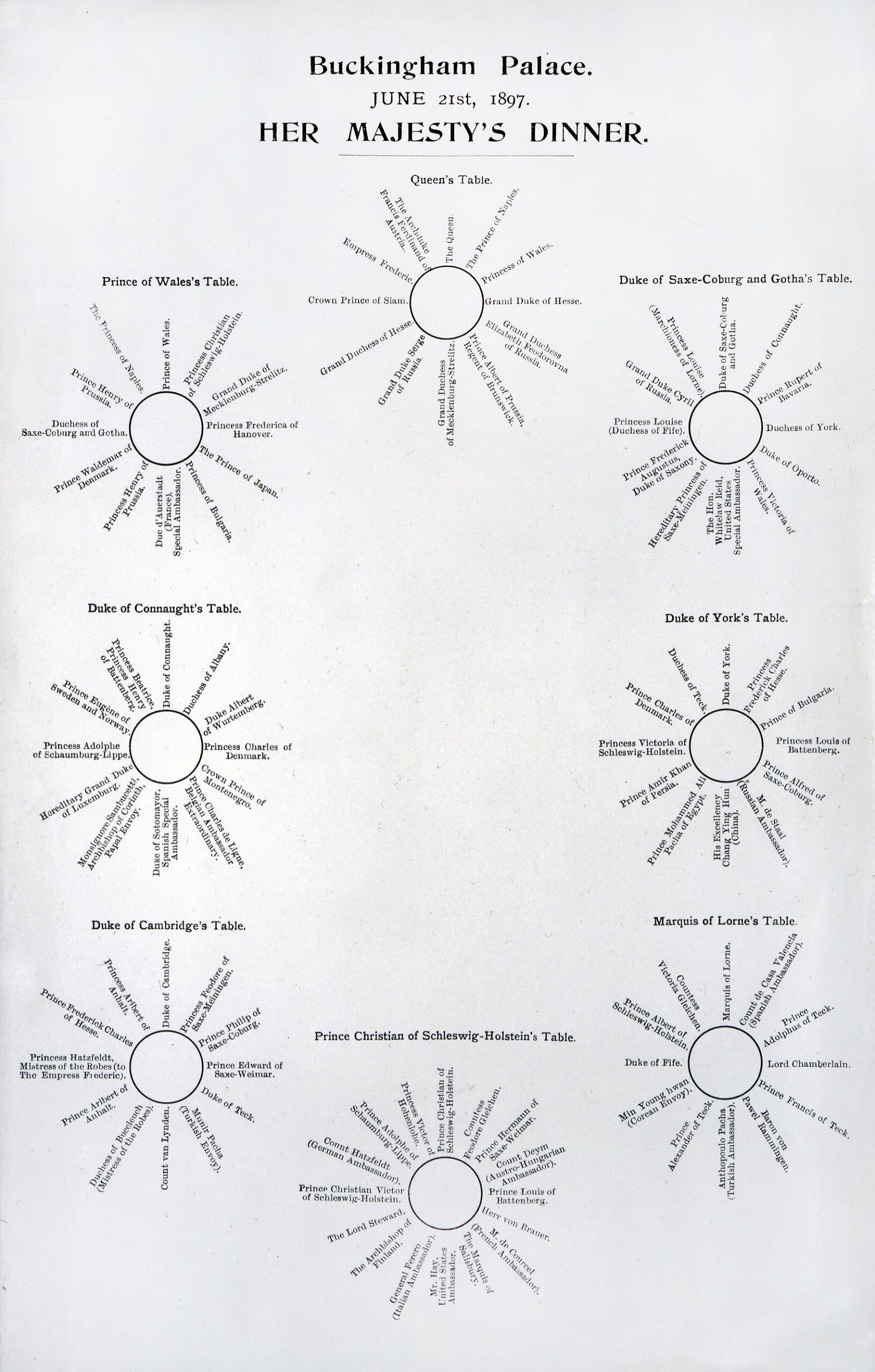
Buckingham Place, June 21st, 1897, Her Majesty’s Dinner. Catalogue Ref: LC 2/146
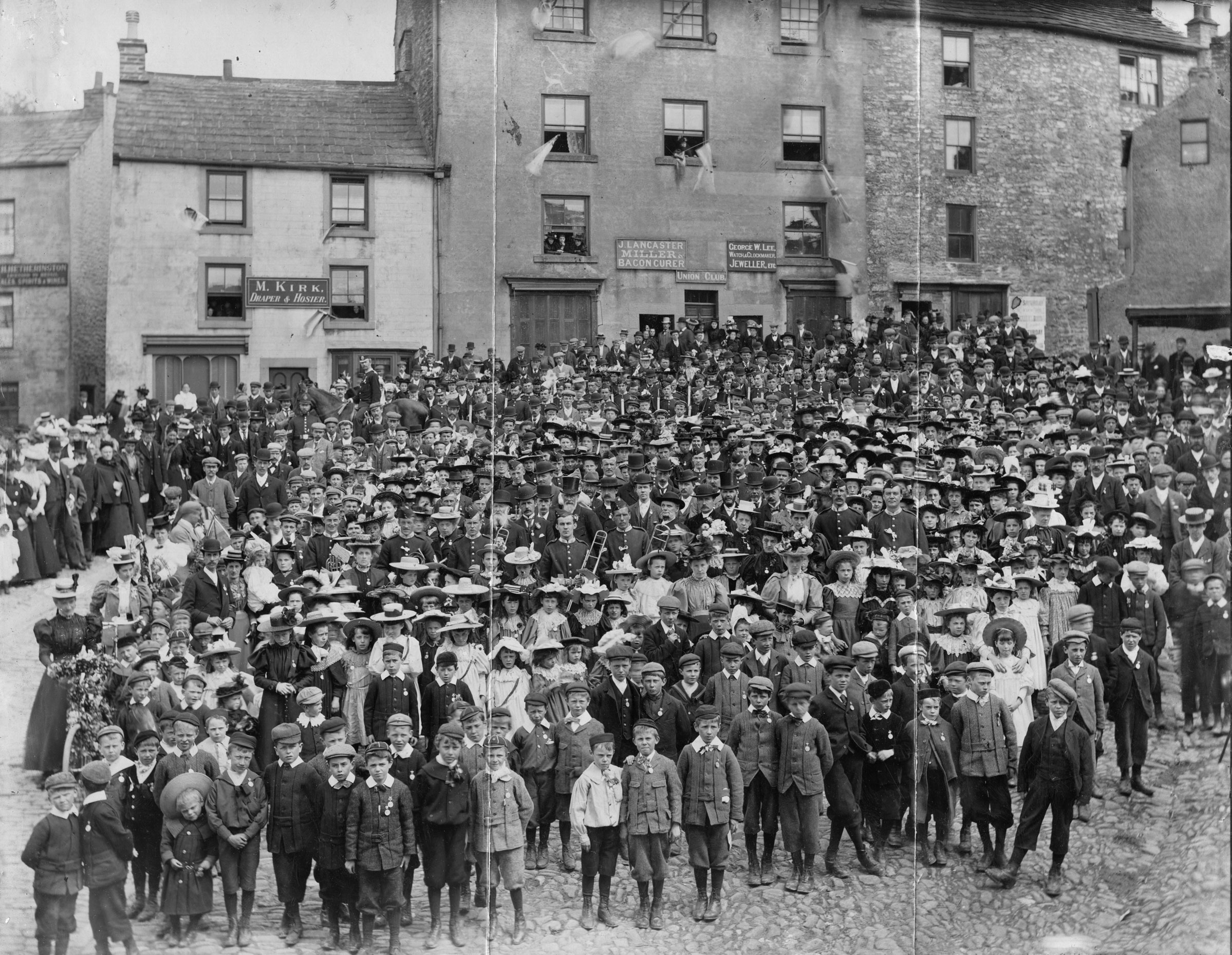
Queen Victoria’s Diamond Jubilee Celebrations, Alston, Cumberland, June 1897, Catalogue ref: COPY 1/430/711
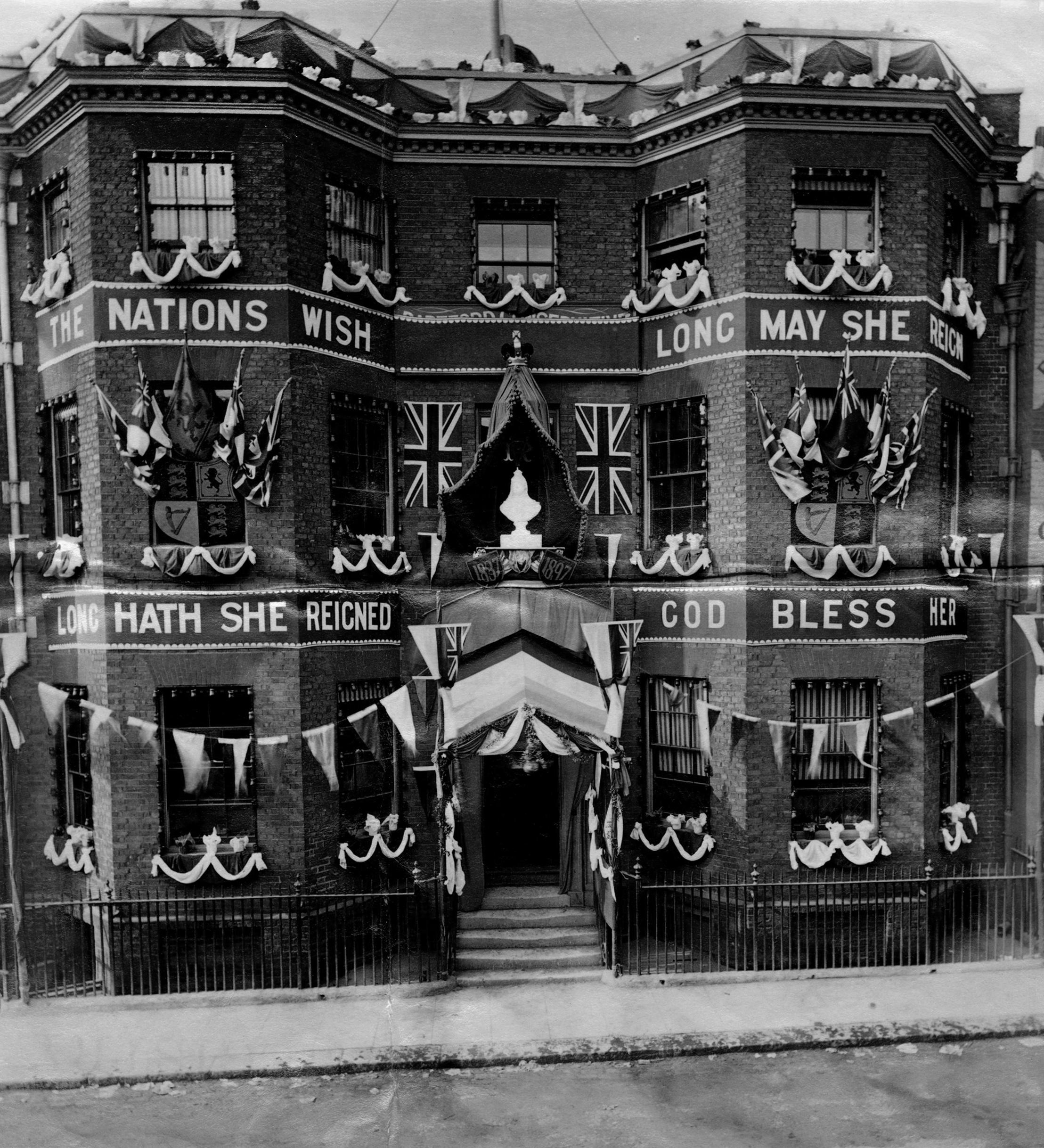
‘Dartford Bank House Club with Victoria Jubilee decoration’ 1897, Catalogue ref: COPY 1/431/34
Focus:
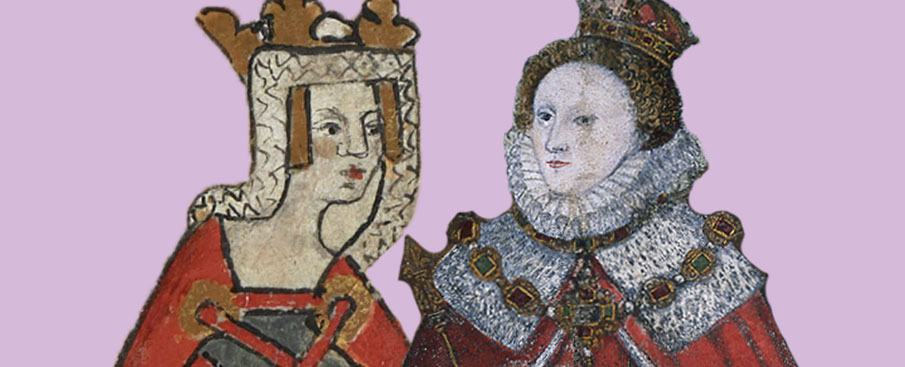
Building on earlier activities, pupils look at further sources relating to past female monarchs and continue to investigate differences and similarities.
Here pupils explore two original seals comparing the role of Matilda and Elizabeth I. What do these sources reveal about their roles? How different is the role our Queen Elizabeth II today? Have any aspects of her role stayed the same?
Empress Matilda
Teacher explains that to meet our first queen we have to transport ourselves back to the year 1135, nearly 1000 years ago! Empress Matilda was the daughter of Henry I of England, one of William the Conqueror’s sons. She wasn’t supposed to be Queen, but her brother died and Henry her father, named her his heir so she would inherit throne when he died.
Matilda was a formidable woman! She fought against her cousin Stephen of Blois for 19 years as he tried to take the throne from her. Many of her father’s supporters sided with Stephen, as they thought a man would be a stronger and more effective leader. In the ‘Middle Ages’ women rarely held power or could control their own lives so it is important for us to find out about women who challenged this state of affairs.
Matilda fought back! She imprisoned Stephen in 1141 and tried to plan her coronation. However, Stephen’s wife then raised an army against Matilda and her supporters, and eventually Stephen was crowned King of England. Matilda escaped to France, not quite a Queen, but her son Henry II later became King of England. She continued to rule in Normandy which was under England’s control and advised her son. Matilda died in 1167 but she played an important role in the story of English monarchy. Her royal seal, used to ‘sign’ important documents shows Matilda looking powerful and impressive. A typical seal of this time highlighted the expectations of a medieval monarch: on the front a king sat on a throne, a symbol of justice to his people holding a sceptre. On the reverse the king was shown holding a sword sitting on a warhorse ready to defend his the kingdom. It was expected that a woman could not act as a judge or lead an army into battle and clearly not rule over a kingdom. This was the first time ever that female power had been pictured in this way and why her seal is so significant.
For more on the history of Matilda: https://www.readingmuseum.org.uk/blog/matilda-empress
Elizabeth I
Nearly 400 hundred years later, Elizabeth I came to the throne in 1558. She was the daughter of Henry VIII and his second wife, Anne Boleyn. Her mother, was the first of Henry VIII’s wives to be executed. Elizabeth I proved to be an incredibly powerful queen. She certainly made sure she dressed the part too! She never married as she believed that she was ‘married’ to her country. Also known as Good Queen Bess, she ruled for over 45 years, a very long time in those days, bearing in mind that the average Tudor only lived to around 35 years of age! Elizabeth I’s Great Seal was special as it was attached to all important documents from the Queen. It meant that the information in the document had the Queen’s ‘seal of approval’ and reflected her commands.
Elizabeth I was dedicated to maintaining her power and role as Queen of England. She kept her authority over the English nobility and her ambitious courtiers with elaborate court rituals. She was even adopted names from Greek mythology and literature of the age. Official ‘face patterns” had to be used to ensure that portraits showed her as youthful and powerful. The artist Nicholas Hilliard also produced ‘portrait miniatures’, small images of Elizabeth I worn at court to express personal loyalty to the Queen.
Elizabeth and her court went on ‘progresses’ so more people could see her. This was important for her control of the kingdom in an age before social media, the internet, radio, television or newspapers. Few could read or write, so the visual messages provided through her Great Seal and royal progresses made her visible throughout her kingdom and helped secure her position
How has the role of Queen changed from the past?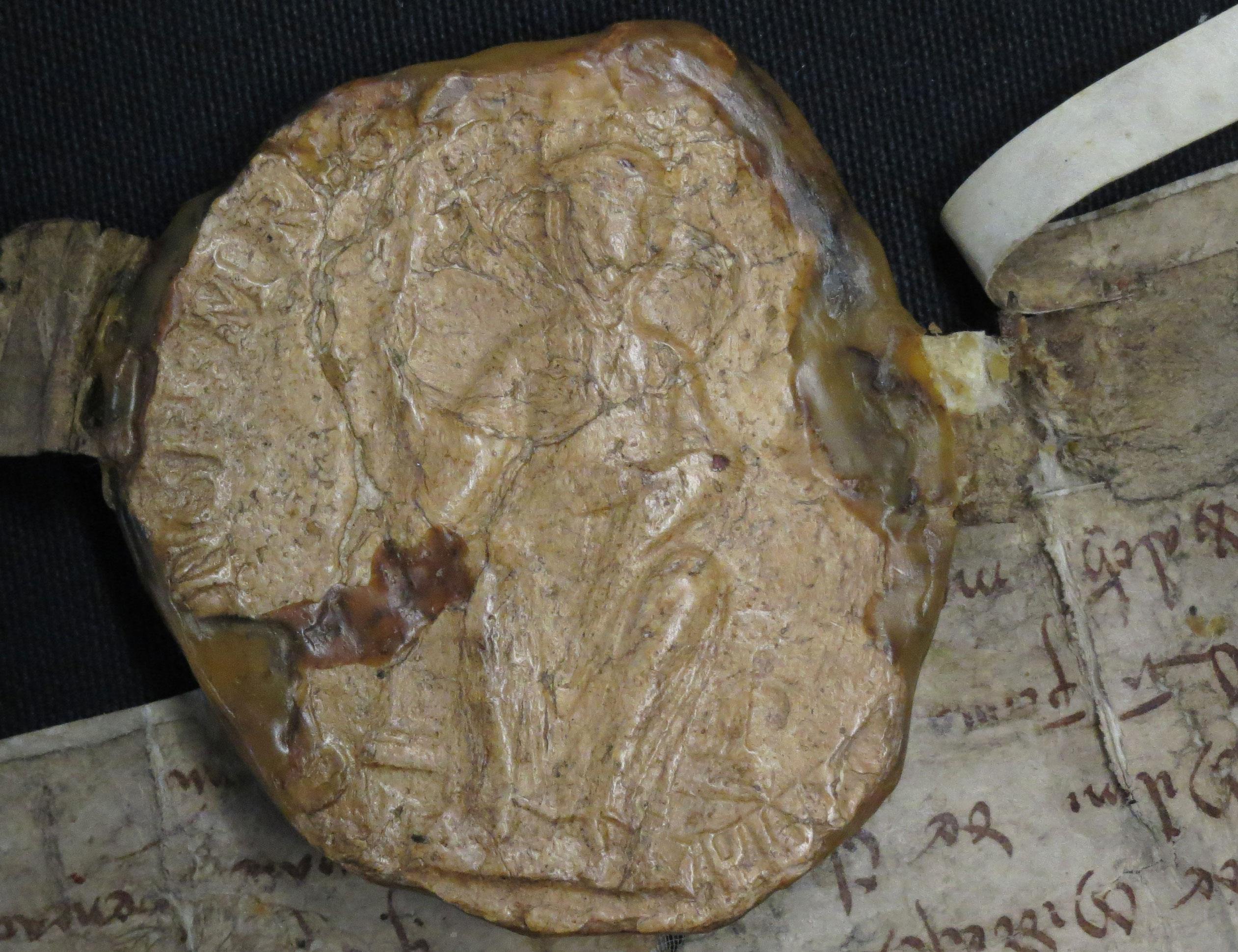
Show the image of Queen Matilda’s seal to the class on a whiteboard/printed copies.
Teacher asks the pupils if they can identify the type of source. If not, explain it is a seal. During the ‘Middle Ages’ instead of signing important documents or providing your password to prove who you are, you would attach your seal to a document to prove your identity. Seals are usually made of beeswax (though the Pope used lead) and usually have a design on them, created by pressing a stamp known as a matrix into softened wax
This is Matilda’s seal and the front shows her seated on a throne. The letters around the edge said ‘SIGILLVM MATHILDIS DEI GRATIA ROMANORVM REGINA’ which means ‘Seal of Matilda, by God’s grace queen of the Romans’. Matilda used her title as ‘Queen of the Romans’ to refer to her first marriage in 1114 to Heinrich V, Holy Roman Emperor and King of the Germans. She used this seal to show her royal connections in Europe and to assert her position in England, where she was not secure enough to commission a Great Seal during her struggle for the throne.
- What does is this seal attached to?
- Why would a seal be used in this way?
- Why do you think a seal had a motto or important words around the edge?
- Why was Matilda’s motto important?
- What picture is shown on the seal?
[The seal shows Matilda sitting on throne holding a sceptre wearing a crown, the image is now very worn. These objects represent the powers of a monarch]
- What impression did Matilda want to create by her seal?
- What other sources from the past could we use to find out about the life of Matilda?
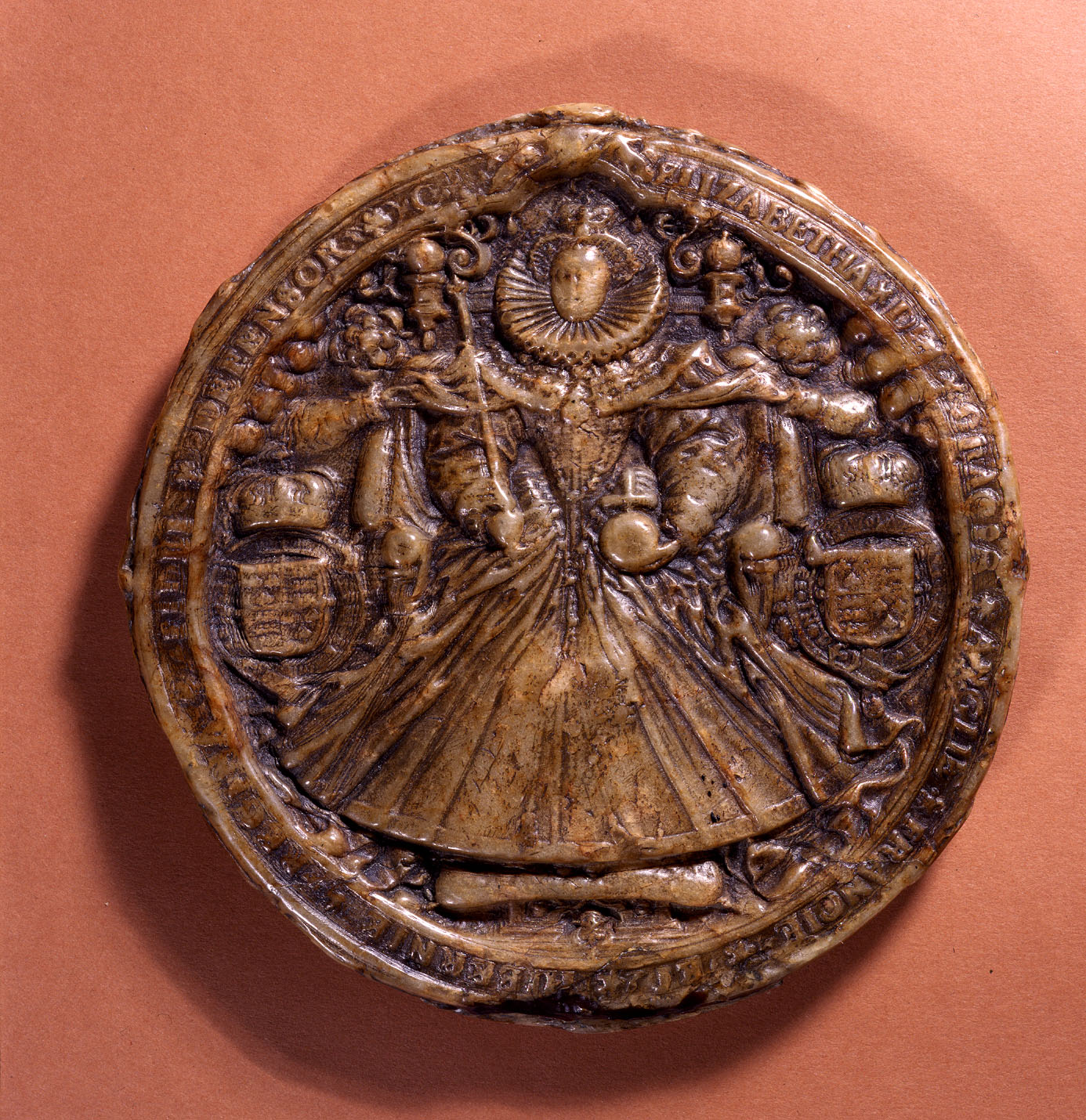
Show the image of Queen Elizabeth I’s Great Seal to the class on a whiteboard/printed copies.
Discuss with the pupils the following questions as a class/in pairs/groups to feedback. Pupils could also add their own annotations to a projected version of the seal.
- Can you find the following objects in the seal?
Pair of hands coming from clouds to hold Elizabeth’s cape; a crown, an orb, sceptre, ruff, coat of arms, Tudor Rose and other leaves and flowers. The Tudor Rose was the symbol for the Tudor monarchs.
- Can you find the motto? It says, in Latin: ‘Elizabetha Dei Gracia Anglie Francie Et Hibernie Regina Fidei Defensor’. It means:‘Elizabeth, by grace of God, Queen of England, France and Ireland, Defender of the Faith’.
- Can you describe Elizabeth I’s dress and hairstyle?
- Why does she hold an orb and sceptre? Do you know what they mean?
- What do the hands coming from the clouds to hold her cape suggest?
- Elizabeth was Head of the Church of England. Which part of the seal tells us this?
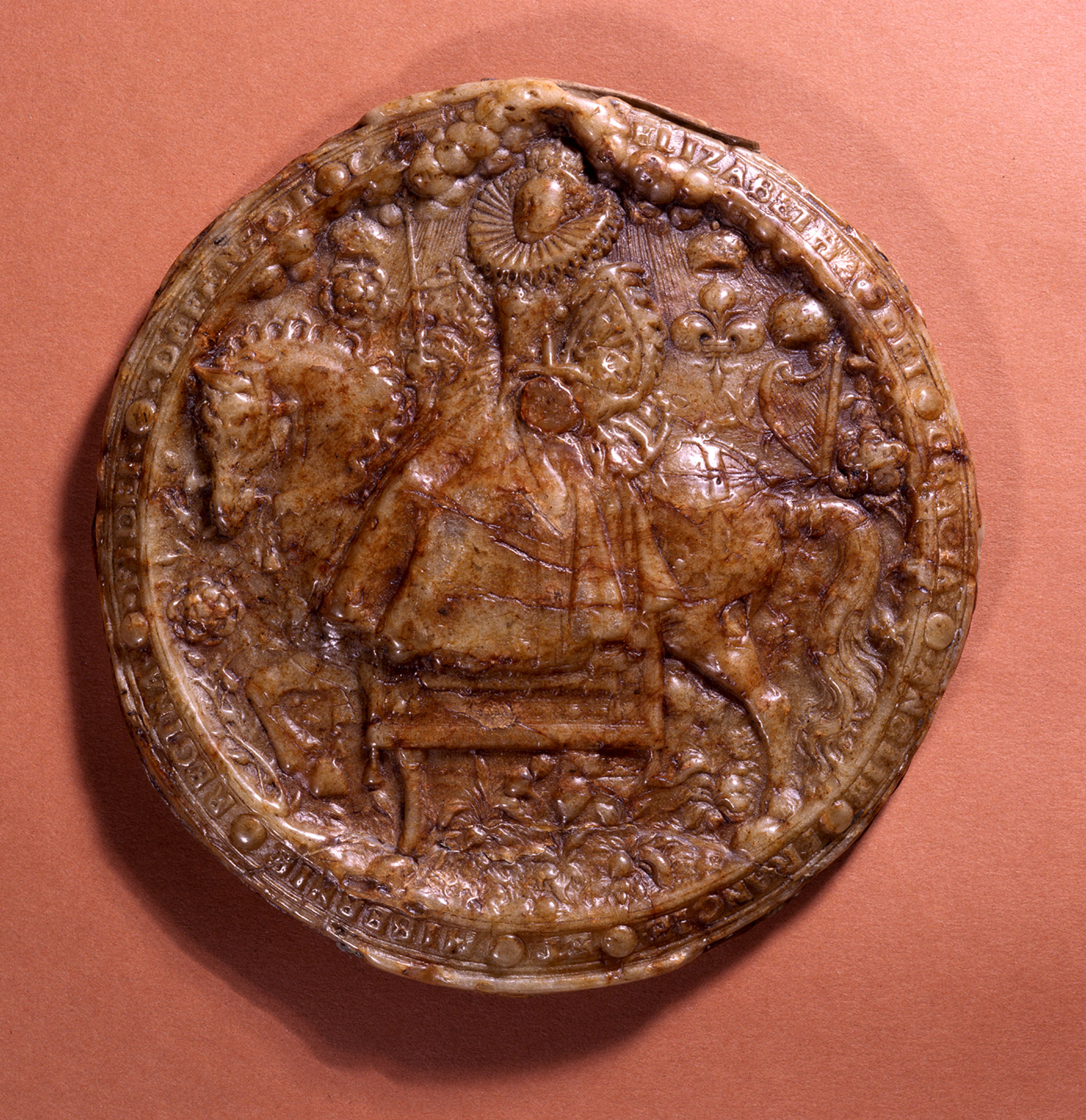
Show the image for the reverse of Queen Elizabeth I’s Great Seal to the class on a whiteboard/printed copies.
Can you find the following objects on the reverse of the seal?
A fleur de lys; harp; clouds and rays around the Queen’s head; a horse with plaited mane; Tudor Rose.
- Why do you think the Tudor Rose appears on both sides of this seal?
- A fleur-de-lys stands for France, which country does the harp stand for?
- Why would she want to include these symbols?
- Why do think Elizabeth is shown seated on a horse?