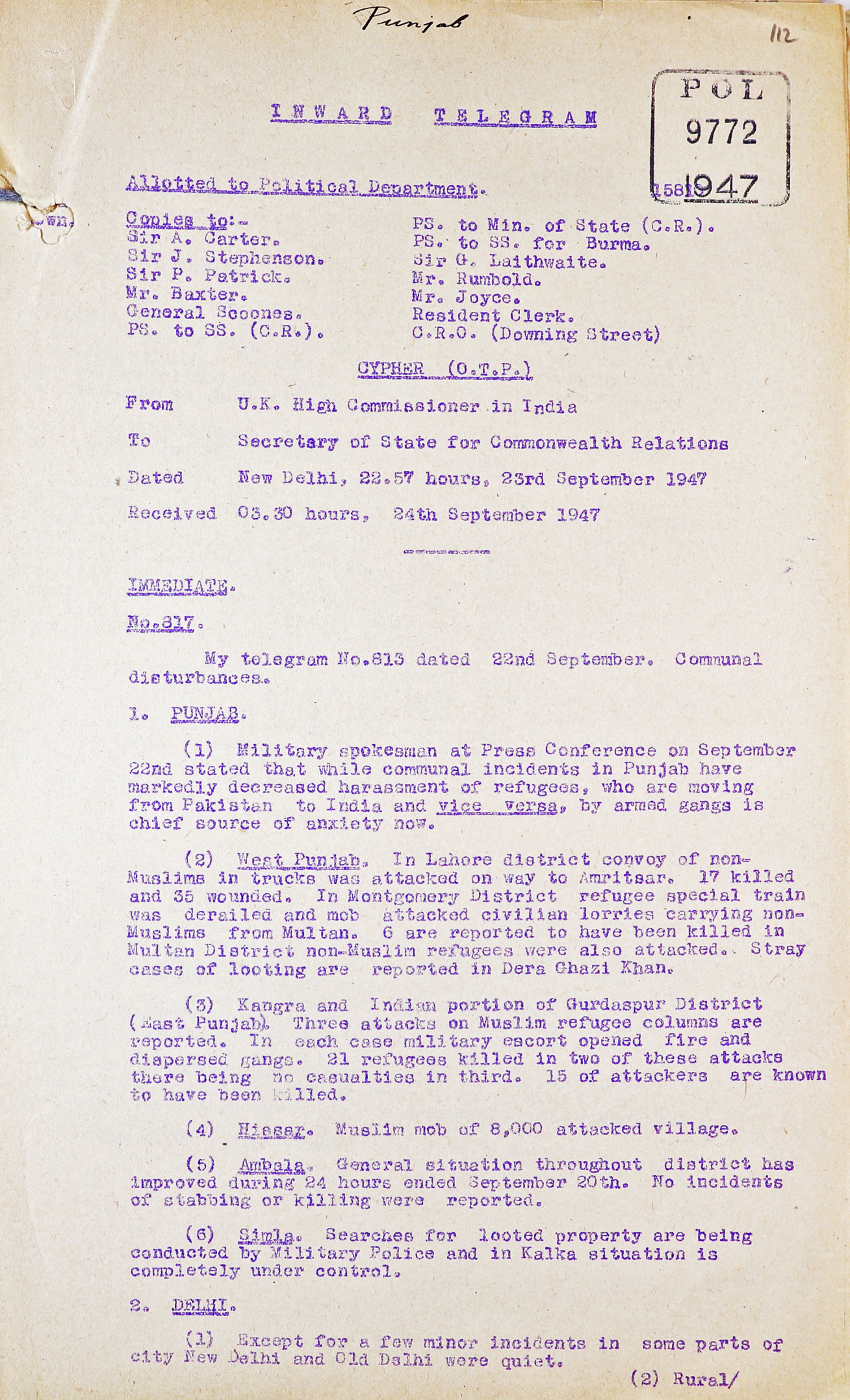
Telegram, September 1947. Catalogue ref: DO 142/416 .
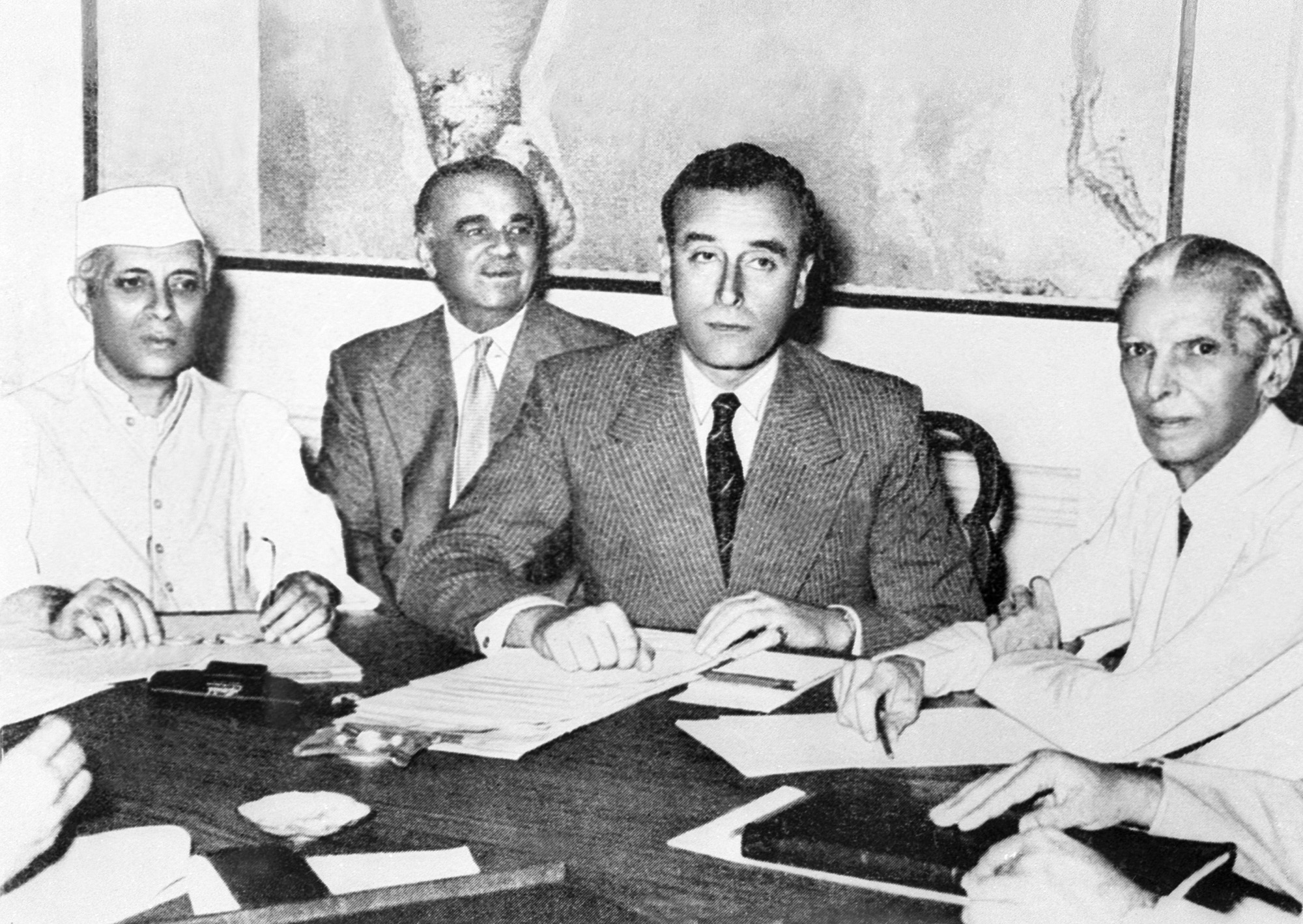
Photograph of: Jawaharlal Nehru – the first Prime Minister of independent India (left), Lord Ismay – Chief of Staff to Lord Mountbatten (centre left), Lord Mountbatten – British Viceroy of India (centre right), and Muhammed Ali Jinnah – first governor-general of Pakistan (right). Dinodia Photos / Alamy Stock Photo
In the below video, Iqbal Singh, Hannah Carter and Eleanor Newbigin introduce a document relating to the partition of British India. They explore what this document’s tone and content can tell us about British official’s attitudes to the violence that occurred after partition. Students also hear an oral testimony from Iqbal’s aunt whose family were displaced in 1946 due to growing tensions in British India. There is an accompanying resource pack you could use to explore this topic further.
The video and resource were launched at a plenary session at the SHP conference 2022.
What can The National Archives documents reveal about the partition of British India?Introduction to Partition
The partition of British India occurred in August 1947 when the British government withdrew from India after almost two hundred years of British rule.
People in British India had called for independence for decades. But, until the early 1940s, very few people–in Britain or India–would have thought that this independence would take the form of dividing up land.
A very important reason for British rule in India was military resources, particularly soldiers. In 1942, a point of uncertainty in the war for Britain, and growing Indian opposition to colonialism, the British government announced they would leave India after the war. There were many different political leaders and groups who disagreed about how to make everyone feel represented after Britain left. Muslims only made up a quarter of the population but these communities were not spread evenly. There were a few areas where Muslims were most of the population. There were calls from some Muslim leaders for these regions to have greater independence. Divisions grew.
By late 1946 British officials had given up on finding a solution in which many different groups could be represented within a single state. In February 1947 Lord Mountbatten was sent to oversee Britain’s withdrawal. On the 3rd June 1947 he stunned everyone by announcing with leaders Jawaharlal Nehru and Muhammad Ali Jinnah that Britain would give power to not one but two new governments – the government of India and the government of Pakistan, a year earlier than previously planned.
Officials from Britain and British India were given just 9 weeks to work out how British India would be divided. The final borders split the eastern and western areas of British India and ran through the provinces of Punjab and Bengal, important areas economically and politically with a roughly 50:50 split of Indian and Muslim populations.
Independence was declared on 14th and 15th August 1947 but the borders of these two new nations were announced 2 days later on the 17th of August. This meant that people celebrated independence without knowing for sure quite where the line between these two countries would be drawn.
People living in the regions affected by partition felt scared and uncertain about their future – not wanting to end up on the ‘wrong side’ of the border. In the months around August 1947 over 15 million people are thought to have migrated across the new borders. In Punjab in particular this huge human migration was accompanied by brutal violence- some of which we can see as a reflection of the fear and uncertainty of what was going on, of the future. However it is important to stress that much of the violence was not random but orchestrated by militias connected to various political parties who wanted to secure the best possible outcome after the British left India.
Communal disturbances
Our mystery document begins with the heading ‘communal disturbances’ which is a word we do not really recognise today. But it was a term that was widely used by officials in British-India to describe tensions between different religious groups. The use of the term ‘communal’ instead of just saying ‘religious’ showed that the British thought they were dealing with something specific to Indian society. It was thought that because of strong religious ideas Indian people were most likely to resolve things through violence. Religion was always assumed the cause, not more specific, local issues, which enabled officials to see the violence as something they were not responsible for, that it was caused by timeless differences between people.
Documents at The National Archives
The documents at The National Archives alongside those at the British Library India Office collection and records published in the Transfer of Power collection are some of the major collections of records in the UK about the period we are studying. While there is some duplication, the records at The National Archives are particularly strong for records of policy making at the highest level and for records of British armed forces stationed in India.
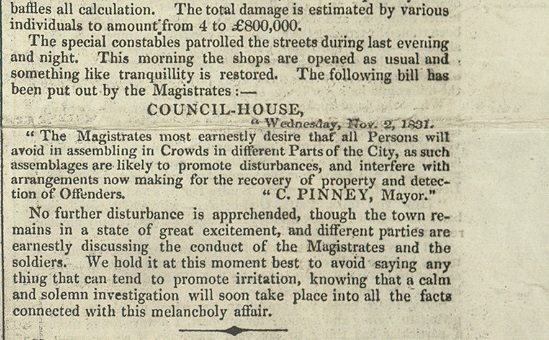
Extracts from ‘The Bristol Gazette’ on a riot in Bristol, 3 November 1831 Catalogue ref: HO 40/28.
According this newspaper, there were 8 inquests into why people died during the riot ‘of which two died by excessive drinking, four were burnt in the Square, and two were shot. A very great number must have lost their lives, of which we can obtain no account’.
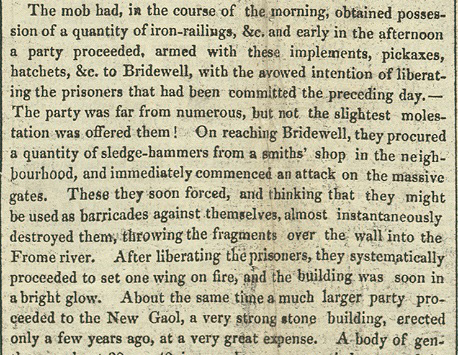
Extracts from ‘The Bristol Gazette’ on a riot in Bristol, 3 November 1831 Catalogue ref: HO 40/28.
According this newspaper, there were 8 inquests into why people died during the riot ‘of which two died by excessive drinking, four were burnt in the Square, and two were shot. A very great number must have lost their lives, of which we can obtain no account’.

Advertisement for a dinner in Gateshead in August 1830 to celebrate the July 1830 revolution in France, Catalogue ref: HO 44/21