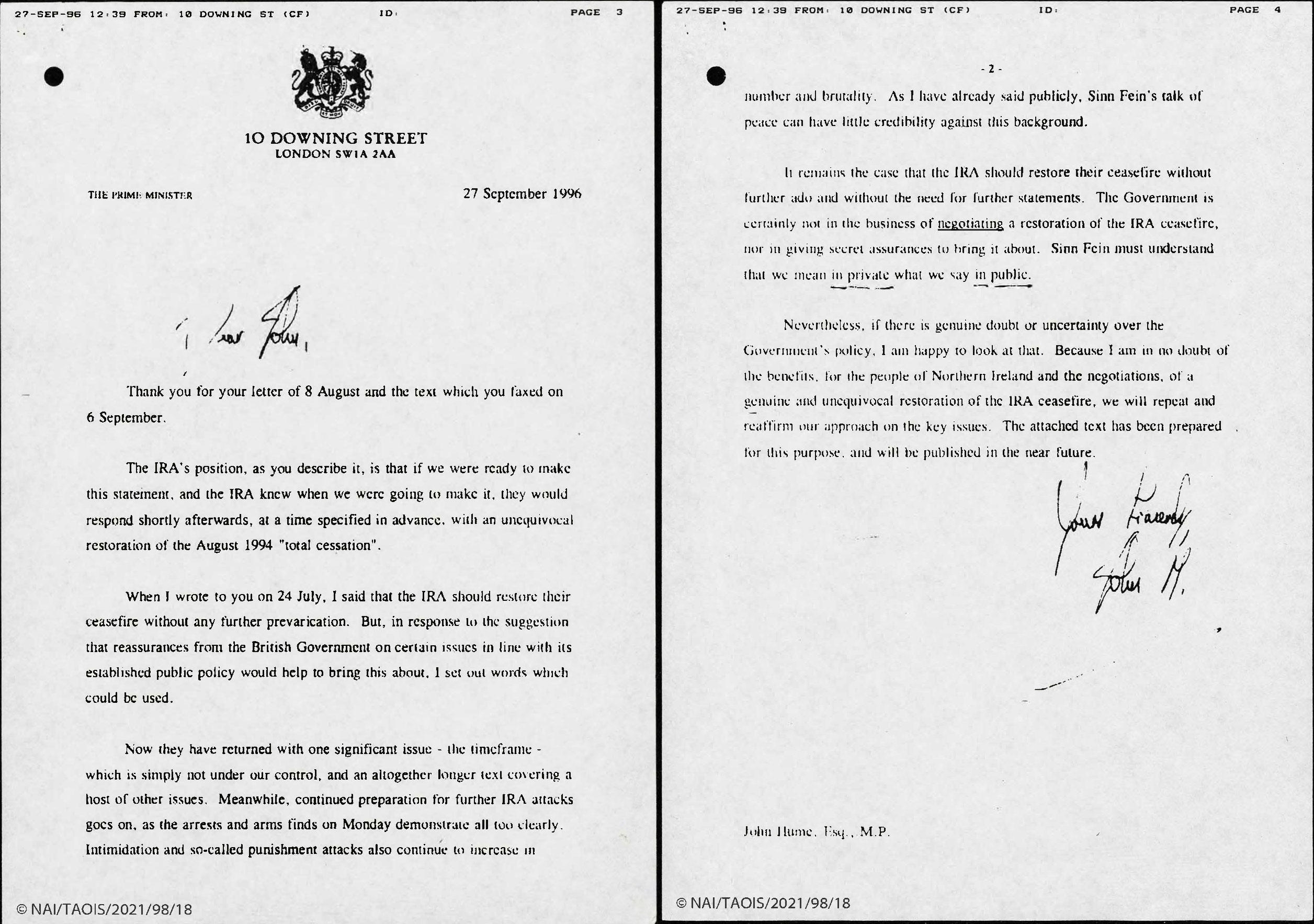
A letter from the UK Prime Minister John Major to the SDLP leader John Hume, September 1996
Context notes
One of the key dates in the peace process was the Downing Street Declaration of 1993. In this agreement, the UK and Irish governments enshrined the principle of consent – that Northern Ireland would remain in the United Kingdom unless the majority of the people of Northern Ireland decided otherwise. Another key principle was that only political parties which rejected violence would be included in talks about the future of Northern Ireland. In 1994 the Provisional IRA (PIRA) announced a ceasefire. This helped Sinn Féin to be accepted into discussions. However, the PIRA broke its ceasefire in February 1996. The Social Democratic and Labour Party (SDLP) leader, John Hume, had been in discussions with Sinn Féin leader Gerry Adams through the early 1990s and as this letter suggests, continued to try to encourage communication between Republicans and the UK government.
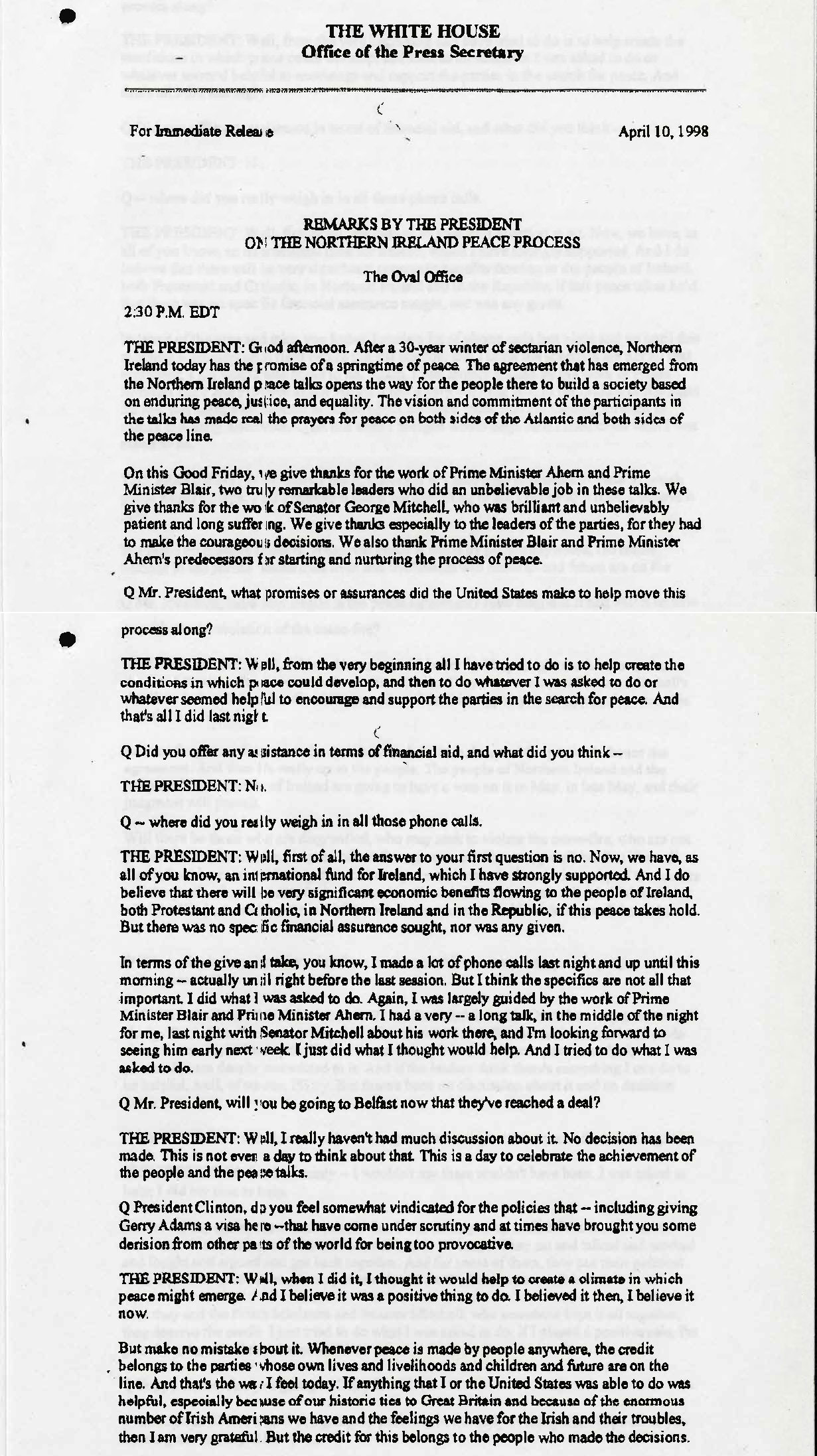
Extracts from a Question and Answer session between US President Bill Clinton and US journalists on 13 April 1998
Context notes
The USA had a large population of Irish-Americans, descended from people who had emigrated to the USA since the 1600s. As a result, US Presidents tended to be very interested in the situation in Ireland, particularly Democratic Presidents as the Democratic Party had a large support among Irish-Americans. When he was first elected in 1995, President Clinton was relatively critical of the British government in Northern Ireland. However, over time his position changed and he worked to support the peace process alongside the UK and Irish governments and the political parties in Northern Ireland.
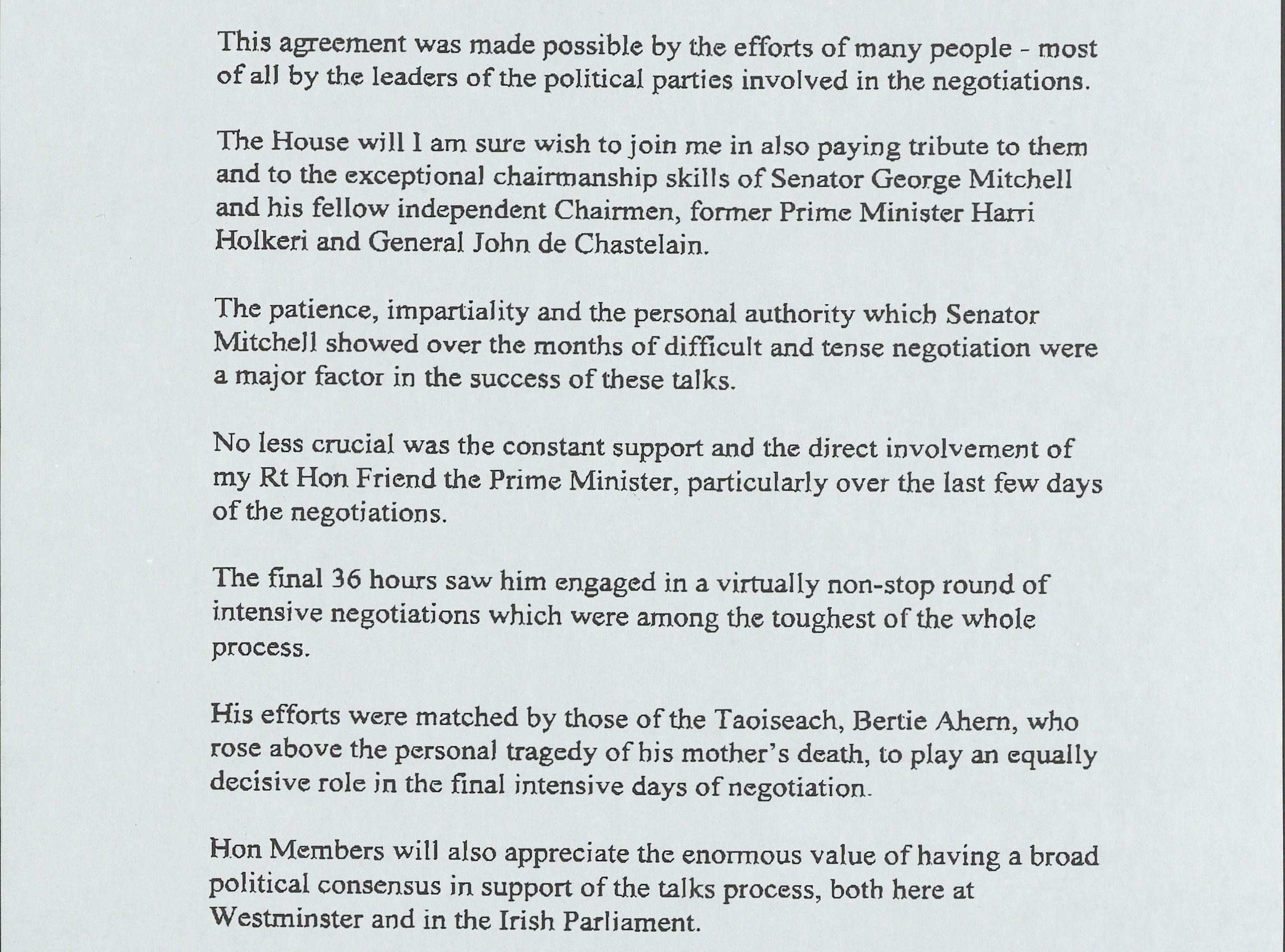
Source 5
Extract from a statement by the UK Secretary of State for Northern Ireland, Dr Mo Mowlam in April 1998. Catalogue Ref: PREM 49 / 412
Context notes
In 1972 the Northern Ireland Parliament (based at Stormont on the edge of Belfast) was suspended due to the political upheavals in the province. What followed was known as Direct Rule – Northern Ireland was governed directly by the UK Government, and the main responsibility for Northern Ireland lay with the Secretary of State for Northern Ireland. When Labour won the 1997 UK General Election, Dr Marjorie ‘Mo’ Mowlam became the Northern Ireland Secretary. In this document she set out the main terms of the Belfast (Good Friday) Agreement and in this extract gives credit to some of those who made it possible. Senator George Mitchell is an American politician. John de Chastelain is a Canadian diplomat and former army general. Harri Holkeri is a former prime minister of Finland. Tony Blair is the UK Prime Minister. Bertie Ahern is the Taoiseach (Prime Minister) of Ireland.
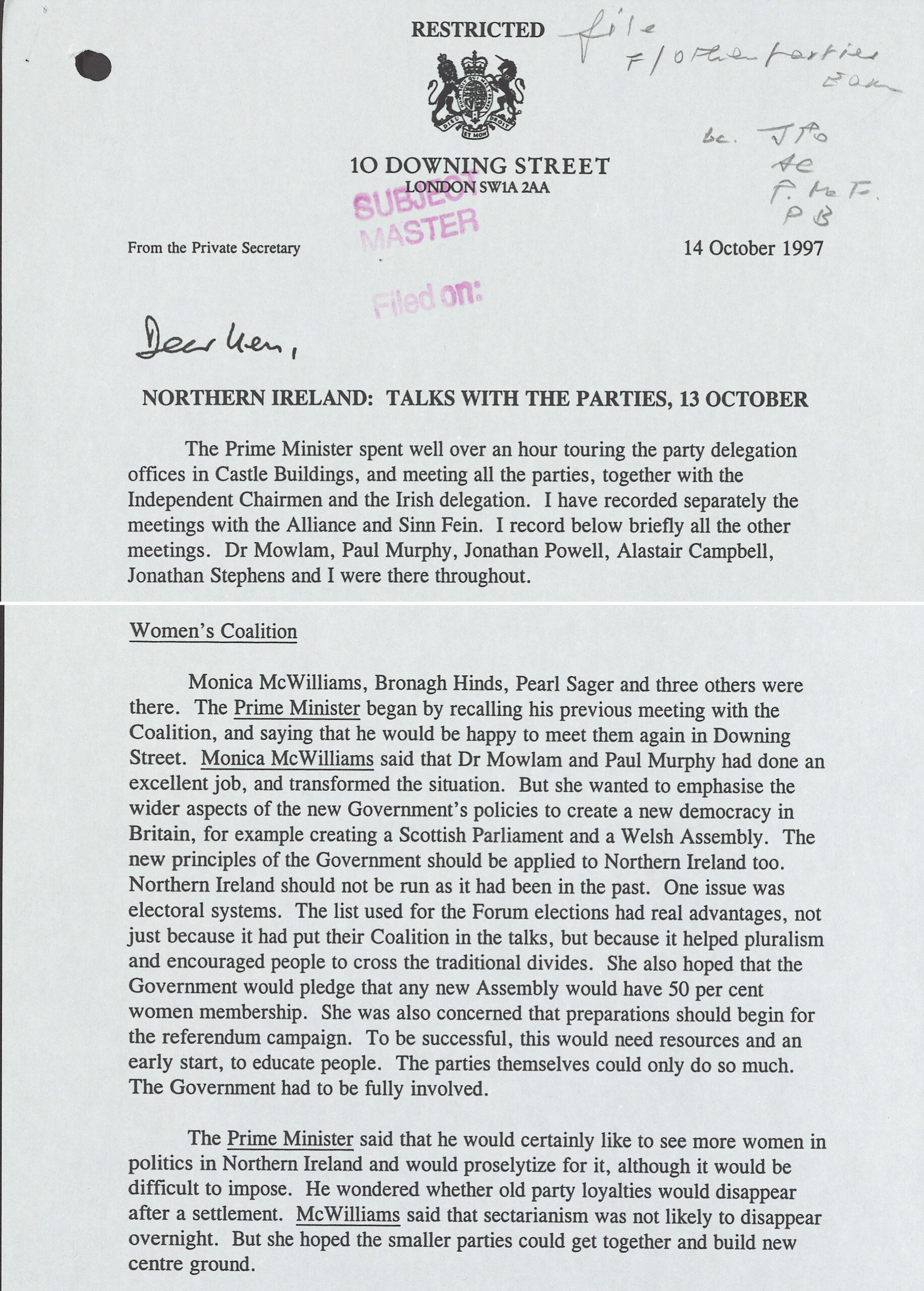
Extract from a report summarising talks between the UK government and various political parties and community groups in Northern Ireland, 14 October 1997. Catalogue Ref: PREM 49 / 119
Context notes
This meeting took place about six months before the final Belfast (Good Friday) Agreement. The Prime Minister and Taoiseach met with all of the Northern Ireland parties. This extract records their discussions with the Northern Ireland Women’s Coalition (NIWC). This was a cross-community party founded in 1996 by a Catholic academic, Monica McWilliams and a Protestant social worker, Pearl Sagar. They did not campaign specifically as a feminist organisation, and they were not Nationalist or Unionist in their aims. The movement principally aimed to try to represent the views of the wider community and not the main political parties or the paramilitary groups.
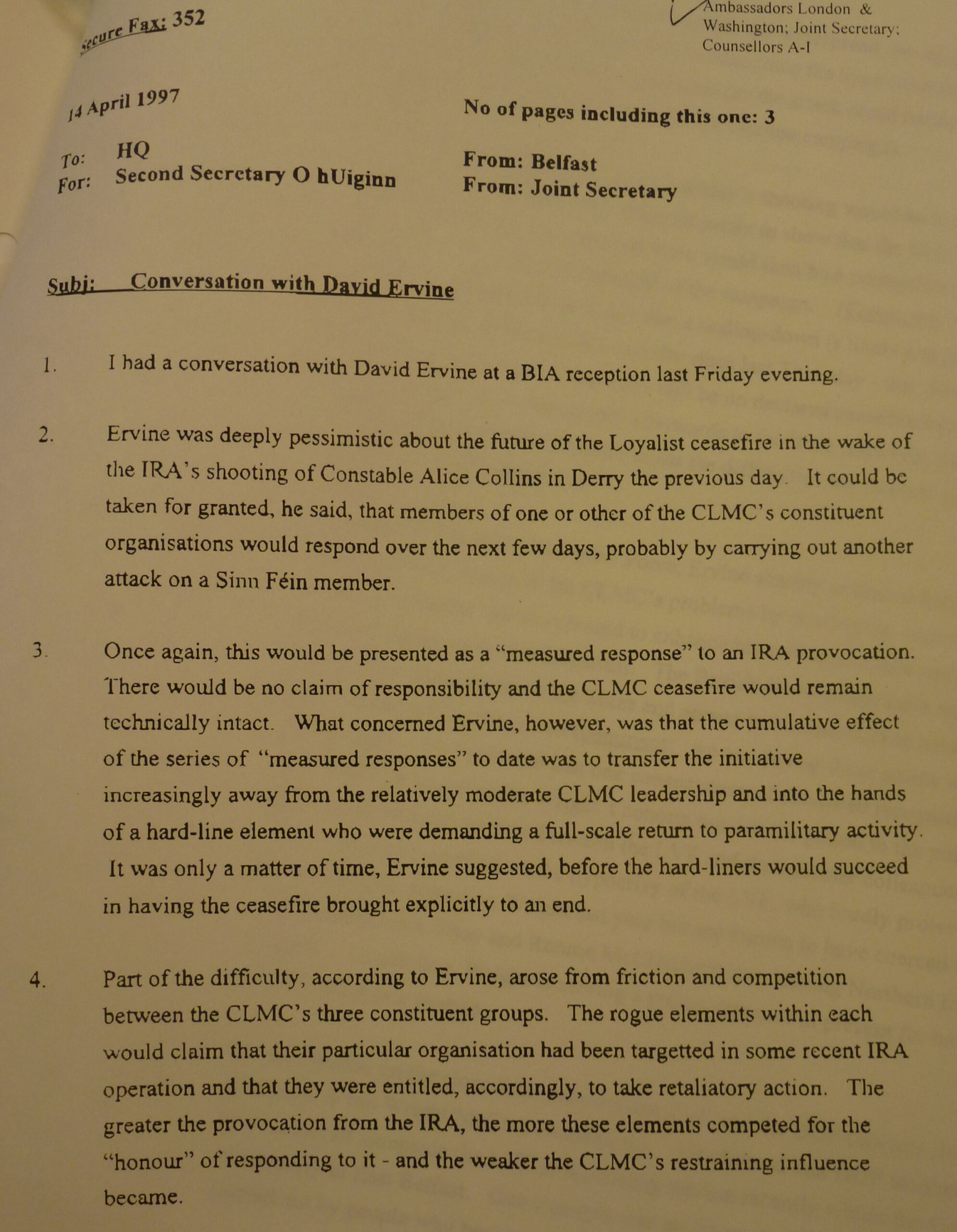
Extract from a report written 14 April 1997 by an official to Seán Ó hUiginn, the Joint Secretary of the Anglo-Irish Secretariat in Belfast. It describes a conversation with David Ervine, a former Loyalist paramilitary and member of the Progressive Unionist Party.
Context notes
For most of the 1970s, 1980s and early 1990s Loyalist paramilitary organisations had been active in Northern Ireland. They attacked IRA activists, Sinn Féin politicians, other Republican activists but also many who were simply members of the Catholic or Nationalist communities. By the 1990s Loyalist paramilitaries were becoming more active than the Provisional IRA in terms of the number of attacks carried out. However, an important group within the Loyalist paramilitaries favoured an end to conflict by the early 1990s. One of the most important was Gusty Spence of the Ulster Volunteer Force (UVF). Another was David Ervine, also a former paramilitary. Ervine met Spence in prison and was greatly influenced by him. He rejected violence and both Ervine and Spence became key figures in bringing about a Loyalist ceasefire in 1994. Leaders of the paramilitary groups the UVF, the Ulster Defence Association (UDA) and the Red Hand Commando formed an umbrella organisation called the Combined Loyalist Military Command (CLMC). This organisation co-ordinated the actions and statements of Loyalist organisations, although it was always a difficult job to control all of the factions within their respective organisations. Ervine himself went on to be a representative in the Northern Ireland government after the Agreement and was generally very well regarded by other politicians involved in the peace process.
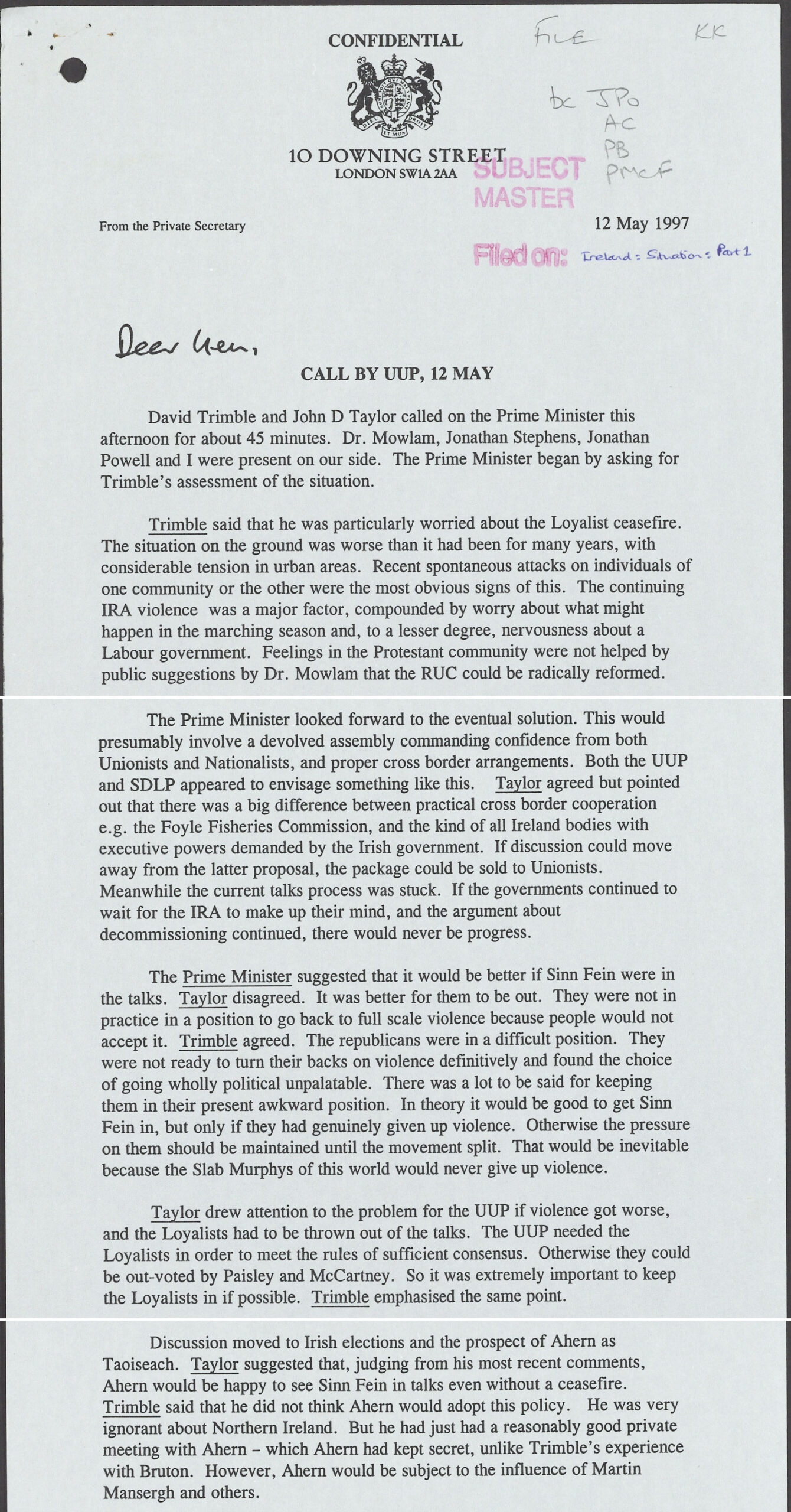
Part of a record of a meeting on 12 May 1997 between the UK Prime Minister Tony Blair and David Trimble, leader of the Ulster Unionist Party (UUP) and John Taylor, the Deputy Leader of the UUP. Catalogue Ref: PREM 49/108
Context notes
This document was a record of a meeting between the UK Prime Minister Tony Blair and David Trimble, leader of the Ulster Unionist Party (UUP) and John Taylor, the Deputy Leader of the UUP. Blair had only just won the UK election on May 1st. All sides were anxious to see whether the new government would maintain the same position as the previous Conservative government or whether Blair would take a different approach. At the time all groups were making plans for talks to set up a new government in Northern Ireland which would be based in Northern Ireland and run by representatives elected in elections in Northern Ireland. One of the biggest issues was the inclusion in elections of parties which had not signed up to the principles of The Downing Street Declaration of 1993, which had made clear that a party which did not renounce violence could not be part of any talks. Another point of disagreement was on the issue of cross-border cooperation, which related to the role and degree of influence of the Irish Government in matters affecting Northern Ireland. Ahern refers to Bertie Ahern, leader of the Fianna Fáil party in Ireland. As this meeting was taking place an election was due in Ireland in June and Ahern was expected to win, which he did.
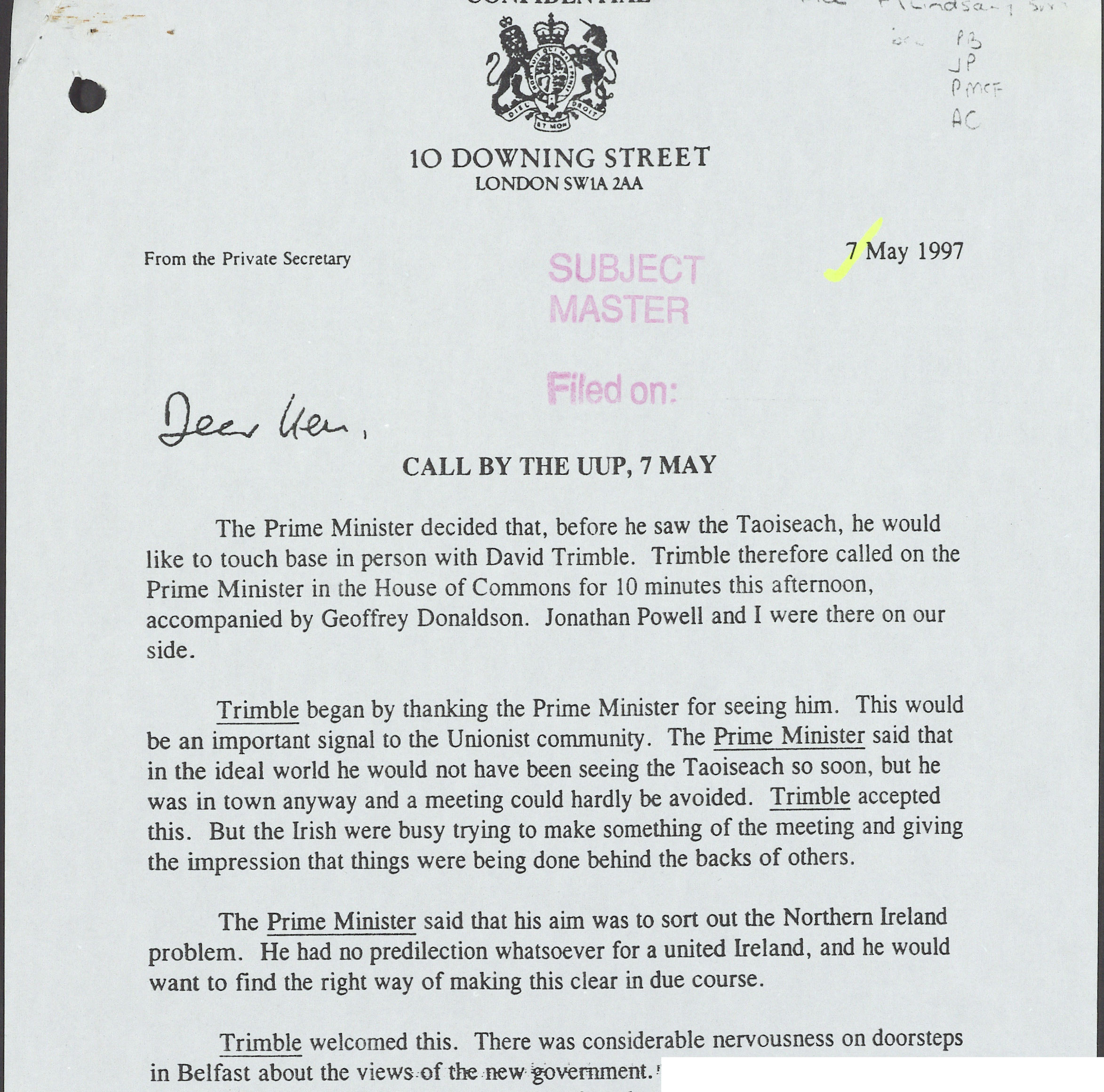
Part of a record of a meeting on 7 May 1997 between the UK Prime Minister Tony Blair and David Trimble, leader of the Ulster Unionist Party (UUP) and Jeffrey Donaldson, of the Ulster Unionist Party (UUP). Catalogue Ref: PREM 49/108
Context notes
This document was a record of a meeting between the UK Prime Minister Tony Blair and David Trimble, leader of the Ulster Unionist Party (UUP) and Jeffrey Donaldson, of the Ulster Unionist Party (UUP). Blair had only just won the UK election on May 1st. All sides were anxious to see whether the new government would maintain the same position as the previous Conservative government or whether Blair would take a different approach.
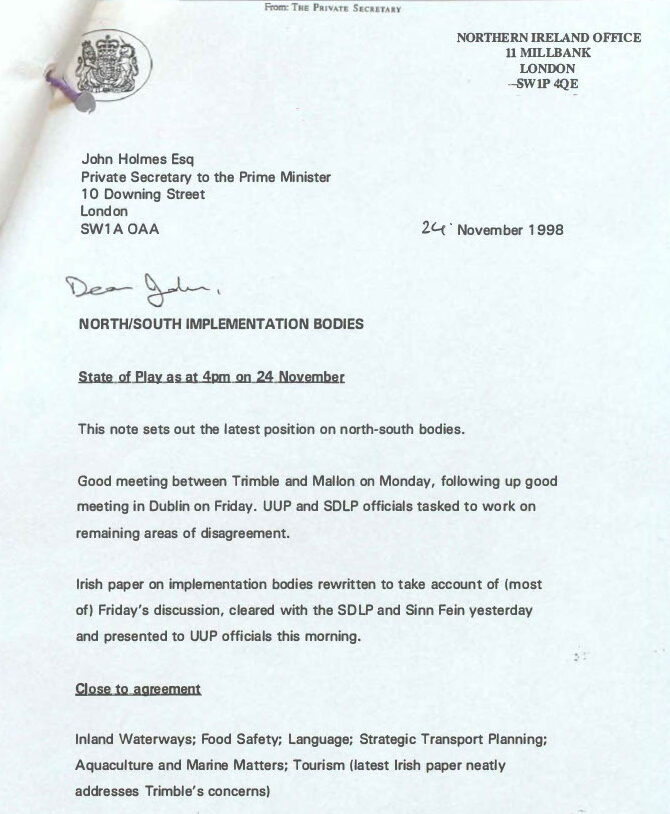
Extract from a note by a UK government official on a meeting about cross-border bodies November 1998
Context notes
Part of the Belfast Agreement of 1998 was the setting up of cross border bodies – organisations which took responsibility for a range of issues across the whole island of Ireland. For example, the North/South Ministerial Council was established. The Council takes the form of meetings between ministers from both Ireland and Northern Ireland and is responsible for twelve policy areas. Six of these areas are the responsibility of corresponding North/South Implementation Bodies. For Unionists in particular, agreeing to these bodies was a massive step as it allowed for deeper cooperation with the Irish government on matters affecting Northern Ireland and Ireland. Trimble was the leader of the Ulster Unionist Party. Mallon was Seamus Mallon, Deputy Leader of the Social and Democratic Labour Party (SDLP), the main Nationalist party at this time.
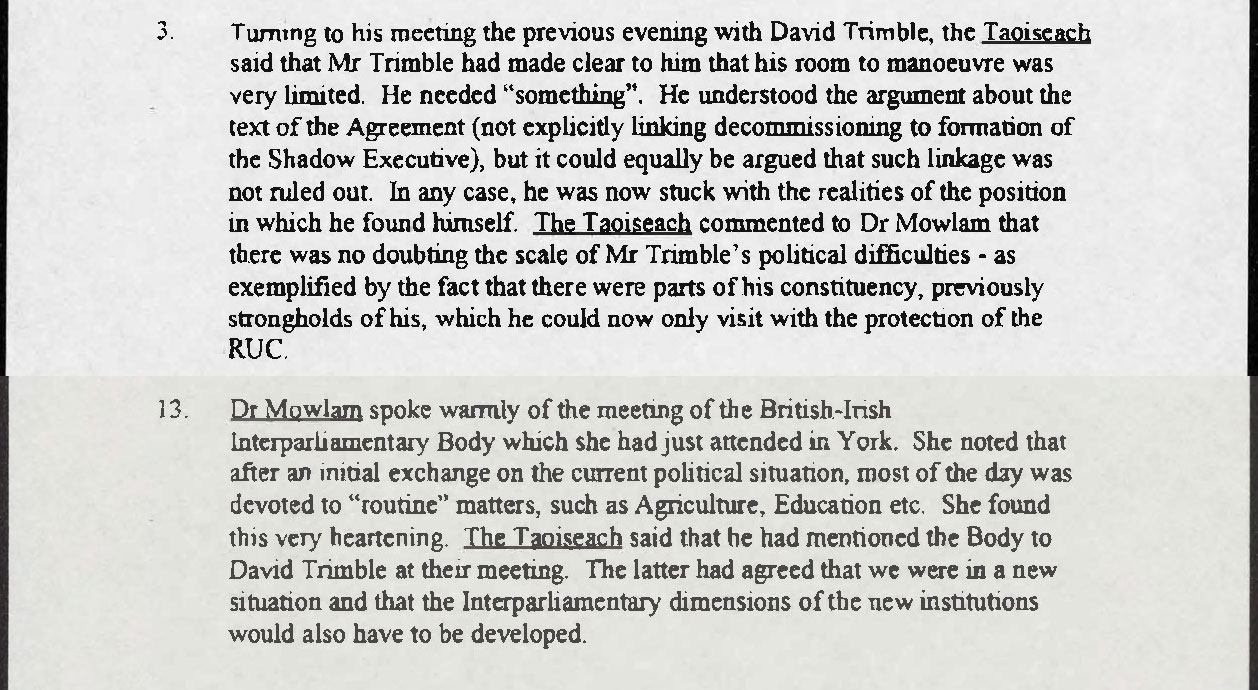
Extract from a report of a meeting between the Taoiseach and the UK Secretary of State for Northern Ireland in September 1998
Context notes
This extract comes from the notes taken at a meeting between Taoiseach Bertie Ahern and Northern Ireland Secretary Mo Mowlam. They discuss a wide range of issues, but these extracts focus on two issues. In section 3 they are discussing the challenges being faced by David Trimble, leader of the Ulster Unionist Party. Decommissioning meant the process of paramilitary groups giving up their weapons. The Shadow Executive was the term used for the new Northern Ireland devolved government before it officially took up its full powers. In section 13 the British-Irish Interparliamentary Body was an organisation formed in 1990. It was made up of 25 UK MPs and 25 Deputies of the Irish Parliament. They met to discuss issues of common interest and to promote understanding.
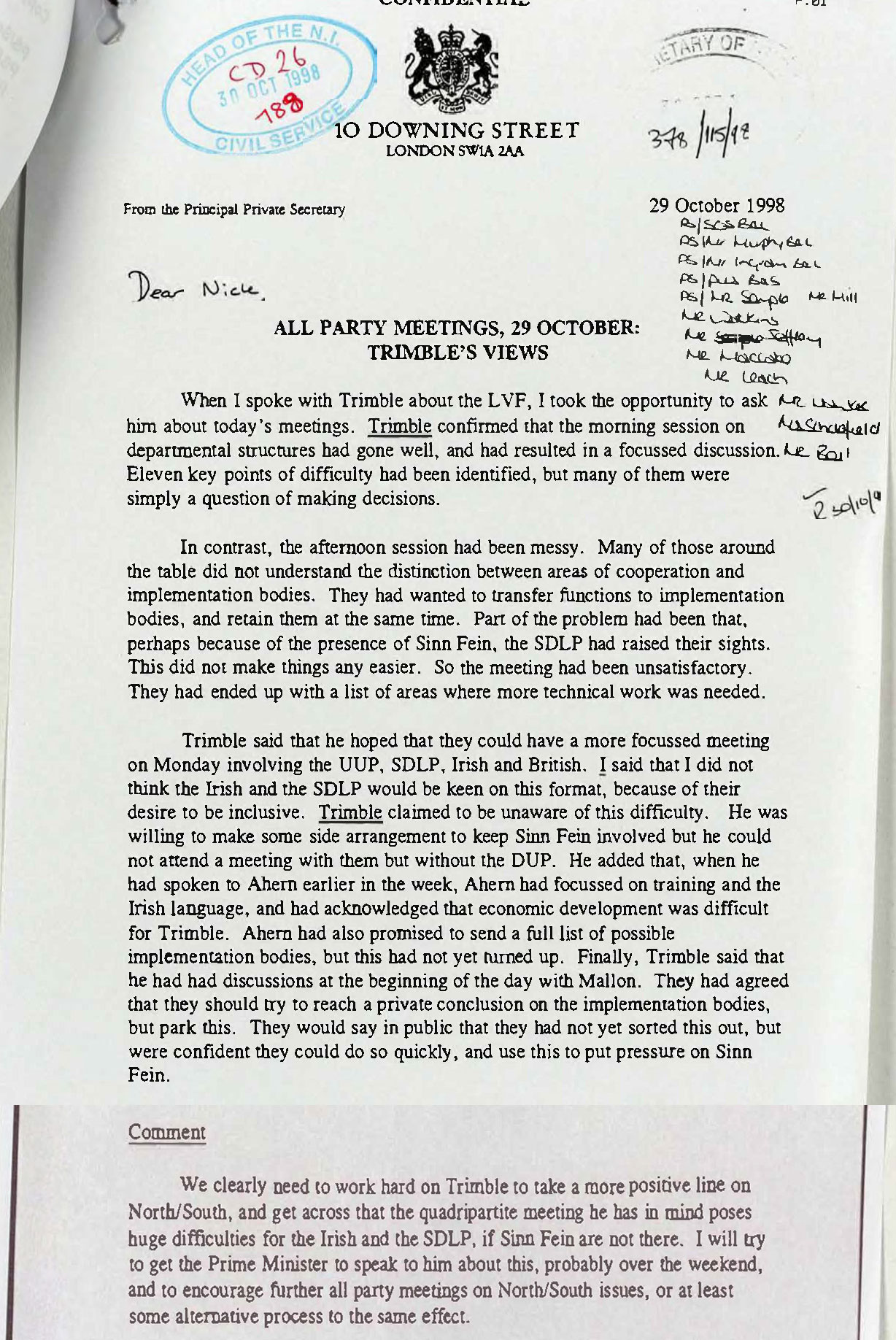
Extracts from a letter between the UK Prime Minister’s Office and the Northern Ireland Office. The letter was sent in October 1998.
Context notes
This letter was written in October 1998, by the Principal Private Secretary to the Prime Minister, a very senior figure in the UK civil service. He had been talking to David Trimble, leader of the Ulster Unionist Party, the largest Unionist Party in Northern Ireland at that time, about the Loyalist Volunteer Force (LVF), a Loyalist paramilitary organisation whose activities were causing concern. In the course of the conversation, they had talked about several other issues as well. The letter is reporting Trimble’s views to a colleague in the Northern Ireland Office.