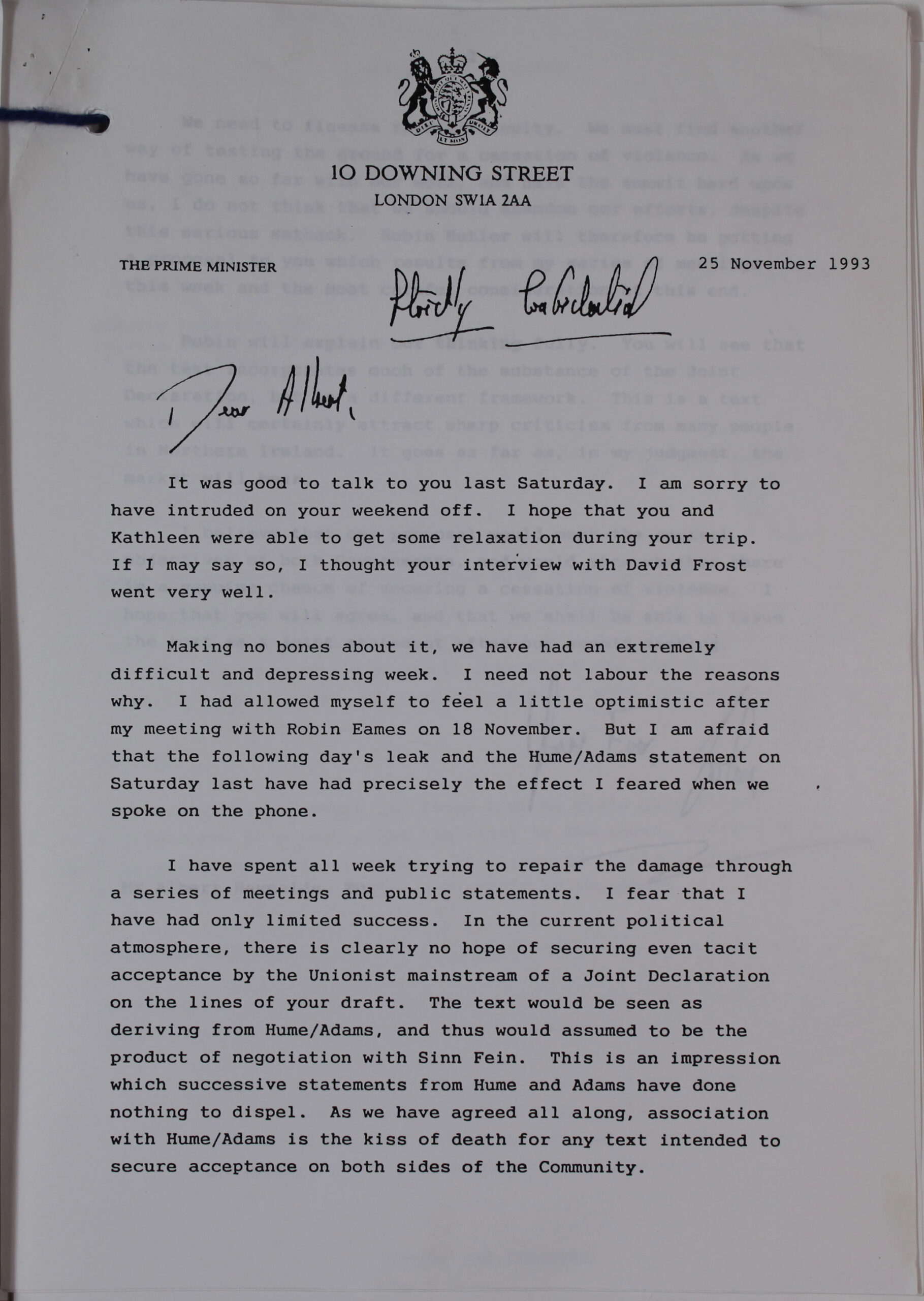
A letter from the British Prime Minister to the Taoiseach November 1993
Context notes
Throughout 1993 the British and Irish governments were talking regularly about Northern Ireland. The governments were also talking to political parties, both Unionist and Nationalist, in Northern Ireland. The British were also talking to representatives of the Provisional Irish Republican Army (PIRA). In the week before this letter a number of events caused problems for Prime Minister John Major. He had spoken to Robin Eames, the most senior figure in the Church of Ireland. That was a positive step, but from this point on things went very wrong. On 15 November a Northern Ireland newspaper reported that the British had been holding talks with the PIRA. On 19 November a newspaper in the Republic published a document drawn up by the Republic’s Department of Foreign Affairs setting out plans for the future of Northern Ireland. On 20 November John Hume and Gerry Adams issued a third joint statement. On 24 November British police intercepted a large shipment of arms which was meant for the Loyalist paramilitary group the Ulster Volunteer Force (UVF).
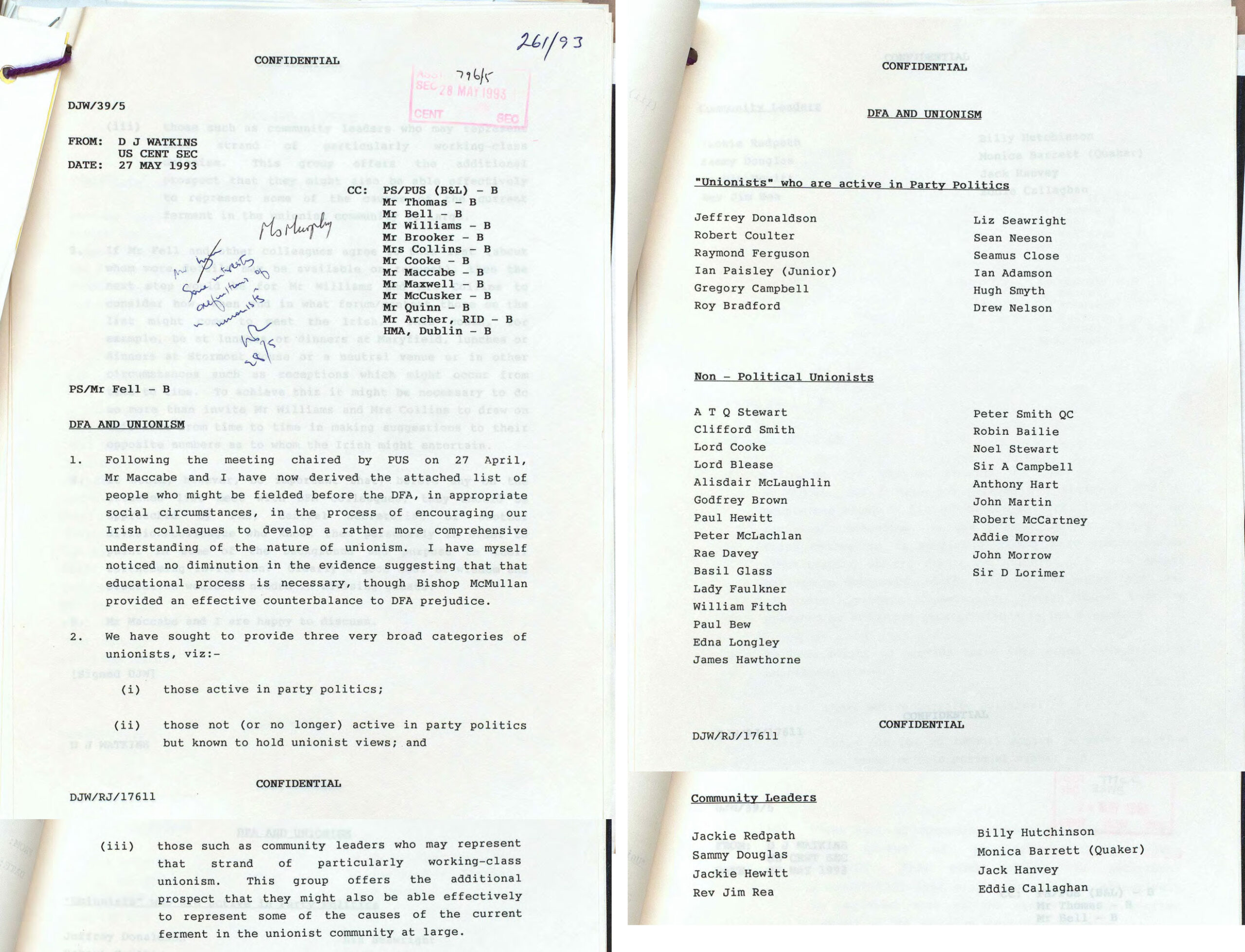
An internal memorandum produced by an official in the Northern Ireland Civil Service in May 1993. It is reporting on a plan to arrange a meeting between representatives of Unionism in Northern Ireland and the Irish Government’s Department of Foreign Affairs (DFA)
Context notes
When Northern Ireland was created in 1921 there was a great deal of hostility and bitterness in the rest of Ireland. Many Irish politicians and officials felt that Ireland should be united, and that Northern Ireland should not exist. By the 1990s this hostility towards Northern Ireland was greatly reduced. However, there was a problem that many in the Irish Government were unsympathetic towards Northern Ireland’s Unionist community. It was felt that many in Irish public life and its institutions regarded Unionists with suspicion, and thought they were simply pawns of the British government.
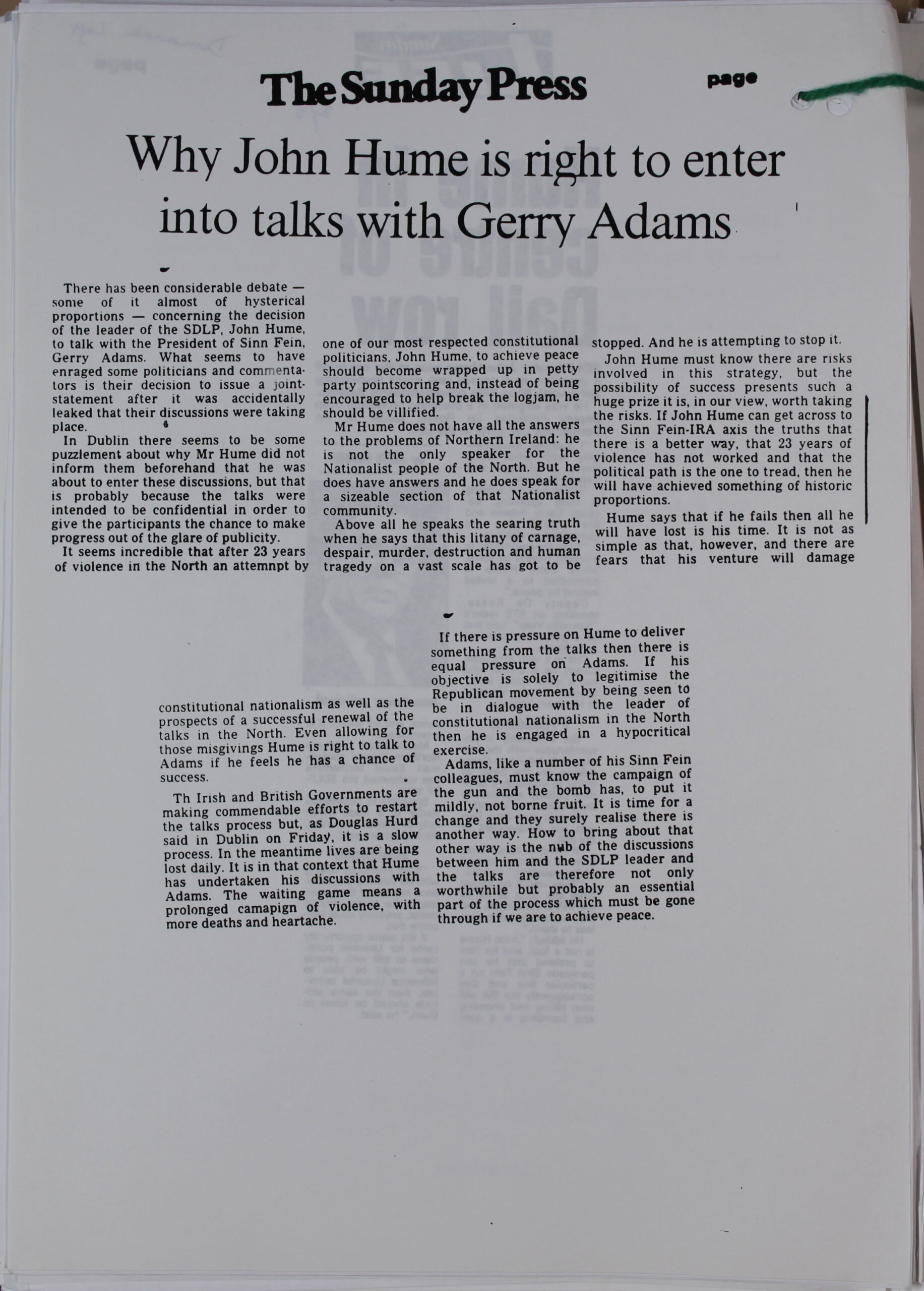
A newspaper cutting contained in a UK government file. The article was published in May 1993 in The Sunday News, a newspaper in the Irish Republic.
Context notes
John Hume was the leader of the Social Democratic Labour Party (SDLP), the largest Nationalist party in Northern Ireland at the time. Gerry Adams was the leader of Sinn Féin, which was generally seen as the political wing of the IRA although Gerry Adams always officially denied that there was a link between the two organisations. They began a series of meetings in 1992 to discuss the conditions which would be necessary to end the conflict in Northern Ireland. In April 1994 these ‘secret’ talks were discovered and widely reported in the newspapers and as a result Hume and Adams made a public statement about their talks in April 1993. They then continued to meet and made further public statements in September and November 1993, setting out their views on how government and politics in Northern Ireland should develop.

Biography
Henry Patterson – Ulster University
- Emeritus Professor of Irish Politics at Ulster University
- Published extensively on the history of Northern Ireland, Ireland and Anglo-Irish relations.
- Publications include:
- Ireland’s Violent Frontier: the Border and Anglo-Irish Relations during the Troubles (2016)
- Unionism and Orangeism since 1945 (2007), Ireland since 1939 (2006)
- Northern Ireland 1921-2001 Political Forces and Social Classes (2002)
- Class Conflict and Sectarianism The Protestant Working Class and the Belfast Labour Movement 1868-1920 (2020)
- Member of the Centenary Historical Advisory Panel established by the Secretary of State for Northern Ireland in August 2020.
Interpretation
The most important factor that led to the achievement of the Good Friday Agreement was David Trimble’s leadership of the Ulster Unionist Party. Trimble led a naturally conservative force to embrace an accord which involved a share in government for Sinn Féin, a party which unionists regarded as spokespersons for a terrorist campaign that accounted for over sixty per cent of deaths during the Troubles.
His predecessor, James Molyneaux, had pronounced the IRA ceasefire of 1994 the most destabilising event in the history of Northern Ireland. He feared that any subsequent negotiations would see unionists pressed to make unacceptable political concessions to prevent a return to violence.
When Molyneaux resigned in 1995 David Trimble, was perceived as the most right wing of the contenders . However, once Leader, Trimble broke decisively with Molyneaux’s passive approach. Convinced that he had obtained acceptance of Northern Ireland’s constitutional position by nationalists and republicans he was prepared to go into government with Sinn Féin, agree to the early release of paramilitary prisoners and the radical reform of policing. Without this willingness to go over the heads of many of his party members and activists the Agreement would not have been possible.
Task
Study each interpretation and summarise the key points made by the historian.
- What do they argue is the most important factor, individual or group?
- How did this contribute to the peace process and Belfast (Good Friday) Agreement?
- What challenges and obstacles had to be overcome?
- What evidence is given to support this interpretation?
- Does the historian’s biographical information help to explain their interpretation?
- From your own knowledge how convincing do you find this interpretation?
- What further evidence would you want to find in the documents to make the interpretation convincing?
- If you were to provide a one-word summary of this individual’s contribution, which of these would you choose, or can you think of a better word?
- Obstructive / Unhelpful / Marginal / Constructive / Helpful / Pragmatic / Visionary / Essential

Biography
Eleanor Williams – University of Cardiff and Researcher, The National Archives (UK)
- International relations and politics tutor at Cardiff University.
- First Class Honours Degree in International Relations and Politics at Cardiff University.
- Masters Degree in International Relations.
- PhD from Queen’s University Belfast investigating the ethics of state intelligence during the conflicts in Northern Ireland and Colombia
- Researcher at The National Archives identifying documents about The Belfast (Good Friday) Agreement
Interpretation
One of the most important factors which led to the achievement of the Good Friday Agreement was the inclusion of the people who were conducting the violence, which were the Republicans and the Loyalists. In the past, there had been other attempts at peace such as the Sunningdale Agreement of 1973. Whilst this agreement had many of the key ideas of the Good Friday Agreement of 1998, one of the main things missing were the groups who were conducting the violence. This meant that Republicans and Loyalists, who were not part of the agreement, had no incentive to stop their violent campaigns. Subsequently, making peace in the 1970s was very difficult and resulted in thousands of more people being killed.
In the Good Friday Agreement of 1998, the Republican and Loyalist groups were part of the negotiations and agreement. This was difficult for all groups involved. People had to negotiate with groups who were responsible for killing their loved ones, friends, and people within their own community. However, it meant that some of their key grievances could be resolved, as well as having to compromise too with key issues such as decommissioning. By involving the Loyalists and Republicans, those who were responsible for the violence now had a stake in peace and led them to signing the Good Friday Agreement.
Task
Study each interpretation and summarise the key points made by the historian.
- What do they argue is the most important factor, individual or group?
- How did this contribute to the peace process and Belfast (Good Friday) Agreement?
- What challenges and obstacles had to be overcome?
- What evidence is given to support this interpretation?
- Does the historian’s biographical information help to explain their interpretation?
- From your own knowledge how convincing do you find this interpretation?
- What further evidence would you want to find in the documents to make the interpretation convincing?
- If you were to provide a one-word summary of this individual’s contribution, which of these would you choose, or can you think of a better word?
- Obstructive / Unhelpful / Marginal / Constructive / Helpful / Pragmatic / Visionary / Essential

Biography
Tom Hennessey – Canterbury Christ Church University
- Professor of Modern British and Irish History at Canterbury Christ Church University.
- Junior Research Fellow, at the Institute of Irish Studies, at Queen’s University, Belfast.
- Research Officer at the Centre for the Study of Conflict, the University of Ulster.
- Research Assistant at the think tank Democratic Dialogue
- Research Fellow at the School of Politics, at Queen’s University, Belfast.
- Member of the Ulster Unionist Party’s Talks Team during the negotiation of the Belfast (Good Friday) Agreement in 1998.
Interpretation
A key turning point was the Republican movement’s dropping of the demand for a declaration by the British of intent to withdraw from Northern Ireland. This was a traditional Republican demand, and its ending can be traced back to a speech given by Jim Gibney of Sinn Féin, in 1992, at Bowdenstown, the burial place of the great Irish Republican, Wolfe Tone, where they make major announcements, when he said: “We know and accept that the British government’s departure must be preceded by a sustained period of peace and will arise out of negotiations. We know and accept that such negotiations will involve the different shades of Irish nationalism, and Irish unionism engaging the British government either together or separately to secure an all-embracing and durable peace process.”
Jim Gibney was part of Gerry Adams’ think tank at Sinn Féin and he was setting the scene that there would be a longer process which would not require the British to agree to withdrawal up front. This marks a key change by the republican movement and a change in the thinking about the role of armed struggle against the British.
Task
Study each interpretation and summarise the key points made by the historian.
- What do they argue is the most important factor, individual or group?
- How did this contribute to the peace process and Belfast (Good Friday) Agreement?
- What challenges and obstacles had to be overcome?
- What evidence is given to support this interpretation?
- Does the historian’s biographical information help to explain their interpretation?
- From your own knowledge how convincing do you find this interpretation?
- What further evidence would you want to find in the documents to make the interpretation convincing?
- If you were to provide a one-word summary of this individual’s contribution, which of these would you choose, or can you think of a better word?
- Obstructive / Unhelpful / Marginal / Constructive / Helpful / Pragmatic / Visionary / Essential

Biography
Caoimhe Nic Dháibhéid – University of Sheffield
- Senior Lecturer in Modern History at the University of Sheffield.
- Studied History and French at University College Cork, before undertaking an M.A. and Ph.D. at Queen’s University Belfast.
- 2009-10 Research Fellow at the Institute of Irish Studies, Queen’s University Belfast
- 2010-2012 Rutherford Research Fellow at Fitzwilliam College, Cambridge.
- Researches in Irish history, in particular the Irish Revolution; political violence and terrorism since the nineteenth century; and the cultural history of the Irish Revolution, particularly the history of emotions.
Interpretation
When thinking about the key contributors who shaped the peace process at various points Bertie Ahern is absolutely crucial because he is a deal maker. He comes from a background of undertaking very effective trade union negotiations and is instinctively oriented towards outcomes and getting deals done. He understands the importance of making key concessions. In particular, the amending of articles two and three of the Irish Constitution, which removed the claim to Northern Ireland as part of its national territory is absolutely crucial. Making that concession at an early stage of the negotiations and getting the people of Ireland to agree to it was key to building unionist confidence because they saw there was a new relationship between North and South. A long-standing Unionist fear was that they were bordered by an aggressive state waiting to swamp them. So the changing of articles two and three seems to me to be an important turning point because it handed Trimble the commitment necessary for him to convince the unionists that Ireland was serious about change.
Task
Study each interpretation and summarise the key points made by the historian.
- What do they argue is the most important factor, individual or group?
- How did this contribute to the peace process and Belfast (Good Friday) Agreement?
- What challenges and obstacles had to be overcome?
- What evidence is given to support this interpretation?
- Does the historian’s biographical information help to explain their interpretation?
- From your own knowledge how convincing do you find this interpretation?
- What further evidence would you want to find in the documents to make the interpretation convincing?
- If you were to provide a one-word summary of this individual’s contribution, which of these would you choose, or can you think of a better word?
- Obstructive / Unhelpful / Marginal / Constructive / Helpful / Pragmatic / Visionary / Essential

Biography
Frank Sheridan – Irish Government Diplomat and Researcher, The National Archives (Ireland)
- Irish Foreign Service 1973 – serving in USA, Britain, the European Union, South America and Africa.
- Private Secretary to Irish Foreign Minister.
- Irish Ambassador to Mozambique.
- Irish Ambassador to Brazil.
- 2014 Masters in contemporary Irish History, Trinity College Dublin.
- Researcher film documentary – John Hume building Irish lobby in US.
- Researcher for Seamus Mallon, former Deputy First Minister in Northern Ireland, politics memoir.
- Edited memoir by British diplomat, Sir David Goodall, on negotiation of the Anglo-Irish Agreement 1985.
- Researcher on Anglo-Irish affairs identifying documents for release to the Irish National Archives.
Interpretation
Unlike all the previous attempts at finding a solution to the conflict in Northern Ireland, the negotiations of the Belfast Good Friday Agreement were overseen by an external chairperson acting as a sort of referee on who could participate, the agenda for talks, and how to conduct them. That person was neutral, with no prior affiliation to any group in Northern Ireland or the two governments. He was former U.S. Senator, George Mitchell, a lawyer and politician with a strong record of achievement, and in 1995 he was proposed for the role by U.S. President, Bill Clinton.
The idea of such an appointment came from Irish-American pressure during the US presidential election in 1992 and on election, President Clinton appointed Mitchell, recently retired, first as advisor on Northern Ireland and then proposed to the British and Irish government leaders that Mitchell oversee all-party talks on the conflict.
It took almost a year to secure the agreement of all involved to Mitchell’s appointment. On the thorny issue of admission to talks of representatives of paramilitary groups, Mitchell drew up the Mitchell Principles, requiring a solemn pledge to non-violence and the use of only democratic means. For two years, with endless patience, Mitchell oversaw talks with the parties, slowly nudging them towards agreement and securing the involvement, usually by telephone calls from the White House to party leaders, of President Clinton, in support of his efforts which culminated in the Belfast Good Friday Agreement on 10th April, 1998.
Task
Study each interpretation and summarise the key points made by the historian.
- What do they argue is the most important factor, individual or group?
- How did this contribute to the peace process and Belfast (Good Friday) Agreement?
- What challenges and obstacles had to be overcome?
- What evidence is given to support this interpretation?
- Does the historian’s biographical information help to explain their interpretation?
- From your own knowledge how convincing do you find this interpretation?
- What further evidence would you want to find in the documents to make the interpretation convincing?
- If you were to provide a one-word summary of this individual’s contribution, which of these would you choose, or can you think of a better word?
- Obstructive / Unhelpful / Marginal / Constructive / Helpful / Pragmatic / Visionary / Essential
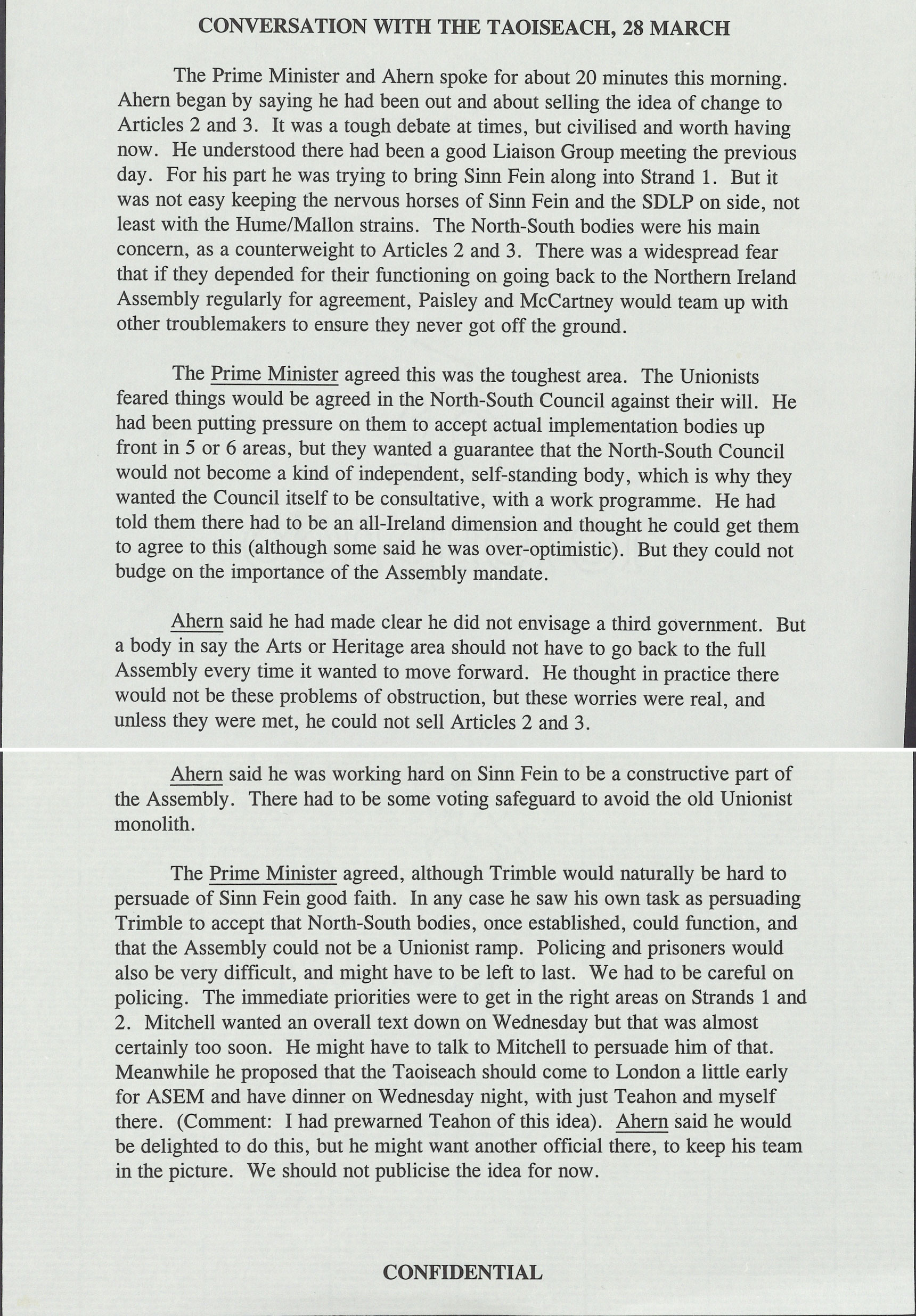
Notes from a meeting between the UK Prime Minister Tony Blair and the Taoiseach Bertie Ahern, 28 March 1998.
Context notes
Blair became Prime Minister in May 1997 and Ahern became Taoiseach in June 1997. The two leaders had a good working relationship which helped the peace process. In this conversation they refer to a number of developments. Strand One was the creation of a new Assembly to govern Northern Ireland. Strand Two concerned relations between the Irish government and Northern Ireland, and the creation of organisations which would have a role in issues which ran across the border between Northern Ireland and Ireland, such as heritage or cultural bodies.
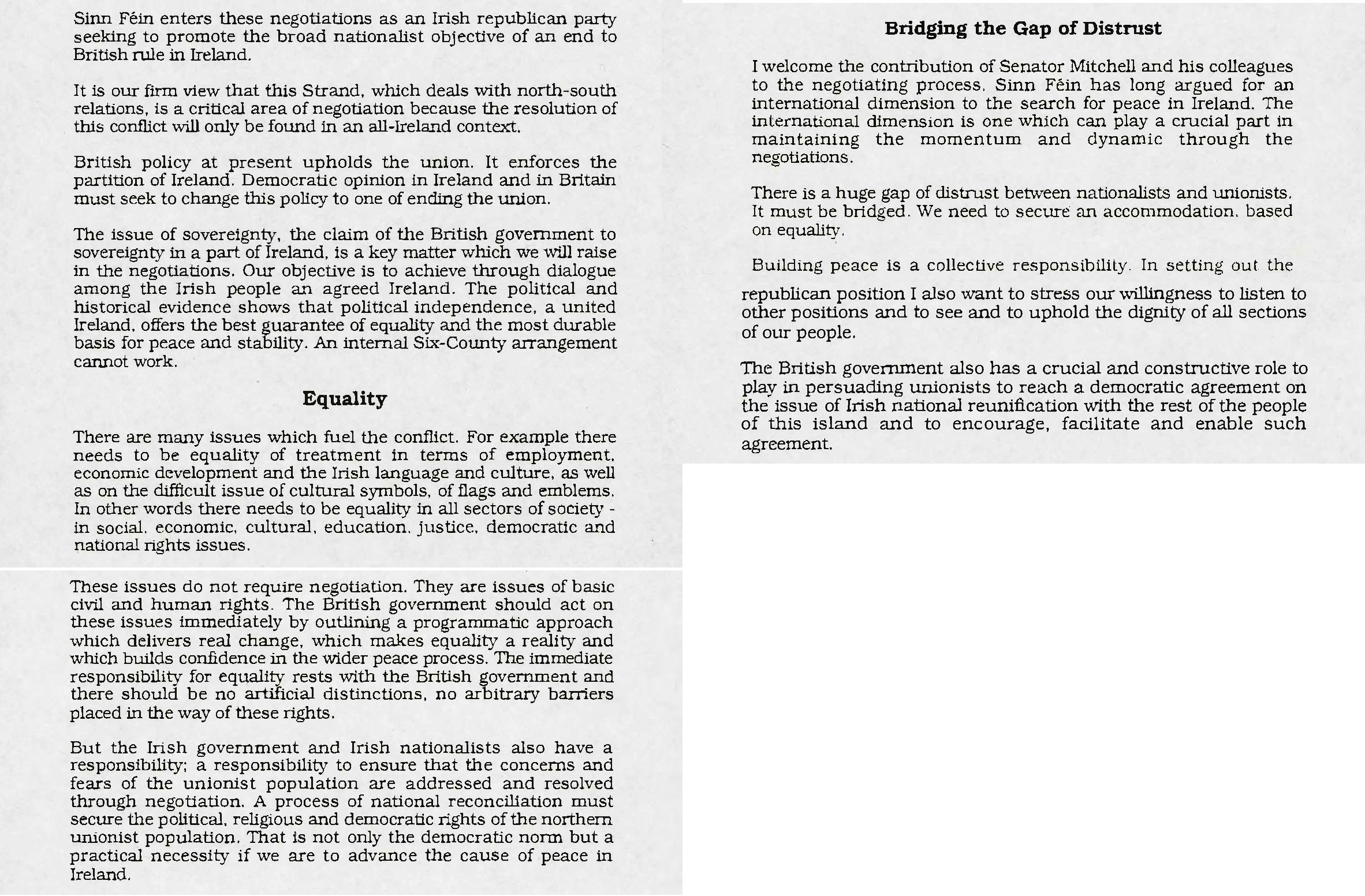
Extracts from the opening remarks of Sinn Féin leader Gerry Adams to the first meeting of Northern Ireland parties and the UK and Irish governments in October 1997.
Context notes
When the peace process began there were three main strands of the discussions. Strand One concerned the Northern Ireland Assembly. Strand Two concerned issues within the island of Ireland and relations between the Irish government and Northern Ireland. Strand Three concerned relations between the British and Irish governments. This document sets out the opening comments made by the Sinn Féin leader Gerry Adams at the opening talks on Strand Two. Sinn Féin was a Republican party in Northern Ireland. Unionists and the British government regarded Sinn Féin as the political wing of the Provisional IRA. However, Sinn Féin always denied that there was an official connection.