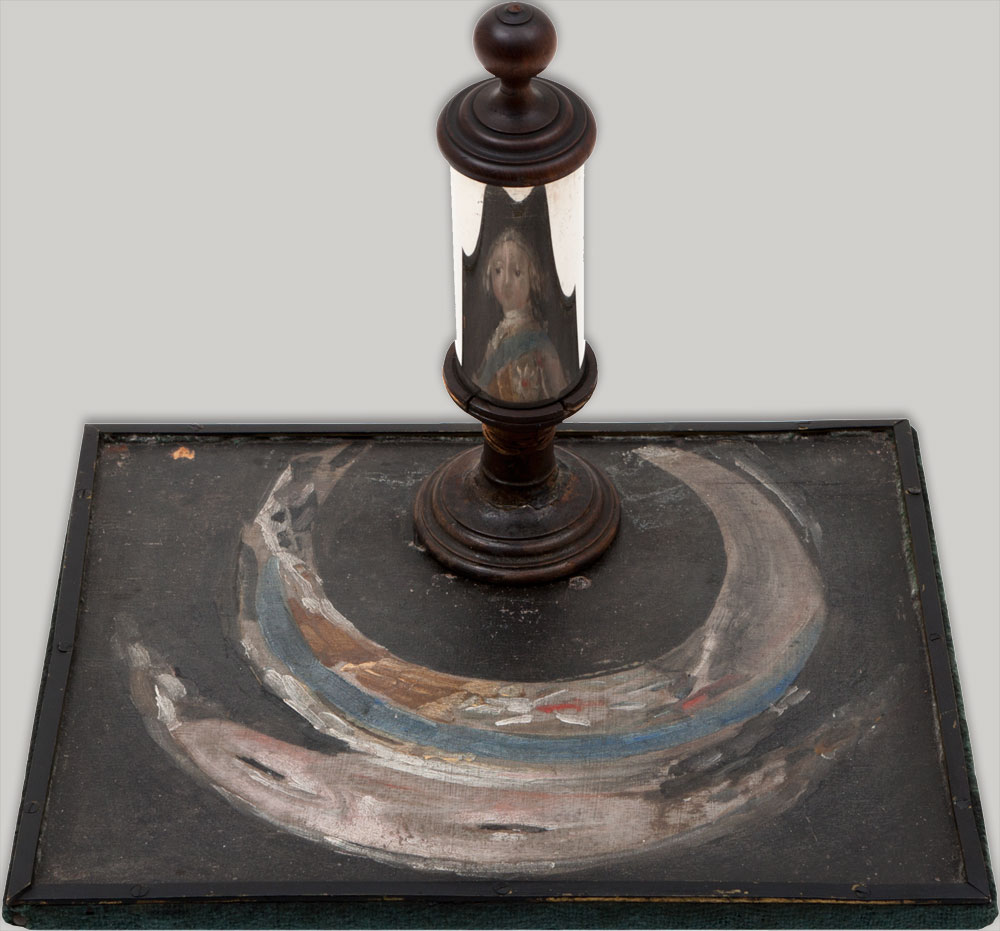
The ‘secret’ anamorphic (deliberately distorted) image of Prince Charles Edward Stuart is a mess of paint on a wooden board. When viewed through a metal cylinder placed on the tray, the portrait of the Prince is apparent as a reflection. The objects were used when drinking toasts to the exiled Prince and Stuart family. If a non Jacobite came to the house, the cylinder could be removed from the tray so hiding a person’s support for the Stuart cause. The artist who painted it is unknown.
By courtesy of the West Highland Museum © www.westhighlandmuseum.org.uk
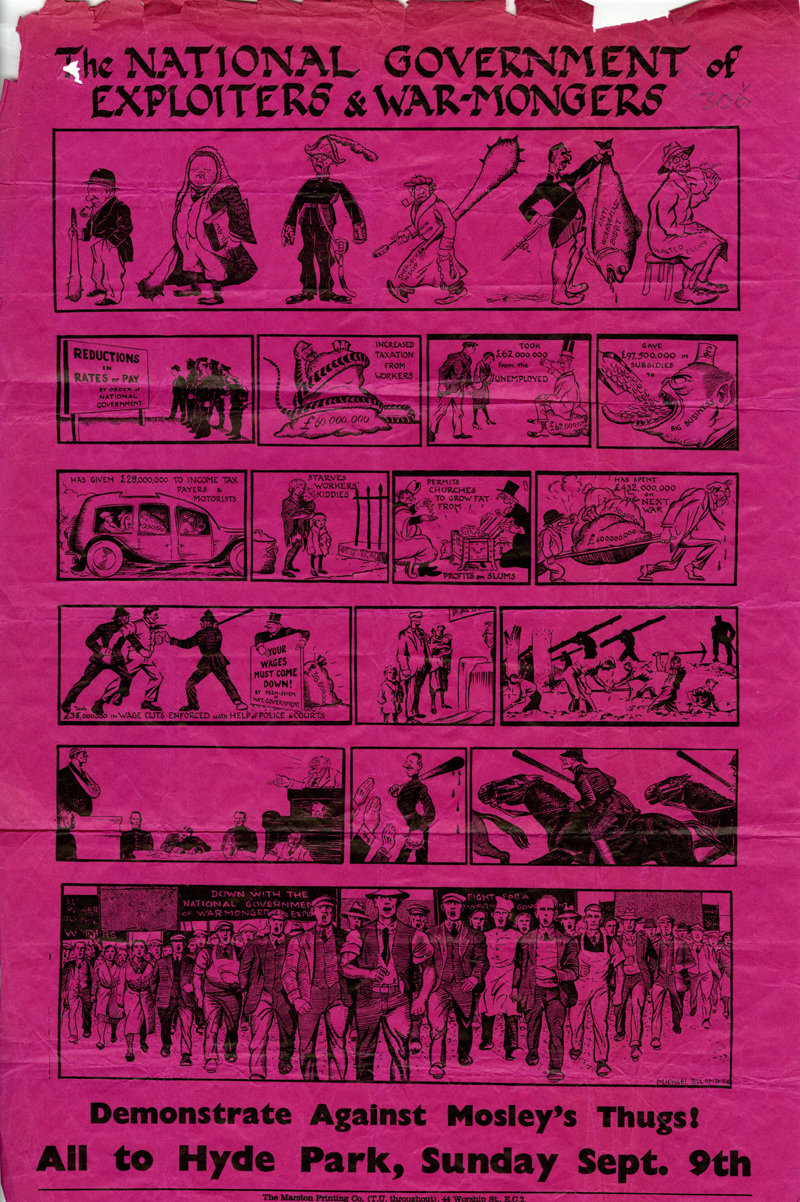
Poster attacking the coalition National Government of Ramsey Macdonald as well as calling on readers to demonstrate their opposition to the British Union of Fascists. BUF leader Oswald Mosley led a march to Hyde Park in September 1934. (MEPO 2/3074)
William Joyce (“Lord Haw-Haw” in the Second World War) attempted to prosecute the Daily Worker newspaper for incitement to violence because it urged anti-fascists to counter-demonstrate against the Blackshirts in this way.
The figures depicted on the top row (left to right):
Stanley Baldwin. Lord President of Council, later Prime Minister (1935).
Viscount Hailsham. Secretary of State for War and Leader of the House of Lords, later Lord Chancellor (1935).
Eyres-Monsell. First Lord of the Admiralty
Thomas Inskip. Attorney General
Chamberlain, Chancellor of the Exchequer
Walter Elliot, Minister for Agriculture
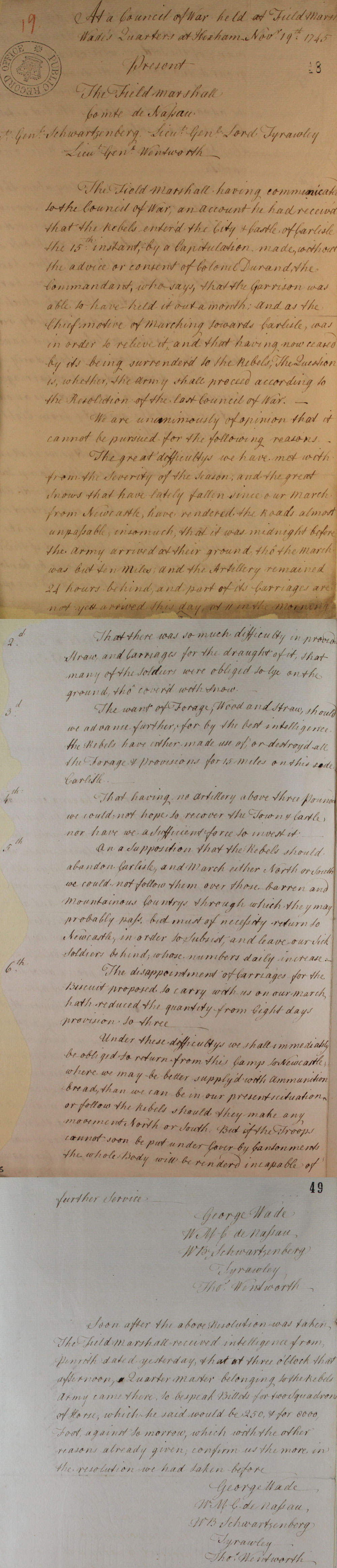
Resolutions from General Wade’s Council of War regarding Carlisle. The council conclude they cannot continue to try and recapture Carlisle. They do not have sufficient supplies, the roads are bad and weather conditions harsh. If the rebels leave Carlisle, it would be dangerous to pursue them into the highlands (SP 36/74/19).
Transcript
At a Council of War held at Field Marshal Wade’s Quarters at Hexham, November 19th 1745
Present
The Field Marshall
Comte de Nassau
Lieutenant General Schwartzenberg. Lieutenant General Lord Tyrawley
Lieutenant General Wentworth
The Field Marshall having communicated to the Council of War, an account he had received that the Rebels enter’d the City & Castle of Carlisle the 15th instant, by a Capitulation, made, without the advice or consent of Colonel Durand, the Commandant who says, that the Garrison was able to have held it out a month: and as the Chief motive of marching towards Carlisle, was in order to relieve it and that having now ceased by its being surrendered to the Rebels, The Question is whether, the Army shall proceed according to the Resolution of the last Council of War.-
We are unanimously of opinion that it cannot be pursued for the following reasons-
The great difficultys we have met with from the severity of the season, and the great snows that have lately fallen since our march from Newcastle, have rendered the Roads almost unpassable, insomuch, that it was midnight before the Army arrived at their ground [though] the march was but ten miles and the Artillery remained 24 hours behind, and part of its carriages are not yet arrived this day at 11 in the morning
2nd That there was so much difficulty in providing straw and carriages for the draught of it, that many of the soldiers were obliged to lye on the ground, [though] covered with snow.
3rd The want of Forage [food found by hunting and gathering], wood and straw, should we advance further, for by the best intelligence the Rebels have either made use of or destroyed all the Forage & provisions for 15 miles on this side of Carlisle.
4th That having no artillery above three pounds we could not hope to recover the Town & Castle nor have we a sufficient force to invest it.
5th And a supposition that the Rebels should abandon Carlisle, and march either North or South we could not follow them over those barren and mountainous countrys through which they may probably pass but must of necessity return to Newcastle, in order to subsist, and leave our sick soldiers behind, whose numbers daily increase.
6th The disappointment of carriages for the Biscuit proposed to carry with us on our march hath reduced the quantity from eight days provision to three.
Under these difficultys we shall immediately be obliged to return from this camp to Newcastle where we may be better supply’d with ammunition, bread, than we can be in our present situation or follow the Rebels should they make any movement North or South. But if the Troops cannot soon be put under cover by cantonments the whole body will be rendered incapable of further service.
George Wade
W.M.C. De Nassau
W.B. Schwartzenberg
Tyrawley
Thomas Wentworth
Soon after the above Resolutions was taken, the Field Marshall received intelligence from Penrith dated yesterday, that at three o ’clock that afternoon, a Quarter Master belonging to the Rebels Army, came there to bespeak Billets [arrange lodgings] for two squadron of Horse, which he said would be 250, & for 8000 Foot against tomorrow, which with the other reasons already given, confirm us more in the resolution we had taken before.
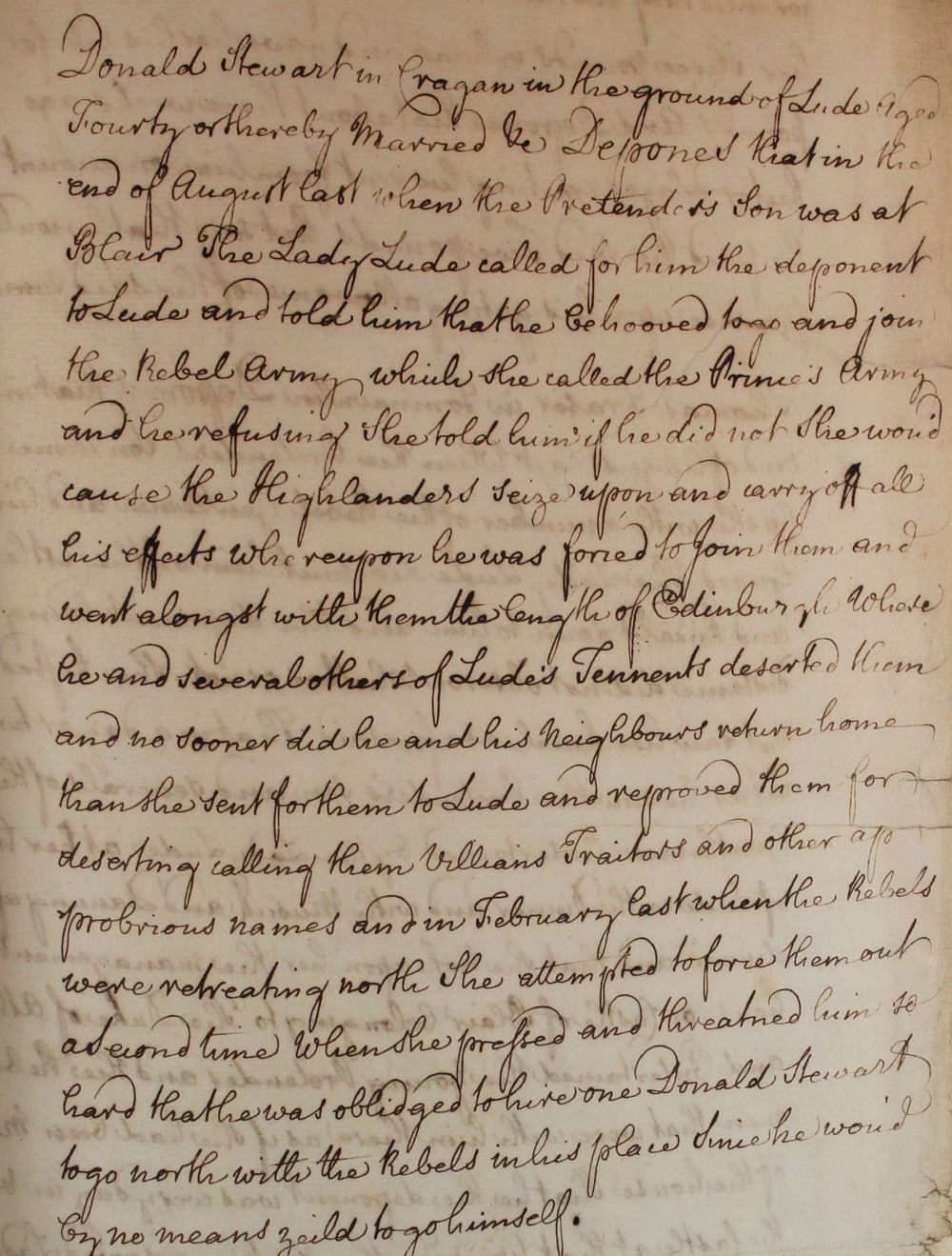
Extract from a statement about Lady Lude who was recorded to have forced her tenants into the rebel army of the Young Pretender, 5 August 1746 (SP 54/33/26D).
Transcript
Donald Stewart in Cragan in the ground of Lude aged fourty or thereby married. He Deponed [declared under oath] that in the end of August last when the Pretender’s son was at Blair, The Lady Lude called for him the deponent [witness under oath] to Lude and told him that he behooved [to be necessary] to go and join the Rebel Army which she called the Prince’s Army and he refusing she told him if he did not she would cause the Highlanders seize upon and carry off all his effects [possessions] whereupon he was forced to join them and went alongst with them the length of Edinburgh, where he and several others of Lude’s [tenants] deserted them and no sooner did he and his neighbours return home that she sent for them to Lude and reproved them for deserting calling them villains Traitors and other approbrious [shameful] names and in February last when the Rebels were retreating north she attempted to force them out a second time when she pressed and threatened him so hard that he was obliged to hire one Donald Stewart to go North with the rebels in his place since he would by no means yield to go himself.
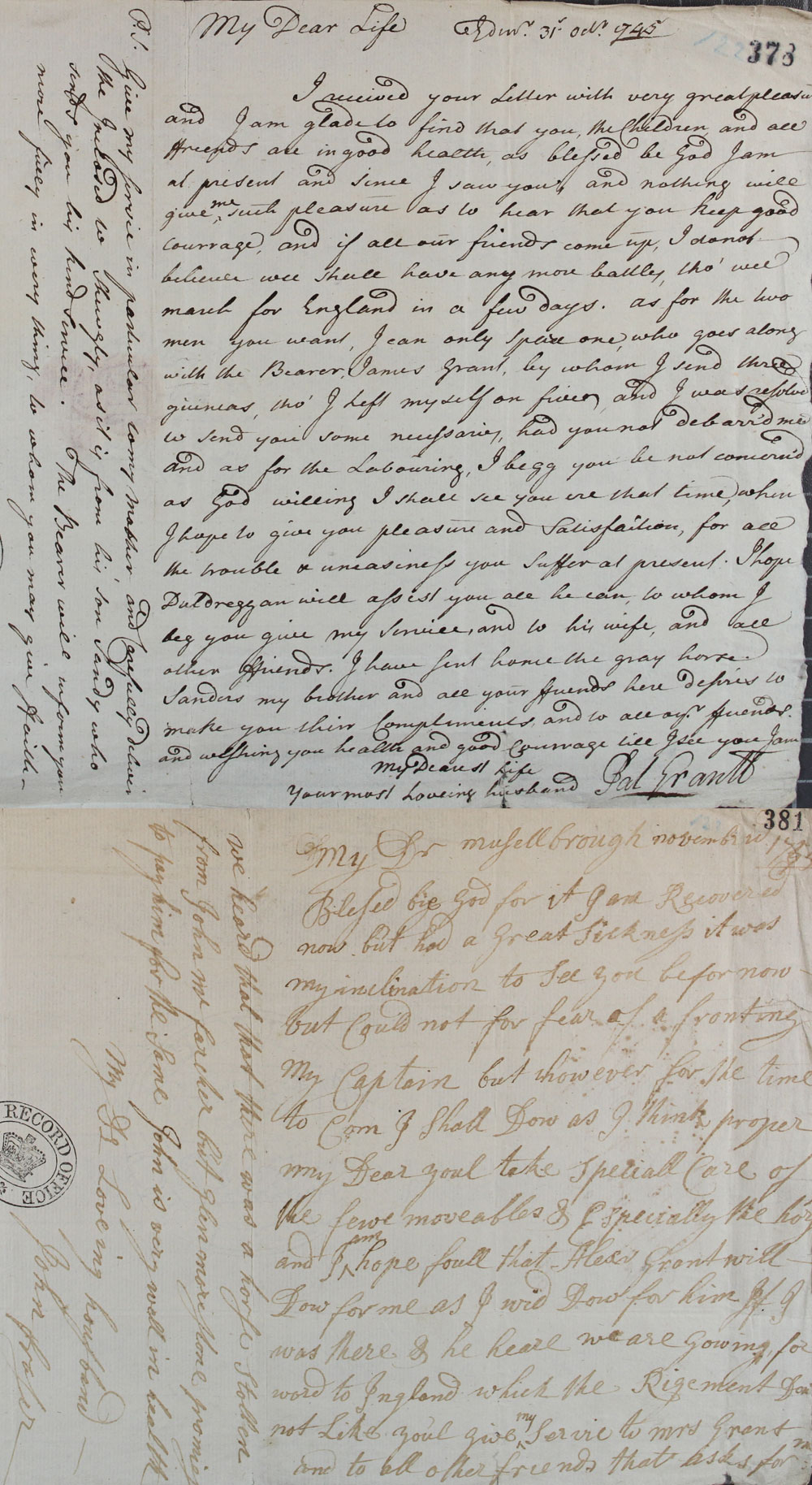
Letter from a Jacobite soldier to his wife, 31st October 1745 (SP 54/26/122, no.18 (f.378)).
Transcript
My Dear Life, Edin. [Edinburgh] 31st October 1745
I received your letter with very great pleasure and I am glad to find that you, the children and all friends are in good health, as blessed be God I am at present and since I saw you and nothing will give me such pleasure as to hear that you keep good courage, and if all our friends come up I do not believe we shall have any more battles, though we march for England in a few days. As for the two men you want, I can only spare one, who goes along with the Bearer, James Grant, by whom I send three guineas, though I left myself on five and I was resolved to send you some necessaries, had you not debarred me, and as for the labouring, I begg you be not concerned as God willing I shall see you ere that time, when I hope to give you pleasure and satisfaction for all the trouble & uneasiness you suffer at present. I hope Duldreggan will assist you all he can to whom I beg you give my service, and to his wife and all other friends. I have sent home the gray horse. Sanders my brother and all your friends here desires to make you their compliments and to all your friends and wishing you health and good courage I’ll see you I am,
My dearest life,
Your most loving husband, Pal Grantt
P.S. Give my service in particular to my mother and carefully deliver the Inclosed to Shurgly as it is from his son Sandy who sends you his service. The Bearer will inform you more fully in everything to whom you may give faith.
Letter from John Fraser, Jacobite soldier to his wife, 10 November 1745 (SP 54/26/122, no.21 (f.381)).
Transcript
Musellbrough, November 10th 1745
My Dear
Blessed bye [be] God for it I am Recovered but had a Great Sickness it was my inclination to see you before now but could not for fear of afronting [offending] My Captain but however for the time to [come] I shall Done [do] as I think proper my Dear soul take special care of the few moveables [possessions] & especially the horse and I am hopeful that Alexander Grant will [do] for me as I will [do] for him If I was there & he heare [here] We are gowing [going] forward to Ingland [England] which the Regiment [don’t] like. You’ll give my service to Mrs Grant and to all other friends that asks for [news]
We heard that [that] there was a horse stollen [stolen] from John McFarcher but Glenmoristone promised to pay him for the same. John is very well in health
Thy [Ever] Loveing housband [husband]
John Fraser
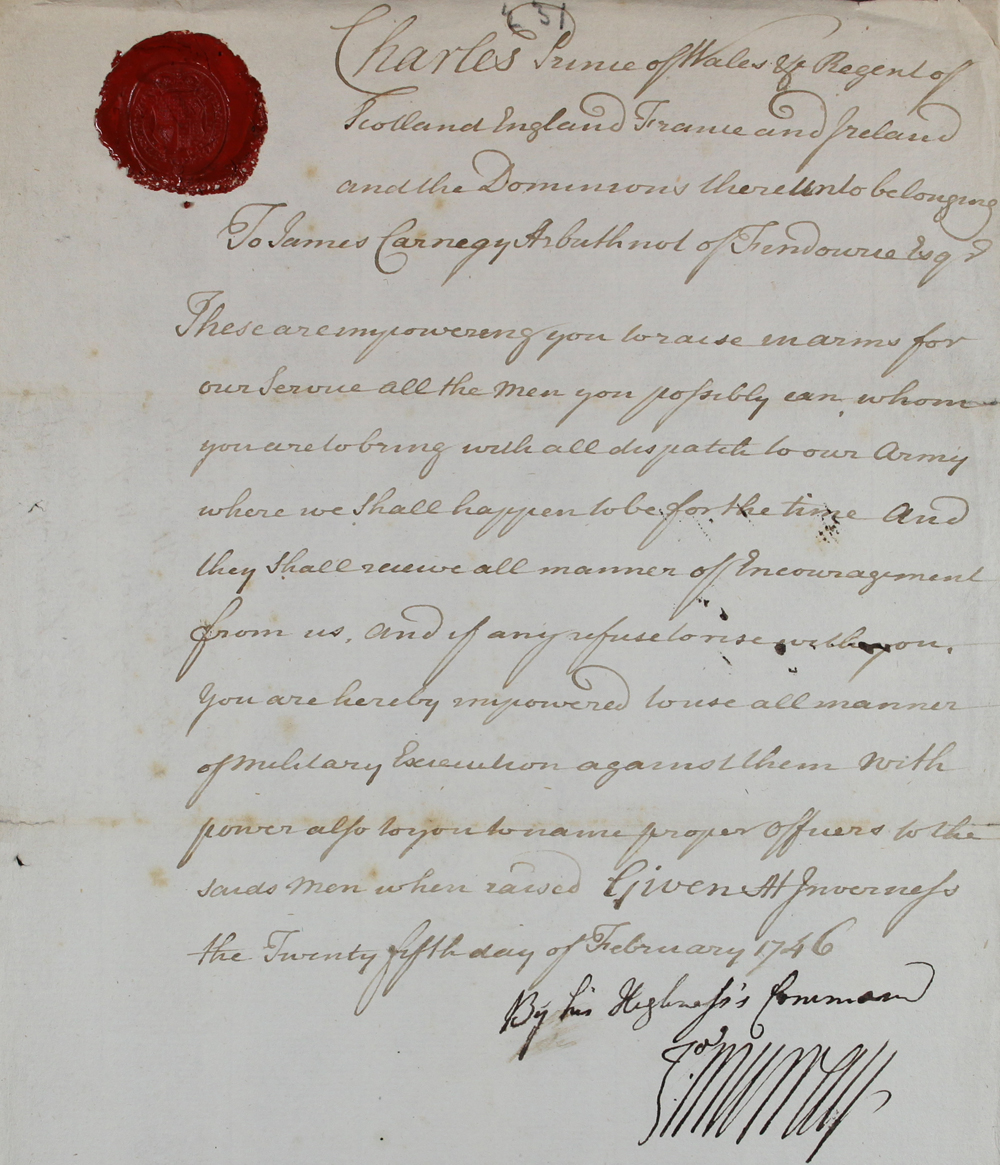
A warrant [royal order] from the Young Pretender [Charles Edward Stuart] given at Inverness to Mr James Carnegy Arbuthnot to raise an army, 25 February 1746 (SP 54/26/123F).
Transcript
Charles Prince of Wales & Regent of Scotland, England France and Ireland and the Dominions there unto belonging
To James Carnegy Arbuthnot of Findowrie Esq
These are impowering you to raise in arms for our Service all the men you possibly can whom you are to bring with all dispatch to our Army where we shall happen to be for the time. And they shall receive all manner of Encouragment from us. And if any refuse to rise with you, you are hereby impowered to use all manner of military Execution against them with power also to you to name proper officers to the [lands?] men when raised. Given At Inverness the twenty fifth day of February 1746,
By his Highness’s Command
J. Murray
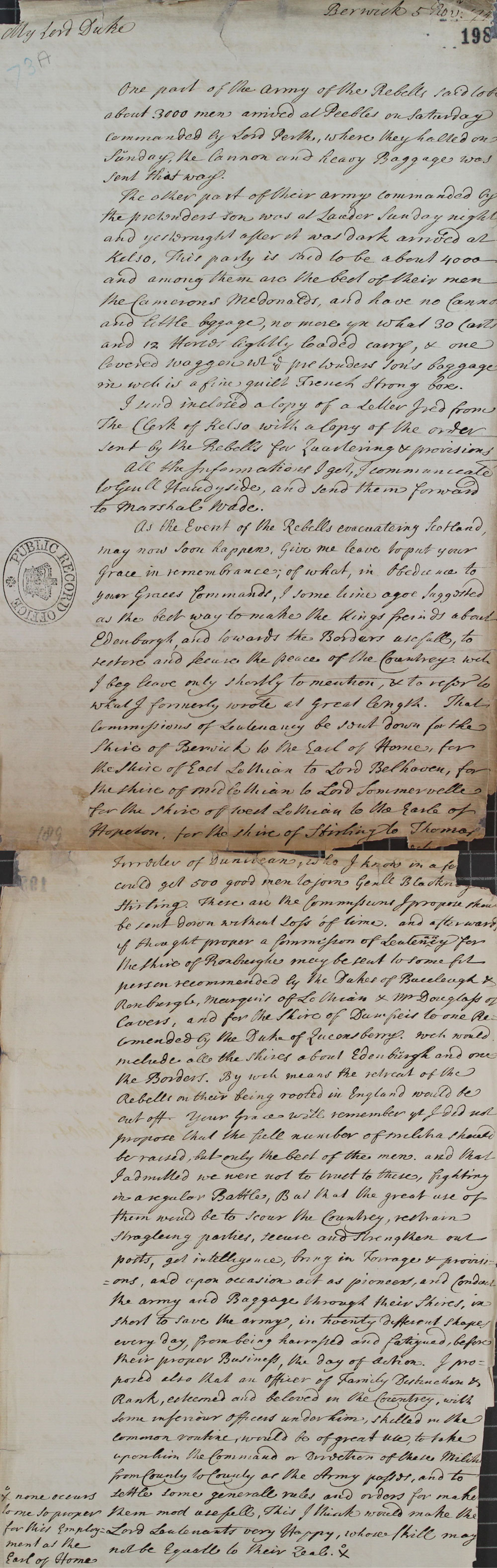
Lord Justice Clerk Fletcher reporting to the Duke of Newcastle, 5 November 1745 (SP 54/26/73A).
Transcript
My Lord Duke Berwick 5th Nov ‘45
One part of the Army of the Rebells said to be about 3000 men arrived at Peebles on Saturday commanded by Lord Perth, where they halted on Sunday, the Cannon and heavy Baggage was sent that way.
The other part of their army commanded by the Pretender’s son was at Lauder. Sunday night and yesterday after it was dark arrived at Kelso, This party is said to be about 4000 and among them are the best of their men, the Camerons McDonalds, and have no Cannon and little baggage, more [in] what 30 carts and 12 Horses lightly loaded carry, & one covered wagon [with the] pretenders son’s baggage in which is a fine guilt French strong box.
I send inclosed a copy of a letter I red from The Clerk of Kelso with a copy of the order sent by the Rebells for Quartering & provisions. All the informations I get, I communicate to General Handyside, and send them forward to Marshal Wade.
As the Event of the Rebells evacuatering Scotland, may now soon happen, give me leave to put your Grace in remembrance, of what, in obedience to your Graces Commands, I sometime agoe suggested as the best way to make the Kings friends about Edenburgh, and towards the Borders usefull, to restore and secure the peace of the country which I beg leave only shortly to mention, & to refer to what I formerly wrote at great length. That commissions of Lieutenancy be sent down for the Shire of Berwick to the Earl of Home, for the Shire of East Lothian to Lord Belhaven, for the Shire of Midlothian to Lord Sommerville for the Shire of West Lothian to the Earl of Hopeton, for the Shire of Stirling to Thomas… [last line of document damaged ]
For order of Dunliean who I know in a few… [document damaged] could get 500 good men to join General Blackney [in] Stirling. These are the commissions I propose should be sent down without loss of time. And afterwards if thought proper a Commission of Lieutenancy for the Shire of Roxbrurgh may be sent to some fit person recommended by the Dukes of Baraclough & Roxbourgh, Marquis of Lothian & Mr. Douglas of Cavers and for the shire of Dumfries to one recommended by the Duke of Queensbury. Which would include all the shires about Edenburgh and on the Borders. By which means the retreat of the rebels on their being rooted in England would be cut off. Your Grace will remember yet I did not propose that the full number of militia should be raised, but only the Best of the men. and that I admitted we were no to trust to these, fighting in a regular Battle, But that the great use of them would be to scour the Country, restrain stragleing parties, secure and strengthen our posts, get intelligence, bring in Forrage and provisions, and upon occasion act as pioneers, and conduct the army and Baggage through their Shires, in short to save the army, in honesty different shapes every day, from being harassed and fatigued, before their proper Business, the day of Action. I proposed also that an Officer of Family Distinction & rank, esteemed and beloved in the Countrey, with some inferior officers under him, skilled in the common routine, would be of great use, to take upon him the Command or Direction of these Militia from County to County as the Army progresses, and to settle some general rules and orders for [making] them most usefull, This I think would make the Lord Lieutenants very happy, whose skill may not be Equall to their zeal *
*None occurs to me so proper for this employment as the Earl of Home.
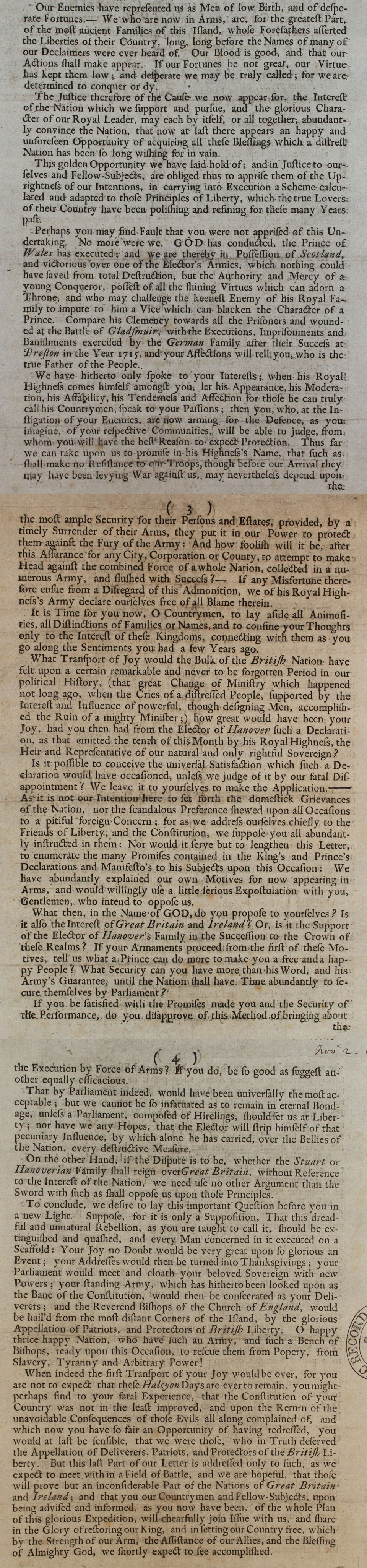
Extracts from a printed letter from Charles Edward Stuart addressed to ‘the nobility, gentry and free-born subjects’, 2 November 1745 (SP 54/26 /72D).
Transcript
Our Enemies have represented us as Men of low Birth, and of desperate Fortunes.- We who are now in Arms, are, for the greatest Part, of the most ancient Families of this Island, whose Forefathers asserted the Liberties of their Country, long, long before the Names of many of our Declaimers were ever heard of. Our Blood is good, and that our Actions shall make appear. If our Fortunes be not great, our Virtue has kept them low; and desperate we may be truly called; for we are determined to conquer or dy [die]
The Justice therefore of the Cause we now appear for, the Interest of the Nation which we support and pursue, and the glorious Character of our Royal Leader, may each by itself, or all together, abundantly convince the Nation, that now at last there appears an happy and unforeseen Opportunity of acquiring all these Blessings which a distrest Nation has been so long wishing for in vain.
This golden Opportunity we have laid hold of; and in Justice to ourselves and Fellow-Subjects, are obliged thus to apprise them of the Uprightness of our Intentions, in carrying into Execution a Scheme calculated and adapted to those Principles of Liberty, which the true Lovers of their Country have been polishing and refining for these many Years past.
Perhaps you may find Fault that you were not apprised of this Undertaking. No more were we. GOD has conducted, the Prince of Wales has executed; and we thereby in Possession of Scotland, and victorious over one of the Elector’s Armies, which nothing could have saved from total Destruction, but the Authority and Mercy of a young Conqueror, possest of all the shining Virtues which can adorn a Throne, and who may challenge the keenest Enemy of his Royal Family to impute to him a Vice which can blacken the Character of a Prince. Compare his Clemency [mercy] towards all the Prisoners and wounded at the Battle of Gladsmuir, with the Executions, Imprisonments and Banishments exercised by the German Family after their Success at Preston in the Year 1715, and your Affections will tell you, who is the true Father of the People.
We have hitherto only spoke to your Interests; when his Royal Highness comes himself amongst you, let his Appearance, his Moderation, his Affability, his Tenderness and Affection for those he can truly call his Countrymen, speak to your Passions; then you, who, at the Instigation of your Enemies, are now arming for the Defence, as you imagine, of your respective Communities, will be able to judge, from whom you will have the best Reason to expect Protection. Thus far we can take upon us to promise in his Highness’s Name, that such as shall make no Resistance to our Troops, though before our Arrival they may have been levying War against us, may nevertheless depend upon
(3) the most ample Security for their Persons and Estates, provided, by a timely Surrender of their Arms, they put it in our Power to protect them against the Fury of the Army: And how foolish will it be, after this Assurance for any City, Corporation or County, to attempt to make Head against the combined Force of a whole Nation, collected in a numerous Army, and flushed with Success?- If any Misfortune therefore ensure from a Disregard of this Admonition, we of his Royal Highness’s Army declare ourselves free of all Blame therein.
It is Time for you now, O Countrymen, to lay aside all Animosities, all Distinctions of Families or Names, and to confine your Thoughts only to the Interest of these Kingdoms, connecting with them as you go along the Sentiments you had a few Years ago.
What Transport of Joy would the Bulk of the British Nation have felt upon a certain remarkable and never to be forgotten Period in our political History, (that great Change of Ministry which happened not long ago, when the Cries of a distressed People, supported by the Interest and Influence of powerful. Though designing Men, accomplished the Ruin of a mighty Minister;) how great would have been your Joy, had you then had from the Elector of Hanover such a Declaration, as that emitted the tenth of this Month by his Royal Highness, the Heir and Representative of our natural and only rightful Sovereign?
Is it possible to conceive the universal Satisfaction which such a Declaration would have occasioned, unless we judge of it by our fatal Disappointment? We leave it to yourselves to make the Application.
As it is not our Intention here to set forth the domestick Grievances of the Nation, nor the scandalous Preference shewed upon all Occasions to a pitiful foreign Concern; for as we address ourselves chiefly to the Friends of Liberty, and the Constitution, we suppose you all abundantly instructed in them: Nor would it serve but to lengthen this Letter, to enumerate the many Promises contained in the King’s and Prince’s Declarations and Manifesto’s to his Subjects upon this Occasion: We have abundantly explained our own Motives for now appearing in Arms, and would willingly use a little ferious Expostulation with you, Gentlemen, who intend to oppose us.
What then, in the Name of GOD, do you propose to yourselves? Is it also the Interest of Great Britain and Ireland? Or, is it the Support of the Elector of Hanover’s Family in the Succession to the Crown of these Realms? If your Armaments proceed form the first of these Motives, tell us what a Prince can do more to make you a free and a happy People? What Security can you have more than his Word, and his Army’s Guarantee, until the Nation shall have Time abundantly to secure themselves by Parliament?
If you be satisfied with the Promises made you and the Security if the Performance, do you disapprove of this Method of bringing about
(4)
the Execution by Force of Arms? If you do, be so good as suggest another equally efficacious.
That by Parliament indeed, would have been universally the most acceptable; but we cannot be so infatuated as to remain in eternal Bondage, unless a Parliament, composed of Hirelings, should set us at Liberty; nor have we any Hopes, that the Elector will strip himself of that pecuniary Influence, by which alone he has carried, over the Bellies of the Nation, every destructive Measure.
On the other Hand, if the Dispute is to be, whether the Stuart or Hanoverian Family shall reign over Great Britain, without Reference to the Interest of the Nation, we need use no other Argument than the Sword with such as shall oppose as upon those Principles.
To conclude, we desire to lay this important Question before you in a new Light. Suppose, for it is only a Supposition, That this dreadful and unnatural Rebellion, as you are taught to call it, should be extinguished and quashed, and every Man concerned in it executed on a Scaffold: Your Joy no Doubt would be very great upon so glorious an Event; your Address would then be turned into Thanksgivings; your Parliament would meet and cloath your beloved Sovereign with new Powers; your standing Army, which has hitherto been looked upon as the Bane of the Constitution, would then be consecrated as your Deliverers; and the Reverend Bishops of the Church of England, would be hail’d from the most distant Corners of the Island, by the glorious Appellation of Patriots, and Protectors of British Liberty. O happy thrice happy Nation, who have such an Army, and such a Bench of Bishops, ready upon this Occasion, to rescue them from Popery, from Slavery, Tyranny and Arbitrary Power!
When indeed the first Transport of your Joy would be over, for you are not to expect that these Halcyon Days are ever to remain, you might perhaps find to your fatal Experience, that the Constitution of your Country was not in the least improved, and upon the Return of the unavoidable Consequences of those Evils all along complained of, and which now you have so fair an Opportunity of having redressed, you would at last be sensible, that we were those, who in Truth deserved the Appellation of Deliverers, Patriots, and Protectors of the British Liberty. But this last Part of our Letter is addressed only to such, as we expect to meet with in a Field of Battle, and we are hopeful, that those will prove but an inconsiderable Part of the Nations of Great Britain and Ireland; and that you our Countrymen and Fellow-Subjects, upon being advised and informed, as you have now been, of the whole Plan of this glorious Expedition, will cheerfully join Issue with us, and share in the Glory of restoring our King, and in setting our Country free, which by the Strength of our Arm, the Assistance of our Allies, and the Blessing of Almighty God, we shortly expect to see accomplished.
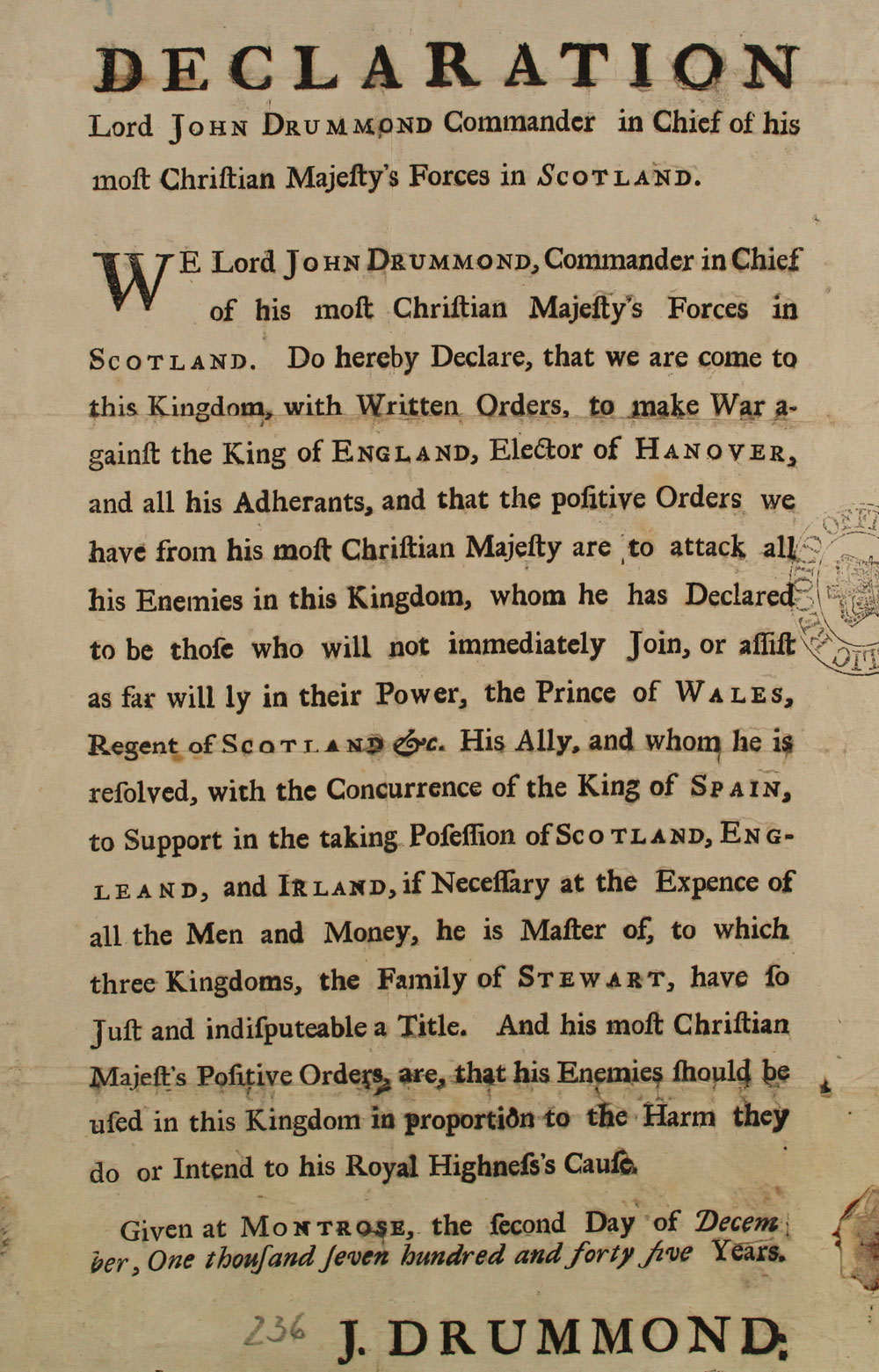
Printed handbill from Lord John Drummond, Scottish Commander, 2 December, 1745 (SP 54/26/90B).
Transcript
DECLARATION
Lord JOHN DRUMMOND Commander in Chief of his most Christian Majesty’s Forces in SCOTLAND.
WE Lord JOHN DRUMMOND, Commander in Chief of his most Christian Majesty’s Forces in SCOTLAND. Do hereby Declare, that we are come to this Kingdom, with Written Orders, to make War against the King of ENGLAND, Elector of HANOVER, and all his Adherants, and that the positive Orders we have from his most Christian Majesty are to attack all his Enemies in this Kingdom, whom he has Declared to be those who will not immediately Join, or assist as far will ly in their Power, the Prince of WALES, Regent of SCOTLAND etc. His Ally, and whom he is resolved, with the Concurrence of the King of SPAIN, to Support in the taking Posession of SCOTLAND, ENGLEAND, and IRLAND, if Necessary at the Expence of all the Men and Money, he is Master of, to which three Kingdoms, the Family of STEWART, have so Just and indisputeable a Title. And his most Christian Majest’s Positive Orders are, that his Enemies should be used in this Kingdom in proportion to the Harm they do or Intend to his Royal Highness’s Cause.
Given to MONTROSE, the second Day of December, One thousand seven hundred and forty five Years.
J. DRUMMOND.
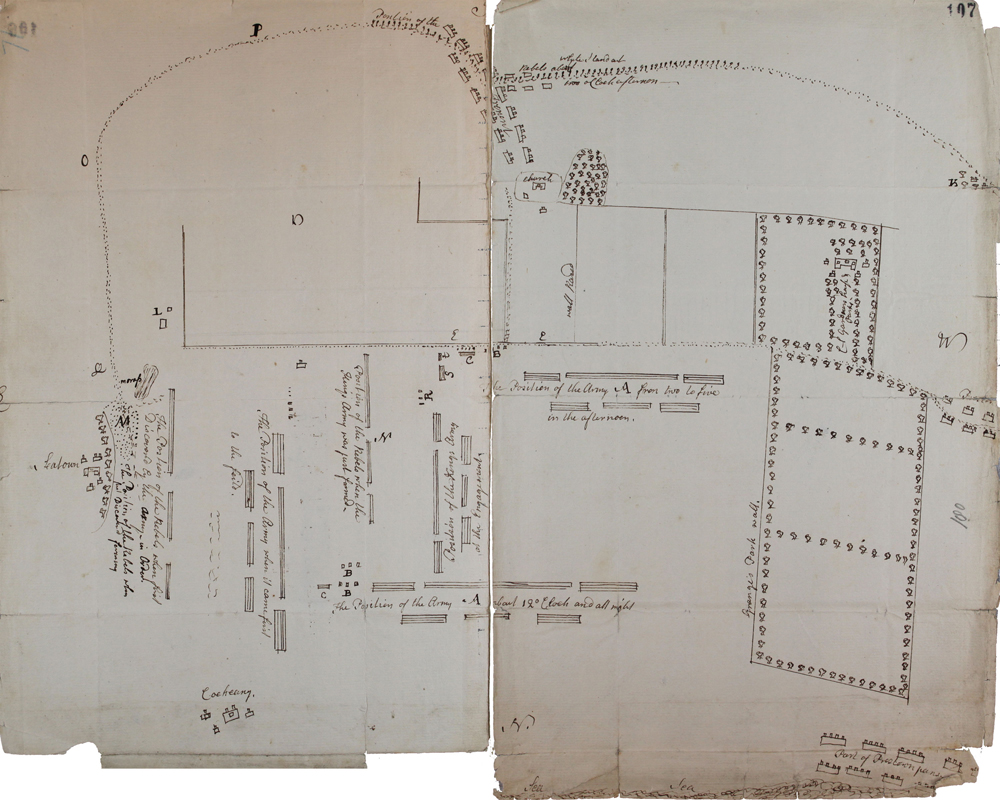
Plan of the Battle of Prestonpans, 21 September 1745 (SP 54/26/71).
Download a high-resolution version of this plan (JPG, 874 KB)
Transcript
1. Position of the Rebels about two o’clock afternoon
2. Position of the Army from two to five in the afternoon.
3. Part of Prestown pans.
4. The Position of the army. About 12 o’ clock and all night
5. Position of the King’s army of the engagement.
6. Position of the rebels when the King’s army was just formed.
7. The Position of the army when it came first in the field.
8. Coeheany
9. The Position of the Rebels when first Discovered by the army in Order.
The Position of the Rebels when first Discovered forming.