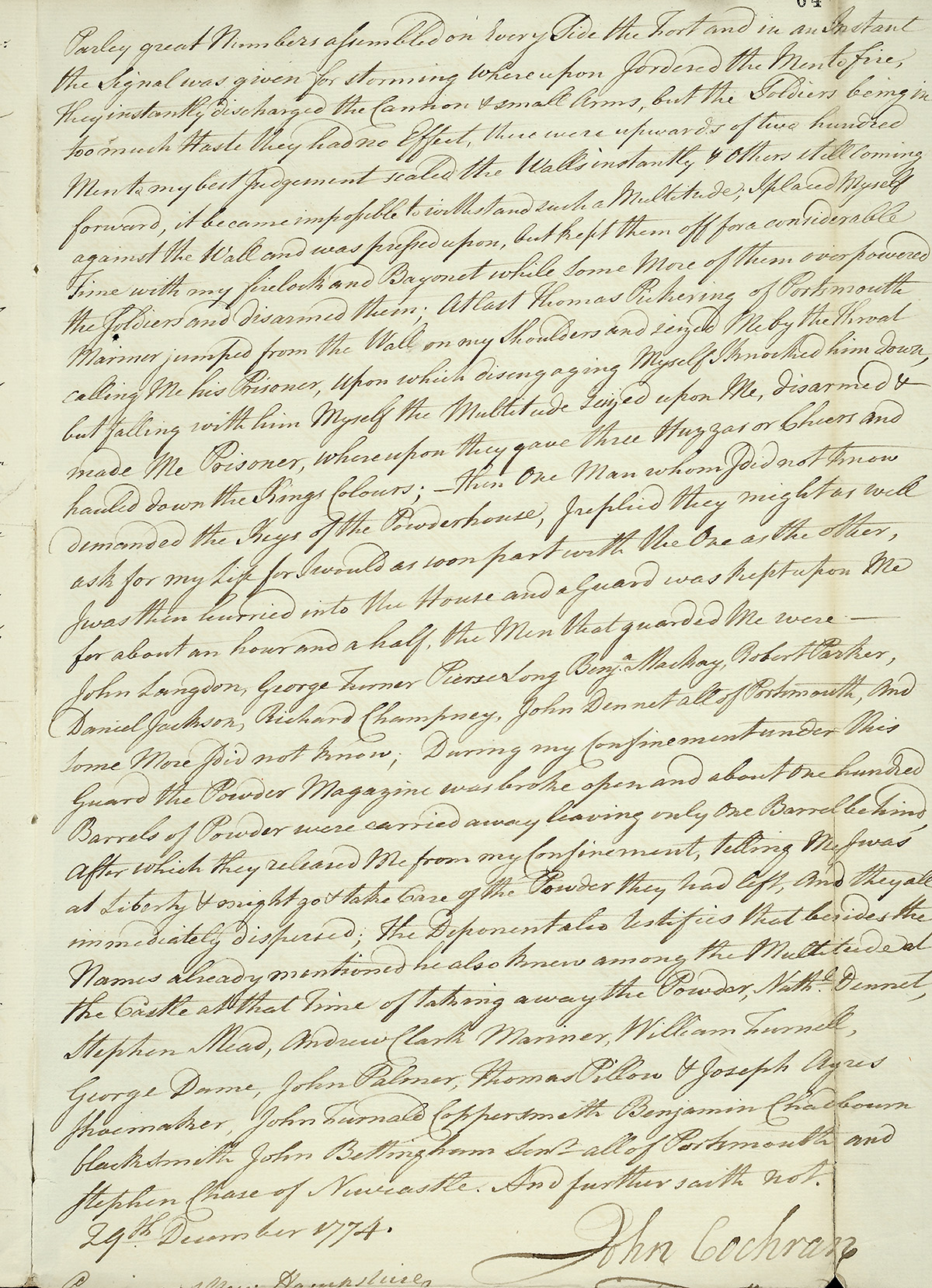
Extract from a Deposition [statement made by order of the Governor] by John Cochran concerning the attack on Fort William and Mary in New Castle, New Hampshire, 29 December 1774. Catalogue ref: CO 5/939 f.64
Captain John Cochran was assigned to the fort in 1771 and was originally from Londonderry. He was a Loyalist and defended the fort when attacked.
In 1774, the British Parliament passed four acts, which became known as the ‘Intolerable’ or ‘Coercive’ Acts. These closed Boston’s Port, dissolved the Massachusetts Assembly, moved trials in Massachusetts to Britain, and made provisions for British soldiers stationed on the continent. In response to these acts, colonists across America came together in a series of Continental Congresses to discuss how best to act next.

Extract from an eight-page inventory of lost and damaged property from the house of Thomas Hutchinson. Lieutenant Governor of Massachusetts Bay, 26 August 1765. Catalogue ref: CO 5/755 f.373
Hutchinson wrote to the Secretary of State with an inventory of his goods to request compensation for his losses, totalling, according to the Colonial Society of Massachusetts, £2,218. This source covers part of his claim for goods and furniture.

Extract from an article published in the Boston Evening Post, 28 October 1765, criticising the introduction of the Stamp Act. Catalogue ref: CO 5/755 f.391
The Stamp Act, passed by the British Parliament in March 1765, stated that paper goods in the colonies must carry a royal stamp. Its purpose was to raise revenue to pay for the cost of defending the colonies in the Seven Years War against France, which had ended two years earlier. The colonists saw this as a tax that they had not consented to and was passed without consideration from their colonial assemblies. Therefore, in anticipation of the first stamps arriving in the colonies in November, the colonists rioted against the law.
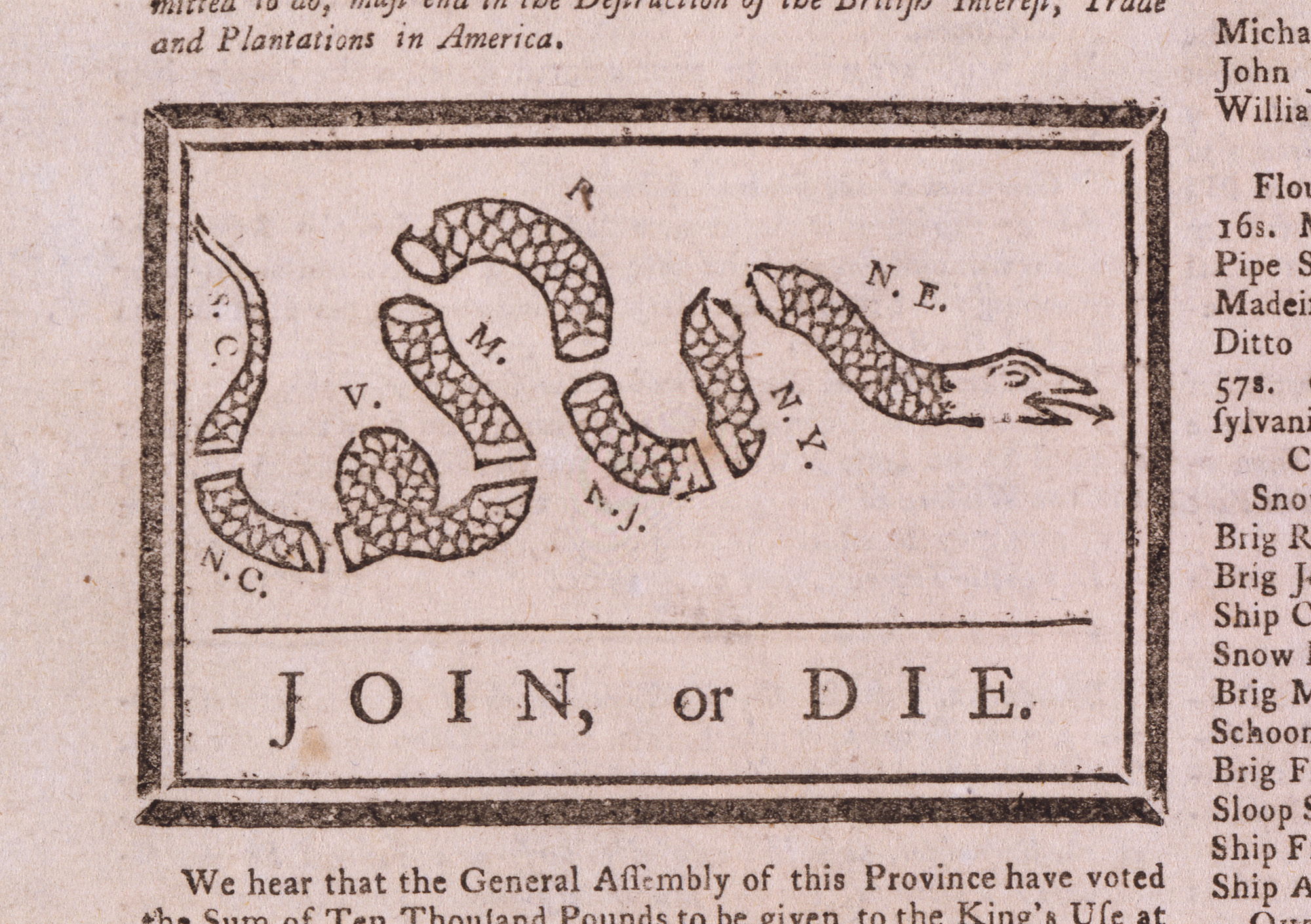
On 4th July 1776, the American colonies declared their independence from Great Britain. This declaration of independence from British colonial rule has been explained in terms of anger over taxation, fear of losing rights and liberties, and the idea of fundamental corruption within the colonial administration. This lesson focusses on the political thought that inspired the American Revolution, and the ideas that influenced the decision to declare independence.
Use the documents in this lesson to explore the context for the political thought that inspired the American Revolution.
What political ideas in the colonies influenced the American Revolution?The Seven Years’ War was fought between Great Britain and France from 1756-1763, primarily on the North American continent. Following the end of the war, in which Britain and her allies were victorious, Parliament passed a series of acts to raise money to pay for the expense of what they saw as a war for the defence of Britain’s American colonies.
The Stamp Act was passed in March of 1765, and introduced a tax on paper goods. There was a precedent that the colonial assemblies, being the direct representatives of the colonists, should pass taxation, and therefore the Stamp Act, which was passed by Parliament directly, faced a severe backlash. There were violent riots across the continent, with looting of British officials’ homes, like Thomas Hutchinson, Governor of Massachusetts. The rallying cry of ‘no taxation without representation’ became well-known. Parliament decided to repeal the Act in March 1766.
Later, in 1767, Parliament passed the Townshend Duties, which introduced taxes on multiple commodities, including glass, paper, and tea. In response, complaints were printed in pamphlets and newspapers, including John Dickinson’s Letters from a Farmer in Pennsylvania. The colonists came together to form non-importation associations, in which they boycotted British goods to pressurise Britain to repeal the duties. This action worked and the Act was repealed in March 1770, although a tax on tea remained.
Several other incidents occurred between the repeal of the Townshend Duties and the next series of Acts in 1774. On the 5 March 1770, British soldiers fired into a crowd of Bostonians, killing multiple people. This caused a serious outcry and became known as the ‘Boston Massacre’. Moreover, in 1772, the HMS Gaspee, a ship enforcing the Navigation Acts, ran aground off the coast of Rhode Island. It was attacked and set on fire by a group of men protesting the customs laws.
Furthermore, the 1773 Tea Act, intended to bail out the East Indian Company, sparked the Boston Tea Party, which took place on the 16th of December 1773. In this, a group of colonists in Boston dumped 340 chests of Tea into Boston’s Harbour.
In response to the Boston Tea Party, Britain passed the Coercive Acts, which came into force in June 1774. This included: The Boston Port Act; The Massachusetts Government Act; The Administration of Justice Act; and the Quartering Act. These closed Boston’s Ports, dissolved the Massachusetts Assembly, allowed trials to be moved to other colonies or Great Britain, and made more stringent provisions for the stationing of British troops on the continent. To protest these, the colonists came together in a series of Continental Congresses, in which they debated how best to respond to British Actions.
Alongside the Coercive Acts, in 1774 the Government of Great Britain also passed the Quebec Act, which granted freedom of religion to Catholics living in the province after the British won it from the French following the Seven Years’ War. Previously, only Protestants had been allowed to practice their religion. However, this act caused widespread opposition in the colonies. The colonists perceived it as a further extension of illegitimate authority. Given their history as religious refugees, they feared that, once it had taken root in Quebec, Catholicism would move into the colonies and exert papal tyranny over Protestant communities. In their critiques, the colonists emphasised fears of arbitrary authority and despotism, and the importance of religious liberty. They feared that the enlargement of the territory of Quebec, which had gained lands from New York, Pennsylvania, and Virginia, would intensify the tyrannical power that would be established there. It was ultimately unlikely that the freedom of religion granted to Catholics in Quebec would have had any negative influence.
Following an increase in tensions, and the outbreak of fighting in 1775, the Americans issued the Declaration of Independence on the 4 July 1776.
Throughout this eleven-year period, the Americans drew on several different political traditions to articulate their grievances against Great Britain. They were influenced by ideas from classical Greece and Rome; Enlightenment thinkers like John Locke, Baron Charles Montesquieu, and David Hume; British actors that theorised about the English Civil War and Revolution; and religious ideas. The documents here make contemporary references to British history including Magna Carta and raise questions over the rights of people and responsibilities of government.
Thomas Paine’s pamphlet entitled ‘Common Sense’, first published in Philadelphia in 1776 after conflict had broken out between the British and colonists, was widely read by Americans and fed into arguments for independence, making the case for equality, independence and a republic. Paired with all these ideological ideas, the colonists also had pragmatic concerns over trade, taxation and religion.


Map description
The map shows the southern coast of England and the northern coast of France. A box around the coast near Bayeux reflects a zoomed-in box in the cover of the map, showing close-ups of the beaches. The beaches are labelled Utah, Omaha, Gold, Juno and Sword.
Dotted lines show where troops were coming from and which beaches they landed at. A line labelled “American troops en route to Utah and Omaha beaches” goes from Falmouth, Fowey, Plymouth, Dartmouth, Torquay, Exeter, Weymouth and Poole to the Utah and Omaha beaches. A line labelled “British troops en route to Gold beach” goes from Southampton to Gold Beach. A line labelled “Canadian troops en route to Juno beach” goes from Portsmouth to Juno beach. A final line labelled “British troops en route to Sword beach” goes from Newhaven to Sword beach.


