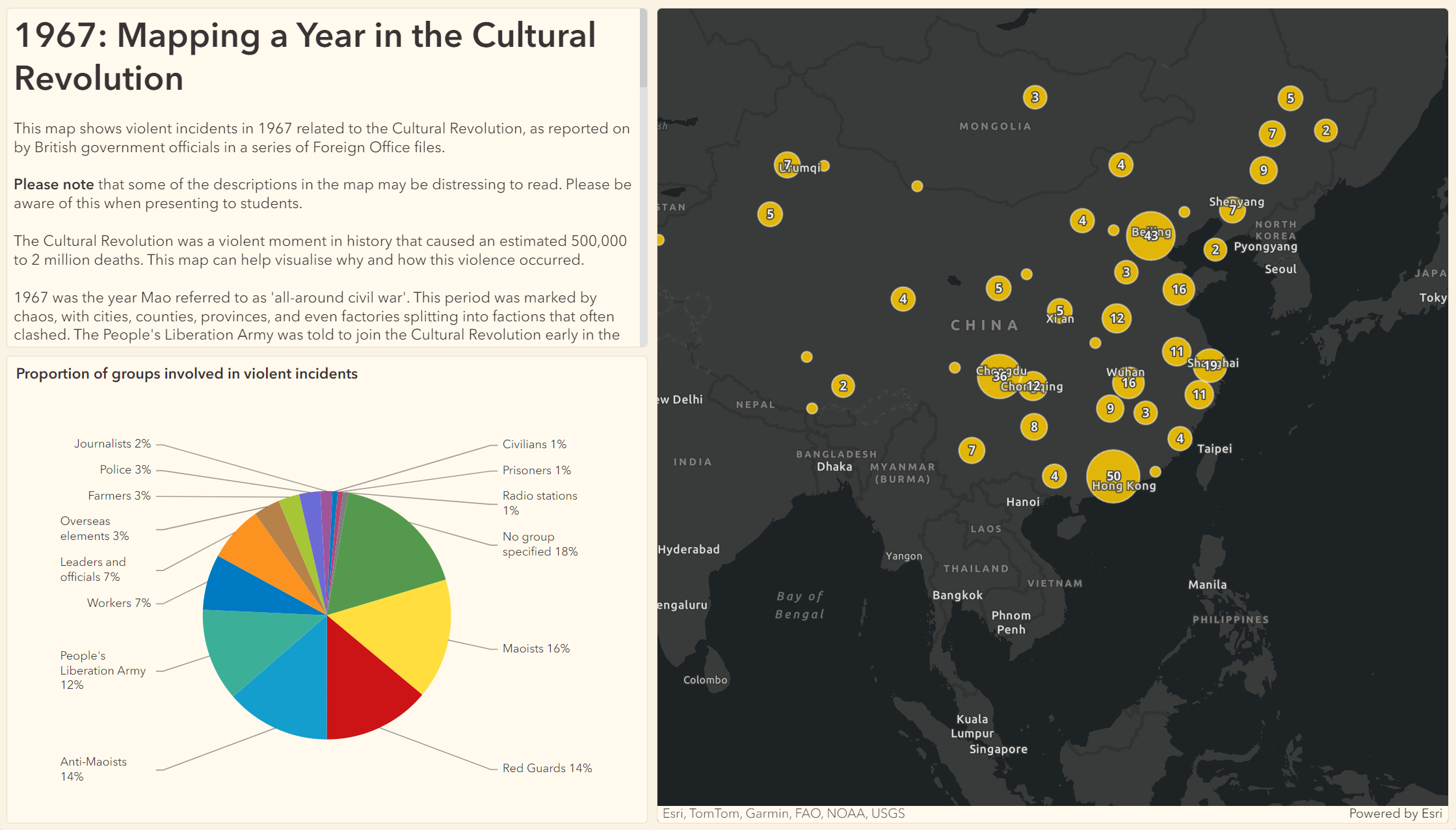
This map shows violent incidents in 1967 related to the Cultural Revolution, as reported on by British government officials in a series of Foreign Office files.
The interactive version of this map is hosted on an external site that does not yet meet our criteria for accessibility. In the meantime, we provide an accessible spreadsheet of all events featured on the map.
View the interactive map of the Cultural Revolution.
Please note that some of the descriptions in the map may be distressing to read. The descriptions contain references to death and injury, often on a large scale. Please be aware of this when presenting to students or other users.
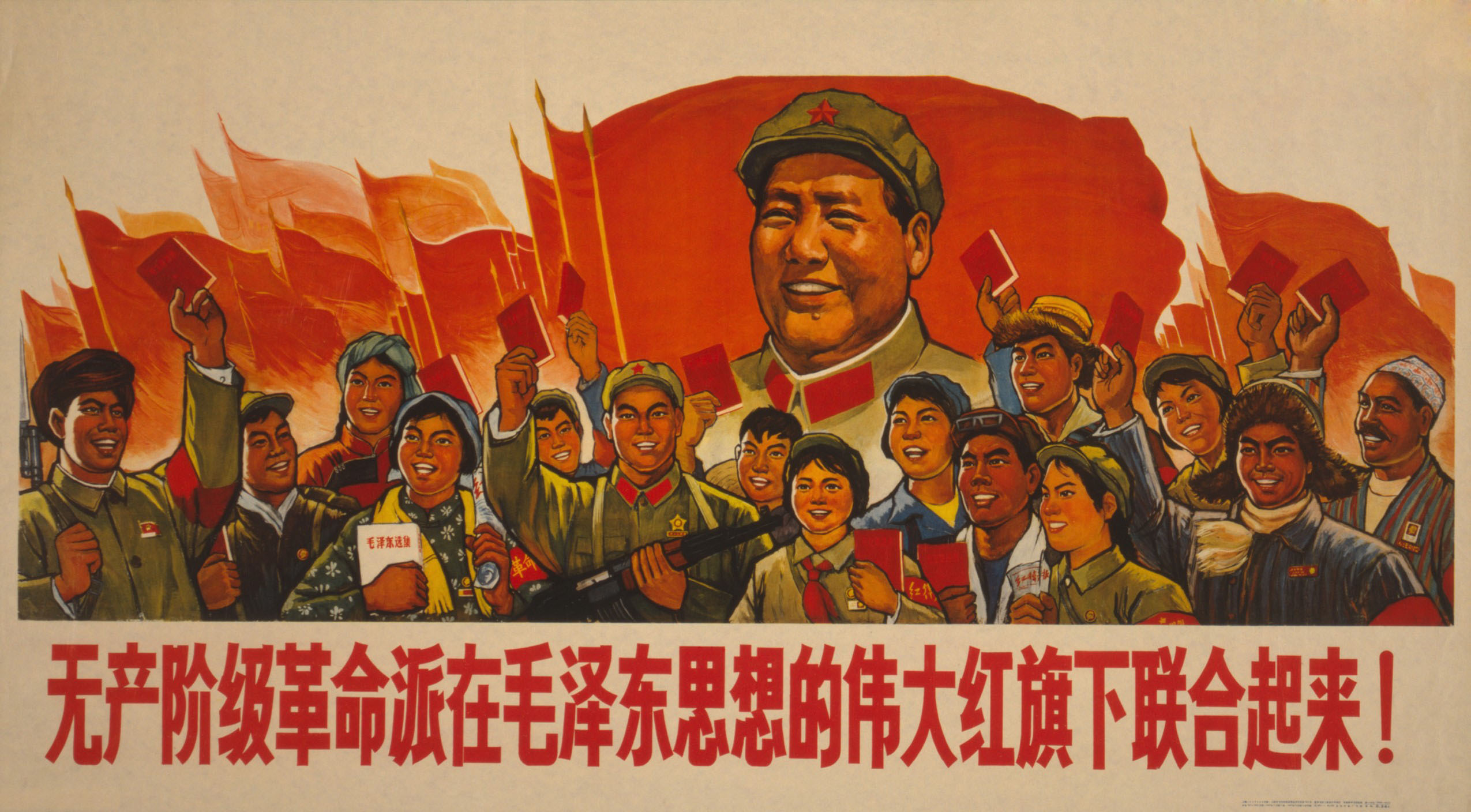
The Cultural Revolution took place in China from 1966 to 1976. It was not a revolution to overthrow the government or people in power. Instead, it was a political movement initiated by Mao Zedong, who was Chairman of the Chinese Communist Party (CCP) and leader of China. It aimed to purge capitalist and traditional elements from Chinese society and to reassert Mao’s authority. It caused an estimated 500,000 to 2 million deaths and deeply impacted China and its people.
To achieve the objectives of the Cultural Revolution, Mao mobilised young people to form Red Guard groups, following his ideas as written down in his famous Little Red Book. The cult of Mao soared to new heights and his image was seen throughout China. The Red Guard targeted people that represented the ‘Four Olds’: old ideas, old culture, old customs, and old habits. This included intellectuals, scientists, and senior officials.
The violence exhibited by the Red Guard soon spiralled out of control, and Mao had to send in the People’s Liberation Army to restore order. The Cultural Revolution, however, did not end until his death in 1976.
Use the original sources in this lesson to explore the Cultural Revolution. How and why did it come about, and what were some of its impacts?
Note: People’s Liberation Army = the military of the Chinese Communist Party (CCP) and the People’s Republic of China.
Did the Cultural Revolution in China achieve its aims?The Cultural Revolution in China was a social and political movement from 1966 to 1976. Mao Zedong, the Chairman of the Chinese Communist Party (CCP), initiated it with the aim of reasserting his authority and strengthening the revolutionary spirit in the country.
Origins (Hundred Flowers Campaign and Great Leap Forward)
The Cultural Revolution had its roots in China’s earlier political history after the establishment of the People’s Republic of China in 1949. In 1956, Mao Tse-tung proposed a new Party policy on science and culture with the slogan ‘Let all flowers bloom together and diverse schools contend’. The policy became known as the ‘Double-Hundred Policy’1 (also known as the Hundred Flowers Campaign). This came from the earlier slogans ‘let a hundred flowers bloom’ and ‘let a hundred schools of thought contend’. The former was aimed at artists and writers, urging them to express themselves freely (within the boundaries of social realism). The latter was aimed at scientists and intellectuals, encouraging scientific developments.
At first, intellectuals did not criticise the policy due to their earlier experience of persecution. However, Mao and others persistently encouraged them to voice their political opinions. By the summer of 1956, newspapers started publishing criticisms of the government. This included criticisms of bureaucracy, social realism, and neglect of Marxist humanitarian principles. The intelligentsia gained greater confidence as they witnessed the Hungarian Revolution of 1956, led by anti-Stalinists, which showed the potential for transformation within the Soviet system and prompted similar aspirations in China.
Mao Zedong’s leadership had faced challenges during the Great Leap Forward, his five-year plan of forced agricultural collectivisation and rural industrialisation initiated in 1958. It resulted in economic setbacks and widespread famine. In an effort to regain power and his revolutionary capability, Mao launched the Cultural Revolution.
Aims of the Cultural Revolution
The primary goal of the Cultural Revolution was to remove what Mao identified as bourgeois influences and counter-revolutionary tendencies within the Chinese Communist Party and society as a whole. Mao aimed to ensure his supremacy within the party and revive revolutionary fervour to confront established power structures and dismantle the ‘Four Olds’2: ‘old ideas’, ‘old culture’, ‘old customs’, and ‘old habits’.
Mao mobilised young people, primarily students, to form Red Guard groups. These groups targeted intellectuals, party officials, and individuals associated with the pre-Communist era. They engaged in widespread purges, public humiliation, and destruction of cultural artefacts and symbols. The movement soon descended into chaos, with different factions emerging and vying for power. Conflicts between Red Guard factions, the army, and other political groups became increasingly violent. As the situation spiralled out of control, Mao called upon the People’s Liberation Army (PLA) to restore order. This intervention led to the suppression of the Red Guards and the reestablishment of centralised control.
End of the Cultural Revolution
Lin Biao, a key military figure and Mao’s designated successor, rose to prominence during this period. However, his ambitions clashed with Mao’s, leading to his downfall in 1971. Mao’s death in 1976 marked the end of the Cultural Revolution.
The Cultural Revolution had a deep impact on Chinese society and politics. Many high-ranking officials, intellectuals, and individuals associated with the pre-Communist era were purged. There was disruption of governance and significant loss of life. The Cultural Revolution also resulted in economic turmoil and stagnation as the focus shifted from economic development to political struggle. Social structures were disrupted, families were torn apart, and traditional values were suppressed. Numerous historical and cultural artefacts, including ancient temples, books, and artworks, were destroyed.
The Cultural Revolution remains a sensitive and controversial topic in China. Its legacy continues to shape Chinese politics and society, and its memory is subject to state control and historical reinterpretation.
1 The “Double-Hundred” Policy – The State Council Information Office the People’s Republic of China
2 Deshpande, G. P. “China’s Great Cultural Revolution.” Economic and Political Weekly 1, no. 11 (1966): 453–55. https://www.jstor.org/stable/4357141.
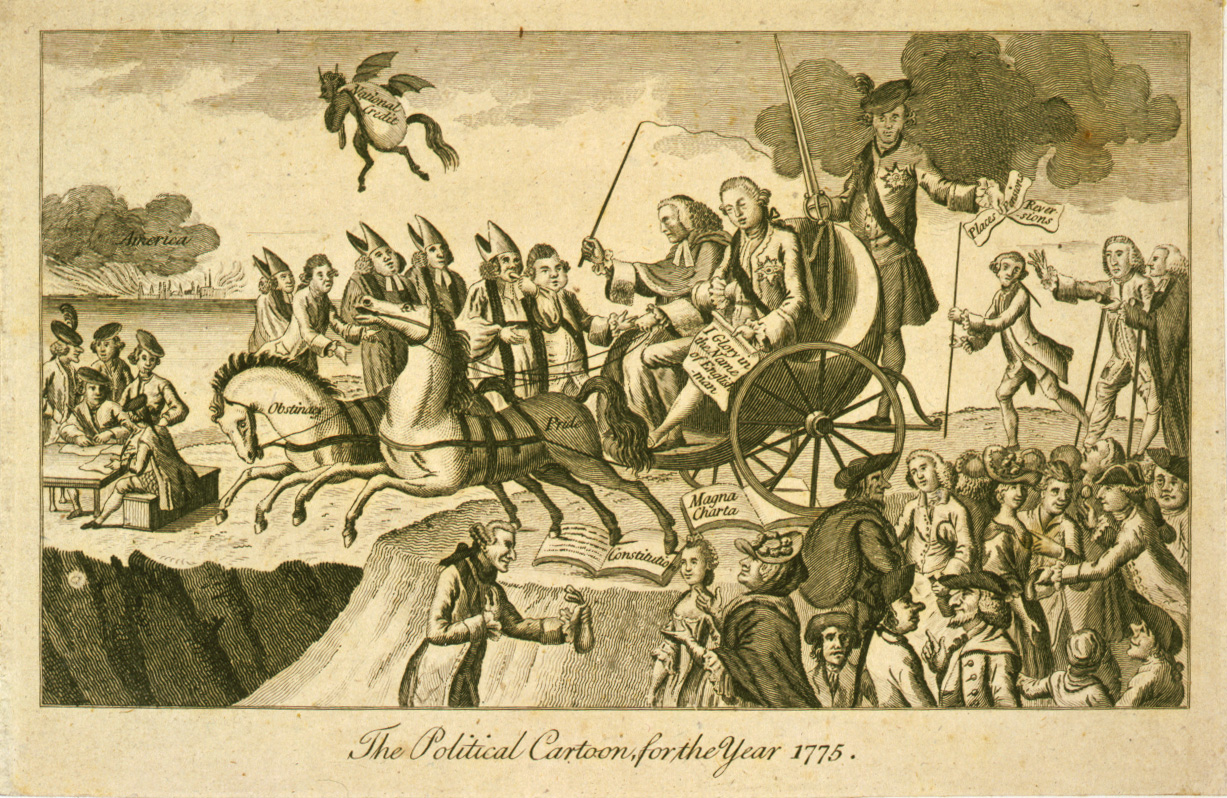
Cartoon engraving entitled ‘The Political Cartoon for the year 1774’ from the ‘Westminster Magazine’. Artist unknown. The ‘Westminster Magazine’ was printed in London, England by T. Wright, Essex Street, Strand, and sold by J. Bew, Paternoster-Row; and other booksellers in Great-Britain and Ireland, 1776-1783. Image courtesy of Library of Congress, Prints and Photographs Division, Cartoon Prints, British.
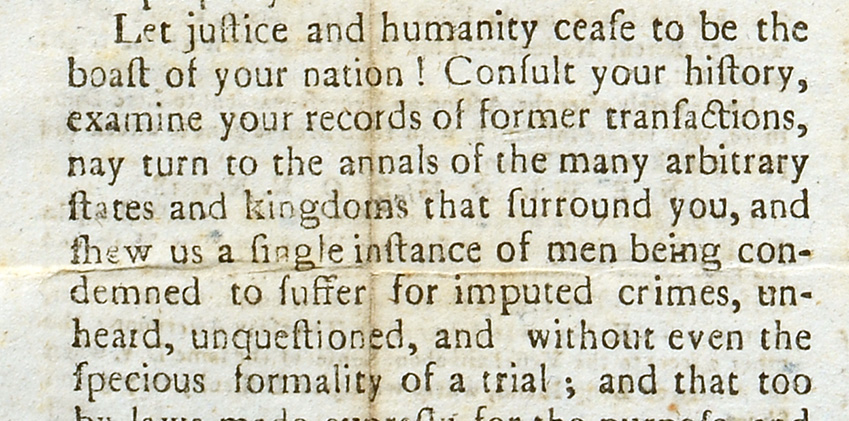
Extract from The New Hampshire Gazette, entitled ‘Continental Congress to People of Great Britain’, 2 December 1774. Catalogue ref: CO 5/939 (2 of 4)

Extract from the Boston Evening Post, 28 October 1765. Catalogue ref: CO 5/755 f.391
The Glorious Revolution mentioned in this source officially began with the reign of James II in 1685. William of Orange successfully invaded Britain and James II abdicated from the throne in 1688. The Glorious Revolution (1688–89) permanently established the role of Parliament and marked the move from absolute to constitutional monarchy.

Extract from the Declaration of Independence, 4 July 1776. Catalogue ref: EXT 9/76
On the 4 July 1776, the American colonies issued a joint Declaration of Independence, written by Thomas Jefferson. This laid down their desire to gain independence from Great Britain.

A proclamation from Sir James Wright, Captain General, Governor and Commander in Chief, of His Majesty’s Province of Georgia, 1774. Catalogue ref: CO 5/663 f.156
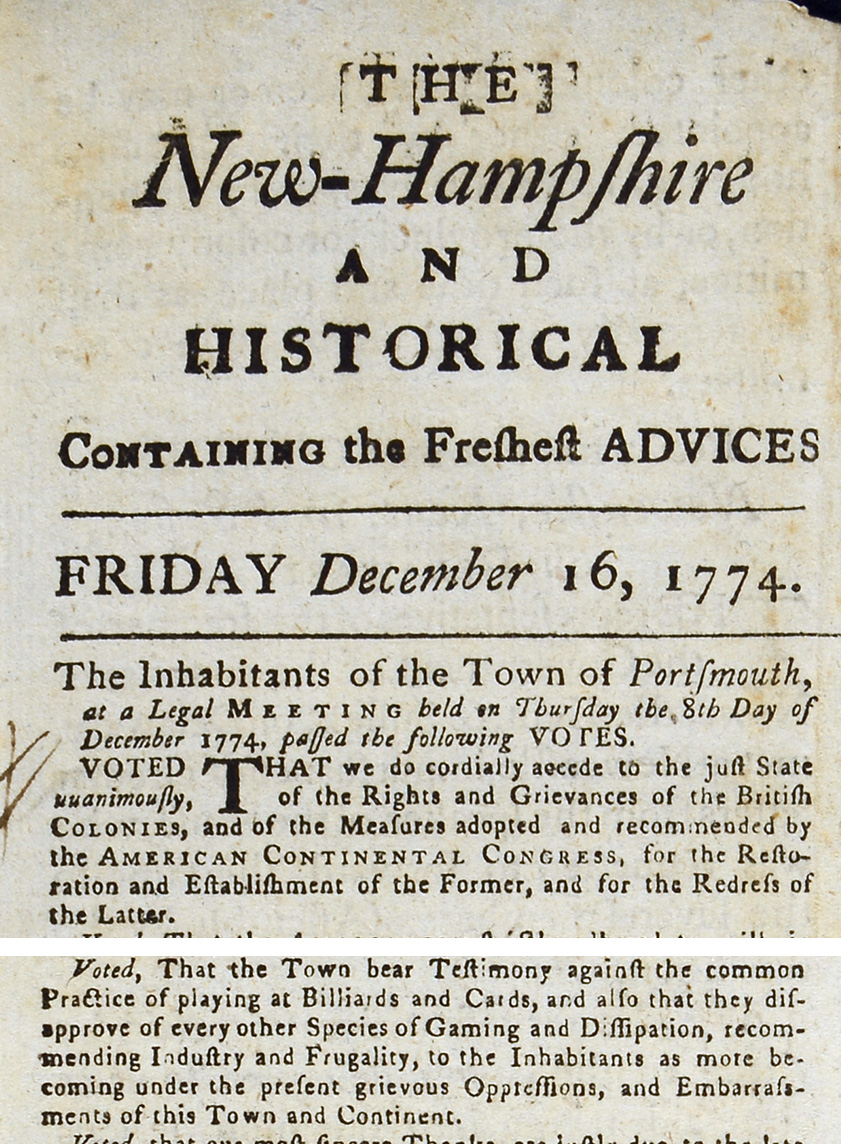
Extracts from the New Hampshire Gazette, 16 December 1774. Catalogue ref: CO 5/939 (1 of 4)
A meeting of the town of Portsmouth, New Hampshire concerning their grievances.
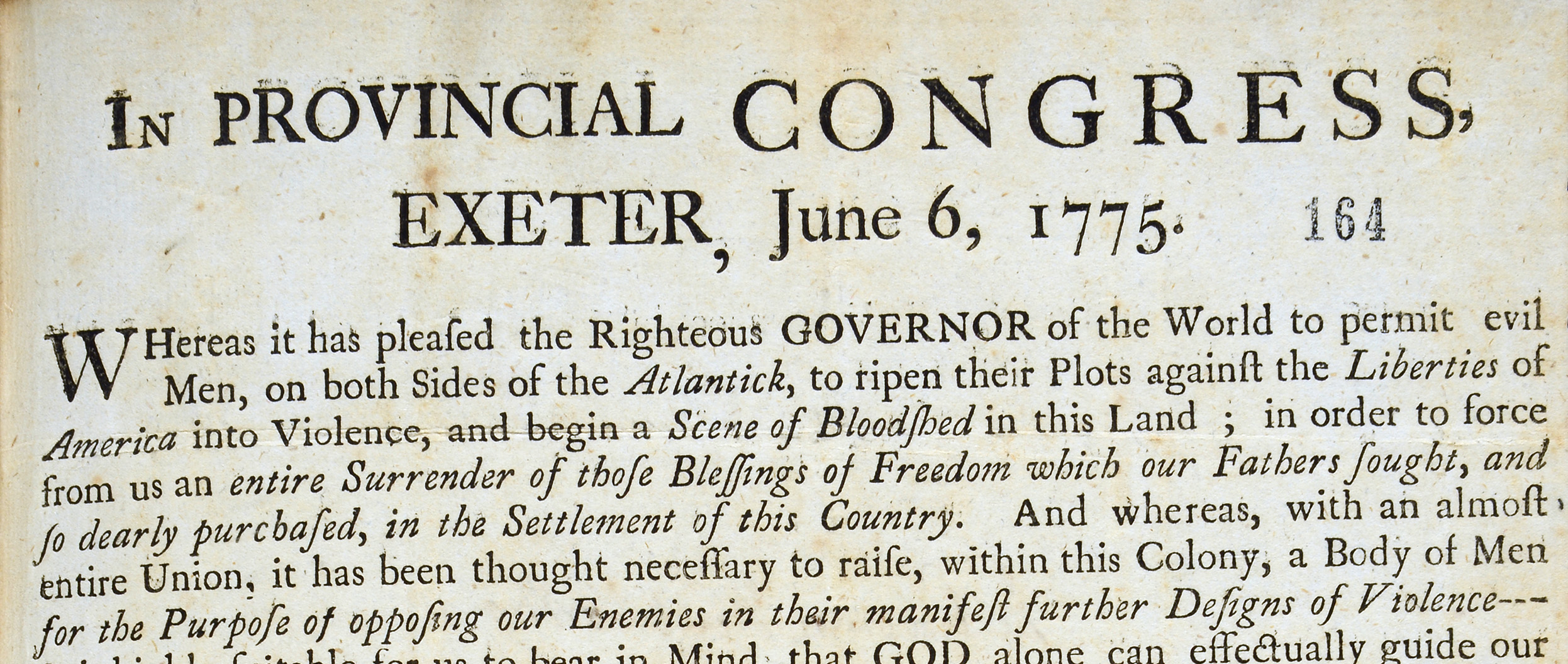
Extract from ‘In Provincial Congress, Exeter, New Hampshire, 6 June 1775’ by Matthew Thornton, President. Catalogue ref: CO 5/939 f.164
These resolutions were passed by the provincial congress of New Hampshire, in the town of Exeter.
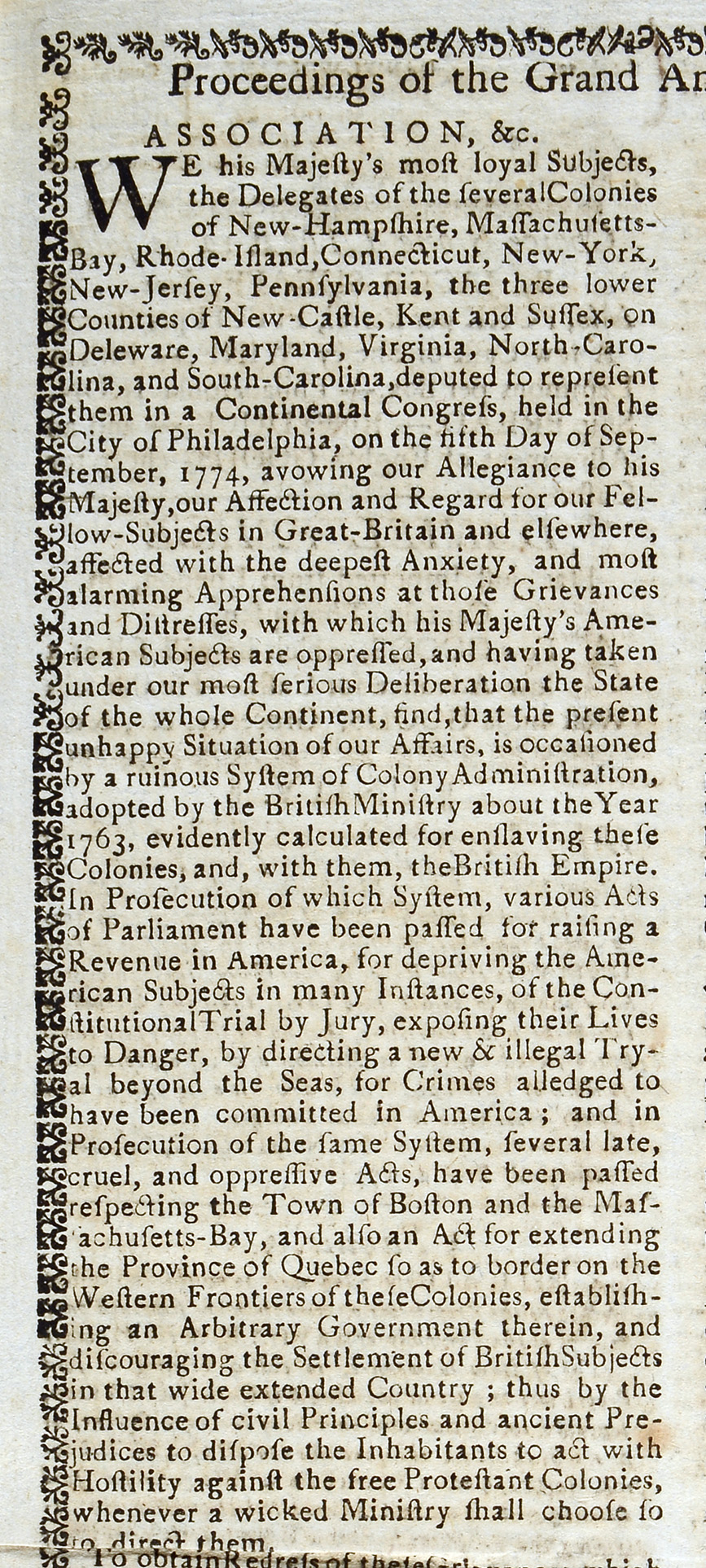
Extract from the ‘Proceedings of the Grand Continental Congress’, 5 September 1774. Catalogue Ref: CO 5/939 (3 of 4)