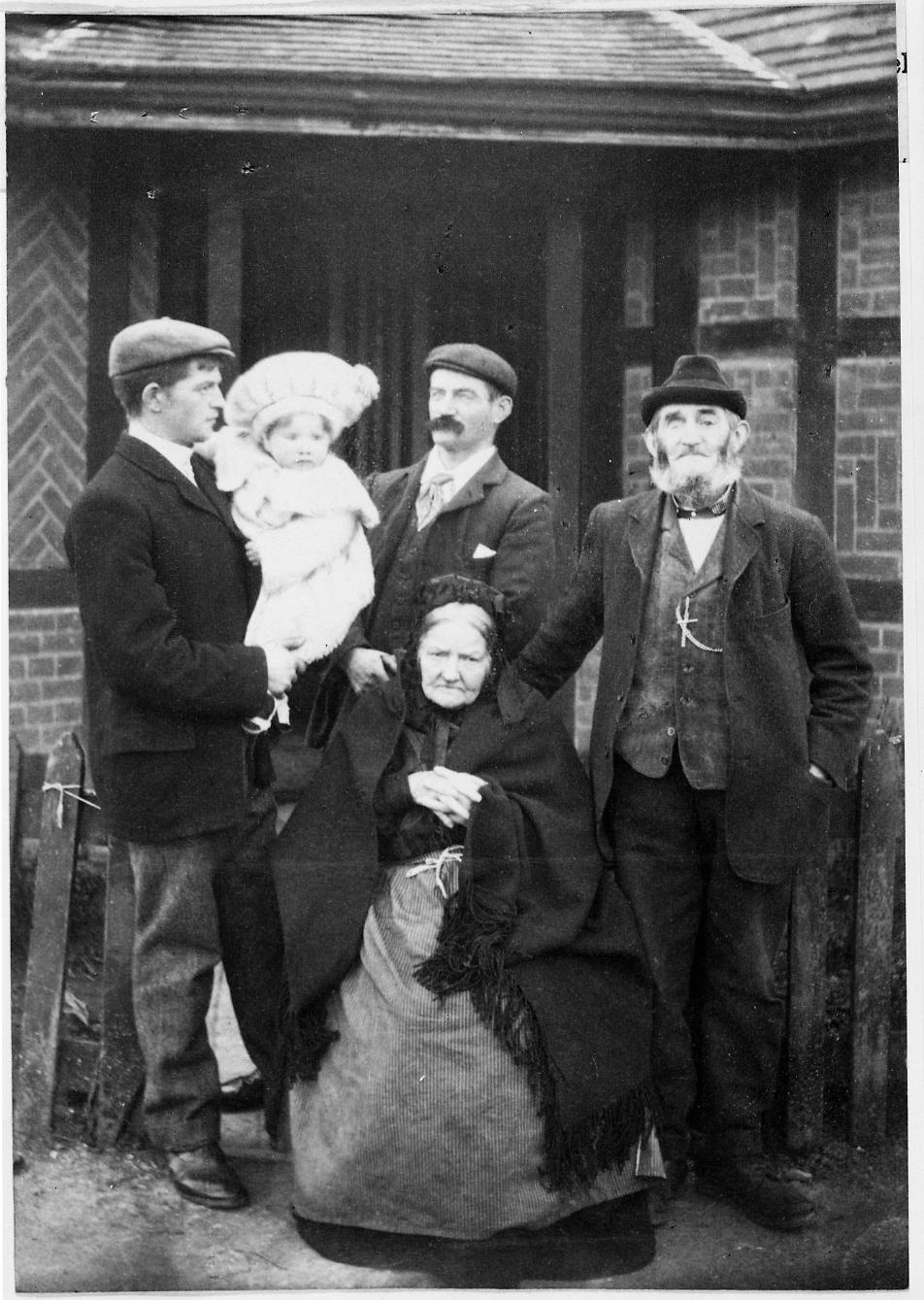
 Using images for descriptive and narrative writing

In 2016, as part of our programme of events to commemorate the centenary of the First World War, a group of students aged 16 to 19 joined us at the National Archives to create a stop-motion animation film telling the stories of those who experienced the Battle of the Somme, as detailed in the records within our collection. The film won a MEDEA award for User Generated Media and is an excellent resource for use in classrooms to tell the tales of the Somme.
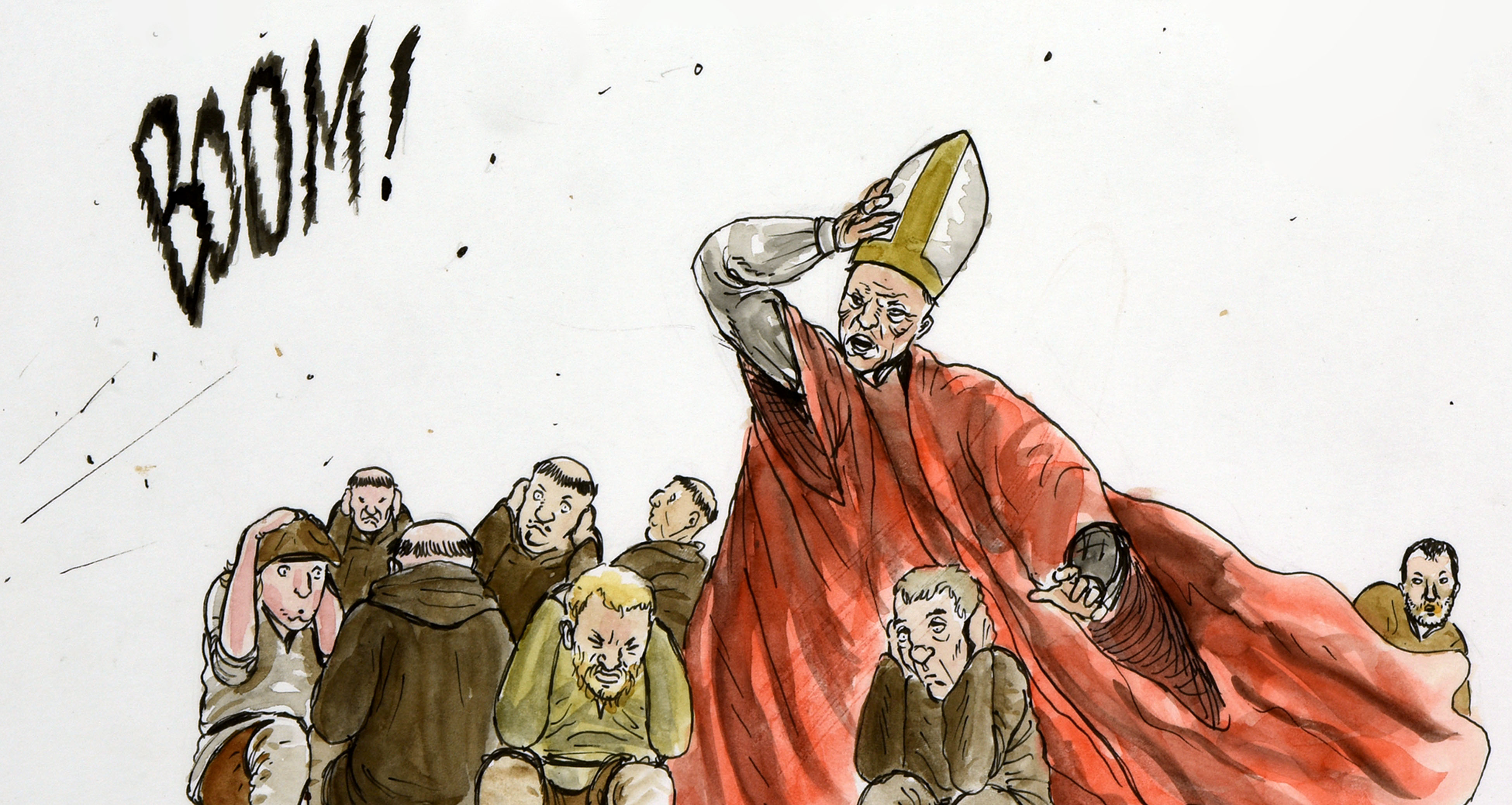
‘Chronicles of the Dissolution – Piety, Plunder and Protest’ is a graphic arts project illustrated by eight students who spent a week at The National Archives, illustrating their interpretations of Early Modern records from the State Papers of Henry VIII. The tales are told through the eyes of individual characters, from the lowliest carpenter to the ruthless commissioner. Together they give us a unique insight into the consequences which followed dissolution as a result of Henry VIII’s determination to reform the English Church.
Transcript and description of Chronicles of the Dissolution (PDF, 0.1MB)
High-resolution version of the eBook (PDF, 71MB)
 How did Indian soldiers respond to the First World War?
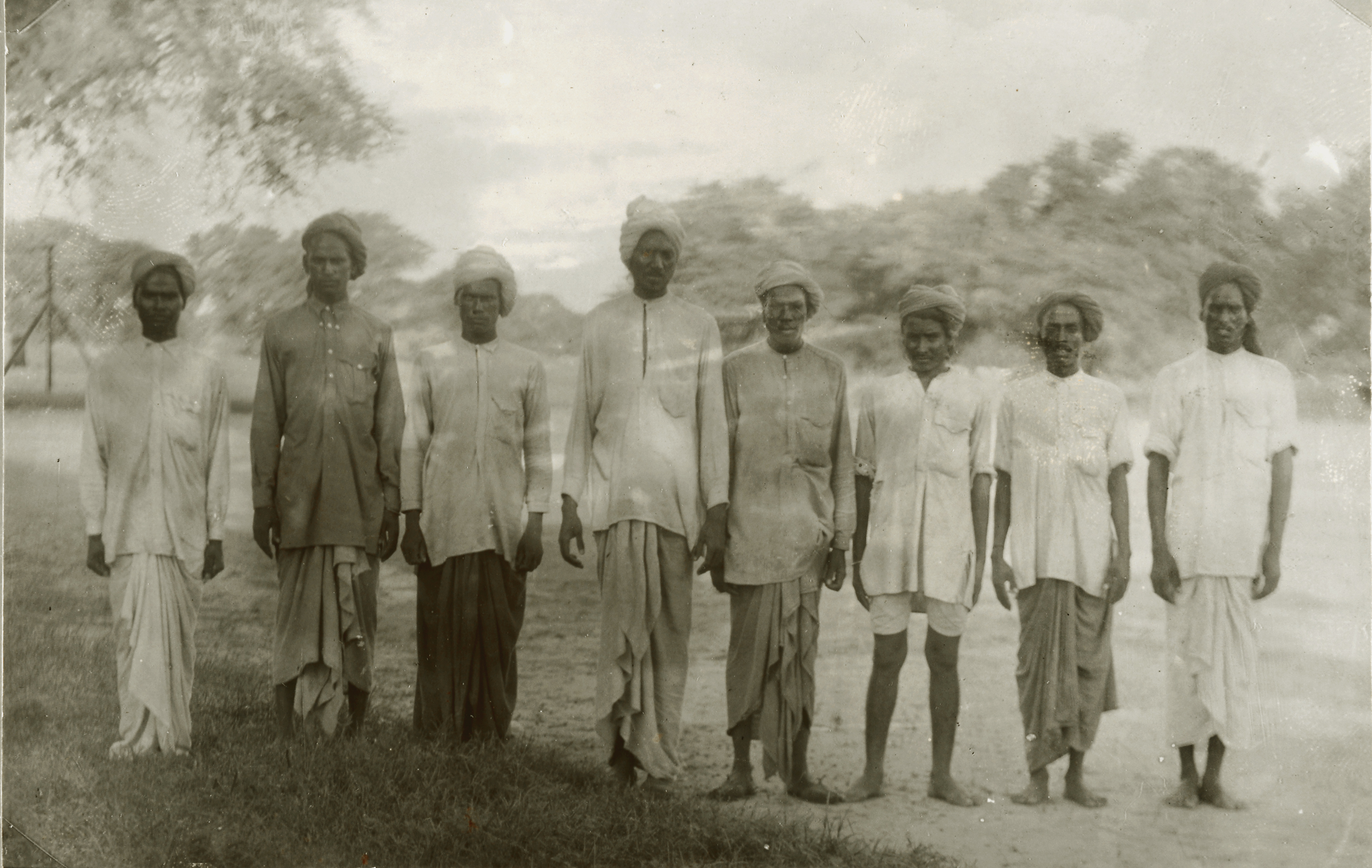
When war broke out in 1914, as part of the British Empire, India rallied to the support of Britain. Over 1.4 million Indian soldiers and non-combatants served in the war, including on the Western Front. Before 1914 a ‘colour bar’ to uphold British prestige was in force, preventing Indian troops from fighting against a ‘white’ enemy. In this context, the First World War marked a significant departure in imperial relations.
Recruited from the ‘martial races’ and trained in frontier warfare, the Indian Army – the largest volunteer force in the world – was in no sense a modern army prepared for the industrial warfare of the Western Front. How did they respond? Did they discharge their duties with their traditional fighting qualities and loyalty or were there dissenting voices? What led to dissent and how widespread was it?
About 138,600 Indian soldiers saw action on the Western Front. They took part in major battles at Ypres, La Bassée, Festubert, Neuve Chapelle, Loos, Somme and Cambrai. They suffered heavy casualties, fought with courage and won eight Victoria Crosses on the Western Front out of a total of 11 awarded during the First World War. Sir Walter Lawrence (Commissioner for the Welfare of Indian troops) concluded: ‘it was a bold experiment to bring them to Europe … it seems to have succeeded.’ However, some British Army Officers considered the Indian Corps to be a failure.
Indian soldiers themselves took pride fighting in a ‘white man’s war’ to prove themselves equal. Their letters show genuine expressions of loyalty and prayers for British victory. For Indian soldiers family honour and ‘izzat‘ was bound up with military tradition. Despite this, their letters also reveal some expressions of dissent. As war dragged on and casualty figures mounted, some felt that Indians were used as cannon fodder. They urged potential recruits not to enlist for service in Europe. When the wounded were sent back to the trenches this caused much unhappiness as this was seen as non-contractual and there were petitions about this, even to the King. Their rate of pay, 11 Rupees per month, became another reason for discontent and was raised to 20 Rupees by the last years of the War. Lack of leave caused homesickness, leading some to feign illness or use Indian herbs to induce sores. However, from the evidence it is clear that desertions were few, dissent never became mass rebellion and recruitment in India was not affected. Even when the most important Muslim state, Turkey, became an ally of Germany, British Muslim soldiers stayed loyal to the Empire and disregarded German propaganda.
To secure their collaboration, the imperial state manipulated traditional Indian soldierly qualities for King and Empire. This is also evident in Europe from official pronouncements praising their gallantry, the organisation of hospitals on caste and religious principles, and the setting up of a burial ground for Muslims near the Woking Mosque while Sikhs and Hindus were cremated at Patcham (in contravention of the 1902 Cremation Act). But there was a limit to how far British prestige could be compromised, even for political reasons.
The years before 1914 had witnessed unrest both in India and among Indians in Europe and the USA. In 1907, Madame Cama had unfurled the tricolour at a Socialist Conference in Germany while Madan Lal Dhingra assassinated Sir Curzon Wylie in London. Although Indians enthusiastically pledged support for the war, pockets of radicals caused anxiety: it was feared that seditious literature would be smuggled into Europe to undermine the loyalty of the troops. A special Censor’s Office was set up at Boulogne to monitor morale and check for letters and literature showing signs of dissent. Radicals in the USA, like Har Dyal and the Ghadar Party, were kept under strict surveillance. They aimed to stir up Indian soldiers against the British with their publications, fiercely critical of British rule. The actual amount of seditious literature proved to be negligible and the Indians remained loyal.
Concepts of loyalty and dissent are complex issues as these documents reveal. Wilfred Owen and Siegfried Sassoon’s First World War poems are a case in point.
The First World War marked a turning point in imperial relations. It was accepted that the Indian army needed reforms. Did the Indian contribution in the war hasten the process of decolonisation? There is no easy answer. The Montague-Chelmsford reforms fell far short of expectations. The Rowlatt Acts of 1919, the massacre at Amritsar and martial law brought repression rather than the promised reforms. However, the soldiers’ experience of Western society widened their horizons and created new aspirations.
Rozina Visram
Author of ‘Ayahs, Lascars and Princes: Indians in Britain 1700-1947’ (1986)
and ‘Asians in Britain: 400 Years of History’ (2002)
Glossary
India or Indians: this term is used to refer to British India (1858-1947), comprising present day India, Pakistan, Bangladesh and Burma.
‘Martial Races’: Based on the theory of ‘martial races’ the Indian Army, recruited from the peasant classes, was drawn from a narrow ethnic and geographical pool mainly from northern and central India, the North-West Frontier Province and Nepal. These ethnic groups were considered to be ‘naturally more warlike’. The theory of ‘martial races’ raised their profile as the ‘chosen warriors’ leading them to enlist with enthusiasm.
Izzat: honour, prestige or absence of shame.
Cannon fodder: belief that certain groups of soldiers were used more than others in battle; in this case Indian soldiers felt that they were sent to the trenches ahead of the white soldiers.
Tricolour: Literally three colours. In this context the colours were green, yellow and red, the proposed Indian national flag.
Montague-Chelmsford reforms: 1917-18. The reforms outlined proposals for an increased representation of Indians in the Government of India.
Rowlatt Acts: 1919. Named after the High Court Judge, the Act gave the police wide powers to decide which offences amounted to a conspiracy against the Government. It also provided for speedy trials, not by a jury, but by special tribunals. Those suspected were denied representation by a lawyer; there was no right of appeal.
Amritsar Massacre: 1919. A peaceful, unarmed crowd of men, women and children, gathered for a protest meeting at Jalianwala Bagh were fired upon by the order of the military commander, General Dyer. 379 died and 1,200 were wounded. Ironically Amristar province had contributed the highest number of men for the First World War.
Cremation Act 1902: By this Act cremation could only take place in a crematorium of which notice had been given to the Secretary of State.
Additional Notes
Madame Cama: Bhikaji Rustom Cama was influenced by the India House Revolutionary Movement based in Highgate, London. She settled in Paris after 1909 and edited the newspaper, ‘Bande Mataram’ (Hail Motherland). See The British Library, IOR: POS 6052, History Sheet of Madame Bhikaji Cama.
Madan Lal Dhingra: See The National Archives References: CRIM/1/113/1 and CRIM 10/99.
Further Reading
Rozina Visram: Ayahs, Lascars and Princes: Indians in Britain (Pluto Press, 1986; Routledge Revivals, 2016) Chapter 6 (Soldiers of the Empire in two World Wars).
Santanu Das: 1914-1918 Indians on the Western Front (Gallimard, 2014)
David Omissi: Indian Voices of the Great War Soldiers’ Letters, 1914-18 (Macmillan. 1999)
 Key documents from The National Archives
In unleashing the Second World War, the Nazi regime was responsible for the deaths of around 50 million people, including civilians and soldiers. The Nazis and their allies committed genocide against Europe’s Roma, murdered millions of Catholic Poles and Soviet Prisoners of War, and caused death and destruction throughout occupied Europe. The genocide of the Jews that has come to be known as the Holocaust was both intertwined with and separate from these other killings.
For the Nazis, murdering the Jews was part of a vast scheme for the racial reorganisation of Europe, which would create a pan-European Germanic empire with ‘Nordics’ at the top of the hierarchy, Slavs at the bottom, and Jews eliminated. At the same time, the Nazi obsession with the Jews was different from the way it regarded other ‘races’: Jews were both hated and feared and – at least at the level of the Nazi leadership – were regarded as the masterminds behind a vast world conspiracy that aimed to destroy the ‘Aryan race’.
Many of the regimes that allied themselves with Nazi Germany – especially Croatia, Romania, Slovakia, Vichy France and Hungary – found that the Nazis’ anti-Jewish obsession chimed with their own aspirations for creating ethnically homogeneous nation states. Even if they were not as driven by antisemitism as the Nazis, such regimes made use of the atmosphere created and licence granted by the Nazis to fulfill their own ambitions. As a result, as it played out across Europe, the Holocaust was so far-reaching because of the role played by collaborators, from states to institutions such as auxiliary police battalions, to individuals.
As the documents in this important collection show, the murder of the Jews was a complex series of interrelated events. There was not one single, unidirectional policy that saw Jews everywhere in Nazi-occupied Europe ghettoised and then deported to death camps. Rather, the experiences of different Jewish communities were very different, depending on what sort of occupation regime they lived under, the attitude of local administrations, the extent of SS penetration in the area, military circumstances, the Germans’ need for labour – especially towards the end of the war – and other factors such as possibilities for escape, hiding or resistance. What we call ‘the Holocaust’ was a continent-wide crime: a series of vastly different experiences for all involved, united by the fact that everywhere the Nazis aimed to kill Jews as and when they could.
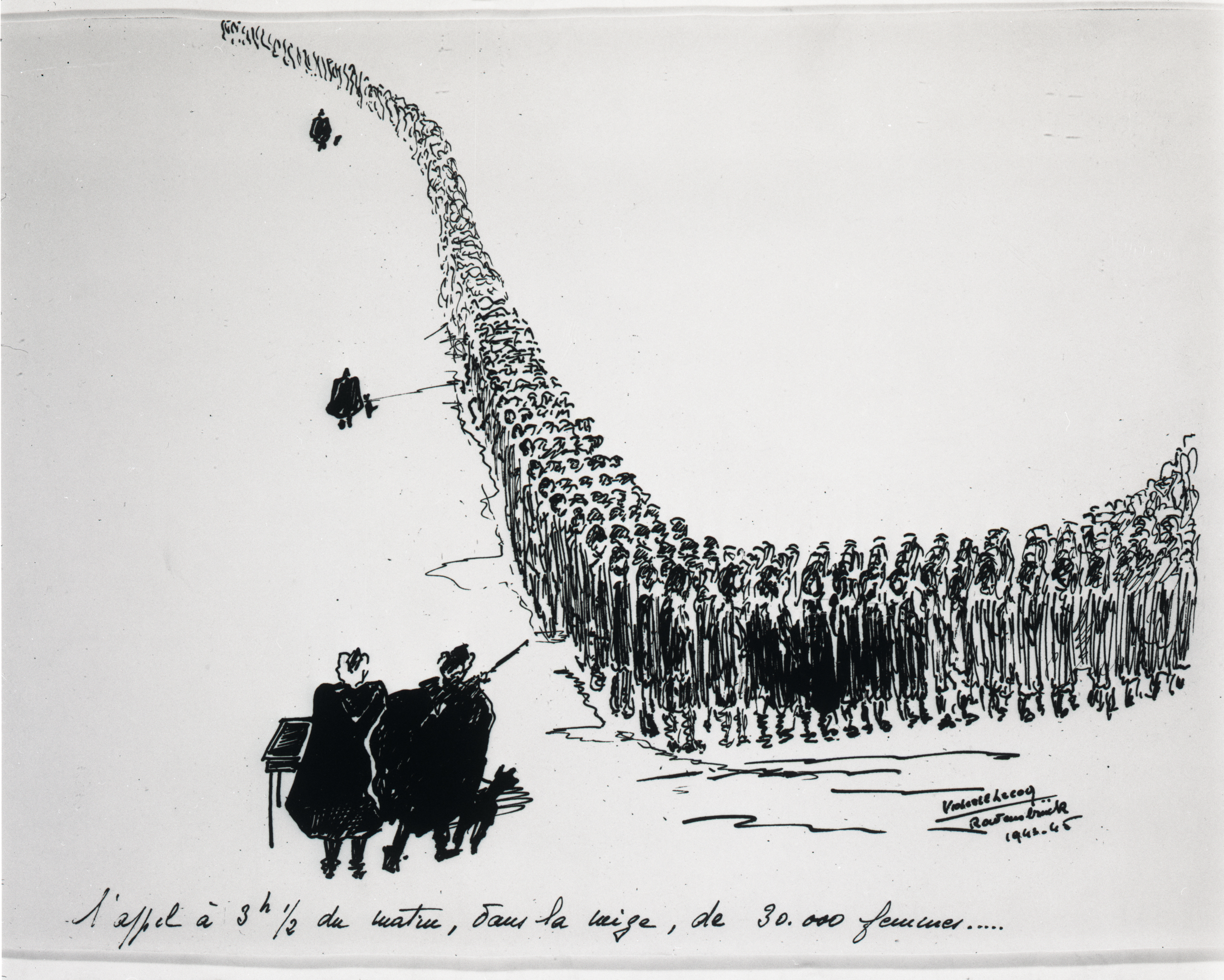
The complexity of the Holocaust means that documents such as the Riegner telegram or the Lichtheim telegram are all the more remarkable, since they show that some concerned contemporaries were trying to make sense of what the Nazis were doing to Europe’s Jews. Plans of the Auschwitz and Treblinka camps, reports from the Warsaw ghetto and from Polish representatives in London, all show that knowledge of the murders was circulating. Nevertheless, it was only in July 1944, when most of the Jews of Hungary (the last remaining large Jewish population group in Europe outside of Russia) had already been murdered, that Churchill could write that ‘we are in the presence of one of the greatest and most horrible crimes ever committed.’ In other words, how to interpret the documents remains a matter of historical debate: do they show that the Allies understood that the Nazis intended to wipe out the Jews and that therefore they should have done more to save them? Or should they not be read in isolation but placed in the broader context of wartime issues, which might reveal that they were received and understood piecemeal, so that no real comprehension of the extent of Nazi plans prevailed? In the presence of images such as Violette Le Coq’s drawings of Ravensbrück (in The National Archives because they were used as evidence at the 1946 Ravensbrück trial), such questions might seem irrelevant. But beyond the fact that the Nazis killed six million Jews, more or less destroying an ancient civilisation, only questions such as these, which rely on documents such as those held at The National Archives to establish interpretations and meanings, can help us in some measure to grapple with the enormity of the Nazis’ crimes.
Dan Stone
Professor of Modern History
Royal Holloway, University of London
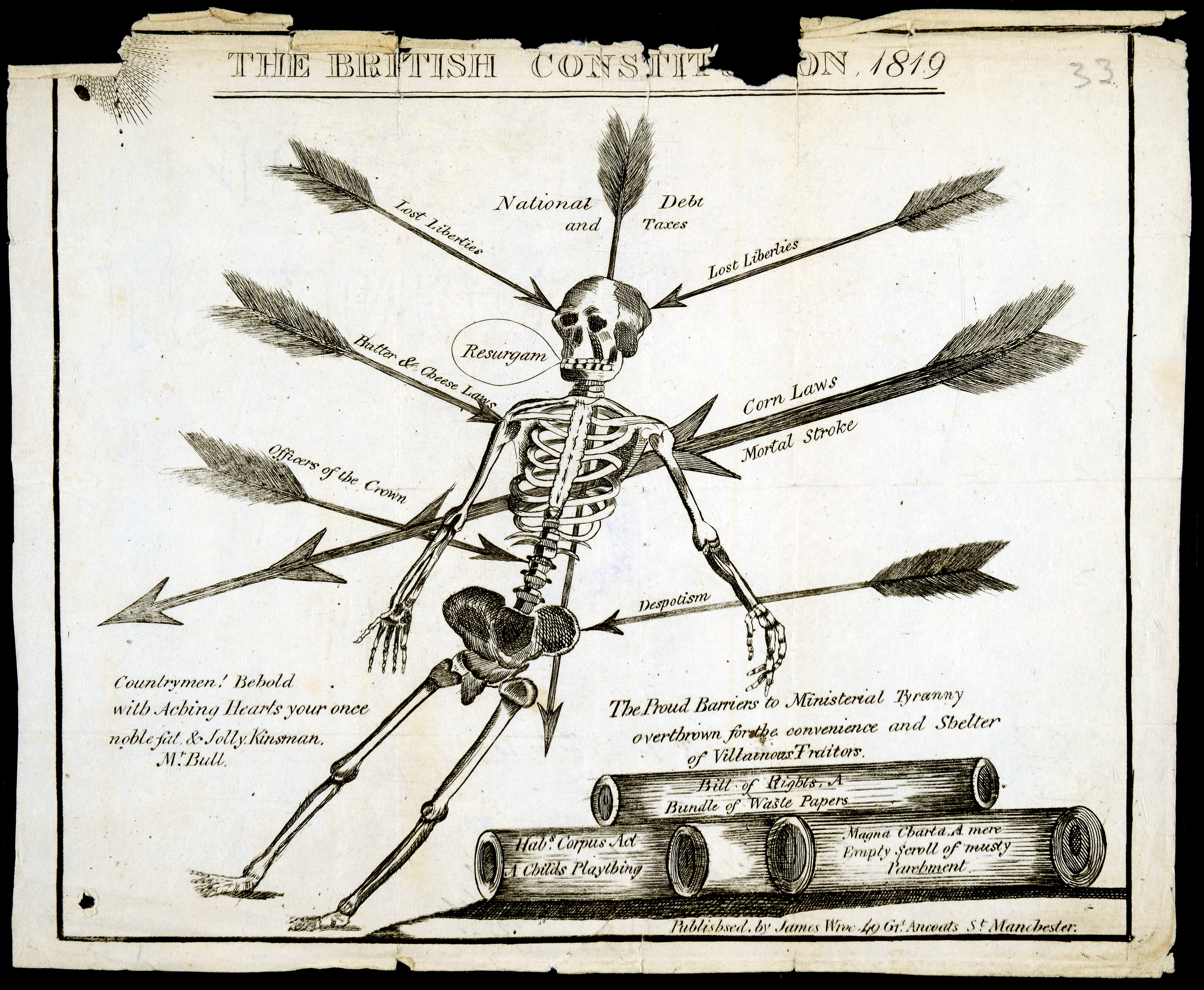 How close was Britain to revolution?
After the failure of rebellion in 1817, economic conditions improved rapidly in 1818. A wave of strikes for higher wages helped to reverse some of the losses of 1816-1817, particularly in the cotton industry. Workers briefly organised a ‘philanthropic union’, an early attempt at a national union of all trades which could support each other in disputes. However, 1819 saw other slumps with widespread wage cuts and unemployment, prompting a second wave of protest for parliamentary reform. This time the radical reformers took care to avoid the failed plots and rebellions of 1817, aiming instead to rally such overwhelming numbers of protestors that the government would be forced to back down.
The climax of the national series of mass meetings was a rally of 60,000 people at St Peter’s Fields, Manchester, on 16 August 1819, addressed by the orator Henry Hunt. Hunt called for a peaceful show of strength from across the region: for several weeks beforehand the reformers for miles around practised marching in military formation, drilled by old soldiers, to ensure order on the day. But the local magistrates believed the reformers were preparing for armed rebellion; they declared the meeting illegal and warned people to stay indoors. Several months before, the Home Office had secretly told them: ‘your Country will not be tranquillized, until Blood shall have been shed either by the Law or the sword.’
The meeting rallied peacefully with flags, banners, and music, watched by reporters from the national press. As it began the magistrates, fearful of what would happen next, sent in the Manchester Yeomanry (a local volunteer cavalry) to arrest Hunt; they then ordered the regular Hussars to clear the field. The senior magistrate, the Reverend William Hay, fired off a report to London the same evening claiming that rebellion had been averted and injuries had been few; however, cavalrymen such as Major Dyneley wrote enthusiastically of winning ‘the battle of Manchester’ against the ‘enemy’ reformers. Reports in the press, including both the radical ‘Manchester Observer’ and ‘The Times’ of London, told of many deaths and hundreds of casualties, many of them inflicted face-to-face by cavalry sabres, although the authorities tried to discredit individual cases.
The news of Peterloo spread far and wide, with fairground booths as far away as Devon displaying detailed hand-coloured prints of the scene. There were protest meetings, which led to further arrests, and for a time rebellion appeared to threaten. In the spring of 1820 there was serious unrest in Yorkshire and armed rebellions in Ireland and Scotland; in Glasgow, a provisional government was optimistically proclaimed.
In January 1820, some of the London ultra-radicals plotted to assassinate the Cabinet in the dramatic ‘Cato Street conspiracy’; however, the whole thing was a trap laid by government. The plotters’ every move was watched by informers – yielding some gripping details about London’s tiny but committed revolutionary underground – but they were arrested and executed. 1820 also saw a popular movement which was more difficult to suppress: a campaign in support of Queen Caroline, the estranged wife of the new monarch George IV, who was trying to divorce her. Reformers compared her treatment with that of the female reformers cut down at Peterloo: ‘The same power which scourged us, is oppressing you’ declared radicals from Lancashire. Support for the Queen spread among troops, and there were signs of mutiny among the guards. The radical printer William Benbow excitedly posted bills urging them to imitate the Italian soldiers who had supported a revolution in Naples.
In the end, the forces of the state proved stronger than those of reform. However, at the next crisis in 1832, the government was forced to back down, unwilling to use military force against reformers for a second time.
Dr Robert Poole
University of Central Lancashire [UCLAN], author of ‘Return to Peterloo’
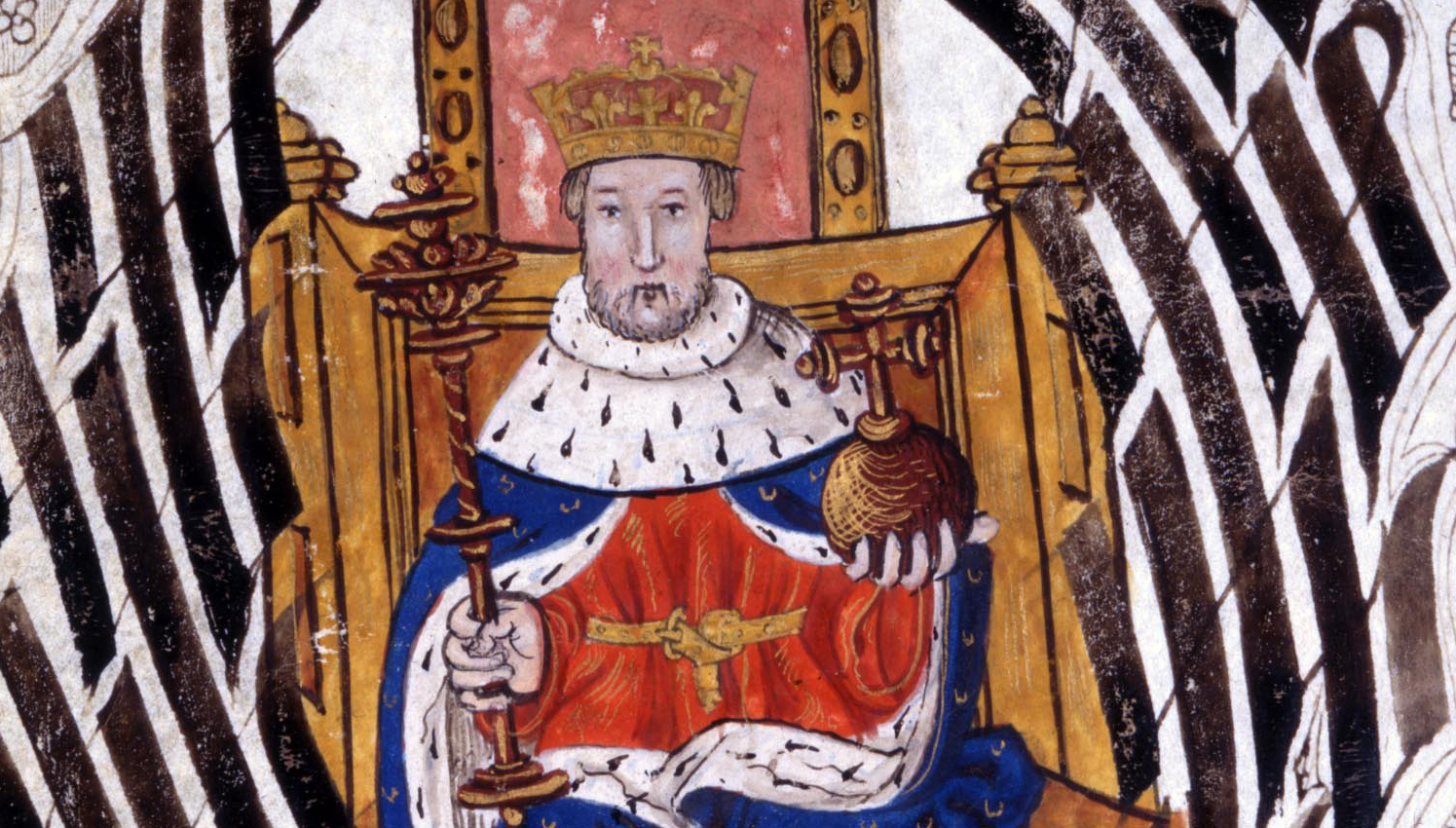 How did state and people respond to religious change?
by Dr Natalie Mears, University of Durham
The Reformation was one of the most transformative events in the history of the British Isles. Not only did it profoundly (although ultimately slowly and haphazardly) change people’s religious beliefs, but it also ushered in important political, constitutional, social and cultural change. Moreover, it played a fundamental role in the establishment of national identity. It defined England (Wales and Ireland were ignored; Scotland was a separate power) as a new Israel. That is to say, an island bastion of the true (i.e. protestant) faith, especially favoured by God and physically separated from largely Roman Catholic (and hence corrupt and tyrannical) continental Europe. Indeed, our understanding of the Reformation – and, therefore, the histories written of it – has been shaped precisely by these factors ever since John Foxe’s ‘Actes and monumentes’ (commonly known as the ‘Book of Martyrs’).
Was this all because Henry VIII fell in love with Anne Boleyn? Certainly, the combination of Henry’s need for a male heir to rule over a patriarchal society, his infatuation for Anne, and her determination not to be just the king’s mistress were all significant triggers. But it seems likely that home-grown evangelicalism (in England’s case, left over from the Lollard movement) and the dissemination of reforming ideas from abroad would, sooner or later, have effected some sort of ‘Reformation’, as it did in other continental countries.
It would be a mistake, however, to think that the Reformation in England, Wales and Ireland was a forgone conclusion. The Henrician Reformation was notoriously haphazard, not least because Henry himself – despite pushing from Anne, Thomas Cranmer and Thomas Cromwell – was never really convinced by evangelicalism. His realms could have remained jurisdictionally ‘semi-detached’ from the Papacy (he was too fond of the supremacy to give it up) while remaining religiously close to Rome. Similarly, had Edward VI not died unexpectedly in 1553 – he was not the sickly boy of legend, but relatively robust one with a liking (if not the skill) for jousting as well as an impressive hat collection – the Tudor Reformation may have been distinctly less idiosyncratic and more in line with continental beliefs and practice, than it ultimately was. And, as Christopher Haigh and Eamon Duffy have shown that the Tudors’ dominions remained largely Catholic until at least 1580, if Mary had lived or produced an heir then the Reformation could have fizzled out altogether.
Ultimately, what these documents show is that we need to pay as much, if not more, attention to how people articulated their ideas and beliefs, as to what they articulated: the language they used, the ritual actions they employed, the way they defined themselves and others, and how their perceptions shaped the way they acted. The Reformation may have ‘begun’ with Henry VIII’s beliefs about his marriage and the succession and his emotions regarding Anne Boleyn, but its real story lies in the beliefs, actions, perceptions, and prejudices of his subjects.
Reading list
This is a full, but by no mean comprehensive, reading list for the Reformation, covering England, Wales and Ireland. The material is mixed: some of the items are books, but many are journal articles which you will primarily find in, or via, a university library.
Reading list on the English Reformation c1527-1590, (PDF, 0.07MB)
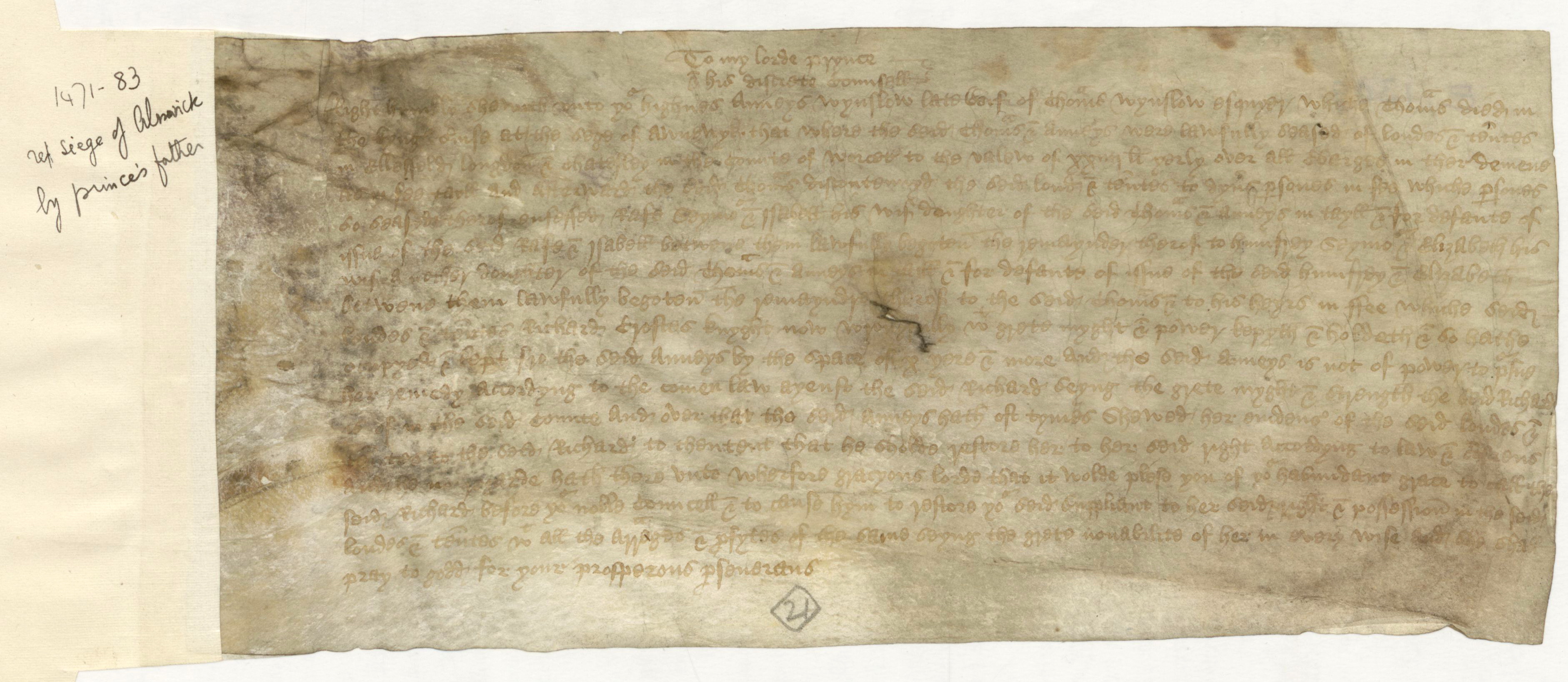
Following the death of her husband at the siege of Alnwick, lands that belonged to Anneys Wynslow’s family were taken forcibly by a man called Richard Croftus, who then held the lands for ten years. In this document, Anneys asks the Prince of Wales to use his legal power to intervene on her behalf and help her family regain her lands.
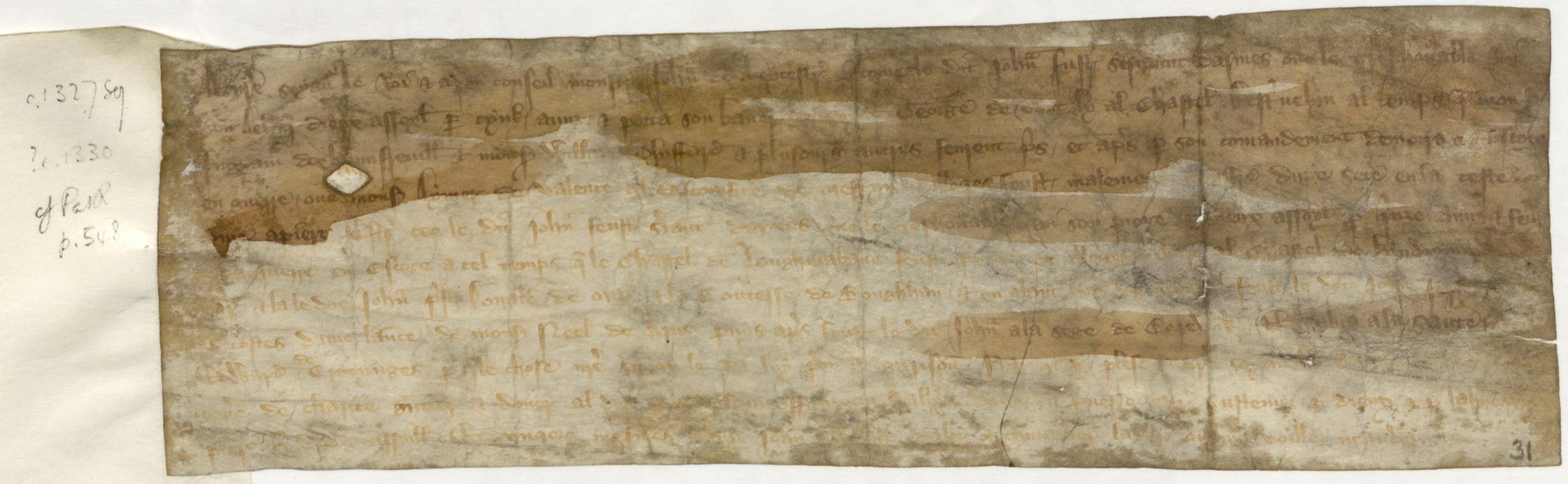
John de Leycestre asks the king to follow up on his promise to reward John for his service in the king’s army during the siege of Berwick.

William Perheved asks to be pardoned for murder because he served in the king’s army at the sieges of several castles.