Key details
Date of redevelopment: 2021-22 (Brotherton Research Centre); 2022 (Stack One)
Cost: Approx. £1.2m (Brotherton Research Centre) and £1m (Stack One)
Who funded it: The John Victor Bedford Will Trust and the University of Leeds for public spaces, and the Arts and Humanities Research Council’s (AHRC) Capacity for Collections Fund for Stack One storage space
Case study themes
Service sustainability, accessibility
Project summary
New approaches to teaching, as well as two unmissable funding opportunities, led to the refurbishment of the Brotherton Research Centre at the University of Leeds. The public and storage space has been redesigned to encourage greater interaction with a wider range of collections. Two projects ran one after the other and used different sources of funding. The public space in the research centre was refurbished first, quickly followed by the refurbishment of Stack One.
These two complementary projects improve the user experience and reach a wider audience. Teaching programmes can now be delivered using the collections in a fully AV-equipped teaching space, or in the flexible search room which is suitable for groups as well as individual researchers.
Challenges and opportunities
The timing of funding was a challenge. The need to redesign the research centre was a long-held ambition. When the funding opportunity from the Bedford Trust came up, the team had to act quickly to bring their vision to life. This was the same with the stack refurbishment. An initial bid to the AHRC to do this work was rejected. However, when their Capacity for Collections team came back to say that the project could be funded if it could be completed in the next nine months, it was hard to say no.
Managing two back-to-back projects was difficult. Ideally, the refurbishment of Stack One would have taken place first, so that all collections would be equally accessible when the research centre opened. The service could not close again so soon, so running another major project had an impact on both service delivery and staff capacity.
Moving collections: The short time scale for the stack project alongside the complexity of the shelving installation was challenging. Although Stack One is the smallest strongroom, it still contained 4,000 linear metres of collections which were stored temporarily at DeepStore (a secure document storage service). There wasn’t enough time to carry out the detailed location mapping that was needed, and once the collections were in DeepStore, they could not be accessed until the recant.
The existing rolling racking track was found to be so deeply embedded in the floor that it needed to be removed using a jackhammer. The additional noise this caused during the exam period meant that night working had to be quickly introduced so the new floor could be installed in time.
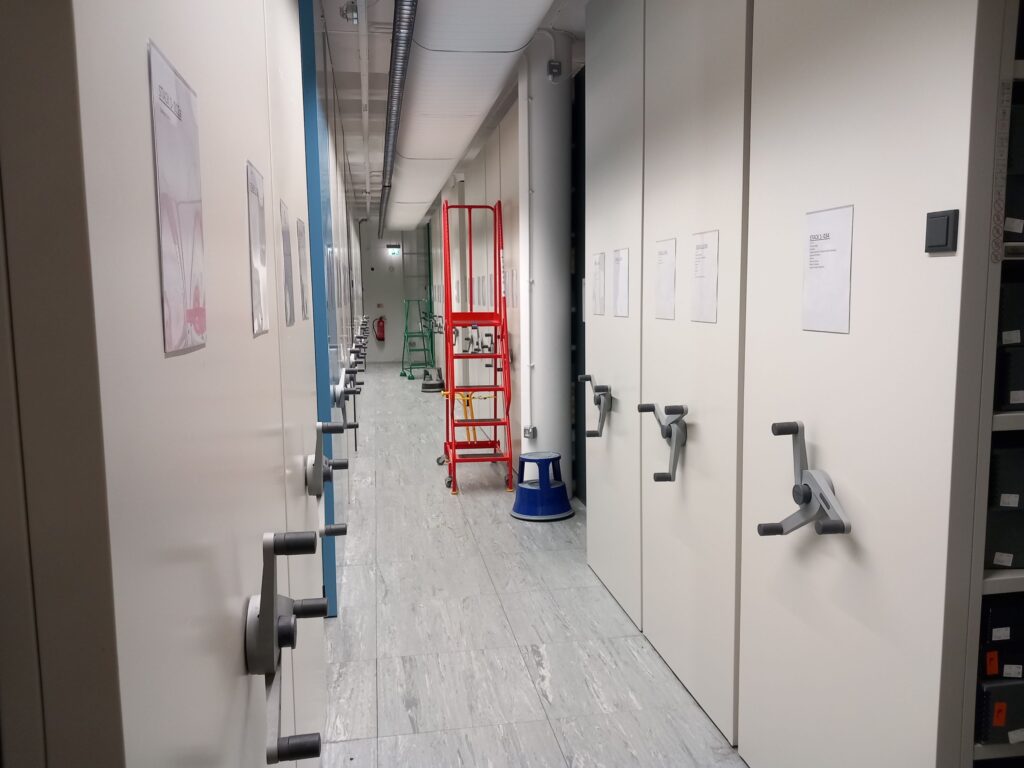
Refurbished Stack One. © University of Leeds.
Returning collections to the strongroom: This was not a like-for-like process, as the new Stack One had been specifically designed for rolled plans which were too long for lifts or trolleys, bulky textile collections and large artworks. As a result, large format collections were prioritised at Stack One, whilst some other collections previously stored there had to be relocated to other stores. Although this was difficult, it has created some expansion room and made it possible to open up previously underused collections.
Outcomes
A flexible public space, where all the furniture in the room is on wheels and can be moved and reconfigured very easily. There is a height-adjustable table for wheelchair users. Around two thirds of the space can be used for group activities and can be easily reconfigured to accommodate formal teaching, group work, pairs or individual use.
The remaining space is set up for individual study. Collections in all formats can be easily produced, and wall-mounted easels are particularly useful for increasing access to artworks. The space is well-suited for evening events, adding to the range of activities that can take place in the research centre.
We’ve had brilliant feedback – students regularly comment on the ambience of the space. The improved retrieval and customer service space has had a positive effect on staff morale, which was especially important after two long, complex projects.
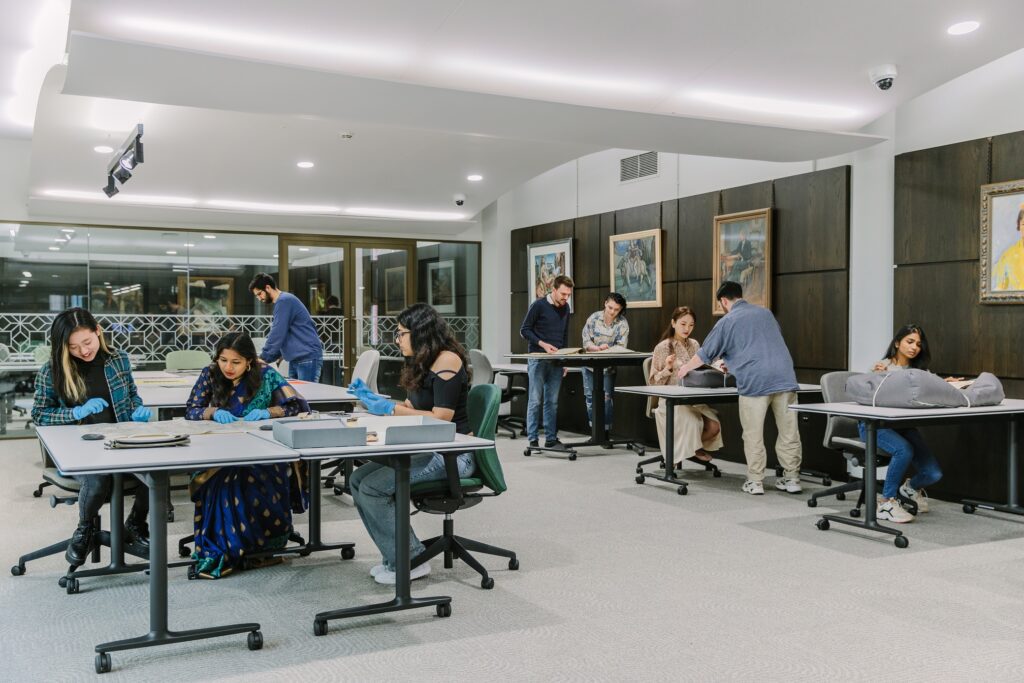
Group teaching in the Brotherton Research Centre. © University of Leeds.
There has been an increase in physical usage. Previous work done by the collections and engagement managers to develop relationships with departments who were not traditional users of Special Collections has started to pay off in the new space. This work, alongside both refurbishments, has aligned with a university-wide transformation of undergraduate teaching. Special Collections is now more integrated into course design and better used by staff and students than ever before.
What did you learn from the process?
Learning when to compromise – understanding the various specialisms and knowledge that different people bring to the project, and listening to one another, is key. For example, understanding that the architect might have a better understanding of visuals may mean compromising and trusting the process. Equally, being able to make the point about things that can’t be compromised is important. Potted plants may offer lovely visuals, but they may also offer a lovely home to pests!
Access to information, especially around budgets – the university’s hierarchy around who can see what part of the budget could be problematic.
The closure of the search room following on from Covid-19 lockdowns had a real impact on in-person visits. This was made worse by the resultant need for social distancing, which meant that the temporary search room could not hold as many visitors as had been expected.
Although the university’s project management team were excellent, relationships with contractors were strained. Some contractors were unwilling to speak using simple, plain terms. The Special Collections team needed to upskill themselves significantly to understand plans, such as being able to work out symbols and acronyms.
Keep an eye on team morale: It can be difficult to see the end of a project when you’re in the middle of a building site handling complaints. Not everyone will appreciate the bigger picture or buy into the organisation’s vision.
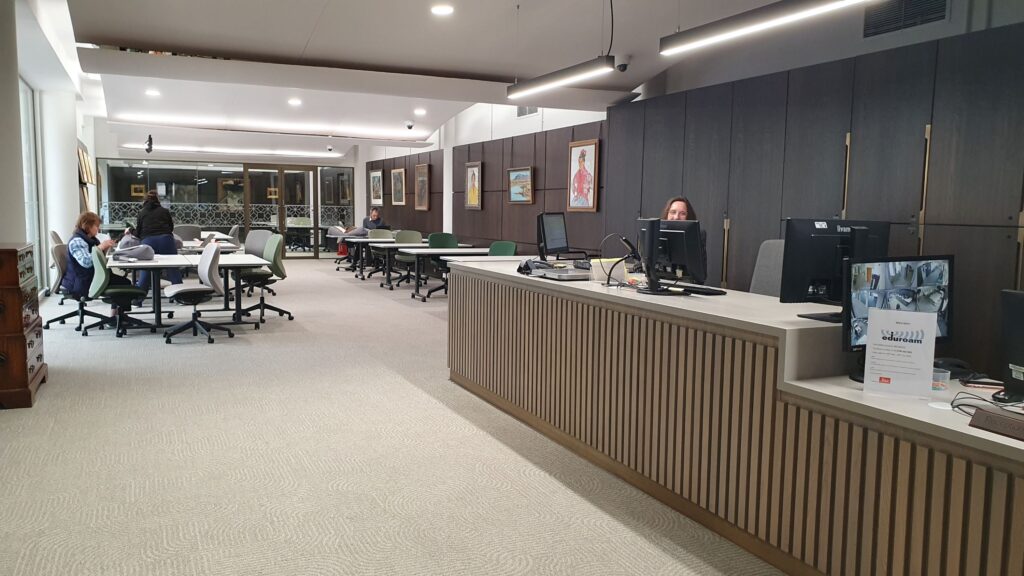
View of the Brotherton Research Centre. © University of Leeds.
What is one piece of advice you would give others in a similar position?
Make sure you have someone seconded from your audience/collections team to work on the project full time. It is vital to have someone who has eyes on everything. One of the difficulties the team experienced is that they were working on the capital project alongside their main role, which was very challenging. It would have made a huge difference to have a person with a background in audiences/collection who could have acted as a link between the project manager, contractor/subcontractors and stakeholders.
How will this work be developed in the future?
The new research centre means that the service can continue to develop and evolve. For example, there is an aim to offer volunteering opportunities to people from outside the university community. Thinking about physical accessibility has led to more awareness of barriers to using the collections which may not be physical. This includes considering the language used to talk about guidance, and the experiences neurodiverse people may have when using the space.